HAL Id: hal-01844844
https://hal.archives-ouvertes.fr/hal-01844844
Submitted on 25 Oct 2018HAL is a multi-disciplinary open access
archive for the deposit and dissemination of sci-entific research documents, whether they are pub-lished or not. The documents may come from teaching and research institutions in France or abroad, or from public or private research centers.
L’archive ouverte pluridisciplinaire HAL, est destinée au dépôt et à la diffusion de documents scientifiques de niveau recherche, publiés ou non, émanant des établissements d’enseignement et de recherche français ou étrangers, des laboratoires publics ou privés.
Violet Light of ZnO Nanocrystals
Sandrine Bernardini, Mohamed Hameda Benchekroun, Khalifa Aguir, Olivier
Margeat, Jörg Ackermann, Christine Videlot-Ackermann
To cite this version:
Sandrine Bernardini, Mohamed Hameda Benchekroun, Khalifa Aguir, Olivier Margeat, Jörg Acker-mann, et al.. NO2 Gas Sensing at Room Temperature under Ultra- Violet Light of ZnO Nanocrystals. Sensors & Transducers Journal, International Frequency Sensor Association (IFSA), 2018, 222, pp.1 - 5. �hal-01844844�
Sensors & Transducers
Published by IFSA Publishing, S. L., 2018 http://www.sensorsportal.com
NO
2
Gas Sensing at Room Temperature under
Ultra-Violet Light of ZnO Nanocrystals
1
Sandrine BERNARDINI,
1Mohamed HAMEDA BENCHEKROUN
,1
Khalifa AGUIR,
2Olivier MARGEAT,
2Jörg ACKERMANN,
2
Christine VIDELOT-ACKERMANN
1 Aix Marseille Univ., Univ. Toulon, CNRS, IM2NP, Marseille, France 2 Aix Marseille Univ., CNRS, CINaM, Marseille, France
1 Tel.: +33(0)491288971, fax: +33(0)491288775 1 E-mail: [email protected]
Received: 25 April2018 /Accepted: 7 June 2018 /Published: 30 June 2018
Abstract: Nitrogen dioxide (NO2) is a major component of the outdoor air pollution. Microsensors are interesting
devices to check and to monitor this toxic oxidizing gas. Recent advances in flexible electronics, a complementary technology to the conventional rigid silicon technology, have motivated research efforts. Flexible substrates enable new applications such as wearable sensors, electronics on skin/organs as well as a possible reducing cost during the fabrication process. However, flexible substrates required low working temperature to avoid thermal degradation. This work aims to prove the possibility to use zinc oxide nanocrystals (ZnO NCs) post-annealed at low temperature as a sensitive material to detect NO2 at low working temperature. Thus, our study has been
performed on rigid substrates to check first the sensitive layer behaviour depending on the temperature. Then, to be able to reduce the working temperature, a continuous Ultra-Violet illumination has been used. We propose a NO2 detection at room temperature by ZnO NCs deposited on rigid substrates by spin coating from colloidal
solutions as sensitive layers for air quality monitoring.
Keywords: Gas Sensor, Nitrogen dioxide, Room-temperature, UV activation, ZnO nanocrystal, Environmental
monitoring.
1. Introduction
Nitrogen Oxides NOx (NOx = NO + NO2) are
mainly produced by petrol or diesel burning engines and coil/oil furnaces [1]. NO is a poisonous, odorless, colorless gas. Once it is mixed with air, it quickly combines forming nitrogen dioxide (NO2). NO2 is a
highly reactive chemical compound found in short-lived atmospheric trace gases with both anthropogenic and natural sources [2].
NO2 is one of the most air pollutant kinds of NOx
species from the human health point of view. NO2 is
highly toxic, reddish brown gas with a very pungent odor [3]. It disturbs atmospheric oxidation rates [4], and participates to surface ozone production [5]. Therefore, the need for air quality checking is increasing and the development of NOx sensitive
microsensors enabling a mesh area monitoring is really attractive. The different organisms request detection under 3 ppm to protect human health [6]. Moreover, to improved comfort to users, more and more applications are developed with flexible electronics. It is an emerging technology, which complement rigid ones enabling new applications such
2
as flexible displays, printed radio frequency identification tags on packaging, sensors on skin [7-9]. These devices are expected to be lightweight, conformable, compatible with textiles, tissues, and organs [10-11]. To develop micro gas sensors on flexible substrate, the Metal OXide gas sensors (MOX) are propitious due to their high sensitivity at a low cost process. Among MOX, Zinc Oxide (ZnO) based materials have shown outstanding electrical, chemical and sensory characteristics [12]. We aimed to fabricate MOX sensors on flexible substrate to fit shapes on a smart object for NO2 monitoring.
However, most of flexible substrates do not resist to temperature higher than 120°C. Previous studies have shown detection under ozone gas as low as 35 ppb [13] and depending on filter nature, O3 can be totally
trapped while NO2 can pass over a specific
concentration range [14]. In this study, our main purpose was to point out that, using continuous Ultra-Violet (UV) light on the ZnO nanocrystals (NCs), the sensing responses at room temperature are also enhanced for NO2 detection. In Section 2, our
methodology will be summarized with the sensor fabrication and the experimental set up. Then, the results will be discussed in Section 3. We conclude the paper in Section 4.
2. Methodology
This paragraph is composed of two parts: one is the sensing film fabrication; the other is the measurement system set-up.
2.1. Device Structures
Our gas sensor consists of Ti/Pt interdigitated electrodes (5 and 100 nm, respectively) deposited on Si/SiO2 substrates by magnetron sputtering. Fig. 1(a)
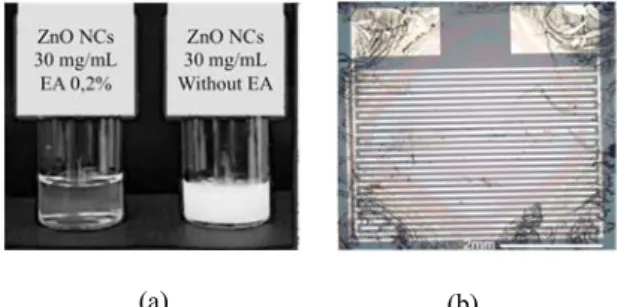
shows two solutions based on ZnO NCs with a diameter of about 5 nm in isopropanol at 30 mg/mL: one named S1 without ethanolamine (EA) with a milky white aspect indicating the presence of agglomerates and the second one named S2 with EA (0.2 vol.%) with a transparent aspect [15].
(a) (b)
Fig. 1. (a) Pictures of solutions based on ZnO NCs
in isopropanol at 30 mg/mL with or without 0.2 vol.% of EA. (b) Sample image with ZnO NCs with EA
after a post annealing at 80 °C.
These solutions (S1 and S2) were deposited by spin coating on substrates during 30 s at 2000 rpm/min. Fig. 1(b) presents an optical images of a thin film sensor based on ZnO NCs dispersed in isopropanol with of EA as short-chain surfactant.Previous studies have shown that 0.2 % volume of EA gives aggregate-free solutions [16]. After mixing ZnO NCs with 0.2 vol.% of EA in isopropanol, the EA molecules spontaneously graft on the surface of ZnO NCs and enhance the particles solubility. The small sized NCs to form sensing thin films are beneficial for the surface-area-to-volume ratio to adsorb gas molecules. To be compatible with a flexible substrate, a low post-annealing temperature (80°C) was realized for 30 min before gas sensing measurements.
2.2. Experimental Setup
A 0.1 V DC voltage was applied to the sample while the electrical resistance was monitored using a Keithley Model 2450 SourceMeter Source Measure Unit (SMU) Instrument (Keithley, U.S.A.). It is well known that humidity interferes with ZnO nanoparticles and increases the layer conductivity. Indeed, the adsorption of water molecules on the ZnO surface led to a decrease in electrical resistance. At high temperature, it is easy to evaporate water molecules on the ZnO surface. However, at low temperature, they will stay at the sensitive layer surface and they will disturb the gas detection. To avoid these water molecules some filters have been used in the experimental set up to focus only on NO2
detection without humidity. Dry air was used as both the reference and the carrier gas (it means no humidity RH = 0 %). A constant total flow was maintained at 500 Standard Cubic Centimeters per Minute (SCCM) via mass flow controllers to reach the NO2
concentration in a short time (less than 30 s). In order to find the best operating conditions, the gas detections were carried out in a closed chamber under 30 s exposures to NO2 by measuring the resistance through
the sensitive material in dark and temperature excitations (up to 300°C) or using UV light (λ = 390 nm) at room temperature. We used a Light-Emitting Diode (LED - UV5TZ-390-30) fixed at 10 mm from the sensing material as continuous UV illumination to obtain more photogenerated charge carriers. The samples were illuminated during 30 minutes under dry air before the first measurement to reach a stable resistance value.
3. Result and Discussion
We prepared two different sensitive layers with resulting layer thicknesses measured by a contact profilometer Dektak XTS (Bruker, Germany) equipped with a stylus of 2 μm radius. The sensitive layer without EA deposited by spin coating is around 80 nm thick. The sensitive layer with EA realized by
spin-coating at the same speed (2000 rpm/min during 30 s) is around 50 nm. The gas response is defined in (1) as the ratio of the resistance change on the surface of the gas sensor after and before being exposed to NO2:
R =RNO2 / Rdry air, (1)
where RNO2 is the sensor resistance in presence of
NO2 and Rdry air is the sensor resistance through
dry airflow.
2.1. Temperature-dependent NO2 Sensing Properties of ZnO Nanoparticles in Dark As a n-type semiconductor material when ZnO is exposed to air, oxygen atoms will be adsorbed on the surface of ZnO and capture electrons from its conduction band to form oxygen ion species. A depletion layer is formed in ZnO, which causes the resistance increase. NO2 is an oxidizing gas.
Therefore, it will capture electrons, increasing the sensor’s resistance. After completing the sensing response process, the sensing element can be regenerated by exposing it to dry air again, as oxygen will be adsorbed on the surface to form oxygen ions again. Generally, metal oxide based gas sensors operate at high temperatures (200-400 °C) to facilitate the chemical reaction to produce the sensor response. The gas molecules interact with the surface via Van Der Waals force. To remove these molecules, heating the substrate can provide some activation energy. To investigate the ZnO NCs sensing properties in dark, a temperature dependence study has been done. Fig. 2 presents sensor responses of thin film obtained with solution S2. The sensors were exposed 30 s to 2 ppm of NO2 in dark for four working temperatures: 25 °C,
100 °C, 200 °C and 275 °C. Prior gas sensing measurements, the deposited thin film was post-annealed to 300 °C.
Fig. 2. Sensor responses based on S2 solution and post
annealed at 300°C versus working temperatures
under 2 ppm of NO2 in dark.
This result indicates no noticeable resistance variation at room temperature in dark. Then, by heating the substrate, the semiconductor conductivity increases and surface reactions facilitated. Thus, the
sensor responses were measured and an optimum working temperature was obtained at 200 °C. It confirms that sensors based on ZnO NCs as most MOX sensors need a high operating temperature to enable the adsorption and the desorption process. This is also in agreement with our previous studies and this optimum is lower than for ozone detection found around 300 °C in dark [17].
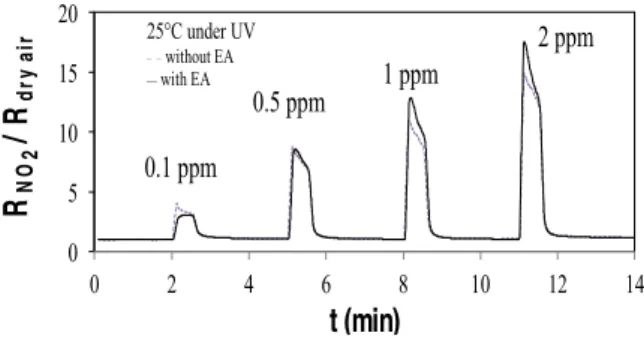
2.2. NO2 Sensing Properties of ZnO NCs at Room Temperature under UV Light Working at high temperature could affect device lifetime and long-term stability of sensing performances. In our case, it will also limit the sensor’s application on flexible substrate or in explosive environment. To be able to work at room temperature, a continuous UV illumination is needed. Fig. 3 shows the sensors responses for four concentrations under continuous UV light at 25 °C.
Fig. 3. Sensor responses at 25°C of ZnO NCs thin films,
with or without EA, post annealed at 80°C versus NO2 concentrations under constant UV light and dry air flow
(RH = 0 %).
We observe a linear response increase with the concentrations. At each concentration, the sensors behaviors were in the same order of magnitude independently of EA. Light illumination will create excitons and enhances sensing properties. It is reported that O2− is formed at temperature lower than
150 °C and O−, O2− are formed at higher temperature
[18–19]. At room temperature, we assume that only O2− will be present at the ZnO NCs surface. A
depletion layer is formed at the surface that causes the resistance to increase. Reactions between the oxygen ions and the target gas molecules lead to the sensor’s signal output. In 2016, Fabbri, et al. have confirmed this widely accepted sensing mechanism, which involves oxygen adsorption and desorption [20]. They have shown that the NO2 sensing response by ZnO thin
film on alumina was higher in N2 than in the air but
irreversible in N2. Detections of 5 ppm NO2 at room
temperature were reported in the air with light illumination at different wavelengths. However, the final annealing at 500 °C is not compatible with
0 20 40 60 0 50 100 150 200 250 300 RNO 2 ma x / Rdr y ai r T (°C) 2 ppm NO2 during30 s Dark 0 5 10 15 20 0 2 4 6 8 10 12 14 RNO 2 / Rdr y ai r t (min) 0.1 ppm 0.5 ppm 1 ppm 2 ppm 25°C under UV _ _without EA __with EA
4
flexible substrate. It is important to remind here that in our work low NO2 detection as low as 0.1 ppm were
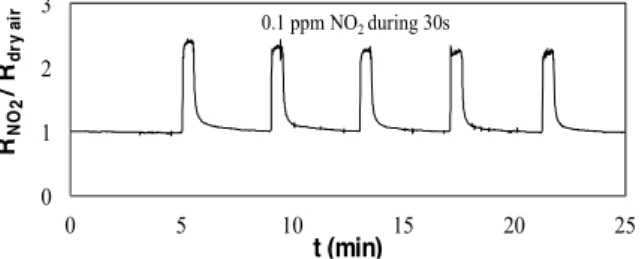
obtained with ZnO NCs layers post annealed only at 80 °C. Fig. 4 presents a fine response repeatability of a sensor at 25 °C under UV for 0.1 ppm of NO2, the
lowest concentration available during these experiments. 0 1 2 3 0 5 10 15 20 25 RNO 2 / Rdr y a ir t (min) 0.1 ppm NO2 during 30s
Fig. 4. Sensor response repeatability under 0.1 ppm of NO2 at 25°C and UV illumination of ZnO NCs thin films
with EA, post annealed at 80 °C.
Our study demonstrates that it possible to detect at room temperature low NO2 concentrations as 100 ppb
using UV light activation. A small amount of EA will not reduce the response but greatly improve the dispersion and thus enable reproducible deposition as spray process on flexible substrate at room temperature.
7. Conclusion
This work reports an ambient temperature way to detect NO2. Using UV light activation, low NO2
concentrations as 100 ppb have been detected by sensors based on ZnO NCs fabricated in solution. This kind of materials can be spray on flexible substrate. It opens a new way to develop NO2 sensors on flexible
substrate. For next studies, ZnO NCs sensors will be processed on flexible substrate and tested in presence of various gases at room temperature assisted by light activation.
Acknowledgements
The authors thank Mr. A. Combes and Dr. Fiorido for their technical support. Profilometer measurements were performed in a PLANETE CT PACA cleanroom facility (CINaM, Marseille).
References
[1]. J. Namiesnik, T. Gorecki, B. Kozdron-Zabiega, J. Lukasiak, Indoor air quality (IAQ), Pollutants, their
sources, and concentration levels, Building
Environment, Vol. 27, Issue 3, 1992, pp. 339-356.
[2]. N. A. Krotkov, et al., Aura OMI observations of regional SO2 and NO2 pollution changes from 2005 to
2015, Atmospheric Chemistry and Physics, Vol. 16, Issue 7, 2016, pp. 4605-4629.
[3]. J. N. Galloway, A. M. Leach, A. Bleeker, J. W. Erisman, A chronology of human understanding of the nitrogen cycle, Philosophical Transaction of the
Royal Society of London B Biological Sciences,
Vol. 368, Issue 1621, 2013, 20130120.
[4]. L. C. Valin, A. R. Russell, R. C. Cohen, Variations of OH radical in an urban plume inferred from NO2 column measurements, Geophysical Research Letters, Vol. 40, Issue 9, 2013, pp. 1856-1860.
[5]. B. N. Duncan, L. N. Lamsal, A. M. Thompson, Y. Yoshida, Z. Lu, D. G. Streets, M. M. Hurwitz, K. E. Pickering, A space-based, high-resolution view of notable changes in urban NOx pollution around the world (2005–2014), Journal of Geophysics Research:
Atmospheres, Vol. 121, Issue 2, 2016, pp. 976–996.
[6]. http://www.inrs.fr/dms/ficheTox/FicheFicheTox/ FICHETOX_133-4/FicheToxSynthetique_133.pdf, 02-2016.
[7]. S. Park, M. Vosguerichian, Z. A. Bao, A Review of Fabrication and Applications of Carbon Nanotube Film-Based Flexible Electronics, Nanoscale, Vol. 5, Issue 5, 2013, pp. 1727−1752.
[8]. V. Zardetto, T. M. Brown, A. Reale, A. Di Carlo, Substrates for Flexible Electronics: A Practical Investigation on the Electrical, Film Flexibility, Optical, Temperature, and Solvent Resistance Properties, Journal of Polymer Science, Part B:
Polymer Physics, Vol. 49, Issue 9, 2011, pp. 638−648.
[9]. D. McCoul, W. Hu, Recent Advances in Stretchable and Transparent Electronic Materials, Advanced
Electronic Materials, Vol. 2, Issue 5, 2016, 1500407.
[10]. A. Nathan, A. Ahnood, M. T. Cole, S. Lee, Y. Suzuki, P. Hiralal, F. Bonaccorso, T. Hasan, L. Garcia-Gancedo, A. Dyadyusha, Flexible Electronics: The Next Ubiquitous Platform, in Proceeding of the
IEEE, Vol. 100, Special Centennial Issue, 2012,
pp. 1486−1517.
[11]. S. J. Kim, K. Choi, B. Lee, Y. Kim, B. H. Hong, Materials for Flexible, Stretchable Electronics: Graphene and 2D Materials, Annual Review Material
Research, Vol. 45, 2015, pp. 63−84.
[12]. V. A. Coleman, C. Jagadish, Chapter 1 - Basic Properties and Applications of ZnO, in: Zinc Oxide Bulk, Thin Films Nanostructures, Elsevier Science
Ltd, Oxford, 2006, pp. 1–20.
[13]. S. Bernardini, M. H. Benchekroun, T. Fiorido, K. Aguir, M. Bendahan, S. B. Dkhil, M. Gaceur, J. Ackermann, O. Margeat, C. Videlot-Ackermann, Ozone Sensors Working at Room Temperature Using Zinc Oxide Nanocrystals Annealed at Low Temperature, in Proceedings of the Eurosensors, Vol. 1, Issue 4, 2017, pp. 423-427.
[14]. M. Othman, C. Théron, M. Bendahan, C. Rivron, S. Bernardini, G. Le Chevallier, L. Caillat, K. Aguir, T.-H. Tran-Thi, Selective Detection of NO2 with Specific Filters for O3 Trapping, in Proceedings of the
Eurosensors, Vol. 1, Issue 4, 2017, pp. 405-409.
[15]. S. Bernardini, M. Hameda Benchekroun, K. Aguir, M. Gaceur, O. Margeat, J. Ackermann, C. Videlot-Ackermann, Ultra-Violet Assisted ZnO Nanocrystals for NO2 Sensing at Room Temperature, in
Proceedings of the Third International Conference on Advances in Sensors, Actuators, Metering and Sensing (ALLSENSORS 2018), 2018, pp. 33-34.
[16]. A. K. Diallo, M. Gaceur, S. B. Dkhil, Y. Didane, O. Margeat, J. Ackermann, C. Videlot-Ackermann, Impact of surfactants covering ZnO nanoparticles on
solution-processed field-effect transistors: From dispersion state to solid state, Colloids and Surfaces A:
Physicochemical and Engineering Aspects, Vol. 500,
2016, pp. 214–221.
[17]. M. Acuautla, S. Bernardini, L. Gallais, T. Fiorido, L. Patout, M. Bendahan, Ozone flexible sensors fabricated by photolithography and laser ablation processes based on ZnO nanoparticles, Sensors and
Actuators B: Chemical, 203, 2014, pp. 602–611.
[18]. N. Barsan, U. Weimar, Conduction model of metal oxide gas sensors, Journal of Electroceramics, Vol. 7, Issue 3, 2001, pp. 143–167.
[19]. N. Yamazoe, G. Sakai, K. Shimanoe, Oxide semiconductor gas sensors, Catalysis Surveys from
Asia, Vol. 7, Issue 1, 2003, pp. 63–75.
[20]. B. Fabbri, A. Gaiardo, A. Giberti, V. Guidi, C. Malagù, A. Martucci, M. Sturaro, G. Zonta, S. Gherardi, P. Bernardoni, Chemoresistive properties of photo-activated thin and thick ZnO films, Sensors
and Actuator B: Chemical, Vol. 222, 2016,
pp. 1251–1256.
__________________
Published by International Frequency Sensor Association (IFSA) Publishing, S. L., 2018 (http://www.sensorsportal.com).