Publisher’s version / Version de l'éditeur:
ASME Journal of Heat Transfer, 130, November 11, pp. 114502-114506, 2008
READ THESE TERMS AND CONDITIONS CAREFULLY BEFORE USING THIS WEBSITE. https://nrc-publications.canada.ca/eng/copyright
Vous avez des questions? Nous pouvons vous aider. Pour communiquer directement avec un auteur, consultez la première page de la revue dans laquelle son article a été publié afin de trouver ses coordonnées. Si vous n’arrivez pas à les repérer, communiquez avec nous à [email protected].
Questions? Contact the NRC Publications Archive team at
[email protected]. If you wish to email the authors directly, please see the first page of the publication for their contact information.
NRC Publications Archive
Archives des publications du CNRC
This publication could be one of several versions: author’s original, accepted manuscript or the publisher’s version. / La version de cette publication peut être l’une des suivantes : la version prépublication de l’auteur, la version acceptée du manuscrit ou la version de l’éditeur.
For the publisher’s version, please access the DOI link below./ Pour consulter la version de l’éditeur, utilisez le lien DOI ci-dessous.
https://doi.org/10.1115/1.2955477
Access and use of this website and the material on it are subject to the Terms and Conditions set forth at
Benchmark studies for the generalized streamwise periodic heat
transfer problem
Beale, Steven
https://publications-cnrc.canada.ca/fra/droits
L’accès à ce site Web et l’utilisation de son contenu sont assujettis aux conditions présentées dans le site LISEZ CES CONDITIONS ATTENTIVEMENT AVANT D’UTILISER CE SITE WEB.
NRC Publications Record / Notice d'Archives des publications de CNRC:
https://nrc-publications.canada.ca/eng/view/object/?id=264f8c43-5c34-4a03-93e1-ead1ab9fc7ee
https://publications-cnrc.canada.ca/fra/voir/objet/?id=264f8c43-5c34-4a03-93e1-ead1ab9fc7ee
Benchmark Studies for the
Generalized Streamwise Periodic Heat
Transfer Problem
Steven B. Beale
Fellow ASME
National Research Council of Canada, Montreal Road,
Ottawa, ON, K1Y 0A5, Canada e-mail: [email protected]
This is a comparison of calculations performed with a scheme for handling streamwise-periodic boundary conditions with known solutions to the common problem of fully developed heat transfer in a plane duct. Constant value, constant flux, mixed boundary conditions, and linear wall flux (conjugate heat transfer) are all considered. Agreement is, in every case, near exact showing that the methodology may be applied with confidence to complex en-gineering problems with a variety of thermal wall boundary conditions. 关DOI: 10.1115/1.2955477兴
Keywords: computational fluid dynamics, periodic boundary conditions, heat transfer, plane duct
Introduction
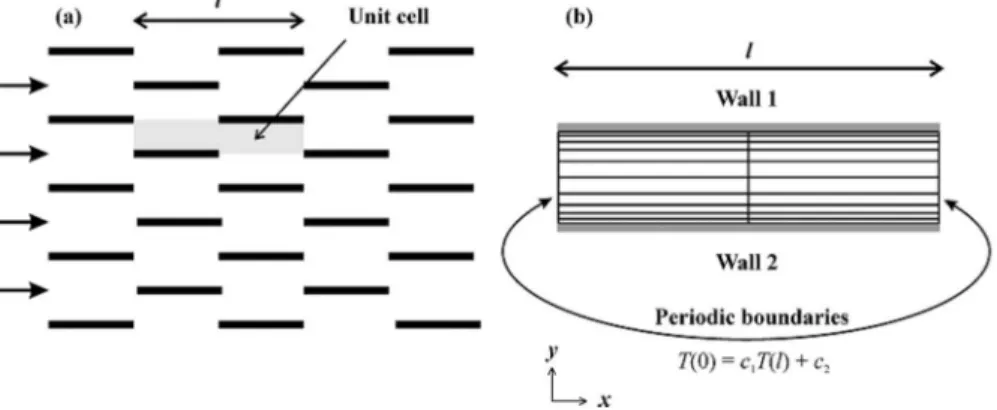
Computational fluid dynamics has been used on occasion to improve the design of heat exchangers. Frequently, streamwise-periodic boundary conditions are employed to perform calcula-tions for fully developed flow and heat transfer in situacalcula-tions where a single unit cell represents a geometry repeated numerous times in the flow direction over some characteristic length scale, l. Fig-ure 1共a兲 illustrates one such example. Under the circumstances, suitably reduced or nondimensionalized pressure and temperature fields, asymptotically approach constant values. Patankar et al.关1兴 pioneered the development of methodologies for periodic heat transfer under conditions of either constant heat flux共Neumann兲 or constant wall temperature 共Dirichlet兲 boundary conditions. These approaches were subsequently applied by numerous other researchers in numerical heat transfer work. The reader will note that the choice of state variable in Ref.关1兴 differs for the constant
Twand q˙
⬙
boundary value problems. For this reason the approach cannot readily be adopted for problems involving combinations of Neumann and Dirichlet boundary conditions, or for the interme-diate linear 共Robin兲 boundary value problem. Mixed boundary conditions arise naturally, e.g., within the passages of heat ex-changers transferring energy between two working fluids.Recently the present author 关2兴 proposed a rationale, which could, in principle, be applied not only to the Dirchlet and Neu-mann problems, but also to the intermediate linear boundary value problem, as well as combinations of different wall boundary con-ditions. This is possible because primitive variables, temperature and pressure, were selected as state variables. However, the only example given in Ref. 关2兴 was a 3D constant Tw offset-fin heat
exchanger geometry. The purpose of this article is to present com-parisons of the methodology 关2兴 for a simple geometric case, namely, the fully developed Graetz problem, over a range of ther-mal boundary conditions, and to demonstrate that it is possible to obtain fully developed solutions under regularly repeating but
ar-bitrary wall boundary conditions using a primitive-variable for-mulation, i.e., to validate the methodology. The deliberate choice of simplified geometry allows for exact comparison with data from the standard literature to be made without compromise in terms of the general nature of the methodology and its potential for practical application.
Periodic Boundary Conditions
The general details of how periodic boundary conditions are applied to the flow by means of a pressure jump or shock, were provided in Ref.关2兴. Therefore only material related to heat trans-fer is provided below. The streamwise-periodic thermal condition may be expressed关3兴 as follows:
T共0兲 = c1T共l兲 + c2 共1兲 with c1= T0共0兲 − Tw共0兲 T0共l兲 − Tw共l兲 共2兲 c2= T0共0兲 − c1T0共l兲 共3兲 where T0 is a suitable reference, e.g., local bulk temperature. Thus, the temperature difference or jump between the given up-stream and downup-stream values is ⌬T =共c1− 1兲T + c2, an expres-sion, which will prove useful when prescribing periodic boundary conditions below. For Tw⫽constant, the upstream wall values
must be computed from those downstream
Tw共0兲 =
T0共0兲 + B共l兲T⬁
1 + B共l兲 共4兲
where the driving force关4兴 is
B=T0− Tw
Tw− T⬁
共5兲 and T⬁is an ambient or external value. Periodicity is defined here as being the case if and only if the local heat transfer driving force is cyclic,
B共x + l,y兲 = B共x,y兲 共6兲
It being assumed that the upstream bulk value, T0共0兲, is prescribed a priori, whereas the downstream value T0共l兲 is computed itera-tively at run time.
Benchmark Cases
The methodology was tested by obtaining performance calcu-lations for fully developed flow and heat transfer in ducts, for which solutions are known for a variety of wall conditions. Table 1 shows the four cases considered.
共1兲 constant wall temperatures, T1and T2共Dirichlet兲 共2兲 constant heat fluxes q˙1
⬙
and q˙2⬙
共Neumann兲共3兲 one constant heat flux, q˙1
⬙
, and one constant temperature,T2共mixed兲
共4兲 heat flux prescribed according to a linear rate equation 共Robin兲, namely,
q˙⬙= U共T⬁− Tw兲 共7兲
a physical interpretation being the transfer of heat to walls of overall heat transfer coefficients, U1 and U2, which in turn transfer heat to two reservoirs, at temperatures T1⬁and
T2⬁. Under the circumstance, a nondimensional wall resis-tance关5兴 is defined, for each wall, by
Rw=
k UDh
共8兲
Contributed by the Heat Transfer Division of ASME for publication in the J OUR-NAL OFHEATTRANSFER. Manuscript received October 15, 2007; final manuscript re-ceived March 4, 2008; published online August 29, 2008. Review conducted by Jayathi Murthy.
Journal of Heat Transfer Copyright © 2008 by NRC Canada NOVEMBER 2008, Vol. 130 / 114502-1
This is related to the Biot number according to Rw= 1 /共4Bi兲. Cases共1兲–共4兲 in Table 1 summarize the performance of these four commonly encountered internal forced convection problems关6兴 in terms of the Nusselt number.
Implementation
In computational heat transfer codes based on the finite-volume method关7兴, a set of linear algebraic equations having the form
兺
aNB共TNB− TP兲 + S = 0 共9兲is solved for steady flow. TPis the in-cell value of T at any given
computational cell, with neighbors NB= W 共west兲, E 共east兲, S 共south兲, and N 共north兲. NB: With temperature, T, as state variable, the units of the linking neighbor coefficients, aNB, are W/K as opposed to the more usual units of kg/s when enthalpy is depen-dent variable.
The wall boundary conditions in Eq.共9兲 are linearized accord-ing to
S= C共T⬁− TP兲 共10兲
where C is a source-term coefficient and T⬁ is a source-term value. Equation共10兲 follows the notation of Spalding 关8兴, which is consistent with the zero-flux form of Eq. 共9兲. Patankar 关7兴 em-ployed the form S = SC+ SPTPwith SC= CT⬁and SP= −C.
For Case 共4兲, the source-term coefficient and wall value are computed using harmonic and arithmetic averaging关7兴,
1 C= ␦y kAN + 1 UAN 共11兲 Tw= k/␦y k/␦y+ UTP+ U k/␦y+ UT⬁ 共12兲
As noted in Ref.关9兴, the Dirichlet and Neumann cases are eas-ily constructed as limits of the linear Case共4兲. This is achieved by 共i兲 setting the resistance, Rw, to a very small number, so that U and
Care correspondingly large共Dirichlet兲, or 共ii兲 by setting both Rw
and T⬁= q˙
⬙
/Cto large numbers共Neumann兲.Fig. 1 Example of streamwise-periodic geometry showing unit cell geometry for „a… offset fin and „b… plane duct showing the mesh and boundary conditions
Table 1 Benchmark problems and results
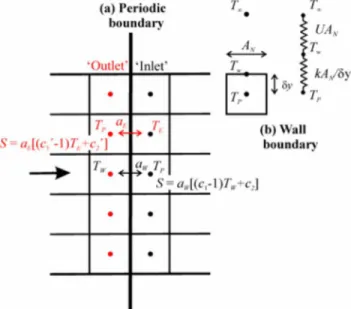
The streamwise-periodic boundary condition is prescribed 关2兴 in two steps: 共i兲 By activating true cyclic boundary conditions across the inlet/outlet in the streamwise direction, storage is as-sured for the missing streamwise linking coefficients, aNB, in the energy and momentum equations at what would otherwise be the inlet and outlet of the domain, creating an endless flow loop.共ii兲 At the inlet a step or jump in the temperature field across the boundary is imposed by prescribing a line of source terms S = aW关共c1− 1兲TW+ c2兴 in computational cells immediately down-stream of the periodic boundary, as shown in Fig. 2共a兲. Combin-ing these with the terms aW共TW− TP兲 in Eq. 共9兲 has the effect of
replacing TW with c1TW+ c2, from Eq. 共1兲. For parabolic situa-tions, such as considered here, no further considerations are re-quired.
For elliptic problems, Eq.共1兲 may be rewritten in the form
T共l兲 = c1⬘T共0兲 + c2⬘ 共13兲 and a similar line of source terms S = aE关共c1
⬘
− 1兲TW+ c2⬘
兴 must be prescribed immediately upstream of the boundary at the outlet 关10兴, as shown in Fig. 2. For the particular case of constant Tw, thepresent formulation is equivalent to that of Kelkar and Patankar 关11兴; however, it is more generally used for a wide range of ther-mal boundary conditions.
A staggered velocity scheme with hybrid differencing of con-vection and diffusion terms关7兴 was implemented in thePHOENICS
code 关12兴, which is based on a version of theSIMPLE algorithm 关7,8,13兴. Calculations were performed with meshes of both 2 ⫻ 100 and 10⫻ 100 cells in the x-y plane, similar to that shown Fig. 1共b兲, and concentrated by means of a geometric progression toward the walls where velocity and temperature gradients are maximum. 共NB: A minimum of two cells in the x-direction is required for the present method.兲 Regardless of the number of cells in the x-direction, the values of local Nusselt numbers, Nu1 and Nu2, at the north and south walls, were observed to be invari-ant. These were obtained as follows:
Nu =Dh
k C
冉
TP− T⬁ T0− Tw冊
共14兲 where TPis the in-cell value of T nearest the appropriate north or south wall, Fig. 2共b兲, and C is the source-term coefficient, from Eq.共10兲.
Results
Table 1 provides a comparison of the present results, in terms of Nusselt numbers, with those of Shah and London关6兴 and others. These are discussed briefly below.
共1兲 Dirichlet problem. Agreement with analytical solutions is within 0.07% for共a兲 T1= T2and共b兲 T1⫽T2.
共2兲 Neumann problem. 共a兲 q˙1
⬙
= q˙2⬙
agreement is within 0.04%. 共b兲 q˙1⬙
= 0 agreement is exact.共c兲 q˙1⬙
⫽q˙2⬙
. Figure 3 shows that agreement is excellent for this case. For q˙2⬙
= q˙1⬙
艋 2.5 the present data agree with Ref.关6兴 to within 0.3%, and substantially better asq˙2
⬙
= q˙1⬙
→ 0. Note that as q˙2⬙
= q˙1⬙
→ 26 / 9, Nu → ⬁ because T1 → T0.共3兲 Mixed problem. 共a兲 q˙1
⬙
= 0 agreement is within 0.02%.共b兲q˙1
⬙
⫽0 exact agreement is obtained.共4兲 Linear boundary values. 共a兲 T1⬁= T2⬁. Figure 4 is a com-parison of the present results with those of Sideman et al.关5兴 in terms of Nusselt number as a function of wall resistance. Agree-ment is always within 0.07%.共b兲 T1⬁⫽T2⬁. The same result is obtained as for Cases 1共a兲 and 3共b兲, regardless of whether U1 = U2or not, showing these to be special cases of 4共b兲.
Discussion and Conclusion
Comparison of the present numerical work with previously ob-tained analytical and numerical results of others indicates that it is possible to prescribe fully developed streamwise-periodic bound-ary conditions under a range of thermal conditions. The results show that multiple wall temperatures/fluxes, a combination of constant temperature and constant flux, and linear wall conditions
Fig. 2 Boundary condition implementation showing „a… jump boundary condition at the inlet/exit and „b… wall boundary notation
Fig. 3 Comparison of the present work with the expression of Shah and London †6‡ for Case 2„c…
Fig. 4 Comparison of the present work with the data of Side-man et al. †5‡ for Case 4„a…
Journal of Heat Transfer NOVEMBER 2008, Vol. 130 / 114502-3
can all be handled by the methodology. Although only pairs of boundary values were considered for a plane duct, the extension to a manifold of boundary fluxes and temperatures, and/or com-plex geometries and recirculating flow regimes with or without mass transfer at the walls, is readily apparent. Performance calcu-lations for such problems are generally correlated with empirical, rather than analytical data.
Cases 1共a兲, 2共a兲–共c兲, 3共a兲, and 4共a兲 all admit fully developed solutions where the solution is independent of the inlet bulk tem-perature and heat is transferred to or from the working fluid. Cases 1共b兲, 3共b兲, and 4共b兲 only allow for cyclic solutions where no net heat is transferred to or from the working fluid, and the bulk temperature is simply a weighted average of wall values. It is important, when considering more complex geometries, to iden-tify which class of problem is under consideration. For example, for crossflow in a bank of finned tubes, there may be temperature variations from fin tip to root, and a periodic solution still achieved; on the other hand, if alternate rows are at different tem-peratures, only a cyclic solution is possible. Nusselt number cor-relations for the former class of problem are, generally speaking, of more interest to the heat exchanger designer. It is also impor-tant to appreciate that not every problem involving regularly re-peating geometry will necessarily admit a steady fully developed periodic solution关14兴.
In view of the wide range of Nusselt numbers observed in Figs. 3 and 4, the presumption of constant flux or constant temperature formulations for engineering problems will lead to substantial er-rors, when applied to periodic problems where these are, in fact, variable, and is neither recommended nor necessary. A conclusion of this study is that the primitive-variable streamwise-periodic for-mulation generates reliable results over a range of thermal bound-ary conditions, as verified by analytical and other data. Based on this observation, the methodology may be applied with confidence to performance calculations for complex periodic heat and mass transfer problems.
Nomenclature
a ⫽ linking coefficient, W/K
AN ⫽ area of north face of computational cell, m2 C ⫽ source-term coefficient, W/K Dh ⫽ hydraulic diameter, m k ⫽ thermal conductivity, W/共m K兲 l ⫽ length, m T ⫽ temperature, K q˙
⬙
⫽ heat flux, W / m2 S ⫽ source term, WU ⫽ overall heat transfer coefficient, W /共m2K兲
␦y ⫽ cell half distance, m
Nondimensional Numbers
B ⫽ heat transfer driving force Bi ⫽ Biot number
Nu ⫽ Nusselt number
Rw ⫽ thermal resistance
Subscripts
E, W, S, N ⫽ east, west, south, and north neighbors NB ⫽ neighbor P ⫽ nodal w ⫽ wall 0 ⫽ reference, bulk ⬁ ⫽ external, ambient References
关1兴 Patankar, S. V., Liu, C. H., and Sparrow, E. M., 1977, “Fully-Developed Flow and Heat Transfer in Ducts Having Streamwise-Periodic Variations of Cross-Sectional Area,” ASME J. Heat Transfer, 99, pp. 180–186.
关2兴 Beale, S. B., 2007, “Use of Streamwise Periodic Conditions for Problems in Heat and Mass Transfer,” ASME J. Heat Transfer, 129, pp. 601–605. 关3兴 Beale, S. B., and Spalding, D. B., 1998, “Numerical Study of Fluid Flow and
Heat Transfer in Tube Banks With Stream-Wise Periodic Boundary Condi-tions,” Trans. Can. Soc. Mech. Eng., 22, pp. 394–416.
关4兴 Spalding, D. B., 1963, Convective Mass Transfer; An Introduction, Arnold, London.
关5兴 Sideman, S., Luss, D., and Peck, R. E., 1964, “Heat Transfer in Laminar Flow in Circular and Flat With共Constant兲 Surface Resistance,” Appl. Sci. Res., Sect. A, 14, p. 1570171.
关6兴 Shah, R. K., and London, A. L., 1978, Advances in Heat Transfer, T. F. Irvine, and J. P. Hartnett, eds., Academic, New York.
关7兴 Patankar, S. V., 1980, Numerical Heat Transfer and Fluid Flow, Hemisphere, New York.
关8兴 Spalding, D. B., 1980, Mathematical Modelling of Fluid-Mechanics,
Heat-Transfer and Chemical-Reaction Processes: A Lecture Course, Imperial Col-lege, University of London, London.
关9兴 Sparrow, E. M., and Patankar, S. V., 1977, “Relationships Among Boundary Conditions and Nusselt Numbers for Thermally Developed Duct Flows,” ASME J. Heat Transfer, 99, pp. 483–485.
关10兴 Beale, S. B., 1993, Ph.D. thesis, Imperial College of Science, Technology and Medicine, London.
关11兴 Kelkar, K. M., and Patankar, S. V., 1987, “Numerical Prediction of Flow and Heat Transfer in a Parallel Channel With Staggered Fins,” ASME J. Heat Transfer, 109, pp. 25–30.
关12兴 Spalding, D. B., 2006, “PHOENICS Overview 共Version 3.6兲,” CHAM Ltd., TR001, London.
关13兴 Patankar, S. V., and Spalding, D. B., 1972, “A Calculation Procedure for Heat, Mass, and Momentum Transfer in Three-Dimensional Parabolic Flows,” Int. J. Heat Mass Transfer, 15, pp. 1787–1806.
关14兴 Beale, S. B., 2005, “Mass Transfer in Plane and Square Ducts,” Int. J. Heat Mass Transfer, 48, pp. 3256–3260.