Bilateral Exchanges in Social Networks and the
Design of Public Institutions
by
Ankur Mani
B.Tech, Electrical Engineering, Indian Institute of Technology, Delhi
MS, Electrical Engineering, Arizona State University, Tempe, AZ
Submitted to the Program in Media Arts and Sciences
in partial fulfillment of the requirements for the degree of
ARCHMES
MASSACHUNETT$ INfNi^LfDoctor of Philosophy
OF TECHNOLOGYat the
JUL 14 2014
MASSACHUSETTS INSTITUTE OF TECHNOLOGY
LIBRARIES
@
Massachusetts
September 2013
Institute of Technology 2013. All rights reserved.
Signature redacted
Author ...
Program in Media Arts and Sciences
September 26, 2013
Certified by...
Signature redacted...
Alex (Sandy) Pentland
Toshiba Professor of Media Arts and Sciences
Signature redacted
Thesis Supervisor
Accepted by ...
c-Mitch Resnick
LEGO Papert Professor of Learning Research
Program in Media Arts and Sciences
Academic Head
Bilateral Exchanges in Social Networks and the Design of
Public Institutions
by
Ankur Mani
Submitted to the Program in Media Arts and Sciences on September 26, 2013, in partial fulfillment of the
requirements for the degree of Doctor of Philosophy
Abstract
In this thesis, I study bilateral exchanges in social networks. I integrate the market based approach in economics and network based approach in sociology. I also give a joint model of externalities and peer pressure in networks and propose mechanisms
to control externalities in networked societies.
The study of exchanges in networks is big and growing. In this thesis, I focus on exclusive exchanges or matching in bipartite networks where the matched couples perform an economic exchange with each other. This thesis makes three contribu-tions to matching theory. First, I relax the standard assumpcontribu-tions of costless transfers between matched couples and introduce a new algorithm to compute stable match-ings or core with proofs of correctness and convergence. Second, I introduce a new distributed dynamics and show that it converges to stable matching. Third, I give an axiomatic characterization of fair outcomes in bipartite matching based upon a collective bargaining argument and give a fast algorithm to compute it.
I also introduce a joint model of externalities and peer pressure in networks and propose new design of public institutions that are more efficient in the control of externalities in networked societies. The design principles I propose are well suited for environmental policies, and health policies. The same design principles can also be used for marketing and revenue management for products and services with network externalities. I demonstrate the efficiency of my policies in two experiments. The first experiment showed that my proposed policies give better outcome in promoting higher physical activity among people than traditional policies such as Pigouvian subsidies. The second experiment showed that my proposed policy can help promote energy conservation and I report much higher conservation than any achieved through price shocks or any other energy conservation experiment in my knowledge.
Thesis Supervisor: Alex (Sandy) Pentland
Acknowledgments
I am indebted to many people who both directly and indirectly contributed to this thesis. First I would like to thank Alex (Sandy) Pentland for taking me in his tutelage at MIT, providing me with freedom to explore and define my problems while guiding me towards problems of importance to society. I also thank him for being a close collaborator and supporting me during unproductive and productive times equally. His faith in me during the times the research did not seem to move along provided me the confidence to push on and break the barriers. Next, I would like to thank Asuman Ozdaglar. I have learnt a lot from Asu. The most important thing that I learnt from Asu is that the model I work on should reflect the real world and accuracy should not be given up so that it becomes easy to get the results. Her influence is seen in my work on matching and the model is a result of several discussions with Asu. Next I would like to thank Parag Pathak. Parag is one of the most crisp thinkers I know. My interactions with Parag has helped me identify crisp problems and make precise claims about my results.
I thank my collaborators, Iyad Rahwan, Kobi Gal and Claire Michelle Loock, with whom I worked on several experiments that fed into the thesis directly and indirectly. I would also like to thank my other collaborators over the years at MIT with whom I had the pleasure to work on other research. I thank Lav Varshney, Peter Krafft, Wen Dong, Bruno Lepri, Alex Rutherford, Wesley Gifford and Anshul Sheopuri.
I thank Yahoo Key Scientific Challenges and Martin Family Fellowship for Sus-tainability for the support.
I thank several colleagues who provided valuable comments on my work. I would like to thank Azaraksh Malekian, Ilan Lobel, David Lazer, Yusuke Narita, Benjamin Golub, Itay Fainmasser, participants of the Harvard-MIT networks reading group, MIT CS-Econ reading group, MIT Econ theory lunch, MIT Machine Learning Tea, MIT Systems Dynamics reading group, MIT-U Albany colloquium, and Pentlandians over the years, namely Ben Waber, Taemie Kim, Daniel Olguin Olguin, Wei Pan, Na-day Aharony, Yves-Alexandre DeMontjoye, Manuel Cebrian, Nicole Freedman, Vivek
MIT who made life at MIT wonderful and exciting. I would like to thank Haitham Hassanieh, Ana Luisa Santos, Selene Mota, Ehsan Hoque, Inna Lobel, Kathy Miu, Jon Medley, Gleb Akselrod, Cody Gilleland, Sean Smeland, Leeland Ekstrom, Vivek Sharma, Smita Sharma, Shreeharsh Kelkar, Sushmit Goswami, Josh Bendavid, Geor-gious Papadopoulous and others.
I thank my friends from IIT Delhi and other close friends. I especially thank Hatinder Madan, Dhaval Gothi, Ashish Kapoor, Alok Ranjan, Rohit Dube, Nikhil Garg, Ashutosh Punhani, Sachin Jain, Jai Singh, Chinmay, Kartikey Kumar, Ri-neesh Bansal, Puru Gupta, Amit Kataria, Roopak Hooda, Vishal Makani, Manish Agrawal, Jayant Kumar, Abhishek Kashyap, Gaurav Diwan, Ritu Shrivastava, Amit Kapoor, Rajesh Kumar, Gunjan Shukla, Aman Singh, Aditya Renduchintala and others. These guys were responsible for the wonderful days during my undergrad and onwards.
I sincerely thank my parents, Amma and Papaji, and my sisters, Priyanka Mani and Swina Mani for their love, faith and continued support throughout my life. I also thank my new family, Mumsie, Pete and Jon Sheren for their love and care they have given me in the past few years. Finally, I thank my loving, caring and supportive wife, Ila. She has been with me through all the ups and downs, through the frustrating days and nights when I was stuck to days when I had a breakthrough. I could not have done it with you. This one is for you BLLC.
Bilateral Exchanges in Social Networks and the Design of
Public Institutions
by
Ankur Mani
The following people served as readers for this thesis:
Thesis Reader ...
Signature redacted
Asuman Ozdaglar
Professor
Department of Electrical Engineering and Computer Science
Bilateral Exchanges in Social Networks and the Design of
Public Institutions
by Ankur Mani
The following people served as readers for this thesis:
Signature redacted
Thesis Reader ... Parag Pathak Professor Department of Economics6)
Contents
Cover page Abstract Acknowledgments Contents List of Figures List of Tables 1 Introduction 1.1 Introduction . . . . 1.2 Related Work . . . . 1.3 Outline. . . . .2 Generalized Stable Matching in Bipartite Networks 2.1 Introduction . . . . 2.1.1 Application Scenarios . . . . 2.1.2 Related Work . . . . 2.1.3 Our Contributions . . . . 2.1.4 Outline . . . . 2.2 Model . . . .. . . . . 2.2.1 Network and Payoffs . . . .
11 1 3 5 11 15 17 19 19 21 27 29 29 31 32 34 35 35 35
G am e . . . . 2.3.1 Summary of the Hungarian algorithm . . . 2.4 O ffers . . . . 2.5 Some Graph Theoretic Terminology and Results . 2.6 The Generalized Hungarian Algorithm . . . . 2.6.1 Initialization . . . . 2.6.2 Iteration . . . . 2.6.3 Exam ple . . . . 2.7 Results Related to the Algorithm . . . . 2.7.1 Correctness of Offer Updates . . . .
. . . . 37 . . . . 39 . . . . 4 1 . . . . 43 . . . . 43 . . . . 44 . . . . 44 . . . . 46 . . . . 46 . . . . 46
2.7.2 Convergence to A-maximum generalized stable matching . . . 2.7.3 Computing SASTGOP in the Generalized Hungarian Algorithm 2.8 Approximately Stable Matchings and Convergent Dynamics 2.8.1 Approximate Stability . . . . 2.8.2 Natural Myopic Dynamics . . . . 2.9 Conclusions and Future Work . . . . 2.10 Proofs of Theorem 1 and associated Lemmas and Corollaries 2.10.1 Proof of Theorem 1 . . . . 2.10.2 2.10.3 2.10.4 2.10.5 2.10.6 2.11 Proof 2.11.1 2.11.2 2.11.3 Proof of Corollary 1 . . . . Proof of Lemma 2 . . . . Proof of Lemma 3 . . . . Proof of Lemma 4 . . . . Proof of Corollary 2 . . . . of Theorem 2 and associated propositions Proof of Proposition 3 . . . . Proof of Proposition 4 . . . . Proof of Theorem 2 . . . . 2.12 Proof of Theorem 3 and associated Lemmas and Corollaries 48 50 . . . . . 51 . . . . . 51 . . . . . 54 . . . . . 58 . . . . . 59 . . . . . 59 . . . . . 60 . . . . . 60 . . . . . 61 . . . . . 61 . . . . . 62 . . . . . 62 . . . . . 62 . . . . . 63 64 . . . . . 65 12
2.12.1 Proof of Lemma 5. . . . . 2.12.2 Proof of Theorem 3 . . . . 2.12.3 Proof of Corollary 3 . . . . 2.13 Appendix: Proofs of Propositions 1 and 2 . . . . 2.13.1 Proof of Proposition 1 . . . . 2.13.2 Proof of Proposition 2 . . . . 2.14 Appendix: Graph Theoretic Terminology . . . . 2.14.1 Paths . . . . 2.14.2 Alternating Paths, Alternating Trees and Near-Perfect 2.15 Appendix: Structural Properties of the Hungarian Forest . . 2.16 Appendix: Proof of Lemma 1 . . . . 2.16.1 Proof of Lemma 4 . . . . 2.17 Appendix: Examples . . . .
3 Fairness in Bipartite Matching With Transfers 3.1 Introduction . . . . 3.2 Model . . . . 3.2.1 Balancedness 3.2.2 Fairness . . . . 3.3 Algorithm . . . . 3.4 Main Results . . . . . 3.5 Conclusions and Future 3.6 Proof of Theorem 5 3.7 Proof of Theorem 6 3.8 Proof of Theorem 7 . . . . 95 . . . . 98 . . . . 98 . . . . 99 . . . . 100 . . . . 104 . . . . 104 . . . . 105 . . . . 107 . . . . 109 Work
4 Design of Public Institutions for
4.1 Introduction . . . . 4.2 Main Results . . . . Networked Societies 111 112 116 116 4.2.1 Overview of Mechanism . 13 Matchings 65 66 67 68 68 69 70 70 71 72 74 75 86 95
4.3 Localizing Externalities in social networks: Inducing Peer Pressure to Promote Cooperation . . . .
4.3.1 Model of Externalities . . . . 4.3.2 Externalities with Peer Pressure . . . . 4.3.3 Assumptions . . . . 4.3.4 Equilibrium with Peer Pressure . . . . 4.3.5 Pigouvian Mechanism (Direct Reward) . . . . 4.3.6 Social Mechanisms (Rewarding the Peers) . . . . . 4.3.7 Efficiency and Cost of Social Reward . . . . 4.3.8 Illustrative Example: Promoting Energy Efficiency 4.3.9 Properties of the Subgame Perfect Equilibria of the
gam e . . . . 4.3.10 Proof of Proposition 17 . . . . 4.3.11 Proof of Theorem 9 . . . . 4.3.12 Proofs for Welfare Comparison Results . . . . 4.4 Experiments and Applications to Public Policy . . . . 4.4.1 Promoting Physical Activity . . . . 4.4.2 Promoting Energy Conservation . . . . 4.5 Conclusions . . . . two . . . 120 . . . 120 . . . 122 . . . 123 . . . 125 . . . 126 . . . 127 . . . 128 . . . 130 stage . . . . . 132 . . . . . 142 . . . . . 142 . . . . . 143 . . . . . 146 . . . . . 146 . . . . . 148 . . . . . 161 5 Conclusions and Future Work
Bibliography
165 169
List of Figures
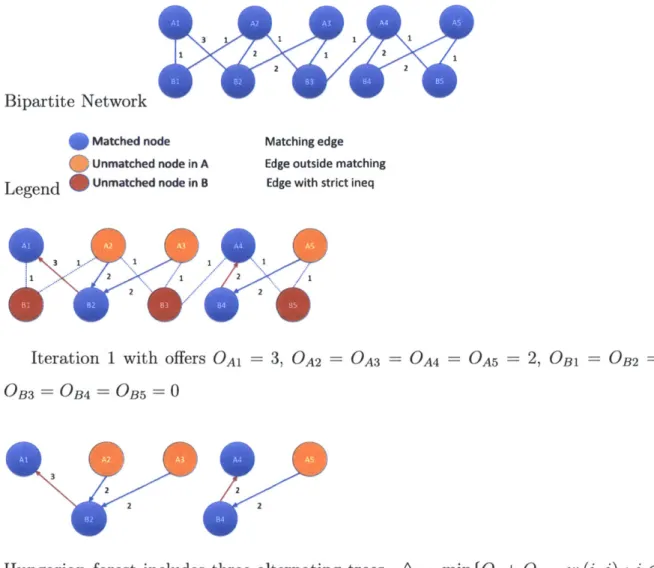
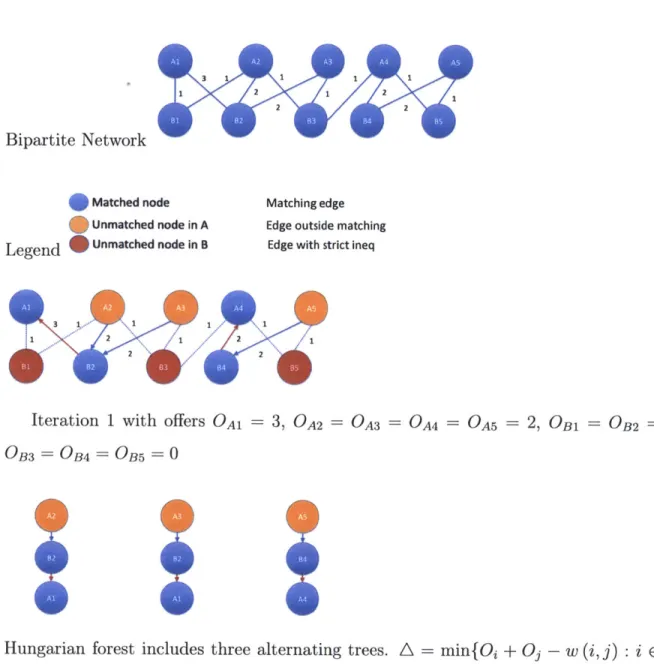
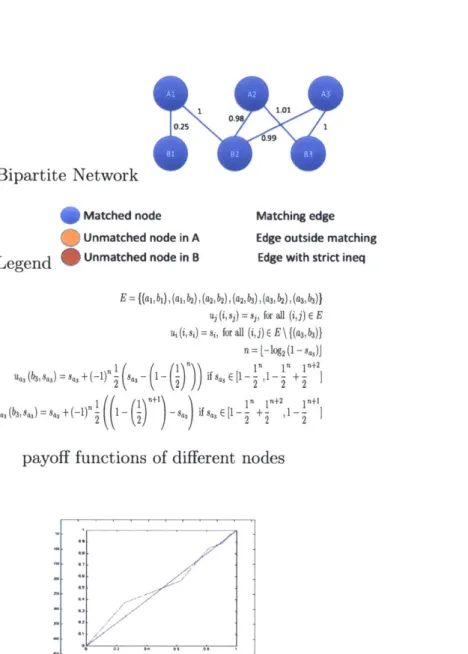
2-1 Running the Hungarian Algorithm to find the stable matching in the standard weighted matching problem . . . . 87 2-2 Running the Hungarian Algorithm to find the stable matching in the
standard weighted matching problem: Iteration 1 . . . . 88 2-3 Running the Hungarian Algorithm to find the stable matching in the
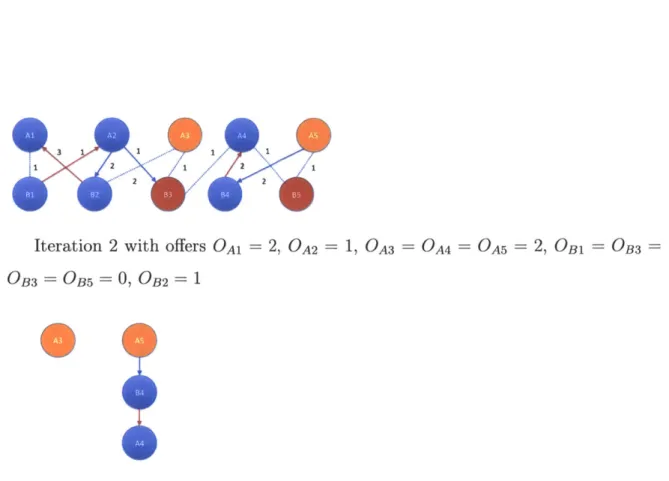
standard weighted matching problem, only the offers on one of the alternating trees is updated: Iteration 2 . . . . 89 2-4 Running the Hungarian Algorithm to find the stable matching in the
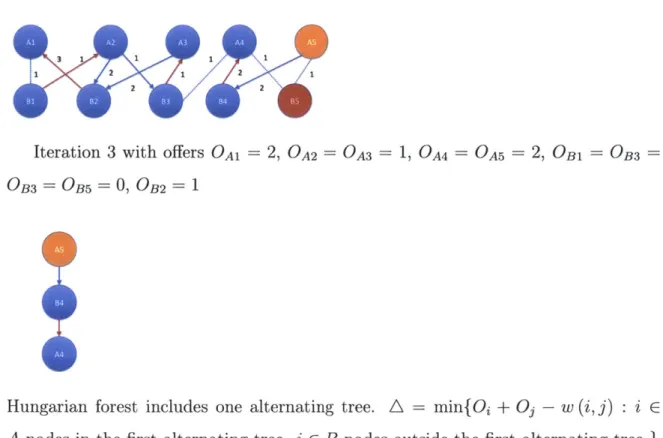
standard weighted matching problem, only the offers on one of the alternating trees is updated: Iterations 3 and 4 . . . . 90 2-5 The Generalized stable matching problem . . . . 91 2-6 The Hungarian Algorithm does not work for the generalized stable
matching problem . . . . 92 2-7 The Generalized Hungarian Algorithm find the A-maximum
general-ized stable matching for the generalgeneral-ized stable matching problem . . 93 4-1 (a) Individuals A and B (red) actions cause a global externality on the
rest of society (blue). This behavior can be encouraged/discouraged by internalizing the externality in the form of subsidy or tax on A and B directly; (b) Localizing externalities to the peers (yellow) of individu-als A and B incentivizes their respective peers to use peer influence to encourage/discourage the behavior causing the positive/negative ex-ternality, respectively . . . . 117
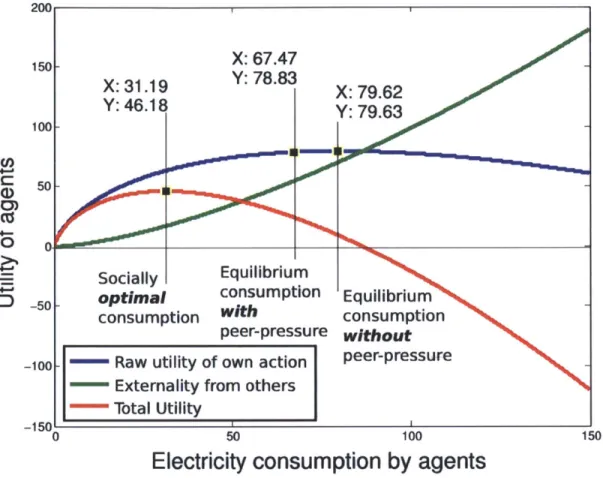
consumption only slightly to X = 67.46 due to high marginal cost of pressure; (green) Externality experienced due to other agents' con-sumption; (red) Total utility curve is the difference between the navy and green curves, and is maximized at the (much lower) socially opti-mal consumption level of X = 31.19. . . . . 131 4-3 (navy) Budget required for rewards under Pigouvian mechanism for a
target consumption level; (green) Budget required for rewards under Social mechanism for a desired consumption level. It increases much slower as the target consumption level is reduced. . . . . 133 4-4 (navy) Redistribution loss under Pigouvian mechanism for a target
con-sumption level; (green) Redistribution loss under Social mechanism for a desired consumption level. It increases much slower as the target con-sumption level is reduced; (red) Social loss under Social mechanism for a desired consumption level; (magenta) Total (redistribution + social) loss under Social mechanism for a desired consumption level. . . . 134 4-5 Average energy consumption. The pattern of consumption correlates
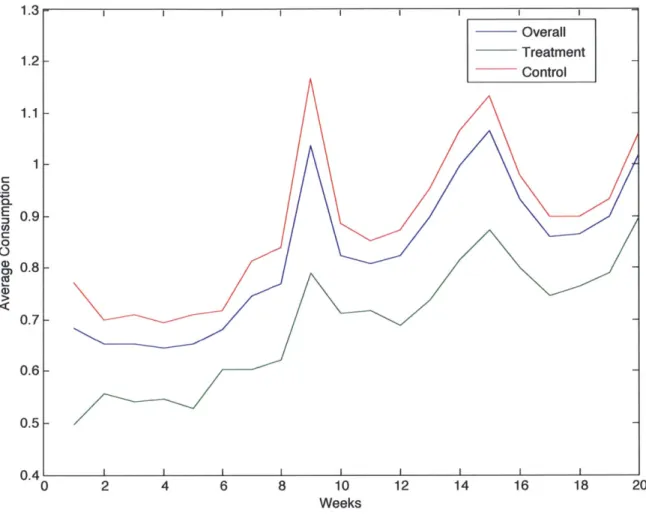
with the outside temperature suggesting that people spent more time indoors when it was cold. The consumption of the treatment group is lower than people in the control group. . . . 157 4-6 Average energy consumption against average weekly temperature.
Con-sumption increases with the decrease in outside temperature suggesting that people spent more time indoors when it was cold. The consump-tion of the treatment group is lower than people in the control group. 158
List of Tables
4.1 Regression results: a is the average consumption,
#
is the tempera-ture effect and -y is the treatment effect. The p-values are very low suggesting that the regression is statistical significant. . . . . 159Chapter 1
Introduction
1.1
Introduction
How different are the characteristics of societies that are constrained to local inter-actions in networks as compared to societies where all interinter-actions happen in orga-nized markets? Among most species and even in modern human societies, exchange, whether of food, information, or labor, naturally tends to occur locally, as encounters happen between nearby individuals in networks. In the absence of coordination across multiple individuals and arbitrage, such exchanges are also often bilateral. Neoclassi-cal economic theory has provided us with a deep understanding of organized markets. We understand equilibrium in these markets as well as the welfare properties and dynamics. This understanding has guided the design of public institutions and the control of externalities for centuries. The market model of society assumes that indi-vidual actions are just response to the market norms or prices and are independent of social structure and social interactions. Using the model of organized markets, public policies are designed for an independent population and completely ignore the interactions among individuals in the population. On the other hand, sociological theories of society consider economic actions to be embedded in a social structure. Economic Sociology and in particular network exchange theory in sociology has pro-vided us with very important insights into the properties of local exchanges, the origin of social capital, power in social relationships, fairness in local exchanges and
peer-pressure. We still do not understand however, how these local exchanges govern the large scale properties of networked societies - stability, welfare, dynamics, and fairness - and how can we use peer-pressure to improve social welfare. This lack of understanding has prohibited us from designing effective public institutions and poli-cies for networked societies. Today we have easy availability of 'big data' about social and economic interactions. To use this new resource for the betterment of society, we need to understand exchanges in networked societies and build tools for computing the structure of stable and fair networked societies and predict how they may respond to policy changes. This dissertation is an exploration of some questions on networked societies.
There are two kinds of bilateral exchanges in networked societies: (a) 'Exclusive exchanges', where each agent can perform an exchange with at most one other agent and (b) 'Non-exclusive exchanges.' Exclusive exchanges form the foundation of impor-tant social and economic relationships such as marriage and employment and deserve special attention. The fundamental mathematical structure of exclusive exchanges is close to matching that has been well studied in mathematics. While the sociologists were studying matching in exchange networks. economists studied matching with respect to markets with indivisible goods as well. There is a lot of work on matching in economics, sociology, computer science, and operations research, that is related to exclusive exchanges. I focus only on exclusive exchanges and in particular matching in bipartite networks. The work on exchange networks in sociology and matching in economics often assumes that matched agents can costless transfer utilities amongst themselves. This is often justified by assuming that there is a good to be exchanges between the matched agents that has quasilinear utility for both agents. An exam-ple of such a good is money. Often such assumption is not valid as in the case of matched couples that do not exchange money for services in the marriage. I study a model of matching that relaxes this assumption. The tools I develop for the study of exclusive exchanges build upon and expand the horizons of the work on matching. My exploration focuses on exclusive exchanges or matching. My results on matching open several questions for further exploration.
When the model of society changes from the market to the network, it is obvious to ask if the design of public institutions change as well. In particular, should the control of externalities in the society be done my mechanisms that act outside the market. Traditionally, taxation and subsidies have been the mechanisms to control externalities in societies. I propose alternate mechanisms for the design of effective public institutions that work with non-market interventions. Although my particular examples concern the design of public policies, these recommendations can also be used for revenue management and marketing of goods with externalities.
The contributions of this dissertation are:
1. A theoretical framework for the study of exclusive bilateral exchanges or match-ing in networked societies.
2. Computational tools and algorithms with proofs of correctness and convergence for computing the structure of stable and fair exchanges in bipartite networks. 3. Natural dynamics that converge to stable matching in such networks.
4. Proposal for the design of public policy and revenue management policies using peer pressure for networked societies.
5. Experimental evidence that the proposed design of public policies using peer-pressure is more efficient than existing policies such as individual taxation and subsidies and its applications to health and energy policies.
In the next section, I present a concise survey of related work.
1.2
Related Work
My work lies at the boundary of several disciplines including sociology, economics, mathematics and computer science. It is hard to do justice to the wide spectrum of work but I try to present a sample of some of the important and relevant pieces of work. The section is organized in four parts. In the first part, I discuss some
classical literature on exchanges in markets and networks. In the second part, I discuss literature on exclusive exchanges. In the third part, I discuss fairness in exclusive exchanges. In the fourth part, I discuss literature on the control of externalities through social interventions.
Exchanges in Markets and Networks
Market exchanges are widely studied in economics. General equilibrium theory in neoclassical economics, studies the society where individuals are price-taking agents interacting within open markets and shows the existence of stable outcomes and convergent dynamics in open markets. In the classical work [1161, Walras suggested an auction in which the auctioneer announces prices of the goods and the individuals in the society declare the quantities of each good they would like to buy. The auctioneer then adjusts the prices such that the demand of each good is equal to its supply. In
[7],
Arrow and Debreu prove the existence of a set of prices for goods in the market of buyers and sellers such that the aggregate demand for each good equal the aggregate supply. The first fundamental theorem of welfare economics suggests that allocations in general equilibrium are pareto-efficient. This line of work however, does not investigate the interactions among individuals in the society. The assumption is that there is an owner of the market that takes all the goods and reallocates them at the right prices. Forward-looking versions of the tatonnement process introduced by Walras including bargaining between individuals in the market have been shown to converge to the Walrasian equilibrium. A good survey is provided in [45].Some of the early works in exchanges in networks started with the classical work of Granovetter [501. Granovetter introduced the concept of 'embeddedness' and sug-gested that economic actions are embedded in social networks and not in abstract markets. This led to a new era of 'economic sociology,' and a long debate on the goods and bads of the markets and networks. The standard assumption in the markets,"my money is as good as yours," was questioned in networks [1171 and new concepts such as 'social capital' were introduced [31][90]. Later in [51J, Granovetter commented on how network structures impact economic outcomes. This work is far from complete
and asks several questions about computation of efficient social structures, predicting the welfare properties of a given social network and others. A good survey of the work on economic sociology is given in [118].
Recently exchanges in networks have been investigated in computer science liter-ature along the lines of bargaining. Some initial work was done in [18]. In [18] the authors study a network consisting of buyers, sellers and price-setting agents. This is a first attempt to extend the Arrow-Debreu model to the networks, where instead of one price-setting agent for the whole market there are several price-setting agents.
Exclusive Bilateral Exchanges in Networks
Earlier works on exclusive exchanges in networks in sociological literature provided several theories regarding the equilibrium in exchange networks instead of markets. The work on exchange networks was originally studied in [341,[33]. The authors char-acterized the distribution of power and value in a social network when individuals in the network perform exclusive bilateral exchanges. They studied a particular kind of equilibrium where all exchanges are locally fair. Recent literature [20],[36],[78] has extended this work in the light of the axiomatic Nash bargaining solution. How-ever, there has been no mathematical framework that analyzes the dynamics of the exchanges in such networks, stability properties of the exchanges networks and the convergence to the equilibrium. Almost all the work on exchanges in networks deals with bargaining and assumes there is a pie at each edge of the network to be split between the individuals at the end of the edges. This assumption is similar to work on matching of workers to firms [62] in economics literature or buyers to sellers [69],[66]. The first work on exclusive exchanges in bipartite networks rather than markets is by Kranton and Minehart [66]. The work discusses a two-stage game, the first stage being network formation and the second, exchanges in networks. The authors char-acterize the topological conditions of the networks that are socially efficient and show that rational individuals can form socially efficient networks in the absence of pro-duction costs. The authors consider a Walrasian auction for the competitive outcome unlike the myopic dynamics discussed in our work.
The matching literature in economics is closely related to our problem of exclusive exchanges. Two particular versions of the problem have been studied in particular. The first is the marriage problem(one-to-one matching), while the second is the college admissions problem(many-to-one matching) [46]. The applications to market design have been studied in the context of national resident matching and school assignment for students in Boston and New York [1],[2]. In these problems, individuals had exogenous preferences for partners and there was no concept of utility transfers or payments to the partners. An important extension of this work has been to study the case when payments can be made between partners. The classical works extend the marriage problem to the markets with indivisibilities [691 and the college admissions problem to the employment problem [62]. More recent work that unifies the two works is [53]. The work closest to exclusive exchanges is [691. The authors in [69] study allocation of goods, where each seller has exactly one good and each buyer demands only one good. Thus, an exchange is made when a buyer and a seller come to an agreement on the price. The authors show that the society is stable for a set of prices and all stable outcomes are socially efficient. Several algorithms have been proposed to compute this price including
[38]
in which the authors present the Walrasian auction for indivisible goods. Again, this line of work assumes an organized market and does not investigate local exchanges within networks. A good survey of the matching literature until 1992 can be found in [96].In my work on exclusive exchanges, I model the bipartite matching case, as in the job matching. I relax the assumption of costless transfer of utilities among matched individuals. I provide algorithms for computing a stable set of exchanges that resists profitable deviations by any subset of agents in the network. I also study natural convergent myopic dynamics that are simple and memory-less.
Fairness in Exclusive Exchanges
The question of fairness in matching with transfers among matched pairs is impor-tant and well debated. The problem is often motivated by procedural fairness [92] because of the prevalence of central assignments such as the medical resident
match-1.2. RELATED WORK
ing. Procedural fairness guarantees ex-ante fairness even an assignment that was generated by a fair procedure may not be ex-post fair. The common notion of fair-ness in two-sided matching is median stable matching studied in [109][641. In [100] the authors extended the work to matching with transfers between matched pairs. These definitions of fairness are motivated by procedural fairness and the geometry of the core. They do not, however, provide a convincing argument for fairness as pro-vided by the axiomatic characterization of the Nash bargaining solution in the case of two agent bargaining. The Nash Bargaining Solution [82] or the Kalai-Smorodinsky solution [56] are the most commonly accepted axiomatic solutions considered to be fair outcomes to a two agent bargaining problem. The most common extension of the Nash bargaining solution to larger coalitions is the Shapley value [101]. However, the Shapley value may not even be inside the core of the matching. A new extension, the coalitional Nash bargaining solution [32], restricts the outcomes to the core but also restricts the set of possible coalitions to deviate from the grand coalition. These problems arise mainly because both axiomatic solutions rely on transferable utilities across any sets of players that is not naturally present in the matching problem. An-other variation is the Myerson value [81] that restricts coalitions to the connected components of a graph. However, the exclusive bilateral exchange problem has an even stronger constraint, that each player can perform exchange with at most one of its neighbors.
In the sociology literature on exchanges in networks [34][33], the authors have introduced a notion of 'balancedness.' An outcome of the network exchange game is balanced if the payoff profile satisfies the Nash bargaining solution for each exchange in the exchange network. Several experiments conducted by the authors show that people in networks also converge to balanced outcomes. Recently, in computer science literature, [65] Klienberg and Tardos have also explored this notion of fairness and have provided an algorithm to compute the set of balanced outcomes. The problem with the balanced outcomes is that they may not be globally fair and there may be infinitely many balanced outcomes that are only locally fair.
I study the concept of fairness in exclusive exchanges and show that a new concept
of fairness is needed. I introduce the new concept of fairness for exclusive bilateral exchanges that is consistent with the existing concepts and give an algorithm to compute the set of fair exclusive exchanges.
Control of Externalities in Networked Societies
Traditional policies to control externalities and promote cooperation include govern-ment quotas, and Pigouvian taxation or subsidies that make individuals internalize the externality they incur. However, such solutions are based on a model of external-ity that discounts local exchanges and peer pressure. Recent economic models of peer pressure show that pressure can act as a mechanism for improving the social welfare of the group [24].
There is growing evidence of the power of social influence in general, and peer pressure in particular, in promoting cooperative behavior. In evolutionary biology, mechanisms like direct reciprocity, network reciprocity, and group selection all work by exploiting the locality of interaction [85]. When people interact in small groups in experimental public goods games (PGG), the ability to punish or reward peers (even at a cost) has been shown to promote cooperative behavior [42, 91]. Similarly, economic models of peer pressure show that pressure acts as a mechanism for im-proving the social welfare of the group
[241
and is conducive of successful business partnerships [57]. In microfinance, stronger social ties can increase the likelihood of repayment of joint-liability loans, by facilitating monitoring and enforcement [61]. The effectiveness of peers on loan repayment has been demonstrated even in the ab-sence of joint liability [21]. In relation to natural resource usage, strong community identification is instrumental to preventing the overuse of water resources [114], and so do other community-based incentives [115]. Top-down rules have been blamed for the degraded inshore ground fishery in Maine, in contrast to the Maine lobster fishery, which has been governed by informal community-based institutions and yielded much higher levels of compliance with sustainable resource use [39].I present a joint model of externalities and peer-pressure and propose an alterna-tive solution to the problem of global cooperation when externalities are global, but
1.3. OUTLINE
interactions are local [76]. I also present results from two experiments that tested my proposed solutions for the control of externalities.
1.3
Outline
The outline of the rest of the document is as follows. In chapter 2, I present my results on the stability and dynamics of exclusive exchanges in networked societies and algorithms for computing exclusive stable bilateral exchanges. In chapter 3, I present my results on fairness and how they depend on network structure. In chapter 4, I propose a design of public policies that use peer-pressure for the control of externalities in networked societies and provide theoretical proof and experimental evidence that they are more efficient than existing policies. Finally, in chapter 5, I give the conclusions and directions for future research.
Chapter 2
Generalized Stable Matching in
Bipartite Networks
2.1
Introduction
The weighted matching problem in bipartite networks and two-sided markets is an important problem with wide applications in assignment games [691, family economics [12] [13], job matching [35],[621, resource allocation [16], matching internet advertise-ments to users[40 and several others. A weighted matching in a bipartite network is comprised of (i) a matching of agents from one side of the network to the other side and (ii) the splits of the weights of matched edges between the matched agents. The payoff of a matched agent is the split given to the agent. The problem is often studied in two forms, the distributed form and the centralized form. In the distributed form of the problem, the studied concept is stable matching or core '. A stable matching is a weighted matching with payoffs of the agents satisfying the following conditions: (i) all agents have weakly higher payoffs than their reserved payoffs, and (ii) if any two adjacent agents in the network split the edge between them with one of them deriving strictly higher payoff than in the weighted matching then the other agent derives strictly lower payoff than in the weighted matching. In the centralized form of the problem, the studied concept is the optimal matching. An optimal matching
is the matching of agents from one side of the network to the other side, that maxi-mizes the sum of the weights of the matched edges. The integer linear programming formulation of the weighted matching problem and its integer relaxation has provided elegant results about the duality between the optimality and stability. The linear pro-gramming reduction has also provided important insights into the structure of the set of stable matchings [98]. The Hungarian algorithm [67] is a classic primal-dual algo-rithm that finds the maximum weight matching as well as the stable matching. With discretization of possible splits of the edges, the Hungarian algorithm also motivates natural myopic dynamics [161, [35] similar to the deferred acceptance algorithm used in the marriage problem [46]. It has been critical for designing incentive compatible, non-manipulable and optimal mechanisms for assignment problems and motivates the multi-unit auctions in [38].
The weighted matching problem assumes costless transfer of utilities between any two matched agents or costless redistribution of the weights on the matched edges between the end agents. In most real situations this assumption is not true. In the general case when the costless transfer of utilities is not assumed, the utilities of the agents depends both on its match and the split assigned to the agent and is continu-ous and strictly increasing in the split. We refer to this problem as the Generalized Weighted Matching problem. In this case the problem is a integer non-linear pro-gram and there is no strong duality between the optimality and stability. Most tools developed for the original weighted matching problem including the Hungarian algo-rithm, do not work for the generalized weighted matching problem and they cannot be trivially generalized. Through this chapter, we want to develop tools to study the Generalized Weighted Matching problem. In particular, we introduce an algorithm that converges to the generalized stable matching. The algorithm generalizes the Hungarian algorithm [67] for bipartite matching and hence, we call it the General-ized Hungarian Algorithm. We also introduce the concept of approximately stable matching and a natural dynamics that converge to approximately stable matchings. Our concept of approximate stability is very natural and satisfies important continu-ity properties. In the limit, we show that approximately stable matchings converge
to stable matchings. Our dynamics are different from the deferred acceptance algo-rithm. The deferred acceptance algorithm is made for the purpose of allocation by a central market authority. On the other hand, our dynamics simulates distributed asynchronous offers by agents from both sides of the network. We show that under very realized conditions, the dynamics converge almost surely to approximately stable matchings.
2.1.1
Application Scenarios
The lack of tools to study the generalized weighted matching problem has restricted the accurate modeling of many bipartite matching scenarios. We give give two ex-amples here, one in family economics and one in matching in markets and networks with indivisibilities like job markets. In family economics, the classical work of Becker [12],[13] provides a unitary model that assumes that families make decisions as a unit. In this model, the external factors such as market changes only result in the cost-less transfer of utilities among the couples without affecting the net welfare of the householddue to Becker's altruist explanation [13]. Empirical studies have falsified the unitary model and the assumption of costless transfer of utilities[22], [74]. As a response, several other models have been proposed about intra-household alloca-tions including the bargaining models [77],[73] and the collective model [19]. While the bargaining models have some underlying assumptions of fairness, the collective model is the more natural model that only assumes pareto-efficiency in allocations that is empirically verified [28]. While the collective model has been studied for intra-household allocations in committed marriages and the effects of external factors such as market changes, there has been no work on finding stable marriages and the house-hold allocations under the collective model assumption as was done with the unitary model assumption [46]. The Generalized Hungarian Algorithm can find the stable marriages in a heterogeneous society under the assumption of the collective model of household behavior. Our results can also help the investigation of effects of external factors such as labor market and taxation on household decisions such as expenses, fertility, childcare, divorce and the choice of partners.
31
In the markets with indivisibilities the classical assignment game [69] motivates, job matching [62] and exchanges in buyer-seller networks [661. The problems assume the quasilinear utility of money. The quasilinearity assumption guarantees that the utilities are transferrable between any pair of matched pairs. Since we know that the budget effects on indirect utilities is non-linear and different for different individuals, the quasilinearity assumption is not justified. In the absence of this assumption, the problem becomes the generalized weighted matching problem. The generalized
Hungarian algorithm can find the prices of goods in the core as well as help understand the comparative statics as the availability of goods and the structure of the network changes.
2.1.2
Related Work
The generalized weighted matching problem has been studied as the generalization of the assignment problem in [69]. In the case of the assignment problem, the Walrasian equilibria coincide with the core of the matching or the generalized stable matching. However, the stable matching or core is more general than Walrasian equilibria.In [59], [102], the authors study the existence of the Walrasian equilibria for the generalized assignment game. They show that the generalized assignment game is a balanced game and following Scarf's result [97] that all balanced games have non-empty core, the assignment game has a non-empty core. The existence of a generalized stable matching has also been shown in [35]. The authors show that when the utilities are continuous, then the infinite game can be approximated by finite games all of which have a non-empty core. In the limit they show that the generalized matching problem also must have a non-empty core. However, none of these studies give a method to find the generalized stable matching. The only construction of the generalized stable matching is in [60] who show the existence of the generalized stable matching through the Kakutani's fixed point theorem and hence use numerical methods to compute the fixed point for special cases. In [35] and [62], the authors give salary-adjustment processes based on deferred-acceptance algorithm to find the stable matching when
2.1. INTRODUCTION
the edges in the network can be split in finitely many ways. 2 The authors in [62]
give an important comparative statics result that says that the worst stable matching for one side of the network weakly improves for that side when one agent is added to the other side and the best stable matching for one side of the network weakly deteriorates for that side when one agent is removed from the other side. In [371, the authors study the lattice structure of the set of generalized stable matchings or Walrasian equilibria. They study the minimum price Walrasian equilibria as a mechanism for allocating goods to buyers and show that the minimum price Walrasian equilibrium is buyer optimal and is also non-manipulable by the buyers. Recent work in [4] has shown similar results and provided a construction of such Walrasian equilibrium. Although we do not use these results in this chapter the results in these works are important tools for the study of the generalized stable matching. We provide different characterizations and our own constructive proof of the existence of the generalized stable matching using combinatorial optimization techniques. There is some independent work on generalized weighted matching again in the context of the generalized assignment game that uses graph theoretic techniques like in this chapter. In [25], [26] the authors study the comparative statics of allocations with external market effects. They study graph allocation structures that comprise of an assignment and a directed acyclic graph of goods with edges between goods that belong to the demand set of the same buyer. The edges are directed towards the good that is assigned to the buyer. They study local comparative statics that does not change the graph allocation structures but only the prices and global comparative statics in which larger changes in external market factors or outside options can change the graph allocation structures along with the prices of the goods. They give an important insight into the comparative statics that there can be at most five types of atomic market transitions or changes in the graph allocation structures in response to small enough changes in the external factors. Our algorithm generalizes the Hungarian algorithm and provides important insights into the comparative statics
2
Under the assumption of separability of the workers in the firms production function, the job matching problem in [62] is equivalent to the generalized weighted matching problem.
for special network structures. Our dynamics are the first stochastic and distributed dynamics studies in the context of matching problems.
2.1.3
Our Contributions
The main contributions in this chapter are the generalization of the Hungarian al-gorithm to compute the generalized stable matching in bipartite networks and the natural dynamics that converge to approximately stable matchings. This algorithm is also the first constructive proof of the existence of the generalized stable match-ing and builds upon techniques from combinatorial optimization. There are three important results related to the algorithm.
(1) First, the convergence and correctness of the algorithm depends upon the update rule for the Generalized Hungarian Algorithm. At every iteration of the algorithm the matching is updated. An important monotonicity condition that our algorithm satisfies is that the matching size is weakly increasing. The original Hungar-ian algorithm satisfies a stronger monotonicity condition that the matching topology does not change unless the matching size strictly increases. In the general case, the matching topology may not be preserved but the monotonicity of the matching size is sufficient for the convergence of the algorithm.
(2) Second, we characterize the generalized stable matching that is optimal for one side of the network in a special class of graphs. Graphs in this class have a matching that covers all but one agent such that all agents in the graph can be reached from the unmatched agent along paths with alternating edges within the matching and outside the matching. We show that as the reserved payoff of the unmatched agent increases, the set of payoff vectors for such generalized stable matchings trace a strictly monotonic path in the Euclidean space.
(3) Third, the algorithm always converges to the generalized stable matching that gives the highest payoff to one side of the network among the set of all possible generalized stable matchings. This result is important for designing mechanisms for allocation of goods in markets and networks.
2.1.4
Outline
The organization of the rest of the chapter is as follows. In section 2.2, we introduce the model. In section 2.3, we show that the assignment game is a special case of our model and show how the Hungarian algorithm cannot be trivially generalized to our model. In sections 2.4 and 2.5, we introduce important concepts from graph theory and develop some important characterization results. In section 2.6, we present our algorithm for computing the generalized stable matching. In section 2.7, we introduce our main results about the correctness and convergence of the algorithm and the op-timality of the point of convergence. In section 2.8 we study the approximately stable matching sn natural dynamics that converge to approximately stable matchings. In section 2.9, we give our conclusions and directions of future work. The proofs of the results related to the algorithm are given in sections 2.10, 2.11, and 2.12.
2.2
Model
In this section we formulate the problem and introduce necessary terminology.
2.2.1
Network and Payoffs
Assume A and B are two finite and mutually exclusive sets of agents and X = A U B.
A bipartite network between A and B is a graph S = (X, E C A x B), whose agents
are agents in X and whose edges connect agents from A to agents in B. Given a bipartite network S, we will refer to the set of agents as XS, the sets of agents in
A and B as As and Bs respectively, and the set of edges as Es when necessary.
When the agent set X is understood, we will refer to the network by the edge set E. Without loss of generality, we will assume that the graph S is connected.
A set of agents X' C X induces a subgraph Six, = (X', Elx,) of S, such that EIx, = {(ij) E E: i E X',j E X'}.
The set of neighbors of a agent i E X is Nbrs (i) = {j E X : (i, j) E E}. When the
context is well understood, we will also refer to Nbrs (i) as NbrE (i) or just Nbr (i).
35
The set of neighboring agents of x C X is Nbrs (x) = UiexNbrs (i).
A weight function w : E -+ R+ assigns a weight to each edge. An edge (i, j) with
i E A and j E B has a weight w (i,
j)
that can be split between i and j. A split on the edge (i, j) is the pair (si, sj), with si+
sj = w (i, j).The agents derive payoffs from the part of the split given to them. For a split
(si, sj), the payoff of the agent i is ui (j, si) and the payoff of the agent
j
is u (i, sj). The payoff of a agent depends upon both the part of the split given to the agent and the edge on which the split is made. Thus for each edge the payoff of a agent is a unique function of the part of the split given to the person. We assume that the payoff func-tion u3 (i,.) is strictly increasing and bicontinuous over (0, w (i,j))
in the split for each pair (i,j).
Unless specified otherwise, we will assume that lim_,o ui (j, x) = -oc and limx+(i,j) ui (j, w (i, j)) = oo for all i E X and all (i, j) E EWhen a split is made on (i,
i)
such that the payoff of agent i is x, the corresponding payoff of agentj
is vj (i, x) = u2 (i, w (i,j)
- u1 (j, x)). Thus the function v3 (i, x) isdefined for all x E R and is strictly decreasing and bicontinuous for each pair (i,
j).
We will refer to these functions as pareto payoff functions. 'Each agent i E X gets a reserved payoff ri, if i does not split any edge with its neighbors. The reserved payoff vector will be represented as r E Rf+, where the elements of the vector are the reserved payoffs of the agents.
2.2.2
Matching
Given a matching M C E, we will refer to the match for any agent i as M (i). A split
for the matching M is a function sM : A U B -+ R+ such that sM (i+SM -) = W
(i
j)
for all (i,
j)
E M, and sM (i) = 0, if i is unmatched. A weighted matching is a tuple(M, sM) of matching and a split for the matching. The payoff profile U (M, sM) for
a weighted matching (M, sM) is a vector where each element is the payoff of a agent for the given weighted matching. The payoff of a agent i for the weighted matching
3
The assumption that the range of the utilities is the whole R is not necessary for the algorithm, as we will see in the examples in Appendix 2.17, but simplifies the proofs in the chapter.
4
The graph of the function corresponds to the pareto frontier of the utility possibility set for the pair of agents
2.3. A SPECIAL CASE: THE STANDARD WEIGHTED MATCHING OR THE ASSIGNMENT GAME 37
(M, sM) is Ui (M, sM) = ui (M (i), sM (i)) if i is matched and Uj (M, sM) = ri if i is
not matched.
A weighted matching is stable if all agents have payoffs weakly higher than their reserved payoffs and for all neighboring agents, (i, j) E E, all splits (si, sj) on (i, j) that give a strictly higher payoff to one agent, give strictly worse payoff to the other
agent.5 i.e. ui (j, si) > Uj (M, sM) =:> u3 (i, sj) < U (M, sM). Alternatively,
a weighted matching is stable if all agents have payoffs weakly higher than their reserved payoffs and for all neighboring agents, (i, j) E E, the pareto payoff for the agent, i given the the payoff of the agent
j
for the weighted matching, is weakly less than the payoff of i for the weighted matching. i.e. vi(j,
U (M, sM)) < Ui (M, sM).A special case in this model is the standard assignment game. We will see how the Hungarian algorithm used to find stable matching in the special case fails for the general case.
2.3
A Special Case: The Standard Weighted
Match-ing or the Assignment Game
When for all agents i E X, the payoffs ui(j, si) is linear in si, and does not depend
upon the match, j, then the problem reduces to the well studied weighted matching in bipartite networks [98]. For simplicity assume ui(j, si) = si for all i E X. Then a
generalized stable matching is a matching M' and a split vector s, such that
Si+s =W(ij), for all (ij) E M* (2.1)
si = ri, for all i unmatched (2.2)
si + sj ;> W (i, j) , for all (i, j) E E (2.3)
si > ri, for all i G X (2.4)
5
For the bipartite matching problem, the core coincides with the set of stable matchings because the absence of profitable bilateral deviations implies absence of profitable multilateral deviations.
A weighted matching is a solution to the above set of inequalities if and only if the splits is a solution to the minimization problem and the matching is the solution to the maximization problem below.
min (si - ri) max 1 (w (i, j) - (ri + rj)) X (i, j)
iEAUB (ij)EE
such that si
+
sj ;> w (i, j), for all (i, j) E E such that X (i, j) < 1, for all i E A U B(ij)EE
Si > ri X (i, j) 0, for all (i, j) E E
The corners of the polytope resulting from the constraints in the maximization problem are integral due to the total unimodularity property and therefore the integer constraints have been relaxed. Hence, the maximum is attained by a matching defined by the characteristic function X' that is the optimal solution to the maximization program. The minimization problem is the dual linear program of the maximization problem. the maximization problem is called the maximum weight matching problem. In a finite graph with finite weights, the optimal solution exists and the optimal value is finite. From the strong duality, the minimization problem has a solution with the minimum value same as the maximum weight over all the matchings. At the optimal solution for the minimization problem, for any edge (i, j) E M', si + sj = w (i, j),
where the matching M' is defined by the maximizing characteristic function X*, and si and sj is the minimizing split. The matching M' and the split vector s is a solution to the system of inequalities 2.1.
The Hungarian algorithm simultaneously finds the maximum weight matching and the minimizing split and hence gives a stable matching. Besides providing a constructive proof of existence of a generalized stable matching in the general case, our algorithm also extends the Hungarian algorithm for bipartite matching for the general case. The extension of the Hungarian algorithm to find the general stable matching is non trivial. We now explain why the Hungarian method will not work for the general case.
2.3. A SPECIAL CASE: THE STANDARD WEIGHTED MATCHING OR THE ASSIGNMENT GAME 39
2.3.1
Summary of the Hungarian algorithm
We first give a summary of the Hungarian algorithm. An example case is presented in appendix 2.17 that shows the working and limitations of the algorithm. The Hungarian algorithm takes a weighted bipartite graph S with edges E and gives a maximum weight matching M* and a split vector s. The matching M* and the split vector s together is a generalized stable matching. For simplicity we assume that there exists a perfect matching in the graph S; otherwise dummy agents can be inserted such that the resulting graph has a perfect matching. Without loss of generality, we also assume that all reserved payoffs are 0; a translation of the weights of the edges can reduce the problem to this case when the reserved payoffs are not 0. The Hungarian algorithm is a primal-dual algorithm.
During the algorithm, we maintain a split vector s that is a potential or satisfies the condition si + sj ;> w (i, j), for all (i, j) E E. We refer to the subgraph where
the inequality is tight as E, = {(i, j) E E : si + sj = w (i, j)}. We also maintain
a matching M in the E, throughout the algorithm. An orientation of the graph (denoted by is obtained by orienting all the edges in M from B to A and all edges outside the matching from A to B. Initially, s = 0 and M is empty. In each step, either we modify s, or modify the orientation to obtain a matching with more edges. We are done if M is a perfect matching.
Changing the matching
In a general step, let A0 C A and B, C B be the vertices not covered by M. Let Z be the set of vertices reachable from A4 by a directed path in E. If B4,
n
Z isnonempty, then reverse the orientation of a directed path in E from A4 to B4. Thus
the size of the corresponding matching increases by 1.
Changing the potential
If B0 n Z is empty, then let A := min{s(i) + s(j) - w(i, j) : i E Z n A, j E B \ Z}.
s by A on the vertices of Z
n
A and increase s by A on the vertices of Zn
B. The resulting s is still a potential. E, changes, but it still contains M. We orient the new edges from A to B. By the definition of A the set Z of vertices reachable from Ap increases.We repeat these steps until M is a perfect matching, in which case it gives a maximum weight matching.
Problems with general case
We now show why the Hungarian algorithm does not work for the general case. Please note that a critical thing in the Hungarian algorithm is to maintain a potential throughout the algorithm. When the splits are changed in the iteration, the resulting split is still a potential. A constant decrease in s by A on the vertices of Z
n
A andincrease in s by A on the vertices of Z
n
B gives us a new split that is also a potential.In the general case a potential is a split that satisfies the condition
Ui- (j, oi) + uj (Z', oj) '> w (zj, for all (Zi, j)EE
where oi = ui
(j,
si) , oj = uj (i, sj), for all (i,j)
C
M'. When ui is nonlinear then a simple update rule as in the linear case will not result into a potential. The edges that were tight in Es may not satisfy the condition for s to be a potential. It is also not easy to say that an update rule exists that will give a new potential different from the old potential while keeping the matching fixed. We demonstrate this through an example in the appendix. Hence, the Hungarian algorithm cannot be trivially extended to the general case.To go further, we will need to define some more terminology. It is simpler to work with utilities instead of the splits. So we define some additional terminology and define the problem with utilities instead of splits.
2.4
Offers
An offer profile is a vector 0 E Rx where the element Oi is agent i's offer. We will denote the restriction of an offer profile 0 to a set of agents Y as Oly. An offer profile 0 is feasible, if there exists a weighted matching (M, sM), with payoff profile U (M, sM) = 0. An offer profile 0 is individually rational if 0 > r. An offer profile 0 is stable if for all neighboring agents, (i, j) E E, agent i's offer is weakly higher than the pareto payoff of i given j's payoff is equal to j's offer, i.e.
Oi > vi (j, Oj). Given an offer profile 0, the equality subgraph EQ (0) is the
subset of edges E for which the stability constraint is critical, i.e. EQ (0) = {(i,
j) C
E : O = vj (i, 0)}. We will refer to the neighbors of a agent i in the equalitysubgraph EQ (0) as NbrEQ(O) (i).
We can now reduce the problem in terms of offer profiles. The reduced problem is to find a matching M0 and an offer profile 00 such that
7 = r, for all i unmatched (2.5)
O = vj (i, O) , for all (i, j) C M, (2.6)
00
vj (i, 00) , for all (i, j) E E (2.7)00 ri, for all i
C
A U B (2.8)The first two sets of constraints are the feasibility constraints, the third set of constraints are the stability constraints and the fourth set of constraints are the individual rationality constraints. Once such an offer profile is identified, the weighted matching can be constructed as follows.
From Feasible Offer Profile to Weighted Matching
We first give a feasibility test for the offer profile in the following proposition.
Proposition 1. An offer profile 0* is feasible for the bipartite network S with
re-served payoff profile r if and only if the equality subgraph EQ (0*) has a matching M* in which every agent i E X with offer 0*