HAL Id: hal-00301225
https://hal.archives-ouvertes.fr/hal-00301225
Submitted on 12 Aug 2003HAL is a multi-disciplinary open access
archive for the deposit and dissemination of sci-entific research documents, whether they are pub-lished or not. The documents may come from teaching and research institutions in France or abroad, or from public or private research centers.
L’archive ouverte pluridisciplinaire HAL, est destinée au dépôt et à la diffusion de documents scientifiques de niveau recherche, publiés ou non, émanant des établissements d’enseignement et de recherche français ou étrangers, des laboratoires publics ou privés.
Intercontinental transport of tropospheric ozone: A
study of its seasonal variability across the North
Atlantic utilizing tropospheric ozone residuals and its
relationship to the North Atlantic Oscillation
J. K. Creilson, J. Fishman, A. E. Wozniak
To cite this version:
J. K. Creilson, J. Fishman, A. E. Wozniak. Intercontinental transport of tropospheric ozone: A study of its seasonal variability across the North Atlantic utilizing tropospheric ozone residuals and its relationship to the North Atlantic Oscillation. Atmospheric Chemistry and Physics Discussions, European Geosciences Union, 2003, 3 (4), pp.4431-4460. �hal-00301225�
ACPD
3, 4431–4460, 2003 Intercontinental transport of tropospheric ozone J. K. Creilson et al. Title Page Abstract Introduction Conclusions References Tables Figures J I J I Back CloseFull Screen / Esc
Print Version Interactive Discussion
© EGU 2003 Atmos. Chem. Phys. Discuss., 3, 4431–4460, 2003
www.atmos-chem-phys.org/acpd/3/4431/ © European Geosciences Union 2003
Atmospheric Chemistry and Physics Discussions
Intercontinental transport of tropospheric
ozone: A study of its seasonal variability
across the North Atlantic utilizing
tropospheric ozone residuals and its
relationship to the North Atlantic
Oscillation
J. K. Creilson1, 2, J. Fishman1, and A. E. Wozniak1, 2 1
Atmospheric Sciences Research, NASA Langley Research Center, Hampton, Virginia, USA 2
Science Applications International Corporation (SAIC), Hampton, Virginia, USA Received: 17 July 2003 – Accepted: 7 August 2003 – Published: 12 August 2003 Correspondence to: J. K. Creilson ([email protected])
ACPD
3, 4431–4460, 2003 Intercontinental transport of tropospheric ozone J. K. Creilson et al. Title Page Abstract Introduction Conclusions References Tables Figures J I J I Back CloseFull Screen / Esc
Print Version Interactive Discussion
© EGU 2003
Abstract
Using the empirically-corrected tropospheric ozone residual (TOR) technique, which utilizes coincident observations of total ozone from the Total Ozone Mapping Spec-trometer (TOMS) and stratospheric ozone profiles from the Solar Backscattered Ultra-violet (SBUV) instruments, the seasonal and regional distribution of tropospheric ozone
5
across the North Atlantic from 1979–2000 is examined. Its relationship to the North At-lantic Oscillation (NAO) is also analyzed as a possible transport mechanism across the North Atlantic. Monthly climatologies of tropospheric ozone for five different regions across the North Atlantic exhibit strong seasonality. The correlation between these monthly climatologies of the TOR and adjacent ozonesonde profiles in both Region 1
10
(eastern North America-western North Atlantic) and Region 5 (eastern North Atlantic-western Europe) are highly significant (R values of+0.98 and +0.96, respectively) and help to validate the use of satellite retrievals of tropospheric ozone. Distinct springtime interannual variability over North Atlantic Region 5 (eastern North Atlantic-western Eu-rope) is particularly evident and exhibits similar variability to the positive phase of the
15
NAO (R=+0.61, ρ =< 0.01). Positive phases of the NAO are indicative of a stronger Bermuda-Azores high and a stronger Icelandic low and thus faster more zonal flow across the North Atlantic from west to east. This flow regime appears to be causing the transport of tropospheric ozone across the North Atlantic and onto Europe. The consequence of such transport is the impact on a downwind region’s ability to meet
20
their ozone attainment goals. This link between the positive phase of the NAO and increased tropospheric ozone over Region 5 could be an important tool for prediction of such pollution outbreaks.
1. Introduction
The distribution of ozone in the troposphere is important and of particular interest for a
25
ACPD
3, 4431–4460, 2003 Intercontinental transport of tropospheric ozone J. K. Creilson et al. Title Page Abstract Introduction Conclusions References Tables Figures J I J I Back CloseFull Screen / Esc
Print Version Interactive Discussion
© EGU 2003 troposphere through the formation of the hydroxyl radical, OH. While on the other hand,
it is a greenhouse gas, that can affect the radiative properties of the atmosphere and potentially the climate system (e.g. Fishman et al., 1979a; Gauss et al., 2003). After considerable debate in the 1970s, it is now recognized that tropospheric ozone has both natural and anthropogenic sources: Injection from the stratosphere provides the
5
primary natural source, while the anthropogenic source is photochemical production in the boundary layer (e.g. see discussions by Fishman et al., 1979b; Wang et al., 1998; von Kuhlmann et al., 2003).
To obtain a better understanding of the global tropospheric ozone budget, it is im-portant that a clear picture of its global distribution be obtained. To this end, several
10
observational techniques have been developed using information from satellite mea-surements (e.g. Fishman et al., 1990; Kim and Newchurch, 1996, 1998; Hudson and Thompson, 1998; Ziemke et al., 1998, 2000; Fishman and Balok, 1999; Thompson et al., 2003; Fishman et al., 2003). In this study, we use the data set described in Fishman et al. (2003) to examine how an important regional aspect of the tropospheric ozone
15
distribution is influenced by long-range transport and how this transport may vary from year to year. In particular, it has been shown that during the summer over the North Atlantic the amount of photochemically-generated ozone transported from North Amer-ica appears to be greater than the amount injected from the stratosphere (Parrish et al., 1993), supporting the speculation that transport of pollution off the North American
20
continent can have a strong effect on downwind regions. Li et al. (2002b) found that the spring tropospheric ozone maximum seen at Bermuda is primarily due to boundary layer transport from eastern North America and not injection from the stratosphere, as previously thought (Oltmans and Levy, 1992, 1994; Moody et al., 1995). Further-more, it is of particular concern that pollution from North America may be impacting
25
the overall air quality of Europe (Jonson et al., 2001; Li et al., 2002a; Prather et al., 2003). One of the goals of the current study is to determine if this long-range transport of tropospheric ozone can be observed in the TOR data base, and whether or not a relationship can be established between the amount of ozone transport and prevailing
ACPD
3, 4431–4460, 2003 Intercontinental transport of tropospheric ozone J. K. Creilson et al. Title Page Abstract Introduction Conclusions References Tables Figures J I J I Back CloseFull Screen / Esc
Print Version Interactive Discussion
© EGU 2003 meteorological parameters that exhibit significant interannual variability.
The North Atlantic Regional Experiment (NARE) specifically focused on the magni-tude of the pollution coming off of the east coast of North America and the amount found over the adjacent North Atlantic Ocean (Parrish et al., 1993, 1998; Berkowitz et al., 1996). Parrish et al. (1993) speculated that this pollution may be getting
trans-5
ported across the North Atlantic and impacting Europe. Chemical transport models and tracer studies have estimated that the flux of ozone and other trace gases from North America to the North Atlantic Ocean can be high (Chin et al., 1994; Atherton et al., 1996; Liang et al., 1998) and under the right meteorological conditions can be seen thousands of kilometers downwind of its sources (Stohl and Trickl, 1999; Li et
10
al., 2002a; Stohl et al., 2002, Stohl et al., 2003). Quantitative estimates of this flux of ozone from North America to the North Atlantic have been approximated to range from 1.0 to 1.6 Gmol/day (Chin et al., 1994; Berkowitz et al., 1996) to as much as 3.8 Gmol/day (Liang et al., 1998).
Previous studies identified episodes of long range transport of North American
tro-15
pospheric ozone towards Europe (Parrish et al., 1993; Stohl and Trickl, 1999; CENR, 2001; Li et al., 2002a; Reeves et al., 2002; Stohl et al., 2002). Most of these studies focus on the warm conveyor belt process associated with cyclonic pressure systems where tropospheric ozone is lifted into the free troposphere over the eastern conti-nental U.S. and transported via the westerlies across the North Atlantic and onto
Eu-20
rope (Berkowitz et al., 1996; Cooper et al., 2002; Reeves et al., 2002). Berkowitz et al. (1996) found during NARE that the main synoptic scale transport mechanism was associated with these eastward moving cyclonic systems. This process coupled with direct westerly flow off the North American continent act as the primary mechanisms of ozone transport onto the North Atlantic. Once into the North Atlantic, the movement of
25
this ozone can come under flow patterns that are modulated by the North Atlantic Os-cillation (NAO). In the mid-latitudes, the NAO is the leading mode of variability across the North Atlantic and dictates the strength and pathways of the westerly movement of air across this region. Stohl et al. (2003) discovered that the combination of synoptic
ACPD
3, 4431–4460, 2003 Intercontinental transport of tropospheric ozone J. K. Creilson et al. Title Page Abstract Introduction Conclusions References Tables Figures J I J I Back CloseFull Screen / Esc
Print Version Interactive Discussion
© EGU 2003 systems over eastern North America and a strong low situated over the Icelandic
re-gion can quickly (2–3 days) transport NOx pollution directly across the North Atlantic and onto Europe. The strong low that was seen over Iceland during this event directed the flow of air and, even though this was a case study of one episode, highlights the strong transport mechanism associated with the Icelandic low. Seasonal Relationships
5
involving the phase of the NAO and surface ozone in Mace Head Ireland (Li et al., 2002a) and between the NAO and Saharan dust build-up in the Caribbean (Moulin et al., 1997) have been discovered. While based on the phase of the NAO and time of the year, similar relationships between an increase in greenhouse gases over Western Europe and the NAO have been speculated.
10
Using the tropospheric ozone residual (TOR) database described in Fishman et al. (2003), the integrated result of intercontinental transport and in situ photochemi-cal production of tropospheric ozone from 1979–2000 is examined and its relationship to the North Atlantic Oscillation is studied. This investigation examines the impact that the NAO has on the seasonal distribution of tropospheric ozone at several sites across
15
the North Atlantic. We begin with a discussion about the prevailing meteorology across the North Atlantic, followed by a discussion of the distribution of tropospheric ozone across this region, its relationship with the NAO and available ozonesonde profiles on both sides of the Atlantic, and continues by examining the strongest relationship found in the data and why it may be occurring.
20
2. North Atlantic Circulation and the North Atlantic Oscillation
The prevailing atmospheric flow off of North America is from west to east. This flow regime transports air parcels containing anthropogenic pollution off of the continent and out into the North Atlantic Ocean. Three dominant mechanisms assist in this movement of air. They are frontal lifting via the warm conveyor belt process, convection over
con-25
tinental areas that lifts air parcels into the free troposphere where they are transported by the westerlies, and direct westerly movement of boundary layer air. Once out over
ACPD
3, 4431–4460, 2003 Intercontinental transport of tropospheric ozone J. K. Creilson et al. Title Page Abstract Introduction Conclusions References Tables Figures J I J I Back CloseFull Screen / Esc
Print Version Interactive Discussion
© EGU 2003 the North Atlantic Ocean, the large scale features that govern this region help
deter-mine its fate. In the midlatitudes, the large-scale circulation over the North Atlantic is primarily governed by three features: 1) the Icelandic low, 2) the semi-permanent Bermuda-Azores high, and 3) the Northeasterly trade winds (Aguado and Burt, 1999). Across the northern part of the North Atlantic (northward of 30◦N), the Icelandic low
5
and the Bermuda-Azores high dominate. The northeasterly trade winds run south of this area (20◦N) towards the equator.
The NAO index is determined by the strength and location of the Icelandic low and the Bermuda-Azores high. According to Hurrell (1995) and Hurrell et al. (2003), the NAO index is defined as the difference in sea level pressure between a station in
ei-10
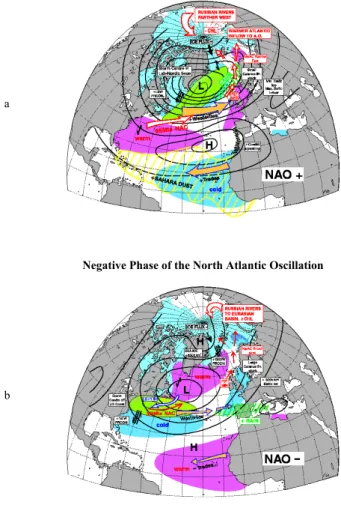
ther Lisbon, Portugal (extended winter index) or Ponta Delgada, Azores (monthly and seasonal indices), and a station in Stykkisholmur/Reykjavik, Iceland. During the pos-itive phase of the NAO (top image in Fig. 1), the Icelandic low and the Azores high are relatively strong. This increased difference between the two pressure systems sets up a greater north-south pressure gradient due to the difference in pressure between
15
the low and the high and the associated meridional variation in mass balance between the subtropical mid-latitudes (Bermuda-Azores high) and the higher latitudes (Icelandic low). The gradient produces an enhanced zonal (west to east) flow, causing air to move more quickly and with less impedance from west to east across the North Atlantic. Dur-ing the negative phase (bottom image in Fig. 1), the Icelandic low and the Azores high
20
both weaken causing the circulation across the North Atlantic to be altered (i.e. less zonal, more meridional). This altered flow is less conducive to transport of air parcels making it directly from the North American continent to Europe, which is more than likely due to the increased north-south (meridional) flow pattern that sets up.
Studies of the NAO’s influence have focused primarily on the winter and spring
sea-25
sons when the westerlies are faster and its relationship to changes in North Ameri-can and European climate (temperature and precipitation anomalies) have been noted (Hurrell, 1995; Rogers, 1997). Some of the stronger relationships discovered have linked the positive phase of the NAO with above normal temperatures across western
ACPD
3, 4431–4460, 2003 Intercontinental transport of tropospheric ozone J. K. Creilson et al. Title Page Abstract Introduction Conclusions References Tables Figures J I J I Back CloseFull Screen / Esc
Print Version Interactive Discussion
© EGU 2003 Europe and below normal precipitation across central and southern Europe (Hurrell,
1995; Hurrell et al., 2003; Visbeck et al., 2001). However, the NAO displays con-siderable monthly and interannual variability (Hurrell, 1995) and its effects have been observed in all seasons. Recently, relationships between the NAO and “other” atmo-spheric phenomena, such as total ozone (Appenzeller et al., 2000; Braesicke et al.,
5
2000) and tropospheric ozone (Li et al., 2002a), have been studied. Li et al. (2002a) found that when the spring NAO is positive there is an increase in surface ozone at Mace Head Ireland. This study determined that the increase in surface ozone was due to westerly transport of North American pollution across the North Atlantic.
3. Tropospheric Ozone Data
10
3.1. Tropospheric Ozone Residual (TOR) technique and seasonal depictions
Fishman et al. (2003) present a summary of the global distribution of TOR using coin-cident measurements from the Total Ozone Mapping Spectrometer (TOMS) and Solar Backscattered Ultraviolet (SBUV) instruments from 1979–2000. During this period, nearly eighteen years of monthly averages over most of the globe from 50◦N to 50◦S
15
have been calculated (data available at http://asdwww.larc.nasa.gov/TOR/data.html). A description of the technique can be found in Fishman and Balok (1999) and Fishman et al. (2003). The seasonal distributions shown in Fig. 2 represent the 1979–2000 TOR climatologies across the North Atlantic. Each 1◦ latitude ×1.25◦longitude pixel (TOMS grid size) shown represents an average of ∼1600 points (∼90 days × ∼18 years). This
20
density of data points is able to show the seasonal variability of tropospheric ozone across the North Atlantic with areas of higher tropospheric ozone evident in the spring and summer seasons. Further regional analysis of the seasonal data is completed by binning the data into the five regions shown in Fig. 3 (Oxford Atlas of the World, 2000). Figure 4a shows the monthly climatology of each of these five regions and illustrates
25
pro-ACPD
3, 4431–4460, 2003 Intercontinental transport of tropospheric ozone J. K. Creilson et al. Title Page Abstract Introduction Conclusions References Tables Figures J I J I Back CloseFull Screen / Esc
Print Version Interactive Discussion
© EGU 2003 duction or transport into a particular region. The regions were chosen because they
represent a cross section of the North Atlantic and are in the midlatitudes (between 30 and 45◦N); two of the areas (Regions 1 and 5) are in close proximity to excellent ozonesonde profile climatologies (areas which could be used for validation), spanning the same time period. The seasonal TOR values for each region are defined by 81
5
TOMS grid points centered on each location shown in Fig. 3 and are summarized by season in Table 1. For all seasons except summer, the data show that higher amounts of TOR are present over the North Atlantic than over the adjacent coasts of eastern North America and western Europe. Such a distribution would be consistent with the hypothesis that slower photochemical generation of ozone is taking place during the
10
non-summer seasons, but that rapid generation of boundary-layer ozone during the summer over the eastern United States dominates the observed TOR distribution. 3.2. Ozonesonde analysis and validation
For validation, we compared the TOR over the eastern U.S. and western Europe (Regions 1 and 5 in Fig. 3) with climatological ozonesonde profiles from Wallops
Is-15
land, Virginia (USA) and Hohenpeissenberg (Germany), respectively. Ozonesonde data were obtained from an archive maintained at NASA Langley Research Center (V. Brackett, NASA Langley Research Center, personal communications, 2002). Much of the data in this archive (including the two stations used in this analysis) came from the World Ozone and Ultraviolet Data Center (WOUDC), Environment Canada
20
(http://www.woudc.org/index e.html). From the archive, monthly and seasonal climato-logical profiles were constructed of the integrated ozone in the troposphere at Wallops Island, USA and Hohenpeissenberg, Germany. The integrated amount of ozone in the troposphere is calculated utilizing the thermal tropopause, which is determined when the lapse rate becomes less than 2 K/km. These profiles were then used to compare
25
against the TOR values adjacent or coincident to these two locations. These two data sets were chosen due to their long records that cover the same time period as the TOR data set and their relative proximity to the TOR in Regions 1 and 5. These monthly
ACPD
3, 4431–4460, 2003 Intercontinental transport of tropospheric ozone J. K. Creilson et al. Title Page Abstract Introduction Conclusions References Tables Figures J I J I Back CloseFull Screen / Esc
Print Version Interactive Discussion
© EGU 2003 ozonesonde climatologies were used to compare against the monthly TOR
climatolo-gies for the 1979–2000 time period. Earlier work has shown that ozonesondes can be used as a validation for the amount of tropospheric ozone column data retrieved from satellites (Fishman et al., 1990; Hudson and Thompson, 1998; Ziemke et al., 1998, 2000; Fishman and Balok, 1999; Thompson et al., 2003).
5
Figure 4b compares the monthly climatological TOR cycles in Regions 1 and 5 with the observations from Wallops Island and Hohenpeissenberg, respectively. At Wallops Island, the TOR products underestimate the ozonesonde-derived values by 1.9–8.2 DU per month with the average value being 4.4 DU (∼11%). The comparison between Re-gion 5 and the Hohenpeissenberg data is similarly good with the average value for the
10
TOR being 2.2 DU higher than the ozonesondes with an average monthly difference never exceeding 4.8 DU (January difference). Figures 5a and 5b are plots showing the monthly-averaged profiles derived from ozonesonde measurements compared with the amount derived utilizing the TOR technique for Region 1 and Region 5, respectively. As can be seen in the relationships (Figs. 5a and 5b), the integrated amount of
tropo-15
spheric ozone (TOR) over these regions succinctly captures the variability within the monthly averaged ozonesonde profiles with a correlation coefficient (R-value) of +0.98 for Wallops Island/Region 1 (Fig. 5a) and an R2 value of 0.96. A similarly strong re-lationship (R=+0.96, R2 = 0.93) is also seen for Hohenpeissenberg/western Europe (Fig. 5b). Figure 5c highlights the covariance between the gradients observed in the
20
two sets of climatological measurements. This plot confirms that the average monthly differences in the TOR between these two locations is in good agreement with the same quantities derived from ozonesonde profiles (R=+0.87, R2=0.76). This strong correlation suggests that regional variations observed in the TOR fields can be ana-lyzed on shorter time scales to provide insight into the interannual variability of TOR
25
ACPD
3, 4431–4460, 2003 Intercontinental transport of tropospheric ozone J. K. Creilson et al. Title Page Abstract Introduction Conclusions References Tables Figures J I J I Back CloseFull Screen / Esc
Print Version Interactive Discussion
© EGU 2003 3.3. Meridional differences across the North Atlantic
Figure 4a shows the monthly climatological TOR for each of the 5 regions. Each region shows a distinct seasonal variability with highest amounts in the late spring/early sum-mer timeframe and lesser amounts in the winter season. There appears to be higher amounts in the western Atlantic earlier in the year and greater amounts in the eastern
5
Atlantic as the year progresses. The peak for Regions 1–4 occur in the early summer while Region 5 peak occurs in the mid-summer. It is interesting to note the rapid in-crease through the mid to late spring in each region and then a subsequent leveling off or even dropping off during the early summer. The distribution for Regions 3 and 4 exhibit a distinct leveling off during the late spring/early summer period, possibly due
10
to the onset of the Bermuda-Azores high. Region 2 (Bermuda) shows the strongest spring increase and then followed by a sharp drop-off from June to July, also coinciding with the Bermuda-Azores high. Region 1 shows continued strong TOR during most of the summer which is consistent with the strong production processes in the east-ern U.S. during the summer. While Region 5 shows the later peak and then gradual
15
decrease towards the winter. This could be consistent with a climatologically later pro-duction period or the latent effect of transport of ozone into this region from regions with higher TOR in a preceding month.
3.4. Latitudinal variability of seasonality over the North Atlantic
Figure 6 shows the monthly zonal TOR climatology from approximately 80◦W to 20◦E.
20
Five zones are shown in 5-degree bands from south to north between 20◦N and 45◦N. The legend symbols for each profile represent the midpoint of the 5◦ latitude bands (22 for 20–25◦N; 27 for 25–30◦N; etc.). Analysis of this figure shows some interesting features. All five bands display strong increases through the early to mid springtime period (March–April) with the lower latitude bands (22 and 27) leveling off or actually
25
decreasing in May (band 22). The remaining three bands continue to increase into early summer with latitude band 42 having the latest peak (July). Interestingly, latitude
ACPD
3, 4431–4460, 2003 Intercontinental transport of tropospheric ozone J. K. Creilson et al. Title Page Abstract Introduction Conclusions References Tables Figures J I J I Back CloseFull Screen / Esc
Print Version Interactive Discussion
© EGU 2003 band 37 shows the greatest TOR values (∼44 DU in June). The rapid increase through
the spring and into early summer is consistent with the northward progression of the springtime sun and the subsequent increased photochemical activity. A drop-off in the TOR at band 32 after June is consistent with the climatological onset of the Bermuda high and the ozone destruction processes in the planetary boundary layer that
accom-5
pany it (Oltmans, 1981; Oltmans and Levy, 1992, 1994). The relative maximum in the TOR seen at the lower latitudes (bands 22, 27, and to a lesser extent in band 32) in the October and November timeframe is the subject of an on-going study. The amounts and rate of increase of TOR are consistent with the regional profiles seen in Fig. 4 and with the ozonesonde profiles used in the analysis shown in Fig. 5.
10
4. Relationship between region 5 springtime tropospheric ozone and the NAO
Several researchers have shown seasonal linkages between transport of atmospheric constituents (i.e. ozone, dust) and the phase of the NAO (Moulin et al., 1997; Li et al., 2002a). These analyses have focused on the use of the NAO phase in determining relative strengths of transport mechanisms. In addition to the seasonal TOR values
15
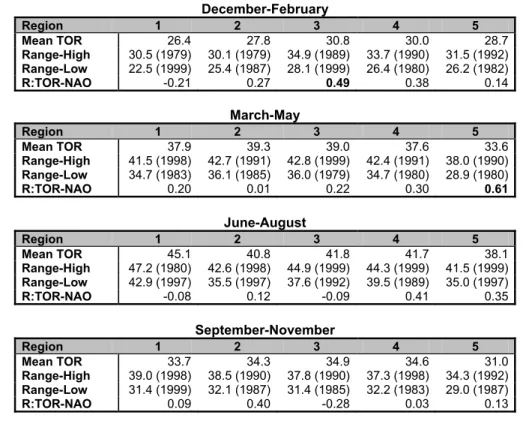
derived for each region by season, contemporaneous correlations between the phase of the NAO and the amount of tropospheric ozone in each region were calculated for each season. From Table 1, the strongest TOR-NAO relationship (level of significance exceeding .01) shown is between the TOR over Western Europe (Region 5) in the spring and the positive phase of the NAO in the same season. Since this relationship
20
is clearly the strongest and other researchers have seen similarly strong relationships, a further look at the TOR over this region is conducted and the remaining focus of this section will be on this particular relationship.
Figure 4a suggests that the monthly progression of tropospheric ozone through the spring (March-April-May(MAM)) exhibits a greater difference in TOR from west to east
25
during April and May than during March. The TOR over Region 1 moves from approxi-mately 31 DU to 38 DU to 45 DU, an increase of 45% (14 DU) across this three month
ACPD
3, 4431–4460, 2003 Intercontinental transport of tropospheric ozone J. K. Creilson et al. Title Page Abstract Introduction Conclusions References Tables Figures J I J I Back CloseFull Screen / Esc
Print Version Interactive Discussion
© EGU 2003 period. While the TOR over Region 5 moves from approximately 32 DU to 34 DU to
37 DU, a 16% (5 DU) increase for this same period. The eastern U.S. has been shown to be an area where tropospheric ozone is photochemically-produced and thus should likely experience an increase in the amount of tropospheric ozone due to increased photochemistry, once precursors are present (usually following the winter season) and
5
an increase in insolation (evident during springtime) occurs. Further breaking down the springtime relationship into two month periods (March–April, March–May, April–May) and correlating it with a two-month average NAO index shows that the April–May time period (R= +0.62) appears to be driving the high overall correlation shown in Table 1 for Region 5. The stronger relationship during this two-month period is consistent with
10
both a greater increase of TOR over this period in this region and a greater amount of ozone available in regions that are further west that could be transported into this region.
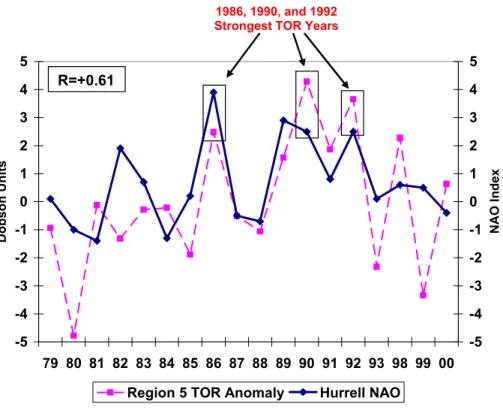
Figure 7 shows the interannual variability of the springtime TOR anomaly in Region 5 versus the Hurrell NAO index in the spring from 1979–2000. NAO index data is
15
provided by the Climate Analysis Section, NCAR, Boulder, CO, USA, Hurrell (1995) and is available athttp://www.cgd.ucar.edu/∼jhurrell/nao.html. For the majority of the years from 1979–2000, the largest positive anomalies of tropospheric ozone (1986, 1990, 1992) correspond to years with a highly positive NAO index. The magnitude of the variability in the TOR appears to be greater than in the NAO index however the sign
20
and extent of the variability of the TOR and NAO appear to be very similar. A further look at the springtime TOR in Region 5 can be seen in Table 2. Table 2 shows the monthly TOR values over this region ranked from years of greater tropospheric ozone to years of lesser tropospheric ozone. Highlighted in red is a positive NAO year (1990) and highlighted in blue is a negative NAO year (1980). The years 1990 and 1980 were
25
chosen because they contained the greatest and least average springtime amounts of tropospheric ozone respectively. Looking at the spring (MAM) season, it is clear that 1990 averaged a relatively high TOR value (38.5 DU) and 1980 averaged a relatively low TOR value (30.3). The relationship appears to break down over the JJA and SON
ACPD
3, 4431–4460, 2003 Intercontinental transport of tropospheric ozone J. K. Creilson et al. Title Page Abstract Introduction Conclusions References Tables Figures J I J I Back CloseFull Screen / Esc
Print Version Interactive Discussion
© EGU 2003 time periods. This breakdown coincides with the times of the year when the westerlies
are not as strong and would have less of an influence than in winter and spring. A similarly strong relationship during 1992, another highly positive NAO-averaged spring, can also be seen. Figure 8a and 8b highlight the magnitude of the TOR over Region 5 for the springs of 1990 and 1980 respectively. Looking at the spring 1990 versus the
5
spring of 1980, it is clearly evident that there is a greater amount of tropospheric ozone over this region during the positive NAO year than during the negative NAO year. For the three-month springtime period, 1990 averages more than 27% more ozone than 1980 (38.5 DU versus 30.3 DU). A similar relationship is seen for 1992 as well (38.2 versus 30.3). Considering the density of data points that make up the seasonal TOR
10
depictions, the observed enhancement is statistically robust .
5. Factors to consider for strong springtime relationship
Several factors could be responsible for the positive relationship between the amount of tropospheric ozone seen in Region 5 and the phase of the NAO during the spring. The first factor deals with the potential transport of tropospheric ozone and/or its
pre-15
cursors across the North Atlantic. During a positive NAO year, the Azores high and the Icelandic low are relatively strong. Figures 8c and 8d show the average sea level pressure pattern and the 850 mb winds during April of both 1990 (Fig. 8c) and 1980 (Fig. 8d) over the North Atlantic, respectively. The sea level pressure and 850mb wind data are from the NCEP/NCAR Reanalysis (Kalnay et al., 1996) and are available at
20
http://www.cdc.noaa.gov/. What is evident in Fig. 8c is the very strong Bermuda-Azores high (> 1027 mb) that persists throughout the month of April 1990. The circulation that sets up between this high pressure system and the low pressure to the north (Icelandic low) creates a strong zonal flow across the North Atlantic with the axis of strongest winds centered along the 45◦N latitude belt. This pathway would enable air parcels
25
that are moving west to east to get channeled through this area on its way towards Eu-rope. The other variable that is seen on this figure are the 850 mb winds. An analysis
ACPD
3, 4431–4460, 2003 Intercontinental transport of tropospheric ozone J. K. Creilson et al. Title Page Abstract Introduction Conclusions References Tables Figures J I J I Back CloseFull Screen / Esc
Print Version Interactive Discussion
© EGU 2003 of these winds shows that the trajectory coming off the North American continent has
a westerly component essentially all the way down to the top of the boundary layer. Similar analyses of the winds and pressure regimes up through the free troposphere also show a similar westerly component to the flow. This pressure regime is evident during positive phases of the NAO (Fig. 1a), allowing for a more direct movement of air
5
across the North Atlantic. This setup would provide an efficient pathway for pollution to be transported from North America to Europe. During negative phases of the NAO (Fig. 1b), the Azores high and/or the Icelandic low are weaker and may set up in a less favorable location for transport to the west; such a situation is seen in Fig. 8d. The flow becomes more meridional (north-south) causing the strong zonal flow to be altered and
10
thus the pathway across the North Atlantic is altered. This pathway is less conducive to direct westerly transport.
Another factor to be considered when discussing the origin of enhanced tropospheric ozone, especially during the spring, is how much ozone of the observed enhanced ozone is coming from the stratosphere. Although the relationship between the NAO
15
and ozone over this region can help to explain the transport of ozone or its precursors, spring is a season when the polar front and jet are further south and can experience fluctuations, frequently being found in the central midlatitudes (Vaughan and Price, 1991). We have conducted a cursory analysis of the distribution of potential vorticity during springs with both a high and a low NAO index to examine the possibility of a
20
relationship between the intensity of stratosphere-troposphere exchange(STE) and the NAO. Our initial findings suggest that a high NAO Index is not a situation in which STE should be enhanced (in fact, there appears to be an anti-correlation), and we believe that this kind of analysis needs to be pursued in considerably more detail but that such a study is beyond the present scope of this paper.
ACPD
3, 4431–4460, 2003 Intercontinental transport of tropospheric ozone J. K. Creilson et al. Title Page Abstract Introduction Conclusions References Tables Figures J I J I Back CloseFull Screen / Esc
Print Version Interactive Discussion
© EGU 2003
6. Conclusions
Long range transport of anthropogenic pollution has been observed in recent aircraft campaigns, model simulations, and satellite retrievals. The results have shown that pol-lution coming off the North American continent has the ability, based on the prevailing meteorology, to progress eastward and impact Europe and points eastward. Utilizing
5
the Tropospheric Ozone Residual (TOR) technique of extracting tropospheric ozone from satellites, the seasonal and regional distribution of tropospheric ozone across the North Atlantic has been investigated. This distribution was then correlated with the North Atlantic Oscillation (NAO) to determine if a relationship exists.
The distribution across the North Atlantic showed strong seasonality, with the spring
10
and summer seasons exhibiting the greatest amounts of tropospheric ozone. The greatest increase of tropospheric ozone is seen during the April and May timeframe across this region. A zonal analysis of tropospheric ozone across this region showed that the latitude band of greatest tropospheric ozone was in the central midlatitudes (35–40◦N) and not the upper midlatitudes (40–45◦N), consistent with a strong
con-15
tinental U.S. influence. Analysis of the amount of tropospheric ozone determined utilizing this technique and the amount and variability of tropospheric ozone from ozonesonde measurements over the same regions (eastern North America (Region 1) and western Europe (Region 5)) show remarkable consistency and are highly cor-related.
20
A strong relationship was discovered between the amount of tropospheric ozone over western Europe and the phase of the NAO. During the spring (March-April-May) from 1979–2000 over this region, increases in tropospheric ozone over this region were strongly correlated with a positive phase of the NAO with the April–May relationship showing the largest contribution. The positive NAO leads to an increase in the westerly
25
winds across the North Atlantic, thereby aiding transport of anthropogenic pollution from North America to Europe.
ACPD
3, 4431–4460, 2003 Intercontinental transport of tropospheric ozone J. K. Creilson et al. Title Page Abstract Introduction Conclusions References Tables Figures J I J I Back CloseFull Screen / Esc
Print Version Interactive Discussion
© EGU 2003 North Atlantic could be significant. European ozone standards are stricter than
stan-dards set in the United States and this increased ozone could be inhibiting the receiving regions from meeting their standards. As countries continue to grow, the significance of the impact on downwind countries from high pollution sources will continue to be a major issue. The ability to forecast the tendency for pollution episodes based on the
5
phase of the NAO would be an important planning tool. Also, future satellite missions with finer resolution coupled with chemical transport models are also going to be im-portant tools in helping to determine the amounts and impact of long-range transport on pollution.
References
10
Aguado, E. and Burt, J. E.: Understanding weather and climate, Prentice Hall, New Jersey, 1999.
Air Quality Research Subcommittee of the Committee on Environment and Natural Resources (CENR), Intercontinental transport of air pollution: Relationship to North American air quality, A review of Federal research and future needs, Washington DC, 2001.
15
Appenzeller, C., Weiss, A. K., and Staehelin, J.: North Atlantic Oscillation modulates total ozone winter trends, Geophys. Res. Lett., 27, 1131–1134, 2000.
Atherton, C. S., Sillman, S., and Walton, J.: Three-dimensional global modeling of the transport and photochemistry over the North Atlantic Ocean, J. Geophys. Res., 101, 29 289–29 304, 1996.
20
Berkowtiz, C. M., Daum, P. H., Spicer, C. W., and Busness, K. M.: Synoptic patterns associated with the flux of excess ozone to the western North Atlantic, J. Geophys. Res., 101, 28 923– 28 933, 1996.
Braesicke, P., Hadjinicolaou, P., Jrrar, A., and Pyle, J.: Variability of total ozone due to the NAO as represented in two different model simulations, Presented at Chapman Conference, 2000.
25
Chin, M., Jacob, D. J., Munger, J. W., Parrish, D. D., and Doddridge, B. G.: Relationship of ozone and carbon monoxide over North America, J. Geophys. Res., 99, 14 565–14 573, 1994.
Fehsen-ACPD
3, 4431–4460, 2003 Intercontinental transport of tropospheric ozone J. K. Creilson et al. Title Page Abstract Introduction Conclusions References Tables Figures J I J I Back CloseFull Screen / Esc
Print Version Interactive Discussion
© EGU 2003
feld, F. C., and Stohl, A.: Trace gas composition of midlatitude cyclones over the west-ern North Atlantic Ocean: A seasonal comparison of O3 and CO, J. Geophys. Res., 107, 10.1029/2001JD000902, 2002.
Fehsenfeld, F. C., Daum, P., Leaitch, W. R., Trainer, M., Parrish, D. D., and H ¨ubler, G.: Trans-port and processing of O3 and O3 precursors over the North Atlantic: An overview of the
5
1993 North Atlantic Regional Experiment (NARE) summer Intensive, J. Geophys. Res., 101, 28 877–28 891, 1996.
Fishman, J., Ramanathan, V., Crutzen, P. J., and Liu, S. C.: Tropospheric ozone and climate, Nature, 282, 818–820, 1979a.
Fishman, J.; Solomon, S.; and Crutzen, P. J.: Observational and Theoretical Evidence in
Sup-10
port of a Significant In-Situ Photochemical Source of Tropospheric Ozone, Tellus, 31, 432– 446, 1979b.
Fishman, J., Watson, C. E., Larsen, J. C., and Logan, J. A.: Distribution of tropospheric ozone determined from satellite data, J. Geophys. Res, 95, 3599-3617, 1990.
Fishman, J., Fakhruzzaman, K., Cros, B., and Nganga, D.: Identification of widespread pollution
15
in the southern hemisphere deduced from satellite analyses, Science, 252, 1693- 1696, 1991.
Fishman, J., Hoell Jr., J. M., Bendura, R. D., McNeal., R. J., and Kirchhoff, V. W. J. H.: NASA GTE TRACE-A experiment (September-October 1992): Overview, J. Geophys. Res., 101, 23 865–23 879, 1996.
20
Fishman, J. and Balok, A. E.: Calculation of daily tropospheric ozone residuals using TOMS and empirically improved SBUV measurements: Application to an ozone pollution episode over the eastern United States, J. Geophys. Res., 104, 30 319–30 340, 1999.
Fishman, J., Wozniak, A. E., and Creilson, J. K.: Global distribution of tropospheric ozone from satellite measurements using the empirically corrected tropospheric ozone residual
tech-25
nique: Identification of the regional aspects of air pollution, Atmos. Chem. Phys., 3, 893–907, 2003.
Gauss, M., Myhre, G., Pitari, G., et al.: Radiative forcing in the 21st century due to ozone changes in the troposphere and lower stratosphere, J. Geophys. Res., 108, D9, 4292, doi:10.1029/2002JD002624, 2003.
30
Hudson, R. D. and Thompson, A. M.: Tropical tropospheric ozone from total ozone mapping spectrometer by a modified residual method, J. Geophys. Res., 103, 22 129–22 145, 1998. Hurrell, J. W.: Decadal trends in the North Atlantic Oscillation: Regional temperatures and
ACPD
3, 4431–4460, 2003 Intercontinental transport of tropospheric ozone J. K. Creilson et al. Title Page Abstract Introduction Conclusions References Tables Figures J I J I Back CloseFull Screen / Esc
Print Version Interactive Discussion
© EGU 2003
precipitation, Science, 269, 676–679, 1995.
Hurrell, J. W., Kushnir, Y., Ottersen, G., and Visbeck, M.: The North Atlantic Oscillation climate significance and environmental impact, American Geophysical Union, 2003.
Kalnay, E., and Coauthors.: The NCEP/NCAR 40-year reanalysis project, Bull. Amer. Met. Soc., 77, 437–472, 1996.
5
Kim, J. H. and Newchurch, M. J.: Climatology and trends of tropospheric ozone over the eastern Pacific Ocean: The influences of biomass burning and tropospheric dynamics, Geophys. Res. Lett., 23, 3723–3726, 1996.
Kim, J. H. and Newchurch, M. J.: Biomass-burning influence on tropospheric ozone over New Guinea and South America, J. Geophys. Res., 103, 1455–1461, 1998.
10
Jaffe, D., Anderson, T. A., Covert, D., Kotchenrutther, R., Trost, B., Danielson, J., Simpson, W., Bernsten, T., Karlsd ´ottir, S., Blake, D., Harris, J., Carmichael, G., and Uno, I.: Transport of Asian air pollution to North America, Geophys. Res. Lett., 26, 711–714, 1999.
Jonson, J. E., Sundet, J. K., and Tarras ´on, L.: Model calculations of present and future levels of ozone and ozone precursors with a global and a regional model, Atmos. Environ., 35,
15
525–537, 2001.
Li, Q., Jacob, D. J., Bey, I., Palmer, P. I., Duncan, B. N., Field, B. D., Martin, R. V., Fiore, A. M., Yantosca, R. M., Parrish, D. D., Simmonds, P. G., and Oltmans, S. J.: Transatlantic transport of pollution and its effects on surface ozone in Europe and North America, J. Geophys. Res., 107, 4166, doi: 10.129/2001JD001422, 2002a.
20
Li, Q., Jacob, D. J., Fairlie, T. D., Liu, H., Yantosca, R. M., and Martin, R. V.: Stratospheric verusu pollution influences on ozone at Bermuda: Reconciling past analyses, J. Geophys. Res., 107, 4611, doi: 10.1029/2002JD002138, 2002b.
Liang, J., Horowitz, L. W., Jacob, D. J., Wang, Y., Fiore, A. M., Logan, J. A., Gardner, G. M., and Munger, J. W.: Seasonal budgets of reactive nitrogen species and ozone over the United
25
States, and export fluxes to the global atmosphere, J. Geophys. Res., 103, 13 435–13 450, 1998.
Liu, S. C., Trainer, M., Fehsenfeld, F. C., Parrish, D. D., Williams, E. J., Fahey, D. W., Hbler, G., and Murphy, P. C.: Ozone production in the rural troposphere and the implications for regional and global ozone distributions, J. Geophys. Res., 92, 4191–4207, 1987.
30
Moody, J. L., Oltmans, S. J., Levy II, H., and Merill, J. T.: Transport climatology of tropospheric ozone: Bermuda, 1988–1991, J. Geophys. Res., 100, 7179–7194, 1995.
ACPD
3, 4431–4460, 2003 Intercontinental transport of tropospheric ozone J. K. Creilson et al. Title Page Abstract Introduction Conclusions References Tables Figures J I J I Back CloseFull Screen / Esc
Print Version Interactive Discussion
© EGU 2003
North Africa by the North Atlantic Oscillation, Nature, 387, 691–694, 1997.
Oltmans, S. J.: Surface ozone measurements in clean air, J. Geophys. Res., 86, 1174–1180, 1981.
Oltmans, S. J. and Levy II, H.: Seasonal cycle of surface ozone over the western North Atlantic, Nature, 358, 392–394, 1992.
5
Oltmans, S. J. and Levy II, H.: Surface ozone measurements from a global network, Atmos. Environ., 28, 9–24, 1994.
Oxford Atlas of the World (8th Edition), Oxford University Press, New York, 304 pp., 2000. Parrish, D. D., Holloway, J. S., Trainer, M., Murphy, P. C., Forbes, G. L., and Fehsenfeld, F.
C.: Export of North American ozone pollution to the North Atlantic Ocean, Science, 259,
10
1436–1439, 1993.
Parrish, D. D., Trainer, M., Holloway, J. S., Yee, J. E., Warshawsky, M. S., Fehsenfeld, F. C., Forbes, G. L., and Moody, J. L.: Relationships between ozone and carbon monoxide at surface sites in the North Atlantic region, J. Geophys. Res., 103, 13 357–13 376, 1998. Prather, M., Gauss, M., Berntsen, T., et al.: Fresh air in the 21st century?, Geophys. Res. Lett.,
15
30, 1100, doi: 10.1029/2002GL016285, 2003.
Reeves, C. E., Penkett, S. A., Bauguitte, S., et al.: Potential for photochemical ozone forma-tion in the troposphere over the North Atlantic as derived from aircraft observaforma-tions during ACSOE, J. Geophys. Res., 107(D23), 4707, doi:10.1029/2002JD002415, 2002.
Rogers, J. C.: North Atlantic storm track variability and its association to the North Atlantic
20
Oscillation and climate variability of northern Europe, J. Clim., 10, 1635–1647, 1997. Stohl, A. and Trickl, T.: A textbook example of long-range transport: Simultaneous observation
of ozone maxima of stratospheric and North American origin in the free troposphere over Europe, J. Geophys. Res., 104, 30 445–30 462, 1999.
Stohl, A., Eckhardt, S., Forster, C., James, P., and Spichtinger, N.: On the pathways and
25
timescales of intercontinental air pollution transport, J. Geophys. Res., 107, D23, 4684, doi:10.1029/2001JD001396, 2002.
Stohl A., Huntrieser, H., Richter, A., Beirle, S., Cooper, O., Eckhardt, S., Forster, C., James, P., Spichtinger, N., Wenig, M., Wagner, T., Burrows, J., and Platt, U.: Rapid intercontinental air pollution transport associated with a meteorological bomb, Atmos. Chem. Phys. Discuss., 3,
30
2101–2141, 2003.
Thompson, A. M., Oltmans, S. J., Schmidlin, F. J., Logan, J. A., Fujiwara, M., Kirchoff, V. W. J. H., Posny, F., Coetzee, G. J. R., Hoegger, B., Kawakami, S., Ogawa, T., Johnson,
ACPD
3, 4431–4460, 2003 Intercontinental transport of tropospheric ozone J. K. Creilson et al. Title Page Abstract Introduction Conclusions References Tables Figures J I J I Back CloseFull Screen / Esc
Print Version Interactive Discussion
© EGU 2003
B. J., V ¨omel, H., and Labow, G.: The 1998–2000 SHADOZ (Southern Hemisphere Ad-ditional Ozonesondes) tropical ozone climatology. 1. Comparison with TOMS and ground-based measurements, J. Geophys. Res., 108, 8238, doi: 10.1029/2001JD000967, 2003. Vaughan, G. and Price, J. D.: On the relation between total ozone and meteorology, Q. J. R.
Meteorol. Soc., 117, 1281–1298, 1991.
5
Visbeck, M. H., Hurrell, J. W., Polvani, L., and Cullen, H. M.: The North Atlantic Oscillation: Past, present, and future, PNAS, 98, 12 876–12 877, 2001.
von Kuhlmann, R., Lawrence, M. C., and Crutzen, P. J.: A model for studies of tropospheric ozone and nonmethane hydrocarbons: Model description and ozone results, 108, D9, 4294, doi:10.1029/2002JD002893, 2003.
10
Wang, Y., Jacob, D. J., and Logan, J. A.: Global simulation of tropospheric
O3−NOx−hydrocarbon chemistry 3. Origin of tropospheric ozone and effects of nonmethane hydrocarbons, J. Geophys. Res., 103, 10 757–10 767, 1998.
Ziemke, J. R., Chandra, S., and Bhartia, P. K.: Two new methods for deriving tropospheric column ozone from TOMS measurements: Assimilated UARS MLS/HALOE and
convective-15
cloud differential methods, J. Geophys. Res., 103, 22 115–22 ,127, 1998.
Ziemke, J. R., Chandra, S., and Bhartia, P. K.: A new NASA data product: Tropospheric and stratospheric column ozone in the tropics derived from TOMS measurements, Bull. Amer. Meteorol. Soc., 81, 580–583, 2000.
ACPD
3, 4431–4460, 2003 Intercontinental transport of tropospheric ozone J. K. Creilson et al. Title Page Abstract Introduction Conclusions References Tables Figures J I J I Back CloseFull Screen / Esc
Print Version Interactive Discussion
© EGU 2003
Table 1. Seasonal mean TOR, TOR range, and TOR-NAO correlation for each of the five
regions shown in Fig. 3 for the 1979–2000 time period. Significant correlations are highlighted. All TOR values are in Dobson Units (DU)
Table 1. Seasonal mean TOR, TOR range, and TOR-NAO correlation for each of the
five regions shown in Figure 3 for the 1979-2000 time period. Significant correlations are highlighted. All TOR values are in Dobson Units (DU).
December-February Region 1 2 3 4 5 Mean TOR 26.4 27.8 30.8 30.0 28.7 Range-High 30.5 (1979) 30.1 (1979) 34.9 (1989) 33.7 (1990) 31.5 (1992) Range-Low 22.5 (1999) 25.4 (1987) 28.1 (1999) 26.4 (1980) 26.2 (1982) R:TOR-NAO -0.21 0.27 0.49 0.38 0.14 March-May Region 1 2 3 4 5 Mean TOR 37.9 39.3 39.0 37.6 33.6 Range-High 41.5 (1998) 42.7 (1991) 42.8 (1999) 42.4 (1991) 38.0 (1990) Range-Low 34.7 (1983) 36.1 (1985) 36.0 (1979) 34.7 (1980) 28.9 (1980) R:TOR-NAO 0.20 0.01 0.22 0.30 0.61 June-August Region 1 2 3 4 5 Mean TOR 45.1 40.8 41.8 41.7 38.1 Range-High 47.2 (1980) 42.6 (1998) 44.9 (1999) 44.3 (1999) 41.5 (1999) Range-Low 42.9 (1997) 35.5 (1997) 37.6 (1992) 39.5 (1989) 35.0 (1997) R:TOR-NAO -0.08 0.12 -0.09 0.41 0.35 September-November Region 1 2 3 4 5 Mean TOR 33.7 34.3 34.9 34.6 31.0 Range-High 39.0 (1998) 38.5 (1990) 37.8 (1990) 37.3 (1998) 34.3 (1992) Range-Low 31.4 (1999) 32.1 (1987) 31.4 (1985) 32.2 (1983) 29.0 (1987) R:TOR-NAO 0.09 0.40 -0.28 0.03 0.13
ACPD
3, 4431–4460, 2003 Intercontinental transport of tropospheric ozone J. K. Creilson et al. Title Page Abstract Introduction Conclusions References Tables Figures J I J I Back CloseFull Screen / Esc
Print Version Interactive Discussion
© EGU 2003
Table 2. Monthly TOR in Region 5 from 1979–2000 ranked in order from greater TOR to
lesser TOR. Positive NAO year (1990) is highlighted in red, while negative NAO year (1980) is highlighted in blue. The number located next to the month is the average TOR value for that month from 1979–2000. All TOR values are in Dobson Units (DU)Table 2. Monthly TOR in Region 5 from 1979-2000 ranked in order from greater TOR to lesser TOR. Positive NAO year (1990) is
highlighted in red, while negative NAO year (1980) is highlighted in blue. The number located next to the month is the average TOR value for that month from 1979-2000. All TOR values are in Dobson Units (DU).
Jan 30.1 Feb 30.8 Mar 31.8 Apr 33.7 May 37.4 Jun 39.8 Jul 41.0 Aug 37.1 Sep 34.2 Oct 31.7 Nov 29.7 Dec 28.5
1989 35.0 1992 36.7 1981 35.4 1992 41.3 1990 42.7 1979 48.4 1990 44.4 1983 41.1 1989 41.2 1992 39.1 1991 34.6 1990 30.6 1990 33.0 1998 34.8 1992 34.7 1990 38.3 1986 41.4 1999 45.6 1985 44.4 1988 40.7 1981 35.7 1991 34.0 1980 34.6 1979 30.4 1979 32.9 1986 34.4 1990 34.4 1989 38.1 1998 41.3 1992 42.1 1998 43.7 1999 40.2 1992 35.4 1979 33.7 2000 34.6 1986 30.3 1992 31.8 2000 33.1 1983 34.3 1987 37.0 2000 40.3 1981 40.8 1999 43.2 1982 40.0 1991 35.3 1982 32.5 1992 31.8 1992 30.2 1982 31.5 1987 32.4 1998 34.2 1984 35.5 1984 40.0 1984 40.6 1987 43.0 1998 38.6 1988 35.1 2000 32.2 1999 30.5 1989 29.8 1983 31.4 1983 31.7 1986 34.1 1999 35.4 1982 39.1 1988 40.5 1979 42.4 1984 38.5 1982 34.7 1981 32.1 1989 30.2 2000 29.3 1985 30.8 1990 31.0 1985 33.3 1988 34.8 1989 38.9 1982 40.4 1992 42.4 1986 38.3 1990 34.5 1980 31.8 1990 30.1 1988 29.0 1991 30.4 1985 31.0 2000 33.3 1998 34.8 1992 38.7 1987 39.9 1988 41.3 1990 37.6 1986 34.3 1990 31.7 1985 29.7 1980 29.0 1984 30.3 1989 30.3 1987 32.6 1983 33.6 1991 38.4 1985 39.5 1991 40.9 1979 37.5 1997 34.0 1984 31.7 1986 29.4 1999 28.9 1987 29.9 1988 30.2 1989 32.4 1979 33.6 1988 37.4 2000 39.3 2000 40.6 1981 37.5 1985 33.8 1998 31.5 1979 28.5 1987 28.7 2000 29.8 1993 29.9 1993 31.0 1981 32.3 1985 36.4 1990 38.4 1980 40.2 1992 36.7 1979 33.8 1989 31.1 1988 28.1 1991 28.5 1988 29.3 1979 29.9 1979 30.1 1991 31.4 1979 35.7 1989 37.7 1981 39.3 1980 36.4 1983 33.5 1986 31.0 1981 28.1 1997 28.1 1986 28.2 1984 29.7 1984 29.0 1986 31.4 1981 35.5 1983 37.6 1986 39.2 1997 35.6 1984 33.3 1985 30.9 1987 27.8 1985 27.9 1999 28.2 1999 29.6 1982 28.9 1980 30.8 1983 34.8 1986 37.4 1984 38.3 1989 34.6 1987 33.3 1983 30.7 1984 27.3 1983 27.4 1993 27.6 1980 28.7 1980 27.8 1993 30.4 1980 32.2 1998 36.7 1983 38.2 1987 34.5 1998 33.3 1997 30.3 1983 26.9 1982 26.8 1998 27.6 1991 28.6 1988 27.4 1982 29.7 1987 32.1 1991 36.7 1982 37.9 2000 34.0 1999 32.9 1999 30.0 1982 26.5 1984 25.4 1980 27.1 1981 26.7 1999 27.0 1985 29.4 1999 31.3 1980 34.7 1989 37.8 1985 33.3 1980 31.2 1988 29.0 1997 25.7 1981 24.1 1981 26.6 1982 25.4 1991 2000 28.9 1993 1993 1993 1991 32.6 2000 30.3 1987 28.1 1993 1993
ACPD
3, 4431–4460, 2003 Intercontinental transport of tropospheric ozone J. K. Creilson et al. Title Page Abstract Introduction Conclusions References Tables Figures J I J I Back CloseFull Screen / Esc
Print Version Interactive Discussion
© EGU 2003
Positive Phase of the North Atlantic Oscillation
Negative Phase of the North Atlantic Oscillation
Fig 1. Graphical representation of the positive phase (1a) and negative phase (1b) of the
North Atlantic Oscillation (NAO). The figure is courtesy of Dr. R. Dickson (www.ices.dk/globec/data/bf4/naomap.htm).
1a
1b
Fig. 1. Graphical representation of the positive phase (a) and negative phase (b) of the North
Atlantic Oscillation (NAO). The figure is courtesy of R. Dickson (www.ices.dk/globec/data/bf4/
ACPD
3, 4431–4460, 2003 Intercontinental transport of tropospheric ozone J. K. Creilson et al. Title Page Abstract Introduction Conclusions References Tables Figures J I J I Back CloseFull Screen / Esc
Print Version Interactive Discussion
© EGU 2003
December-January-February March-April-May
June-July-August September-October-November
Fig 2. Climatological depictions of tropospheric ozone residual across the North Atlantic obtained from the empirical correction technique (Fishman et al., 2003). The four panels correspond to NH winter (December-January-February), spring (March-April-May), summer (June-July-August), and autumn (September-October-November).
Dobson Units (DU)
Fig. 2. Climatological depictions of tropospheric ozone residual across the North Atlantic
ob-tained from the empirical correction technique (Fishman et al., 2003). The four panels corre-spond to NH winter (December-January-February), spring (March-April-May), summer (June-July-August), and autumn (September-October-November).
ACPD
3, 4431–4460, 2003 Intercontinental transport of tropospheric ozone J. K. Creilson et al. Title Page Abstract Introduction Conclusions References Tables Figures J I J I Back CloseFull Screen / Esc
Print Version Interactive Discussion
© EGU 2003
Fig 3. North Atlantic Study Area (8th Oxford Atlas of the World, 2000).The following are the five numbered regions shown in the study area above: Region 1: Wallops Island, VA (37.5N, 75W), Region 2: Bermuda (33.2N, 64.4W), Region 3: Azores (38.5N, 27.5W),Region 4: Lisbon (38.4N, 9.8W), and Region 5: Southwest France (44.4N, 1.2W).
Fig. 3. North Atlantic Study Area (8th Oxford Atlas of the World, 2000).The following are the
five numbered regions shown in the study area above: Region 1: Wallops Island, VA (37.5◦N, 75◦W), Region 2: Bermuda (33.2◦N, 64.4◦W), Region 3: Azores (38.5◦N, 27.5◦W),Region 4: Lisbon (38.4◦N, 9.8◦W), and Region 5: Southwest France (44.4◦N, 1.2◦W).
ACPD
3, 4431–4460, 2003 Intercontinental transport of tropospheric ozone J. K. Creilson et al. Title Page Abstract Introduction Conclusions References Tables Figures J I J I Back CloseFull Screen / Esc
Print Version Interactive Discussion © EGU 2003 1 1 1 1 1 1 1 1 1 1 1 1 2 2 2 2 2 2 2 2 2 2 2 2 3 3 3 3 3 3 3 3 3 3 3 3 4 4 4 4 4 4 4 4 4 4 4 4 5 5 5 5 5 5 5 5 5 5 5 5 25 30 35 40 45 50 J F M A M J J A S O N D TO R (D U ) 1 2 3 4 5 1 1 1 1 1 1 1 1 1 1 1 1 5 5 5 5 5 5 5 5 5 5 5 5 W W W W W W W W W W W W H H H H H H H H H H H H 0 10 20 30 40 50 60 J F M A M J J A S O N D Tro pospheric O zo ne (D U ) 1 5 W H
Fig 4: 4a) Monthly climatological distribution of tropospheric ozone for the five regions
shown in Figure 3. The numbers in the legend and on the profiles correspond to the numbered regions in Figure 3 and are from west to east. 4b) Monthly climatological tropospheric ozone for Regions 1 and 5 and monthly climatological ozonesonde profiles for Wallops Island USA (W) and Hohenpeissenberg, Germany (H). All values are in Dobson Units (DU).
4a
4b
Fig. 4. (a) Monthly climatological distribution of tropospheric ozone for the five regions shown
in Fig. 3. The numbers in the legend and on the profiles correspond to the numbered regions in Fig. 3 and are from west to east. (b) Monthly climatological tropospheric ozone for
Re-gions 1 and 5 and monthly climatological ozonesonde profiles for Wallops Island USA (W) and Hohenpeissenberg, Germany (H). All values are in Dobson Units (DU).
ACPD
3, 4431–4460, 2003 Intercontinental transport of tropospheric ozone J. K. Creilson et al. Title Page Abstract Introduction Conclusions References Tables Figures J I J I Back CloseFull Screen / Esc
Print Version Interactive Discussion © EGU 2003 25 30 35 40 45 50 55 25 30 35 40 45 50 55
Region 1 TOR (DU)
Wallops Ozonesonde (D U ) 25 27 29 31 33 35 37 39 41 43 45 25 30 35 40 45
Region 5 TOR (DU)
H ohenpeissenber g Ozonesonde (D U ) -5 0 5 10 15 20 -5 0 5 10 15 20
Region 1-Region 5 TOR (DU)
Wallo p s -H o h en p e issen b e rg O zo n e (D U ) 5a 5b 5c
Fig 5. Monthly averaged scatter plots (1979-2000) between 5a) Region 1 TOR and ozonesonde profiles from
Wallops Island; 5b) Region 5 TOR and ozonesonde profiles from Hohenpeissenberg; and 5c) Relationship between the difference in TOR between Region 1 and 5 and the difference in ozonesonde profiles between Wallops Island and Hohenpeissenberg. All values are in Dobson Units (DU).
R=+0.98
R=+0.96
R=+0.87
Fig. 5. Monthly averaged scatter plots (1979–2000) between (a) Region 1 TOR and
ozonesonde profiles from Wallops Island; (b) Region 5 TOR and ozonesonde profiles from
Hohenpeissenberg; and(c) Relationship between the difference in TOR between Region 1 and
5 and the difference in ozonesonde profiles between Wallops Island and Hohenpeissenberg. All values are in Dobson Units (DU).
ACPD
3, 4431–4460, 2003 Intercontinental transport of tropospheric ozone J. K. Creilson et al. Title Page Abstract Introduction Conclusions References Tables Figures J I J I Back CloseFull Screen / Esc
Print Version Interactive Discussion © EGU 2003 22 22 22 22 22 22 22 22 22 22 22 22 27 27 27 27 27 27 27 27 27 27 27 27 32 32 32 32 32 32 32 32 32 32 32 32 37 37 37 37 37 37 37 37 37 37 37 37 42 42 42 42 42 42 42 42 42 42 42 42 25 30 35 40 45 50 J F M A M J J A S O N D TO R ( D U ) 22 27 32 37 42
Fig 6. Monthly climatological distribution of tropospheric ozone for five adjacent
latitude bands: 20-25°N, 25-30°N, 30-35°N, 35-40°N, and 40-45°N. The longitudinal range for these bands is from 80°W to 20°E. The number shown on each line represents which band it is; with the number being the approximate midpoint of each of the bands. All TOR values are in Dobson Units (DU).
Fig. 6. Monthly climatological distribution of tropospheric ozone for five adjacent latitude bands:
20–25◦N, 25–30◦N, 30–35◦N, 35–40◦N, and 40–45◦N. The longitudinal range for these bands is from 80◦W to 20◦E. The number shown on each line represents which band it is; with the number being the approximate midpoint of each of the bands. All TOR values are in Dobson Units (DU).
ACPD
3, 4431–4460, 2003 Intercontinental transport of tropospheric ozone J. K. Creilson et al. Title Page Abstract Introduction Conclusions References Tables Figures J I J I Back CloseFull Screen / Esc
Print Version Interactive Discussion © EGU 2003 -5 -4 -3 -2 -1 0 1 2 3 4 5 79 80 81 82 83 84 85 86 87 88 89 90 91 92 93 98 99 00 Do b so n Un it s -5 -4 -3 -2 -1 0 1 2 3 4 5 NAO I n d ex
Region 5 TOR Anomaly Hurrell NAO
Fig 7. Springtime depiction showing the interannual variability and positive relationship
between springtime tropospheric ozone residual anomaly for Region 5 and the springtime Hurrell NAO index (R=+0.61) from 1979-2000. Note the data gap from 1994-1997.
R=+0.61
1986, 1990, and 1992 Strongest TOR Years
Fig. 7. Springtime depiction showing the interannual variability and positive relationship
be-tween springtime tropospheric ozone residual anomaly for Region 5 and the springtime Hurrell NAO index (R= +0.61) from 1979–2000. Note the data gap 1994–1997.
ACPD
3, 4431–4460, 2003 Intercontinental transport of tropospheric ozone J. K. Creilson et al. Title Page Abstract Introduction Conclusions References Tables Figures J I J I Back CloseFull Screen / Esc
Print Version Interactive Discussion
© EGU 2003
1990 (Positive NAO)
1980 (Negative NAO)
8a 8b
8c 8d
Fig 8. Interannual depiction contrasting the magnitude of tropospheric ozone (TOR) during spring (MAM) of a positive NAO year (1990) (8a) and spring of a negative NAO year (1980) (8b), including the corresponding sea level pressure (SLP) and 850mb wind (u and v) streamlines for April of 1990 (8c) and 1980 (8d) (data from NCEP/NCAR Reanalysis). The units for 8a and 8b are Dobson Units (DU), while the units for 8c and 8d are millibars (mb).
Fig. 8. Interannual depiction contrasting the magnitude of tropospheric ozone (TOR) during
spring (MAM) of a positive NAO year (1990)(a) and spring of a negative NAO year (1980) (b),
including the corresponding sea level pressure (SLP) and 850 mb wind (u and v) streamlines for April of 1990(c) and 1980 (d) (data from NCEP/NCAR Reanalysis). The units for (a) and