Role of Complement-Derived and Bacterial Formylpeptide Cbemotactic Factors
in tbe In Vivo Migl'1ltion of Neutropbils in Experimental
Escherichia coli Pyelonepbritis in Rats
Pascal R. Meylan and Michel P. Glauser From the Division des Maladies Infectieuses of the Departement de Medecine Interne, Centre Hospita/ier Universitaire Vaudois, Lausanne, Switzerland
In experimentalEscherichia colipyelonephritis,the bacterial multiplication in the kidney parenchyma triggers a burst of neutrophil extravascular migration, as measured by the myeloperoxidase (MPO) activity in the kidney, a marker for tissue neutrophil infiltration. To test the mechanisms of in vivo neutrophil migration, pyelonephritis was surgicallyin-duced in rats that werethen either complement-depleted with cobra venom factor (CYF), resulting in a profound hypocomplementemia for 72 h after inoculation, or treated with phenylbutazone (PB), a competitive antagonist of bacterial chemotactic formylpeptides. Compared to controls, CYF- and PB-treated animals killed when the neutrophil infiltra-tion started (32 h) had a significantly reduced neutrophil infiltrainfiltra-tion, as measured by kid-ney MPO activity. This effect disappeared in animals killed 72 h after surgery, when neu-trophil infiltration peaked. These data suggest that redundant chemotactic mechanisms triggered neutrophil migration. Inhibitingone of these mechanisms only transiently delayed neutrophil migration but did not affect the peak infiltration.
Recent experiments using a rat model of ascending obstructive
Escherichia coli
pyelonephritis have delineated the course of neutrophil polymorpho-nuclear leukocyte infiltration in response to the mul-tiplication of bacteria in the kidney parenchyma [1]. This model therefore offers the opportunity for studying in vivo the mechanisms of neutrophil migra-tion. In vitro experiments using the filter assay or the "under-agarose migration assay" have demon-strated that gradients of various chemoattractants trigger chemotaxis, a directional migration of neu-trophils [2]. The best known chemoattractants are the complement-derived C5a and C5a-des-arg pep-tides [3-5], the bacterial formylpeppep-tides [6, 7], and oxidized derivatives of arachidonic acid generated through the lipooxygenase pathway, mainly leu-kotriene B4 [8]. In vivo, the injection of these sub-stances promotes the extravascular migration ofneu-Received for publication 11 July 1988 and in revised form 4 November 1988.
• This work was supported in part by grant 8.836.81 from the Swiss National Foundation for Scientific Research.
The authors thank Marlies Knaup for technical and Jacque-line Mayor for secretarial assistance.
Please address requests for reprints to Dr. Michel P. Glauser, Division des Maladies Infectieuses, Departement de Medecine Interne, Centre Hospitalier Universitaire Vaudois, 1011 Lausanne, Switzerland.
959
trophils [9]. During acute
E. coli
pyelonephritis, bacteria multiplying within the kidney parenchyma may produce chemotactic formylpeptides [7] and ac-tivate the complement cascade by its alternate path-way [10].We used two approaches to assess the respective role of these chemotactic substances in triggering the migration of neutrophils into the kidney interstitial space. First, cobra venom factor (CVF) was used to deplete circulating complement in rats. Hypocom-plementemia was checked by measuring levels of to-tal serum hemolytic complement (CHso) and
im-munoreactive C3 and the capacity of the serum to generate in vitro neutrophil migration upon zymo-san activation. Second, rats were treated with phenyl-butazone (PB), a competitive inhibitor of chemotac-tic formylpeptides for neutrophil receptors [11-13], in doses that prevented formylpeptide-induced neu-tropenia in rabbits [12]. Some of the animals were killed during the acute phase of pyelonephritis, and the neutrophil infiltration of their kidney paren-chyma was determined by measuring the my-eloperoxidase (MPO) activity, an enzymatic marker for neutrophil infiltration [1]. Another group of animals was killed during the chronic phase of pye-lonephritis, with the aim of correlating the effect of any diminished neutrophil migration during the acute phase with the development of pyelonephritic scarring.
Materials and Methods
In vitro experiments. (l) Complementlevelde-terminations. The CHsowas measured according to
established procedures [14]. Immunoreactive C3levels were determined by rocket immunoelectrophoresis as described by Laurell (15) using a goat antiserum to rat C3c (Nordic Immuno, Tilburg, Netherlands). The serum chemotacticactivityupon zymosanac-tivation wasdetermined in an under-agarose migra-tion assay. Pooled normal rat serum and test sera were activated as follows. Quantities (5 mg each) of washed zymosan (Sigma Chemical, S1. Louis) were added to I-mL aliquots of serum, which were vor-texed and incubated 60 min at 37°C. After centrifu-gation at 1000gfor 15 min, the supernatant washar-vested and stored at - 70°C until tested. Agarose plates (0.75070) were prepared by heating 0.3 g of agarose(Seakem LE; FMC, Rockland,Me)in 32mL of distilled water to 100°C. After cooling to 50°C, 4 mL of warm Medium 199 (concentration lOx) containing Earle's salts (GIBCO Laboratories, Pais-ley, UK), 4 mL of 7.5070 bovine serum albumin,
and 665 J.1L of7.5% NaHC03was added. Aliquots
(2 mL each) were poured into 35 x lO-mm Petri dishes (Falcon, Oxnard, Calif) and allowedto solid-ify. Four pairs of 2A-mm-diameter wells were punched out 4.6 mm apart in each dish and the plugs gently removed by suctioning with a Pasteur pipette [16]. The attractant well was loaded with 5 J.1L of zymosan-activated serum and left to prediffuse for 2 h at 37°C in a humidified incubator with 7% CO2,
Neutrophils were then loaded (5 J.1L containing 2 x 10⁵ cells) into the opposite well and left to migrate for 2 h at 37°C with 7% CO2•Migrationwasstopped
by cooling at 4°C until the cellswere counted. Cells migratingout of the well were counted usinga Nikon inverted microscopewith an ocular grid (LeitzPeri-plan, Wetzlar, GDR) as described [16]. Each experi-ment was done five times. The number of neutro-phils migrating out of the wells was proportional to the reciprocal dilution of the pooled normal rat se-rum. This relationship was used to determine the titers of serum chemotactic activity of test sera. All complement levels in test sera were expressed as per-cent of the level in pooled normal rat serum.
(2) Serum bactericidal activity against E. coli.
The bactericidal effect of rat serum againstE. coli
06:K5:Hl used for inducing pyelonephritis was tested as suggestedby Taylor[17]. The bacteria were grown to midexponential phase (about 107cfu/mL}
in Tryptone soy broth (GIBCO), harvested by cen-trifugation, and resuspended in gelatin-veronal-calcium-magnesium buffer (Bio-Merieux, Lyon, France) containing various concentrations of fresh or heated (56°C, 1 h) pooled normal rat serum to a final volume of 1mL. The test tubes were incubated in a rotatingwaterbath at 37°C. Aliquots were pipet-ted out after 0, 1, 2, 3, and 6 h of incubation and plated onto Columbia agar (GIBCO) with an auto-matic device(Spiral System DS; IG, Zurich). Colo-nies were counted after 24 h of incubation at 37°C and viable counts were expressed as 10glO cfu/mL.
In vivo experiments. (1)Experimental design.
Ascending pyelonephritis was surgically induced in rats as previously described [18, 19]. After re-covering from anesthesia, the rats were randomly assigned to one of three treatment groups. A first group received two iv injections of 100units of CVF (Lot S 4131, Cordis Laboratories, Miami) 1and 32 h after surgery. A control group received an identical schedule of iv saline. A third group received im phenylbutazone, 50 mg/kg per day for 3 d in two divided doses, the first dose being administered on the morning before surgery and the last dose at 72 h after surgery. One-third of the animals in each treatment group were killed 32 h after surgery (the time when neutrophil migration started), 72 h after surgery(the time of peak neutrophil infiltration), or 2 mo after surgery (when chronickidneyscarringwas fully established) [18]. Rats were killed as described [1].
In each experiment, parameters were evaluated as follows. The incidence of gross, macroscopic pye-lonephritis wasexpressed as the number of rats with macroscopiclesions of the left kidney over the total number of rats. Kidneys that do not display pye-lonephritic lesions harbor verylow bacterial counts for a few days after inoculation and indicate a fail-ure to inducepyelonephritis [19, 20]. Bacterial counts in the kidney parenchyma were expressed as 10glO cfu/g kidney tissue. In addition, the severity of the inflammatory changes was assessed by measuring the kidneyweight,which providesa quantitative in-dex of the severityof pyelonephritis.Itincreases in proportion to suppuration during acute pyelonephri-tis, whereas it decreases in proportion to the destruc-tion of kidney tissue during chronic pyelonephritis [1, 18, 19]. To minimizethe effects of kidney weight variation among animals, the ratio of the weight of the left to the weight of the right kidney (L/R kid-neyweightratio) wasused. This ratio also expresses
the compensatory hypertrophy of the right kidney that takes place during chronic pyelonephritis in proportion to the extent of left kidney parenchyma destruction [18]. This has been confirmed by func-tional radioisotopic studies [1].
The kidney MPO activity in the kidney homoge-nates, which has been shown to be a specific and sen-sitive marker for kidney neutrophil infiltration, was also measured [I]. This activity was expressed as MPO activity units per kidney, taking into account both the kidney weight and the dilution due to homogenization. Blood samples from CVF-treated and control rats killed during the acute phase were left to clot for I h at room temperature. The serum was harvested and stored at -70°C before comple-ment level determinations.
(2) Preparation oj isolated neutrophils. Iso-lated neutrophils for in vitro testing were obtained in rats by ip injection of 5 mL of 30 mg/mL Thioglycollate broth (Difco Laboratories, Detroit) containing 2 IU/mL of heparin (Heparin Kabi; Kabi AB, Stockholm). The peritoneal cavity was opened aseptically4h later and washed with IOmL of ice-cold Earle's balanced salt solution containing 7.5 mg/mL of bovine serum albumin (GIBCO) and 2 IU/mL of heparin. The washing fluid was har-vested and the peritoneal cells were centrifuged at 100g,for10min. Hypotonic lysis of the red cells was performed in distilled water (30 sec). Isotonicity was restored by concentrated Earle's. The cells were washed again by centrifugation, resuspended in Earle's, and counted in a hemocytometer. Each rat yielded rv2 x 107cells. Trypan blue exclusion
indi-cated more than 95070 viability. Differential counts on Wright's stained smears indicated that more than 98% of the cells were polymorphonuclear leukocytes.
(3) Statisticalanalysis. In vivo experiments were performed twice and, because they gave reproduc-ible results, the data were pooled for statistical anal-ysis. Linear correlations were computed by the least-squares method. Comparisons between groups were done by the two-tailed Wilcoxon rank sum test. To take into account the fact that three groups were compared, the Bonferroni adjustment was used [21] and the level of significance set at P = .025.
Results
In vitro experiments. The under-agarose migra-tion assay was used as a funcmigra-tional assay for serum
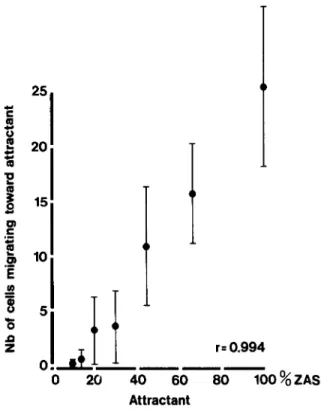
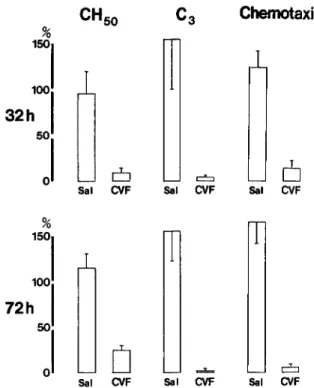
factors able to produce chemotactic substances upon zymosan activation, especially serum C5 [3, 5]. In-deed, the number of cells migrating toward the at-tracting well was proportional to the concentration of zymosan-activated pooled normal rat serum (fig-ure I), suggesting that cell migration is an indicator of the chemotactic substances in activated serum. Figure 2 demonstrates the effect of CVF treatment in rats with pyelonephritis on the CHso,
immunoreac-tive C3, and functional C5 levels. In rats killed 32 h after surgery, the CHso,C3, and functional C5
lev-els were profoundly depressed in CVF-treated rats compared with those in controls. In the group of rats killed 72 h after surgery, CHsolevels in CVF-treated
rats increased slightly but remained profoundly depressed while C3 and functional C5 levels were even lower than those in animals killed 32 h after surgery. Preliminary experiments (data not shown) have demonstrated that similar doses of CVF pro-foundly depressed the complement levels within a few hours after the injection. Thus, CVF-treated rats had very low complement levels from the time of
sur-25
c:
s
u I!! 201
1i
'2!
151
!
Cl 101
'E
III5
I
I
~
:.--lI__
o
---:~
20 40 60 80 100%ZAS AttractantFigure 1. Effect of zymosan activated serum (ZAS) on neutrophil migration in the agarose assay, as measuredby the number of neutrophils migrating toward the attract-ing well. Each point represents the mean and standarddevi-ation of five assays.
Figure 2. Complement levels in animals with pyelo-nephritis killed 32and 72h after the inoculation. CHso: total serum hemolytic complement; C3: immunoreactive C3; Chemotaxis: serum chemotactic activity uponzymo-sanactivation, i.e., functional assay forserum C5. Sal =
saline-treated (controls); CVF = CVF-treated animals. Results areexpressed aspercent of thelevel found inpooled normal rat serum. Columns represent means, andbars in-dicate standard deviations of each group.
%
~I
100 32h 1:I
%15°1
1001
72h:I
o
Sal ().JFo
Sal ().JF c:::::, Sal ().JF -="= Sal ().JFChemotaxis
o
Sal ().JF C::::J Sal CVFgery until 72 h afterwards, and perhaps for a longer time. In contrast, saline-treated animals with pye-lonephritis had highercomplementlevels than those found in pooled normal rat serum, probably result-ing from the acute inflammatory reaction.
In vivo experiments.
Overall, 176 rats had sur-gery to produce pyelonephritis. Fourteen of them died soon after surgery, because of the anesthesia orE.colisepticemia secondaryto severepyelonephri-tis as suggested by post-mortemexamination and cul-tures.As shownin table 1,theseearlydeathsoccurred mainly among the CVF-treated animals and to a lesser degreeamong PB-treated animals killed 72 h or 2 mo after surgery. Therefore, in these treatment groups, the disappearanceof those animals with the most severe pyelonephritis before the planned time of sacrificemight haveintroduced a bias toward un-derestimating the severityof pyelonephritis. In ad-dition, neither CVF nor PB treatment significantly influenced the incidenceof pyelonephritis(table 1). In animals killed32 h after surgery, both CVF-and PB-treatment significantlyreducedMPO activ-ity in their left kidneyscompared to that in controls (figure3). The median MPO activitywasrespectively 19.6 activity units per kidney (CVF) and 13.1 activ-ity units per kidney (PB) compared to 53.1 activactiv-ity units per kidney in controls(P
<
.01 for both com-parisons). Thus, both treatments significantly re-duced the early neutrophil migration into the kid-Table 1. Effect of cobra venom factor (CVF) and phenylbutazone (PB) treatment on pyelonephritis.Severity of pyelonephritis No. of animals
Surviving With pyelo- Overall inflammatory
response'[ Bacterial countsl
Time of until nephritis at
sacrifice"; treatment Operated sacrifice sacrifice(070) median (range) P median (range) P
32 h Saline 20 20 16 (80) 1.39 (1.21-1.54) 8.36 (7.81-9.09) CVF 19 19 15 (79) 1.36 (1.l1-1.57) .79 8.18 (7.39-9.06) .15 PB 20 20 16 (80) 1.24 (1.l3-1.48) <.01 7.92 (6.41-8.45) <.01 72h Saline 18 17 11 (65) 1.76 (1.09-2.41) 8.84 (6.50-10.17) CVF 20 20 18 (90) 2.00 (1.42-2.55) .15 9.43 (8.79-10.24) .035 PB 20 17 15 (83) 1.52 (0.92-1.77) .04 8.67 (7.76-9.74) .31 2 mo Saline 20 20 18 (90) 0.65 (0.10-0.88) 4.93 (1.81-8.08) CVF 20 13 13 (100) 0.64 (0.22-0.97) .94 5.10 (1.75-7.05) .61 PB 19 16 14 (88) 0.47 (0.17-0.98) .52 4.50 (1.73-6.78) .59
NOTE. Pvalues refer to statistical comparisons (Wilcoxon) of each treatment group with controls. *After surgery.
t Ratio of the weight of the left to the weight of the right kidney from animals with pyelonephritis.
1000
Figure 3. Leftkidney myeloperoxidase (MPO) activity of animals sacrificed 32 or72h after inoculation. Sal: saline-treated (controls); CVF: cobravenom factor-treated; PB: phenylbutazone-treated. Closedcircles represent the kidney MPO activityof animals with macroscopic signs of pyelonephritis and highbacterial counts, while opencir-des are from animals without macroscopic pyelonephri-tis and with very lowbacterialcounts «102cfu/g of kid-ney tissue), Bars represent medians,Pvalues (two-tailed Wilcoxon) are indicated beneath the columns.
ney parenchyma. However, despite continued CVF or PB therapy until 72 h after inoculation, there was no longer any significant reduction in the left kid-ney MPO activity in CVF- or PB-treated animals (P = .37 and .31, respectively). These findings show that the initially reduced neutrophil infiltration was transient, probably related to a delayed migration induced by each treatment.
PB diminished the acute inflammatory swelling of kidneys, as measured by the L/R kidney weight
32 72
Hours after bladder inoculation
The present experiments demonstrated that both CVF and PB treatments were able to transiently re-duce the in vivo neutrophil migration early during pyelonephritis, an effect that was no longer appar-ent at the time of peak kidney neutrophil infiltra-tion [1].Itis possible that this transient effect of both treatments on neutrophil migration might have been a result of the CVF or PB treatment becoming in-effective beyond 32 h after surgery.
With regard to CVF treatment, this was probably not the case, because the CVF produced a prolonged hypocomplementemia that lasted throughout the treatment period. Particularly, the ability of serum to produce chemotactic factors upon zymosan acti-vation was strikingly depressed in CVF-treated rats as demonstrated using the under-agarose migration assay. In addition, in studies using animals used in the present experiments and fluorescent antibodies to rat C3, no CVF-treated animal shed demonstra-ble C3-coatedE.coliin the urine during acute pye-lonephritis, in contrast to brisk fluorescent bacilli ob-served in the urine of a majority of control animals. In vitro experiments using fresh pooled normal rat serum to coat E. coliin urine demonstrated that fluorescence was observed with serum dilutions as high as 1:200 [22]. These observations suggest, there-fore, that complement levels within the kidney tis-sue werealso effectivelydepressed by CVF treatment. PB treatment was administered in the present study at doses that others have shown to completely prevent the neutropenia induced in rabbits by iv in-jection of the formylpeptide formyl-methionyl-leucyl-phenylalanine [12]. Although a different ef-ficacy of this drug in the rat can not be excluded, ratio (table 1). This antiinflammatory effect of PB was accompanied by a transient reduction of the bac-terial counts in the pyelonephritic kidneys early af-ter the production of pyelonephritis (32 h). In con-trast, CVF treatment not only did not prevent the inflammatory swelling, but also enhanced bacterial multiplication to a near significant degree in the kid-ney of animals killed 72 h after surgery, a fact prob-ably related to the serum susceptibility of theE.coli
study strain (data not shown). When the rats were killed 2 mo after surgery, theL/Rkidney weight ra-tio was similar in CVF-, PB-, and saline-treated animals, reflecting a degree of pyelonephritic scar-ring of similar severity.
Discussion o 00 o o
•
o 008
Sal CVF PB1
f
•
•
I-•
•
•
•
•
~•
•
•
•
•
I•
•
•
•
'---p= ·.31---' L..p=.37----' Sal CVF PB '---P c .01---' '-P c .01--'o
•
••
100•
•
.-. -f-•
I Ul..
I•
'2 :::I•
•
•
•
....
-•
!
•
+
A 3!•
•
.¥••
T .. 10•
••
•
a
..
e•
A GI..
S
u•
~ 0 0 :Iii 0 8 0 & 0 0 00its effect on early neutrophil migration suggests that the present doses were effective. Wehypothesize that PB inhibited early neutrophil infiltration by inter-fering with bacterial formylpeptide-mediated chemo-taxis. However, it is possible that PB acted by another mechanism involving inhibition of prostaglandin synthesis.
In various experimental models ofE. coli pye-lonephritis, conflicting results have been reported with respect to the effect of decomplementation on neutrophil infiltration and inflammatory damage. Sullivan et al. [23], using a rat model of hematoge-nous pyelonephritis, as well as Roberts et al. [24], using a model of ascending pyelonephritis in rhesus monkeys, demonstrated a reduced neutrophilic in-filtration in CVF-treated animals early after infec-tion, but observations over periods longer than 48 h were not performed. In contrast, Wilson et al. [25], using a rat model of pyelonephritis induced by di-rect intrarenal inoculation, did not observe a reduced neutrophil infiltration in CVF-treated animals fol-lowed for 4 d. Thus, these contradictory results might reflect the fact that the short-term studies detected transient reduction of neutrophil infiltration that was not shown by studies with longer periods of obser-vation.
In experimental models of bacterial diseases other than pyelonephritis, similar findings of delayed neu-trophil exudation have been observed. For instance, Tuomanen et al. [26], using rabbits with experimen-tal Streptococcus pneumoniaemeningitis treated with CVF, observed a delayed rise in cerebrospinal fluid leukocyte counts. Toews et al. [27, 28] observed in experimental pneumococcal andHemophilus in-fluenzaepneumonia a significant neutrophil recruit-ment into the lung of congenitally C5-deficient mice. They concluded that chemotactic factors other than C5a were produced in the alveoli, demonstrating the redundancy of the chemotactic mechanisms after pulmonary challenge withS. pneumoniaeorH.
in-fluenzae.
Similar conclusions might be drawn from the results of the present experiments. Indeed, the lack of a sustained efficacy of both CVF and PB treatment at reducing the peak neutrophil infiltra-tion observed here suggests that several independent chemotactic mechanisms operated during acute pye-lonephritis. We postulate that complement-derived as well as bacterial formylpeptide chemotactic fac-tors played an important role in triggering the neu-trophil migration during the early inflammatory response in vivo. Later on, other concurrentchemo-tactic mechanisms became powerful enough to in-duce a neutrophil migration despite continued com-plement depletion or inhibition of formylpeptide receptors.
Recent evidence suggests that endothelial recog-nition determinants for neutrophil adherence mole-cules may playa role in regulating the extravascular migration of inflammatory cells into inflamed tis-sue [29]. These determinants are upregulated by li-popolysaccharide and other inflammatory media-tors and can facilitate the attachment of neutrophils to the endothelium even in the absence of chemotac-tic factors. They can also act with chemotacchemotac-tic fac-tors to enhance transendothelial migration. There-fore, in addition to chemotactic factors acting on inflammatory cells, neutrophil infiltration might be partially regulated by inflammatory substances act-ing on endothelial cells. These observations might thus be a concurrent explanation for neutrophil in-filtration apparently independent of chemotactic factors.
In the rat model of ascending pyelonephritis, chronic renal scarring follows the irreversible tissue damage that results from acute inflammatory processes (1, 18, 19]. In the present experiments, nei-ther CVF nor PB treatment resulted in any signifi-cant protection against permanent kidney damage. This observation is not invalidated by the early deaths of CVF-treated animals to be killed at 72 h and 2 mo after surgery. Indeed, the disappearance of those rats with the most severe pyelonephritis might only lead to an underestimation of the median sever-ity of pyelonephritis. This supports the interpretation that pyelonephritis was at least as severe in CVF-treated animals as in controls at these later times of sacrifice. The fact that higher bacterial counts were observed during acute pyelonephritis in CVF-treated animals supports our previous findings (1, 19, 30] that excessive infiltration and activation of neutro-phils during the acute phase of pyelonephritis, not bacterial virulence factors, is the major culprit responsible for the tissue damage that leads to pye-lonephritic scarring.
In conclusion, both CVF and PB treatments re-duced early neutrophil infiltration during acute pye-lonephritis. However, this reduction was only tran-sient; peak neutrophil infiltration was not reduced. This suggests that complement-derived as well as bacterial formylpeptide chemotactic factors played an important role in triggering neutrophil migration during the early inflammatory response. Later on,
other concurrent chemotactic mechanisms became powerful enough to induce a neutrophil migration despite continued complement depletion or inhibi-tion of formylpeptide receptors. The similar peak neutrophil infiltration resulted in chronic kidney scarring of similar severity among the various treat-ment groups, supporting the hypothesis that neutro-phils, rather than bacterial virulence factors, play the major role in the pathogenesis of pyelonephritic scarring.
References
I. Meylan PR, Glauser MP. Failure of dexamethasone to pre-vent polymorphonuclear leukocyte infiltration during ex-perimental acute exudative pyelonephritis and to reduce subsequent chronic scarring. J Infec Dis 1988;157:480-485 2. Schiffmann E. Leukocyte chemotaxis. Ann Rev Physiol
1982;44:553-568
3. Goldstein 1M. Complement: biologically activeproducts. In: Gallin 11, Golstein 1M, Snyderman R, eds. Inflammation: basic principles and clinical correlates. New York: Raven Press, 1988:55-74
4. Ward PA, Cochrane CG, Muller-Eberhard HJ. The role of serum complement in chemotaxis of leukocytes in vitro. J Exp Med 1965;122:327-346
5. Fernandez HN, Hugli TE. Primary structural analysis of the polypeptide portion of human C5a anaphylatoxin. J BioI Chern 1978;253:6955-6964
6. Schiffmann E, Showell HV, Corcoran BA, Ward PA, Smith E, Becker EL. The isolation and partial characterization of neutrophil chemotactic factors fromEscherichia coli.
J Immunol 1975;1l4:1831-1837
7. Marasco WA, Phan SH, Krutzsch H, ShowellHJ, Feltner DE, Narin R, Becker EL, Ward PA. Purification and identifi-cation of formyl-methionyl-Ieucyl-phenylalanine as the ma-jor peptide neutrophil chemotactic factor produced by
Escherichia coli.J BioI Chern 1978;259:5430-5439 8. Palmblad J, Malmsten CL, Uden AM, Radmark0,Engstedt
L. Samuels son B. Leukotriene B4 is a potent and stereospecific stimulator of neutrophil chemotaxis and ad-herence. Blood 1981;58:658-661
9. Movat HZ, Rettl C, Burrowes CE, Johnston MG. The in vivo effect of leukotriene B4 on polymorphonuclear leukocytes and the microcirculation. Am J Pathol 1984;1l5:233-244 10. Morrison DC, KlineLF. Activation of the classicaland proper-din pathways of complement by bacteriallipopolysaccha-rides (LPS). J Immunol 1977;1l8:362-368
II. Nelson RD, Gracyk JM, Fiegel VD, Herron MJ, Chenoweth DE. Chemotactic deactivation of human neutrophils: pro-tectiveinfluence of phenylbutazone. Blood 1981;58:752-758 12. Dahinden C, Fehr J. Receptor-directedinhibition of chemotac-tic factor-induced neutrophil hyperactivity by pyrazolone derivative. J Clin Invest 1980;66:884-891
13. Perianin A, Labro MT, Hakim J. Chemokinetic activity of N-formyl-methionyl-Ieucyl-phenylalanine on human neu-trophils and its modulation by phenylbutazone. Biochem Pharmacol 1982;31:3071-3076
14. Ruddy S. Complement. In: Rose NR, Friedman H, Fahay JL, eds. Manual of clinical and laboratory immunology. 3rd ed. Washington, DC: American Society for Microbi-ology, 1986:175-184
15. Laurell CB. Electroimmunoassay. Scand J Clin Lab Invest [Suppl] 1972;124:21-23
16. Orr W, Ward PA. Quantitation of leukotaxis in agarose by three different methods. J Immunol Methods 1978;20: 95-107
17. Taylor PW. Bactericidal and bacteriolytic activity of serum against gram-negative bacteria. Microbiol Rev 1983;47: 46-83
18. Brooks SJD, Lyons JM, Braude AI. Immunization against retrograde pyelonephritis. III. Vaccination against chronic pyelonephritis due to Escherichia coli. J Infect Dis 1977;136:633-639
19. Glauser MP, Lyons JM, Braude AI. Prevention of chronic experimental pyelonephritis by suppression of acute sup-puration. J Clin Invest 1978;61:403-407
20. Glauser MP, Francioli PB, Bille J, Bonard M, Meylan PRo Effect of indomethacin on the incidence of experimental
Escherichia colipyelonephritis. Infect Immun 1983;40: 529-533
21. Godfrey K. Comparing the means of several groups. N Engl J Med 1985;313:1450-1456
22. Paquet N. Detection of complement-coated bacteria in ex-perimental urinary tract infections. Master's thesis, Geneva: University of Geneva, 1984
23. Sullivan MJ, Harvey RA, Shimamura T. The effects of co-bra venom factor, an inhibitor of the complement system, on the sequence of morphological events in the rat kidney in experimental pyleonephritis. Yale J BioI Med 1977; 50:267-273
24. Roberts JA, Roth JK Jr, Domingue G, Lewis RW, Kaack B, Baskin G. Immunology of pyelonephritis in the primate model. VI. Effect of complement depletion. J Uro11983; 129:193-196
25. Wilson OM, Ormrod OJ, Miller TE. Role of complement in chemotaxis: study of a localized infection. Infect Im-mun 1980;29:8-12
26. Tuomanen E, Hengstler B, Zak0, Tomasz A. The role of the complement and arachidonic acid pathways in inflam-mation during pneumococcal meningitis [abstract 682]. In: Program and abstracts of the 25th Interscience Con-ference on Antimicrobial Agents and Chemotherapy. Washington, DC: American Society for Microbiology,1985 27. Toews GB, Vial WC. The role of C5 in polymorphonuclear leukocyte recruitment in response toStreptococcus pneu-moniae.Am Rev Respir Dis 1984;129:82-86
28. Toews GB, Vial WC, Hansen EJ. Role of C5 and recruited neutrophils in early clearance on nontypable Haemophi-Ius influenzaefrom murine lungs. Infect Immun 1985; 50:207-212
29. Pohlman TH, Stanness KA, Beatty PG, Ochs HD, Harlan JM. An endothelial cell surface factor(s) induced in vitro by lipopolysaccharide, interleukin I, and tumor necrosis factor-alpha increases neutrophil adherence by a CDwI8-dependent mechanism. J Immunol 1986;136:4548-4553 30. BilleJ, Glauser MP. Protection against chronic pyelonephritis in rats by suppression of acute suppuration: effect of col-chicine and neutropenia. J Infect Dis 1982;146:220-226