Resistance of
αAI-1 transgenic chickpea
(Cicer arietinum) and cowpea (Vigna
unguiculata) dry grains to bruchid beetles
(Coleoptera: Chrysomelidae)
Christoph Lüthi
1, Fernando Álvarez-Alfageme
1,
Jeffrey D. Ehlers
2, Thomas J.V. Higgins
3and Jörg Romeis
1*
1
Agroscope Reckenholz-Tänikon Research Station ART, Reckenholzstrasse
191, 8046 Zurich, Switzerland:
2Department of Botany and Plant Sciences,
Riverside, CA 92521, USA:
3CSIRO Plant Industry, GPO Box 1600, Canberra,
ACT 2600, Australia
Abstract
Dry grain legume seeds possessing
αAI-1, an α-amylase inhibitor from common
bean (Phaseolus vulgaris), under the control of a cotyledon-specific promoter have
been shown to be highly resistant to several important bruchid pest species.
One transgenic chickpea and four cowpea lines expressing
αAI-1, their respective
controls, as well as nine conventional chickpea cultivars were assessed for their
resistance to the bruchids Acanthoscelides obtectus (Say), Callosobruchus chinensis
L. and Callosobruchus maculatus F. All transgenic lines were highly resistant to both
Callosobruchus species. A. obtectus, known to be tolerant to
αAI-1, was able to develop
in all transgenic lines. While the cotyledons of all non-transgenic cultivars were
highly susceptible to all bruchids, C. chinensis and C. maculatus larvae suffered from
significantly increased mortality rates inside transgenic seeds. The main factor
responsible for the partial resistance in the non-transgenic cultivars was deduced to
reside in the seed coat. The
αAI-1 present in seeds of transgenic chickpea and cowpea
lines significantly increases their resistance to two important bruchid pest species
(C. chinensis and C. maculatus) essentially to immunity. To control
αAI-1 tolerant
bruchid species such as A. obtectus and to avoid the development of resistance to
αAI-1, varieties carrying this transgene should be protected with additional control
measures.
Keywords:
Acanthoscelides obtectus, bruchid management, Callosobruchus chinensis,
Callosobruchus maculatus, GM legumes, stored product protection
(Accepted 31 October 2012; First published online 5 March 2013)
Introduction
Grain legumes play a crucial role in agricultural areas with semi-arid climate. They are not only a major source of protein
for humans but also a source of fodder and help maintain soil fertility of cereal-based cropping systems because of their ability to fix nitrogen from the atmosphere and tolerance to heat and drought (Graham & Vance, 2003). Subsistence farmers in developing countries profit from the fact that dry grain legume seeds are storable over extended periods and are thus available for consumption or sale throughout the year. Storability is important because dramatic seasonal price variation of many grain legumes means farmer returns can be substantially higher when sales are commenced off-season, *Author for correspondence
Phone: + 41 (0)44 377 72 99 Fax: + 41 (0)44 377 72 01
E-mail: [email protected]
Bulletin of Entomological Research (2013) 103, 373–381 doi:10.1017/S0007485312000818
when the prices are considerably higher than at harvest (Moussa et al.,2011).
The most important pests of stored grain legume seeds are bruchid beetles (Coleoptera: Chrysomelidae: Bruchinae). Even low initial infestation rates can cause tremendous damage because of the high fertility and short generation times of bruchid beetles (Southgate,1979). Most subsistence farmers in developing countries rely on traditional storage structures, which are especially vulnerable to bruchid attacks (van Huis,
1991; Nukenine,2010). Application of residual insecticides or fumigants to protect the seeds from bruchids is not reasonable under such circumstances for economic and health reasons (Keneni et al.,2011). Alternative controls that can be applied include cultural, physical, biological, biorational and genetic measures (van Huis, 1991; Murdock et al.,2003; Phillips & Throne, 2010). However, their effective implementation is often hindered by the lack of equipment and expertise of the farmers, and non-acceptance of newly proposed techniques (van Huis, 1991). The protection against bruchids could be improved by growing varieties featuring an inherent seed resistance to bruchid beetles. Despite intensive conventional breeding efforts, bruchid-resistant varieties of chickpea (Cicer arietinum L.) and cowpea (Vigna unguiculata L.), the predomi-nant grain legumes in the Indian subcontinent and the savanna of tropical Africa, respectively, have not been achieved (Keneni et al., 2011). Screening of more than 5000 chickpea lines for resistance to Callosobruchus chinensis L. did not reveal any useful resistance (Singh, 1997). A similar screening of more than 8000 cowpea lines for resistance to the bruchid Callosobruchus maculatus F. revealed only three lines with moderate resistance, including the promising landrace TVu 2027 (Singh, 1977; Singh et al., 1985). However, the moderate resistance of this particular line, for example, lasted only for about 90 days post-infestation (Murdock et al.,2008). This does not meet the requirements of subsistence farmers who need to store the seeds at least until the next sowing season, i.e., for about nine months. Transgenic approaches offer a capable path to obtain varieties with substantially higher resistance than that available in the crop germplasm resources.
Genetic engineering has been used to transfer the gene coding for theα-amylase inhibitor αAI-1, a bruchid resistance factor from the common bean (Phaseolus vulgaris L.), into other grain legumes including pea (Pisum sativum L.), azuki bean (Vigna angularis (Wildenow)), chickpea and cowpea (Ishimoto et al.,1996; Sarmah et al.,2004; Ignacimuthu & Prakash,2006; Solleti et al.,2008). α-Amylases, the target of αAI-1, are key enzymes for starch digestion and have been shown to be vital for bruchid development. The gene construct transferred to the transgenic legumes is regulated by the seed-specific promoter phytohemagglutinin-L gene (dlec2) of P. vulgaris, resulting in expression restricted to the cotyledon and embryonic axis of the developing seeds (Altabella & Chrispeels,1990). Following egg-hatch, bruchid larvae chew into the seed on which they are laid until completion of development. In seeds expressingαAI-1, bruchid infestation of transgenic seeds proceeds normally until the larvae are exposed to αAI-1 in the cotyledons. The development of susceptible bruchid species ceases rapidly and the larvae starve in the first or second instar. At this early stage of development, physical damage and weight loss of the seed is minimal (Schroeder et al., 1995). In all the grain legumes expressingαAI-1 in their cotyledons, there is high resistance to the bruchid species C. chinensis, C. maculatus, Callosobruchus
analis and Bruchus pisorum (L.) (Shade et al.,1994; Schroeder et al., 1995; Ishimoto et al., 1996; Morton et al., 2000; Sarmah et al.,2004; Ignacimuthu & Prakash,2006; De Sousa-Majer et al., 2007; Solleti et al., 2008). The potential of this approach has been demonstrated even under field conditions, where transgenic pea seeds were completely resistant to B. pisorum (Morton et al.,2000).
In the present study, we assessed the resistance ofαAI-1 transgenic cowpea and chickpea lines and several conven-tional chickpea cultivars to the bruchid species C. chinensis, C. maculatus and Acanthoscelides obtectus (Say). The latter is known to be tolerant toαAI-1 (Ishimoto & Kitamura,1992). The two Callosobruchus species are considered to be major pests of chickpea and cowpea. A. obtectus has spread throughout the world and, although primarily attacking the common bean, it has also become a pest of both cowpea and chickpea (CABI crop protection compendium, available on
http://www.cabi.org/cpc). For the first time, we did a simultaneous evaluation of the resistance of different αAI-1-expressing legume species, lines and/or cultivars to three major bruchid pests providing a thorough assessment of the potential of this resistance trait.
Experimental methods Insects
The experiments were carried out with three bruchid species, all provided by C. Adler (Julius Kühn-Institut, Germany): A. obtectus, C. chinensis and C. maculatus. The strains are colonized in the laboratory since 1967 (A. obtectus and C. chinensis) or 1998 (C. maculatus), their geographical origin is unknown. Colonies were maintained on both C. arietinum and V. unguiculata seeds for the respective exper-iments for at least five generations in a climate chamber at 25°C, 50% RH and total darkness.
Seeds
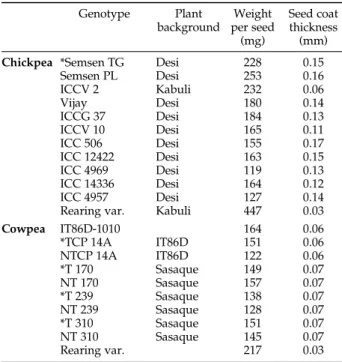
Twelve chickpea and ten cowpea genotypes were included in this study (table 1). Transgenic chickpea seeds of the cultivar Semsen expressingαAI-1 have been described (Sarmah et al.,
2004). The corresponding Semsen non-transgenic parental line was included as a control. In addition, the following conventional chickpea cultivars were included: the Desi type cultivars‘Vijay’ (a high-yielding cultivar released in central India; resistant to Fusarium oxysporum and Helicoverpa armi-gera), ICCC 37 (a high-yielding cultivar released in Andhra Pradesh, India; resistant to F. oxysporum, moderately resistant to H. armigera and moderately tolerant to root rot), ICCV 10 (a high-yielding cultivar released in southern and central India; resistant to F. oxysporum and drought tolerant), ICC 506 (a cultivar resistant to H. armigera) and the Kabuli type ICCV 2 (a cultivar resistant to F. oxysporum and tolerant to drought, salinity and heat stress), with hitherto unknown resistance to bruchids, as well as four Desi cultivars with reported resistance to C. maculatus (ICC 12422, ICC 4969, ICC 14336 and ICC 4957) (Erler et al.,2009). These conventional cultivars and the respective information were provided by the International Crops Research Institute for the Semi-Arid Tropics (ICRISAT) in India.
Transgenic cowpea lines expressingαAI-1 were developed in two diverse cowpea genotypes (Popelka et al.,2006; Higgins et al.,2013). The cowpea parental genotypes from which the
transgenic lines were developed were breeding line IT86D-1010, developed at the International Institute of Tropical Agriculture (IITA), Nigeria, and the Japanese cultivar ‘Sasaque’. The transgenic αAI-1 expressing and non-expres-sing lines developed from IT86D-1010 were TCP 14A and NTCP 14A, respectively, whereas from cultivar Sasaque, three independently transformed lines expressing αAI-1 (T 170, T 239 and T 310) and their corresponding non-transformed null-pair lines (NT 170, NT 239 and NT 310) were assayed.
As an additional control, the commercially available chickpea and cowpea seeds used to rear the bruchids, purchased from a local supermarket, were also included in the experiments.
Physical characteristics of the seeds are presented intable 1. Seed weight is the average of 100 seeds. To determine the average seed coat thickness, ten dried seeds per genotype were peeled and the thickness of the coat at the side of the seed was measured using an Absolute Digimatic 500-181U micrometer (Mitutoyo, Urdorf, Switzerland).
Experimental setup
Experimental conditions were identical to the rearing con-ditions, i.e., 25°C, 50% RH and total darkness. The exper-iments were carried out with each combination of bruchid species and seeds from chickpea and cowpea separately. For the experiments with C. chinensis and C. maculatus, 30 seeds of each genotype were placed individually in an open Petri dish (2.2 × 2.2 × 1 cm) and arranged randomly in a large box (100 × 50 × 20 cm). Approximately 2000 newly emerged adult beetles were released into the box and allowed to oviposit for 24 h. Embryonic development, which is visible through the egg chorion, was inspected on a daily basis and as soon as the first larva started chewing into the seed, all other larvae
on the same seed were removed with a scalpel to avoid interference among multiple larvae developing in a single seed.
Given that A. obtectus does not attach the eggs to the seeds, eggs were collected by carefully sieving the seeds on which adult beetles had been depositing eggs for 24 h. Into each seed, a hole of 1 mm depth was pierced with a needle. After hatching, one larva per seed was carefully introduced into the hole with a fine brush, checked for physical integrity, and observed until it started chewing into the seed. Emerging adults were collected daily from individual seeds, transferred into a 0.2-ml cup and immediately frozen and stored at 20°C until they were dried and weighed.
Chickpea and cowpea resistance to bruchids and stage-specific mortality
Resistance of each chickpea and cowpea genotype to bruchids was calculated as the percentage of seeds in which no adult bruchid emerged. Seeds where no adult bruchid emerged were dissected and the stage-specific mortality determined. We distinguished whether the bruchid (i) failed to perforate the seed coat and enter the cotyledons; (ii) died inside the seed in the larval (further referred to as within-seed larval mortality) or (iii) pupal stage; or (iv) failed to emerge from the seed after successfully completing develop-ment. As only bruchid larvae feeding on the cotyledons and embryonic axis of a seed are exposed toαAI-1, within-seed larval mortality in the different transgenic and correspond-ing non-transgenic chickpea and cowpea genotypes was analyzed.
Impact of host seeds on bruchid life-history parameters For all bruchid adults emerging from the different non-transgenic chickpea cultivars, within-seed developmental time (WSD) and adult dry weight (ADW) were determined to assess sublethal effects on the bruchids. The WSD was calculated by measuring the time from a larva starting to chew into the seed until the emergence of the adult. Emerged adults were sexed and their ADW determined after drying them at 60°C for 72 h using a MX5 microbalance (Mettler Toledo, Greifensee, Switzerland). For both sexes of each bruchid species, the impact when feeding on the different chickpea cultivars was evaluated by correlating WSD and ADW with mean seed weight, seed coat thickness, resistance and the within-seed larval mortality rate.
We did not assess the impact of the seed characteristics for cowpea because the parental lines came from only two genetic backgrounds.
Data analyses
All data were analyzed using the software R (version 2.13.2). Resistance and within-seed larval mortality rates of the transgenic and corresponding null-pair chickpea and cowpea lines, respectively, were analyzed pairwise using Fisher’s exact test. In the case of the cowpea breeding line IT86D-1010, three pairwise comparisons between the parental, transgenic and null-pair lines were conducted and theα-level adjusted according to the Bonferroni method, resulting in α=0.017.
Table 1. Chickpea and cowpea genotypes included in the experiment, their plant background, average seed weight and seed coat thickness. Transgenic lines are indicated with an asterisk.
Genotype Plant background Weight per seed (mg) Seed coat thickness (mm)
Chickpea *Semsen TG Desi 228 0.15
Semsen PL Desi 253 0.16 ICCV 2 Kabuli 232 0.06 Vijay Desi 180 0.14 ICCG 37 Desi 184 0.13 ICCV 10 Desi 165 0.11 ICC 506 Desi 155 0.17 ICC 12422 Desi 163 0.15 ICC 4969 Desi 119 0.13 ICC 14336 Desi 164 0.12 ICC 4957 Desi 127 0.14
Rearing var. Kabuli 447 0.03
Cowpea IT86D-1010 164 0.06 *TCP 14A IT86D 151 0.06 NTCP 14A IT86D 122 0.06 *T 170 Sasaque 149 0.07 NT 170 Sasaque 157 0.07 *T 239 Sasaque 138 0.07 NT 239 Sasaque 128 0.07 *T 310 Sasaque 151 0.07 NT 310 Sasaque 145 0.07 Rearing var. 217 0.03
Results Chickpea genotypes
Results for the chickpea genotypes with respect to resistance and within-seed larval mortality of the three bruchid species are presented infig. 1. The parental Semsen line had, compared to the other non-transgenic cultivars, a relatively high resistance to all three bruchid species. The transgenic Semsen line was completely resistant to C. maculatus and nearly so to C. chinensis. However, the difference to the parental line was only significantly different for the latter bruchid species (P < 0.01). As expected, resistance to A. obtectus was not increased in the transgenic line. Resistance of the other non-transgenic cultivars was not only highly variable within each of the three bruchid species but also varied among species. Resistance was highest against C. maculatus (10–87%), followed by A. obtectus (3–67%) and C. chinensis (0–33%).
Within-seed larval mortality of all bruchid species was low in the non-transgenic chickpea cultivars. Highest mortality rates for A. obtectus, C. chinensis and C. maculatus were 20%, 13% and 26%, respectively. In contrast, within-seed larval mortality in the transgenic line was 100% and 97% for
C. maculatus and C. chinensis, respectively, and, in both cases, significantly higher than the parental Semsen line (P < 0.001). The resistance of the transgenic Semsen line to C. chinensis was exclusively owing to within-seed larval mortality. In the case of C. maculatus, some mortality was caused by the fact that larvae failed to perforate the seed coat. However, all larvae reaching the cotyledon subsequently died in the larval stage. There was no difference in within-seed larval mortality of A. obtectus between the transgenic line and its control.
In all species, there were differences between the overall resistance (i.e., total mortality rate) and the within-seed larval mortality rate in most genotypes (results are illustrated in Supplementary Fig. 1). For A. obtectus and C. chinensis, this difference was exclusively because of adults failing to emerge from the seed after successfully completing their develop-ment. In contrast, C. maculatus larvae frequently failed to perforate the seed coat. In addition, there was a single case of mortality in the pupal stage in the latter species.
In the case of the chickpea seeds, the WSD of the emerging beetles was positively correlated with seed coat thickness (except for A. obtectus males) and the overall resistance (table 2). The ADW was negatively correlated with seed coat Fig. 1. Resistance (percentage of seeds from which no adult beetle emerged) and within-seed larval mortality in different chickpea genotypes for A. obtectus, C. chinensis and C. maculatus. A pairwise comparison was made among the transgenic (TG, bar in gray) and parental (PL) Semsen line using Fisher’s exact test (*P<0.05, ***P<0.01, n.s.=not significant).
thickness and resistance (except for C. maculatus males in both cases) (table 2). With one exception, neither the WSD nor the ADW data correlated with the within-seed larval mortality rate. The WSD and ADW data are provided in detail in Supplementary Table 1.
Cowpea genotypes
Results for the cowpea genotypes with respect to resistance and within-seed larval mortality of the three bruchid species are presented infig. 2. The transgenic IT86D-1010 line (TCP 14A) was completely resistant to the two susceptible Callosobruchus species, significantly more than both the corresponding null-pair line (NTCP 14A) and the parental line (IT86D-1010) (for both, P < 0.001). In contrast, the trans-genic line was significantly more susceptible to A. obtectus than the parental line (P = 0.007), but did not differ from the null-pair line. Furthermore, the null-null-pair line was significantly more susceptible to all bruchid species than the parental line (for all, P < 0.001). All transgenic Sasaque lines were comple-tely resistant to both Callosobruchus species, significantly more than their corresponding null-pair lines (for all, P < 0.001). As expected, none of the transgenic lines were completely resistant to A. obtectus. However, the transgenic line T 170 was more resistant (P = 0.030) and the transgenic line T 310 was more susceptible (P < 0.001) than their corresponding null-pair lines.
Within-seed larval mortality of the Callosobruchus species was 100% in all transgenic lines, significantly higher than in their corresponding null-pair lines and the parental IT86D-1010 line, respectively (for both, P < 0.001). No significant differences could be detected between the parental IT86D-1010 line and its null-pair line for these two bruchids. Mortality of A. obtectus was mostly because of within-seed larval mortality (Supplementary Fig. 1). Mortality was significantly higher in the parental IT86D-1010 line compared to the corresponding transgenic line (P = 0.015) and the null-pair line (P < 0.001). The two latter lines did not differ significantly from each other. In the Sasaque lines, a significantly higher within-seed larval mortality was observed in the transgenic line T 170 compared to the corresponding null-pair line (P = 0.030) and in the null-pair line NT 310 compared to the corresponding transgenic line (P = 0.005).
In cowpea, few adults from A. obtectus and C. maculatus failed to emerge from the seeds, while this was not observed at all for C. chinensis (Supplementary Fig. 1). A. obtectus mainly died in the larval stage inside the seeds. In contrast, larvae of the two Callosobruchus species frequently failed to enter the seeds. Mortality in the pupal stage was observed only once in C. chinensis.
Discussion
All transgenic cowpea lines expressingαAI-1 were com-pletely protected from the bruchid species C. chinensis and C. maculatus. The single chickpea line expressing the inhibitor was also completely resistant to C. maculatus and highly resistant to C. chinensis. This is not surprising, as the two Callosobruchus species are known to be susceptible toαAI-1 (Ishimoto & Kitamura,1989) and it confirms earlier reports of increased resistance of αAI-1 transgenic legumes to these bruchids (Ishimoto et al., 1996; Sarmah et al., 2004; Ignacimuthu & Prakash, 2006; Solleti et al., 2008). The significant increase in within-seed larval mortality clearly demonstrates thatαAI-1 was the cause of this effect. The fact that the transgenic chickpea line was not completely resistant to C. chinensis is likely to be because of a lower expression level of αAI-1 in the transgenic chickpea line compared to the cowpea lines tested (T.J.V. Higgins, unpublished results). It is a common observation that independent transgenic legume lines display varying levels of transgene expression (Shade et al., 1994; Sarmah et al., 2004; Solleti et al., 2008). αAI-1 expression level-dependent resistance of susceptible bruchids has been reported for pea (Shade et al.,1994; Morton et al.,
2000), and other transgenic chickpea and cowpea lines had only detrimental, but not lethal impacts on C. chinensis and C. maculatus (Sarmah et al., 2004; Ignacimuthu & Prakash,
2006; Solleti et al., 2008). Although the experiment was conducted only for a single bruchid generation, we can assume that the initial level of resistance would not decrease during seed storage.αAI-1 is a seed storage protein, which are known to be highly stable, not likely to be changed in dry mature seeds, and only broken down during germination and seedling growth (Ladizinsky & Hymowitz,1979; Chrispeels & Raikhel, 1991). Nevertheless, a high expression level is required to achieve a complete protection of the stored Table 2. Pearson correlation coefficients for mean WSD and mean ADW of females (f) and males (m) of the bruchid species A. obtectus, C. chinensis and C. maculatus emerged from different non-transgenic chickpea cultivars correlated to seed weight, seed coat thickness (see table 1), bruchid-resistance (see fig. 1) and the within-seed larval mortality rate (see fig. 2). *P < 0.05, ***P < 0.01,‘n.s.’ indicates that the correlation was not significant.
Species Sex Seed
weight Seed coat thickness Bruchid resistance Larval mortality rate WSD A. obtectus f n.s. 0.685* 0.601* 0.733* m n.s. n.s. 0.748*** n.s. C. chinensis f n.s. 0.824*** 0.758*** n.s. m n.s. 0.782*** 0.795*** n.s. C. maculatus f n.s. 0.736* 0.744*** n.s. m n.s. 0.684* 0.676* n.s. ADW A. obtectus f n.s. 0.734*** 0.800*** n.s. m n.s. 0.835*** 0.770*** n.s. C. chinensis f n.s. 0.841*** 0.710* n.s. m n.s. 0.772*** 0.842*** n.s. C. maculatus f n.s. 0.754*** 0.815*** n.s. m n.s. n.s. n.s. n.s.
seeds and to prevent development of resistance in susceptible species, but also that αAI-1 has a significant detrimental effect on the survival of susceptible bruchid larvae. The recent finding that bruchids rely heavily on water produced during carbohydrate metabolism (Murdock et al., 2012), in combination with the fact that grain legume seeds are also rich in proteins, implies that αAI-1 not only limits energy production in susceptible larvae but also deprives them of water.
As expected, the transgenic chickpea and cowpea lines were not resistant to A. obtectus, whose α-amylase is not inhibited byαAI-1 (Ishimoto & Kitamura,1992). However, in two out of four cowpea lines there were significant differences in both resistance and within-seed larval mortality between the transgenic lines and their respective control lines. While the cause of the observed differences remains subject to speculation the results suggest that the transformation pro-cedure has caused some changes to the cowpea seed that affect the bruchids. For example, it is known that the process of tissue culture, used in the generation of transgenic plants, can
lead to phenotypic changes often called somaclonal variation (Larkin & Scowcroft,1981; Pellegrineschi,1997).
Comparing the performance of the different bruchid species on the non-transgenic chickpea cultivars, it became evident that certain cultivars were more resistant than others to all three bruchid species. This included the four cultivars reported to be partially resistant to C. maculatus by Erler et al. (2009). In the previous study, where three out of these four cultivars were completely resistant, none of them was completely resistant to C. maculatus in our experiment and the resistance against C. chinensis and A. obtectus was even lower. In our study, both chickpea and cowpea seeds were more susceptible to C. chinensis than to A. obtectus and C. maculatus. This illustrates the difficulty of extrapolating the results obtained with a single bruchid strain; resistance not only varies among bruchid species but also between strains of a species. For example, the cowpea landrace TVu 2027, denoted as bruchid resistant, was in fact only tested with C. maculatus (Singh,1977; Singh et al.,1985). Whether this landrace is also reasonably resistant to other bruchid species is not known. Fig. 2. Resistance (percentage of seeds from which no adult beetle emerged) and within-seed larval mortality in different cowpea genotypes for A. obtectus, C. chinensis and C. maculatus. Comparison was made among the three IT86D lines (IT86D: parental line; TCP14A: transgenic line; NTCP14A: null-pair line) and pairwise among the transformed (T, bar in gray) and respective non-transformed (NT) Sasaque lines 170, 239 and 310 using Fisher’s exact test (*P<0.05, ***P<0.01, n.s.=not significant; for the IT86D lines, the α level was adjusted for three pairwise comparisons using the Bonferroni method, resulting inα=0.017).
Furthermore, this genotype was not only shown to be resistant for a limited period only, but was also highly susceptible to another strain of C. maculatus found in Nigeria (Shade et al.,
1999; Murdock et al.,2008).
Apart from the expression of αAI-1, the major source of resistance to all three bruchid species was the seed coat. In chickpea, the difference between within-seed larval mortality and resistance for C. chinensis and A. obtectus was exclusively because of adults failing to emerge from the seeds. Larvae failing to enter the seeds occurred regularly in C. maculatus only. The role of the seed coat in defense against bruchids is also supported by the fact that WSD and ADW were significantly correlated with seed coat thickness in chickpea. Unfortunately, a thicker seed coat also makes the chickpea less desirable for human consumption (Moreno & Cubero,1978; Gil & Cubero,1993). While there is consensus that the seed coat has an impact on bruchid resistance in chickpea, its value in cowpea is controversial. Although Edde & Amatobi (2003) claim that the seed coat has no value in protecting cowpea against C. maculatus, Lattanzio et al. (2005) state that resistance factors in the seed coat must also be considered in the biochemical defense of cowpea against C. maculatus. Finally, Souza et al. (2011) demonstrated that defense compounds in the seed coat of non-host legumes can significantly contribute to protection against bruchids.
The significant correlation of WSD and ADW with resistance in chickpea indicates that the resistance factor(s) also cause sublethal effects on the surviving beetles, leading to a reduced fitness that will contribute to a delay in bruchid population growth in the stored seeds. But, even though resistance in a range of 80–90%, as observed in those non-transgenic cultivars with the highest resistance, may increase the period until a certain damage threshold is exceeded, multivoltinism, short generation time and high fertility of the bruchid species means significant loses will occur under common storage scenarios, where farmers would store their crops for six months or more (Southgate,1979). According to Erler et al. (2009), only genotypes with a resistance higher than 90% can be considered as practically resistant. Hence, none of the non-transgenic chickpea cultivars tested in our study would be considered resistant to any of the three tested bruchid species. Furthermore, the beetles in our experiment developed in the respective seeds only for a single generation. Bruchids are known to be able to quickly adapt to new hosts. This has, for example, been reported for A. obtectus infesting chickpea (Tucic´ et al., 1997) and for C. maculatus infesting cowpea (Fricke & Arnqvist,2007; Zhu-Salzman & Zeng,2008). Especially for the two Callosobruchus species, which have been attacking both chickpea and cowpea for thousands of generations, the efforts to find new resistance traits in wild relatives and transfer them to domesticated legumes, which was already found to be difficult per se (Sarmah et al.,2004; Murdock et al., 2008), may not provide long-term control. Shade et al. (1999) argue that it is likely that C. maculatus has encountered most resistance genes present in both wild and domesticated Vigna species, and resistance achieved by conventional breeding will therefore be of low durability. The situation should be different for introduced bruchid species, such as A. obtectus. Pelegrini et al. (2008) identified an α-amylase inhibitor in cowpea called VuD1, which efficiently inhibits α-amylases from the αAI-1 tolerant bruchids A. obtectus and Zabrotes subfasciatus, both new world species, but not C. maculatus. The authors suggested that the gene coding for VuD1 could be transferred into other plants to
control these bruchids, but it should also be possible to develop cowpea cultivars with a VuD1-based resistance to A. obtectus and Z. subfasciatus by conventional breeding.
Independent of whether the resistance is achieved by conventional breeding or genetic engineering, bruchid man-agement should not be based on a single resistance factor alone, but a combination of different approaches to maximize efficiency and sustainability of bruchid management (Lüthi et al., 2010). This would not only reduce damage but also prevent or delay development of resistance toαAI-1. Hermetic storage of transgenic seeds in drums or bagging utilizing triple plastic bags (Murdock et al.,2003), or releasing natural enemies (Sanon et al.,1998; Schmale et al.,2003; Velten et al.,
2008) are powerful approaches that could be combined with the transgenic seeds. For the combination with natural enemies, this means, however, that the insecticidal trait in the αAI-1 transgenic seeds should not interfere with the biological control services provided by natural enemies, in particular hymenopteran parasitoids (Romeis et al., 2004). Hosts developing in transgenic seeds have ingested αAI-1, therefore, parasitoids of the larval and pupal stages of bruchids might be exposed to the inhibitor when attacking such hosts. The potential interference with these biological control organisms should thus be considered in the non-target risk assessment ofαAI-1 transgenic legumes prior to commer-cial release (Romeis et al., 2008). A conceptual model describing how transgenic legume seeds expressing αAI-1 could interfere with bruchid control by parasitoids has been developed (Lüthi et al., 2010). An initial non-target risk assessment ofαAI-1 transgenic legumes revealed that harmful effects on the inhibitor on parasitoids cannot be discounted (Álvarez-Alfageme et al., 2012). Further research will be required to determine whether αAI-1 expressing chickpea and cowpea have a negative impact on this important group of non-target organisms. However, if the impact on bruchid parasitoids can be shown to be minimal, we believe thatαAI-1 transgenic legumes are a leap in the development of bruchid-resistant legume seeds and could significantly contribute to food security in developing countries.
Supplementary material
The supplementary material for this article can be found at
http://www.journals.cambridge.org/BER
Acknowledgements
We are grateful to Dr H.C. Sharma and Dr H.D. Upadhyaya (ICRISAT, Patancheru, India) for providing chickpea seeds and Dr C. Adler (Julius-Kühn-Institut, Berlin, Germany) for providing the original bruchid colonies. This study was funded by the NCCR Plant Survival, a research program of the Swiss National Science Foundation.
References
Altabella, T. & Chrispeels, M.J. (1990) Tobacco plants trans-formed with the beanαAI gene express an inhibitor of insect α-amylase in their seeds. Plant Physiology 93, 805–810. Álvarez-Alfageme, F., Lüthi, C. & Romeis, J. (2012)
Characterization of digestive enzymes of bruchid parasitoids – initial steps for environmental risk assessment of geneti-cally modified legumes. PLoS ONE 7, e36862.
Chrispeels, M.J. & Raikhel, N.V.(1991) Lectins, lectin genes, and their role in plant defense. Plant Cell 3, 1–9.
De Sousa-Majer, M.J., Hardie, D.C., Turner, N.C. & Higgins, T.J.V.(2007) Beanα-amylase inhibitors in trans-genic peas inhibit development of pea weevil larvae. Journal of Economic Entomology 100, 1416–1422.
Edde, P.A. & Amatobi, C.I. (2003) Seed coat has no value in protecting cowpea seed against attack by Callosobruchus maculatus (F.). Journal of Stored Products Research 39, 1–10. Erler, F., Ceylan, F., Erdemir, T. & Toker, C.(2009) Preliminary
results on evaluation of chickpea, Cicer arietinum, genotypes for resistance to the pulse beetle, Callosobruchus maculatus. Journal of Insect Science 9, 1–7.
Fricke, C. & Arnqvist, G.(2007) Rapid adaptation to a novel host in a seed beetle (Callosobruchus maculatus): the role of sexual selection. Evolution 61, 440–454.
Gil, J. & Cubero, J.I.(1993) Inheritance of seed coat thickness in chickpea (Cicer arietinum L.) and its evolutionary impli-cations. Plant Breeding 111, 257–260.
Graham, P.H. & Vance, C.P.(2003) Legumes: importance and constraints to greater use. Plant Physiology 131, 872–877. Higgins, T.J.V., Gollasch, S., Molvig, L., Moore, A., Popelka, C.,
Watkins, P., Armstrong, J., Mahon, R., Ehlers, J., Huesing, J., Margam, V., Shade, R. & Murdock, L.(2013) Genetic transformation of cowpea for protection against bruchids and caterpillars. pp. 133–139 in Innovative Research Along the Cowpea Value Chain. Proceedings of the Fifth World Cowpea Conference on Improving Livelihoods in the Cowpea Value Chain Through Advancement in Science, Saly, 27 September–1 October 2010 Ibadan, International Institute of Tropical Agriculture.
Ignacimuthu, S. & Prakash, S.(2006) Agrobacterium-mediated transformation of chickpea withα-amylase inhibitor gene for insect resistance. Journal of Biosciences 31, 339–345.
Ishimoto, M. & Kitamura, K.(1989) Growth inhibitory effects of α-amylase inhibitor from the kidney bean, Phaseolus vulgaris (L) on 3 species of bruchids (Coleoptera, Bruchidae). Applied Entomology and Zoology 24, 281–286.
Ishimoto, M. & Kitamura, K. (1992) Tolerance to the seed α-amylase inhibitor by the two insect pests of the common bean, Zabrotes subfasciatus and Acanthoscelides obtectus (Coleoptera: Bruchidae). Applied Entomology and Zoology 27, 243–251.
Ishimoto, M., Sato, T., Chrispeels, M.J. & Kitamura, K.(1996) Bruchid resistance of transgenic azuki bean expressing seed α-amylase inhibitor of common bean. Entomologia Experimentalis et Applicata 79, 309–315.
Keneni, G., Bekele, E., Getu, E., Imtiaz, M., Damte, T., Mulatu, B. & Dagne, K.(2011) Breeding food legumes for resistance to storage insect pests: potential and limitations. Sustainability 3, 1399–1415.
Ladizinsky, G. & Hymowitz, T.(1979) Seed protein electrophor-esis in taxonomic and evolutionary studies. Theoretical and Applied Genetics 54, 145–151.
Larkin, P. & Scowcroft, W.(1981) Somaclonal variation– a novel source of variability from cell cultures for plant improve-ment. Theoretical and Applied Genetics 60, 197–214.
Lattanzio, V., Terzano, R., Cicco, N., Cardinali, A., Di Venere, D. & Linsalata, V.(2005) Seed coat tannins and bruchid resist-ance in stored cowpea seeds. Journal of the Science of Food and Agriculture 85, 839–846.
Lüthi, C., Álvarez-Alfageme, F. & Romeis, J.(2010) The potential of transgenic legumes in integrated bruchid management: assessing the impact on bruchid parasitoids. pp. 979–984
in Proceedings of the 10th International Working Conference on Stored Product Protection, 27 June to 2 July 2010, Berlin, Julius-Kühn-Archiv.
Moreno, M.-T. & Cubero, J.I.(1978) Variation in Cicer arietinum L. Euphytica 27, 465–485.
Morton, R.L., Schroeder, H.E., Bateman, K.S., Chrispeels, M.J., Armstrong, E. & Higgins, T.J.V.(2000) Beanα-amylase in-hibitor 1 in transgenic peas (Pisum sativum) provides com-plete protection from pea weevil (Bruchus pisorum) under field conditions. Proceedings of the National Academy of Sciences of the United States of America 97, 3820–3825.
Moussa, B., Lowenberg-DeBoer, J., Fulton, J. & Boys, K.(2011) The economic impact of cowpea research in West and Central Africa: a regional impact assessment of improved cowpea storage technologies. Journal of Stored Products Research 47, 147–156.
Murdock, L.L., Seck, D., Ntoukam, G., Kitch, L. & Shade, R.E. (2003) Preservation of cowpea grain in sub-Saharan Africa– Bean/Cowpea CRSP contributions. Field Crops Research 82, 169–178.
Murdock, L.L., Coulibaly, O., Higgins, T.J.V., Huesing, J.E., Ishiyaku, M. & Sithole-Niang, I.(2008) Cowpea. pp. 23–56 in Kole, C. & Hall, T.C. (Eds) A Compendium of Transgenic Crop Plants Vol. 3: Transgenic Legume Grains and Forages. Hoboken, Wiley-Blackwell.
Murdock, L.L., Margam, V., Baoua, I., Balfe, S. & Shade, R.E. (2012) Death by desiccation: effects of hermetic storage on cowpea bruchids. Journal of Stored Products Research 49, 166– 170.
Nukenine, E.N.(2010) Stored product protection in Africa: past, present and future. pp. 26–41 in Proceedings of the 10th International Working Conference on Stored Product Protection, 27 June to 2 July, Berlin, Julius-Kühn-Archiv.
Pelegrini, P.B., Lay, F.T., Murad, A.M., Anderson, M.A. & Franco, O.L.(2008) Novel insights on the mechanism of ac-tion ofα-amylase inhibitors from the plant defensin family. Proteins: Structure, Function, and Bioinformatics 73, 719–729. Pellegrineschi, A.(1997) In vitro plant regeneration via
organo-genesis of cowpea [Vigna unguiculata (L.) Walp.]. Plant Cell Reports 17, 89–95.
Phillips, T.W. & Throne, J.E. (2010) Biorational approaches to managing stored-product insects. Annual Reviews in Entomology 55, 375–397.
Popelka, J.C., Gollasch, S., Moore, A., Molvig, L. & Higgins, T.J.V. (2006) Genetic transformation of cowpea (Vigna unguiculata L.) and stable transmission of the trans-genes to progeny. Plant Cell Reports 25, 304–312.
Romeis, J., Sharma, H.C., Sharma, K.K., Das, S. & Sarmah, B.K. (2004) The potential of transgenic chickpeas for pest control and possible effects on non-target arthropods. Crop Protection 23, 923–938.
Romeis, J., Bartsch, D., Bigler, F., Candolfi, M.P., Gielkens, M.M.C., Hartley, S.E., Hellmich, R.L., Huesing, J.E., Jepson, P.C., Layton, R., Quemada, H., Raybould, A., Rose, R.I., Schiemann, J., Sears, M.K., Shelton, A.M., Sweet, J., Vaituzis, Z. & Wolt, J.D.(2008) Assessment of risk of insect-resistant transgenic crops to nontarget arthropods. Nature Biotechnology 26, 203–208. Sanon, A., Ouedraogo, A.P., Tricault, Y., Credland, P.F. &
Huignard, J.(1998) Biological control of bruchids in cowpea stores by release of Dinarmus basalis (Hymenoptera: Pteromalidae) adults. Environmental Entomology 27, 717–725. Sarmah, B.K., Moore, A., Tate, W., Molvig, L., Morton, R.L., Rees, D.P., Chiaiese, P., Chrispeels, M.J., Tabe, L.M. &
Higgins, T.J.V.(2004) Transgenic chickpea seeds expressing high levels of a beanα-amylase inhibitor. Molecular Breeding 14, 73–82.
Schmale, I., Wäckers, F.L., Cardona, C. & Dorn, S. (2003) Combining parasitoids and plant resistance for the control of the bruchid Acanthoscelides obtectus in stored beans. Journal of Stored Products Research 39, 401–411.
Schroeder, H.E., Gollasch, S., Moore, A., Tabe, L.M., Craig, S., Hardie, D.C., Chrispeels, M.J., Spencer, D. & Higgins, T.J.V.(1995) Beanα-amylase inhibitor confers re-sistance to the pea weevil (Bruchus pisorum) in transgenic peas (Pisum sativum L.). Plant Physiology 107, 1233–1239. Shade, R.E., Schroeder, H.E., Pueyo, J.J., Tabe, L.M.,
Murdock, L.L., Higgins, T.J.V. & Chrispeels, M.J. (1994) Transgenic pea seeds expressing theα-amylase inhibitor of the common bean are resistant to bruchid beetles. Nature Biotechnology 12, 793–796.
Shade, R.E., Murdock, L.L. & Kitch, L.W.(1999) Interactions be-tween cowpea weevil (Coleoptera: Bruchidae) populations and Vigna (Leguminosae) species. Journal of Economic Entomology 92, 740–745.
Singh, B.B., Singh, S.R. & Adjadi, O.(1985) Bruchid resistance in cowpea. Crop Science 25, 736–739.
Singh, K.B. (1997) Chickpea (Cicer arietinum L.). Field Crops Research 53, 161–170.
Singh, S.R.(1977) Cowpea cultivars resistant to insect pests in world germplasm collection. Tropical Grain Legume Bulletin 9, 3–6.
Solleti, S.K., Bakshi, S., Purkayastha, J., Panda, S.K. & Sahoo, L. (2008) Transgenic cowpea (Vigna unguiculata) seeds expressing a beanα-amylase inhibitor 1 confer resistance to storage pests, bruchid beetles. Plant Cell Reports 27, 1841– 1850.
Southgate, B.J.(1979) Biology of the bruchidae. Annual Review of Entomology 24, 449–473.
Souza, A.J., Santos, P.O., Pinto, M.S.T., Wermelinger, T.T., Ribeiro, E.S., Souza, S.C., Deus, M.F., Souza, M.C., Xavier-Filho, J., Fernandes, K.V.S. & Oliveira, A.E.A. (2011) Natural seed coats provide protection against penetration by Callosobruchus maculatus (Coleoptera: Bruchidae) larvae. Crop Protection 30, 651–657.
Tucic´, N., Mikuljanac, S. & Stojkovic´, O. (1997) Genetic variation and covariation among life history traits in populations of Acanthoscelides obtectus maintained on different hosts. Entomologia Experimentalis et Applicata 85, 247–256.
van Huis, A. (1991) Biological methods of bruchid control in the tropics: a review. Insect Science and its Application 12, 87–102.
Velten, G., Rott, A.S., Conde Petit, B.J., Cardona, C. & Dorn, S. (2008) Improved bruchid management through favorable host plant traits and natural enemies. Biological Control 47, 133–140.
Zhu-Salzman, K. & Zeng, R.S.(2008) Molecular mechanisms of insect adaptation to plant defense: lessons learned from a bruchid beetle. Insect Science 15, 477–481.