Algorithm
for Acoustic Echo Cancellation
Mourad Benziane LPM3E laboratory, Electrical engineering department, university of
Bouira, Algeria. [email protected]
Mohamed Bouamar LAAS, Laboratory of Analysis of Signals and Systems, University of
M’sila, Algeria [email protected]
Mouldi Makdir
Electronic department, university of M’sila, Algeria.
[email protected] Abstract—The role of a double talk detector (DTD) in
acoustic echo cancelation (AEC) system is to detect the presence of near-end speech signal with the microphone signal and freeze the filter adaptation to avoid the adaptive algorithm divergence. This paper presents a DTD based on an enhanced Geigel algorithm where a modified form of decision variable is proposed. The aim is to improve the behavior of Geigel algorithm, evaluate performances of the proposed method, and compare it to conventional Geigel algorithm. Recursive Least Squares (RLS) algorithm is used in this case as an adaptive filter which it requires a good DTD due to its fast convergence and its sensitivity to double talk situations.
Keywords—Acoustic echo cancellation; Adaptive filtering; RLS algorithm; DTD; Geigel algorithm.
I. INTRODUCTION
The acoustic echo cancellation (AEC) is one of more important problems in communication systems. The researchers have to improve the performances of AEC systems to make in better conditions the quality of communication, especially with the increasing use of communications devices in hands-free mode [1, 2].
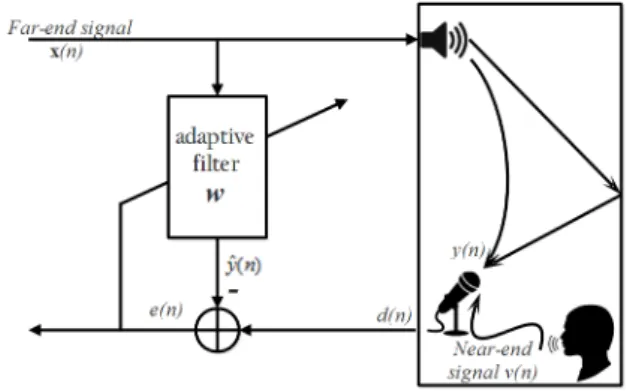
An acoustic echo canceller (figure 1) removes echo signal ( )y n resulting from the coupling between far-end
speech signalx n and the echo path h which returned to the ( ) microphone when the loudspeaker is used. The general concept is to use an adaptive filter to identify the echo path, where the output of adaptive filter ˆ( )y n is then subtracted
from microphone signal d n in order to transmit finally ( ) the near-end signalv n without echo disturbance [3]. ( )
The microphone signal is given by: ( ) ( ) ( ) ( ) ( ) T L d n y n v n n v n = + =h x +
(1)
With: h= h h0 1 ... hL−1impulse response of echopath; ( )x n =x n x n( ) ( −1) ... (x n L− +1) vector of L last
samples of the far-end signal x( )n , where L is the order of
h filter. We have: ˆ( ) T ( ) y n = w xn (2) Where: 0 1 ... L 1 w w w − =
w is the adaptive filter vector.
Thereby we get the error signal: ˆ ( ) ( ) ( )
e n =d n −y n (3) Many algorithms have been used to update the adaptive filter coefficients and allow a good convergence to the optimal solution, like as least mean squares (LMS) based algorithms and recursive least squares (RLS) based algorithms [4, 5]. In fact, each of these algorithms has its advantages; the RLS algorithms have a fast convergence rate and a high computational complexity, while the LMS algorithms have a low complexity and less convergence rate [6, 7].
The most challenge in AEC beside the convergence rate (misalignment) and reduction of computational complexity is the problem of the double talk detection. The main task of a DTD is to halt the filter coefficients updating during the presence of near-end speech to avoid filter divergence [8]. Figure 2 shows the implementation of DTD in AEC system. Many techniques have been used in order to improve behavior of DTD, i.e. Geigel algorithm [9], normalized cross correlation between different available signals [10-12] and more other recent methods [13][14]. An efficient DTD must react fast to the presence of near-end speech and allows resuming of adaptive filter updating when double-talk (DT) is finished. The simplest algorithm used to detect DT situations, is Geigel algorithm [9] which has been used first in network echo cancellation. This algorithm improves a good behavior; however for AEC it presents some problems due especially to its misalignment.
In this paper we propose a modified form of decision variable in order to enhance its performances using in this case RLS algorithm.
This article is organized as follows: section 2 gives the mathematical formulation of RLS algorithm; section 3 presents the Geigel algorithm and the proposed modification; and finally results are discussed in section 4.
Fig. 2. Implementation of Geigel DTD in AEC system. II. RLS ALGORITHM
The RLS algorithm search thewwhich minimize
the
weighted quadratic error:
[ ]
2 0 2 0 ( ) ( ) ( ) ( ) n n i i n n i T n i J n e i d i i λ λ − = − = = = −
w x(4)
The relations defined the conventional RLS algorithm are showed in table I.TABLE I RLS ALGORITHM SUMMARY.
Parameters: p filter order forgetting factor regularization paramerter λ δ = = = Initialization: 0= w 0 1 (0)=
δ
− P I Computation: For: n=1,2,…compute * ( )n = (n−1) ( )n z P x 1 ( ) ( ) ( ) ( ) T n n n n λ = + k z x z 1 ( )n d n( ) Tn ( )nα
= − w x− 1 ( ) ( ) n n w =w − +α nk n 1 ( )n (n 1) ( )n H( )n λ = − − P P k zIII. GEIGEL DOUBLE-TALK DETECTION
Geigel algorithm [9] is a very simple algorithm, it is based on the level comparison between far-end signal x( )n
and microphone signald n( ), the decision variable is
{
}
max ( ) , ( 1) , ( 2) ,..., ( 1) ( ) ( ) G G x n x n x n x n L n d n ξ = − − − + (5)The DT is declared whenever ξG < T
Where T is a detection threshold and LGis the length of far-end signal bloc.
These two parameters describe the DTD performances and must be chosen properly, one simple chose of LG is to take the same length of adaptive filter L[8].
We propose in this work to use in the denominator of decision variable, the mean of the LG last samples of microphone signal.
{
}
{
}
max ( ) , ( 1) , ( 2) ,..., ( 1) ( ) ( ) , ( 1) , ( 2) ,..., ( 1) x n x n x n x n LG n p mean d n d n d n d n LG ξ = − − − + − − − + (6)IV.RESULTS AND DISCUSSION
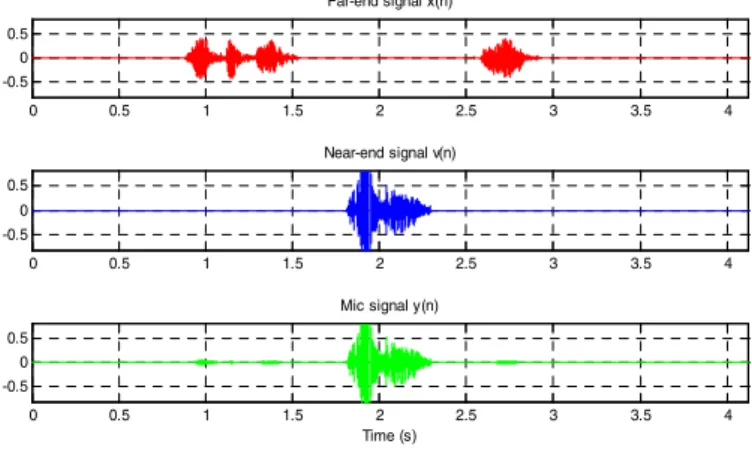
Simulations are performed using signals depicted in figure 3, near-end and far-end signal are a recorded audio sequences composed of 33000 samples (4.12 seconds) sampled at 8 KHz. To simplify simulations, we have used a short echo path (128 taps).
Fig. 3. Speech signals used in simulations.
First of all, we have to fix two parameters (LG and T in this case) of the proposed DTD. Several values of LG and
T are tested with forgetting factor λ=0.999. Figure 4 and 5
show the comparison between misalignment curves where the best result is obtained with LG=12.L and T =45. These values are chosen for the remaining simulations.
0 0.5 1 1.5 2 2.5 3 3.5 4 -0.5 0 0.5 Far-end signal x(n) 0 0.5 1 1.5 2 2.5 3 3.5 4 -0.5 0 0.5 Near-end signal v(n) 0 0.5 1 1.5 2 2.5 3 3.5 4 -0.5 0 0.5
Mic signal y(n)
Fig. 4. Misalignment curves for different LG values.
Fig. 5. Misalignment curves for different T values.
To compare the proposed and conventional methods, we use the binary decision variable calculated as following: when DT is detected, B=1; when DT is not detected, B=0.
Obtained result is illustrated in figure 6, we can remark that Geigel algorithm make several wrong detections more than proposed method, this wrong detection affect the AEC performances and hold the adaptive filter convergence.
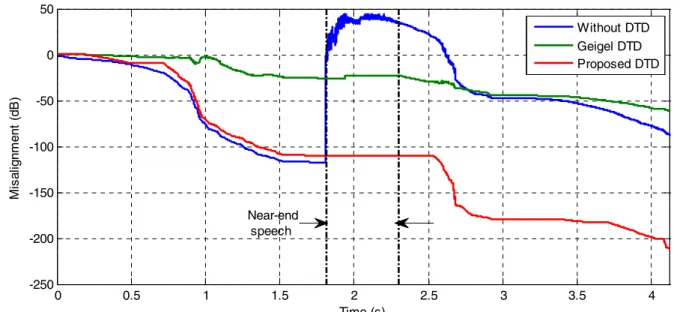
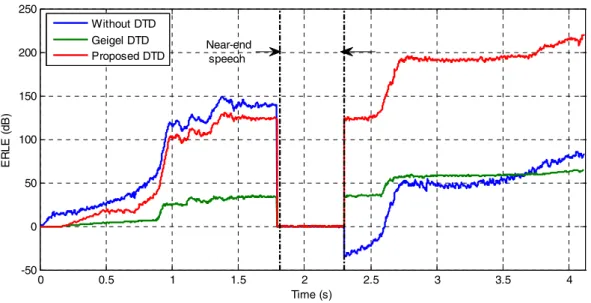
Fig. 6. DTD decisions of conventional Geigel and proposed method. To confirm the efficiency of the proposed method and the impact of DTD on the global performances of an AEC system, we use the normalized misalignment and Echo Return Loss Enhancement (ERLE) criteria defined as:
2 10 2 ( ) ( ) 10log n Misalignment dB = − w h h (7) 2 10 2 ( ) ( ) 10 log ( ) E d n ERLE dB E e n = (8)
Where w( )n −h denotes the Euclidian distance between filter coefficients w and real echo path h.
Obtained results are showed in figure 7 and 8.
The residual echo depicted in figure 9 is calculated as following:
( ) ( ) ( )
residual echo n =e n −v n (9)
Fig. 7. Comparison of misalignment of different methods.
0 0.5 1 1.5 2 2.5 3 3.5 4 -200 -150 -100 -50 0 50 Time (s) M is al ignm ent ( dB ) λ = 0.999 LG=1L LG=2L LG=8L LG=12L Near-end speech 0 0.5 1 1.5 2 2.5 3 3.5 4 -250 -200 -150 -100 -50 0 Time (s) M is al ignm ent ( dB ) λ = 0.999 T=45 T=50 T=55 T=60 Near-end speech 0 0.5 1 1.5 2 2.5 3 3.5 4 -1 0 1 Time (s) A m pl it ude Geigel DTD 0 0.5 1 1.5 2 2.5 3 3.5 4 -1 0 1 Time (s) A m pl it ude Proposed DTD 0 0.5 1 1.5 2 2.5 3 3.5 4 -250 -200 -150 -100 -50 0 50 Time (s) M is a li gnm ent (dB ) Without DTD Geigel DTD Proposed DTD Near-end speech
Fig. 8. Comparison of ERLE of different methods.
Fig. 9. Comparison of residual echo of different methods. Obtained results with different evaluations confirm the
necessity of DTD in AEC system and show the superiority of the proposed method compared to conventional Geigel algorithm. The convergence of conventional Geigel is slow due to the large periods of wrong detections shown in figure 6. Furthermore the residual echo is more significant without DTD and with conventional Geigel DTD. Proposed method in DT situations, presents the best misalignment.
V.CONCLUSION
The presence of a good DTD in an AEC system is essential especially in the case of an adaptive algorithm with a fast convergence rate like the RLS. In this context
confirm the superiority of the proposed method compared to conventional one.
REFERENCES
[1] M. M. Sondhi, "An Adaptive Echo Canceller," Bell Syst. Tech. J., vol., 46, No. 3, pp 497-511, Mar. 1967.
[2] J. Benesty, T. G¨ansler, D. R. Morgan, M. M. Sondhi, and S. L. Gay, Advances in Network and Acoustic Echo Cancellation. Berlin, Germany: Springer-Verlag, 2001.
[3] M. Benziane, M. Bouamar, M. Makdir, “Performance evaluation of RLS algorithm used in acoustic echo cancellation system”, J. Automation & Systems Engineering, Vol.12 (1) pp.48-57, 2018. [4] S.Haykin, “Adaptive Filter Theory”, 3rd Ed, pp.562-687, 1995.
0 0.5 1 1.5 2 2.5 3 3.5 4 -50 0 50 100 150 200 250 Time (s) ER L E ( d B) Without DTD Geigel DTD Proposed DTD Near-end speech 0 0.5 1 1.5 2 2.5 3 3.5 4 -4 -2 0 2 4x 10 -3 Time (s) A m pl it ude Without DTD 0 0.5 1 1.5 2 2.5 3 3.5 4 -4 -2 0 2 4x 10 -3 Time (s) A m pl it ude Geigel DTD 0 0.5 1 1.5 2 2.5 3 3.5 4 -4 -2 0 2 4x 10 -3 Time (s) A m pl it ude Proposed DTD
[7] J. Benesty, C. Paleologu, T. Gnsler, S. Ciochina, “A Perspective on Stereophonic Acoustic Echo Cancellation”, Germany, Berlin:Springer-Verlag, 2011.
[8] T. Giinsler, J.Benesty, St. L. Gay, “Double talk detection schemes for acoustic echo cancellation”, acoustic signal processing for telecommunication, Springer Science Business Media, pp 81-95, 2000.
[9] D.L. Duttweiler, “A twelve-channel digital echo canceler”, IEEE Trans. Commun, vol.26, pp. 647–653, 1978.
[10] Hua Ye and Bo-X. Wu, “A New Double-Talk Detection Algorithm Based on the Orthogonality Theorem”, IEEE Trans. Commun., vol. 39, pp. 1542-1545, Nov 1991.
[11] Jacob Benesty, Dennis R. Morgan, and Juan H. Cho, “A new class of doubletalk detectors based on cross-correlation,” IEEE Transactions on Speech and Audio Processing, vol. 8, pp. 168– 172, March 2000.
[12] M.A. Iqbal, J.W. Stokes, and S.L. Grant, “Normalized double-talk detection based on microphone and AEC error cross-correlation.” Proceedings of IEEE International Conference on Multimedia and Expo, pp. 360–363, Jul. 2007.
[13] Y.S. Park, J.H. Chang, “Double-talk detection based on soft decision for acoustic echo suppression”, Signal Processing, vol. 90, pp. 1737–1741, 2000.
[14] M. Hamidiaa, A. Amrouchea, “A new robust double-talk detector based on the Stockwell transform for acoustic echo cancellation”, Digital Signal Processing, vol. 60, pp. 99–112, 2017.