HAL Id: hal-01869979
https://hal.inria.fr/hal-01869979v2
Submitted on 7 Sep 2018
HAL is a multi-disciplinary open access
archive for the deposit and dissemination of
sci-entific research documents, whether they are
pub-lished or not. The documents may come from
teaching and research institutions in France or
abroad, or from public or private research centers.
L’archive ouverte pluridisciplinaire HAL, est
destinée au dépôt et à la diffusion de documents
scientifiques de niveau recherche, publiés ou non,
émanant des établissements d’enseignement et de
recherche français ou étrangers, des laboratoires
publics ou privés.
Demo: Using nepi-ng for Mesh Networks Experiments
Yonathan Bleyfuesz, Thierry Parmentelat, Thierry Turletti, Farzaneh Pakzad,
Mohamed Mahfoudi, Walid Dabbous
To cite this version:
Yonathan Bleyfuesz, Thierry Parmentelat, Thierry Turletti, Farzaneh Pakzad, Mohamed Mahfoudi, et
al.. Demo: Using nepi-ng for Mesh Networks Experiments. WINTECH 2018 - 12th ACM International
Workshop on Wireless Network Testbeds, Experimental evaluation & CHaracterization, Nov 2018,
New Delhi, India. pp.1-2. �hal-01869979v2�
Demo: Using nepi-ng for Mesh Networks Experiments
Yonathan Bleyfuesz
Université Côte d’Azur, Inria [email protected]
Thierry Parmentelat
Université Côte d’Azur, Inria [email protected]
Thierry Turletti
Université Côte d’Azur, Inria [email protected]
Farzaneh Pakzad
Aptira, Australia [email protected]Mohamed Naoufal
Mahfoudi
Université Côte d’Azur, Inria
Walid Dabbous
Université Côte d’Azur, Inria Walid [email protected]
ABSTRACT
We describe a demonstration run on R2lab, an open wire-less testbed located in an anechoic chamber at Inria Sophia Antipolis. The demonstration consists in easily deploying a Wi-Fi mesh network. The nodes provisioning, configuration and the scenario orchestration and control are automatically done using the nepi-ng experiment orchestration tool. A performance comparison of two wireless mesh routing pro-tocols in presence of controlled interference is shown.
1.
INTRODUCTION
A wireless mesh network allows dynamic and non-hierarchical communication between its nodes, without any infrastructure such as access points. In order to evaluate the performance of wireless mesh routing pro-tocols such as OLSR [1] and BATMAN [2], some special considerations should be taken when deploying an ex-periment:
• Number of nodes: Need to handle a significant number of nodes.
• Multi-hop context: Need to control channel con-ditions in order to allow multiple-hop situations and make possible performance comparison of the two mesh routing protocols.
• Radio conditions: Need to ensure the same phys-ical layer conditions for each iteration of the exper-iment.
Several studies have compared OLSR and BATMAN performance, see [3]. In this paper, we demonstrate nepi-ngas a tool to facilitate the deployment of wire-less network experiments and performance comparison of routing protocols.
2.
MESH NETWORK DEPLOYMENT
US-ING NEPI-NG AND R2LAB
In this demonstration, we use nepi-ng and the FIT R2lab wireless testbed to meet the challenges described
above. R2lab is a wireless testbed located in an ane-choic chamber at Inria Sophia Antipolis, providing a controlled environment that ensures the same RF con-ditions for the different wireless experiments. We are deploying our experiments using nepi-ng, a tool for orchestrating network experiments in an automated and efficient way. See [4] for more details on nepi-ng and R2lab. Indeed, the nepi-ng parallel component allows to configure all of our nodes simultaneously. Thanks to nepi-ng’s nested schedulers [4], we are able to reuse portions of code from previous scripts. We have reused modules for configuring the wireless interfaces and for measuring the RSSI, which allowed us to quickly pin-point the different parameters to characterize precisely our environment and produce a multi-hop scenario. Fur-thermore, we run the experiments directly from our lo-cal machine without having to manually access the gate-way or the wireless nodes. This approach even-though practical and straightforward is more prone to connec-tion losses to the target testbed. However, the results produced by the experiment remain available to the ex-perimenter, as the scripts used by nepi-ng are pushed to the target nodes to run locally.
3.
EXPERIMENT SCENARIO
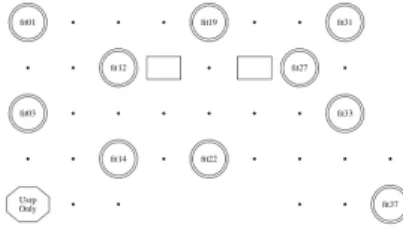
The scenario consists of a wireless mesh network as depicted in Figure 1, using OLSR and BATMAN. We compare performance of these two routing protocols us-ing 3 different metrics: end-to-end latency, packet de-livery ratio, and number of hops. We use olsrd v0.6.6.2-1ubuntu1 and batmand v0.3.2-17 on Ubuntu 16.04 nodes with a 4.4.0-21-generic kernel. We chose the Atheros chipset configured on the 802.11g mode and operating on the 2.457GHz frequency, which provides a mesh in-terface. To maximize the number of hops, we use the minimal Tx power of 5 dBm and the maximal data rate of 54 Mbps that has the lowest range with a single an-tenna element. To create controlled interference, we generate additive Gaussian noise with a gain of -12 dB using the uhd siggen tool from gnuradio 3.7.11.1 on an
USRP N210. We set the mesh fwd option to 0 to pre-vent path forwarding.
Figure 1: Physical location of used nodes used in R2lab
3.1
Experiment flow
The experiment script consists in the six following steps :
• Check if we have reserved the R2lab testbed, turn on and load images on the nodes on demand. • Configure wireless cards and routing protocol on
nodes.
• Let the wireless network settle for 60 s. • Snapshot the routing tables of all nodes.
• Start the pings between the source and destina-tions.
• Stop the routing processes; retrieve the generated data.
Moreover, the experimenter has the following options: • Enable a tcpdump capture on every node and
cre-ate a mini textual heatmap of the R2lab testbed. • Enable an co-channel interference with a white
noise generator in the anechoic chamber.
• Launch the service to snapshot the routing tables on each node every 500 ms.
Table 1 represents the results of 20 runs. We can infer that BATMAN is more reliable on 1-hop routes. However when more than 2 hops are required to reach the destination, both protocols choose highly variable routes. We note that OLSR uses more hops in general and achieves a higher PDR for nodes 19, 27, 31 and 33. Regarding latency, performance are similar except for node 19 with BATMAN, which suffers many retrans-missions due to bad channel conditions.
4.
CONCLUSION
This demonstration shows how wireless mesh net-works can be easily and rapidly deployed using nepi-ng on R2lab. More complete performance results on Bat-man vs OLSR are also available on our github [5] in the form of a Jupyter notebook.
Figure 2: Example of an OLSR run with some modules.
Table 1: Hop count, PDR and RTT for 20 ex-periments Destination 3 12 14 19 22 27 31 33 37 Avg hops 2 2 1 1 1 1 1.32 3.79 2 2 2.63 3 2.95 3.95 3.05 3.16 2.84 0 Avg PDR 87.1 96.65 100 95 99.85 97.8 26.95 41.15 97.75 95 84.85 94.75 54.15 73.7 82.25 88.15 0 0 Stdev PDR 20.91 3.35 0 21.79 0.65 9.59 31.31 38.98 9.58 21.79 27.93 21.75 42.43 40.16 31.72 26.07 0 0 Avg RTT (ms) 9.11 7.35 11 11.12 1.94 1.87 112.28 46.88 4.06 4.08 5.80 5.94 11.01 10.65 7.85 8.11 0 0
Note: Node 1 is the source. Each cell includes 2 results: the top one is for BATMAN, the other for
OLSR.
Acknowledgments
This work and the R2lab testbed are funded by the French ANR through the “Investments for the Future” Program under grants ANR-11-LABX-0031-01 (LABEX UCN@Sophia) and ANR-10-EQPX-0031-01 (EQUIPEX FIT).
5.
REFERENCES
[1] T. Clausen et al. OLSR. RFC 3626, October 2003. [2] A. Neumann et al. Better Approach To Mobile
Ad-hoc Networking (B.A.T.M.A.N.). Internet-Draft, IETF, 2008.
[3] Farzaneh Pakzad. Towards Software Defined Wireless Mesh Networks. PhD thesis, The University of Queensland, 2017.
[4] Thierry Parmentelat et al. nepi-ng: an efficient experiment control tool in R2lab. In ACM WiNTECH 2018 Workshop, New Delhi, India, November 2018.
[5] https:
//github.com/fit-r2lab/r2lab-demos. Batman vs OLSR.