OATAO is an open access repository that collects the work of Toulouse
researchers and makes it freely available over the web where possible
Any correspondence concerning this service should be sent
to the repository administrator:
[email protected]
This is an author’s version published in: http://oatao.univ-toulouse.fr/23270
To cite this version:
Jentzer, Jean-Baptiste
and Alignan, Marion
and Vaca-Garcia, Carlos
and
Rigal, Luc
and Vilarem, Gérard
Response surface methodology to optimise
Accelerated Solvent Extraction of steviol glycosides from Stevia rebaudiana
Bertoni leaves. (2015) Food Chemistry, 166. 561-567. ISSN 0308-8146
Response surface methodology to optimise Accelerated Solvent
Extraction of steviol glycosides from
Stevia rebaudiana
Bertoni leaves
Jean-Baptiste Jentzer
a,
b, Marion Alignan
a,
b,
*
, Carlos Vaca-Garcia
a,
b,
c, Luc Rigal
a,
b, Gérard Vilarem
a,
b • Université de Toulouse, INP-ENSIACET, LO\ (Laboratoire de Chimie Agro-industrielle), 4 Allée Emile Monso, F-31030 Toulouse, Franceb INRA, UMR 1010 O\I, F-31030 Toulouse, France
c King Abdulaziz University, Jeddah, Saudi Arabia
ARTICLE INFO ABSTRACT
Following the approval of steviol glycosides as a food additive in Europe in December 2011, large-scale stevia cultivation will have to be developed within the EU. Thus there is a need to increase the efficiency of stevia evaluation through germplasm enhancement and agronomie improvement programs. To address the need for faster and reproducible sample throughput, conditions for automated extraction of dried stevia leaves using Accelerated Solvent Extraction were optimised. A response surface method ology was used to investigate the influence of three factors: extraction temperature, static time and cycle number on the stevioside and rebaudioside A extraction yields.
Keywords:
Stevia rebaudiana Bertoni
Accelerated Solvent Extraction Steviol glycosides
Genotype screening
Response surface methodology HPLC
The mode! showed that all the factors had an individual influence on the yield. Optimum extraction conditions were set at 100 °C, 4 min and 1 cycle, which yielded 91.8% ± 3.4% of total extractable steviol glycosides analysed. An additional optimisation was achieved by reducing the grind size of the leaves giv ing a final yield of 100.8% ± 3.3%.
1. Introduction
Stevia rebaudiana Bertoni is a perennial herb of the Asteraceae
family, native to the Amambay and Iguaçu districts on the borders of Brazil and Paraguay (I<inghom & Soejarto, 1985). Its principal interest is the high content of natural, dietary valuable sweeteners in its leaves (about 4-20% in leaves, dry weight) (Lemus-Mondaca, Vega-Galvez, Zura-Bravo, & Ah-Hen, 2012). These sweet compo nents are ent-kaurene diterpenoid glycosides, and today more than 30 are recognised in the scientific literature (Wèilwer-Rieck, 2012). The main compound is stevioside (4-13% of leaves dry weight) with a sweetening power of 250-300 (the sweetening power of sucrase, 'table' sugar, is 1 ), and the next most abundant is rebau dioside A (2-4%) with a sweetening power of 300-450. The other well known steviol glycosides (SG) are dulcoside A (0.3%), rebau dioside B, C (1-2%), D and F and steviolbioside (Geuns, 2010; Tavarini & Angelini, 2013). As reported in the literature, rebaudio side A is recognised as Jess astringent than stevioside and therefore
*
Corresponding author at: Université de Toulouse, INP-ENSIACET, LCA (Laboratoire de Chimie Agro-industrielle), 4 Allée Emile Manso, F-31030 Toulouse, France. Tel.: +33 5 34 32 35 26: fax: +33 5 34 32 35 98.E-mail addresses: jeanbaptistejentzer@ensiacetfr Q.-8. Jentzer), marion.alignan@
ensiacet.fr (M. Alignan), [email protected] (C Vaca-Garcia), luc.rigal@ensiacet. fr (L Rigal), [email protected] (G. Vilarem).
http://dx.doi.org/10.1016/j.foodchem.2014.06.078
preferred by the food and beverages industry (I<ennelly, 2002; Tanaka, 1982). The stevia sweeteners have functional and sensory properties superior to those of many other high-potency sweeten ers, like aspartame or cyclamate (Goya!, Samsher, & Goya!, 2010). Many studies suggest that they have antioxidant, anti-diabetic, anti-diarrheal, anti-hyperglycemic, anti-hypertensive, anti-inflam matory, anti-tumour, diuretic and immunomodulatory effects (Chan et al., 2000; Gregersen, Jeppesen, Holst, & Hermansen, 2004; Puri, Sharma, Barrow, & Tiwary, 2012; Shivanna, Naika, I<hanum, & I<aul, 2013).
The Guarani Indians have long been using the leaves of stevia as a sweetening agent. The first crops outside Paraguay were grown by Sumida in Japan in 1968 (Brandie, Starratt, & Gijzen, 1998). After, stevia appeared in many countries, such as Brazil, China, Indonesia, Israel, Tanzania and the United States (Crammer & !kan, 1987; Yoda, Marques, Petenate, & Meireles, 2003). In many of these countries the dried stevia leaves and their extracts were approved as food additives. In the United States the FDA (Food and Drug Administration) banned stevia until 1995 but highly purified steviol glycosides finally received GRAS (Generally Recog nised As Safe) status in both 2008 and 2009 (Wèilwer-Rieck, 2012). Introduction of steviol glycosides onto the European market as food additives was approved at the end of 2011 (European Commission, 2011 ).
Currently, the main stevia producing areas are China, especially in the north, and South Asia (Tavarini & Angelini, 2013). Since a growing market for stevia products has developed in Europe, par ticularly following SG approval as a food additive within the EU on 2 December 2011, it would be of great interest to set up large-scale fully traceable crops to ensure the supply of stevia leaves in this area. To implement such crops, screening of different genotypes adapted to European soi! and climatic conditions is required. On a laboratory scale, SG have up to now been mostly extracted in a batch system by conventional methods: solvent extraction (Bondarev, Reshetnyak, & Nosov, 2001; Liu, Ong, & Li, 1997; Woelwer-Rieck, Lankes, Wawrzun, & Wüst, 2010), Soxhlet extrac tion (Erkucuk, Akgun, & Yesil-Celiktas, 2009), extraction by heating under reflux (Teo, Tan, Yang, Hew, & Ong, 2009), and cold extrac tion (Erkucuk et al., 2009; Jaitak, Bandna, & Kaul, 2009; Teo et al., 2009). These methods suffer from being rather long (at least 1 h) with other drawbacks, like complicated thermoregulation without specific equipment, or use of an environmentally unfriendly solvent ( e.g. methanol). Moreover, little data concerning the extraction efficiency or reproducibility are given in the literature. Although other extraction methods are referenced, e.g. ultra sound-assisted extraction (UAE), microwave-assisted extraction (MAE) or supercritical fluid extraction (SFE) Uaitak et al., 2009; Liu et al., 1997; Teo et al., 2009), these processes are also time con suming and not adapted to analysing a large number of samples. Accelerated Solvent Extraction (ASE) is an automated extraction technique using elevated temperatures and pressures to achieve extraction in very short periods of time. The high temperature leads to better analyte solubility, faster diffusion rates, lower sol vent viscosities and weakening of the solute-matrix interactions. The high pressure allows for working with solvents as liquids above their boiling point and accelerates the overall extraction process (Mustafa & Turner, 2011 ). Finally, compared to conven tional extraction methods, higher automation, extraction yields, recovery and a shorter duration can be achieved (Kukula-Koch et al., 2013). This method can also be used to increase the through put of samples in stevia germplasm evaluation screening pro grams. Therefore ASE was the chosen method for this study. Conceming the parameters that can influence extraction yield, temperature, static time and number of cycles are the main ones and will be studied here using response surface methodology (RSM). This approach allows a reduction in the number of experi ments, and a prediction of the influence of the factors on the chosen response using a mathematical mode!. The latter can be graphically represented with response surfaces that show to what extent the influence of parameters or their interactions are signif icant or not, and can then provide the optimal conditions to improve a process (Bharathi, Patterson, & Rajendiran, 2011; Rai, Majumbar, & De, 2012). Additionally, RSM was used on the ASE of stevia leaves to understand the impact on SG extraction yield of the main parameters ( extraction temperature, static time and number of cycles) and establish preliminary ASE conditions. An additional optimisation and experimental validation were then undertaken to set up the conditions for the ASE method retained.
2. Materials and methods 2.1. Plant material
For extraction method optimisation, S. rebaudiana Bertoni leaves, variety Criolla, were obtained from Paraguay. Leaves of S. rebaudiana Bert. genotypes 1-5 were obtained from Salvagnac,
South West France, genotype 6 from Riom, Central France and genotype 7 from Nicaragua. Plant material was sun dried and stored at room temperature. Before extraction, dried leaves were
ground in an electric grinder P19 Pulverisette (Fritsch, Germany) to pass through a 1 or 0.5 mm diameter circular mesh sieve.
2.2. Chemicals
Acetonitrile (analytical grade) and formic acid were provided by Sigma-Aldrich (France). Deionised water (resistivity > 18.2 MO cm) was made in situ using a Milli-Q Gradient AlO system purchased from Millipore Corporation (Bedford, MA, USA). Stevioside (purity ~95%) and rebaudioside A (purity ~98%), used as standards in this study, were purchased from ChromaDex (Molsheim, France).
2.3. Determination of moisture content
To determine the dry matter content for each sample, 1 g of leaves was oven-dried at 103 ac in an Air Concept AC 120 system (Firlabo, France) to constant weight.
2.4. Extraction methods
2.4.1. Conventional extraction method
Conventional extraction was performed with 15 g of stevia leaves, by adding 600 ml of deionised water in a 1 1 bottle and maintaining at 60 ac for 120 min with magnetic stirring at 250 rpm. Extracts were diluted if necessary and the amount of ste vioside and rebaudioside A were determined by HPLC, method described below, to find the extraction yield of SG from extracts.
2.4.2. Pressurised solvent extraction procedures
An ASE 350 system Dionex Corporation (Sunnyvale, CA, USA) was used for the pressurised liquid extraction. The cells were equipped with a stainless steel frit and a cellulose filter at the bot tom to avoid collection of suspended particles in the collection via!. Five hundred milligrams of crushed leaves were mixed with Fon tainebleau sand (VWR, France) and loaded into a 10 ml stainless steel extraction ce!!. Following the addition of purified water, the cell was pressurised, heated and extracted statically under condi tions obtained from RSM (Table 1) with a rinse volume (100%) of 5 ml and a 100 s nitrogen purge at the end of each extraction.
Table 1
Doehlert design of factors in real values for optimisation of process variables in SG content (stevioside + rebaudioside A) of Stevia rebaudiana Bertoni leaves and
exper-imental results.
Experiments Extraction Static Number Experimental temperature extraction of cycles extraction yield of x1 (°C) time x2 X3 stevioside + (min) rebaudioside A y {%) 70 4 2 91.3 2 100 4 2 99.0 3 85 7 2 97.5 4 55 7 2 91.8 5 40 4 2 84.0 6 55 1 2 82.1 7 85 2 89.6 8 85 5 3 99.3 9 55 5 3 98.0 10 70 2 3 88.9 11 85 3 90.0 12 55 3 80.9 13 70 6 88.0 14 70 4 2 93.3 15 70 4 2 95.1 16 70 4 2 93.5 17 70 4 2 95.6 18 70 4 2 94.0
The pressure in the cell was set at 10.3 MPa. The aqueous extract was completed to exactly 50 ml in a volumetric flask with deion ized water. Extracts were diluted if necessary and the amount of stevioside and rebaudioside A were determined by HPLC, method described below, to determine the extraction yield of SG in extracts.
2.5. Determination of maximal extractable mass of steviol glycosides in stevia leaves
In order to determine the maximal extractable SG content in stevia Ieaves, three successive Accelerated Solvent Extractions (sol vent = water, temperature = 60 °C, static time = 15 min and 1 cycle)
were performed on the same cell to exhaust the Ieaves. The exper iment was made in triplicate and each fraction analysed by HPLC. 2.6. Experimental design
This study was made using an experimental design based on a three-factor Doehlert's type uniform network as described else where (Doehlert, 1970). This consisted of a three-variable (k = 3) Doehlert's design and needed thirteen experiments (plus five extra repetitions at the centre of the experimental domain). In the pres ent study, the ranges of experimental parameters were selected, based on Iiterature and extraction kinetics' results presented below. The experimental conditions are shown in Table 1.
The response values Ywere expressed as the main SG extraction yield obtained by ASE, i.e. stevioside and rebaudioside A.
y = maximal extractabie mass of stevioside and rebaudioside A in leaves mass of extracted stevioside and rebaudioside A in leaves A full second-order polynomial mode) of the design was used to evaluate the extraction yield as the response (Y), as a function of the three independent variables (xi), namely extraction tempera ture (x1), static time (x2) and number of cycles (x3), and their
interactions.
The behaviour of the system can be described by the following second-order polynomial equation:
k k� k k
Y= ao
+
L)ixi+
L L aijxixi+
LaiiXfi=l i=l j=i+l i=l
where Y is the response value, a0 the response value at the centre of
the experimental domain, ai are the linear coefficients, aii are the quadratic coefficients, aii are the interaction coefficients, and xi
the coded values of the three independent variables.
6%
2. 7. HPLC analysis of extracts
Ali the extracts were diluted with deionized water and filtered through a 0.45 µm cellulose membrane filter (Xilab, Belgium) before being subjected to HPLC analysis. The HPLC system con sisted of a Dionex P680 pump, a Dionex ASI-100 automated sample injector, a Dionex Ultimate 3000 Column Compartment (Thermo Scientific, France), a diode array detector (DAD) (Hewlett Packard, France) and piloted by a Chromelon chromatography data system (Thermo Scientific, France) to obtain chromatographie profiles of the extracts. The chromatographie method was adapted for the JECFA method of SG assay published in FAO JECFA Monographs 10 (2010). The mobile phase consisted of0.1% aqueous formic acid (solvent A) and acetonitrile (solvent B). The elution mode was iso cratic at 1 ml/min for 30 min; 69-31% solvent B. Samples were injected (20 µI) onto an apolar Luna reversed-phase C18 column (250 x 4.6 mm ID, 5 µ, Phenomenex, Le Pecq, France) at 40 °C. Chromatograms were recorded at 200 nm. The standards used in the experiments were weighed and dissolved in deionized water. Calibration curves were generated with concentrations ranging from 50 to 500 mg/1 of stevioside and rebaudioside A.
3. Results and discussion
3.1. Selection of experimental conditions and ranges
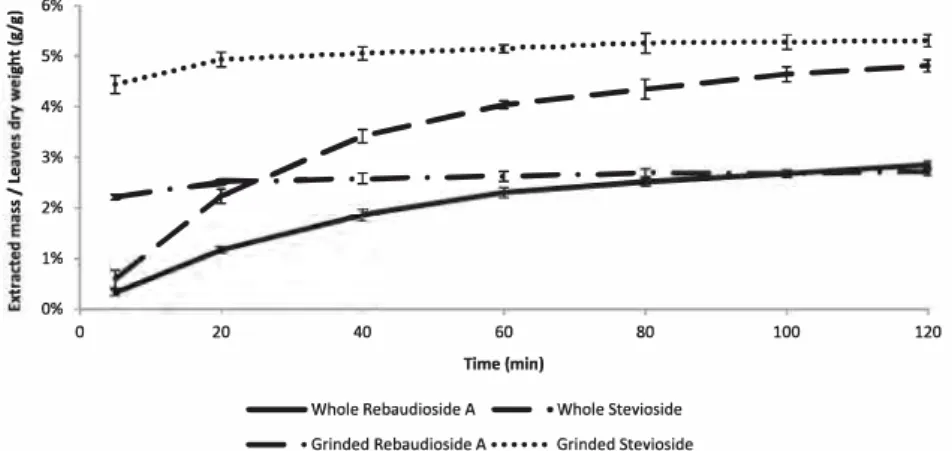
In general, the extraction efficiency of a compound is influenced by multiple parameters such as time, temperature and solvent polarity, and their effects may be either independent or interactive. Before developing the study using RSM, extraction kinetics were determined by conventional extraction methods to select experi mental conditions and ranges. Steviol glycosides' extraction kinet ics were undertaken in triplicate in a batch system, at a temperature of 60 °C and with water as a solvent (Giovanetto, 1990). In order to measure the influence of particle size, Ieaves were used either whole or ground to pass through a 1 mm sieve. Results were plotted Fig. 1. Firstly, as can be seen, the kinetics of the two solutes are the same, so the total yield of stevio side + rebaudioside A can be chosen as the response for the model. Secondly, for ground Ieaves the speed of the extraction was faster and levelled off after 20 min, meaning that an equilibrium had been reached and that the extraction has ended. From this it was concluded that 20 min were sufficient to obtain the maximal SG concentration with ground Ieaves under these conditions. Thirdly, and finally, as stevioside is stable in solution up to 100 °c (Kinghom, 2002), this temperature value was chosen as the upper limit for our experiments.
�
l:
.!!!' 5%
···
••I ••••••••••••• I ••••••••••••• :C• ••••••••••• • I· .•••••••.... 3:• •••••••••••• ;i�--..i
4% 3% � ... ::i 2% 1% 0% o I···_
--r---_.
.,,,,,,r-��- •I- • - :r • --· ;l'C/
20 40 60 Time(min) 80 -wholeRebaudiosideA - •WholeStevioside - • Grinded Rebaudioside A•••••• Grinded Stevioside100 120
3.2. Maximal extractable mass of Steviol glycosides in stevia leaves
Results from exhausting the Ieaves showed that about 86% of the SG were removed with the first extraction and that there was no more SG quantifiable (Limit Of Quantification < 0.01 g/1 of stevia extract, as defined by the European Pharmacopoeia (2007)) in the third extract (data not shown). After the second extraction, the rebaudioside A total content was 3.16 (±0.08)g/100 g of Ieaves dry weight and stevioside was 6.32 (±0.22)g/100 g of leaves dry weight, giving a standard profile of 67% stevioside and 33% rebau dioside A in agreement with Lemus-Mondaca et al. (2012) and Tavarini and Angelini (2013 ). An example of a first extract chro matogram is given in Fig. S1 (see Supplemental material).
3.3. A mathematical mode! to describe the processing of ASE of steviol glycosides from S. rebaudiana Bertoni leaves
The Doehlert experimental design for three variables, the thir teen experiments and the experimental yields of the extractions are shown in Table 1. The maximum yield of extractable stevio side + rebaudioside A (99.3%) was recorded in experiment No. 8, with parameters of 85 °c extraction temperature, 5 min static extraction time and 3 extraction cycles. The Iowest steviol glyco sides' yield (82.1%) was found with 55 °C extraction temperature, 1 min static extraction time and 2 extraction cycles. The data yielded the following second-order polynomial equation (results are given with standard deviations):
Y= 93.78(±0.62) + 6.71 (±0.76)x1 + 5.58(±0.76)x2 + 5.57(±0.76)X3 -1.02(±1.76)X1X2 -4.39(±1.97)X1X3 + 4.45(± 1.97)x2x3 -2.28(± 1.24)x� -3.92(± 1.24)x�
-2.87(± 1.17)x�
For a detailed calculation of the coefficients of the quadratic equation, see Rossi & Haupt, 2007. An F-test and a Student's T-test were used to check the statistical significance and suitability of the model. The F value (0.95) was Jess than the Fisher F parameter at the 95% confidence level ( 5.41 ), so the mathematical mode) fits with the data set. Joglekar and May (1987) have suggested that for a good fit of a mode), the regression coefficient R2 should be
at least 80%. Thus the proposed model had a sufficiently high correlation coefficient value (R2 = 0.9642) to indicate that the
7 T:Extraction T emperature • S:Static TI me* C:Number of Cycles• SS cc 1 SC TC 1 TT 1 TS =:J 0 1 2 3 1 1
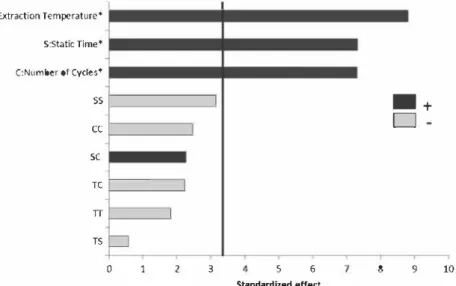
extraction data was adequately explained, i.e. 96% of the data can be explained by the mode). Therefore, the mode) can be used as an estimate of a trend, to be able to predict the influence of the extraction parameters on the extraction yield. Fig. 2 shows that extraction temperature was the most influential parameter, and interaction between extraction temperature and static time, the Ieast. Moreover, only the linear terms were significant (p < 0.05), meaning that the response variables depended more upon the individual change of the independent variables, rather than their interactions.
3.4. Effects of extraction variables on extraction yield of steviol glycosides
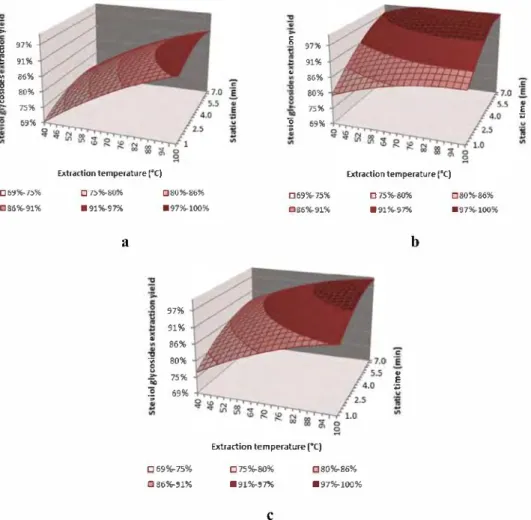
The three-dimensional response surfaces shown in Fig. 3 for the independent variables (static time, temperature and number of cycles) were obtained by keeping the number of cycles constant, which indicated the changes in SG extraction yield under different ASE conditions.
Fig. 3a shows the evolution of the SG extraction yield according to the extraction temperature and static time with the number of cycles kept constant at 1. As can be seen on the three-dimensional response surface, the extraction yield values increased principally with increasing extraction temperature. This means that tempera ture had a strong effect on the yield, whereas static time had no significant effect. The contact time between the solute and solvent was rather short, therefore the main step influencing the extrac tion efficiency is the solute dissolving in the solvent. When the temperature was increased, the viscosity of the water was reduced, thereby increasing its ability to wet the matrix and solubilise the solutes. There is also more energy to break analyte-matrix bonds, thus the diffusion of these analytes is facilitated (Teo, Tan, Yang, Hew, & Ong, 2010). This increase of SG extraction yield with tem perature has also been observed by Puri, Sharma, Barrow, and Tiwary (2012) and Erkucuk, Akgun, and Yesil-Celiktas (2009).
Fig. 3b illustrates the evolution of the SG extraction yield according to extraction temperature and static time, with the num ber of cycles kept constant at 2. As can be seen from the graph, the extraction yield values increased with increasing extraction tem perature and static time. Thus temperature and static time have a significant effect, contact time between the two phases is signif icantly longer, and higher extraction yields are obtained. On the one hand, the addition of an extraction cycle allowed for renewal
-+
D
5 6 8 9 10
Standardized effect
Fig. 2. Standardized Pareto chart showing the effect of different factor terms on SG extraction yield values. Bars exceeding the vertical line on the graph indicate that the corresponding factor tenns are significant (p < 0.05 ).
-;;. 97% � 91% 86%
i
80% � 75% 69% D69%-75% □86%-91% Extraction temperature 1•q □75%-80%■
91%-97%a
Il -� [ .;,1
D80%-86%■
97%-100% 97% 91% 86% 80% 75% 69% li 97% 91%..
86% 80% 75%l
69% □69%-75% 086%-91% Extraction temperature r•q □75%-80% ■91%-97%..
E.,
b
□80%-86%■
97%-100% E.,
Extraction temperature rq 069%-75% C 86%-91% 075%-80% ■91%-97% C 1;180%-86% ■97%-100%Fig. 3. Response surfaces plot for SG extraction yield showing the effect of extraction temperature and static time with number of cycles kept constant at 1 (a), 2 (b) and 3 (c).
of the solvent, which by disturbing the diffusion equilibrium enriched the extract, and on the other, with increasing number of cycles, analytes had more time to diffuse from the matrix to the extraction solvent.
Fig. 3c shows the evolution of the SG extraction yield according to extraction temperature and static time with the number of cycles kept constant at 3. Here, the extraction yield values increased mainly with increasing static time, meaning that the extraction temperature had less effect than the static time with three extraction cycles. The contact time was greater and, thus, dis solution was no longer limiting, and so extraction temperature was no longer an influence. The surface reached a plateau with extrac tion yields at 100% ( extraction temperature ~ 75-100 °c and static time ~5-7 min). The SG extraction was completed, but the overall extraction time was still too long to meet our objective. Indeed, in addition to the 15 min static extraction, an additional 10 min were required for the other steps (i.e. flushing or oven temperature rise) inherent to the method. Which explains why, to save time, we chose to work with only 1 extraction cycle. Thus, we retained the conditions leading to the model's best extraction yield and the con straints of the ASE system: extraction temperature of 100 °C and a static time of 4 min. An extraction yield of 95.3% was expected under these conditions with an overall extraction process lasting 13 min 30 s.
3.5. Experimental validation
Three repetitions were made under the above conditions ( extrac tion temperature = 100 °C, static time = 4 min and 1 cycle) and the
following extraction yields were obtained: 88.3%, 95.2% and 91.9% with an average of 91.8% ± 3.4%. The relative difference with the
95.3% expected was 3.7%. In addition, the verification experiments clearly demonstrated a good fit for the curve, and good reproducibil ity of results for an extraction using these parameters.
In order to further increase extraction yield while minimising extraction time, the particle size was reduced, thus increasing the exchange surface between the matrix and solute. The chosen conditions were as follows: static time 4 min, temperature 100 °c, one extraction cycle and leaves ground in order to pass through a 0.5 mm sieve. Extraction experiments were performed three times and the following extraction yields were obtained: 98.6%, 104.6% and 99.3% with an average of 100.8% ± 3.3%, thus
these extraction conditions were retained. As stated earlier, the SG Accelerated Solvent Extraction method was optimised using leaves from S. rebaudiana Bertoni var. Criolla, which is usually called a variety but is in fact a population. This explains why yields slightly greater than 100% were obtained.
Table 2 (see Supplemental material) summarises the different stevioside extraction methods ( exclu ding conventional methods) from S. rebaudiana leaves reported in the literature (Pol, Ostra, I<arasek, Roth, Benesova, I<otlafikova & Caslavsky, 2007; Erkucuk et al., 2009; Jaitak et al., 2009; Liu, Li & Tang, 2010; Teo et al., 2010; Puri et al., 2012; Rai et al., 2012). The ASE method we have developed is faster than the other methods except for Microwave Assisted Extraction developed by Jaitak et al. (2009) that lasted 1 min. However, this uses mainly methanol as a solvent, which is not eco-friendly. Moreover, ASE provides filtered extracts, a big time-saver with many samples, and in addition gives a maximal
extraction yield for stevioside and rebaudioside A as developed in this study. Yield data is often absent in the literature.
3.6. Experimental validation on different genotypes
Optimisation of the SG extraction method was made using the same Stevia sample (var. Criolla). In order to confirm that the cho sen conditions were suitable for any Stevia genotype, seven of these with different stevioside and rebaudioside A profiles were tested. Two extractions were performed on the same cell to confirm that there was no SG quantifiable in the second extract. Experiments were made in triplicate and SG contents determined (Table 3, in Supplemental material).
As expected, ail the SG were removed in the first extraction (i.e. no more SG quantifiable in the second extract), and the conditions set up were suitable for determining the SG content in the leaves of any stevia genotype. Therefore this ASE method can be used and is well-adapted for stevia genotype screening.
4. Conclusion
During ASE of steviol glycosides from stevia leaves, tempera ture, static time and number of cycles significantly influenced the extraction yield, and response surface analysis did not demonstrate interactions between these independent variables. For the condi tions retained, the second-order polynomial equation predicted the extraction conditions for a yield of 95.3% at 100 °C, 4 min static time and 1 cycle, and experimental results gave an average extrac tion yield of 91.8 ± 3.4%. An additional optimisation was made by reducing the particle size to under 0.5 mm and the experimental results gave an extraction yield of 100.8 ± 3.3%. Finally, the chosen conditions were validated on leaves from seven stevia genotypes with different stevioside and rebaudioside A contents, and a maximal extraction yield was obtained for each. Therefore, the ASE method developed was very fast (13 min 30 s), very efficient, reproducible and can be used for screening S. rebaudiana geno
types. Compared to conventional and non-conventional extraction methods it is faster, eco-friendly, more convenient and does not require as much energy.
Acknowledgements
We would like to thank the Midi-Pyrénées Region and BPI France (French govemment) for financially supporting this work (IUF 1107019M), the Epi Salvagnacois (Salvagnac, France) for lead ing the project,Joël Perret and Mathieu Penin (Stevia Natura, Riom, France) for providing us with Stevia leaves and good advice, and the Agronomy Laboratory and Agrophysiology Laboratory of the Purpan Engineering School (Toulouse, France) for their collaboration.
Appendix A. Supplementary data
Supplementary data associated with this article can be found, in the online version, at http://dx.doi.org/10.1016/j.foodchem.2014. 06.078.
References
Bharathi, V., Patterson, J., & Rajendiran, R. (2011 ). Optimization of extraction of phenolic compounds from Avicennia marina (Forssk.) Vierh using response
surface methodology. International Journal of Biological and Medical Sciences,
46-50.
Bondarev, N., Reshetnyak, O., & Nosov, A. (2001 ). Peculiarities of diterpenoid steviol glycoside production in in vitro cultures of Stevia rebaudiana Bertoni. Plant Science, 161 (1 ), 155-163. http: //dx.doi.org/10.1016/SOl 68-9452(01)00400-9.
Brandie,]. E., Starratt, A. N., & Gijzen, M. (1998). Stevia rebaudiana: Its agricultural,
biological, and chemical properties. Canadian Journal of Plant Science, 78(4),
527-536. http://dx.doi.org/10.4141/P97-114.
Chan, P., Tomlinson, B., Chen, Y. J., Liu, J. C., Hsieh, M. H., & Cheng, J. T. (2000). A double-blind placebo-controlled study of the effectiveness and tolerability of oral stevioside in human hypertension. British Journal of Clinical Pharmacology,
50(3), 215-220.
Crammer, B., & !kan, R. (1987). Progress in the chemistry and properties of rebaudiosides. In T. H. Grenby (Ed.). Developments in Sweeteners (Vol. 3,
pp. 45-64). London: Elsevier Applied Science.
Doehlert, D. H. (1970). Uniform shell designs. Journal of the Royal Statistic Society, 19(3), 231-239.
Erkucuk, A., Akgun, I. H., & Yesil-Celiktas, O. (2009). Supercritical C02 extraction of
glycosides from Stevia rebaudiana leaves: Identification and optimization. The Journal of Supercritical Fluids, 51(1), 29-35. http://dx.doi.org/10.1016/
j.supflu.2009.07.002.
European Commission. (2011 ). Commission Regulation (EU) n°1131 /2011
amending Annex II to Regulation (EC) No 1333/2008 of the European Parliament and of the Council with regard to steviol glycosides. Official Journal of the European Union, L295, 205-211.
European Pharmacopoeia (2007). European directorate for the quality of medicines.
Strasbourg.
Joint FAO/WHO Expert Committee on Food Additives UECFA) (2010). Steviol glycosides. In Compendium of Food Additive Specifications, 73th Meeting (pp.
17-22), FAO JECFA Monographs 10; FAO: Rome.
Geuns, J. M. (2010). Stevia and steviol glycosides. Heverlee, Belgium: Euprint.
Giovanetto, R. H. (1990). Method for the recovery of steviosides from plant raw material. Retrieved from <http:/ /www.freepatentsonline.com/4892938.html>. Gayal, S. K., Samsher & Gayal, R. K. (2010). Stevia (Stevia rebaudiana) a bio
sweetener: A review. International Journal of Food Sciences and Nutrition, 61(1 ),
1-10.
Gregersen, S., Jeppesen, P. B., Holst, J. J., & Herrnansen, K. (2004). Antihyperglycemic effects ofstevioside in type 2 diabetic subjects. Metabolism, 53(1), 73-76. http:// dx.doi.org/10.1016/j.metabol.2003.ü7 .013.
Jaitak, V., Bandna, B. S., & Kaul, V. K. (2009). An efficient microwave-assisted extraction process of stevioside and rebaudioside-A from Stevia rebaudiana
(Bertoni). Phytochemical Analysis, 20(3), 240-245. http://dx.doi.org/10.1002/ pca.1120.
Joglekar, A. M., & May, A. T. (1987). Product excellence through design of experiments. Cereal Foods Word, 32, 857-868.
Kennelly, E. J. (2001 ). Sweet and non-sweet constituents of Stevia rebaudiana. In A.
D. Kinghom (Ed.), Stevia, the genus Stevia (pp. 68-85). London: Taylor & Francis.
Kinghorn, A. D. (2002). Overview. In A. D. Kinghorn (Ed.), Stevia, the genus Stevia
(pp. 1-17). London: Taylor & Francis.
Kinghorn, A. D., & Soejarto, D. D. (1985 ). Current status of stevioside as a sweetening agent for human use. In H. Wagner, H. Hikino, & N. R. Farnsworth (Eds.).
Economies and medicinal plant research (Vol. 1, pp. 1-52 ). London: Academic Press.
Kukula-Koch, W., Aligiannis, N., Halabalaki, M., Skaltsounis, A.-L, Glowniak, K., & Kalpoutzakis, E. (2013 ). Influence of extraction procedures on phenolic content and antioxidant activity of Cretan barberry herb. Food Chemistry, 138(1),
406-413. http: / /dx.doi.org/10.1016/j.foodchem.2012.10.045.
Lemus-Mondaca, R., Vega-Galvez, A., Zura-Bravo, L, & Ah-Hen, K. (2012). Stevia rebaudiana Bertoni, source of a high-potency natural sweetener: A
comprehensive review on the biochemical, nutritional and functional aspects.
Food Chemistry, 132(3), 1121-1132. http://dx.doi.org/10.1016/j.foodchem.2011. 11.140.
Liu, J., Li, J., & Tang, J. (2010). Ultrasonically assisted extraction of total carbohydrates from Stevia rebaudiana Bertoni and identification of extracts. Food and Bioproducts Processing, 88(2-3), 215-221. http://dx.doi.org/10.1016/ j.fbp.2009.12.005.
Liu,J., Ong, C. P., & Li, S. F. Y. (1997). Subcritical fluid extraction of stevia sweeteners from Stevia rebaudiana. Journal of Chromatographie Science, 35(9), 446-450. http:/ /dx.doi.org/10.1093/chromsci/35.9.446.
Mustafa, A., & Turner, C. (2011 ). Pressurized liquid extraction as a green approach in food and herbai plants extraction: A review. Analytica Chimica Acta, 703(1 ),
8-18. http://dx.doi.org/10.1016/j.aca.2011.07.018.
P61, J., Ostra, E. V., Karasek, P., Roth, M., Benesova, K., Kotlarikova, P., et al. (2007). Comparison of two different solvents employed for pressurised fluid extraction of stevioside from Stevia rebaudiana: Methanol versus water. Analytical and Bioanalytical Chemistry, 388( 8 ), 184 7 -185 7. http://dx.doi.org/10.1007 / s00216-007 -1404-y.
Puri, M., Sharma, D., Barrow, C. J., & Tiwary, A. K. (2012). Optimisation of navel method for the extraction of steviosides from Stevia rebaudiana leaves. Food Chemistry, 132(3), 1113-1120. http://dx.doi.org/10.1016/j.foodchem.2011. 11.063.
Rai, C., Majumbar, G. C., & De, S. (2012 ). Optimization of process parameters for water extraction of stevioside using response surface methodology. Separation Science and Technology, 1014-1022.
Rossi, C., & Haupt, K. (2007). Application of the Doehlert experimental design to molecularly imprinted polymers: Surface response optimization of specific template recognition as a function of the type and degree of cross-linking.
Analytical and Bioanalytical Chemistry, 389(2), 455-460. http:/ /dx.doi.org/ 10.1007 /s00216-007-1484-8.
Shivanna, N., Naika, M., Khanum, F., & Kaul, V. K. (2013). Antioxidant, anti-diabetic and renal protective properties of Stevia rebaudiana. Journal of Diabetes and Its Complications. http: / /dx.doi.org/10.1016/j.jdiacomp.2012.10.001.
Tanaka, O. (1982). Steviol-glycosides: New natural sweeteners. Trends in Analytical Chemistry, 1 ( 11 ), 246-248.
Tavarini, S., & Angelini, L G. (2013 ). Stevia rebaudiana Bertoni as a source of bioactive compounds: The effect ofharvest time, experimental site and crop age on steviol glycoside content and antioxidant properties. Journal of the Science of Food and Agriculture. http://dx.doi.org/10.1002/jsfa.6016.
Teo, C. C., Tan, S. N., Yong,J. W. H., Hew, C. S., & Ong, E. S. (2009). Validation ofgreen solvent extraction combined with chromatographie chemical fingerprint to evaluate quality of Stevia rebaudiana Bertoni.Journal of Separation Science, 32( 4), 613-622. http:/ /dx.doi.org/10.1002/jssc.200800552.
Teo, C. C., Tan, S. N., Yong, J. W. H., Hew, C. S., & Ong, E. S. (2010). Pressurized hot water extraction (PHWE). Journal of Chromatography A, 1217(16), 2484-2494.
http:/ /dx.doi.org/10.1016/j.chroma.2009.12.050.
Woelwer-Rieck, U., Lankes, C., Wawrzun, A, & Wüst, M. (2010). Improved HPLC method for the evaluation of the major steviol glycosides in leaves of Stevia rebaudiana. European Food Research and Technology, 231(4), 581-588. http:// dx.doi.org/10.1007 /s00217-010-1309-4.
Wôlwer-Rieck, U. (2012). The Leaves of Stevia rebaudiana (Bertoni), their constituents and the analyses thereof: A Review. Journal of Agricultural and Food Chemistry, 60(4), 886-895. http://dx.doi.org/10.1021/jl2044907. Yoda, S. K., Marques, M. O., Petenate, A j., & Meireles, M. A A (2003 ). Supercritical
fluid extraction from Stevia rebaudiana Bertoni using C02 and C02 + water:
Extraction kinetics and identification of extracted components. Journal of Food Engineering, 57(2), 125-134. http:/ /dx.doi.org/10.1016/S0260-8774(02)00281-9.