HAL Id: cea-02346364
https://hal-cea.archives-ouvertes.fr/cea-02346364
Submitted on 5 Nov 2019HAL is a multi-disciplinary open access
archive for the deposit and dissemination of sci-entific research documents, whether they are pub-lished or not. The documents may come from teaching and research institutions in France or abroad, or from public or private research centers.
L’archive ouverte pluridisciplinaire HAL, est destinée au dépôt et à la diffusion de documents scientifiques de niveau recherche, publiés ou non, émanant des établissements d’enseignement et de recherche français ou étrangers, des laboratoires publics ou privés.
Synaptic Weight Modulation and Logic Function
Learning with Electro-grafted Nano Organic Memristors
Y-P Lin, C Bennett, D Chabi, D Vodenicarevic, D Querlioz, T Cabaret, A
Balan, B Jousselme, C Gamrat, J-O Klein, et al.
To cite this version:
Y-P Lin, C Bennett, D Chabi, D Vodenicarevic, D Querlioz, et al.. Synaptic Weight Modulation and Logic Function Learning with Electro-grafted Nano Organic Memristors. Nanotech France 2016, Jun 2016, Paris, France. �cea-02346364�
Conference topic: Nanoscale Electronics (Neuromorphic architectures)
Synaptic Weight Modulation and Logic Function Learning
with Electro-grafted Nano Organic Memristors
Y-P. Lin,1 C.H. Bennett,2 D. Chabi,2 D. Vodenicarevic,2 D. Querlioz,2 T. Cabaret,1 A. Balan,1 B. Jousselme1, C. Gamrat,3 J-O. Klein,2 V. Derycke1
1 LICSEN, NIMBE, CEA, CNRS, Université Paris-Saclay, CEA Saclay 91191 Gif-sur-Yvette Cedex, France 2 Université Paris-Sud, IEF (UMR CNRS 8622), F-91405 Orsay, France
3 Laboratoire d’intégration de systèmes et de technologies, CEA Saclay, Gif-sur-Yvette F-91191, France
Contact: [email protected]
Abstract:
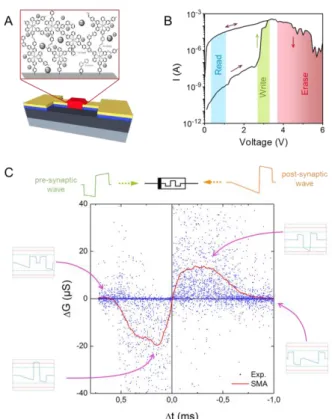
Neuromorphic computing has gained important attention since it is an efficient way to handle advanced cognitive tasks such as image recogni-tion and classificarecogni-tion. Hardware implementa-tion of an artificial neural network (ANN) re-quires arrays of scalable memory elements to act as artificial synapses. Memristors, which are two-terminal analog memory devices, are excel-lent candidates for this application as their tuna-ble resistance could be used to code and store synaptic weights with, in principle, low power consumption. In this work, we studied metal-organic-metal memristors in which the organic layer is a dense and robust electro-grafted thin film of redox complexes. The process allows fabricating planar and vertical junctions, as well as small crossbar arrays. The unipolar devices display non-volatile multi-level conductivity states with high RMAX/RMIN ratio and two dis-tinct thresholds. The characteristics of individu-al memristors were characterized in depth with respect to the targeted synaptic function. We notably showed that they possess the Spike Timing-Dependent Plasticity (STDP) property (their conductivity evolves as a function of the time-delay between incoming pulses at both terminals), which is critical for future applica-tions in neuromorphic circuits based on unsu-pervised learning. In parallel, we implemented a series of memristors as synapses in a simple prototype: a mixed circuit with the neuron im-plemented with conventional electronics. This ANN is able to learn linearly separable 3-input logic functions through an iterative supervised learning algorithm inspired by the Widrow-Hoff rule.
Keywords: spike timing-dependent plasticity,
electro-grafting, organic memristors, supervised learning, neuromorphic circuit.
Figure 1: A) Planar structure of the organic
memristor and schematic of the electro-grafted thin film of redox complexes. B) Unipolar switching behavior of single memristor. C) Cumulative STDP property of single organic memristor during ~4300 sequentially-applied voltage pulses with random time-delay of pre-/post-synaptic input.
References:
Bennett C.H., Chabi D., Cabaret T., Jousselme B., Derycke V., Querlioz D., Klein J.-O., (2015) Super-vised Learning with Organic Memristor Devices and Prospects for Neural Crossbar Arrays, NanoArch 2015 IEEE/ACM International Symposium, 181. Cabaret T., (2014) Etude, réalisation et caractérisa-tion de memristors organiques électro-greffés en tant que nanosynapses de circuits neuro-inspirés, Thesis.