Publisher’s version / Version de l'éditeur:
Technical Note (National Research Council of Canada. Division of Building Research), 1961-03-01
READ THESE TERMS AND CONDITIONS CAREFULLY BEFORE USING THIS WEBSITE. https://nrc-publications.canada.ca/eng/copyright
Vous avez des questions? Nous pouvons vous aider. Pour communiquer directement avec un auteur, consultez la première page de la revue dans laquelle son article a été publié afin de trouver ses coordonnées. Si vous n’arrivez pas à les repérer, communiquez avec nous à [email protected].
Questions? Contact the NRC Publications Archive team at
[email protected]. If you wish to email the authors directly, please see the first page of the publication for their contact information.
NRC Publications Archive
Archives des publications du CNRC
For the publisher’s version, please access the DOI link below./ Pour consulter la version de l’éditeur, utilisez le lien DOI ci-dessous.
https://doi.org/10.4224/20358900
Access and use of this website and the material on it are subject to the Terms and Conditions set forth at
Joint CMHC/DBR Meeting on Window Testing and Evaluation
Dickens, H. B.
https://publications-cnrc.canada.ca/fra/droits
L’accès à ce site Web et l’utilisation de son contenu sont assujettis aux conditions présentées dans le site
LISEZ CES CONDITIONS ATTENTIVEMENT AVANT D’UTILISER CE SITE WEB.
NRC Publications Record / Notice d'Archives des publications de CNRC: https://nrc-publications.canada.ca/eng/view/object/?id=9d73443e-a804-4a12-9d20-773d6ea79831 https://publications-cnrc.canada.ca/fra/voir/objet/?id=9d73443e-a804-4a12-9d20-773d6ea79831
DIVISION OF BUILDING RESEARCH
NATIONAL RESEARCH COUNCIL OF CANADA
'f
E
C
1HI N ][
(!
AlL
NOT FOR PUBLICATION
NOTlE
No.
327FOR INTERNAL USE
PREPARED BY H. B. Dickens CHECKED BY APPROVED BY N.B.H.
March 1961
PREPARED FOR The private use of Central Mortgage and Housing ヲZIセ
__
Corporation and the Division of Building Research セML
SUBJECT Joint CMHC/DBR meeting on window testing and evaluation.
An informal meeting to discuss the present situation concerning window testing and evaluation was held with CMRC and DBR representatives on Wednesday, 22 February 1961 at the Building Research Centre. Those present were:
Mr. I. E. Ashfield ) Mr. R. F. MacDonald ) M.r • A. G. Wilson )
Mr.
K. R. Solvason ) Mr. G.o.
Handegord ) Mr. H. B. Dickens ) CMRC DBRMr. Wilson opened the meeting by stating that the
imminent publication of CGSB specifications for aluminum windows had raised several important questions concerning the accepta-bility of certain types of double-glazed units which should be discussed with the Corporation. He mentioned that there are now available three CGSB specifications for aluminum windows:
63=GP-l- Windows; Aluminum, Vertical and Horizontal Sliding, 63-GP-2- Heavy DutyWindows; Aluminum, Vertical and Horizontal Sliding,
Medium Duty
63-GP-3- Windows; Aluminum, Vertical and Horizontal Sliding, Standard Duty.
It was pointed out that the specification for standard duty Windows, 63-GP-3, would be the one generally affecting windows
•
2
-in houses although the speoifioation for medium duty w-indows, 63-GP=2, would probably apply to some windows in apartments. In addition a specifioation for horizontal sliding sashless windows is being developed. This will cover units with either aluminum or wood frames.
Mr.
Ashfield indicated that the Corporation intends to require that all aluminum windows used in NHA housing meet the appropriate CGSB specification but thaT. it would be neoessary to provide sufficient notice of this intention to the manufacturers to permit them to have their windbws tested to determine their suitability under the specification. It was estimated that this might reqUire some considerable time and he suggested as a possible implementation date, 1 January 1963. Mr. Ashfield also said that he would prefer to implement this requirementthrough the new Canadian Housing Code now being prepared under the auspices of the NRC Associate Committee on the National Building Code.
It was recognized that there are three general test requirements arising from CGSB specification 63-GP-3, namely, structural tests, air infiltration tests, and thermal performance tests. This led to a discussion of the implioations to existing
windows of the thermal performance reqUirements of this specification and of the need to develop standard test conditions so that all
windows can be properly compared. This discussion was based largely on the material contained in the attached memorandum by
Mr.
Wilson(Appendix A). As this memorandum indicates, the Division9s
experience in window thermal testing relates more to commercial windows than to residential windows and sufficient information is not yet'available on the extent to which variations in test conditions will affect thermal performance in relation to
residential Windows. It was agreed that the Division should
assume responsibility for continuing development of a standardized method of test for thermal performance. It was also agreed
that until test procedures are developed sufficiently that the results obtained by other laboratories can be compared with confidence it would appear desirable that all acceptance tests for thermal performance be carried out by the Division. Air
infiltration tests and structural tests, however, are sufficiently well established that these could be carried out by regular
commercial laboratories. It was mentioned that both Warnock Hersey and
4.
v.
Roe had established facilities for carrying out air infiltratibn investigations.During the discussion of the thermal performance
reqUirements of the speoification, particularly the full thermal break reqUirements, the implications to present CMRC acceptance policies were explored as indicated under item l(b) of Appendix A.
•
3
-Mr.
Ashfield pointed out that although present housing standards require that only single sash be installed, CMHC upgrades these requirements on a regional basis by calling for double sashin certain areas of Canada, determined largely on the basis of local practice. In addition, where single sash are ー・イュゥエエ・、セ
and are installed in an area where it is likely that the owner will later install storm windows, a through metal frame may not be permitted bnt'instead a wood frame or'one with improved thermal
performance may be required. This again is handled on a regional basis. The possibility that the thermal break requirement might make aluminum frame windows prohibitive in cost relative to wood frame windows was briefly discussed. It was agreed that
Mr.
MacDonald would estimate the number of aluminum windows now
accepted by the Corporation which do not appear to have an adequate thermal break and which are therefore unlikely to meet the thermal performance reqUj.rements. These figures will give the Division an estimate of the initial total testing that may be required when CMRC makes the specification mandatory.
Wood windows were briefly discussed and it was pointed out that there is a CSA specification for such windows but that this is primarily a materials specification and does not contain a requirement for air leakage. Mr. Ashfield indicated that they would very likely wish to impose a requirement for air leakage
on all wood windows similar to the requirement contained in the specification for standard duty aluminum windows in order that both aluminum wood window manufacturers be treated on a
comparable basis. He also stated that wood windows at present used in housing financed under NHA are not listed in the CMHC Acceptance List unless they do not 」ッセヲッイュ to the intent of the
CSA specification and require acceptance on a special consideration basis.
At this point, results of air leakage tests on wood sashless windows which had been conducted by the Division were presented to the meeting (Table I). These: Snowed that very few of the windows of this type now used in housing would meet the air leakage requirement of 0.75 cu ft per min per ft at 25 mph Wind pressure but that this requirement could be achieved by
the addition of pressure locks to the window (see Table I). Finally, the present status of the DBR evaluation
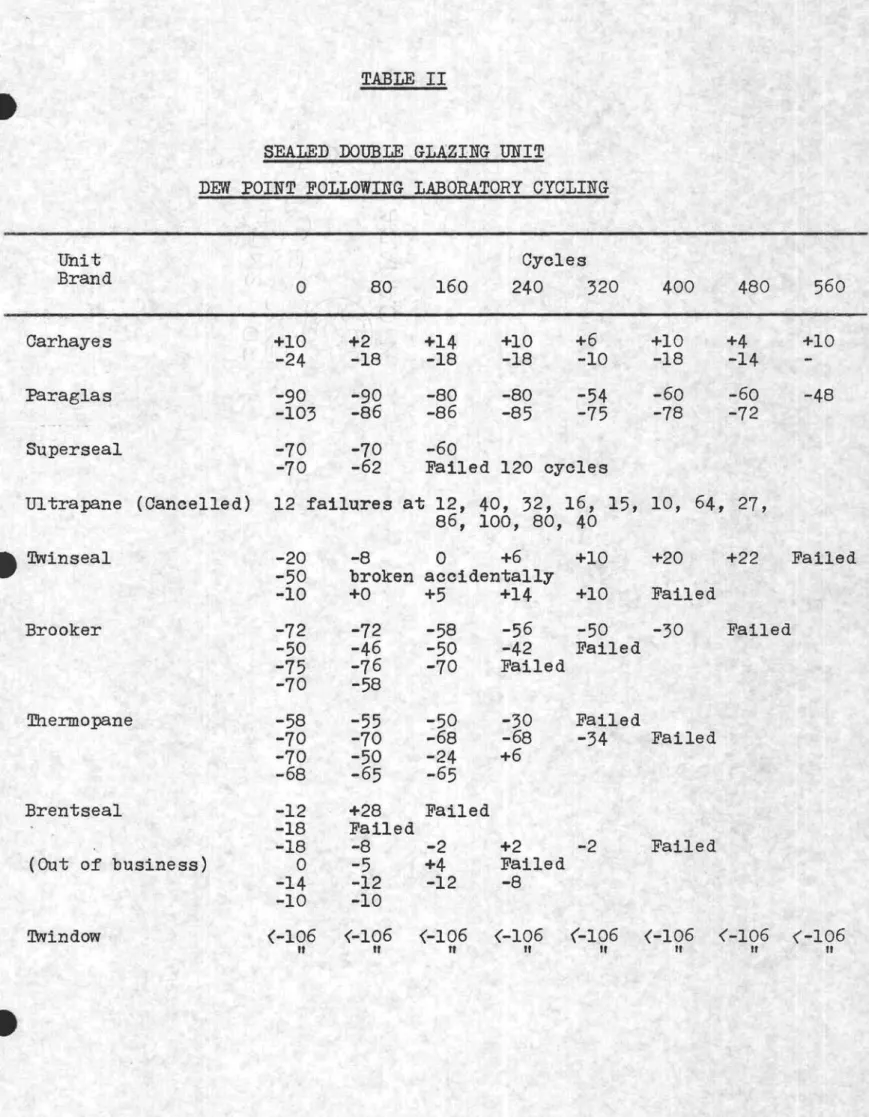
program of factory sealed glaZing was reviewed. A complete list of all factory sealed units examined to date was distributed at the meeting (Table II).
Mr.
Wilson drew attention to the fact that there was a very ,real difficulty in establishing criteria for acceptance of these units because of the complicationsintroduced by the use of desiccant in the units. The desiccant apparently varies in quantity depending on the manufacturer and
:
4
-because of its ability to absorb much moisture tends to obscure the degree to which the actual seal between the two panes of
glass has been destroyed during the accelerated weathering cycle. It was pointed out that approximately 1000 times as much moisture may be required to raise the dew point of the air within the sealed units from -90oF to 32°F in units with desiccant as compared to units without desiccant depending on the amount of desiccant used. The manufacturer, of course, could argue that some reduction of the seal between his units can be accepted
providing the desiccant is able to absorb the moisture introduced. Further consideration is needed to determine a valid criterion.
The tendency toward low temperatures at the edges of factory sealed glazing units was also discussed during which it was pointed out that the use of such units can actually make it easier to meet thermal break requirements in the CGSB specification since the frame has only to be as good as the saSh.
Mr.
Ashfield indicated that factory sealed glazing units with metal sash are not at present accepted by CMRC, although one or two have been accepted with plastic sash. In addition, CMRC does not permit sealed units to be used as sashless sliders.Finally, Mr. Ashfield informed the meeting that he had heard through the CMRC office in Edmonton that a firm was now in business there solely to repair and replace defective factory sealed glazed units.
TABLE I
RESULTS OF AIR LEAKAGE TESTS ON WOOD SASHLESS WINDOWS (PRIME UNIT ONLY. LOCKED)
Trade Locks Tracks Interior Dim. Crack Prime Unit Air Ratio of Name at Light Width x Height Length, Leakage Rate at Leakage to
Meeting ft 25 mph Wind, 0.75 CFM/ft SCFM/ft
1. Pierson Leaf spring Grooves in 44" x 35" 16.2 0.68 to 0.84 .91 to 1.12 top - pressure wood frame
lock bottom
2. Seaforth Pressure look Vinyl s11l 44" x 39" 17.l. 1.63 to 2.15 2.2 to 2.9 top and bottom traok in wood
frame
3. Pierson Rubber snubber Grooves in 48" x 41" 18.3 2.20 to 2.50 2.9 to 3.3 top - pressure wood frame
.
lock bottom
+. Pierson Rubber snubber Grooves in 48" x 41 " 18.3 2.70 3.6 top - pressure wood frame
look bottom
5. Pierson Rubber snubber Grooves in 36" x 36" 15.0 1.45 to 1.70 1.9 to- 2.3 top - pressure wood frame
look bottom
6. Pierson Rubber snubber Grooves in 36" x 17" 10.3 1.86 2.5 (a) top - pressure wood frame
lock. bottom
(b) Pressure lock 0.80 (43% of 1.06
top and bottom above)
7. Pierson
(a) Rubber snubber Grooves in 72" x 47" 23.8 2.38 3.2 top - pressure wood frame
look bottom
(b) Pressure look 1.06 1.4
top and bottom
(0) 2 pressure 0.38 .51
look top and 1 pressure lock bottom
(d) Rubber snubber Foam plastio weatherstrip at head traok 0.70 .93 top - pressure
lock bottom
(e) Rubber snubber Tubular vinyl weatherstrip at head traok 0.72 .96 top - pressure
look bottom
(f) Rubber snubber Increased ウ・。ャゥセ face along head track 2.00 2.7 top - pressure
TABLE II
SEALED DOUBLE GLAZING UNIT
DEW POINT FOLLOWING LABORATORY CYCLING
Unit Cycles Brand 0 80 160 240 320 400 480 560 Carhayes +10 +2 +14 +10 +6 +10 +4 +10 -24 -18 -18 -18 -10 -18 -14 Paraglas -90 -90 -80 -80 -54 -60 -60 -48 -103 -86 -86 -85 -75 -78 -72 Superseal -70 -70 -60 -70 -62 Failed 120 cycles
Ultrapane (Cancelled) 12 failures at 12, 40, 32, 16, 15, 10, 64, 27, 86, 100, 80, 40
e
iWinseal -20 -8 0 +6 +10 +20 +22 Failed -50 broken accidentally -10 +0 +5 +14 +10 Failed Brooker -72 -72 -58 -56 -50 -30 Failed -50 -46 -50 -42 Failed -75 -76 -70 Failed -70 -58 Thermopane -58 -55 -50 -30 Failed -70 -70 -68 -68 -34 Failed -70 -50 -24 +6 -68 -65 -65 Brentseal -12 +28 Failed -18 Failed -18 -8 -2 +2 -2 Failed, (Out of business) 0 -5 +4 Failed-14 -12 -12 -8 -10 -10
Twindow (-106 <-106 (-106 (-106 (-106 (-106 (-106 <-106
It u
-,
Table II - Continuedtt
Unit Cycles Brand 0 80 160 240 320 400 480 560 Permaseal +10 +16 +22 +22 Failed +20 Failed +8 +18 +18 +18 +14 +20 +24 -20 -12 -8 -4Heat Seal -30 Failed
-54 -54 -50 -44 -44 -30 -34 +8 -55 -50 -50 -50 -46 -32 +4 Dual Pane -10 -4 +10 +8 +12 +10 +8 +12 +2 +8 +5 +12 +16 +16 Failed +2 +14 Twinlite -40 Failed -30 Failed -40 -32 Failed -38 -30 -22 +16 Failed 250 cycles -24 -20 -16 -4 Failed -35 -24 Failed
e
Tru Vue ..8 0 +8 +6 +4 +12 +10 +18 (Winnipeg) -30 -5 +5 +4 +6 +18 +12 +18 Cudo -40 -30 -8 -10 -10 -10 0 +4 -40 -30 -30 broken accidentally -48 -30 -20 Vitric ..8 +8 +14 +10 +14 +14 +18 +20 -10 Failed +4 +10 +8 +14 +12 +12 +16 Hermaseal -30 Failed 124 cycles-10 0 Failed 95 cycles
-4 +12 +14 +16 +20 +22 -6 -6 +2 +6 +10 +14
Hedseal -76 -60 -48 -48 -48 -42 -42 -36 -52 -40 -30 -28 -24 -24 -20 -16 Alaska Seal -58 -42 -40 broken accidentally
-50 -6 -20 -30 -28 -36 -38 -36 -70 -24 broken accidentally
,
Table II - Continued-
Unit Cycles Brand 0 80 160 240 320 400 480 560 Polyglass -40 -24 -16 -20 Failed -36 -40 -30 +14 +22 Failed -35 -35 -35 -30 -35 -26 Failed 124 cycles Philex -50 -58 -38 -44 -38 -10 +14 +24 -38 -10 Failed -50 -48 -50 -46 -50 -46 Polarpane -100 -68 -56 -48 -38 -34 -26 -20 -100 -90 -38 -40 -30 -22 -22 -16 Multipane +22 +20 +26 +14 +6 +8 +6 -2 +20 +6 +4 broken accidentally +6 0 -2 -4 Tru Vu -8 +14 Failed +12 +28 Failede
+14 +30 Failed +20 +24 Failed +20 Failed +22 Failed +26 Failed +30 not cycled +20 +26 +20 Failed Armalux -90 -82 -26 -38 -38 -38 -36 -28 -78 -78 -60 -58 -60 -58 -58 -54Nr43-l7-l3W-6
FlL£ NO •.•• ••·•••
DATE;I;..9 セNセNZアセセ[アZZケN ..J96l
NATIONAL RESEARCH COUNCIL
Division of Building Research
MEMORANDUM:-TO: From: Re: H. B. Dickens A. G. Wilson
Window Testing and Specifications
The imminent publication of the CGSB Specifications for Windows, and questions raised relative to the acceptability of the Armicon insulating glass slider, have pointed to the need for an early meeting between members of the Division and CMRC relative to window testing and evaluation. There are questions to be discussed
under several headings.
1. Thermal Performance of Windows,'"
(a) Definition of full thermal break
The CGSB definition requires, in effect, that the inside temperature of the exposed frame should at no point be lower than the lowest glass temperature. The extent to which a window complies with this requirement may depend to some extent on the conditions
of test, particUlarly the method of introducing the heat into the test room and on the geometry of the window arrangement; for example, the projection of the stool or the amount that a window is recessed
in the test frame. It may also depend to some extent on the method of mounting and surrounding construction. Under some conditions it may not be possible for any practical aluminum window arrangement to meet the ideal window requirements if these are interpreted
strictly. It will perhaps be necessary to place some tolerance on the extent to which the aluminum surface temperatures must approach :glass temperatures.
It is clear that it will be necessary to develop standard test conditions so that all windows will be properly compared. The Division has already had considerable experience in window thermal testing but many of the test arrangements to date have been more appropriate for commercial windows than residential windows.
Sufficient information is not yet available on the extent to which variations in test conditions that might be used for residential windows will affect thermal performance. In this respect, the
present method of specifying thermal reqUirements in the CGSB
specifications (i.e. relating frame エ・ュー・イ。エオイ・ウエセ glass -temperatures) is better than specifying an absolute temperature requirement on the frame, since absolute temperatures are more likely to be affected by test conditions than the relative performance of frame and glass.
H. B. Dickens - A2 - 19 January 1961
Until test procedures are fully developed, it would appear desirable that acceptance tests should be carried out by a single laboratory. The practicality of the Division carrying out all tests required for CMRC acceptance, until test procedures are well defined, Should be explored with the Corporation. If this seems desirable the administration of the testing should be worked out. Perhaps it could follow the pattern set for the testing of factory sealed glazing units.
(b) Implications of full thermal break
It is probable that no windows with aluminum frames, presently used in residential construction, meet the full thermal break requirement in the CGSB specification. It would be of value to know at this point how many aluminum frame windows are being used in NHA construction. It will be necessary to estimate the number of windows that might be involved in connection with the testing referred to in (a) above. Records of the Corporation might be of assistance in this connection.
It has been proposed that aluminum frame windows incorporating the thermal breaks required to meet the CGSB specification would be prohibitive in cost relative to wood frame windows including those with aluminum guides, such as the Weatherstone. This would mean
that essentially no double windows with aluminum frames would be used in }TI{A construction. Perhaps this is already the situation. However,
there are perhaps two potential anomalies or weaknesses in the Corporation's position in this respect.
First, if there is presently no restriction on the use of single windows, the use of these may be encouraged by the requirement for full thermal breaks in double aluminum windows. Also it may seem inconsistent to carefully specify ideal イセuゥイ・ュ・ョエウ for the thermal performance of double windows when single metal windows are permitted. Secondly, there is the question of the acceptability of factory
sealed glazing units from the thermal standpoint. The use of factory sealed glazing units actually makes it much easier to meet the thermal break reqUirements in the CGSB specification, since the frame has
only to be as good as the sash. Our measurements have shown that even with the edges of the units buried in glazing compound as
recommended by the manufacturer for fixed sash, surface temperatures at the edge of the factory sealed glazing units are considerably lower than at the edge of the double glazing in wood sash. When the factory sealed glazing units are used as sliders, with edges partly exposed, the surface temperatures will be still lower and frames of correspondingly low thermal resistance will be suitable. It perhaps may seem inconsistent to be so concerned about the thermal performance
H. B. Dickens - A3 - 19 January 1961
are to be installed alongside these windows. Although the frames for use with sliding factory sealed glazing units can easily be made to meet the present wording of the thermal requirements in the CGSB
specifications, the suitability of the sash itself must be considered. If it is considered an acceptable arrangement, it would seem that
the thermal reqUirements of the CGSB specifications will encourage its use in lieu of some other double glaZing arrangements that would be thermally superior but which would impose more stringent require-ments on the frame.
2. Air Leakage Requirements on Sashless Windows
The proposal to put an upper limit of 0.75 cfm per foot
at 25 mph wind pressure on sashless horizontal sliding windows should perhaps be considered in relation to the results of air leakage
measurements carried out by DBR. Although the requirement is highly desirable, it would also appear that it is unlikely to bernet by any of the unweatherstripped horizontal sliders in either wood, metal or vinyl tracks presently on the market. The requirement might lead to some desirable improvements in horizontal sliding windows, but on the other hand it might also make it difficult for this type of window to compete with the traditional unweatherstripped wood double hung Window, which it has been replacing, unless some reqUirements are introduced for this type of window as well. 3. Factory Sealed Glazing Units
It has been nine months since the last general discussion with officers of the Corporation on the factory sealed glaZing
evaluation program. Some experience has subsequently been obtained in the laboratory weathering apparatus on several units and it would be desirable to review the situation again.
One of the major problems is going to be establishing criteria based on the results of the laboratory weathering tests. One of the major complications in this will be the effect on results of the desiccant in the units. With many of the units under test leakages have developed but the dew points have risen only slightly as a result of the moisture up-take of the desiccant. Some
consideration of this has shown that about 1000 times as much moisture may be required to raise the dew point from minus 90°F
to 32°F in units with desiccant as compared to units Without desiccant, depending on the amount of desiccant used. This raises the important question of whether a comparable and appropriate amount of desiccant has been used in all units submitted for test. Furthermore, although the laboratory weathering apparatus may accelerate the failure of
the sealing arrangements used in various types of units in a comparable manner, it is not clear to what extent the treatment accelerates the transfer of moisture. This makes it especially difficult to compare the performance of units with and without desiccant, or with different amounts of desiccant. From this standpoint the number of cycles required to produce a significant dew point rise may be a more valid criterion than the cycles
required to produce 32°F dew point. Testing all units キゥエセッオエ
desiccant might be an approach to consider.
In view of the items listed above, it is suggested that a meeting be arranged between officers of the Division and the Corporation at the earliest convenience of all concernedo
,
H. B. Dickens - A4 - 19 January 1961
(Signed) A. Grant Wilson AGW:EC