Short-Term (5-Day) Changes in Food Intake
Alter Daily Hemodynamics in Rabbits
Vladan Antic, Abdul Dulloo, and Jean-Pierre Montani
Background: In humans, particularly among
individ-uals trying to lose weight, cycles of hypophagia followed by cycles of hyperphagia are quite common and may lead to an increased cardiovascular morbidity. The aim of the present study was to evaluate the alterations in daily mean arterial pressure (MAP) and heart rate (HR) during short-term (5-day) changes in food intake.
Methods: Adult male rabbits instrumented for
contin-uous (24 h/day) telemetric recording of blood pressure (BP) and HR were subjected to five 14-day periods of altered food intake. Each period consisted of 5 days in which food intake was set to ⫺50%, ⫺25%, ⫹25%,
⫹50%, or ⫹100% (food ad libitum) per day followed by
9 days at 150 g/day of maintenance diet.
Results: The increase in food intake induced an
imme-diate and significant increase in HR and a less pronounced increase in MAP. Similarly, a 25% and 50% decrease in
food intake induced a decrease in HR and MAP. Unlike the increase in HR during hyperphagia, which reached a plateau after 1 day, the decrease in HR during hypophagia was progressive. The effect of hyperphagia on MAP and HR was reversible within 1 day, whereas hypophagia induced changes were persistent over several days.
Conclusions: A highly significant linear relationship
can be established across the alterations in food intake (from ⫺50% to ⫹100%) and the respective changes in blood pressure (BP) or HR. These data suggest that prompt changes in hemodynamics induced by alterations in food intake might be implicated in the early events during weight gain or during weight loss. Am J Hypertens 2003;16:302–306 © 2003 American Journal of Hyperten-sion, Ltd.
Key Words: Hemodynamics, hyperphagia,
hypopha-gia, hypertension, rabbits.
O
verweight and obese individuals in industrializedsocieties are under constant medical and social pressure to lose weight. Because long-term weight loss is rarely attained, this leads to repeated bouts of dieting that usually interchange with the same number of weight regain intervals. Health consequences of weight cycling are still a subject of controversy.
On the other hand, even short periods of overeating or fasting without significant changes in body weight may affect metabolic and hemodynamic parameters. It cannot be excluded that frequent, short-term, hyper-/hypophagia induced hemodynamic changes may have deleterious ef-fects on overall cardiovascular risk and thus possibly con-fer the harmful health effects of weight cycling. However, not much is known about the nature of the relationship between short-term alterations in food intake and blood pressure (BP) and heart rate (HR), particularly in humans. In a series of six normotensive subjects of normal weight, O’Dea et al1 reported minor changes in BP and sympa-thetic activity (noradrenaline turnover) after 10 days of
either over- or underfeeding. In moderately obese and borderline hypertensive women, a short (3-day) protocol of semistarvation had very little effect on hemodynamic parameters.2A number of animal studies have focused on the hemodynamic changes that occur with high fat diet induced obesity or with food restriction; however, most of the studies focused on the long-term effects of food alter-ations rather than on the early phase changes, ie, within the first few days of food alterations.
High fat diet overfeeding induces hypertension and tachycardia in dogs3,4and rabbits.5,6Surprisingly, in our rabbits,6tachycardia and hypertension occurred within the very first days following the switch to high fat diet. This effect was clearly independent of weight gain, which oc-curred later in the experiment, and was mediated to a large extent by the activation of the sympathetic nervous sys-tem.7However, because the experimental protocol in our previous studies was designed to assess the chronic effects of high fat intake and obesity, we were unable to distin-guish the effects of hyperphagia per se from the effects of Received May 21, 2002. First decision July 11, 2002. Accepted
October 30, 2002.
From the Department of Medicine/Physiology, University of Fri-bourg, FriFri-bourg, Switzerland.
This work was supported in part by grants from the Swiss National
Science Foundation (3100-061634.00 and 3200.061687).
Address correspondence and reprint requests to Dr. Jean-Pierre Mon-tani, Department of Medicine/Physiology, University of Fribourg, Rue du Muse´e 5, CH-1700 Fribourg, Switzerland; e-mail: [email protected]
0895-7061/03/$30.00 © 2003 by the American Journal of Hypertension, Ltd. doi:10.1016/S0895-7061(02)03272-7 Published by Elsevier Science Inc.
high fat diet and to study in more detail the acute changes induced by hyperphagia with a normal fat diet.
In the present study, to gain insight into the relationship between acute changes in food intake and hemodynamic parameters, we followed the dynamics of BP and HR changes and sodium balance during transient alterations in food intake in rabbits. To keep the proportions of nutrients ingested constant, as well as to eliminate the specific effects of increased fat intake, normal rabbit chow was used throughout the experiment.
Materials and Methods
Animal Preparation
Adult male lop-eared rabbits (body weight 4.33 ⫾ 0.10 kg) of the breed Be´lier Franc¸ais were used in this study. All protocols were approved by the State Animal Com-mittee. Under halothane anesthesia and aseptic techniques, the rabbits were instrumented with an implantable pres-sure transducer and radio transmitter (model TA11PA-C40, Data Sciences International, St. Paul, MN) to monitor arterial pressure by telemetry, as described previ-ously.6After surgery, the rabbits were housed in individ-ual cages customized for urine collection, in a quiet air-conditioned room with a 12-h light– dark cycle. The rabbits were allowed to recover for at least 10 days before the start of the experiments. All animals had free access to tap water and were fed 150 g of standard rabbit chow daily (Provimi Kliba, Kaiseraugst, Switzerland).
Continuous Hemodynamic Monitoring By Telemetry
Each metabolic cage was equipped with receivers, con-nected via a multiplexer to a calibrated pressure analog adapter, as described previously.6 The analog pressure signal was then sent to an A/D converter and processed by a personal computer using customized algorithms8to com-pute mean arterial pressure (MAP) and HR on a beat-to-beat basis. The signal was sampled at 500 Hz, for 5-sec periods every 30 sec, from 10 am to 8 am the next morning.
Experimental Protocol
Nine rabbits kept on standard rabbit chow (150 g/day) were subjected to five 14-day cycles of altered food intake. Each cycle consisted of 5 days of increased or decreased food intake of regular chow followed by 9 days of recov-ery at 150 g/day of regular chow. Altered amount of food were ⫺50% (75 g/day), ⫺25% (112.5 g/day), ⫹25% (187.5 g/day), or ⫹50% (225 g/day) as compared with maintenance of 150 g/day and a period with ad libitum food intake (301.6⫾ 8.4 g/day, thus about ⫹100%). The sequence of cycles was randomly chosen for each animal, but such that a cycle of restricted food intake was followed by a cycle of increased food intake. Body weight was measured twice per week. The amount of 150 g/day of
regular chow as maintenance diet was established based on the energy need of rabbits and empirically as quantity that allows Be´lier Franc¸ais rabbits to reach 4.5 kg of body weight at the age of 35 weeks.
Analytical Measurements
Urine sodium was determined by flame photometry (mod-el IL 943, Instrumentation Laboratory, Lexington, MA).
Statistical Analysis
Statistical analysis within group was performed by analy-sis of variance for repeated measurements. As each rabbit within a group served as its own control, experimental values were compared with control values in each group using Dunnett’s multiple comparison procedure. Changes were considered to be statistically significant if P was⬍ .05.
Results
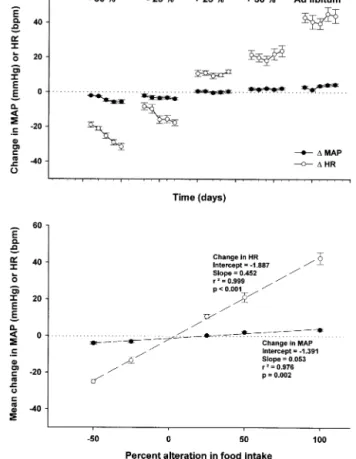
No significant fluctuations in body weight were observed throughout the experiment. Five-day alterations in normal chow intake induced changes both in HR and in BP (Fig. 1A). The increase in food amount by 25% (to 187.5 g/day) caused a slight but statistically nonsignificant rise in BP, whereas HR increased significantly from 176.6 ⫾ 2.3 beats/min to 187.4⫾ 2.5 beats/min on day 1 and remained stable until day 5 of altered food intake (188.6 ⫾ 2.1 beats/min at day 5). A 50% increase in food intake (225 g/day) induced a modest but statistically significant rise in BP, from 66.5⫾ 3.9 mm Hg to 68.5 ⫾ 4.1 mm Hg at day 1 (P⬍ .01), which remained unchanged through the 5-day period (68.8 ⫾ 3.9 at day 5). Heart rate increased con-comitantly from 177.2⫾ 3.3 to 198.7 ⫾ 2.1 beats/min on day 1 and to 201.0 ⫾ 2.0 beats/min on day 5 of ⫹50% food intake. Five days of food ad libitum (301.6 g and 8.4 g/day) or⫹100% caused even more pronounced changes in hemodynamic parameters. The MAP increased from 63.5⫾ 3.6 to 66.5 ⫾ 4 mm Hg on day 1 and to 67.9 ⫾ 4.1 mm Hg on day 5 of ad libitum intake. In parallel, HR increased from 175.6⫾ 2.3 to 218.6 ⫾ 3.5 beats/min on day 1 and to 219.5⫾ 4.6 beats/min on day 5.
The decrease in food intake by 25% (to 112.5 g/day) induced a drop in BP (from 69.0⫾ 2.9 to 65.2 ⫾ 3.4 mm Hg; P ⬍ .01), as well as a progressive reduction in HR from 181.0⫾ 2.7 to 172.8 ⫾ 3.6 beats/min on day 1 and to 163.5⫾ 3.2 beats/min on day 5. Furthermore, a 50% decrease in food intake (75 g/day) induced a significant drop in BP from 69.2⫾ 2.8 to 63.6 ⫾ 2.9 on day 5, and a marked and progressive drop in HR from 183.0⫾ 4.0 to 164.1 ⫾ 4.6 beats/min on day 1 and to 151.6 ⫾ 3.4 beats/min on day 5 of the restricted food period. The effects of moderate hyperphagia on MAP and HR were reversible within 1 day. However, the recovery of HR after 5 days of reduced food intake was not complete within 1 week of observation. In addition, the normalization of BP
and HR after 5 days of food intake ad libitum required several days.
To assess the relationship between observed changes in MAP and HR on one hand and food intake alterations on the other, linear regression analysis was performed. For each 5-day period of altered food intake, the mean change in MAP and HR was calculated. As shown in Fig. 1B, a linear relationship can be established when alterations in MAP and HR are plotted against the changes in food intake. Both regression lines show a highly significant correlation (P⬍ .001; r2⬎ 0.9).
Sodium balance followed the changes in MAP and HR. Increases in food intake of 25%, 50%, and ad libitum (ap-proximately 100%) induced a positive sodium balance of 0.9
⫾ 1.8 mmol/day, 2.6 ⫾ 1.5 mmol/day and 6.5 ⫾ 1.0 mmol/
day, respectively, whereas decreases in food intake of 25% and 50% caused a negative sodium balance of⫺0.8 ⫾ 0.6 mmol/day and⫺5.5 ⫾ 0.4 mmol/day, respectively.
Discussion
Although the effect of caloric restriction on reducing BP and HR is well established in long-term experiments,9,10
the dynamic characteristics of this relationship in the short-term are not well known. Furthermore, there is scarce information on the acute effect of step-change in-creases in the amount of standard diet on these hemody-namic parameters.
We assessed the effects of 5-day quantitative alterations in food intake. Despite the absence of body weight changes, hemodynamic changes occurred rapidly after the switch to altered food intake. Increase in food intake by 25%, 50%, and 100% caused a prompt increase in HR that reached a plateau the very first day, with no further sig-nificant increase observed during the next 4 days. This increase in HR was accompanied by a slight but significant increase in MAP (at the⫹50% and ⫹100% food intake levels) that followed the same dynamics. The effect of the increase of food intake by 25% and 50% on HR and BP was reversed within 1 day when the amount of food given was reversed to the baseline value (150 g/day). However, the observed increases in HR and BP with feeding ad libitum (⫹100%) was more pronounced and reversed only within several days after the end of food intake alterations. The consequences of food intake restriction were compa-rable in amplitude to the previously mentioned changes with increased food intake; however, several distinctions should be mentioned. The HR decrease induced by re-duced food intake was progressive and did not reach a plateau within 5 days. In addition, recovery of HR after 5 days of restricted food intake was not complete over a period of several days. This data suggest that metabolic adaptation and mechanisms implied in the adaptation to reduced food intake cause changes in cardiovascular reg-ulation that persist well beyond the period of altered food intake.
The novel finding of this study is the information on the nature of the relationship between the short-term alter-ations in food intake and changes in HR and MAP. We found that a remarkably linear relationship can be estab-lished between the percentage change in food intake and the respective change in HR and BP. However, it should be noted that the relationship applies to a range from
⫺50% to ⫹100% of food intake when compared with the
food quantity of the maintenance diet. One may hypothe-size that the relationship beyond these limits, particularly toward even more restricted food intake, is not necessarily linear. In addition, in this study, the steady state level for HR was not reached during 5 days of 50% food restriction, although our linear regression is based on the average for the 5 days of altered food intake. However, it should be noted that linear regression based on the values from day 5 for each period shows also respectable linearity with r2
⬎ 0.9 (data not shown).
Alterations in the autonomic nervous activity is the most likely mechanism implicated in the hemodynamic changes observed, although this was not tested in our study. Adaptation to excess food intake includes an in-crease in sympathetic activity that may lead to a rise in HR and BP and a parallel increase in energy expenditure.11
FIG. 1. A) Changes in mean arterial pressure (MAP) and heart rate
(HR) induced by 5-day alterations in food intake. All values are significantly different from the control value that precedes the al-teration (P ⬍ .05), except for changes in MAP induced by 25% increase in food intake (n ⫽ 9). All values are expressed as mean ⫾ SEM. B) Regression analysis for mean values changes in MAP and HR over 5-day periods plotted against the respective alterations in food intake (n ⫽ 9). All values are expressed as mean ⫾ SEM. bpm ⫽ beats per minute.
However, this adaptation in rabbits shows a rapid rise to the maximum values, which is likely driven by overfeed-ing induced changes and which also vanishes rapidly after the period of overfeeding. Consistent with the role of the sympathetic nervous system is the finding that sympathetic blockade prevents or attenuates the hypertension induced by long-term fat overfeeding in rabbits7and dogs.12 Hu-man studies on short-term excess or restriction in food intake similarly suggest a major role of the sympathetic system in the observed hemodynamic changes.1,2,13 In addition, a significant decrease in parasympathetic activity may occur in overfeeding, as found in both animal14and human15studies.
Insulin is a plausible candidate for the mediator of the early effect of overfeeding on sympathetic nervous activ-ity. The acute effects of insulin on sympathetic nervous activity have been extensively documented.16 –19 How-ever, the role of acute hyperinsulinemia in elevating BP remains controversial.20
Postprandial alterations in endo-thelial function are likely to potentiate the effect of sym-pathetic activation on the vasculature.21–23In parallel with impaired endothelium-dependent vasodilation, stimulation of endothelin production by insulin may also promote vasoconstrictive effects.24,25
Leptin, in addition to its presumed role in the chronic regulation of food intake and energy expenditure, may also participate in the acute changes induced by alteration of food intake. Overfeeding induces an increase in plasma leptin concentration within several hours.26Elevated lev-els of leptin through its hypothalamic peptidergic media-tors may stimulate the sympathetic nervous system.27,28 Conversely, food restriction rapidly reduces leptin levels in both animals29and humans.30
The rapid changes in sodium balance that we observed may have more than one source. Again, sympathetic acti-vation and its renal sodium retaining effects are likely to be involved.3 In addition, acute hyperinsulinemia may di-rectly induce sodium retention.31
We hypothesize that even short-term fluctuations in food intake may have harmful consequences on the car-diovascular system. The practically continuous postpran-dial state induced by overfeeding may alter functional characteristics of the endothelial cells and promote vaso-constricting events that may in turn potentiate BP eleva-tion. In addition, the reported detrimental effects of weight cycling on the cardiovascular risk32–34may in part be due to acute hemodynamic alterations induced by frequent dieting and overfeeding.
Acknowledgments
The authors thank Mr. Aldo Tempini and Ms. Marie-Franc¸oise Baeriswyl for technical help and analytical mea-surements, as well as Mr. Laurent Monney, Mr. Andre´ Gaillard and Mr. Edouard Regli for the general set-up of the animal room.
References
1. O’Dea K, Esler M, Leonard P, Stockigt JR, Nestel P: Noradrenaline turnover during under- and over-eating in normal weight subjects. Metabolism 1982;31:896 –899.
2. Andersson B, Elam M, Wallin BG, Bjorntorp P, Andersson OK: Effect of energy-restricted diet on sympathetic muscle nerve activity in obese women. Hypertension 1991;18:783–789.
3. Hall JE, Brands MW, Dixon WN, Smith MJ Jr: Obesity-induced hypertension. Renal function and systemic hemodynamics. Hyper-tension 1993;22:292–299.
4. Rocchini AP, Moorehead CP, DeRemer S, Bondie D: Pathogenesis of weight-related changes in blood pressure in dogs. Hypertension 1989;13:922–928.
5. Carroll JF, Dwyer TM, Grady AW, Reinhart GA, Montani JP, Cockrell K, Meydrech EF, Mizelle HL: Hypertension, cardiac hy-pertrophy, and neurohumoral activity in a new animal model of obesity. Am J Physiol 1996;271:H373–H378.
6. Antic V, Tempini A, Montani JP: Serial changes in cardiovascular and renal function of rabbits ingesting a high-fat, high-calorie diet. Am J Hypertens 1999;12:826 –829.
7. Antic V, Kiener-Belforti F, Tempini A, Van Vliet BN, Montani JP: Role of the sympathetic nervous system during the development of obesity-induced hypertension in rabbits. Am J Hypertens 2000;13: 556 –559.
8. Montani JP, Mizelle HL, Van Vliet BN, Adair TH: Advantages of continuous measurement of cardiac output 24 h a day. Am J Physiol 1995;269:H696 –H703.
9. Brozek J, Chapman CB, Keys A: Drastic food restriction: effect on cardiovascular dynamics in normotensive and hypertensive condi-tions. JAMA 1948;137:1569 –1574.
10. Walford RL, Harris SB, Gunion MW: The calorically restricted low-fat nutrient-dense diet in Biosphere 2 significantly lowers blood glucose, total leukocyte count, cholesterol, and blood pressure in humans. Proc Natl Acad Sci U S A 1992;89:11533–11537. 11. Landsberg L, Young JB: The role of the sympathoadrenal system in
modulating energy expenditure. Clin Endocrinol Metab 1984;13: 475–499.
12. Rocchini AP, Mao HZ, Babu K, Marker P, Rocchini AJ: Clonidine prevents insulin resistance and hypertension in obese dogs. Hyper-tension 1999;33:548 –553.
13. Sowers JR, Nyby M, Stern N, Beck F, Baron S, Catania R, Vlachis N: Blood pressure and hormone changes associated with weight reduction in the obese. Hypertension 1982;4:686 –691.
14. Van Vliet BN, Hall JE, Mizelle HL, Montani JP, Smith MJ Jr: Reduced parasympathetic control of heart rate in obese dogs. Am J Physiol 1995;269:H629 –H637.
15. Arone LJ, Mackintosh R, Rosenbaum M, Leibel RL, Hirsch J: Autonomic nervous system activity in weight gain and weight loss. Am J Physiol 1995;269:R222–R225.
16. Muntzel MS, Morgan DA, Mark AL, Johnson AK: Intracerebroven-tricular insulin produces nonuniform regional increases in sympa-thetic nerve activity. Am J Physiol 1994;267:R1350 –R1355. 17. Rowe JW, Young JB, Minaker KL, Stevens AL, Pallotta J,
Lands-berg L: Effect of insulin and glucose infusions on sympathetic nervous system activity in normal man. Diabetes 1981;30:219 –225. 18. Vollenweider P, Randin D, Tappy L, Jequier E, Nicod P, Scherrer U: Impaired insulin-induced sympathetic neural activation and va-sodilation in skeletal muscle in obese humans. J Clin Invest 1994; 93:2365–2371.
19. Scherrer U, Randin D, Tappy L, Vollenweider P, Jequier E, Nicod P: Body fat and sympathetic nerve activity in healthy subjects. Circulation 1994;89:2634 –2640.
20. Anderson EA, Hoffman RP, Balon TW, Sinkey CA, Mark AL: Hyperinsulinemia produces both sympathetic neural activation and vasodilation in normal humans. J Clin Invest 1991;87:2246 –2252.
21. Jagla A, Schrezenmeir J: Postprandial triglycerides and endothelial function. Exp Clin Endocrinol Diabetes 2001;109(Suppl):S533– S547.
22. Stepniakowski KT, Sallee FR, Goodfriend TL, Zhang Z, Egan BM: Fatty acids enhance neurovascular reflex responses by effects on alpha 1-adrenoceptors. Am J Physiol 1996;270:R1340 –R1346. 23. Stepniakowski KT, Goodfriend TL, Egan BM: Fatty acids enhance
vascular alpha-adrenergic sensitivity. Hypertension 1995;25:774 –778. 24. Cardillo C, Nambi SS, Kilcoyne CM, Choucair WK, Katz A, Quon MJ, Panza JA: Insulin stimulates both endothelin and nitric oxide activity in the human forearm. Circulation 1999;100:820 –825. 25. Nava P, Collados MT, Masso F, Guarner V: Endothelin mediation
of insulin and glucose-induced changes in vascular contractility. Hypertension 1997;30:825–829.
26. Kolaczynski JW, Ohannesian JP, Considine RV, Marco CC, Caro JF: Response of leptin to short-term and prolonged overfeeding in humans. J Clin Endocrinol Metab 1996;81:4162–4165.
27. Haynes WG, Morgan DA, Walsh SA, Mark AL, Sivitz WI: Recep-tor-mediated regional sympathetic nerve activation by leptin. J Clin Invest 1997;100:270 –278.
28. Dunbar JC, Hu Y, Lu H: Intracerebroventricular leptin increases
lumbar and renal sympathetic nerve activity and blood pressure in normal rats. Diabetes 1997;46:2040 –2043.
29. MacDougald OA, Hwang CS, Fan H, Lane MD: Regulated expres-sion of the obese gene product (leptin) in white adipose tissue and 3T3-L1 adipocytes. Proc Natl Acad Sci U S A 1995;92:9034 –9037. 30. Boden G, Chen X, Mozzoli M, Ryan I: Effect of fasting on serum leptin in normal human subjects. J Clin Endocrinol Metab 1996;81: 3419 –3423.
31. DeFronzo RA, Cooke CR, Andres R, Faloona GR, Davis PJ: The effect of insulin on renal handling of sodium, potassium, calcium, and phosphate in man. J Clin Invest 1975;55:845–855.
32. Hamm P, Shekelle RB, Stamler J: Large fluctuations in body weight during young adulthood and twenty-five-year risk of coronary death in men. Am J Epidemiol 1989;129:312–318.
33. Lissner L, Odell PM, D’Agostino RB, Stokes J III, Kreger BE, Belanger AJ, Brownell KD: Variability of body weight and health outcomes in the Framingham population. N Engl J Med 1991;324: 1839 –1844.
34. Folsom AR, French SA, Zheng W, Baxter JE, Jeffery RW: Weight variability and mortality: the Iowa Women’s Health Study. Int J Obes Relat Metab Disord 1996;20:704 –709.