SUPPLEMENTAL MATERIAL:
Influencers identification in complex networks
through reaction-diffusion dynamics
I. SUPPLEMENTARY FIGURES AND TABLES
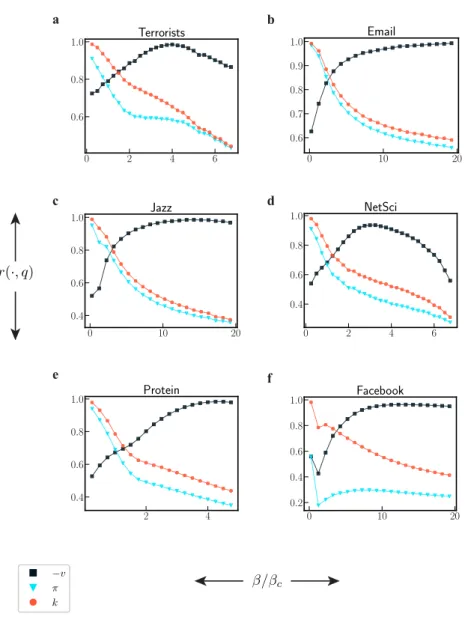
0 10 20 0.6 0.7 0.8 0.9 1.0 Email 0 10 20 0.2 0.4 0.6 0.8 1.0 Facebook 0 10 20 0.4 0.6 0.8 1.0 Jazz 0 2 4 6 0.4 0.6 0.8 1.0 NetSci 0 2 4 6 0.6 0.8 1.0 Terrorists r(·, q) a b c β/βc d e f −0.04 −0.02 0.00 0.02 0.04 −0.04 −0.02 0.00 0.02 0.04 −v π k 2 4 0.4 0.6 0.8 1.0 Protein
FIG. S1. Contact-network spreading model: a comparison between nodes centrality and node spreading ability q in the real networks analyzed in the main text. Each panel shows the Pearson linear correlation r between nodes centrality and nodes spreading ability q. Differently from the main text (Fig. 3 and Fig. 4), the metrics considered in addition to ViralRank (v) are PageRank (π), with dumping parameter c = 0.85 and degree centrality (k). Results are for: (a) 9/11 terrorists, (b) email, (c) jazz collaborations, (d) network scientists co-authorships, (e) protein interactions and (f) Facebook friendships. The PageRank performance is qualitatively similar but always worse than that of the degree centrality.
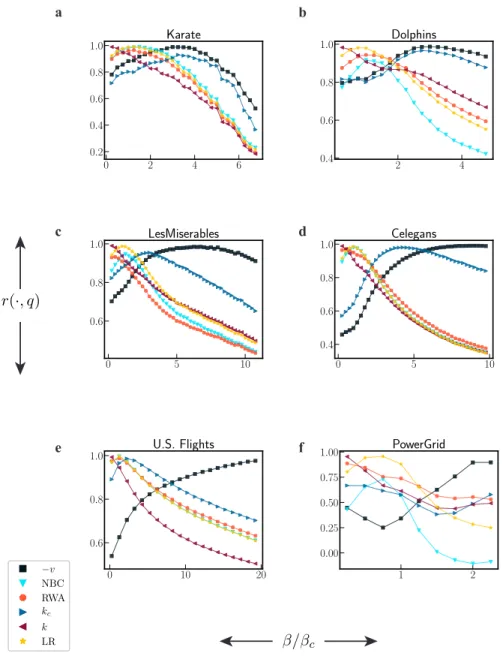
−0.04 −0.02 0.00 0.02 0.04 −0.04 −0.02 0.00 0.02 0.04 −v NBC RWA kc k LR a b c d e f
β/β
cr(
·, q)
0 5 10 0.4 0.6 0.8 1.0 Celegans 2 4 0.4 0.6 0.8 1.0 Dolphins 0 2 4 6 0.2 0.4 0.6 0.8 1.0 Karate 0 5 10 0.6 0.8 1.0 LesMiserables 1 2 0.00 0.25 0.50 0.75 1.00 PowerGrid 0 10 20 0.6 0.8 1.0 U.S. FlightsFIG. S2. Contact-network spreading model: a comparison between nodes centrality and nodes spreading ability q in real networks. Pearson linear correlation between nodes centrality and q as a function of β/βcfor six additional datasets: (a) karate club friendships, (b) dolphins interactions, (c) characters co-appearances in the novel ’Les Miserables’, (d) C.elegans neural connections, (e) U.S. domestic flights and (f) U.S. powergrid supply lines. The structural properties of these networks, and of all other datasets, are reported in Table S1.
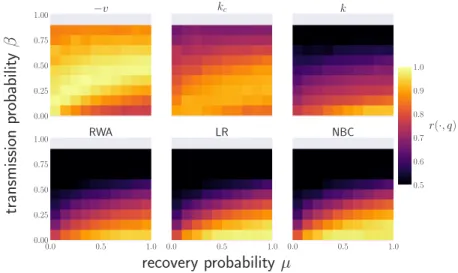
0.00 0.25 0.50 0.75 1.00 −v kc k 0.0 0.5 1.0 0.00 0.25 0.50 0.75 1.00 RWA 0.0 0.5 1.0 LR 0.0 0.5 1.0 NBC 0.5 0.6 0.7 0.8 0.9 1.0
recovery probability µ
transmission
probabilit
y
β
r(·, q)FIG. S3. Correlation in the full parameter space (β, µ) for 9/11 terrorists network.
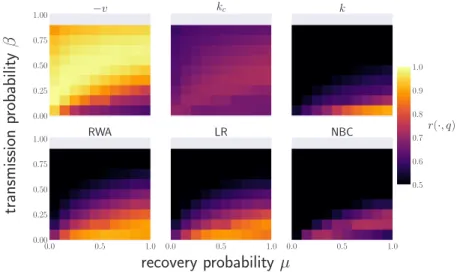
0.00 0.25 0.50 0.75 1.00 −v kc k 0.0 0.5 1.0 0.00 0.25 0.50 0.75 1.00 RWA 0.0 0.5 1.0 LR 0.0 0.5 1.0 NBC 0.5 0.6 0.7 0.8 0.9 1.0
recovery probability µ
transmission
probabilit
y
β
r(·, q)FIG. S4. Correlation in the full parameter space (β, µ) for jazz collaborations network.
0.00 0.25 0.50 0.75 1.00 −v kc k 0.0 0.5 1.0 0.00 0.25 0.50 0.75 1.00 RWA 0.0 0.5 1.0 LR 0.0 0.5 1.0 NBC 0.5 0.6 0.7 0.8 0.9 1.0
recovery probability µ
transmission
probabilit
y
β
r(·, q)0.00 0.25 0.50 0.75 1.00 −v kc k 0.0 0.5 1.0 0.00 0.25 0.50 0.75 1.00 RWA 0.0 0.5 1.0 LR 0.0 0.5 1.0 NBC 0.5 0.6 0.7 0.8 0.9 1.0
recovery probability µ
transmission
probabilit
y
β
r(·, q)FIG. S6. Correlation in the full parameter space (β, µ) for protein interaction network.
0.00 0.25 0.50 0.75 1.00 −v kc k 0.0 0.5 1.0 0.00 0.25 0.50 0.75 1.00 RWA 0.0 0.5 1.0 LR 0.0 0.5 1.0 NBC 0.0 0.2 0.4 0.6 0.8 1.0
recovery probability µ
transmission
probabilit
y
β
r(·, q)FIG. S7. Correlation in the full parameter space (β, µ) for Facebook friendships network.
N L D C hki hk2i βc βu/βc Ref. Karate 34 78 5 0.57 4.59 35.65 0.1477 2.50 [1] Terrorists 62 152 5 0.49 4.90 40.03 0.1396 2.50 [2] Dolphins 62 159 8 0.26 5.13 34.90 0.1723 2.00 [3] LesMiserables 77 254 5 0.57 6.60 79.53 0.0905 3.50 [4] Email 167 3250 5 0.59 38.92 2508.78 0.0158 6.50 [5] Jazz 198 2742 6 0.62 27.70 1070.24 0.0266 4.25 [6] Celegans 297 2148 5 0.29 14.04 365.70 0.0399 5.75 [7] NetSci 379 914 17 0.74 1.15 9.22 0.1424 2.00 [8] U.S. Flights 500 2980 7 0.62 11.92 641.12 0.0189 8.00 [9] Protein 1458 1948 19 0.07 2.08 14.85 0.1632 2.25 [10] Facebook 4039 88234 8 0.61 43.69 4656.14 0.0095 4.75 [11] PowerGrid 4941 6594 46 0.08 2.67 10.33 0.3483 1.50 [7]
TABLE S1. Structural properties of all the datasets analyzed. The different columns are the number of nodes and links N and L, the diameter D, the global clustering C, the first and second moment of the degree distribution hki = 1/NP
iki and hk2i = 1/NP
ik 2
i and the epidemic threshold βc; the last two columns are the upper-critical value βuabove which ViralRank outperforms all the other metrics and the data source, respectively.
[1] Wayne W Zachary, “An information flow model for conflict and fission in small groups,” Journal of anthropological research 33, 452–473 (1977).
[2] Valdis E Krebs, “Mapping networks of terrorist cells,” Connections 24, 43–52 (2002).
[3] David Lusseau, Karsten Schneider, Oliver J Boisseau, Patti Haase, Elisabeth Slooten, and Steve M Dawson, “The bottlenose dolphin community of doubtful sound features a large proportion of long-lasting associations,” Behavioral Ecology and Sociobiology 54, 396–405 (2003).
[4] Donald Ervin Knuth, The Stanford GraphBase: a platform for combinatorial computing, Vol. 37 (Addison-Wesley Reading, 1993).
[5] Rados law Michalski, Sebastian Palus, and Przemys law Kazienko, “Matching organizational structure and social network extracted from email communication,” in Business Information Systems: 14th International Conference, BIS 2011, Pozna´n, Poland, June 15-17, 2011. Proceedings, edited by Witold Abramowicz (Springer Berlin Heidelberg, Berlin, Heidelberg, 2011) pp. 197–206.
[6] Pablo M Gleiser and Leon Danon, “Community structure in jazz,” Advances in complex systems 6, 565–573 (2003). [7] Duncan J Watts and Steven H Strogatz, “Collective dynamics of small-worldnetworks,” nature 393, 440 (1998).
[8] Mark EJ Newman, “Finding community structure in networks using the eigenvectors of matrices,” Physical review E 74, 036104 (2006).
[9] Vittoria Colizza, Romualdo Pastor-Satorras, and Alessandro Vespignani, “Reaction-diffusion processes and metapopulation models in heterogeneous networks,” Nature Physics 3, 276–282 (2007).
[10] St´ephane Coulomb, Michel Bauer, Denis Bernard, and Marie-Claude Marsolier-Kergoat, “Gene essentiality and the topol-ogy of protein interaction networks,” Proceedings of the Royal Society B: Biological Sciences 272, 1721–1725 (2005). [11] Jure Leskovec and Julian J Mcauley, “Learning to discover social circles in ego networks,” in Advances in neural information