Publisher’s version / Version de l'éditeur:
Vous avez des questions? Nous pouvons vous aider. Pour communiquer directement avec un auteur, consultez la première page de la revue dans laquelle son article a été publié afin de trouver ses coordonnées. Si vous n’arrivez pas à les repérer, communiquez avec nous à [email protected].
Questions? Contact the NRC Publications Archive team at
[email protected]. If you wish to email the authors directly, please see the first page of the publication for their contact information.
https://publications-cnrc.canada.ca/fra/droits
L’accès à ce site Web et l’utilisation de son contenu sont assujettis aux conditions présentées dans le site LISEZ CES CONDITIONS ATTENTIVEMENT AVANT D’UTILISER CE SITE WEB.
Technical Report (National Research Council of Canada. Digital Technologies);
no. DT-201, 2021-01-29
READ THESE TERMS AND CONDITIONS CAREFULLY BEFORE USING THIS WEBSITE.
https://nrc-publications.canada.ca/eng/copyright
NRC Publications Archive Record / Notice des Archives des publications du CNRC :
https://nrc-publications.canada.ca/eng/view/object/?id=2d3a1b6a-a197-43bd-a5d8-b0a890c0f0e2 https://publications-cnrc.canada.ca/fra/voir/objet/?id=2d3a1b6a-a197-43bd-a5d8-b0a890c0f0e2
NRC Publications Archive
Archives des publications du CNRC
For the publisher’s version, please access the DOI link below./ Pour consulter la version de l’éditeur, utilisez le lien DOI ci-dessous.
https://doi.org/10.4224/40002027
Access and use of this website and the material on it are subject to the Terms and Conditions set forth at
Towards ethics by design in online abusive content detection
National Research Council Canada Page 1
Towards Ethics by Design in Online
Abusive Content Detection
Svetlana Kiritchenko, Isar Nejadgholi
Digital Technologies
January 2021
Technical Report: DT-201
Towards Ethics by Design in Online Abusive Content Detection
Svetlana Kiritchenko Isar Nejadgholi National Research Council Canada
{svetlana.kiritchenko,isar.nejadgholi}@nrc-cnrc.gc.ca
Abstract
To support safety and inclusion in online com-munications, significant efforts in NLP re-search have been put towards addressing the problem of abusive content detection, com-monly defined as a supervised classification task. The research effort has spread out across several closely related sub-areas, such as de-tection of hate speech, toxicity, cyberbullying, etc. There is a pressing need to consolidate the field under a common framework for task formulation, dataset design and performance evaluation. Further, despite current technolo-gies achieving high classification accuracies, several ethical issues have been revealed. We bring ethical issues to forefront and propose a unified framework as a two-step process. First, online content is categorized around personal and identity-related subject matters. Second, severity of abuseis identified through compar-ative annotation within each category. The novel framework is guided by the Ethics by Design principle and is a step towards building more accurate and trusted models.
1 Introduction
With the increased use of social media, especially among young people, serious concerns about safety and inclusion in online communications have been raised. Up to 40% of users have reported being subjected to online harassment, cyberbullying, and other types of abuse (Duggan,2017;Hinduja and Patchin,2020). Often, the victims of online abuse are the most vulnerable parts of society: ethnic minorities, LGBTQ community, or people with dis-abilities. In response, many social media platforms strive to monitor online content and quickly remove abusive posts, but the sheer volume of posts poses significant problems. Automatic detection of abu-sive content can provide assistance and (partially) alleviate the burden of manual inspection.
Much NLP research has been devoted to the problem of automatic abusive content detection.1
It has been studied under a plethora of names, such as detection of flaming (Spertus,1997), cyber-bullying (Dadvar et al.,2013), online harassment (Golbeck et al.,2017), hate speech (Djuric et al.,
2015;Davidson et al.,2017), toxicity (Dixon et al.,
2018;Aroyo et al.,2019), and others. While these sub-areas of the general space of abusive language tackle similar problems, they differ in their focus and scope. Recent surveys bySchmidt and Wie-gand(2017); Fortuna and Nunes(2018);Mishra et al.(2019);Vidgen et al.(2019);Vidgen and Der-czynski(2020); Salawu et al.(2020) summarize the advancements in these areas focusing mostly on the technical issues and the variety of machine learning approaches proposed for the tasks.
In this paper, we examine the general area of abu-sive language detection from the ethical viewpoint. We bring together all the related sub-fields, and sur-vey the past work focusing on the different formu-lations of the task and the common data collection and annotation techniques. We discuss challenges that the field faces from the ethical perspective, including fairness and mitigation of unintended bi-ases, transparency and explainability, safety and security. In accordance with the Ethics by Design principle, we propose to bring the ethical issues to the early stages of system development: the task formulation and data collection and annotation.
Typically, the task has been defined as a binary classification problem (abusive vs. non-abusive). However, the social and ethical implications of the task call for more fine-grained labelling of abuse. A few attempts have been made to sep-arate abusive language into sub-categories, such as hate speech, threats, aggressive, or offensive
1We use the term abusive broadly, covering the full range
of inappropriate and disturbing content, from simple profani-ties and obscene expressions to threats and severe insults.
language, but the obscure boundaries between the sub-categories make the task challenging even for human annotators (Poletto et al.,2017;Founta et al.,
2018). To overcome this challenge, we propose to annotate abusive texts for severity of abuse using comparative annotation techniques. We argue that severity is a simpler yet more practical dimension for abuse categorization. Further, employing com-parative annotation would generate fine-grained (or continuous) severity scores while improving the overall reliability of annotations (Goffin and Olson,
2011;Kiritchenko and Mohammad,2017). Besides severity of abuse, the subject matter (or the target of abuse) is a crucial aspect of an abu-sive text (Waseem et al.,2017;Vidgen et al.,2019;
Zampieri et al.,2019a). Knowing if the text (abu-sive or non-abu(abu-sive) talks about an individual, a group of people, or an entity closely associated with a specific identity group (e.g., Muslims, gay people, etc.) can help in measuring and mitigating unintended biases in data and model outputs, and in transparency and explainability of the models.
Overall, the contributions of this work are as follows:
• We survey the existing works on abusive lan-guage detection (including various sub-areas, such as detection of hate speech, cyberbully-ing, online harassment, etc.) focusing on task formulation and data collection and annota-tion methods;
• We enumerate the main challenges of the task with regard to ethical issues, such as fairness, explainability, and safety;
• We propose a novel framework comprising two dimensions, severity of abuse and subject matter of an utterance, and outline the ways in which data collection and annotation can be adjusted to the framework. While identi-fying target groups subjected to abuse have been explored in previous work, annotating for severity of abuse using comparative an-notation techniques has not been considered before. We further discuss how the proposed framework can help in addressing the techni-cal and ethitechni-cal issues.
We focus on abuse detection in online texts, though the framework can be applied to other media (im-ages, video, speech) and multimodal contexts.
2 Overview of the Common Practices We start with reviewing the common practices of formulating the task of online abuse detection and the methods for collecting and annotating datasets. 2.1 Task Formulation for Automated Abuse
Detection
The abusive content detection task has typically been defined as a supervised classification problem across various definitions and aspects of abusive language. In addition to the main task of determin-ing whether a text is abusive or not, several other dimensions have been explored, including expres-sion of abuse, target of abuse, and legality of abuse (Waseem et al.,2017;Fiˇser et al.,2017;Poletto et al., 2017;Vidgen et al.,2019;Niemann et al.,
2019;Zufall et al.,2020).
Expression of abuse: Online abuse can be ex-pressed in different forms, such as hate speech, in-sults, physical threats, stereotyping, and more. Fo-cusing on slightly different aspects of abuse, these categories have obscure boundaries, and are often challenging for humans and machines to split apart (Poletto et al.,2017;Founta et al.,2018).
Another practical distinction is whether the abu-sive language is explicit or implicit (Waseem et al.,
2017). Explicit abuse is relatively easy to recog-nize as it contains explicit obscene expressions and slur. Implicit abuse, on the other hand, is not im-mediately apparent as it can be obscured by the use of sarcasm, humor, stereotypes, ambiguous words, and lack of explicit profanity. In many existing datasets implicit abuse can be found in only a small proportion of instances (Wiegand et al.,2019). Fur-thermore, implicit abuse presents additional chal-lenges to human annotators as sometimes specific background knowledge and experience are required in order to understand the hidden meaning behind implicit statements. To deal effectively with this class of abuse, large annotated datasets focusing on implicitly abusive language are needed so that au-tomatic detection systems are exposed to a wide va-riety of such examples through their training data. Target of abuse: Abusive speech can be directed towards particular person(s) or entities, or con-tain undirected profanities and indecent language (Zampieri et al.,2019a). While obscene language, in general, can be disturbing to some audiences, abuse targeting specific individuals or groups is of-ten perceived as poof-tentially more harmful and more concerning for society at large. Therefore, majority
of research on abusive language detection has been devoted to targeted abuse. Waseem et al.(2017) distinguished two target types: an individual and a generalized group. They argued that the distinction between an attack directed towards an individual or a generalized group is important from both the sociological and the linguistic points of view. Thus, this distinction may call for different handling of the two types of abusive language when manually annotating abusive speech and when building au-tomatic classification systems. For example, in research on cyberbullying, where abusive language is directed towards specific individuals, more con-sensus in task definition and annotation instructions can be found, and higher inter-annotator agreement rates are often observed (Dadvar et al.,2013).
A third target type—entity or concept—can also be considered (Zampieri et al.,2019a;Vidgen et al.,
2019). Acceptable criticism of an entity (e.g., coun-try), a concept (e.g., religion), an organization, or an event, can be semantically similar to abusive language. However, there is often a thin line be-tween criticizing a concept and attacking people associated with the concept (e.g., an anti-Islamic propaganda can induce hatred towards Muslims). Legality of abuse: Some types of abusive state-ments, such as hate speech and defamatory allega-tions, are not only morally unacceptable, but also illegal in several countries. To automatically de-termine if a statement is illegal, the corresponding laws need to be translated into manageable NLP tasks (Fiˇser et al.,2017;Zufall et al.,2020). How-ever, the definitions of illegal online abuse vary across jurisdictions and typically cover only the most severe cases of abuse that can threaten the society at large. Therefore, the NLP research com-munity should focus on a broader problem and design solutions that can be easily configurable for a specific set of requirements.
2.2 Data Collection
Several datasets manually annotated for abuse de-tection have been made available. Datasets can be collected from a single platform, such as Yahoo! (Djuric et al., 2015), Wikipedia (Wulczyn et al.,
2017), Facebook (Kumar et al., 2018), Twitter (Waseem and Hovy,2016;Davidson et al.,2017;
Founta et al.,2018), or from multiple discussion forums (Van Bruwaene et al.,2020).
Generally, it is laborious and costly to build an abuse detection corpus that is balanced with
re-spect to hateful and harmless comments (Schmidt and Wiegand,2017). Since abusive behaviour is relatively infrequent, random sampling results in datasets extremely skewed towards benign samples (Founta et al.,2018). Existing sampling strategies rely on known abusive/profane words, words de-scribing the target populations, or monitoring users known for abusive behavior. A combination of ran-dom sampling and targeted search have also been used (Chatzakou et al.,2017;Wulczyn et al.,2017;
Founta et al.,2018).
Sometimes, specific data collection procedures are defined based on the task at hand. For exam-ple,Hosseinmardi et al. (2015) used a snowball sampling method starting from a small number of users who posted offensive content on Instagram.
Waseem and Hovy(2016) focused on sexism and racism, and collected tweets matching query words that are likely to occur in these cases. Davidson et al.(2017) used a lexicon of words and phrases identified by users as related to hate speech. 2.3 Data annotation
Tversky and Kahneman(1974) were the first psy-chologists that showed how humans employ heuris-tics to make judgements under uncertainty. These heuristics are formed based on complex factors and lead to systematic personal biases. On top of the general issue of subjectivity, in the case of abuse detection, a different understanding of what to consider abusive language resulted in sometimes contradictory annotation guidelines, and incompati-ble and erroneous datasets. For example,van Aken et al.(2018) questioned 10–15% of manually ob-tained labels on two widely used datasets, Kaggle Toxicity by Jigsaw and Google2 and the one by
Davidson et al.(2017).Waseem et al.(2017) and
Nobata et al.(2016) observed that expert annota-tors reach higher inter-rater agreements and pro-duce better quality annotations compared to crowd-sourced workers.
To minimize the effect of subjectivity, some of the datasets are annotated by multiple annotators. The proportion of majority votes per instance rep-resents the level of agreement, and can serve as a rough estimate for severity of abuse. However, most often the votes are aggregated into a sin-gle label. Wiegand et al. (2019) and Davidson et al. (2017) used majority voting whereas Gao
2
and Huang(2017) annotated a statement as hate speech if at least one annotator labeled it as hateful.
Golbeck et al.(2017) collected judgements from two trained annotators, and a third annotator was employed only if the first two disagreed.
3 Current Technical and Ethical Challenges
In this section, we highlight common technical and ethical issues related to the currently employed task definition and the available datasets, regardless of applied machine learning techniques.
Task Formulation: In practical applications, the definitions of abusive language heavily rely on com-munity norms and context and, therefore, are impre-cise, application-dependent, and constantly evolv-ing (Chandrasekharan et al.,2018). To make the task more tractable and focused, previous research has mostly concentrated on specific types of online abuse (e.g., hate speech, sexism, personal attacks). However, it has been shown that defining and an-notating types of abuse are challenging tasks and often result in inconsistent definitions across stud-ies, highly overlapping categorstud-ies, and low inter-annotator agreements (Waseem et al.,2017;Poletto et al.,2017;Founta et al.,2018).
Recently, the complexity of the task formula-tion has been brought to the attenformula-tion of the com-munity, and several studies have proposed multi-level frameworks to address the task.Waseem et al.
(2017) mapped the different types of abuse to two-dimension: identity- versus person-directed abuse and explicit versus implicit abuse. They argued that inter-annotator agreement is high when the abuse is directed to a person and explicit and low when the abuse is generalized and implicit. For-tuna et al.(2020) demonstrated that many different definitions are being used for equivalent concepts, which makes most of the publicly available datasets incompatible. They suggested that hierarchical multi-class annotation schemas should be deployed to formulate the online abuse detection task. Sap et al.(2020) formulated offensive language detec-tion as a hierarchical task that combines structured classification with reasoning on social implications. They trained a model that translates an offensive statement to the implied stereotype that is hurtful to the target demographic. Assimakopoulos et al.
(2020) formulated hate speech as hierarchical and multi-layer inferences on sentiment, target, expres-sion of abuse and violence.
Because of the complexities of task formulation, most of the studies focus on one specific dataset, and combining existing datasets is not a trivial task. Moreover, the scope of studied abusive behaviors has been limited (Jurgens et al.,2019).
Sampling Bias: Sampling techniques deployed to boost the number of abusive examples may result in a skewed distribution of concepts and entities re-lated to targeted identity groups. These unintended entity misrepresentations often translate into bi-ased abuse detection systems.Dixon et al.(2018) andDavidson et al.(2019) focused on the skewed representation of vocabulary related to racial de-mographics in the abusive part of the dataset, and showed that adding counter-examples (benign sen-tences with the same vocabulary) would mitigate the bias to some extent. Park et al.(2018) mea-sured gender bias in models trained on different abusive language datasets and suggested various mitigation techniques, such as debiasing an em-bedding model, proper augmentation of training datasets, and fine-tuning with additional data. Ne-jadgholi and Kiritchenko(2020) explored multiple types of selection bias and demonstrated that the ratio of offensive versus normal examples leads to a trade-off between False Positive and False Negative error rates. They concluded that this ratio is more important than the size of the training dataset for training effective classifiers. They also showed that the source of the data and the collection method can lead to topic bias and suggested that this bias can be mitigated through topic modeling.
Annotation Bias: Besides skewed data representa-tions resulting from data sampling, annotator bias is another barrier for building fair and robust sys-tems.Wilhelm and Joeckel(2019) studied the influ-ence of social media users’ personal characteristics on the evaluation of hate comments, focusing on abuse aimed towards women and sexual minorities. Their results indicate that moral judgments can be gendered. Breitfeller et al.(2019) used the de-gree of discrepancies in annotations between male and female annotators to surface nuanced microag-gressions. Also, it has been shown that annotators’ knowledge of different aspects of hateful behaviour can have a significant impact on the performance of trained classification models (Waseem,2016). Similarly, annotators’ insensitivity or unawareness of dialect can lead to biased annotations and am-plify harms against racial minorities (Waseem et al.,
Quantifying Bias: Even though the developers of datasets and models are cognizant of the risk of various biases, quantifying the extent of this risk is challenging. Dixon et al.(2018) proposed a way of measuring bias in trained models by building a synthetic dataset and using an evaluation met-ric that computes error disparity across identity groups. Kaggle competition on the Unintended Bias in Toxicity Classification, introduced a set of metrics that measure unintended bias for identity references across multiple dimensions. Also, dif-ferent definitions and frameworks of fairness have been used for the evaluation of automatic abuse detection systems to encourage the development of systems that are optimized not only for the overall performance but also for fair outputs across differ-ent target groups (Borkan et al.,2019;Garg et al.,
2019).Dinan et al.(2020) decomposed gender bias in text along several pragmatic and semantic di-mensions and proposed classifiers for controlling gender bias.
Embedding models are one of the important sources of bias in natural language processing sys-tems. There has been an active line of work that aims to quantify bias and stereotypes in language models that generate text representations. Early works focused on gender and racial bias and in-troduced association tests for measuring bias in word embeddings (Bolukbasi et al.,2016;Caliskan et al.,2017;Manzini et al., 2019). For contextu-alized word embeddings, May et al. (2019) and
Kurita et al.(2019) used pre-defined sentence tem-plates, andNadeem et al.(2020) andNangia et al.
(2020) collected crowd-sourced sentences to mea-sure stereotypical biases hidden in language els. Not only do pre-trained neural language mod-els reflect social biases, they are also prone to gen-erating racist, sexist, or otherwise toxic language which hinders their safe deployment (Gehman et al.,
2020). However, it is still unclear how the bias and toxicity present in language models impact the out-put of the trained classifiers.
Generalizability: Wiegand et al.(2019) showed that sampling bias can limit the generalizability of trained models. Depending on the sampling method and the platform that the dataset is col-lected from, some datasets are mostly comprised of explicitly abusive texts while others mainly con-tain sub-types of implicit abusive language such as stereotypes. The study demonstrated that models trained on datasets with explicit abuse and less
bi-ased sampling perform well on other datasets with similar characteristics, whereas datasets with im-plicit abuse and biased sampling contain specific features usually not generalizable to other datasets.
Nejadgholi and Kiritchenko(2020) demonstrated that platform-specific topics can negatively impact the generalizability of the trained classifiers. They showed that removing over-represented benign top-ics can improve the generalization across datasets. Explainability: As the impact of AI becomes more significant in our daily lives, developers of automatic systems are expected to earn the trust of users by providing explanations for automat-ically made decisions. Traditional lexicon and feature-based models are interpretable to some ex-tent as they use features understandable by hu-mans. Several lexicons of abusive expressions have been built manually, automatically, and semi-automatically (Razavi et al., 2010; Gitari et al.,
2015;Wiegand et al.,2018). In feature-based sys-tems, bag-of-words and character n-grams have been most frequently used, but some other explain-able features, such as the ones derived from senti-ment analysis, tone analysis, subjectivity, and topic modelling, have also been employed (Fortuna and Nunes,2018). However, the accuracy of lexicon and feature-based systems is often significantly lower than the accuracy of deep learning models (Dixon et al., 2018;Gunasekara and Nejadgholi,
2018;Founta et al.,2019).
Neural networks, on the other hand, are effec-tively black boxes. Recent research has leveraged the LIME (locally interpretable model-agnostic ex-planations) algorithm in an attempt to interpret a model’s representation of abusive statements (Srivastava and Khurana, 2019; Mahajan et al.,
2020). LIME’s explanations consist of words highly weighted by the model, but no further infor-mation is provided on why a text is classified as abusive (Ribeiro et al.,2016). Similarly, attention mechanisms embedded in deep learning architec-tures were used to identify the abusive parts of a text (Chakrabarty et al.,2019). However, it is not clear if such mechanisms provide meaningful ex-planations of a model’s decisions (Jain and Wallace,
2019;Wiegreffe and Pinter,2019).
Output probability (or confidence) scores pro-duced by classifiers have been used to explain the severity of abuse (Hosseini et al.,2017;Gr¨ondahl et al.,2018). However, it is not clear how well these probabilities correspond to the human perception
of severity and in what ways they might be affected by sampling methods.
Another approach to explainability is through more comprehensive data annotation so that more particulars can be learned directly from training data. For example, models trained on the Kaggle Toxicity dataset labelled for five sub-categories of toxicity provide more information than the previ-ous versions of this dataset annotated with binary labels (Wulczyn et al.,2017). Another example is the OffensEval dataset that includes annotations for the target of abuse (individual, group, or other) (Zampieri et al., 2019b). Sap et al. (2020) em-ployed modern large-scale language models in an attempt to automatically generate explanations as social bias inferences for abusive social media posts that target members of identity groups. They asked human annotators to provide free-text statements that describe the targeted identity group and the implied meaning of the post in the form of simple patterns (e.g., “women are ADJ”, “gay men VBP”). They showed that while the current models are ca-pable of accurately predicting whether the online post is offensive or not, they struggle to effectively reproduce human-written statements for implied meaning.
Transparency: Mitchell et al.(2019) introduced the concept of model cards as a means to address transparency of deep learning models. They urged the developers of models to report the details of data on which the models were trained and clarify the scope of use, including the applications where the employment of the model is not recommended. As an example, they presented a model card for an automatic abuse detection system, Perspective API (Jigsaw, Perspective API,2017). Similar concepts, data statements (Bender and Friedman,2018) and datasheets for datasets (Gebru et al.,2018), were proposed to standardize the process of document-ing datasets. Bender(2019) explained how trans-parent documentation can help in mitigating the ethical risks.
Safety and Security: Several studies have shown that trained abuse detection systems can be de-ceived or attacked by malicious users. Hosseini et al. (2017) demonstrated that an adversary can query the system multiple times and find a way to subtly modify an abusive phrase resulting in significantly lowering confidence that the phrase is abusive. Gr¨ondahl et al. (2018) showed that adding a positive word such as ‘love’ to an abusive
comment can flip the model’s predictions. They studied seven models trained for hate speech detec-tion and concluded that although character-based models are more resistant to attacks, model vari-ety is less important than the type of training data and labelling criteria. Further,Kurita et al.(2020) observed that in spite of rich sub-word represen-tations, a BERT-based classifier can be deceived by inserting a specific rare word to an abusive sen-tence. Kalin et al. (2020) proposed a structured approach for securing a toxicity detection classifier in a production setting.
4 A Novel Framework for Abusive Language Detection
To address some of the issues outlined in the pre-vious section, we propose a novel framework for categorizing online abusive language. We identify two primary dimensions of interest, designed to cover the full range of the spectrum, from most genial, non-abusive to extremely abusive texts:
1. subject matter of utterance 2. severity of abuse
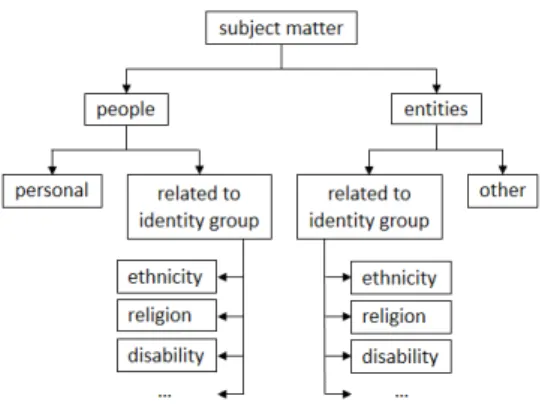
Subject Matter: As previous research demon-strated, it is essential from both legal and linguistic points of view to identify the target of abuse—who (or what) the abuse is directed towards. We extend this idea to cover both abusive and non-abusive texts, and propose to specify the subject matter of an utterance. We define subject matter as the topic of a factual statement or the target of an opinion. Having all types of texts, positive, negative, and neutral opinions as well as factual statements, an-notated for subject matter can help in balancing the distribution of abusive and non-abusive instances for different types of targets and broadening the range of instances related to the same subject mat-ter. However, we consider only subject matters that can potentially be targets of abuse, namely people (individuals and groups) and entities related to iden-tity groups. All other subject matters are grouped under the category ‘other’. Identity groups are sec-tions of population with significant membership that are usually defined by ethnicity, religion, gen-der, or sexual orientation, but can also be defined by other characteristics, such as physical appearance, occupation, political affiliation, etc. Entities related to identity groups include concepts (e.g., Islam is related to Muslims), events (e.g., Pride Parade is re-lated to the LGBTQ community), ideas, etc. While negative remarks towards entities would normally
Figure 1: Taxonomy for subject matter of an utterance.
constitute an acceptable form of criticism, having such instances in the training datasets would ensure the systems’ exposure to examples of non-abusive texts linguistically similar to abusive instances.
When the subject matter is people, we distin-guish personal and identity group related reference. If the subject matter (whether a single person or a group) is referred to by identity terms associ-ated with an identity group, we call it ‘relassoci-ated to identity group’; otherwise, we classify it as ‘per-sonal’. Notice that unlike previous research, we do not distinguish subject matters at the level of individuals and groups as similar legal considera-tions and linguistic patterns are observed for both types. Identity group related subject matters can be further characterized by the basis on which the identity group is defined (e.g., race) as well as by the specific identity (e.g., African-Americans).
Figure1shows the full multi-level hierarchical taxonomy for subject matters. Since an utterance can refer to more than one identity group, multiple categories can be assigned to an instance.
Severity of Abuse: Online abusive content em-bodies a spectrum of practices that differ in mo-tivation, expression, and consequences (Shepherd et al.,2015;Pohjonen and Udupa,2017). While separating different forms of online abuse (e.g., threats, insults, hate speech) proved problematic, a more attainable, yet valuable objective can be determining the level of severity of abuse—a point on the scale from non-abusive, friendly instances to extremely abusive, violent messages. Ordering tex-tual instances by the severity of abuse can help hu-man moderators to prioritize messages for hu-manual inspection and to promptly respond to potentially dangerous ones.
The common technique for annotating items on a fine-grained ordinal scale is rating scales.
How-ever, traditional rating scales suffer from a number of shortcomings, including inconsistencies in an-notations by different annotators and by the same annotator over time, scale region bias, and fixed granularity (Baumgartner and Steenkamp, 2001;
Presser and Schuman,1996). To overcome these problems, human annotators can be asked to pro-vide comparative judgements instead (Goffin and Olson,2011;Aroyo et al.,2019).
An efficient comparative technique, widely used in marketing research, is Best–Worst Scaling ( Lou-viere and Woodworth,1990;Louviere et al.,2015). In Best–Worst Scaling (BWS), an annotator is pre-sented with n items ( where n is typically 4 or 5) and asked to select the best item (the most abu-sive) and the worst item (the least abuabu-sive). All the items to be annotated are organized in m n-tuples in such a way that ensures each item is annotated multiple times and compared with a diverse set of other items. After annotating around 1.5 × N to 2 × N such n-tuples (where N is the total num-ber of textual instances to be annotated), a real-valued score of severity can be calculated for each textual instance, and a ranked list of instances by severity can be obtained (Flynn and Marley,2014;
Kiritchenko and Mohammad,2016).
Since BWS tuples are formed randomly (though, ensuring the diversity of comparisons for each item), for some tuples the choice of the most abu-sive and/or least abuabu-sive texts might be apparent for most annotators. Extremely abusive texts would be often selected as the most abusive and get a high severity score while genial and friendly texts would mostly be selected as the least abusive and get low scores. Yet, in some tuples two or more texts might express similar levels of severity. In such cases, since annotators are forced to make a decision for each tuple, the answer by each anno-tator would be selected randomly between these similarly abusive items. This means that the items would be chosen (on average) by the same number of annotators, and, therefore, the aggregated scores for these items would be close to each other.
It has been shown that Best–Worst Scaling pro-duces more reliable annotations as compared to the traditional rating scales, especially on linguistically more complex items (Kiritchenko and Mohammad,
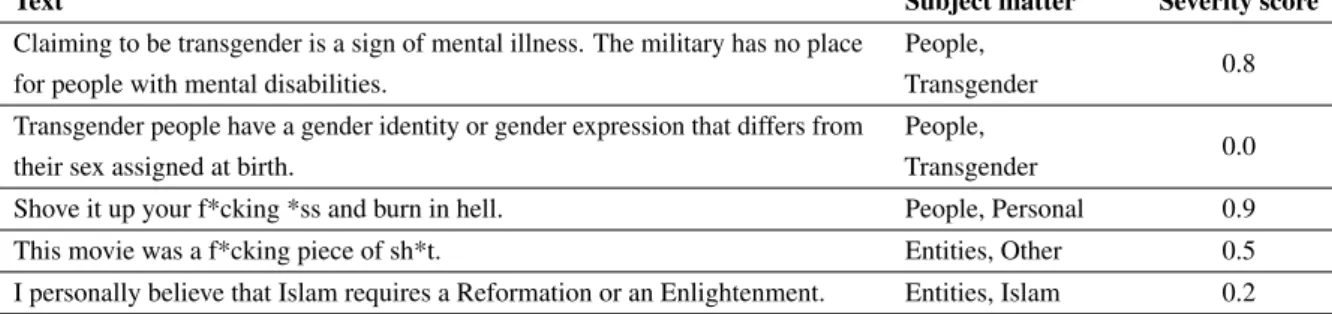
2017). Figure2demonstrates an example of a hy-pothetical BWS annotation for severity of abuse. Table1shows examples of texts annotated accord-ing to the entire framework.
Text Subject matter Severity score Claiming to be transgender is a sign of mental illness. The military has no place
for people with mental disabilities.
People,
Transgender 0.8
Transgender people have a gender identity or gender expression that differs from their sex assigned at birth.
People,
Transgender 0.0
Shove it up your f*cking *ss and burn in hell. People, Personal 0.9 This movie was a f*cking piece of sh*t. Entities, Other 0.5 I personally believe that Islam requires a Reformation or an Enlightenment. Entities, Islam 0.2
Table 1: Examples of texts with hypothetical annotations. Severity scores are on the scale from 0 (least abusive) to 1 (most abusive). The absolute values of severity scores are not meaningful but the relative values distinguish between facts, criticism, obscene sentences, and highly abusive contents. Some of the texts are taken from the Kaggle Unintended Bias in Toxicity dataset by Jigsaw and Google.
Figure 2: Example of a BWS annotation for severity.
5 Advantages of the Novel Framework The proposed framework addresses some of the problems outlined earlier.
Task Formulation: The framework focuses on a general class of abusive behavior and aims to ex-tend the scope of studied online abuse without the painful process of enumerating and precisely defin-ing a myriad of types. Instead, many types can be roughly defined as regions in the proposed two-dimensional space of subject matter and severity of abuse. For example, ‘physical threat’ can be mapped to (subject matter: people, severity: high), and ‘personal attack’ can be mapped to (subject matter: personal, severity: moderate to high). In this way, separate research efforts are expected to produce more compatible and more applicable out-puts. Still, listing different types of abuse with their coarse-grained definitions and examples can be extremely helpful in guiding data collection and annotation.
Data Collection and Sampling Bias: To en-sure adequate representation for different identity groups, data can be collected for each group using abusive and benign query terms that refer to mem-bers of that group or to entities associated with the
group. The sets of terms can be acquired manu-ally or semi-automaticmanu-ally using unsupervised tech-niques, such as topic modeling, clustering, etc. Tex-tual messages collected in this way would include abusive as well as neutral and friendly utterances about an identity group or closely related concepts, cover a variety of topics, and contain explicit and implicit language. However, this method of data collection does not specifically target the ‘personal’ category. It can also result in low proportions of abusive texts and introduce unintended biases, such as topic bias (Wiegand et al.,2019). Therefore, the data collection should be spread out over a period of time (to diversify the set of covered topics) and supplemented with other techniques, such as sam-pling based on lexicons of common abusive words and expressions, sampling of messages written by users known for abusive behavior, and random sam-pling. Further, data from existing abusive language datasets as well as abusive examples reported by users on dedicated websites, such as HeartMob3 and Microaggressions4, are valuable data sources. Collecting data with a specific focus on identity groups allows to account for fairness in representa-tion at the beginning of the development cycle.
The set of identity groups represented in a dataset is decided apriori based on a research fo-cus, a data source, and available resources. A preliminary round of exploratory annotations can be beneficial to expand the list of commonly ad-dressed groups (e.g., women, African-Americans, immigrants) to other identities. Further exploratory rounds can be run periodically to include new, pre-viously non-existent or missed, categories.
Annotation Bias: Manually annotating for
sever-3
https://iheartmob.org
ity of abuse is a particularly subjective task, and often requires specific expertise obtained through training or life experiences. We recommend having data annotated for subject matter first, and then the severity annotations can be done independently for different identity groups and involve correspond-ing annotator pools. Most often, online abuse is directed towards minorities and marginalized com-munities, therefore it is vital to involve and consult the members of these communities to adequately represent their values and to reduce data annota-tion bias (Blackwell et al.,2017). In cases where community involvement in annotation is infeasi-ble, professionals specializing in related issues or trained annotators can be employed.
Quantifying Bias: Although the new framework does not guarantee the fairness of trained models, it allows measuring and mitigating bias through comparability of the overall automatic detection error or the False Positive and False Negative error rates for different identity groups.
Generalizability: The conceptions of target groups based on specific identities are expected to be applicable across online platforms and domains. The generalizability of trained models will be im-proved by increasing the proportion of texts with implicit meaning and texts that provide acceptable criticism of entities and concepts. Further, the pro-posed framework will improve the generalizability by allowing data annotators to use the full spectrum of the severity dimension without forcing them to decide where the boundary between abusive and benign languages lies. That decision is applica-tion and domain specific and can be left to human moderators, making trained systems suitable to a greater variety of applications.
Explainability: Within the framework, the sys-tems are trained to predict and output the detailed information on the target of abuse and the level of severity that can serve as basic explanations for human and machine decisions. More comprehen-sive explanations can sometimes be derived when the targeted group is coupled with the words and expressions in the message that are considered par-ticularly insulting for that group. Similarly, know-ing the target of abuse is imperative in recogniz-ing and explainrecogniz-ing implicit abuse and stereotypical references. Further, these explanations can serve educational purposes when employed in a system that assists users at the time of message creation. Transparency: The framework provides a means
to measure the class imbalances in a dataset across target groups. Reporting the limitations of a dataset is essential for transparency and helps practitioners to better identify the scope of use of trained models. Safety and Security: The vulnerability of clas-sification systems due to their high sensitivity to specific words suggests that those words are over-represented in the training datasets. The proposed framework can improve the safety of such systems by including more training examples with implicit meaning and training systems to learn fine-grained information which is not directly correlated with explicitly abusive words.
6 Limitations and Ethical Considerations Delineating target categories based on identity groups, selecting search terms associated with the groups, and annotating for fine-grained target cat-egories can propagate harmful stereotypes and re-inforce social iniquity (Beukeboom and Burgers,
2019). NLP researchers should ground their work in the relevant literature from other disciplines, such as sociology, sociolinguistics, and social psy-chology, and engage with the lived experiences of members of affected communities in order to mini-mize such adverse effects (Blodgett et al.,2020).
Viewing and annotating abusive content for pro-longed periods of time can cause significant dis-tress to human annotators (Roberts,2016;Vidgen et al.,2019). This concern is even more critical for members of marginalized groups annotating abu-sive texts directed towards their community. To re-duce the possible harmful effects on mental health of the annotators, special procedures can be put in place, including the right consent process, com-prehensive instructions, limited exposure time, fair compensation, and mental health support. Annota-tors should be made aware of why they are labeling such contents and how their work contributes to the safety of online platforms for their communities. 7 Conclusion and Future Directions A new framework structured around the dimen-sions of subject matter and severity of abuse is pro-posed as a step towards building less biased, more accurate and generally more trustable automatic abuse detection systems. Comprehensive data col-lection and annotation proposed within the frame-work allow for better control and transparency on data characteristics and model performance with regard to unintended biases, generalizability,
ex-plainability, and safety. As the next step, the usabil-ity and efficacy of the proposed framework need to be tested. Thus, future work will include build-ing an extensive list of identity groups subjected to online abuse, assembling lexicons of terms asso-ciated with the groups for targeted sampling, and writing detailed annotation guidelines for both an-notation steps. Then, empirical datasets in multiple languages can be collected, annotated, and released to the research community for experimenting and building trustable machine learning models.
References
Betty van Aken, Julian Risch, Ralf Krestel, and Alexan-der L¨oser. 2018. Challenges for toxic comment clas-sification: An in-depth error analysis. In Proceed-ings of the 2nd Workshop on Abusive Language On-line.
Lora Aroyo, Lucas Dixon, Nithum Thain, Olivia Red-field, and Rachel Rosen. 2019. Crowdsourcing sub-jective tasks: the case study of understanding tox-icity in online discussions. In Proceedings of the Workshop on Subjectivity, Ambiguity and Disagree-ment in Crowdsourcing, pages 1100–1105.
Stavros Assimakopoulos, Rebecca Vella Muskat, Lon-neke van der Plas, and Albert Gatt. 2020. Annotat-ing for hate speech: The MaNeCo corpus and some input from critical discourse analysis. In Proceed-ings of the 12th Language Resources and Evaluation Conference, pages 5088–5097, Marseille, France. European Language Resources Association.
Hans Baumgartner and Jan-Benedict E.M. Steenkamp. 2001. Response styles in marketing research: A cross-national investigation. Journal of Marketing Research, 38(2):143–156.
Emily M Bender. 2019. A typology of ethical risks in language technology with an eye towards where transparent documentation can help. In Future of Ar-tificial Intelligence: Language, Ethics, Technology Workshop.
Emily M Bender and Batya Friedman. 2018. Data statements for natural language processing: Toward mitigating system bias and enabling better science. Transactions of the Association for Computational Linguistics, 6:587–604.
Camiel J. Beukeboom and Christian Burgers. 2019. How stereotypes are shared through language: a re-view and introduction of the social categories and stereotypes communication (SCSC) framework. Re-view of Communication Research, 7:1–37.
Lindsay Blackwell, Jill Dimond, Sarita Schoenebeck, and Cliff Lampe. 2017. Classification and its conse-quences for online harassment: Design insights from HeartMob. Proceedings of the ACM on Human-Computer Interaction, 1(2):1–19.
Su Lin Blodgett, Solon Barocas, Hal Daum´e III, and Hanna Wallach. 2020. Language (technology) is power: A critical survey of “bias” in NLP. In Pro-ceedings of the 58th Annual Meeting of the Asso-ciation for Computational Linguistics, pages 5454– 5476.
Tolga Bolukbasi, Kai-Wei Chang, James Y Zou, Venkatesh Saligrama, and Adam T Kalai. 2016. Man is to computer programmer as woman is to homemaker? debiasing word embeddings. In Ad-vances in Neural Information Processing Systems, pages 4349–4357.
Daniel Borkan, Lucas Dixon, Jeffrey Sorensen, Nithum Thain, and Lucy Vasserman. 2019. Nuanced metrics for measuring unintended bias with real data for text classification. In Companion Proceedings of The 2019 World Wide Web Conference, pages 491–500. Luke Breitfeller, Emily Ahn, David Jurgens, and
Yu-lia Tsvetkov. 2019.Finding microaggressions in the wild: A case for locating elusive phenomena in
so-cial media posts. In Proceedings of the 2019
Con-ference on Empirical Methods in Natural Language Processing and the 9th International Joint Confer-ence on Natural Language Processing (EMNLP-IJCNLP), pages 1664–1674, Hong Kong, China. Aylin Caliskan, Joanna J Bryson, and Arvind
Narayanan. 2017. Semantics derived automatically from language corpora contain human-like biases. Science, 356(6334):183–186.
Tuhin Chakrabarty, Kilol Gupta, and Smaranda Mure-san. 2019. Pay “attention” to your context when classifying abusive language. In Proceedings of the Third Workshop on Abusive Language Online, pages 70–79, Florence, Italy.
Eshwar Chandrasekharan, Mattia Samory, Shagun Jhaver, Hunter Charvat, Amy Bruckman, Cliff Lampe, Jacob Eisenstein, and Eric Gilbert. 2018. The Internet’s hidden rules: An empirical study of Reddit norm violations at micro, meso, and macro scales. Proceedings of the ACM on Human-Computer Interaction, 2(CSCW):1–25.
Despoina Chatzakou, Nicolas Kourtellis, Jeremy Blackburn, Emiliano De Cristofaro, Gianluca Stringhini, and Athena Vakali. 2017. Mean birds: Detecting aggression and bullying on Twitter. In Proceedings of the ACM Conference on Web Science, pages 13–22.
Maral Dadvar, Dolf Trieschnigg, Roeland Ordelman, and Franciska de Jong. 2013. Improving cyberbul-lying detection with user context. In Proceedings of the European Conference on Information Retrieval, pages 693–696.
Thomas Davidson, Debasmita Bhattacharya, and Ing-mar Weber. 2019. Racial bias in hate speech and abusive language detection datasets. In Proceedings of the Third Workshop on Abusive Language Online, pages 25–35, Florence, Italy.
Thomas Davidson, Dana Warmsley, Michael Macy, and Ingmar Weber. 2017. Automated hate speech detection and the problem of offensive language. In Proceedings of the International AAAI Conference on Web and Social Media.
Emily Dinan, Angela Fan, Ledell Wu, Jason We-ston, Douwe Kiela, and Adina Williams. 2020. Multi-dimensional gender bias classification. arXiv preprint arXiv:2005.00614.
Lucas Dixon, John Li, Jeffrey Sorensen, Nithum Thain, and Lucy Vasserman. 2018. Measuring and mitigat-ing unintended bias in text classification. In Pro-ceedings of the 2018 AAAI/ACM Conference on AI, Ethics, and Society, pages 67–73.
Nemanja Djuric, Jing Zhou, Robin Morris, Mihajlo Gr-bovic, Vladan Radosavljevic, and Narayan Bhamidi-pati. 2015. Hate speech detection with comment em-beddings. In Proceedings of the International Con-ference on World Wide Web, pages 29–30.
Maeve Duggan. 2017. Online Harassment 2017. Pew Research Center.
Darja Fiˇser, Tomaˇz Erjavec, and Nikola Ljubeˇsi´c. 2017. Legal framework, dataset and annotation schema for socially unacceptable online discourse practices in Slovene. In Proceedings of the First Workshop on Abusive Language Online, pages 46–51.
T. N. Flynn and A. A. J. Marley. 2014. Best-worst scal-ing: theory and methods. In Stephane Hess and An-drew Daly, editors, Handbook of Choice Modelling, pages 178–201. Edward Elgar Publishing.
Paula Fortuna and S´ergio Nunes. 2018. A survey on au-tomatic detection of hate speech in text. ACM Com-puting Surveys (CSUR), 51(4):1–30.
Paula Fortuna, Juan Soler, and Leo Wanner. 2020.
Toxic, hateful, offensive or abusive? what are we
really classifying? an empirical analysis of hate
speech datasets. In Proceedings of the 12th
Lan-guage Resources and Evaluation Conference, pages 6786–6794, Marseille, France.
Antigoni Maria Founta, Despoina Chatzakou, Nicolas Kourtellis, Jeremy Blackburn, Athena Vakali, and Il-ias Leontiadis. 2019. A unified deep learning archi-tecture for abuse detection. In Proceedings of the 10th ACM Conference on Web Science, pages 105– 114.
Antigoni Maria Founta, Constantinos Djouvas, De-spoina Chatzakou, Ilias Leontiadis, Jeremy Black-burn, Gianluca Stringhini, Athena Vakali, Michael Sirivianos, and Nicolas Kourtellis. 2018. Large scale crowdsourcing and characterization of Twit-ter abusive behavior. In Proceedings of the InTwit-terna- Interna-tional AAAI Conference on Web and Social Media. Lei Gao and Ruihong Huang. 2017. Detecting online
hate speech using context aware models. In Pro-ceedings of the International Conference on Recent
Advances in Natural Language Processing, RANLP 2017, pages 260–266, Varna, Bulgaria.
Sahaj Garg, Vincent Perot, Nicole Limtiaco, Ankur Taly, Ed H Chi, and Alex Beutel. 2019. Counterfac-tual fairness in text classification through robustness. In Proceedings of the 2019 AAAI/ACM Conference on AI, Ethics, and Society, pages 219–226.
Timnit Gebru, J. Morgenstern, Briana Vecchione, Jen-nifer Wortman Vaughan, H. Wallach, Hal Daum´e, and K. Crawford. 2018. Datasheets for datasets. In Proceedings of the 5th Workshop on Fairness, Ac-countability, and Transparency in Machine Learn-ing, Stockholm, Sweden.
Sam Gehman, Suchin Gururangan, Maarten Sap, Yejin Choi, and Noah A Smith. 2020. Realtoxici-typrompts: Evaluating neural toxic degeneration in language models. In Findings of EMNLP.
Njagi Dennis Gitari, Zhang Zuping, Hanyurwimfura Damien, and Jun Long. 2015. A lexicon-based approach for hate speech detection. International Journal of Multimedia and Ubiquitous Engineering, 10(4):215–230.
Richard D. Goffin and James M. Olson. 2011. Is it all relative? Comparative judgments and the possi-ble improvement of self-ratings and ratings of others. Perspectives on Psychological Science, 6(1):48–60. Jennifer Golbeck, Zahra Ashktorab, Rashad O Banjo,
Alexandra Berlinger, Siddharth Bhagwan, Cody Buntain, Paul Cheakalos, Alicia A Geller, Ra-jesh Kumar Gnanasekaran, Raja Rajan Gunasekaran, et al. 2017. A large labeled corpus for online harass-ment research. In Proceedings of the ACM Confer-ence on Web SciConfer-ence, pages 229–233.
Tommi Gr¨ondahl, Luca Pajola, Mika Juuti, Mauro Conti, and N Asokan. 2018. All you need is “love” evading hate speech detection. In Proceedings of the 11th ACM Workshop on Artificial Intelligence and Security, pages 2–12.
Isuru Gunasekara and Isar Nejadgholi. 2018. A review of standard text classification practices for multi-label toxicity identification of online content. In Pro-ceedings of the 2nd Workshop on Abusive Language Online (ALW2), pages 21–25.
S. Hinduja and J. W. Patchin. 2020. Cyberbullying fact sheet: Identification, Prevention, and Response. Cy-berbullying Research Center.
Hossein Hosseini, Sreeram Kannan, Baosen Zhang, and Radha Poovendran. 2017. Deceiving Google’s Perspective API built for detecting toxic comments. arXiv preprint arXiv:1702.08138.
Homa Hosseinmardi, Sabrina Arredondo Mattson, Ra-hat Ibn Rafiq, Richard Han, Qin Lv, and Shivakant Mishra. 2015. Analyzing labeled cyberbullying inci-dents on the Instagram social network. In Proceed-ings of the International Conference on Social Infor-matics, pages 49–66.
Sarthak Jain and Byron C. Wallace. 2019. Attention is not Explanation. In Proceedings of the 2019 Con-ference of the North American Chapter of the Asso-ciation for Computational Linguistics: Human Lan-guage Technologies, Volume 1 (Long and Short Pa-pers), pages 3543–3556, Minneapolis, Minnesota. Jigsaw, Perspective API. 2017. https://www.
perspectiveapi.com/#/home.
David Jurgens, Libby Hemphill, and Eshwar Chan-drasekharan. 2019. A just and comprehensive strat-egy for using NLP to address online abuse. In Pro-ceedings of the 57th Annual Meeting of the Asso-ciation for Computational Linguistics, pages 3658– 3666, Florence, Italy.
Josh Kalin, David Noever, and Gerry Dozier. 2020. Systematic attack surface reduction for de-ployed sentiment analysis models. arXiv preprint arXiv:2006.11130.
Svetlana Kiritchenko and Saif M. Mohammad. 2016. Capturing reliable fine-grained sentiment associa-tions by crowdsourcing and best–worst scaling. In Proceedings of the Annual Conference of the North American Chapter of the Association for Computa-tional Linguistics: Human Language Technologies (NAACL), San Diego, California.
Svetlana Kiritchenko and Saif M. Mohammad. 2017. Best-worst scaling more reliable than rating scales: A case study on sentiment intensity annotation. In Proceedings of the Annual Meeting of the Associa-tion for ComputaAssocia-tional Linguistics (ACL), Vancou-ver, Canada.
Ritesh Kumar, Atul Kr Ojha, Shervin Malmasi, and Marcos Zampieri. 2018. Benchmarking aggression identification in social media. In Proceedings of the First Workshop on Trolling, Aggression and Cyber-bullying (TRAC-2018), pages 1–11.
Keita Kurita, Paul Michel, and Graham Neubig. 2020. Weight poisoning attacks on pre-trained models. In Proceedings of the Annual Meeting of the Associa-tion for ComputaAssocia-tional Linguistics.
Keita Kurita, Nidhi Vyas, Ayush Pareek, Alan W Black, and Yulia Tsvetkov. 2019. Measuring bias in contex-tualized word representations. In Proceedings of the First Workshop on Gender Bias in Natural Language Processing, pages 166–172.
Jordan J. Louviere, Terry N. Flynn, and A. A. J. Mar-ley. 2015. Best-Worst Scaling: Theory, Methods and Applications. Cambridge University Press.
Jordan J. Louviere and George G. Woodworth. 1990. Best-worst analysis. Working Paper. Department of Marketing and Economic Analysis, University of Alberta.
Aditya Mahajan, Divyank Shah, and Gibraan Jafar. 2020. Explainable AI approach towards toxic com-ment classification. Technical report.
Thomas Manzini, Lim Yao Chong, Alan W Black, and Yulia Tsvetkov. 2019. Black is to criminal as cau-casian is to police: Detecting and removing multi-class bias in word embeddings. In Proceedings of the 2019 Conference of the North American Chap-ter of the Association for Computational Linguistics: Human Language Technologies, Volume 1 (Long and Short Papers), pages 615–621.
Chandler May, Alex Wang, Shikha Bordia, Samuel Bowman, and Rachel Rudinger. 2019. On measur-ing social biases in sentence encoders. In Proceed-ings of the 2019 Conference of the North American Chapter of the Association for Computational Lin-guistics: Human Language Technologies, Volume 1 (Long and Short Papers), pages 622–628.
Pushkar Mishra, Helen Yannakoudakis, and Ekaterina Shutova. 2019. Tackling online abuse: A survey of automated abuse detection methods. arXiv preprint arXiv:1908.06024.
Margaret Mitchell, Simone Wu, Andrew Zaldivar, Parker Barnes, Lucy Vasserman, Ben Hutchinson, Elena Spitzer, Inioluwa Deborah Raji, and Timnit Gebru. 2019. Model cards for model reporting. In Proceedings of the Conference on Fairness, Account-ability, and Transparency, pages 220–229.
Moin Nadeem, Anna Bethke, and Siva Reddy. 2020. Stereoset: Measuring stereotypical bias in pretrained language models. arXiv preprint arXiv:2004.09456.
Nikita Nangia, Clara Vania, Rasika Bhalerao, and Samuel R. Bowman. 2020. Crows-pairs: A chal-lenge dataset for measuring social biases in masked language models. In Proceedings of the Conference on Empirical Methods in Natural Language Process-ing (EMNLP).
Isar Nejadgholi and Svetlana Kiritchenko. 2020. On cross-dataset generalization in automatic detection of online abuse. In Proceedings of the 4th Workshop on Online Abuse and Harms.
Marco Niemann, Dennis M Riehle, Jens Brunk, and J¨org Becker. 2019. What is abusive language? In Proceedings of the Multidisciplinary International Symposium on Disinformation in Open Online Me-dia, pages 59–73.
Chikashi Nobata, Joel Tetreault, Achint Thomas, Yashar Mehdad, and Yi Chang. 2016. Abusive lan-guage detection in online user content. In Proceed-ings of the International Conference on World Wide Web, pages 145–153.
Ji Ho Park, Jamin Shin, and Pascale Fung. 2018. Re-ducing gender bias in abusive language detection. In Proceedings of the Conference on Empirical Meth-ods in Natural Language Processing, pages 2799– 2804, Brussels, Belgium.
Matti Pohjonen and Sahana Udupa. 2017. Extreme speech online: An anthropological critique of hate speech debates. International Journal of Communi-cation, 11:19.
Fabio Poletto, Marco Stranisci, Manuela Sanguinetti, Viviana Patti, and Cristina Bosco. 2017. Hate speech annotation: Analysis of an Italian Twitter cor-pus. In Proceedings of the Italian Conference on Computational Linguistics (CLiC-it 2017), pages 1– 6.
Stanley Presser and Howard Schuman. 1996. Ques-tions and Answers in Attitude Surveys: Experiments on Question Form, Wording, and Context. SAGE Publications, Inc.
Amir H Razavi, Diana Inkpen, Sasha Uritsky, and Stan Matwin. 2010. Offensive language detection using multi-level classification. In Proceedings of the Canadian Conference on Artificial Intelligence, pages 16–27.
Marco Tulio Ribeiro, Sameer Singh, and Carlos Guestrin. 2016. “Why should I trust you?” Ex-plaining the predictions of any classifier. In Proceed-ings of the ACM SIGKDD International Conference on Knowledge Discovery and Data Mining, pages 1135–1144.
Sarah T. Roberts. 2016. Commercial content moder-ation: Digital laborers’ dirty work. In The Intersec-tional Internet: Race, Sex, Class and Culture Online. Peter Lang Publishing.
S. Salawu, Y. He, and J. Lumsden. 2020. Approaches to automated detection of cyberbullying: A survey. IEEE Transactions on Affective Computing, 11(1):3– 24.
Maarten Sap, Dallas Card, Saadia Gabriel, Yejin Choi, and Noah A Smith. 2019. The risk of racial bias in hate speech detection. In Proceedings of the 57th Annual Meeting of the Association for Compu-tational Linguistics, pages 1668–1678.
Maarten Sap, Saadia Gabriel, Lianhui Qin, Dan Juraf-sky, Noah A Smith, and Yejin Choi. 2020. Social bias frames: Reasoning about social and power im-plications of language. In Proceedings of the An-nual Meeting of the Association for Computational Linguistics.
Anna Schmidt and Michael Wiegand. 2017. A survey on hate speech detection using natural language pro-cessing. In Proceedings of the Fifth International Workshop on Natural Language Processing for So-cial Media, pages 1–10.
Tamara Shepherd, Alison Harvey, Tim Jordan, Sam Srauy, and Kate Miltner. 2015. Histories of hating. Social Media+ Society, 1(2).
Ellen Spertus. 1997. Smokey: Automatic recognition of hostile messages. In Proceedings of the AAAI Conference on Innovative Applications of Artificial Intelligence, pages 1058–1065.
Saurabh Srivastava and Prerna Khurana. 2019. Detect-ing aggression and toxicity usDetect-ing a multi dimension capsule network. In Proceedings of the Third Work-shop on Abusive Language Online, pages 157–162. Amos Tversky and Daniel Kahneman. 1974. Judgment
under uncertainty: Heuristics and biases. Science, 185(4157):1124–1131.
David Van Bruwaene, Qianjia Huang, and Diana Inkpen. 2020. A multi-platform dataset for detect-ing cyberbullydetect-ing in social media. Language Re-sources and Evaluation, pages 1–24.
Bertie Vidgen and Leon Derczynski. 2020. Direc-tions in abusive language training data: Garbage in, garbage out. arXiv preprint arXiv:2004.01670. Bertie Vidgen, Alex Harris, Dong Nguyen, Rebekah
Tromble, Scott Hale, and Helen Margetts. 2019. Challenges and frontiers in abusive content detec-tion. In Proceedings of the Third Workshop on Abu-sive Language Online, pages 80–93, Florence, Italy. Zeerak Waseem. 2016. Are you a racist or am I seeing things? Annotator influence on hate speech detec-tion on Twitter. In Proceedings of the First Work-shop on NLP and Computational Social Science, pages 138–142.
Zeerak Waseem, Thomas Davidson, Dana Warmsley, and Ingmar Weber. 2017. Understanding abuse: A typology of abusive language detection subtasks. In Proceedings of the First Workshop on Abusive Language Online, pages 78–84, Vancouver, BC, Canada.
Zeerak Waseem and Dirk Hovy. 2016. Hateful sym-bols or hateful people? Predictive features for hate speech detection on Twitter. In Proceedings of the NAACL Student Research Workshop, pages 88–93. Zeerak Waseem, James Thorne, and Joachim Bingel.
2018. Bridging the gaps: Multi task learning for domain transfer of hate speech detection. In Gol-beck J., editor, Online harassment, pages 29–55. Springer.
Michael Wiegand, Josef Ruppenhofer, and Thomas Kleinbauer. 2019. Detection of abusive language: the problem of biased datasets. In Proceedings of the Conference of the North American Chapter of the Association for Computational Linguistics: Hu-man Language Technologies, pages 602–608. Michael Wiegand, Josef Ruppenhofer, Anna Schmidt,
and Clayton Greenberg. 2018. Inducing a lexicon of abusive words–a feature-based approach. In Pro-ceedings of the 2018 Conference of the North Amer-ican Chapter of the Association for Computational Linguistics: Human Language Technologies, pages 1046–1056.
Sarah Wiegreffe and Yuval Pinter. 2019. Attention is not not explanation. In Proceedings of the 2019 Con-ference on Empirical Methods in Natural Language
Processing and the 9th International Joint Confer-ence on Natural Language Processing (EMNLP-IJCNLP), pages 11–20.
Claudia Wilhelm and Sven Joeckel. 2019. Gendered morality and backlash effects in online discussions: An experimental study on how users respond to hate speech comments against women and sexual minori-ties. Sex Roles, 80(7-8):381–392.
Ellery Wulczyn, Nithum Thain, and Lucas Dixon. 2017. Ex machina: Personal attacks seen at scale. In Pro-ceedings of the 26th International Conference on World Wide Web, pages 1391–1399.
Marcos Zampieri, Shervin Malmasi, Preslav Nakov, Sara Rosenthal, Noura Farra, and Ritesh Kumar. 2019a. Predicting the type and target of offensive posts in social media. In Proceedings of the Con-ference of the North American Chapter of the Asso-ciation for Computational Linguistics: Human Lan-guage Technologies, pages 1415–1420, Minneapo-lis, Minnesota.
Marcos Zampieri, Shervin Malmasi, Preslav Nakov, Sara Rosenthal, Noura Farra, and Ritesh Kumar. 2019b. Semeval-2019 task 6: Identifying and cate-gorizing offensive language in social media (offense-val). In Proceedings of the 13th International Work-shop on Semantic Evaluation, pages 75–86.
Frederike Zufall, Huangpan Zhang, Katharina Klop-penborg, and Torsten Zesch. 2020. Operationalizing the legal concept of ‘incitement to hatred’ as an NLP task. arXiv preprint arXiv:2004.03422.