HAL Id: hal-01834157
https://hal.archives-ouvertes.fr/hal-01834157
Submitted on 10 Jul 2018
HAL is a multi-disciplinary open access
archive for the deposit and dissemination of
sci-entific research documents, whether they are
pub-lished or not. The documents may come from
teaching and research institutions in France or
abroad, or from public or private research centers.
L’archive ouverte pluridisciplinaire HAL, est
destinée au dépôt et à la diffusion de documents
scientifiques de niveau recherche, publiés ou non,
émanant des établissements d’enseignement et de
recherche français ou étrangers, des laboratoires
publics ou privés.
Link between Parental Separation and Decreased
Performance in French High School Students
Claire Berticat, Valérie Durand, Michel Raymond, Charlotte Faurie
To cite this version:
Claire Berticat, Valérie Durand, Michel Raymond, Charlotte Faurie. Link between Parental Separation
and Decreased Performance in French High School Students. Journal of Behavior, JSciMed Central,
2017. �hal-01834157�
Abstract
Extensive evidence suggests that parental separation during childhood correlates with negative outcomes in offspring. However, the importance of parental separation relative to the presence of a stepparent remains poorly documented. Involving a sample of 639 French university students, we investigated the link between parental separation and academic performance, as measured by the level of success demonstrated at high school final exam (Baccalauréat). We showed that students who experienced parental separation scored significantly lower at this exam. More precisely, absence of the father during the year of preparation for the Baccalauréat was negatively associated with exam score, particularly when the students lived with their single mother. The presence of a stepfather could compensate partly for the absence of the biological father and lead to an intermediate score. The effects were independent of the child’s sex. These results are discussed in the context of evolutionary theories of parental investment.
Keywords • Evolutionary biology • Parental separation • Stepfather • Parental investment • Education *Corresponding author
Claire Berticat, Institute of Evolutionary Sciences, University of Montpellier, Campus Triolet, cc65, 34095 Montpellier Cedex 5, France
Tel: +33-46-714-4632
Email: [email protected] Submitted: 09 June 2017
Accepted: 02 October 2017 Published: 18 October 2017 Copyright: © 2017 Berticat et al.
OPEN ACCESS
Original Research Article
Link between Parental
Separation and Decreased
Performance in French High
School Students
Claire Berticat
*, Valérie Durand, Michel Raymond,
Charlotte Faurie
ISEM, University of Montpellier, CNRS, IRD, EPHE, Montpellier, France
INTRODUCTION
Ongoing research into the short-term and long-term consequences of parental separation in childhood [1,2] has found that children of separated/divorced parents are at a greater risk of a number of adverse outcomes, including reduced socioeconomic well-being [3], early first intercourse [4], physical health problems [5,6], and behavioral problems [7,8,9]. These studies should be considered in the context of the recent upward trend in divorce in Western populations [10]. In France, the rate of divorce amongst married couples has risen from 2.9% in 1960 to 9.3% in 2000 and 10.3% in 2013 ; and because parents are not necessarily married, 26% of children aged 0-18 had separated parents in 2011 [11,12]. The issue of child outcomes in differing household structures is thus of increasing importance in today's society, as what was once deemed unconventional family life shifts towards convention.
Academic achievement
Researchers have also consistently shown parental conflicts and divorce to be negatively related to academic achievement [13-19]. Academic achievement can be considered a proximate cue for both future socioeconomic status and expected health status, because it determines both the quantity and the quality of resources that an individual can obtain [20]. These findings are relevant to evolutionary questions because socioeconomic status
is related to reproductive success: men of high status are more likely to reproduce [21-23] and to father more offspring [24-26] than men of lower status. Meta-analyses consistently found that children from divorced families performed lower on measures of academic achievement than their peers from non-separated families [17,18]. Similarly, a large longitudinal study found that divorce had significant negative long-term effects on children's academic achievements [27].
Stepfathers
Few studies have investigated the consequences of the presence of a stepparent on academic achievement. They tend to show that children in households with stepparents have lower school grades and are less likely to graduate from high school or enter college when compared with children in households containing both a biological mother and a biological father [28-32]. Some studies suggest that the presence of a stepfather results in a diversion of financial resources by the stepfather or by stepfamilies [33,34], and/or a diversion of time spend by the mother with her child [35]. However, most of these studies did not include single parent households. Thus, the relative importance of parental separation versus presence of a stepparent remains poorly documented.
Berticat et al. (2017)
Email: [email protected]
2/8 J Behav 2(3): 1012 (2017)
Cultural variations
In addition, these studies have generally examined child populations within the United States or the United Kingdom. Countries differ both in the prevalence of parental separation and on a number of other variables that might affect the association between growing up with separated parents and children's academic outcomes (www.oecd.org/els/family/database.htm). It is therefore important to study this problematic in various countries [36].
The Baccalauréat in France
In the present study, academic achievement was measured by participants’ score on the “Baccalauréat”, which French students take at the end of high school. The Baccalauréat diploma, an academic qualification created in 1908, is an important social landmark in the French culture for a wide range of jobs. Depending on regions in France, 11 year-old children have between 50% and 80% chances (69% in Montpellier) to pass the Baccalauréat in their life [37,38]. Those who do not pass this diploma are restricted in terms of social advancement. The Baccalauréat score is considered as a good proxy to assess socio-economic competencies and later status, which is not independent from life expectancy [20] and reproductive success [25,39]. For example, in a sample of 18,798 French adults born between 1939 and 1954 (Gazel cohort, see [40] for details), those who passed the diploma (42%) had, on average, 21% higher incomes than those who did not pass it. More generally, this diploma plays a symbolic role in social prestige and social recognition. In France, in 2010, although 85% of candidates have been successful (i.e., obtained a score above 10), only 65% of individuals aged 16-20 have passed this diploma [37,38].
This study aimed to investigate, in a sample of French university students, the association between academic achievement and parental/household structure. We thus compared outcomes of participants with separated versus non-separated biological parents. We also performed a more detailed analysis by comparing students of three categories, depending on who they were living with the year before the Baccalauréat (both biological parents, biological mother and stepfather, or biological mother alone).
MATERIALS AND METHODS
Sample
Between 2010 and 2012, an anonymous questionnaire was completed by 639 science students from all academic levels at the University of Montpellier, who had lived with at least one of their biological parents during the year before the Baccalauréat. Passing the Baccalauréat is required for admission into any French university. The Baccalauréat is scored on a scale of 0-20, and participants obtain the diploma if they score 10 or more. A “catch up” session is organized for students who scored between 8 and 10 at the first session: if they score at least 10 at this second session, they can be admitted into a University. In the present study, in the case of participants who completed two
exam sessions, only the score of the first session was considered. Questionnaires were completed in one of two settings: during the last 15 minutes of classes (in 2010), or during annual university registration (in 2011 and 2012). Participation was on a voluntary basis. Participants were given information sheets about the confidentiality and general aim of the study, and written consent was collected.
Questionnaire
Participants were first asked to display their Baccalauréat transcript and their average score at the first session of the examination was recorded. Participants were then asked to report personal and familial information, including: participant’s age, sex and maternal birth order, biological parents’ socioeconomic status, educational level (number of years in higher education) and first language, separation of the parents, and familial category i.e. with whom they resided during the year preceding the Baccalauréat (5 answers were possible: with two biological parents, with biological mother and stepfather, with biological father and stepmother, with biological mother alone, or with biological father alone). As specified in the questionnaire, the term stepfather, or stepmother refers to a man, or a woman, who is present in the household and in a relationship with the child’s mother (father), after the separation of the biological parents. The data set was cleared of individuals who were in the categories with biological father only (N=17) or with biological father and stepmother (N=8), due to the low frequencies of these categories and lack of representativeness. The resulting sample included N=614 participants.
Statistical analyses
All statistical analyses were conducted on R 3.3.2 software (www.r-project.org) using linear regression models. The Baccalauréat score was the dependent variable, and two models were used depending on the independent variable tested: the relationship status of the parents in model A1, with two levels (separated / not separated), and the familial category of the student during the year preceding the exam in model B1, with three levels (with two biological parents, with biological mother and stepfather, or with biological mother alone). For both models A1 and B1, 5 variables were controlled for: sex (two levels: male/ female), year repetitions (two levels: yes/no), year of the study (2010, 2011, or 2012), mother’s first language (two levels: French/ foreign), and father’s first language (two levels: French/foreign). Individuals older than 18.5 years at time of the Baccalauréat were considered as having repeated at least one year. We did not include the variables maternal birth order (three levels: firstborn, later-born, and only child) and academic level of each biological parent (number of years in higher education), because they were missing for almost half of individuals. Nevertheless, in a second step, we added these three variables to the previous models A1 and B1, to build models A2 (relationship status) and B2 (familial category).
The interaction term between participant’s sex and the independent variable of interest (parental relationship status or familial category) was also considered in all models. The
significance of each term was evaluated using F-tests, and the normality of the residuals was checked using the Shapiro-Wilk normality test. The missing data were not imputed.
RESULTS
Descriptive statistics
Due to missing data, the sample was reduced to 506 participants (288 women and 218 men). Among them, 22% had separated parents. This finding was not significantly different from the total sample (N=639, Fisher's exact test P = 0.36) and from the national value in France in 2011 (25%, binomial exact test: P = 0.22). Separated and non-separated parents did not significantly differ for education level (Wilcoxon, mothers P = 0.23, fathers P = 0.99), or for the probability to have a foreign first language (Fisher exact test, mothers P = 0.16, fathers P = 0.41). The children of separated parents and non-separated parents did not differ in terms of repeating a school year (Fisher exact test, P = 0.73).
During the year preceding the Baccalauréat, 393 of these participants lived with their two biological parents, whereas 62 participants lived with their biological mother alone, and 51 participants lived with their biological mother and a stepfather. Baccalauréat scores ranged between 8.0 and 19.9. The median score was 12.0. The mean score was 12.1 ± 0.8 (standard error of the mean), which was not significantly different from the mean score of the total sample of participants (Wilcoxon test, P = 0.89).
Models A1 and B1
The interaction terms between sex and the independent variable (parental separation, or familial category) were not significant (F1,497 = 1.03, P = 0.31 and F2,495 = 0.80, P = 0.44, respectively), and were therefore removed from further analyses.
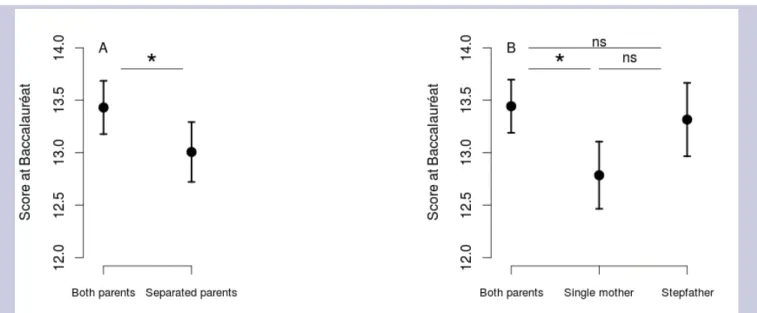
In model A1, an influence of parental separation on exam
score was detected (F1,498 = 4.78, P = 0.03): separation was associated with a 0.42 point decrease in exam scores (Table 1, Fig. 1A). The variables sex and first language of the mother were not significant (Table 1). The variables repetition of at least one school year and first language of the father had significant negative effects on exam scores, with a 1.09 and a 1.12 decrease in exam scores, respectively (F1,498 = 38.18, P < 10-5 and F
1,498 = 14.70,
P < 10-3), see Table 1. This model explained 15% of the variance.
A log transformation of the dependent variable was necessary to normalize the residuals [41].
Model B1 revealed a significant effect of the familial category (3 categories, see Statistical analyses section above) during the year preceding the exam (F2,497 = 3.57, P = 0.03, Table 2, Fig. 1). Participants in the category biological mother alone had a 0.6 point lower exam score on average, which was significantly different from the category two biological parents (F1,497 = 7.11, P = 0.007), but not from the category biological mother and stepfather (F1,497 = 2.34, P = 0.12). In addition, no significant difference was detected between the categories two biological parents and biological mother and stepfather (F1,497 = 0.21, P = 0.64). The category biological mother and stepfather was intermediate between the two others (see Fig. 1B). The same control variables as in the first model were significant (Table 2). This model explained 15% of the variance. A log transformation of the scores was necessary to normalize the residuals.
Models A2 and B2
Models A2 and B2, included, in addition to the variables present in models A1 and B1, maternal birth order (three levels: firstborn, later-born and only child), and educational levels of each biological parent (number of years in higher education). These variables were missing for almost half of individuals. The sample size was therefore reduced to N=368 (219 women and 149 men). None of these three variables had a significant effect, and models A2 and B2 displayed qualitatively identical results as models A1 and B1, see Tables 3 and 4.
Figure 1. Average Baccalauréat scores of the students depending on (A) the separation of their parents and (B) their family structure during the year preceding the exam
Berticat et al. (2017)
Email: [email protected]
4/8 J Behav 2(3): 1012 (2017)
DISCUSSION
This study has examined for the first time the link between family structure and academic achievement, as measured by Baccalauréat scores, among French university students. We found that parental separation was significantly and negatively associated with Baccalauréat scores. Moreover, the absence of the father during the year preceding this final exam was negatively correlated with students’ academic performances, particularly when the students lived with their biological mother alone. The presence of a stepfather seemed to partly compensate for the absence of the biological father, leading to a score in-between.
Humans are characterized by an extended juvenile period that is important for the acquisition of physical, social, and cognitive competencies that support survival and reproduction [42,43]. This long developmental period is related to a high dependency on adult care giving [44,45], namely parental investment and alloparenting [46]. In humans, the extended period of childhood dependency and the short intervals between births make human mothers more dependent on fathers and relatives to share the costs of raising the children [47].
Table 1: Score at the Baccalauréat as a function of the marital status of the parents and potential confounding variables (Model A1, N = 506, linear regression, 14.7% of variance explained). For each variable, the estimate, the standard error of the mean (SE), and the P-value of the F-test are given. For categorical variables, the estimates are for one category compared to the reference category (underlined term). Items in bold showed significant effects (P < 0.05).
Estimate SE P Intercept 13.43 0.25 Separated parents 0.03 yes/no -0.42 0.19 Sex 0.19 male/female -0.22 0.17 Repetition of a year <10-5 yes/no -1.08 0.18 Maternal language 0.14 Foreign/French 0.44 0.3 Paternal language <10-3 Foreign/French -1.12 0.29
Year of the study <10-3
2011/2010 -0.91 0.27
2012/2010 -0.38 0.29
Table 2: Score at the Baccalauréat as a function of familial structure during the year preceding the exam and potential confounding variables (Model B1, N = 506, linear regression, 15% of variance explained). For each variable, the estimate, the standard error of the mean (SE), and the P-value of the F-test are given. For cat-egorical variables, the estimates are for one category compared to the reference category (underlined term). Items in bold showed significant effects (P < 0.05).
Estimate SE P
Intercept 13.44 0.25
Familial structure 0.03
Mother alone/Both parents -0.66 0.25 Mother and stepfather/Both
parents -0.13 0.27 Sex 0.23 male/female -0.2 0.17 Repetition of year <10-5 yes/no -1.1 0.18 Maternal language 0.14 Foreign/French 0.44 0.3 Paternal language <10-3 Foreign/French -1.1 0.29
Year of the study <10-3
2011/2010 -0.95 0.27
2012/2010 -0.38 0.29
Table 3: Score on the Baccalauréat as a function of marital status of the biological parents and potentially confounding variables (Model A2, N = 368, linear regres-sion, 16% of variance explained). For each variable, the estimate, the standard error of the mean (SE), and the P-value of the F-test are given. For categorical variables, the estimates are for one category compared to the reference category (underlined term). Items in bold showed significant effects (P < 0.05).
Estimate SE P Intercept 13.32 0.4 Separated parents 0.02 yes/no -0.54 0.23 Sex 0.13 male/female -0.29 0.19 Repetition of year <10-5 yes/no -0.96 0.2
Mother’s education level 0.02 0.03 0.44
Father’s education level -0.01 0.03 0.79
Maternal language 0.25 Foreign/French 0.41 0.35 Paternal language 0.01 Foreign/French -0.94 0.35 Birth order 0.94 later-born/firstborn 0.03 0.2 only child/firstborn -0.06 0.26
Year of the study <10-3
2011/2010 -1.01 0.3
Father absence
The absence of the biological father has been the topic of an extensive amount of literature in psychological, anthropological, and epidemiological studies. This literature generally demonstrates that in westernized populations, biological father absence, either due to extra-marital birth, paternal death, or divorce, is predictive of poorer child wellbeing, in areas of educational attainment, academic achievement, and mental health [3,14,19,48]. The role of fathers in providing both direct child care and financial support, along with the economic disadvantages of lone mother households, are typically highlighted as key mediators of the negative consequences of father absence.
A range of studies highlight diversity in the form and consequences of father absence [49,50]. In western populations, the absence of the father is associated with various developmental changes, such as in girls, early sexual activity, early onset of puberty, and teen pregnancy [51-54], and in both sexes, more sexual partners, higher risks of divorce in adulthood and effects
on endocrine patterns [51-57], although these associations might be confounded by genetic effects [58]. Nevertheless, no effect of parental separation has been detected on the number of children or grandchildren [53].
As in the present study, researchers have consistently shown that parental divorce is negatively associated to children's academic achievements [16,17,27,59-61]. The stress of parental relationship disruption and impact of new unrelated father figures on the rearing environment of children may be influential on their outcomes [35,62].
Stepfather presence
Although remarriage is frequent in many diverse human populations [59], most of the studies on academic achievements did not control for the presence of a stepfather. The present study addresses this important gap in the literature. The differences observed between familial categories in the present study may be directly due to the change in the child's home environment. Investment is notably lower in stepchildren than in biological children [31,34,63-68]. Alternatively, there may be indirect effects: stepfather presence may induce a change in maternal care-giving practices. Some research also suggested that the presence of a stepfather is associated with a diversion of maternal care [31,32,66,67].
In the present study, however, average Baccalauréat score found in the presence of a stepfather was in between the average scores of the two other familial categories (see Fig. 1 B). Interestingly, in UK children, time investment from both parents decreased linearly with increasing child age from 1.5 to 9 years, suggesting that maternal time investment is of relatively less importance for a teenager than for a younger child [39]. The influence of the stepfather is therefore possibly milder for a teenager.
Some positive effects of stepfathers have also been documented. For example, their education level is positively associated with adult intelligence of their stepsons [69]. The negative effect of stepfather presence on academic achievement may be overcome if stepfathers are encouraged to interact more with their stepchildren [70]. In addition, aside from direct investment, it could be that stepfather presence is indirectly beneficial through support to the mother [71].
Sex differences
We did not find any significant effect of the child’s sex on exam score nor any significant interaction with family structure. Similarly, a large longitudinal study did not find any interaction between parental divorce and child’s sex when predicting academic performance [27]. This finding is consistent with several other studies [17,72-74]. In contrast, a study concluded that the negative effects of parental divorce on academic achievement were stronger for girls than boys [75]. In sum, evidence is mixed as to whether sex differences modify the impact of parental divorce on academic achievements.
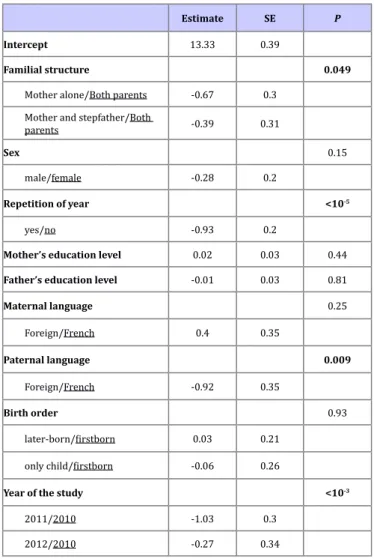
Table 4: Score at the Baccalauréat as a function of familial category during the year before the exam and potentially confounding variables (Model B2, N = 368, linear regression, 16% of variance explained). For each variable, the estimate, the standard error of the mean (SE), and the P-value of the F-test are given. For cat-egorical variables, the estimates are for one category compared to the reference category (underlined term). Items in bold showed significant effects (P < 0.05).
Estimate SE P
Intercept 13.33 0.39
Familial structure 0.049
Mother alone/Both parents -0.67 0.3 Mother and stepfather/Both
parents -0.39 0.31
Sex 0.15
male/female -0.28 0.2
Repetition of year <10-5
yes/no -0.93 0.2
Mother’s education level 0.02 0.03 0.44
Father’s education level -0.01 0.03 0.81
Maternal language 0.25 Foreign/French 0.4 0.35 Paternal language 0.009 Foreign/French -0.92 0.35 Birth order 0.93 later-born/firstborn 0.03 0.21 only child/firstborn -0.06 0.26
Year of the study <10-3
2011/2010 -1.03 0.3
Berticat et al. (2017)
Email: [email protected]
6/8 J Behav 2(3): 1012 (2017)
Limitations
An alternative explanation of our results is that mother-only households are households which experienced a more recent parental separation than stepfather-present households (and so the mother has not had time to repartner). It may indeed be the stress of parental separation, rather than the presence or absence of a stepfather, which drives our results. As we have no information on the time of parental separation and arrival of the alternative partner, such longitudinal effects could not be evaluated here. However, some studies suggest that the effects of divorce are most pronounced when it occurs during or just beyond the high school level [32].
It must be noted that a significant problem with examining the impact of parental separation on child outcomes is the potential for selection effects, i.e. families who experience divorce having different characteristics from those who do not experience divorce. Nevertheless, after controlling for selection effects, Steele et al. [32] found that experience of marital breakdown during childhood in a Norwegian population is associated with a lower educational level. Moreover, negative relationships between father absence and indicators of child wellbeing are remarkably consistent, including in studies utilizing longitudinal analysis and related methods capable of isolating causality [48]. In our sample, we did not find significant differences between separated and non-separated parents regarding their education level or their first language. This suggests that selection effects were not involved. Concerning parents’ income, we had a low response rate. In France, such information is more or less confidential and rarely communicated to children. However, it is correlated to educational level, which is included as an independent variable in all our models.
Our sample is constituted of university students, thus it originates from the 65% of individuals aged 16-20 who have passed the Baccalauréat. This means that their skills at school are above the population mean. Those students for whom separation and/or the presence of a stepfather was too detrimental to succeed were not sampled. The negative effect of the presence of parental separation and/or the presence of a stepfather is therefore likely to have been underestimated.
CONCLUSION
Overall, some effects of family structure on child academic achievement are likely to be due to a loss of paternal care. Among these losses, some may be either amplified or compensated for by the presence of a stepfather. Our study is consistent with the impact of family structure on academic achievement and highlights the importance of distinguishing, among individuals who have experienced parental separation, those who lived with a stepfather or not.
There are several opportunities to build upon this research. Firstly, it would be useful to investigate the consequences of the temporal dynamics of family structure. Specifically, the impact of age at parental separation, at stepfather arrival, and at half-sibling birth should be analyzed. Indeed, household structure probably
does not induce the same effects on children of various ages [35]. Secondly, the analysis of larger samples would allow examining the case of lone father households and the consequences of stepmother presence. These patterns are also likely to be culture-dependent. Understanding the impact of parental separation on child academic outcomes would greatly benefit from longitudinal cross-cultural studies.
ACKNOWLEDGEMENT
We thank the students who participated in this study. This is contribution ISEM 2017-242 of the Institute of Evolutionary Science of Montpellier.
DISCLOSURE
We declare no financial interest and no conflict of interest.
REFERENCES
1. Amato PR. Research on divorce: continuing trends and new develop-ments. Journal of Marriage and Family. 2010; 72(3): 650-666. 2. Lansford JE. Parental divorce and children’s adjustment. Perspectives
on Psychological Science. 2009; 4(2): 140-152.
3. Gadalla TM. Impact of marital dissolution on men’s and women’s in-comes: a longitudinal study. Journal of Divorce & Remarriage. 2008; 50(1); 55-65.
4. Quinlan RJ. Father absence, parental care, and female reproductive development. Evolution and Human Behavior. 2003; 24 (6): 376-390. 5. Bzostek SH, Beck AN. Familial instability and young children’s
physi-cal health. Social Science & Medicine. 2011; 73(2): 282-292.
6. Langton CE, Berger LM. Family Structure and Adolescent Physical Health, Behavior, and Emotional Well-Being. The Social service re-view. 2011; 85(3): 323-357.
7. Fomby P, Cherlin AJ. Family Instability and Child Well-Being. Ameri-can sociological review. 2007; 72(2): 181-204.
8. Emery RE. Interparental conflict and the children of discord and di-vorce. Psychological Bulletin. 1982; 92(2): 310-330.
9. Hetherington EM. An overview of the Virginia Longitudinal Study of Divorce and Remarriage with a focus on early adolescence. Journal of Family Psychology. 1993; 7(1): 39-56.
10. Glick PC, Lin SL. Recent changes in divorce and remarriage. Journal of Marriage and the Family. 1986; 48(4): 737.
11. INSEE. Tableaux de l’économie française. 2010.
12. INSEE. Tableaux de l’économie française. Familles avec enfants. 2015. 13. Evans, M DR, Kelley J, Wanner RA. Educational attainment of the chil-dren of divorce: Australia. Journal of Sociology. 2001; 37(3): 1940– 1990.
14. Fomby, Paula, Andrew J, Cherlin. Family instability and child well-being. American sociological review. 2007; 72(2): 181-204. 15. Guttmann, J, Rosenberg, M. Emotional intimacy and children's
adjust-ment: A comparison between single-parent divorced and intact fami-lies. Educational Psychology. 2003; 23(4): 457-472.
16. Amato PR, Keith B. Parental divorce and the well-being of children: A meta-analysis. Psychological Bulletin. 1991; 110(1): 26-46.
17. Amato PR. Children of divorce in the 1990s: An update of the Amato and Keith (1991) meta-analysis. Journal of Family Psychology. 2001; 15(3): 355-370.
18. Jeynes WH. Examining the effects of parental absence on the academ-ic achievement of adolescents: The challenge of controlling for family income. Journal of family and Economic Issues. 2002; 23(2): 189-210. 19. Piketty T. The impact of divorce on school performance: evidence
from France. 1968-2002, 2003.
20. Wilkinson R. Mind the gap: hierarchies, health and evolution. Paris: Weidenfeld & Nicolson Ltd. 2000.
21. Fieder M, Huber S. The effects of sex and childlessness on the asso-ciation between status and reproductive output in modern society. Evolution and Human Behavior. 2007; 28(6): 392-398.
22. Nettle D. Why do some dads get more involved than others? Evidence from a large British cohort. Evolution and Human Behavior. 2008; 29(6): 416-423.e1.
23. Waynforth D, Dunbar, R IM. Conditional mate choice strategies in humans: evidence from “lonely hearts” advertisements. Behaviour. 1995; 132(9): 755-779.
24. Cronk L. Wealth, status, and reproductive success among the Muko-godo of Kenya. American Anthropologist. 1991; 93(2): 345–360. 25. Fieder M, Huber S, Bookstein FL, Iber K, Schafer K, Winckler G,
Wall-ner B. Status and reproduction in Humans: new evidence for theva-lidity of evolutionary explanations on basis of a university sample. Ethology. 2005; 111(10): 940-950.
26. Nettle D, Pollet TV. Natural Selection on Male Wealth in Humans. The American Naturalist. 2008; 172(5): 658-666.
27. Sun Y, Li Y. Marital disruption, parental investment, and children’s academic achievement. A prospective analysis. Journal of Family Is-sues. 2001; 22(1): 27-62.
28. Downey DB. Understanding academic achievement among children in stephouseholds: the role of parental resources. sex of stepparent, and sex of child. Social Forces. 1995; 73(3): 875-894.
29. Astone NM, McLanahan SS. Family structure, parental practices and highschool completion. American Sociological Review. 1991; 56(3): 309.
30. Beller AH, Chung SS. Family structure and educational attainment of children: Effects of remarriage. Journal of Population Economics. 1992; 5(1), 39-59.
31. Case A, Lin IF, McLanahan S. Educational attainment of siblings in stepfamilies. Evolution and Human Behavior. 2001; 4(22), 269-289. 32. Steele F, Sigle-Rushton W, Kravdal Ø. Consequences of family
disrup-tion on children’s educadisrup-tional outcomes in Norway. Demography. 2009; 46: 553.
33. Boggess S. Family structure, economic status, and educational attain-ment. Journal of Population Economics. 1998; 11(2): 205-222. 34. Zvoch K. Family type and investment in education. Evolution and
Hu-man Behavior. 1999; 20(6): 453-464.
35. Lawson DW, Mace R. Trade-offs in modern parenting: a longitudinal
study of sibling competition for parental care. Evolution and Human Behavior. 2009; 30(3): 170-183.
36. Bernardi F, Boertien D. Non-intact families and diverging educational destinies: A decomposition analysis for Germany, Italy, the United Kingdom and the United States. Social science research. 2017; 63: 181-191.
37. Menesr-Depp. L’espérance d’obtenir le baccalauréat pour un élève de sixième. Menesr-Depp, Repères et références statistiques. 2015; 242-243.
38. Menesr-Depp. La proportion de bacheliers dans une génération. Menesr-Depp Repères et références statistiques. 2015; 240-241. 39. Pérusse D. Cultural and reproductive success in industrial societies:
Testing the relationship at the proximate and ultimate levels. Behav-ioral and Brain Sciences. 1993; 16(2): 267-283.
40. Faurie C, Bonenfant S, Goldberg M, Hercberg S, Zins M, Raymond M. Socio-economic status and handedness in two large cohorts of French adults. British Journal of Psychology. 2008; 99(4): 533-554. 41. Crawley MJ. The R Book. John Wiley & Sons: Chichester, UK, 2007. 42. Geary DC. Evolution and proximate expression of human paternal
in-vestment. Psychological Bulletin. 2000; 126(1): 55.
43. Mayr E. Behavior programs and evolutionary strategies: natural se-lection sometimes favors a genetically “closed” behavior program, sometimes an“ open” one. American Scientist. 1974; 62: 650-659. 44. Bogin BA. Evolutionary hypotheses for human childhood. American
Journal of Physical Anthropology. 1997; 40: 63-89.
45. Mchenry H. Behavioral ecological implications of early hominid body-size. Journal of Human Evolution. 1994; 27(1-3): 77-87.
46. Sear R. Beyond the nuclear family: an evolutionary perspective on parenting. Current Opinion in Psychology. 2016; 7: 98-103.
47. Hrdy SB. Mothers and others. Harvard University Press. 2011. 48. McLanahan S, Tach L, Schneider D. The causal effects of father
ab-sence. Annual review of sociology. 2013; 39: 399-427.
49. Lawson DW, Schaffnit SB, Hassan A, Ngadaya E, Ngowi B, Mfinanga SG, James S, Borgerhoff Mulder M. Father absence but not fosterage predicts food insecurity, relative poverty, and poor child health in northern Tanzania. American journal of human biology. 2016; 29(3). 50. Sear R, Mace R. Who keeps children alive? A review of the effects of
kin on child survival. Evolution and Human Behavior. 2008; 29(1): 1-18.
51. Ellis BJ, Bates JE, Dodge KA, Fergusson DM, Horwood LJ, Pettit GS, Woodward L. Does father absence place daughters at special risk for early sexual activity and teenage pregnancy? Child Development. 2003; 74(3): 801-821.
52. Maestripieri D, Roney JR, DeBias N, Durante KM, Spaepen GM. Father absence, menarche and interest in infants among adolescent girls. Developmental Science. 2004; 7(5): 560-566.
53. Alvergne A, Faurie C, Raymond M. Developmental plasticity of hu-man reproductive development: Effects of early family environment in modern-day France. Physiology & Behavior. 2008; 95(5): 625-632. 54. Cuplin I, Heron J, Araya R, Joinsen C. Early childhood father absence and depressive symptoms in adolescent girls from a UK cohort: the
Berticat et al. (2017)
Email: [email protected]
8/8 J Behav 2(3): 1012 (2017)
mediating role of early menarche. J Abnorm Child Psychol. 2015; 43(5): 921-931.
55. Kim K, Smith PK. Family relations in early childhood and reproduc-tive development. Journal of Reproducreproduc-tive and Infant Psychology. 1999; 17(2): 133-148.
56. Flinn, MV, & England, B. G. Social economics of childhood glucocorti-coid stress response and health. American Journal of Physical Anthro-pology, 1997; 102(1): 33-53.
57. Surbey MK. Family composition, stress, and the timing of human men-arche. In T. E. Ziegler & F. B. Bercovitch (Eds.), Socioendocrinology of primate reproduction, New York, NY, US: Wiley-Liss. 1990; 11-32. 58. Barbaro N, Boutwell BB, Barnes JC, Shackelford TK. Genetic
confound-ing of the relationship between father absence and age at menarche. Evolution and Human Behavior. 2017; 38(3): 357-365.
59. Hewlett BS. Demography and childcare in preindustrial societies. Journal of Anthropological Research. 1991; 47(1): 1-37.
60. Jeynes W. Divorce, family structure, and the academic success of chil-dren. Routledge. 2012.
61. Anthony CJ, DiPerna JC, Amato PR. Divorce, approaches to learning, and children’s academic achievement: a longitudinal analysis of me-diated and moderated effects. Journal of School Psychology. 2014; 52(3), 249-261.
62. Daly M,Wilson M. Child abuse and other risks of not living with both parents. Ethology and sociobiology. 1985; 6(4): 197-210.
63. Anderson KG, Kaplan H, Lancaster J. Paternal care by genetic fathers and stepfathers I: reports from Albuquerque men. Evolution and Be-havior. 1999; 20(6): 405-431.
64. Anderson KG, Kaplan H, Lam D, Lancaster J. Paternal care by genetic fathers and stepfathers II: reports by Xhosa high school students. Evolution and Behavior. 1999; 20(6): 433-451.
65. Daly M, Wilson MI. Some differential attributes of lethal assaults on small children by stepfathers versus genetic fathers. Ethology and So-ciobiology. 1994; 15(4): 207-217.
66. Daly M, Wilson M. The truth about Cinderella: A darwinian view of parental love. Yale University Press. 1998.
67. Flinn MV. Step- and genetic parent/offspring relationships in a Carib-bean village. Ethology and Sociobiology. 1988; 9(6): 335-369. 68. Harris GT, Hilton NZ, Rice ME, Eke AW. Children killed by genetic
parents versus stepparents. Evolution and Human Behavior. 2007; 2(28): 85-95.
69. Eriksen W, Sundet JM, Tambs K. Are stepfathers’ education levels associated with the intelligence of their stepsons? A register-based study of Norwegian half-brothers. British Journal of Psychology. 2013; 104(2): 212-224.
70. Emmott EH, Mace R. Direct investment by stepfathers can mitigate effects on educational outcomes but does not improve behavioural difficulties. Evolution and Human Behavior. 2014; 35(5): 438–444. 71. Rohwer S, Herron JC, Daly M. Stepparental behavior as mating effort
in birds and other animals. Evolution and Human Behavior. 1999; 20: 367-390.
72. Allison PD, Furstenberg FF. How marital dissolution affects children: Variations by age and sex. Developmental Psychology. 1989; 25(4): 540-549.
73. Lansford JE, Malone PS, Castellino DR, Dodge KA, Pettit GS, Bates JE. Trajectories of internalizing, externalizing, and grades for children who have and have not experienced their parents’ divorce or separa-tion. Journal of Family Psychology. 2006; 20(2): 292-301.
74. Levine DI, Painter G. Family structure and youths’ outcomes: which correlations are causal? SSRN Electronic Journal. 1999.
75. Neighbors B, Forehand R, Armistead L. Is parental divorce a criti-cal stressor for young adolescents? Grade point average as a case in point. Adolescence. 1992; 27(107): 639-646.