HAL Id: hal-01590661
https://hal.archives-ouvertes.fr/hal-01590661
Submitted on 24 May 2019
HAL is a multi-disciplinary open access
archive for the deposit and dissemination of
sci-entific research documents, whether they are
pub-lished or not. The documents may come from
teaching and research institutions in France or
abroad, or from public or private research centers.
L’archive ouverte pluridisciplinaire HAL, est
destinée au dépôt et à la diffusion de documents
scientifiques de niveau recherche, publiés ou non,
émanant des établissements d’enseignement et de
recherche français ou étrangers, des laboratoires
publics ou privés.
Gait analysis using optimality criteria imputed from
human data
Adina Panchea, Philippe Fraisse, Sylvain Miossec, Olivier Buttelli, Angèle van
Hamme, Marie-Laure Welter, Nacim Ramdani
To cite this version:
Adina Panchea, Philippe Fraisse, Sylvain Miossec, Olivier Buttelli, Angèle van Hamme, et al.. Gait
analysis using optimality criteria imputed from human data. 20th IFAC World Congress, Jul 2017,
Toulouse, France. pp.13510-13515, �10.1016/j.ifacol.2017.08.2340�. �hal-01590661�
IFAC PapersOnLine 50-1 (2017) 13510–13515
ScienceDirect
Available online at www.sciencedirect.com
2405-8963 © 2017, IFAC (International Federation of Automatic Control) Hosting by Elsevier Ltd. All rights reserved. Peer review under responsibility of International Federation of Automatic Control.
10.1016/j.ifacol.2017.08.2340
© 2017, IFAC (International Federation of Automatic Control) Hosting by Elsevier Ltd. All rights reserved.
Gait analysis using optimality criteria
imputed from human data
Adina M. Panchea∗ Sylvain Miossec∗ Olivier Buttelli∗ Philippe Fraisse∗∗ Ang`ele Van Hamme∗∗∗
Marie-Laure Welter∗∗∗ Nacim Ramdani∗
∗Univ. Orl´eans, INSA CVL, PRISME EA4229, F45072, Orl´eans,
France. (e-mail: [email protected])
∗∗LIRMM UMR 5506 CNRS, Univ. Montpellier 2, 161 rue Ada,
Montpellier, 34392 France.
∗∗∗INSERM UMRS 975 BEBG Team, CNRS UMR 7225, UPMC
Paris 6, Groupe Hospitalier Piti´e-Salpˆetri`ere, Paris F-75013, France
Abstract: This study proposes an efficient and automatic tool to understand and analyze the human natural and fast gait tasks. First, the gait tasks are modeled as a nonlinear optimal control problem along with a nonlinear model predictive control, usually used in the humanoid robots control. Second, under the assumption that the walking motions are the result of an optimization process, the identification of plausible optimality criteria weight values is achieved with an inverse optimal control (IOC) approach. Our IOC walking scheme is performed on ten subjects with ten trials for each gait task considered. Results show that the variability observed in the experimental data are exhibited by our proposed scheme. Finally, an easy distinguish can be made between the gait tasks only by checking out the exhibited criteria weight values.
Keywords: Optimal control theory, Inverse optimal control, Modeling for control optimization,
Identification and control methods, Human walking control, Trajectory and Path Planning. 1. INTRODUCTION
Understanding human walking arises in several areas of study in robotics such as motion generation and control of humanoid robots, human-robot interaction, design and control of exoskeletons or prostheses. One way of achieving some insights is from the experimental data of human walking by motion capture systems, measurements of ex-ternal forces (force plates), EMG recordings etc. Never-theless, there are many walking parameters which are not available, such as center of mass position, joint torques etc. In this context, accurate dynamic human models are proposed in literature such as dynamic whole-body models (Felis et al. (2015)) or models which are generally used in humanoid robots control (Aftab et al. (2012)) to capture and gain access to the walking parameters of interest. Over the last decades, human walking motions are con-sidered to be the result of an optimization process where one or multiple optimality criteria are minimized (Alexan-der (1984)). Un(Alexan-der this hypothesis, the optimality cri-terion/criteria minimized by the human motor control remain(s) unknown. One way towards the identification of these assumed optimality criteria for human walking motion can be achieved by considering the inverse optimal control (IOC) problem. The latter was already used in the literature to understand human walking behaviour and one can find it solved with different approaches, such as the
bi- This work is supported by the French National Research
Agency under contract ANR 2012 TECS 0020 ECOTECH (www.ecotechsan.org).
level approach (Clever et al. (2016)) or the approximately optimal control approach (Papadopoulos et al. (2015)). The latter studies the human body by using the dynamics of an unicycle robot type (Mombaur et al. (2010)) or by considering it a hybrid dynamic multi-body system with several degrees of freedom (Mombaur et al. (2013)). Being interested in gaining some insights from human natural and fast walking behaviours, the goal of our study is first: to propose an effective simplified modeling for the tasks and second: to identify plausible optimality criteria in an optimal control framework.
In our study, the human body is modeled by making use of the previously employed walking patterns for the design and the control of humanoid robots. These kind of walking patterns (Carpentier et al. (2016), Naveau et al. (2016)) consist on a nonlinear optimization problem based on a model predictive control (MPC) scheme, as suggested in Herdt et al. (2010). The inconvenient in the latter studies consists in the random selection of the optimality criteria weight values. The latter motivated us to make use of the IOC problem, along with a nonlinear optimization problem for the human body modeling, and propose an efficient and automatic scheme of identifying the optimality criteria weight values.
We propose to impute such optimality criteria from human natural and fast walking motions, by using the improved version of the inverse Karush-Kuhn-Tucker (KKT) ap-proach as proposed in Panchea (2015) or Lin et al. (2016). Then, the identified criteria weight values are used in the
Proceedings of the 20th World Congress
The International Federation of Automatic Control Toulouse, France, July 9-14, 2017
Copyright © 2017 IFAC 14052
Gait analysis using optimality criteria
imputed from human data
Adina M. Panchea∗ Sylvain Miossec∗ Olivier Buttelli∗
Philippe Fraisse∗∗ Ang`ele Van Hamme∗∗∗
Marie-Laure Welter∗∗∗ Nacim Ramdani∗
∗Univ. Orl´eans, INSA CVL, PRISME EA4229, F45072, Orl´eans,
France. (e-mail: [email protected])
∗∗LIRMM UMR 5506 CNRS, Univ. Montpellier 2, 161 rue Ada,
Montpellier, 34392 France.
∗∗∗INSERM UMRS 975 BEBG Team, CNRS UMR 7225, UPMC
Paris 6, Groupe Hospitalier Piti´e-Salpˆetri`ere, Paris F-75013, France
Abstract: This study proposes an efficient and automatic tool to understand and analyze the human natural and fast gait tasks. First, the gait tasks are modeled as a nonlinear optimal control problem along with a nonlinear model predictive control, usually used in the humanoid robots control. Second, under the assumption that the walking motions are the result of an optimization process, the identification of plausible optimality criteria weight values is achieved with an inverse optimal control (IOC) approach. Our IOC walking scheme is performed on ten subjects with ten trials for each gait task considered. Results show that the variability observed in the experimental data are exhibited by our proposed scheme. Finally, an easy distinguish can be made between the gait tasks only by checking out the exhibited criteria weight values.
Keywords: Optimal control theory, Inverse optimal control, Modeling for control optimization,
Identification and control methods, Human walking control, Trajectory and Path Planning. 1. INTRODUCTION
Understanding human walking arises in several areas of study in robotics such as motion generation and control of humanoid robots, human-robot interaction, design and control of exoskeletons or prostheses. One way of achieving some insights is from the experimental data of human walking by motion capture systems, measurements of ex-ternal forces (force plates), EMG recordings etc. Never-theless, there are many walking parameters which are not available, such as center of mass position, joint torques etc. In this context, accurate dynamic human models are proposed in literature such as dynamic whole-body models (Felis et al. (2015)) or models which are generally used in humanoid robots control (Aftab et al. (2012)) to capture and gain access to the walking parameters of interest. Over the last decades, human walking motions are con-sidered to be the result of an optimization process where one or multiple optimality criteria are minimized (Alexan-der (1984)). Un(Alexan-der this hypothesis, the optimality cri-terion/criteria minimized by the human motor control remain(s) unknown. One way towards the identification of these assumed optimality criteria for human walking motion can be achieved by considering the inverse optimal control (IOC) problem. The latter was already used in the literature to understand human walking behaviour and one can find it solved with different approaches, such as the
bi- This work is supported by the French National Research
Agency under contract ANR 2012 TECS 0020 ECOTECH (www.ecotechsan.org).
level approach (Clever et al. (2016)) or the approximately optimal control approach (Papadopoulos et al. (2015)). The latter studies the human body by using the dynamics of an unicycle robot type (Mombaur et al. (2010)) or by considering it a hybrid dynamic multi-body system with several degrees of freedom (Mombaur et al. (2013)). Being interested in gaining some insights from human natural and fast walking behaviours, the goal of our study is first: to propose an effective simplified modeling for the tasks and second: to identify plausible optimality criteria in an optimal control framework.
In our study, the human body is modeled by making use of the previously employed walking patterns for the design and the control of humanoid robots. These kind of walking patterns (Carpentier et al. (2016), Naveau et al. (2016)) consist on a nonlinear optimization problem based on a model predictive control (MPC) scheme, as suggested in Herdt et al. (2010). The inconvenient in the latter studies consists in the random selection of the optimality criteria weight values. The latter motivated us to make use of the IOC problem, along with a nonlinear optimization problem for the human body modeling, and propose an efficient and automatic scheme of identifying the optimality criteria weight values.
We propose to impute such optimality criteria from human natural and fast walking motions, by using the improved version of the inverse Karush-Kuhn-Tucker (KKT) ap-proach as proposed in Panchea (2015) or Lin et al. (2016). Then, the identified criteria weight values are used in the
Proceedings of the 20th World Congress
The International Federation of Automatic Control Toulouse, France, July 9-14, 2017
Copyright © 2017 IFAC 14052
Gait analysis using optimality criteria
imputed from human data
Adina M. Panchea∗ Sylvain Miossec∗ Olivier Buttelli∗
Philippe Fraisse∗∗ Ang`ele Van Hamme∗∗∗ Marie-Laure Welter∗∗∗ Nacim Ramdani∗
∗Univ. Orl´eans, INSA CVL, PRISME EA4229, F45072, Orl´eans,
France. (e-mail: [email protected])
∗∗LIRMM UMR 5506 CNRS, Univ. Montpellier 2, 161 rue Ada,
Montpellier, 34392 France.
∗∗∗INSERM UMRS 975 BEBG Team, CNRS UMR 7225, UPMC
Paris 6, Groupe Hospitalier Piti´e-Salpˆetri`ere, Paris F-75013, France
Abstract: This study proposes an efficient and automatic tool to understand and analyze the human natural and fast gait tasks. First, the gait tasks are modeled as a nonlinear optimal control problem along with a nonlinear model predictive control, usually used in the humanoid robots control. Second, under the assumption that the walking motions are the result of an optimization process, the identification of plausible optimality criteria weight values is achieved with an inverse optimal control (IOC) approach. Our IOC walking scheme is performed on ten subjects with ten trials for each gait task considered. Results show that the variability observed in the experimental data are exhibited by our proposed scheme. Finally, an easy distinguish can be made between the gait tasks only by checking out the exhibited criteria weight values.
Keywords: Optimal control theory, Inverse optimal control, Modeling for control optimization,
Identification and control methods, Human walking control, Trajectory and Path Planning. 1. INTRODUCTION
Understanding human walking arises in several areas of study in robotics such as motion generation and control of humanoid robots, human-robot interaction, design and control of exoskeletons or prostheses. One way of achieving some insights is from the experimental data of human walking by motion capture systems, measurements of ex-ternal forces (force plates), EMG recordings etc. Never-theless, there are many walking parameters which are not available, such as center of mass position, joint torques etc. In this context, accurate dynamic human models are proposed in literature such as dynamic whole-body models (Felis et al. (2015)) or models which are generally used in humanoid robots control (Aftab et al. (2012)) to capture and gain access to the walking parameters of interest. Over the last decades, human walking motions are con-sidered to be the result of an optimization process where one or multiple optimality criteria are minimized (Alexan-der (1984)). Un(Alexan-der this hypothesis, the optimality cri-terion/criteria minimized by the human motor control remain(s) unknown. One way towards the identification of these assumed optimality criteria for human walking motion can be achieved by considering the inverse optimal control (IOC) problem. The latter was already used in the literature to understand human walking behaviour and one can find it solved with different approaches, such as the
bi- This work is supported by the French National Research
Agency under contract ANR 2012 TECS 0020 ECOTECH (www.ecotechsan.org).
level approach (Clever et al. (2016)) or the approximately optimal control approach (Papadopoulos et al. (2015)). The latter studies the human body by using the dynamics of an unicycle robot type (Mombaur et al. (2010)) or by considering it a hybrid dynamic multi-body system with several degrees of freedom (Mombaur et al. (2013)). Being interested in gaining some insights from human natural and fast walking behaviours, the goal of our study is first: to propose an effective simplified modeling for the tasks and second: to identify plausible optimality criteria in an optimal control framework.
In our study, the human body is modeled by making use of the previously employed walking patterns for the design and the control of humanoid robots. These kind of walking patterns (Carpentier et al. (2016), Naveau et al. (2016)) consist on a nonlinear optimization problem based on a model predictive control (MPC) scheme, as suggested in Herdt et al. (2010). The inconvenient in the latter studies consists in the random selection of the optimality criteria weight values. The latter motivated us to make use of the IOC problem, along with a nonlinear optimization problem for the human body modeling, and propose an efficient and automatic scheme of identifying the optimality criteria weight values.
We propose to impute such optimality criteria from human natural and fast walking motions, by using the improved version of the inverse Karush-Kuhn-Tucker (KKT) ap-proach as proposed in Panchea (2015) or Lin et al. (2016). Then, the identified criteria weight values are used in the
Proceedings of the 20th World Congress
The International Federation of Automatic Control Toulouse, France, July 9-14, 2017
Copyright © 2017 IFAC 14052
Gait analysis using optimality criteria
imputed from human data
Adina M. Panchea∗ Sylvain Miossec∗ Olivier Buttelli∗
Philippe Fraisse∗∗ Ang`ele Van Hamme∗∗∗ Marie-Laure Welter∗∗∗ Nacim Ramdani∗
∗Univ. Orl´eans, INSA CVL, PRISME EA4229, F45072, Orl´eans,
France. (e-mail: [email protected])
∗∗LIRMM UMR 5506 CNRS, Univ. Montpellier 2, 161 rue Ada,
Montpellier, 34392 France.
∗∗∗INSERM UMRS 975 BEBG Team, CNRS UMR 7225, UPMC
Paris 6, Groupe Hospitalier Piti´e-Salpˆetri`ere, Paris F-75013, France
Abstract: This study proposes an efficient and automatic tool to understand and analyze the human natural and fast gait tasks. First, the gait tasks are modeled as a nonlinear optimal control problem along with a nonlinear model predictive control, usually used in the humanoid robots control. Second, under the assumption that the walking motions are the result of an optimization process, the identification of plausible optimality criteria weight values is achieved with an inverse optimal control (IOC) approach. Our IOC walking scheme is performed on ten subjects with ten trials for each gait task considered. Results show that the variability observed in the experimental data are exhibited by our proposed scheme. Finally, an easy distinguish can be made between the gait tasks only by checking out the exhibited criteria weight values.
Keywords: Optimal control theory, Inverse optimal control, Modeling for control optimization,
Identification and control methods, Human walking control, Trajectory and Path Planning. 1. INTRODUCTION
Understanding human walking arises in several areas of study in robotics such as motion generation and control of humanoid robots, human-robot interaction, design and control of exoskeletons or prostheses. One way of achieving some insights is from the experimental data of human walking by motion capture systems, measurements of ex-ternal forces (force plates), EMG recordings etc. Never-theless, there are many walking parameters which are not available, such as center of mass position, joint torques etc. In this context, accurate dynamic human models are proposed in literature such as dynamic whole-body models (Felis et al. (2015)) or models which are generally used in humanoid robots control (Aftab et al. (2012)) to capture and gain access to the walking parameters of interest. Over the last decades, human walking motions are con-sidered to be the result of an optimization process where one or multiple optimality criteria are minimized (Alexan-der (1984)). Un(Alexan-der this hypothesis, the optimality cri-terion/criteria minimized by the human motor control remain(s) unknown. One way towards the identification of these assumed optimality criteria for human walking motion can be achieved by considering the inverse optimal control (IOC) problem. The latter was already used in the literature to understand human walking behaviour and one can find it solved with different approaches, such as the
bi- This work is supported by the French National Research
Agency under contract ANR 2012 TECS 0020 ECOTECH (www.ecotechsan.org).
level approach (Clever et al. (2016)) or the approximately optimal control approach (Papadopoulos et al. (2015)). The latter studies the human body by using the dynamics of an unicycle robot type (Mombaur et al. (2010)) or by considering it a hybrid dynamic multi-body system with several degrees of freedom (Mombaur et al. (2013)). Being interested in gaining some insights from human natural and fast walking behaviours, the goal of our study is first: to propose an effective simplified modeling for the tasks and second: to identify plausible optimality criteria in an optimal control framework.
In our study, the human body is modeled by making use of the previously employed walking patterns for the design and the control of humanoid robots. These kind of walking patterns (Carpentier et al. (2016), Naveau et al. (2016)) consist on a nonlinear optimization problem based on a model predictive control (MPC) scheme, as suggested in Herdt et al. (2010). The inconvenient in the latter studies consists in the random selection of the optimality criteria weight values. The latter motivated us to make use of the IOC problem, along with a nonlinear optimization problem for the human body modeling, and propose an efficient and automatic scheme of identifying the optimality criteria weight values.
We propose to impute such optimality criteria from human natural and fast walking motions, by using the improved version of the inverse Karush-Kuhn-Tucker (KKT) ap-proach as proposed in Panchea (2015) or Lin et al. (2016). Then, the identified criteria weight values are used in the
Proceedings of the 20th World Congress
The International Federation of Automatic Control Toulouse, France, July 9-14, 2017
Copyright © 2017 IFAC 14052
nonlinear optimization modeling scheme to predict gait parameters, such as step positions and durations along with both the kinematics and dynamics of the center of mass and of the center of pressure. Our proposed IOC walking scheme can be considered for humanoid robots control or in clinical decisions, rehabilitation, therapy sci-ences and all scisci-ences with interest in predicting human behaviour, with the advantage of an automatic choice on the optimality criteria weight values. Along with this long list of potential applications and advantages we can also add the fact that these automatic criteria weight values imputed from human motions can be used to replicate, to understand and to distinguish between natural and fast human walking behaviour.
The organization of this paper is as follows. In Sect. 2, the human natural and fast walking tasks and the way we reconstruct the CoM position is described. Sect. 3, presents the human walking model, while Sect. 4 summarizes the inverse KKT approach. Experimental data results of our IOC walking scheme are given in Sect. 5 while Sect. 6 ends the study with conclusions and future work.
2. HUMAN WALKING TASKS DESCRIPTION Ten healthy subjects without any known locomotion de-generative diseases agreed to reproduce the walking tasks. Subjects, barefoot and standing upright and motionless on a force plate level with the ground, were instructed to perform walking following a beep delivered by the experimenter. Two experimental walking conditions are tested: (1) the natural gait condition (denoted NGC) where subjects walked normally, and (2) the fast gait condition
(denoted FGC) where subjects walked as fast as they
could. Each subject performed 10 trials for each condition and only the first two steps are analyzed.
Center of pressure (CoP). A force platform operating
at a sampling rate equal to 2000 Hz is used to record the first two steps exerted by the subjects during the walking task and to provide the ground reaction forces and moments with respect to the medio-lateral, antero-posterior, and vertical axes of the force plate. Such infor-mation allows the access to the center of pressure position trajectory, step lengths and CoM position, velocity and acceleration. First, the CoP position is interpolated and, second, we’ll make use of the resulted interpolated and filtered CoP position to reconstruct the CoM using the dy-namics of a cart on table (Kajita et al. (2003)), as reported later. We carry out B-spline interpolation techniques for the CoP position curve in order to filter and to re-sample the actual data. B-spline basis functions are defined by piecewise polynomials capable of modeling observations by providing two types of independent controls: a set of fixed control points (knots) and spline degree. The degree of the B-spline used depends on the desired order of derivative. Generally a spline of rth order can be differentiated (r
−
2)thtimes. For instance, if we require a smooth jerk curve,
then B-splines of degree 5 and above should be used. In our study, the number of B-splines knots and degree are chosen empirically to be 600 and 5, respectively. The interpolated CoP position curve resulted in the R2statistic above 96% for most of the time-series features.
Center of mass (CoM). A way towards rebuilding the
CoM position is by making use of Kajita’s walking pattern (Kajita et al. (2006)). Therefore, we reconstruct the CoM by using the cart on table dynamics as proposed in Kajita et al. (2006), where the CoP position is computed from the ground reaction force given by the force platform:
p = c−h g¨c,
where p is the CoP, c and ¨c are the CoM position
and acceleration, h is the altitude, g = 9.8 [m/s2] is
acceleration due to gravity.
Step length. The step positions (Xf = [L1 L2]) were
measured from the antero-posterior CoP displacement between its initial position and its position at the second foot-off time of the stance leg (determined by the sudden arrest of the anterior displacement of the CoP) (fig. 1). In our study, we evaluate the first and the second foot-off time of the stance leg.
Anthropomorphic parameters. The anthropomorphic
parameters are estimated from the anthropomorphic table presented in Winter (2005), using each subject’s height and mass.
Fig. 1. Antero-posterior CoP displacement, measurement of the step positions (Xf = [L1 L2]) from the
time-course of the antero-posterior CoP displacement along with the gait cycle: three double support where both feet are on the ground (DS0, DS1, DS2) and two
single support where one foot is on the ground (SS1,
SS2).
3. HUMAN WALKING: A NONLINEAR OPTIMAL CONTROL MODELING
In this section, the human body modeling consists in a nonlinear optimization problem where the decision vari-ables consisting in the walking motion parameters are optimal with respect to the known optimality criteria.
3.1 Decision variables
In our proposed direct optimal control (DOC) formulation the vector of decision variables u∈ m+7 is composed of
• the CoM smooth jerk curve ...c ∈ m, where m =
NDS0+ . . . + NDS2, and N = [NDS0. . . NDS2] ∈
5
is the vector of number of samples in each of the five gait cycle phases,
• the step positions Xf ∈ 2,
• and the vector of sampling time interval values Tp = [TpDS0. . . TpDS2] ∈ 5 corresponding to each
gait cycle phase, as defined in Fig. 1. Proceedings of the 20th IFAC World Congress
Toulouse, France, July 9-14, 2017
Adina M. Panchea et al. / IFAC PapersOnLine 50-1 (2017) 13510–13515 13511
Gait analysis using optimality criteria
imputed from human data
Adina M. Panchea∗ Sylvain Miossec∗ Olivier Buttelli∗ Philippe Fraisse∗∗ Ang`ele Van Hamme∗∗∗
Marie-Laure Welter∗∗∗ Nacim Ramdani∗
∗Univ. Orl´eans, INSA CVL, PRISME EA4229, F45072, Orl´eans,
France. (e-mail: [email protected])
∗∗LIRMM UMR 5506 CNRS, Univ. Montpellier 2, 161 rue Ada,
Montpellier, 34392 France.
∗∗∗INSERM UMRS 975 BEBG Team, CNRS UMR 7225, UPMC
Paris 6, Groupe Hospitalier Piti´e-Salpˆetri`ere, Paris F-75013, France
Abstract: This study proposes an efficient and automatic tool to understand and analyze the human natural and fast gait tasks. First, the gait tasks are modeled as a nonlinear optimal control problem along with a nonlinear model predictive control, usually used in the humanoid robots control. Second, under the assumption that the walking motions are the result of an optimization process, the identification of plausible optimality criteria weight values is achieved with an inverse optimal control (IOC) approach. Our IOC walking scheme is performed on ten subjects with ten trials for each gait task considered. Results show that the variability observed in the experimental data are exhibited by our proposed scheme. Finally, an easy distinguish can be made between the gait tasks only by checking out the exhibited criteria weight values.
Keywords: Optimal control theory, Inverse optimal control, Modeling for control optimization,
Identification and control methods, Human walking control, Trajectory and Path Planning. 1. INTRODUCTION
Understanding human walking arises in several areas of study in robotics such as motion generation and control of humanoid robots, human-robot interaction, design and control of exoskeletons or prostheses. One way of achieving some insights is from the experimental data of human walking by motion capture systems, measurements of ex-ternal forces (force plates), EMG recordings etc. Never-theless, there are many walking parameters which are not available, such as center of mass position, joint torques etc. In this context, accurate dynamic human models are proposed in literature such as dynamic whole-body models (Felis et al. (2015)) or models which are generally used in humanoid robots control (Aftab et al. (2012)) to capture and gain access to the walking parameters of interest. Over the last decades, human walking motions are con-sidered to be the result of an optimization process where one or multiple optimality criteria are minimized (Alexan-der (1984)). Un(Alexan-der this hypothesis, the optimality cri-terion/criteria minimized by the human motor control remain(s) unknown. One way towards the identification of these assumed optimality criteria for human walking motion can be achieved by considering the inverse optimal control (IOC) problem. The latter was already used in the literature to understand human walking behaviour and one can find it solved with different approaches, such as the
bi- This work is supported by the French National Research
Agency under contract ANR 2012 TECS 0020 ECOTECH (www.ecotechsan.org).
level approach (Clever et al. (2016)) or the approximately optimal control approach (Papadopoulos et al. (2015)). The latter studies the human body by using the dynamics of an unicycle robot type (Mombaur et al. (2010)) or by considering it a hybrid dynamic multi-body system with several degrees of freedom (Mombaur et al. (2013)). Being interested in gaining some insights from human natural and fast walking behaviours, the goal of our study is first: to propose an effective simplified modeling for the tasks and second: to identify plausible optimality criteria in an optimal control framework.
In our study, the human body is modeled by making use of the previously employed walking patterns for the design and the control of humanoid robots. These kind of walking patterns (Carpentier et al. (2016), Naveau et al. (2016)) consist on a nonlinear optimization problem based on a model predictive control (MPC) scheme, as suggested in Herdt et al. (2010). The inconvenient in the latter studies consists in the random selection of the optimality criteria weight values. The latter motivated us to make use of the IOC problem, along with a nonlinear optimization problem for the human body modeling, and propose an efficient and automatic scheme of identifying the optimality criteria weight values.
We propose to impute such optimality criteria from human natural and fast walking motions, by using the improved version of the inverse Karush-Kuhn-Tucker (KKT) ap-proach as proposed in Panchea (2015) or Lin et al. (2016). Then, the identified criteria weight values are used in the
Proceedings of the 20th World Congress
The International Federation of Automatic Control Toulouse, France, July 9-14, 2017
Copyright © 2017 IFAC 14052
Gait analysis using optimality criteria
imputed from human data
Adina M. Panchea∗ Sylvain Miossec∗ Olivier Buttelli∗
Philippe Fraisse∗∗ Ang`ele Van Hamme∗∗∗
Marie-Laure Welter∗∗∗ Nacim Ramdani∗
∗Univ. Orl´eans, INSA CVL, PRISME EA4229, F45072, Orl´eans,
France. (e-mail: [email protected])
∗∗LIRMM UMR 5506 CNRS, Univ. Montpellier 2, 161 rue Ada,
Montpellier, 34392 France.
∗∗∗INSERM UMRS 975 BEBG Team, CNRS UMR 7225, UPMC
Paris 6, Groupe Hospitalier Piti´e-Salpˆetri`ere, Paris F-75013, France
Abstract: This study proposes an efficient and automatic tool to understand and analyze the human natural and fast gait tasks. First, the gait tasks are modeled as a nonlinear optimal control problem along with a nonlinear model predictive control, usually used in the humanoid robots control. Second, under the assumption that the walking motions are the result of an optimization process, the identification of plausible optimality criteria weight values is achieved with an inverse optimal control (IOC) approach. Our IOC walking scheme is performed on ten subjects with ten trials for each gait task considered. Results show that the variability observed in the experimental data are exhibited by our proposed scheme. Finally, an easy distinguish can be made between the gait tasks only by checking out the exhibited criteria weight values.
Keywords: Optimal control theory, Inverse optimal control, Modeling for control optimization,
Identification and control methods, Human walking control, Trajectory and Path Planning. 1. INTRODUCTION
Understanding human walking arises in several areas of study in robotics such as motion generation and control of humanoid robots, human-robot interaction, design and control of exoskeletons or prostheses. One way of achieving some insights is from the experimental data of human walking by motion capture systems, measurements of ex-ternal forces (force plates), EMG recordings etc. Never-theless, there are many walking parameters which are not available, such as center of mass position, joint torques etc. In this context, accurate dynamic human models are proposed in literature such as dynamic whole-body models (Felis et al. (2015)) or models which are generally used in humanoid robots control (Aftab et al. (2012)) to capture and gain access to the walking parameters of interest. Over the last decades, human walking motions are con-sidered to be the result of an optimization process where one or multiple optimality criteria are minimized (Alexan-der (1984)). Un(Alexan-der this hypothesis, the optimality cri-terion/criteria minimized by the human motor control remain(s) unknown. One way towards the identification of these assumed optimality criteria for human walking motion can be achieved by considering the inverse optimal control (IOC) problem. The latter was already used in the literature to understand human walking behaviour and one can find it solved with different approaches, such as the
bi- This work is supported by the French National Research
Agency under contract ANR 2012 TECS 0020 ECOTECH (www.ecotechsan.org).
level approach (Clever et al. (2016)) or the approximately optimal control approach (Papadopoulos et al. (2015)). The latter studies the human body by using the dynamics of an unicycle robot type (Mombaur et al. (2010)) or by considering it a hybrid dynamic multi-body system with several degrees of freedom (Mombaur et al. (2013)). Being interested in gaining some insights from human natural and fast walking behaviours, the goal of our study is first: to propose an effective simplified modeling for the tasks and second: to identify plausible optimality criteria in an optimal control framework.
In our study, the human body is modeled by making use of the previously employed walking patterns for the design and the control of humanoid robots. These kind of walking patterns (Carpentier et al. (2016), Naveau et al. (2016)) consist on a nonlinear optimization problem based on a model predictive control (MPC) scheme, as suggested in Herdt et al. (2010). The inconvenient in the latter studies consists in the random selection of the optimality criteria weight values. The latter motivated us to make use of the IOC problem, along with a nonlinear optimization problem for the human body modeling, and propose an efficient and automatic scheme of identifying the optimality criteria weight values.
We propose to impute such optimality criteria from human natural and fast walking motions, by using the improved version of the inverse Karush-Kuhn-Tucker (KKT) ap-proach as proposed in Panchea (2015) or Lin et al. (2016). Then, the identified criteria weight values are used in the
Proceedings of the 20th World Congress
The International Federation of Automatic Control Toulouse, France, July 9-14, 2017
Copyright © 2017 IFAC 14052
Gait analysis using optimality criteria
imputed from human data
Adina M. Panchea∗ Sylvain Miossec∗ Olivier Buttelli∗
Philippe Fraisse∗∗ Ang`ele Van Hamme∗∗∗ Marie-Laure Welter∗∗∗ Nacim Ramdani∗
∗Univ. Orl´eans, INSA CVL, PRISME EA4229, F45072, Orl´eans,
France. (e-mail: [email protected])
∗∗LIRMM UMR 5506 CNRS, Univ. Montpellier 2, 161 rue Ada,
Montpellier, 34392 France.
∗∗∗INSERM UMRS 975 BEBG Team, CNRS UMR 7225, UPMC
Paris 6, Groupe Hospitalier Piti´e-Salpˆetri`ere, Paris F-75013, France
Abstract: This study proposes an efficient and automatic tool to understand and analyze the human natural and fast gait tasks. First, the gait tasks are modeled as a nonlinear optimal control problem along with a nonlinear model predictive control, usually used in the humanoid robots control. Second, under the assumption that the walking motions are the result of an optimization process, the identification of plausible optimality criteria weight values is achieved with an inverse optimal control (IOC) approach. Our IOC walking scheme is performed on ten subjects with ten trials for each gait task considered. Results show that the variability observed in the experimental data are exhibited by our proposed scheme. Finally, an easy distinguish can be made between the gait tasks only by checking out the exhibited criteria weight values.
Keywords: Optimal control theory, Inverse optimal control, Modeling for control optimization,
Identification and control methods, Human walking control, Trajectory and Path Planning. 1. INTRODUCTION
Understanding human walking arises in several areas of study in robotics such as motion generation and control of humanoid robots, human-robot interaction, design and control of exoskeletons or prostheses. One way of achieving some insights is from the experimental data of human walking by motion capture systems, measurements of ex-ternal forces (force plates), EMG recordings etc. Never-theless, there are many walking parameters which are not available, such as center of mass position, joint torques etc. In this context, accurate dynamic human models are proposed in literature such as dynamic whole-body models (Felis et al. (2015)) or models which are generally used in humanoid robots control (Aftab et al. (2012)) to capture and gain access to the walking parameters of interest. Over the last decades, human walking motions are con-sidered to be the result of an optimization process where one or multiple optimality criteria are minimized (Alexan-der (1984)). Un(Alexan-der this hypothesis, the optimality cri-terion/criteria minimized by the human motor control remain(s) unknown. One way towards the identification of these assumed optimality criteria for human walking motion can be achieved by considering the inverse optimal control (IOC) problem. The latter was already used in the literature to understand human walking behaviour and one can find it solved with different approaches, such as the
bi- This work is supported by the French National Research
Agency under contract ANR 2012 TECS 0020 ECOTECH (www.ecotechsan.org).
level approach (Clever et al. (2016)) or the approximately optimal control approach (Papadopoulos et al. (2015)). The latter studies the human body by using the dynamics of an unicycle robot type (Mombaur et al. (2010)) or by considering it a hybrid dynamic multi-body system with several degrees of freedom (Mombaur et al. (2013)). Being interested in gaining some insights from human natural and fast walking behaviours, the goal of our study is first: to propose an effective simplified modeling for the tasks and second: to identify plausible optimality criteria in an optimal control framework.
In our study, the human body is modeled by making use of the previously employed walking patterns for the design and the control of humanoid robots. These kind of walking patterns (Carpentier et al. (2016), Naveau et al. (2016)) consist on a nonlinear optimization problem based on a model predictive control (MPC) scheme, as suggested in Herdt et al. (2010). The inconvenient in the latter studies consists in the random selection of the optimality criteria weight values. The latter motivated us to make use of the IOC problem, along with a nonlinear optimization problem for the human body modeling, and propose an efficient and automatic scheme of identifying the optimality criteria weight values.
We propose to impute such optimality criteria from human natural and fast walking motions, by using the improved version of the inverse Karush-Kuhn-Tucker (KKT) ap-proach as proposed in Panchea (2015) or Lin et al. (2016). Then, the identified criteria weight values are used in the
Proceedings of the 20th World Congress
The International Federation of Automatic Control Toulouse, France, July 9-14, 2017
Copyright © 2017 IFAC 14052
Gait analysis using optimality criteria
imputed from human data
Adina M. Panchea∗ Sylvain Miossec∗ Olivier Buttelli∗
Philippe Fraisse∗∗ Ang`ele Van Hamme∗∗∗ Marie-Laure Welter∗∗∗ Nacim Ramdani∗
∗Univ. Orl´eans, INSA CVL, PRISME EA4229, F45072, Orl´eans,
France. (e-mail: [email protected])
∗∗LIRMM UMR 5506 CNRS, Univ. Montpellier 2, 161 rue Ada,
Montpellier, 34392 France.
∗∗∗INSERM UMRS 975 BEBG Team, CNRS UMR 7225, UPMC
Paris 6, Groupe Hospitalier Piti´e-Salpˆetri`ere, Paris F-75013, France
Abstract: This study proposes an efficient and automatic tool to understand and analyze the human natural and fast gait tasks. First, the gait tasks are modeled as a nonlinear optimal control problem along with a nonlinear model predictive control, usually used in the humanoid robots control. Second, under the assumption that the walking motions are the result of an optimization process, the identification of plausible optimality criteria weight values is achieved with an inverse optimal control (IOC) approach. Our IOC walking scheme is performed on ten subjects with ten trials for each gait task considered. Results show that the variability observed in the experimental data are exhibited by our proposed scheme. Finally, an easy distinguish can be made between the gait tasks only by checking out the exhibited criteria weight values.
Keywords: Optimal control theory, Inverse optimal control, Modeling for control optimization,
Identification and control methods, Human walking control, Trajectory and Path Planning. 1. INTRODUCTION
Understanding human walking arises in several areas of study in robotics such as motion generation and control of humanoid robots, human-robot interaction, design and control of exoskeletons or prostheses. One way of achieving some insights is from the experimental data of human walking by motion capture systems, measurements of ex-ternal forces (force plates), EMG recordings etc. Never-theless, there are many walking parameters which are not available, such as center of mass position, joint torques etc. In this context, accurate dynamic human models are proposed in literature such as dynamic whole-body models (Felis et al. (2015)) or models which are generally used in humanoid robots control (Aftab et al. (2012)) to capture and gain access to the walking parameters of interest. Over the last decades, human walking motions are con-sidered to be the result of an optimization process where one or multiple optimality criteria are minimized (Alexan-der (1984)). Un(Alexan-der this hypothesis, the optimality cri-terion/criteria minimized by the human motor control remain(s) unknown. One way towards the identification of these assumed optimality criteria for human walking motion can be achieved by considering the inverse optimal control (IOC) problem. The latter was already used in the literature to understand human walking behaviour and one can find it solved with different approaches, such as the
bi- This work is supported by the French National Research
Agency under contract ANR 2012 TECS 0020 ECOTECH (www.ecotechsan.org).
level approach (Clever et al. (2016)) or the approximately optimal control approach (Papadopoulos et al. (2015)). The latter studies the human body by using the dynamics of an unicycle robot type (Mombaur et al. (2010)) or by considering it a hybrid dynamic multi-body system with several degrees of freedom (Mombaur et al. (2013)). Being interested in gaining some insights from human natural and fast walking behaviours, the goal of our study is first: to propose an effective simplified modeling for the tasks and second: to identify plausible optimality criteria in an optimal control framework.
In our study, the human body is modeled by making use of the previously employed walking patterns for the design and the control of humanoid robots. These kind of walking patterns (Carpentier et al. (2016), Naveau et al. (2016)) consist on a nonlinear optimization problem based on a model predictive control (MPC) scheme, as suggested in Herdt et al. (2010). The inconvenient in the latter studies consists in the random selection of the optimality criteria weight values. The latter motivated us to make use of the IOC problem, along with a nonlinear optimization problem for the human body modeling, and propose an efficient and automatic scheme of identifying the optimality criteria weight values.
We propose to impute such optimality criteria from human natural and fast walking motions, by using the improved version of the inverse Karush-Kuhn-Tucker (KKT) ap-proach as proposed in Panchea (2015) or Lin et al. (2016). Then, the identified criteria weight values are used in the
Proceedings of the 20th World Congress
The International Federation of Automatic Control Toulouse, France, July 9-14, 2017
Copyright © 2017 IFAC 14052
nonlinear optimization modeling scheme to predict gait parameters, such as step positions and durations along with both the kinematics and dynamics of the center of mass and of the center of pressure. Our proposed IOC walking scheme can be considered for humanoid robots control or in clinical decisions, rehabilitation, therapy sci-ences and all scisci-ences with interest in predicting human behaviour, with the advantage of an automatic choice on the optimality criteria weight values. Along with this long list of potential applications and advantages we can also add the fact that these automatic criteria weight values imputed from human motions can be used to replicate, to understand and to distinguish between natural and fast human walking behaviour.
The organization of this paper is as follows. In Sect. 2, the human natural and fast walking tasks and the way we reconstruct the CoM position is described. Sect. 3, presents the human walking model, while Sect. 4 summarizes the inverse KKT approach. Experimental data results of our IOC walking scheme are given in Sect. 5 while Sect. 6 ends the study with conclusions and future work.
2. HUMAN WALKING TASKS DESCRIPTION Ten healthy subjects without any known locomotion de-generative diseases agreed to reproduce the walking tasks. Subjects, barefoot and standing upright and motionless on a force plate level with the ground, were instructed to perform walking following a beep delivered by the experimenter. Two experimental walking conditions are tested: (1) the natural gait condition (denoted NGC) where subjects walked normally, and (2) the fast gait condition
(denoted FGC) where subjects walked as fast as they
could. Each subject performed 10 trials for each condition and only the first two steps are analyzed.
Center of pressure (CoP). A force platform operating
at a sampling rate equal to 2000 Hz is used to record the first two steps exerted by the subjects during the walking task and to provide the ground reaction forces and moments with respect to the medio-lateral, antero-posterior, and vertical axes of the force plate. Such infor-mation allows the access to the center of pressure position trajectory, step lengths and CoM position, velocity and acceleration. First, the CoP position is interpolated and, second, we’ll make use of the resulted interpolated and filtered CoP position to reconstruct the CoM using the dy-namics of a cart on table (Kajita et al. (2003)), as reported later. We carry out B-spline interpolation techniques for the CoP position curve in order to filter and to re-sample the actual data. B-spline basis functions are defined by piecewise polynomials capable of modeling observations by providing two types of independent controls: a set of fixed control points (knots) and spline degree. The degree of the B-spline used depends on the desired order of derivative. Generally a spline of rth order can be differentiated (r
−
2)thtimes. For instance, if we require a smooth jerk curve,
then B-splines of degree 5 and above should be used. In our study, the number of B-splines knots and degree are chosen empirically to be 600 and 5, respectively. The interpolated CoP position curve resulted in the R2statistic above 96% for most of the time-series features.
Center of mass (CoM). A way towards rebuilding the
CoM position is by making use of Kajita’s walking pattern (Kajita et al. (2006)). Therefore, we reconstruct the CoM by using the cart on table dynamics as proposed in Kajita et al. (2006), where the CoP position is computed from the ground reaction force given by the force platform:
p = c−h g¨c,
where p is the CoP, c and ¨c are the CoM position
and acceleration, h is the altitude, g = 9.8 [m/s2] is
acceleration due to gravity.
Step length. The step positions (Xf = [L1 L2]) were
measured from the antero-posterior CoP displacement between its initial position and its position at the second foot-off time of the stance leg (determined by the sudden arrest of the anterior displacement of the CoP) (fig. 1). In our study, we evaluate the first and the second foot-off time of the stance leg.
Anthropomorphic parameters. The anthropomorphic
parameters are estimated from the anthropomorphic table presented in Winter (2005), using each subject’s height and mass.
Fig. 1. Antero-posterior CoP displacement, measurement of the step positions (Xf = [L1 L2]) from the
time-course of the antero-posterior CoP displacement along with the gait cycle: three double support where both feet are on the ground (DS0, DS1, DS2) and two
single support where one foot is on the ground (SS1,
SS2).
3. HUMAN WALKING: A NONLINEAR OPTIMAL CONTROL MODELING
In this section, the human body modeling consists in a nonlinear optimization problem where the decision vari-ables consisting in the walking motion parameters are optimal with respect to the known optimality criteria.
3.1 Decision variables
In our proposed direct optimal control (DOC) formulation the vector of decision variables u∈ m+7 is composed of
• the CoM smooth jerk curve ...c ∈ m, where m =
NDS0+ . . . + NDS2, and N = [NDS0. . . NDS2]∈
5
is the vector of number of samples in each of the five gait cycle phases,
• the step positions Xf ∈ 2,
• and the vector of sampling time interval values Tp = [TpDS0. . . TpDS2] ∈ 5 corresponding to each
gait cycle phase, as defined in Fig. 1. Proceedings of the 20th IFAC World Congress
Toulouse, France, July 9-14, 2017
13512 Adina M. Panchea et al. / IFAC PapersOnLine 50-1 (2017) 13510–13515
The total duration of the two steps D = T
p N ∈ 1 is
calculated by using the sampling size vector N ∈ 5which
is defined in advance for each gait cycle phase and the
Tp∈ 5vector of sampling time values which is estimated
by the DOC formulation.
3.2 The cost function
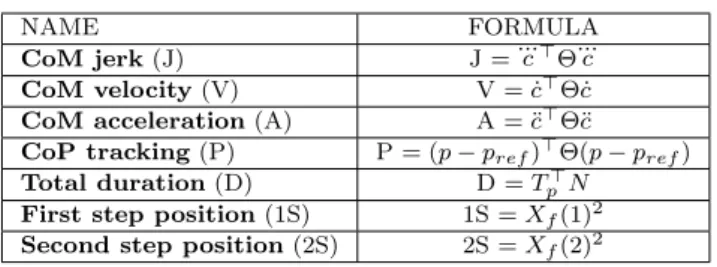
The basis of criteria is composed of optimality criteria proposed in Aftab et al. (2012), to which we add the min-imization of each step length and the total step duration to obtain larger and faster steps. Therefore, the minimiza-tion of CoM smooth jerk curve is necessary to generate stable motions, but also it was showed that a weakly weighted minimization helps smoothing the contact forces and therefore the resulting motion. The minimization of the CoM velocity always allow quicker steps.
Let’s define diagonal matrix Θ∈ m×mwhich diagonal is
vector τ ∈ m defined by
τ = [TpDS01DS0, TpSS11SS1, TpDS11DS1,
TpSS21SS2, TpDS21DS2], where 1DS0 to 1DS2are some vectors composed of as many 1 values as the dimension of each gait cycle phase DS0to
DS2, and TpDS0 to TpDS2 are scalars that correspond to
the sampling time interval value of each gait cycle phase as described above.
Table 1. Basis of criteria.
NAME FORMULA
CoM jerk (J) J =...c Θ...c
CoM velocity (V) V = ˙c Θ ˙c CoM acceleration (A) A = ¨c Θ¨c
CoP tracking (P) P = (p− pref) Θ(p− pref)
Total duration (D) D = Tp N
First step position (1S) 1S = Xf(1)2
Second step position (2S) 2S = Xf(2)2
3.3 The kinematic and the dynamic constraints
CoP. The static balance is ensured if the CoP always stays within the base of support during the single support (SS) and double support (DS) phases while walking. Hence, this constraint is represented in the optimization problem for the SS and DS phases by:
−a ≤ p − Xf ≤ lf− a (1)
where a is the ankle to heel horizontal distance and lf
represents the foot length.
CoM position and velocity. During the optimization problem the CoM position, velocity, acceleration and jerk values at initial time t0 and final one tf are required to
be equal with the observed ones, to assure initial and final feasible values: (c(t0) = cdata(t0))∧ (c(tf) = cdata(tf)) ( ˙c(t0) = ˙cdata(t0))∧ ( ˙c(tf) = ˙cdata(tf)) (¨c(t0) = ¨cdata(t0))∧ (¨c(tf) = ¨cdata(tf)) (2)
Foot step placements. To ensure feasible step place-ments generated by our optimization algorithm, the posi-tion of the next foot step depending on the current posiposi-tion of the foot in the air is bounded:
−B ≤ Xf(i)− Xf(i− 1) ≤ B, (3)
where B = (ttouchdown(i)− ttouchdown(i− 1))vmax, with
Xf(i), the position of the next foot step on x axis, Xf(i−1)
the current position of the foot in the air on x axis, vmax
a vector of approximate maximum Cartesian speed and
ttouchdown the time when the foot in the air is planned to
touch the ground.
3.4 Our DOC scheme with predicted step positions and phase durations
Now, we can express the minimization problem, corre-sponding to the 2D gait model (where the CoM position on
z-axis is considered constant and dependent on subject’s
height) with predicted step positions and phase durations, in the corresponding nonlinear optimization problem to be solved: minimize u k i=1 αiΦi(u) subject to h(u)≡ (2) g(u)≡ (3) ∧ (1) (4)
where αi are positive weights corresponding to each
crite-rion from the predefined basis Φ; k represents the number of proposed criteria and u = (...c Xf Tp) is the vector of
decision variables as presented in Subsect. 3.1.
In summary, the DOC scheme writes: Find the CoM
smooth jerk curve (...c ∈ m) in x-axes, the foot step
positions (Xf ∈ 2) and each gait cycle phase sampling
time values (Tp ∈ 5) with given sampling size on each
gait cycle phase (N∈ 5) by minimizing a given composite
criteria (4) while maintaining balance (1), ensuring feasi-ble step placements (3) and feasifeasi-ble final CoM position, velocity and acceleration values (2).
4. HUMAN WALKING : AN INVERSE OPTIMAL CONTROL FRAMEWORK
The DOC scheme proposed in the previous section will be used at the core of the IOC problem which is based on the inverse KKT approach. More details about this approach can be found in Aghasadeghi and Bretl (2014), Panchea (2015), Panchea and Ramdani (2015) or Lin et al. (2016). The IOC problem aims to impute the optimality criterion (the IOC decision variables) underlying observed actual motions (the IOC known variables).
The DOC problem (4) is used to underlie the KKT optimality conditions with the decision variables composed of the optimality criteria weight values αi and known
variables u : k i=1 αi∇Φi(u) + m1 i1=1 νi1∇hi1(u) + m2 i2=1 λi2∇gi2(u) = 0(5) hi1(u) = 0, i1= 1 . . . m1(6) gi2(u)≤ 0, i2= 1 . . . m2(7) λi2≥ 0, λgi2(u) = 0, i2= 1 . . . m2(8) where∇ is the gradient w.r.t u, m1and m2 represent the
number of equality and inequality constraints respectively; where conditions (6)-(7) are the primal feasibility con-ditions, (8) is the complementarity slackness concon-ditions, Proceedings of the 20th IFAC World Congress
Toulouse, France, July 9-14, 2017
while (5) is the stationarity condition. The complementary slackness condition (8) implies that the ith dual optimal
multiplier related to the inequality constraint is zero unless the ithequality constraint is active at the optimum:
((λi2> 0 =⇒ gi2(u) = 0) ∧ (gi2(u) < 0 =⇒ λi2 = 0)). (9) The inequality constraints were found negative while test-ing them with experimental data, thereby based on (9) all the dual optimal multipliers are equal to zero. Therefore, the IOC problem boils down to the minimization of the residuals on (5) without the inequality constraints, while (6)-(7) are only checked to be sure that we are dealing with feasible human motions:
minimize
z0=[α,ν]∈ k+m1
A0z0 2
subject to αi≥ 0
(10) with A0= ki=1αi∇Φi(u) + im1=11 νi1∇hi1(u).
Solving (10) assumes that the trajectories are only approx-imately optimal rather than optimal. Formulation (10) emphasizes that the IOC problems are ill-posed. When matrix A0 is not singular, trivial solutions arise. For
in-stance, z0 = 0 is clearly solution. Furthermore, if a given
composite cost function f is a solution, so do G◦ f or
f + κ, where G is any convex increasing function and κ
any constant. In the literature, the ill-possedness issue is solved by means of normalization methods. One can find different methods of normalization to enforce non-singular solutions:
(1) ki=1αi = 1, as in Albrecht et al. (2011) for a bi-level
approach, which we denote as the sum normalization
method.
(2) By using some prior knowledge on the sought cost function, i.e. one of the weights is arbitrary fixed to 1 (Mombaur et al. (2010), Aghasadeghi and Bretl (2014)). (3) By improving the second normalization method and using each cost function as a pivot, thereby testing each criterion (Panchea (2015)), which we denote as the pivot
normalization method.
In this study, the first and third ways of normalization are tested and we expect to obtain as result the same combination of criteria.
The criteria weight values are imputed by solving one least square problem (LS) with the use of the sum normalization
method : minimize z=[αi,ν]∈ k+m1 A 0z 2 subject to (αi≥ 0) ∧ ( k i=1 αi= 1) (11)
and as many LS problems as criteria defined in the basis of criteria with the use of the pivot normalization method, where each criterion will be used as pivot once at a time:
minimize
z=[αi,ν]∈ (k−1)+m1
Az − b 2
subject to αi≥ 0
(12) with A = ki=1−1αi∇Φi(u) + im1=11 νi1∇hi1(u) and b =
−∇Φi∗(u) which corresponds to the gradient of the
crite-rion used as pivot and with weight value equal to 1, i.e.
αi∗ = 1.
For the analyzed human walking task we solve eight LS problems: one as in (11) and the rest of seven as in (12). All constrained LS problems are solved with the interior-point method, while the gradients are calculated numerically. As we supposed the system’s states are near-optimal, an important indicator regarding the proximity of the solution to optimality is used and corresponds to the residual norm value, denoted RN, of the LS problem: equal to A0z 2for (11) and to Az − b 2for (12).
By working with human actual data we do not have access to the ground truth of the criteria weight values, thereby a RN threshold is selected small enough to indicate the near-optimal hypothesis. The results which exhibit RN below or equal a chosen RN threshold value (equal to 10−3) are
considered sufficiently close to the optimality. Moreover, the results which exhibited RN below or equal the RN threshold value are used to solve the DOC problem as in (4) in order to estimate CoP position and to calculate the correlation values, denoted R2 between the estimated
curves and the real ones.
5. EXPERIMENTAL DATA RESULTS
In this section, criteria defined in Table 1 are imputed from human walking motions collected as described in Sect.2. First, in Subsect. 5.1 the exhibited results for one subject (denoted as typical subject) are presented in more details. Second, Subsect. 5.2 summarizes the results which are similar for the typical subject, for the 200 trials collected for ten subjects while performing the NGC and FGC.
5.1 Typical subject
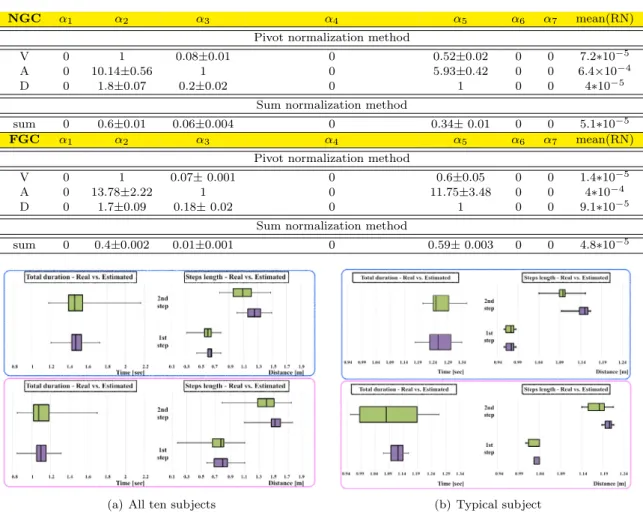
For the typical subject our IOC-walking approach dis-carded 4 out of 8 LS solutions due to large RN value, while through the accepted ones, three criteria (among the ones in the basis of criteria given in Table 1) were obtained: V, A and D. Both pivot normalization method and sum normalization method exhibited these criteria, as it can be seen in Table 2.
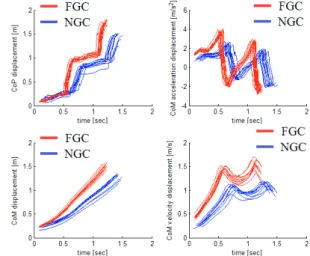
Fig. 2. Typical subject: FGC/NGC trials representation used for analyses.
Moreover, the exhibited criteria weight values are almost similar for the analyzed trials, as the standard deviation Proceedings of the 20th IFAC World Congress
Adina M. Panchea et al. / IFAC PapersOnLine 50-1 (2017) 13510–13515 13513
while (5) is the stationarity condition. The complementary slackness condition (8) implies that the ith dual optimal
multiplier related to the inequality constraint is zero unless the ithequality constraint is active at the optimum:
((λi2> 0 =⇒ gi2(u) = 0) ∧ (gi2(u) < 0 =⇒ λi2= 0)). (9) The inequality constraints were found negative while test-ing them with experimental data, thereby based on (9) all the dual optimal multipliers are equal to zero. Therefore, the IOC problem boils down to the minimization of the residuals on (5) without the inequality constraints, while (6)-(7) are only checked to be sure that we are dealing with feasible human motions:
minimize
z0=[α,ν]∈ k+m1
A0z0 2
subject to αi≥ 0
(10) with A0= ki=1αi∇Φi(u) + im1=11 νi1∇hi1(u).
Solving (10) assumes that the trajectories are only approx-imately optimal rather than optimal. Formulation (10) emphasizes that the IOC problems are ill-posed. When matrix A0 is not singular, trivial solutions arise. For
in-stance, z0 = 0 is clearly solution. Furthermore, if a given
composite cost function f is a solution, so do G◦ f or
f + κ, where G is any convex increasing function and κ
any constant. In the literature, the ill-possedness issue is solved by means of normalization methods. One can find different methods of normalization to enforce non-singular solutions:
(1) ki=1αi = 1, as in Albrecht et al. (2011) for a bi-level
approach, which we denote as the sum normalization
method.
(2) By using some prior knowledge on the sought cost function, i.e. one of the weights is arbitrary fixed to 1 (Mombaur et al. (2010), Aghasadeghi and Bretl (2014)). (3) By improving the second normalization method and using each cost function as a pivot, thereby testing each criterion (Panchea (2015)), which we denote as the pivot
normalization method.
In this study, the first and third ways of normalization are tested and we expect to obtain as result the same combination of criteria.
The criteria weight values are imputed by solving one least square problem (LS) with the use of the sum normalization
method : minimize z=[αi,ν]∈ k+m1 A 0z 2 subject to (αi≥ 0) ∧ ( k i=1 αi= 1) (11)
and as many LS problems as criteria defined in the basis of criteria with the use of the pivot normalization method, where each criterion will be used as pivot once at a time:
minimize
z=[αi,ν]∈ (k−1)+m1
Az − b 2
subject to αi≥ 0
(12) with A = ki=1−1αi∇Φi(u) + im1=11 νi1∇hi1(u) and b =
−∇Φi∗(u) which corresponds to the gradient of the
crite-rion used as pivot and with weight value equal to 1, i.e.
αi∗ = 1.
For the analyzed human walking task we solve eight LS problems: one as in (11) and the rest of seven as in (12). All constrained LS problems are solved with the interior-point method, while the gradients are calculated numerically. As we supposed the system’s states are near-optimal, an important indicator regarding the proximity of the solution to optimality is used and corresponds to the residual norm value, denoted RN, of the LS problem: equal to A0z 2 for (11) and to Az − b 2for (12).
By working with human actual data we do not have access to the ground truth of the criteria weight values, thereby a RN threshold is selected small enough to indicate the near-optimal hypothesis. The results which exhibit RN below or equal a chosen RN threshold value (equal to 10−3) are
considered sufficiently close to the optimality. Moreover, the results which exhibited RN below or equal the RN threshold value are used to solve the DOC problem as in (4) in order to estimate CoP position and to calculate the correlation values, denoted R2 between the estimated
curves and the real ones.
5. EXPERIMENTAL DATA RESULTS
In this section, criteria defined in Table 1 are imputed from human walking motions collected as described in Sect.2. First, in Subsect. 5.1 the exhibited results for one subject (denoted as typical subject) are presented in more details. Second, Subsect. 5.2 summarizes the results which are similar for the typical subject, for the 200 trials collected for ten subjects while performing the NGC and FGC.
5.1 Typical subject
For the typical subject our IOC-walking approach dis-carded 4 out of 8 LS solutions due to large RN value, while through the accepted ones, three criteria (among the ones in the basis of criteria given in Table 1) were obtained: V, A and D. Both pivot normalization method and sum normalization method exhibited these criteria, as it can be seen in Table 2.
Fig. 2. Typical subject: FGC/NGC trials representation used for analyses.
Moreover, the exhibited criteria weight values are almost similar for the analyzed trials, as the standard deviation Proceedings of the 20th IFAC World Congress
Toulouse, France, July 9-14, 2017
![Fig. 1. Antero-posterior CoP displacement, measurement of the step positions (X f = [L 1 L 2 ]) from the time-course of the antero-posterior CoP displacement along with the gait cycle: three double support where both feet are on the ground (DS 0 , DS 1 ,](https://thumb-eu.123doks.com/thumbv2/123doknet/14367360.503808/3.892.491.799.476.649/antero-posterior-displacement-measurement-positions-posterior-displacement-support.webp)