CarSpeak: A Content-Centric Network for
Autonomous Driving
by
Swarun Suresh Kumar
Submitted to the Department of Electrical Engineering and Computer Science in partial fulfillment of the requirements for the degree of
Master of Science in Computer Science and Engineering at the
MASSACHUSETTS INSTITUTE OF TECHNOLOGY
June 2012
ARCHNIES
CAHUSTTS INSTITUTE U TSCHOLOGyJ U
L
'
21?1
R©
Massachusetts Institute of Technology 2012. All rights reserved.
A u th or ...
...
Department of Electrical Engineering and Computer Science
May 23, 2012
Certified by
Associate
....
...
....
...
Dina Katabi
ofessor of Computer Science and Engineering
Thesis Supervisor
Accepted by .. ....
. . ... . ....
A e bOL
lie A. Kolodziejski
Chairman, Department Committee on Graduate Students
CarSpeak: A Content-Centric Network for
Autonomous Driving
by
Swarun Suresh Kumar
Submitted to the Department of Electrical Engineering and Computer Science on May 23, 2012, in partial fulfillment of the
requirements for the degree of
Master of Science in Computer Science and Engineering
Abstract
We introduce CarSpeak, a communication system for autonomous driving. CarSpeak enables a car to query and access sensory information captured by other cars in a manner similar to how it accesses information from its local sensors. CarSpeak adopts a content-centric approach where information objects - i.e., regions along the road - are first class citizens. It names and accesses road regions using a multi-resolution system, which allows it to scale the amount of transmitted data with the available bandwidth. CarSpeak also changes the MAC protocol so that, instead of having nodes contend for the medium, contention is between road regions, and the medium share assigned to any region depends on the number of cars interested in that region.
CarSpeak is implemented in a state-of-the-art autonomous driving system and tested on indoor and outdoor hardware testbeds including an autonomous golf car and 10 iRobot Create robots. In comparison with a baseline that directly uses 802.11, CarSpeak reduces the time for navigating around obstacles by 2.4x, and reduces the probability of a collision due to limited visibility by 14 x.
Thesis Supervisor: Dina Katabi
Acknowledgments
I am greatly indebted to Dina Katabi, my adviser, for her guidance and support. She
is incredibly hardworking and always has the best interest of her students in mind. She constantly guides and motivates her students, and is always brimming with passion and enthusiasm for research. She is an expert in her area, and is extremely helpful in helping students pursue interesting problems, while providing them the freedom to pursue their own ideas. I would like to sincerely thank Dina for her helpful suggestions and comments at every stage of this project. I am indeed fortunate to have such a wonderful mentor guiding me throughout my graduate student life at MIT.
Many thanks to Lixin Shi for the extraordinary efforts he put in, while working with me on this project, including running experiments late into the night. I would sincerely like to thank Nabeel Ahmed for working with us closely during the ini-tial stages of the project and demystifying the ath9k driver for us. I am grateful to Stephanie Gil, for her outstanding efforts while working with us on the outdoor ex-periments in Singapore. I would like to thank Prof. Daniela Rus for many valuable discussions on aspects pertaining to Robotics in this project. A special thanks to Brice Rebsamen and Tirthankar Bandyopadhyay for assisting us with the golf car in Singapore, and actively helping us with the outdoor experiments. I would like to thank Pratik Chaudhari and Sertac Karaman for helping us with the RRT* path planner and Sam Powers and Edward Mugica for helping us with ROS and using iRobot Creates. I am thankful to Fadel Adib, for helping us edit the final version of the paper and Haitham Al-Hassanieh, for helping us with connecting voltage regu-lators. I would like to thank Sachithra Hemachandra for providing us with Hokuyo laser sensors and helping us to power Kinects using iRobot Creates. I am grateful to our group's admin assistant Mary McDavitt, for helping us with last-minute travel arrangements to Singapore and assisting us with packing the equipment.
I am indebted to Shyam Gollakota for many useful discussions and honest feedback on this project and for his invaluable mentorship throughout my graduate student life at MIT. I am extremely thankful to Hariharan Rahul, for teaching me much of what
I know about wireless communication today, while working with him on MegaMIMO
- my first project at MIT. I am grateful to all my group members, who journeyed with me on my first two years at MIT - Fadel, Jue, Lixin, Nabeel, Nate, Rahul, Sam, Szymon and Shyam.
I would like to thank all the professors, students and researchers, I've interacted with during my courses and research at MIT. I am thankful to all my professors and friends at IIT Madras, my undergraduate university. I am grateful to Prof. Pandu Rangan, my undergraduate research adviser, for introducing me to the world of re-search in Computer Science.
Words cannot describe how indebted I am to my parents. They have always sup-ported me at every stage of my life. I am indeed grateful for being able to talk to them about anything and everything, and for the patient hearing and valuable advice and support that they always give me.
Contents
1 Introduction 15
1.1 CarSpeak's Design . . . . 17
1.2 Implementation and Results . . . . 18
1.3 Contributions . . . . 20
2 Related Work 21 2.1 Autonomous Vehicles . . . . 21
2.2 Robotic Networks . . . . 22
2.3 Vehicular Ad-hoc Networks . . . . 22
2.4 Content Centric Networking . . . . 23
3 Primer on Autonomous Vehicles 25 3.1 Sensor Infrastructure . . . . 25
3.2 Planner . . . . 26
3.3 Controller . . . . 27
4 CarSpeak's Architecture 29 4.1 Content-Centric MAC . . . . 30
4.2 Multi-Resolution Naming and Addressing . . . . 30
4.3 Loss-Resilient Compression system . . . . 31
5 Multi-Resolution Naming 33 5.1 Information Naming and Representation . . . . 33
5.2 Information Retrieval and Maintenance . . . . 35
5.2.1 Garbage Collection . . . . 36
5.3 Information Quality . . . . 36
6 Loss-Resilient Compression 39 6.1 Octree Encoding . . . . 40
6.2 Loss Resilient Compression Scheme . . . . 41
6.3 Properties . . . . 42
7 Content Centric MAC 43 7.1 Tracking Region Requests . . . . 43
7.1.1 Internal Requests . . . . 44
7.1.2 External Requests . . . . 44
7.2 Region Contention . . . . 44
7.2.1 Sharing the Medium Among Regions . . . . 45
7.2.2 Controlling Medium Access . . . . 45
7.2.3 Partitioning a Node's Transmissions Among Regions . . . . . 46
7.3 Scaling . . . . 47
8 Discussion 49 8.1 Communicating Processed Information. . . . . 49
8.2 One Hop vs. Multi-Hops. . . . . 49
8.3 Regular Traffic. . . . . 50
9 Implementation 51 9.1 Multi Resolution Naming . . . . 51
9.2 Loss Resilient Compression . . . . 52
9.3 Content Centric MAC . . . . 52
10 Evaluation Environment 53 10.1 Testbed . . . . 53
10.2.1 802.11 . . . . . 10.2.2 802.11+Naming 10.3 Metric . . . . 11 Results 11.1 Region Contention 11.1.1
Method
. .. 11.1.2 Results . . . . 11.2 Region Requests. 11.2.1Method
. 11.2.2 Results . 11.3 Scaling . . . . 11.3.1 Method . 11.3.2 Results . 11.4 Compression . . . . . 11.4.1Method
. . . 11.4.2 Results . . . . 11.5 Resolution . . . . 11.5.1 Method . . . 11.5.2 Results . . . . 11.6 Planning Efficiency . 11.6.1Method
. . . 11.6.2 Results . . . . 11.7 Safety . . . . 11.7.1 Method . . . 11.7.2 Results . . . . 11.8 Outdoor Experiments 11.8.1Method
. . . 11.8.2 Results . . . . . . . . . . .. . . . . . . . . . . . . . . . . . . . . . . . . . . . . . . . . . . . . . . . . . . . . . . . . . . . . . . . . . . . . . . . . . . . . . . . . . . . . . . . on an Autonomous Vehicle. . . .
55 55 55 57 . . . . 57 . . . . 57 . . . . 58 . . . . 58 . . . . 58 . . . . 59 . . . . 60 . . . . 60 . . . . 60 . . . . 61 . . . . 62 . . . . 62 . . . . 64 . . . . 64 . . . . 64 . . . . 65 . . . . 65 . . . . 66 . . . . 67 . . . . 67 . . . . 68 . . . . 69 . . . . 69 . . . . 70 . . . . . . . . . . . .12 Conclusion and Future Work 73 12.1 Future Work ... ... 73 12.1.1 Cloud-based Designs ... ... 73
List of Figures
1-1 Example of sensory information used in autonomous driving.
The figure shows a 3D-point cloud of a road obtained by a Velodyne laser sensor, where colors refer to elevation from the ground. Note that a 3D-point cloud provides the (x, y, z) coordinates of points lying on the surface of obstacles. . . . . 16 1-2 Representation of regions using Octree. . . . . 19
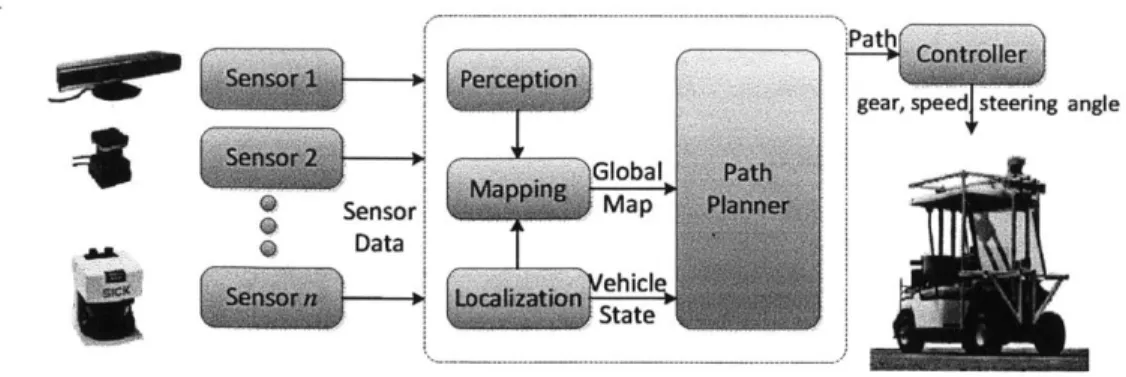
3-1 High-Level Architecture of Autonomous Vehicular Systems.
The path planner module uses information from various sensors to compute a safe path for the vehicle. . . . . 26
4-1 Information Flow in CarSpeak. CarSpeak has three components:
A Multi-Resolution Naming and Addressing system, A Loss-Resilient
Compression system and a Content-Centric MAC . . . . 30
5-1 Naming Regions in CarSpeak. The figure on the left shows four different regions at different hierarchies with L = 2. The figure on the right depicts the truncated sub-trees corresponding to these regions in the Octree. ... ... ... 35
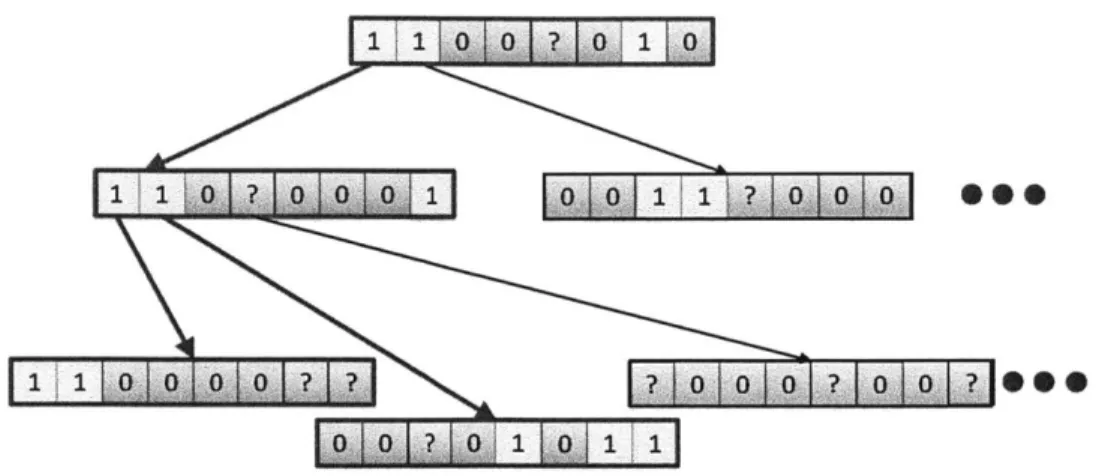
6-1 Octree Representation Representation of 3D-point cloud using a
2-level Octree. Vertices that are unoccupied are not expanded; vertices that are completely occupied or unknown are terminated by special leaf vertices; these have been omitted for clarity. . . . . 40
6-2 Picking tree T for compression Tree T picked with
j
initialized to0 is highlighted by red contours. . . . . 41
10-1 CarSpeak's Indoor Testbed. The blue circles denote candidate
lo-cations for robots and gray boxes denote obstacle lolo-cations. . . . . . 54 10-2 CarSpeak's Outdoor Setup. Image of the actual golf car route
demonstrating the lobby area that poses a hazardous blind-spot for the golf car and makes visual confirmation of a pedestrian difficult before he enters the road. . . . . 54
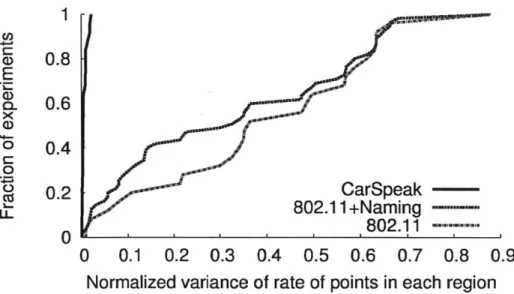
11-1 Region Contention. CDFs of variance in rate of points received from
two regions. The variance obtained using CarSpeak is significantly smaller, across a variety of topologies and in the presence of mobile
robots... ... 59
11-2 Region Requests. Ratio of the number of points received from two requested regions plotted against ratio of the number of requests made for the two regions. CarSpeak ensures the wireless bandwidth is allo-cated to region proportionally to the number of requests they receive. 60 11-3 Scaling. Number of 3D points received at a receiver by CarSpeak,
802.11 and 802.11+Naming as a function of the number of
contend-ing nodes. We observe that while CarSpeak scales gracefully, 802.11's performance deteriorates when there are over 6 nodes, due to an ex-cessive number of collisions and the lack of a back off mechanism in the broadcast mode. . . . . 61
11-4 Compression module. Ratio of the number of points received over the number of transmitted points measured across packet loss rates when packetizing compressed point cloud data, using CarSpeak's com-pression module and without using comcom-pression. CarSpeak's compres-sion module provides a consistent gain of 4.5x over sending uncom-pressed data, while packetizing comuncom-pressed point cloud data performs poorer than CarSpeak for packet loss rates as low as 2%. . . . . 63
11-5 Resolution. The figure shows the rate at which information is received from a requested low-resolution region, for different schemes. Increasing the number of robots that do not have the requested resolution can dramatically impact the performance of 802.11 and 802.11+Naming. In contrast, CarSpeak maintains high rate of information from the desired region. . . . . 65 11-6 Experiment setup for (a), The shortest path 1 from A to destination
is blocked, efficient communication from sensor B should enable A to take path 2; for (b), There is a potential collision of A with B when A tries to merge into the traffic in another road at the T intersection. The collision can be avoided if A can hear from C about the other side of the road. ... ... 66 11-7 Planning Efficiency. Time taken by the robot to navigate an
ob-stacle ridden environment across number of contending wireless nodes. CarSpeak performs 2.4x better, on average, than the baseline 802.11 implementation in a network of over 6 robots. . . . . 67 11-8 Safety. Percentage of successful detection of Robot B across number of
wireless nodes contending for the medium. For a network of over 6 con-tending transmitters, CarSpeak's probability of successfully detecting Robot B is 14x that of 802.11 and 6.5x that of 802.11+Naming. . . 68 11-9 Time Delay Averages for CarSpeak and 802.11. Distances on
the x-axis are grouped into bins of two meters representing distances of the golf car from the crosswalk at the time the pedestrian enters the crosswalk. . . . . 71 11-10Comparison of golf car distance from the crosswalk when the
pedestrian enters the crosswalk to the distance from the cross-walk at which the receiver issues a stop command to the ve-hicle. Distances on the x-axis are grouped into bins of two meters. . 71
Chapter 1
Introduction
Autonomous vehicles have been the topic of much recent research [5, 34, 19]. The goal of these systems is to drive from point A to point B in an efficient and safe manner, while dealing with continuous changes in the environment due to pedestrian and object movements, and the potential of unexpected events, such as road-work and accidents. To achieve their goal, autonomous vehicles need detailed real-time information about their surroundings [24]. They typically use laser rangefinder sensors to discover the surfaces of nearby objects and represent this information as a 3D-point
cloud similar to that shown in Fig. 1-1. Using only the car's on-board sensors, however,
prevents autonomous vehicles from uncovering hidden objects that are not directly in their line-of-sight, e.g., a kid running around the corner, or a car pulling out of an occluded driveway. These sensors also cannot deliver long-range data with sufficient accuracy, which limits the car's ability to plan ahead [34]. Further, they are costly (e.g., the sensors alone on an autonomous vehicle can cost several hundred thousand US dollars [18, 19]). For these reasons, the report from the recent DARPA Urban Challenge identifies the need for information sharing between autonomous vehicles as a key lesson learned from the contest [4]. However, 802.11 is ill-suited for this application. Navigation sensors can generate real-time streams at Gb/s from each car, leading to a scenario where there is always more data than bandwidth to send it. Furthermore, a communication protocol that cannot capture the importance of different pieces of information for the application will end up inundating the medium
I
Figure 1-1: Example of sensory information used in autonomous driving. The figure shows a 3D-point cloud of a road obtained by a Velodyne laser sensor, where colors refer to elevation from the ground. Note that a 3D-point cloud provides the (x, y, z) coordinates of points lying on the surface of obstacles.
with irrelevant or stale data, and potentially denying access to important and urgent information.
This thesis introduces CarSpeak, a communication system that addresses the needs of autonomous vehicles. CarSpeak enables cars to request and access sensory information from other cars, as well as static infrastructure sensors, in a manner sim-ilar to how they access their own sensory information. To achieve its goal, CarSpeak adopts a content-centric design, where information objects are first class citizens. CarSpeak's information objects are regions in the car's environment (e.g., a cube of
1 m3). In CarSpeak, a car can request a real-time stream of a 3D-point cloud data from a particular region along the road. It can also zoom in to get a more detailed description, or zoom out for a wider view.
1.1
CarSpeak's Design
CarSpeak delivers its design via three components that address the main challenges in sharing navigation sensor data:
" How does a car describe the information it wants, at a particular resolution, if
that information describes a region along the road?
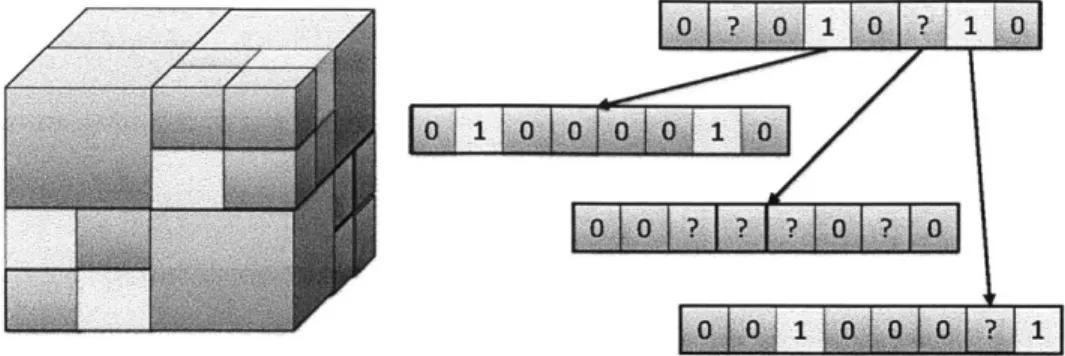
In order to name and find road regions, CarSpeak divides the world recursively into cubes; smaller cubes provide a finer description of the encompassing cube. Each cube refers to a region. To efficiently represent this data, CarSpeak uses an Octree, a data structure commonly used in graphics to represent 3D ob-jects [30, 11]. Each node in the Octree refers to a cube, and the sub-tree rooted at that node refers to finer details inside that cube, as shown in Fig. 1-2. The Octree representation allows CarSpeak to name regions at different resolution and according to their location in the world. Specifically CarSpeak names a re-gion by referring to the root of the rere-gion's sub-tree; it expresses the resolution of the region using the depth from the root of the region's sub-tree. The Octree also enables a car to store its data efficiently because, though the world is huge, each car needs to only expand the part of the Octree in its neighborhood. " How does the system allocate the wireless bandwidth to the most recent data
from the region, given that multiple cars may sense the same region and each car does not know what information other cars know?
CarSpeak adopts a content-centric MAC where information objects, as opposed to senders, contend for medium access. Further, each information object (i.e., 3D-point cloud stream) obtains a share of the medium proportional to the num-ber of requests it receives.
CarSpeak implements this abstraction using a distributed protocol, where nodes that sense a region contend on its behalf. Requests for region data are broad-cast on the medium. Nodes compute a summary value of the quality of the information they have of each region (which is a measure of the timeliness and completeness of this information). CarSpeak uses a low overhead protocol to
share this information among the nodes as annotations on their transmitted data packets. Each car uses these annotations to compute how much sensory data it should transmit so that its contribution to each stream is proportional to the completeness and freshness of the data it has from the corresponding re-gion. CarSpeak then enforces this allocation by controlling the 802.11 contention window appropriately.
e How does the system compress the redundancy in the transmitted sensor data
while being resilient to packet loss?
CarSpeak makes each packet self-contained by assigning it an independent set of branches in the Octree that are derived from the root. As a result, each received packet can be correctly inserted into the tree independent of other packets. CarSpeak also reduces the overlap between data transmitted by cars that sense the same region. Recall that each region is a cube that encompasses many smaller cubes, whose values keep changing in real-time due to the arrival of new sensor data. In CarSpeak even if multiple cars receive a request for the same region (i.e., the same encompassing cube), each of them will pick a different permutation according to which they transmit the sub-cubes in the region. Thus, if only one car has sensor data about the region, it will eventually transmit all the sub-cubes from the region. However, if multiple cars have data about the same region, then they are likely to cover all sub-cubes in the region, while limiting the overlap in their transmissions.
1.2
Implementation and Results
We built a prototype of CarSpeak in ROS, the Robot OS [28] and integrated it with a state of the art path planner, whose earlier version was used in the DARPA Urban Challenge. We evaluated CarSpeak on two testbeds: 1) an indoor testbed of iRobot Create programmable robots connected to netbooks with Atheros AR9285 cards and gathering sensor data from Xbox 360 Kinects, and 2) an outdoor testbed composed of an autonomous Yamaha G22E golf car mounted with Hokuyo laser range sensors,
Building an Octree
Octree
Figure 1-2: Representation of regions using Octree.
and exchanging sensory information with the Create robots. We compared CarSpeak with a baseline inter-vehicle communication protocol that directly uses the existing 802.11 protocol.
Experiments from the indoor testbed show that compared to the 802.11 baseline, CarSpeak reduces the time taken to navigate an environment with obstacles by 2.4 x, and the probability of a collision due to limited visibility by 14 x.
Outdoor experiments with the a Yamaha golf car tests the role of communication in enabling cars to react safely to pedestrians who suddenly exit a blind spot and cross the car's path. Empirical results show that use of CarSpeak allows for the receiver on the golf car to issue a stop command with a maximum average delay of 0.45 seconds which is 4.75x smaller than the minimum delay of 2.14 seconds using 802.11. These relatively small delays using CarSpeak allow the vehicle to safely stop before the crosswalk if the pedestrian appears at distances as small as 1.4 meters on average, even when the vehicle is traveling at its maximum velocity of 2 meters per second. In contrast, using 802.11 the vehicle is unable to stop before reaching the crosswalk if the pedestrian appears when the vehicle is closer than four meters from the crosswalk on average.
1.3
Contributions
To our knowledge, CarSpeak is the first communication system for multiple au-tonomous vehicles that focuses on maximizing the utility of information for this application, and that is fully integrated with autonomous vehicle systems. It is eval-uated on a testbed of autonomous vehicles, and demonstrated to reduce path length
and the probability of collisions. Its content-centric design that operates on real-time rich sensory data sets it apart from past work on VANET. This design is delivered via three components including a multi-resolution naming and addressing scheme, a content-centric MAC, and a new approach to compressing rich sensory data that is suitable for lossy and dynamic environments.
Chapter 2
Related Work
Related work falls broadly in the following four categories:
2.1
Autonomous Vehicles
Recent years have witnessed major advances in designing and building autonomous vehicles, spurred by research in sensing and computation technologies. Many advances have been made in the past decade, as evidenced, for example, by the series of contests sponsored by the US Department of Defense (Defense Advanced Research Projects Agency (DARPA)). The DARPA Urban challenge (2007) promoted research and de-velopment of several autonomous vehicles capable of navigation in an urban setting in the presence of other such vehicles [5, 34, 19]. Initiatives from the industry such as Google's driverless car [1] aim to further develop this technology.
Research in this domain focus on various issues pertaining to the navigation sys-tem in a single autonomous vehicle. Research on autonomous path planning [15, 8] focuses on robust algorithms that chart obstacle-free trajectories for vehicles to fol-low towards their destination. Past work has also dealt with recognizing obstacles in the environment based on sensor data through advanced perception algorithms [18]
including pedestrian detection [21,
351.
Campbell et al. [4] cite the key approaches, lessons and challenges from the DARPA Urban challenge. Among the lessons learned from the contest was that there
was a need for information sharing between autonomous vehicles. To this end, CarS-peak focuses on designing a communication protocol that is most suitable for sharing sensory data between autonomous vehicles.
2.2
Robotic Networks
Our work is related to a broad area in robotics that studies networks of robots. Past work in this area can be divided into two categories:
The first category uses communication as a black-box, and focuses on algorithms that enable robots to collaborate on a desired task. Cooperative exploration [25] involves a team of mobile robots collaboratively building and updating a map or representation of an indoor environment. Pursuit evasion [16, 31] enables a large team of robots that are used to detect intruders and conduct surveillance. The robots communicate with each other to coordinate their movement to span the environment and guarantee complete coverage.
The second category considers the application as a black-box and focuses on har-vesting robot mobility to improve network connectivity or throughput. For instance, Le Ny et al. [26] In contrast, deploy rultiple robots to form an ad-hoc wireless communication network, while guaranteeing reliable communication between these agents, and possibly with some fixed base stations. Gil et al. [9] dynamically position a team of aerial vehicles that maintain communication-link quality to support a team of ground robots which are performing a collaborative task.
In contrast with these designs, our work is based on designing the communication protocols around the needs of the application, and takes neither as a black box.
2.3
Vehicular Ad-hoc Networks
A large number of research papers have focused on the problem of Vehicular ad-hoc networks (VANETs). Some of the work in this area focuses on designing efficient routing protocols to achieve minimum communication time between vehicles with
minimum consumption of network resources [20, 29, 33]. Huang et al. approach the problem of VANETs using the Delay-Tolerant network (DTN) model since [22] to account for rapid changes in network topology. tolerant networks [22]. Some sys-tems [3, 6] focus on designing a MAC protocol to reliably broadcast emergency mes-sages with minimum delay. Jiang et al. [14] focus specifically on detecting accidents with minimum probability of false alarm.
None of these papers, however, present a content-centric architecture or design a MAC protocol where information objects contend for the medium. Also, none of them present a solution that is particularly suitable for autonomous driving.
2.4
Content Centric Networking
Our work builds on past work on content-centric networking. Content-centric net-working is an alternative netnet-working architecture that is based on the principle that a communication network must allow a user to focus on the data he or she needs, rather than having to reference a specific, physical location where that data is to be retrieved from. Past work in this domain is mostly focused on the Internet [12, 17]. Jacobson et al. [12] allow users on the Internet to retrieve content by name, and de-couples identity from location. Some papers apply this concept in the wireless domain, with primary focus on storage or routing information content [27, 32]. For instance, Oh et al. [27] focus on routing emergency information in a mobile ad-hoc network using the principles of content centric networking.
Our work differs from these papers in that it is focused on resource sharing at the
MAC layer. Also, it is fully integrated with an autonomous driving system in terms
Chapter 3
Primer on Autonomous Vehicles
In this section, we provide a quick background of autonomous driving software so that it is clearer how CarSpeak interfaces with these systems. Successful performance of autonomous vehicles relies on their ability to sense and process information about the environment around them. To obtain this information, autonomous vehicles and robots are typically equipped with ranging sensors, which deliver real-time measure-ments of the distance of the vehicle to the surrounding 3D objects. The vehicle may use laser scanners, ultrasonic range finders for outdoor settings and kinect for indoor settings [34, 5, 19, 10]. Other sensors like cameras and light detectors are also used for additional information.
Most autonomous vehicles use the Robot Operating System (ROS) framework [28]. ROS provides a publish/subscribe architecture, where a module (e.g., sensor) publishes a topic (e.g., /sensor-data) that can be subscribed to by multiple modules. We discuss the commonly defined high-level modules below (Figure 3-1):
3.1
Sensor Infrastructure
Each sensor attached to the autonomous vehicle has an associated module which converts raw sensor information obtained from the driver into a generic sensor format. The most widely used format is a 3D-point cloud which provides the 3-D (x, y, z) coordinates of points lying on the surface of obstacles. The point cloud, along with a
gear, speed steering angle
Sensor Map
Data
State
Figure 3-1: High-Level Architecture of Autonomous Vehicular Systems. The path planner module uses information from various sensors to compute a safe path for the vehicle.
timestamp t denoting the time of retrieval of sensor data, is published by each sensor module.
3.2
Planner
The planner's goal is to use sensory information to plan an obstacle-free path for the vehicle to navigate along. The planner typically has access to a detailed global map of the environment. The planner is sub-divided into four modules:
" Perception module subscribes to point cloud information from the sensors and applies complex obstacle detection algorithms to recognize obstacles in the frame of reference of the vehicle. It publishes a map of these obstacles.
" Localization module publishes the vehicle's position within the global map based on GPS, odometry or more advanced sensory infrastructure, some of which can be as accurate as a few centimeters [19].
" Mapper subscribes to information from the localization and perception mod-ules and publishes a global map incorporated with locations of obstacles. " Path planner subscribes to the vehicle's location and the global obstacle map
3.3
Controller
The controller subscribes to the vehicle's path and issues steering and velocity-control commands to the vehicle, so that it navigates along the computed path. In many cases, the controller may execute emergency maneuvers if there is substantial change in the obstacle map due to moving obstacles.
Chapter 4
CarSpeak's Architecture
CarSpeak's design aims to interface effectively with the ROS (Robotic Operating Sys-tem) architecture for autonomous vehicles. From the perspective of the ROS planner, CarSpeak looks like a local sensor that streams sensory information obtained from other vehicles. 1 CarSpeak receives requests from the car's planner by subscribing to /query..region topic. It propagates these requests over the network to CarSpeak modules on other vehicles to direct them to transmit information from the requested region. When it receives sensory data in response to requests it sent, like other sensors, CarSpeak publishes this data as a stream of 3D point-cloud data (under the topic
/car-speak).
The planner may now subscribe to the information from the requested regions. Unless refreshed, a subscription (as well as the corresponding requests broad-cast on the medium) expires after one minute. Timing out subscriptions is done for efficient use of bandwidth as cars are expected to lose interest in some regions and gain interest in others, as they move around.CarSpeak's guarantees are best effort, i.e. CarSpeak aims to best use of available bandwidth to send as much relevant information as possible, in a loss-resilient man-ner. CarSpeak has three components: A Content-Centric MAC, a Multi-Resolution Naming and Addressing system, and a Loss-Resilient Compression system.
I Sharing information requires a notion of trust. One option is to use the IEEE 1609.2 security standard for inter-vehicular networks to digitally sign and verify all messages. However, further details are beyond the scope of this paper.
Sensor PointCloud Data Data R/W IOctree Path
4
larw tr Controller Command Reg on ID Packets Vehicle Requests I,Figure 4-1: Information Flow in CarSpeak. CarSpeak has three components:
A Multi-Resolution Naming and Addressing system, A Loss-Resilient Compression
system and a Content-Centric MAC
Fig. 4-1 illustrates how these components interact with each other, the planner, and the wireless channel.
4.1
Content-Centric MAC
The MAC receives region requests from the planner and broadcasts these requests on the medium. It also keeps track of requests received from other cars over the wireless medium. It evaluates the importance of different regions based on how many requests they have recently received and tries to satisfy these requests by working with the other CarSpeak components.
4.2
Multi-Resolution Naming and Addressing
The multi-resolution naming and addressing system subscribes to 3D-point cloud information published by local sensors and builds an Octree-representation of this data. The Octree is read by the compression module whenever CarSpeak sends data packets in response to outside requests, and is written by the compression module
whenever CarSpeak receives data packets in response to requests generated by the car. The multi-resolution naming and addressing system also publishes updates to the Octree caused by the arrival of external data as a 3D-point cloud under the topic
/car.speak,
which is subscribed to by the planning system of the autonomous vehicle.4.3
Loss-Resilient Compression system
The loss-resilient compression is triggered by the MAC to generate compressed data packets for transmission on the medium or to decode received data packets and insert them in the Octree.
In the following chapters, we discuss the design and functioning of each of these modules in more detail.
Chapter 5
Multi-Resolution Naming
In autonomous vehicles, sensory information is typically represented as a 3D-point cloud. The point-cloud representation however is unstructured, and hence does not facilitate requesting information about a specific region. It is also inefficient because it does not compress the information by leveraging the fact that points close to each other tend to have similar labels: empty or occupied. Sharing information across vehicles requires a naming scheme in which a car can name a specific region of interest. It also requires an efficient representation that compresses the exchanged data and reduces bandwidth consumption.
5.1
Information Naming and Representation
CarSpeak uses the Octree naming system to identify and represent sensor information from the environment. Specifically, CarSpeak divides the world recursively to cubes. It starts with a known bounding cube that encompasses all points observed by vehicles in the environment. This root cube is known and agreed upon by all vehicles and is uniquely determined by the vehicle's location. Each cube is then recursively divided into 8 smaller cubes as shown in Figure 5-1. A cube is set to be either: (1) occupied, if the point cloud representation has points within it (i.e., the cube has some object and the car should not drive through it); (2) unoccupied, if there are no points within it (i.e., the cube is vacant and the car may drive through it); and (3) unknown if there
is no sufficient sensory information about it (i.e., the cube may have some object but the car does not yet have sensor data to identify it). We note that a parent is occupied if any of its descendants are occupied. A parent is unoccupied only if all of its descendants are unoccupied. Otherwise the parent is unknown.
CarSpeak maintains this recursive structure in an Octree, where each vertex in the Octree represents a cube, and the sub-tree rooted at that vertex refers to the recursive divisions of the cube. The Octree representation allows CarSpeak to name road regions at different resolutions and according to their locations in the world. Specifically, in CarSpeak a region is an encompassing cube, which is nothing but a sub-tree in the Octree, truncated to L levels, where L is the resolution at which the region is described. In principle, one can allow regions of any size to have any resolution. This would allow a car to request the whole world at the finest resolution. Such a design is both inefficient and unnecessary.
Thus, CarSpeak expresses large regions at high resolutions and smaller regions at finer resolutions. Specifically, CarSpeak partitions the Octree into mutually disjoint trees, where each tree is truncated to L levels. Each of these truncated sub-trees denotes a region and forms a hierarchy, as shown in Fig. 5-1. All regions are described completely by their corresponding truncated sub-tree, which contain up to 8L - 1 vertices, labeled either "occupied", "unoccupied", or "unknown". Regions
at a higher-level in the hierarchy provide a zoom-out view and are represented at a coarser spatial granularity, whereas regions at a lower level in the hierarchy provide a zoom-in view and are represented at a finer spatial granularity. A key point to note is that truncated sub-trees corresponding to any pair of regions, regardless of their hierarchy, do not overlap.
To assign regions globally unique names, we number them in ascending order in a top-down, breadth-first manner starting from the region containing the root of the Octree (that provides a coarse view of the entire environment). The number of regions and the parameter L can be chosen by the designer based on the size of the vehicles and their mobility.
\~
t
L
Regions
Octree
Figure 5-1: Naming Regions in CarSpeak. The figure on the left shows four
different regions at different hierarchies with L
=2. The figure on the right depicts
the truncated sub-trees corresponding to these regions in the Octree.
5.1.1
Benefits
CarSpeak Octree-based naming system has two advantages. First, it facilitates
re-questing and accessing sensory data at different resolutions. Second, it compresses
the data both for storage and transmission. In particular, while the world may be
huge, each node need not expand regions that are far from its location. Further, when
exchanging information, a large sub-tree can be sent as one node if all nodes in the
sub-tree have the same value (e.g., if a whole sub-tree has occupied nodes, CarSpeak
sends a single value expressing the fact that the whole sub-tree is occupied).
5.2
Information Retrieval and Maintenance
The multi-resolution naming and addressing module subscribes to information from
local sensors and incorporates this data into its Octree. It also populates its Octree
using sensor data received from other vehicles over the wireless medium. This allows
it to provide this information to other nodes that may failed to obtain it from the
original sender due to packet loss or disconnectivity. Further, it publishes the data it
receives from other vehicles through the topic ./car-speak after converting it to the 3D
point cloud representation. (Note that data from local sensors is already published
by the sensors themselves.)
5.2.1
Garbage Collection
Each vertex of the the Octree data-structure is annotated with
a time-stamp field
that is set to the timestamp of the most recent sensor information stored in this cube.
CarSpeak runs a thread to periodically traverse the Octree and removes vertices which
are outdated. If time-stamp is older than the current time by over a fixed threshold,
then the entire sub-tree is dropped. We note that in CarSpeak, all cars use NTP
to synchronize their time to within tens of milliseconds, which is sufficient for the
purpose of the application.
5.3
Information Quality
The 3D stream of a region contains data from multiple nodes that sense that region.
On average, for each region, CarSpeak aims to provide each node a share of the
medium proportional to the quality of information it possesses about that region.
Let Q(i, r) denotes the quality of information that node i has regarding region r.
CarSpeak evaluates this function based on the following metrics:
" Time: Sensor information gathered more recently is of greater value, than
sen-sor information gathered in the past. CarSpeak decreases the quality of sensen-sor
information Q(i, r) based on delay, by a factor of
p -(tcurr;tsense)where
t,.is the
current timestamp,
tsensedenotes the timestamp at which sensor information
was last obtained from the region and 0
<
p
<
1 is a constant.
* Completeness: The more complete the information a node has about a region,
the higher the value of its information. Hence, CarSpeak linearly increases the
quality of sensor information based on its completeness, i.e., Q(i, r) ca C(i, r),
where C(i, r) is a measure of completeness of information that node i possesses
about region r. The Octree presents an effective metric for measuring C(i, r).
Let C(i, r) denote the number of vertices not labeled unknown in the section of the Octree, possessed by node i, representing region r divided by the number of possible vertices in region r. Hence, C(i, r) represents the fraction of region
r that node i has sensed.
Thus, CarSpeak's multi-resolution naming and addressing system on node i keeps track of the quality of sensor information,
Q(i,
r), possessed by its node for each region r, as:Q(i,
r)
=C(i, r)p(t-cu-t"se),
(5.1)
where tsense, tem, and C(i, r) are as defined above and 0 < p- < 1 is a constant (pt = 0.5 in our implementation).
Chapter 6
Loss-Resilient Compression
3D streams of region data are highly redundant. The information at each node is correlated because occupied cubes tend to be co-located. The same applies to un-occupied and unknown cubes. Further, different nodes that sense the same region may have overlapping information (though the overlap is typically not complete due to differences in perspective and viewing distances). Thus, efficient transmission re-quires compressing the data. A good compression scheme however should deal with the following issues:
" The compression algorithm should have a low computational overhead to main-tain the real-time nature of the data.
" It should not require the cars to track how their information relate to each other.
" It should be resilient to packet loss.
We describe how CarSpeak meets these requirements below.
State-of-the-art compression schemes in the graphics community for 3D-point clouds leverage the fact that the corresponding Octrees can be efficiently encoded to provide a compressed high-entropy representation [30, 11]. Similarly, CarSpeak exploits this compression capability of the Octree.
Figure 6-1: Octree Representation Representation of 3D-point cloud using a 2-level Octree. Vertices that are unoccupied are not expanded; vertices that are completely occupied or unknown are terminated by special leaf vertices; these have been omitted for clarity.
6.1
Octree Encoding
The standard Octree encoding technique is as follows: Let each vertex in the Octree be represented by a tuple of length 8 representing the occupancy of each of its chil-dren. We traverse the tree in a top-down and breadth-first fashion and read off the corresponding tuples to obtain the compressed data. The root vertex can always be assumed to be occupied. Then, for each vertex, its occupied and unknown children are recursively encoded. In contrast, no further information needs to be encoded for unoccupied vertices (as they are assumed to be entirely unoccupied). Additionally, vertices whose descendants are entirely occupied or unknown are terminated by a special 8-tuple (with all entries marked occupied or unknown respectively) and are not further encoded, as shown in Fig. 6-1. The decoder can then faithfully recover the Octree by following the same traversal rules as the encoder.
This algorithm is very efficient since it simply walks the Octree representation. The problem however with using traditional Octree compression is that the loss of even a single byte in the Octree representation affects the correctness of all data following that byte. Consequently, Octree based compression frameworks are highly sensitive to packet loss. Furthermore, the above algorithm cannot deal with data overlap across nodes that sense the same region.
l~~~
iLLdlaa
LTa
?
E
Laa
11 1 o L & 0 Q 0100, 0 09
00? 1 0 1 1
Figure 6-2: Picking tree T for compression Tree T picked with
j
initialized to 0 is highlighted by red contours.6.2
Loss Resilient Compression Scheme
We introduce a new algorithm that leverages the above standard Octree compression, but deals with packet loss and overlap. Specifically: Let r be the region from which a packet is requested by the Content-Centric MAC. Let 0, denote the truncated sub-tree in the Ocsub-tree corresponding to this region. Let , v1, ... , vK-1 denote the leaf
vertices of this sub-tree. The algorithm to generate a packet proceeds as follows: Let variable
j
be set to a random integer between 0 and K - 1, and variableT
be set to an empty tree.(1) Add vertex vj to the tree T as well as all its ancestors tracing all the way up to the root of 0,.
(2) Set
j
+-j
+
1 and repeat step (1), while the encoding ofT
fits within the maximum size of a packet.The algorithm writes the Octree encoding of
T
to a packet and transmits it. Note that all packets are not generated in one shot, i.e. even if two packets are describe the same region, the later one will have more recent information. As nodes pick different random seeds, it is highly probable that different nodes that sense the same region do not transmit overlapping information, at any point in time.The compression algorithm can be further improved by using predictive coding techniques [30, 11] as the sub-graph T preserves edges between parents and children
in the original Octree 0,.
6.3
Properties
The resulting compression algorithm has the following desirable properties:
" It is computationally efficient because it is linear in the size of the region's
Octree.
" It is robust to losses because each packet is self-contained.
" Packets received from different cars that sense the same region have minimal
overlap because at any point in time, they transmit different parts of the region's Octree.
" It supports a form of unequal error protection because the transmitted subtrees
contain paths of all vertices to the root of the region. Hence, vertices at higher levels in the tree are less likely to be lost than vertices at lower levels. Thus, the loss of a packet typically results in the loss of resolution as opposed to complete loss of information.
Chapter
7
Content Centric MAC
CarSpeak adopts a content-centric MAC that focuses on the application's goals and requirements. In CarSpeak, regions, as opposed to senders, contend for the medium. The MAC tracks region requests and allocates to each region a medium share propor-tional to how often it is requested. Further, it ensures that the number of transmissions each node makes on behalf of a region is proportional to the quality of information that the node has about the region as measured by the function Q(i, r). In the fol-lowing sections, we describe how the MAC performs these functions.
7.1
Tracking Region Requests
The content-centric MAC handles requests for different regions both from its own vehicle and other vehicles. The module records REQ, a measure of requests made for each region s by various nodes. In our implementation, REQ, is set to one plus the number of requests made for region s. This is to ensure that in the absence of requests all regions get equal share of the medium.
Requests can be from two sources: Internal Requests, when the request is from its own car and External Requests, when the request is obtained from another car. We explain how the MAC handles the two kinds of requests below:
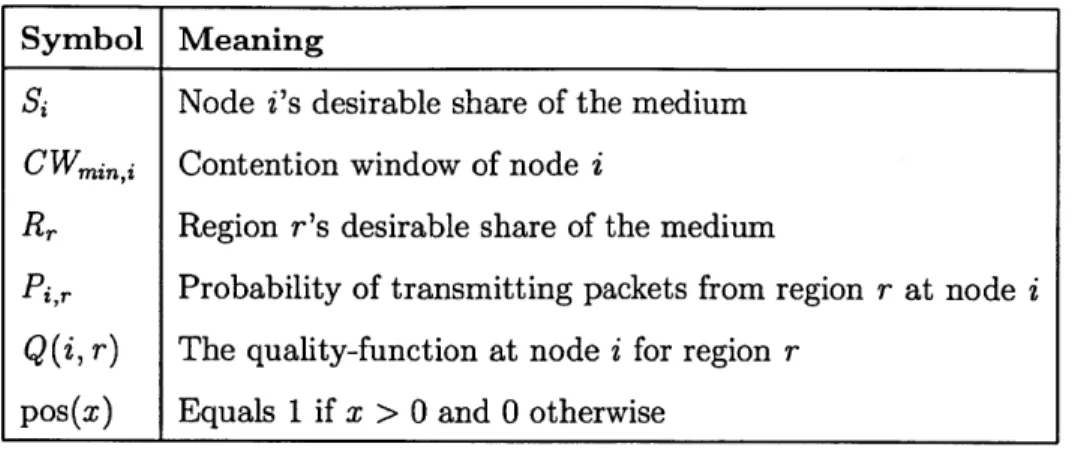
Symbol Meaning
Si Node i's desirable share of the medium
CWmin,i Contention window of node i
Rr Region r's desirable share of the medium
Pi,r Probability of transmitting packets from region r at node i
Q(i, r) The quality-function at node i for region r
pos(x) Equals 1 if x > 0 and 0 otherwise
Table 7.1: Table of Notations. We use i to iterate over nodes, and r to iterate over regions
7.1.1
Internal Requests
When the MAC receives requests from its own car, it broadcasts them to other vehicles over the wireless medium. It also keeps track of past requests and time them out after a minute. When packets with region data arrive, the module checks whether they answer a request that has not timed out, in which case it passes them to the compression module for decoding.
7.1.2
External Requests
The MAC actively listens on the medium to track the requests made for various regions, and to identify which regions are observed by vehicles in the network. When a vehicle receives a request for region s, it updates REQ, accordingly, which biases it to transmit more information about region s, if available.
7.2
Region Contention
CarSpeak aims to share the medium among regions proportionally to the number of requests they receive.
7.2.1
Sharing the Medium Among Regions
Let R, be region's r share of the wireless medium, i.e., the percentage of transmissions that should describe region r. We can write:
R = pos(EZ
Q(i, r))REQr
(7.1)E, pos(E Q(i, s))REQ'(
where REQ, is a measure of requests made for region s, and pos(x) = 1 if x > 0 and 0 otherwise. The function pos(E1
Q(i, r)) ensures that only regions for which some
node has information acquire a share of the medium. Regions that no node has sensed (i.e.,
Q(i,
r) = 0, Vi) do not get a share of the medium.But how does a node obtain the information it needs to substitute in the above equation in order to compute Rr? CarSpeak disseminates this information as anno-tation on the data packets transmitted by each node. Specifically, every CarSpeak packet sent by node
j
includes a list of region ids for which nodej
has information and their correspondingQ(j,
r)'s. By default this list has 5 entries for a total of 40bytes (6 bytes for region ids and 2 bytes for Q(j, r)).
CarSpeak nodes listen on the medium and collects information about the different regions and quality of information that other nodes have for these regions. They use this information to populate a table of region ids, and the quality of information the various nodes have for each region. A garbage collection thread that runs every 10 seconds multiplies
Q(i, r) values by a factor p, (0 < p < 1) in order to age-out quality
information that is outdated it also timeout requests that have not been refreshed in the past minute.
7.2.2
Controlling Medium Access
Using its estimate of the share of the various regions of the medium, Rr's, a node can estimate how often it should transmit, i.e., its own share of the medium. Let Si be the medium share of node i. Node i's share of the medium is the sum of its contribution to the transmissions related to all regions for which i has data. This contribution is also proportional to the quality of information the node has about each of these
regions. Thus:
Si = E R,
'~i
r
.
(T.2)
r Q(j, r)
Conceptually, once a node knows its share of the wireless medium, it should be able to transmit according to that share. At first, it seems that the node can achieve this goal by simply waiting for a transmission opportunity - i.e., the medium being idle - and using such opportunities as often as its share permits. For example, if its share is 20% of the medium time, it then transmits once every five times it senses the medium to be idle. Unfortunately, this approach does not work in practice. In practice, the decision to transmit upon the detection of an idle medium is performed in the card itself and cannot be controlled in software.
Thus, we will enforce the node share indirectly by controlling its contention win-dow CWmin. The relation between the contention winwin-dow and the resulting share of the wireless medium is given in [2] as:
CWmd,i =
2
S
*- (7.3)Si
The above relation is derived from a detailed Markov chain model of the progression of the contention window in 802.11 [2]. Intuitively, however, one can understand it as follows: In 802.11 a node picks a random value between 0 and CWmin. Thus, the average contention value is Cw .+1. Thus, on average the node accesses the medium once every CW 2+1 and hence its share of the medium S = 2
7.2.3
Partitioning a Node's Transmissions Among Regions
While the above ensures that the node gets the proper share of the medium, the node still has to divide this share between various regions depending on: 1) each region's share of the medium, and 2) the quality of information the node has about the region. To achieve this goal, whenever the node has an opportunity to transmit a packet, it
picks the packet from region r with the following probability:
R,
x Q(i,r)P
=R
- x XQr
(7.4)ER,
xEj
Q&,s)Si
iE,
Q(j,
r)
Clearly Zr Pi,r = 1, for every wireless node i.
The above is implemented using a non-blocking UDP socket. Whenever the socket has space for new packets, the node picks those packets from the regions according to the probabilities Pi,r's.
7.3
Scaling
The above design has an important side benefit: it provides congestion control for 802.11 broadcast mode. Specifically, the presence of many 802.11 senders can lead to excessive collisions and a congestion collapse. This effect is countered in 802.11 unicast
mode by the fact that a node that does not receive an ACK for its packet, backs off and doubles its contention window. Hence, during congestion, nodes tend to back off and reduce the number of collisions. In contrast, 802.11 broadcast mode does not have ACKs and hence it cannot use the lack of ACK as a signal of congestion to which it reacts by backing off. This leaves the broadcast mode with no protection against medium congestion. The resulting problem is typically referred to as a broadcast storm [20, 33]. In contrast, CarSpeak scales with a large number of senders because senders do not contend for the medium. It also scales with a large number of regions because as the number of regions increases the share of each region decreases because
Chapter 8
Discussion
In this chapter, we discuss some design considerations in implementing CarSpeak:
8.1
Communicating Processed Information.
An important design decision is whether CarSpeak nodes should send processed sen-sor information, such as locations of pedestrians or whether a road is congested, instead of raw sensor information. While this approach may be sufficient for spe-cialized scenarios, they are not suitable for general-purpose communication between autonomous vehicles. In the most general applications, transmitting nodes in networks of autonomous vehicles need not know how receivers plan to process this information. Furthermore, different receivers may process the same sensor information to achieve different objectives. Native sensor information, available at different resolutions, is the only representation generic enough to cater to varied objectives, such as evaluating road congestion, detecting pedestrians, avoiding vehicles, enabling better localization, route planning, and curb-detection amongst others.
8.2
One Hop vs. Multi-Hops.
One design decision is whether CarSpeak nodes should relay requests, in an attempt to find the relevant information at vehicles that are multiple hops away from the
originator. We chose not to do so, i.e., we do not make vehicles forward region re-quests. Our reasoning is based on the trade off between bandwidth consumption and the value of information about relatively distant locations. CarSpeak targets urban environments and speeds lower than 20 miles per hour. For autonomous driving ap-plications, and even with a conservative estimate, a car should not need information from locations that are farther than half to one minute away. At the above speeds, this translates into locations that are 100 to 200 meters away, which are typically within radio range.' Hence, we believe that limiting access to only information that is within the radio range of the requester is a reasonable design choice that enables each region to expend its wireless bandwidth on serving its local, and hence most urgent, requests.
8.3
Regular Traffic.
CarSpeak can support 802.11 traffic unrelated to autonomous driving as well. Such traffic can be represented simply as a virtual region in space. The designer can decide how to weigh this region in comparison to autonomous driving regions. For example, one may want to divide the medium equally between autonomous driving and other applications by setting Raiwa = 0.5, in which case the autonomous driving
applica-tion can use half the medium share (as well as any resource unused by the virtual region).
'For example, the Dedicated Short Range Communication (DSRC) technology, which was adopted by the intelligent transportation system (ITS) has a radio range of up to 1000 meters [23].