Publisher’s version / Version de l'éditeur:
Proceedings 16th International Conference on Port and Ocean Engineering under Arctic Conditions (POAC'01), pp. 1087-1096, 2001-08-12
READ THESE TERMS AND CONDITIONS CAREFULLY BEFORE USING THIS WEBSITE. https://nrc-publications.canada.ca/eng/copyright
Vous avez des questions? Nous pouvons vous aider. Pour communiquer directement avec un auteur, consultez la première page de la revue dans laquelle son article a été publié afin de trouver ses coordonnées. Si vous n’arrivez pas à les repérer, communiquez avec nous à [email protected].
Questions? Contact the NRC Publications Archive team at
[email protected]. If you wish to email the authors directly, please see the first page of the publication for their contact information.
NRC Publications Archive
Archives des publications du CNRC
This publication could be one of several versions: author’s original, accepted manuscript or the publisher’s version. / La version de cette publication peut être l’une des suivantes : la version prépublication de l’auteur, la version acceptée du manuscrit ou la version de l’éditeur.
Access and use of this website and the material on it are subject to the Terms and Conditions set forth at
Examination of Ice Ridging Methods Using Discrete Particles
Sayed, Mohamed; Savage, S.; Carrieres, T.
https://publications-cnrc.canada.ca/fra/droits
L’accès à ce site Web et l’utilisation de son contenu sont assujettis aux conditions présentées dans le site LISEZ CES CONDITIONS ATTENTIVEMENT AVANT D’UTILISER CE SITE WEB.
NRC Publications Record / Notice d'Archives des publications de CNRC: https://nrc-publications.canada.ca/eng/view/object/?id=9e46a7eb-05d6-41b2-a2e2-cfd360353da7 https://publications-cnrc.canada.ca/fra/voir/objet/?id=9e46a7eb-05d6-41b2-a2e2-cfd360353da7
EXAMINATION OF ICE RIDGING METHODS USING DISCRETE PARTICLES
Mohamed Sayed(1), Stuart B. Savage(2), and Tom Carrieres(3)
1
Canadian Hydraulics Centre, National Research Council, Ottawa, Ontario, Canada 2
Department of Civil Engineering and Applied Mechanics, McGill University, Montreal, Quebec, Canada
3
Canadian Ice Service, Environment Canada, Ottawa, Ontario, Canada
ABSTRACT
The evolution of ice thickness distribution is examined using a number of Monte Carlo simulation strategies. The present paper extends the analysis of Thorndike (2000) to consider different ridging methods. Additionally, the thickness distribution is updated at regular time intervals, and taking into account the influence of strain rates on ridging. The latter aspects are needed in order to adapt the Monte Carlo calculations for use in ice forecasting models. The ice cover is represented here by a large number of discrete particles. Starting from a given initial thickness distribution, ridging is introduced by changing the thickness and area of individual particles at regular time intervals. The results indicate that relatively small changes in ridging strategies may have significant effect on the evolution of the thickness distributions. Ridging (or increasing the
thickness) of particles chosen and combined at random produces appropriate thickness distribution characteristics. Ridging the thinnest particles, on the other hand, does not produce such characteristics.
INTRODUCTION
Deformation of ice covers is usually accompanied by changes to the thickness. Ridging may result from convergence or shear deformation, and open leads can form and expand. Mechanics of thickness build-up and lead opening are complex. The ice cover is often heterogeneous, consisting of different ice types, sizes and properties. Furthermore, local ice failure may involve several modes such as fracture, flexural bending, crushing, and rafting. Consequently, forecasting models, which examine lengths of hundreds of
POAC ‘0 1
Ottawa, Canada
Proceedings of the 16 International Conference onth Port and Ocean Engineering under Arctic Conditions POAC’01 August 12-17, 2001 Ottawa, Ontario, Canada
kilometers, cannot include details of ice thickness evolution. A parameterization, that accounts for the salient features, is usually adopted in such models.
Thorndike et al. (1975) formulated a theory of ice thickness distribution that remains the basis for most models. They used a probability distribution function to account for the amount of ice in thickness categories. Then, they derived expressions for the evolution of that function, which account for thermal growth and mechanical deformation. The theory of Thorndike et al. (1975) included a general redistribution function that required some arbitrary assumptions. Subsequent models included a number of implementations. For example, Hibler (1979) employed a two-category thickness formulation, and Flato and Hibler (1995) used a more elaborate implementation.
Thorndike (2000) also developed an alternative approach based on a Monte Carlo simulation. By dividing the ice cover into discrete particles, and combining random particles, he was able to produce realistic distributions of ice thickness. For example, the resulting distributions display the often observed exponential decay for large thickness value. Recently, Savage (2000) extended the theory of Thorndike et al. (2000) to include general strain rate fields, while replacing any arbitrary cho ice of a redistribution function. There is a vast amount of literature on ice thickness measurements and statistics that may be used to guide the models of ice thickness evolution. We briefly refer here to the investigations of Weeks et al. (1989), McLaren (1989), Wadhams(1992), and Prinsenberg et al. (1996).
The present study was motivated by the development of a new operational ice forecasting model (Sayed and Carierres, 1999). In the current implementation of that model, a mean thickness is calculated for each grid cell. The mean thickness is adjusted at each time step according to convergence of the ice cover. The present paper concerns part of an
investigation aimed at exploring methods for enhancing ice thickness representation in the model. This includes the development of numerically efficient schemes and provide more detailed information on thickness distribution.
In this paper, we consider a number of strategies for Monte Carlo simulation of ridging. The influence of strain rates, and particle ridging method on the resulting thickness distribution are examined. Predicted thickness distributions are compared to those obtained using the continuum thickness distribution model, as well. The present investigation may provide the basis for a Monte Carlo simulation of ridging. Only thickness evolution due to mechanical deformation is considered here. Thermodynamic effects are not included.
It is essential to emphasize that a Monte Carlo approach is based on using relatively simple rules that can lead to realistic results. Such simple rules are not intended to describe the physical processes. They merely constitute efficient numerical schemes. Evaluating the suitability of a certain approach should be based on examining the outcome of the simulation, rather than the physical significance of simulation rules.
THE THICKNESS DISTRIBUTION FUNCTION
In this section, we list the equations that describe the often used continuum thickness distribution function. For details of the derivation of those and the associated
assumptions, the reader is referred to Thorndike et al. (1975), Thorndike (2000), and Savage (2000).
Thorndike et al (1975) defined a thickness distribution function g(h) as the probability of finding a thickness between h and h+dh. This definition implies that the condition
expressed by Equation 1 must be satisfied.
(1)
∫
∞ = 0 1 ) (h dh gThe evolution of the thickness distribution function is given by (2)
( )
( )
+Ψ ∂ ∂ − = ∇ + ∂ ∂ g f h g v t gwhere t is time, v is the velocity vector, f is growth due to thermodynamic effects, and Ψ is a mechanical redistribution function. The latter function, Ψ accounts for the transfer of ice between different thickness categories. An implementation of Equation 2, requires choosing an expression for Ψ based on certain plausible (and arbitrary) assumptions. The stochastic model of Thorndike (2000) was formulated for the special case of finite shear rate with zero divergence. Savage (2000) generalized this model to handle arbitrary strain rates, following the earlier approach of Thorndike, et al. (1975) that was derived for general strain rates. Thus, the mechanical redistribution function was given by
(3) εI εII
[
α( )
θ w +αr( )
θ wr]
+ = Ψ • • 0 0 2 / 1 2 2 where 2 I • ε and 2 II •ε are the first and second invariants of the strain rate tensor. The coefficients α0
( )
θ and αr( )
θ represent the opening of leads and ridging, respectively. They are expressed in terms of the parameter θ as(4) α
( )
θ[
1 cos( )
θ]
2 1 0 = + and (5) α( )
θ[
1 cos( )
θ]
2 1 − = r where (6) = • • I II ε ε θ arctanOpening of leads is accounted for by giving the function wo the form of a delta function,
(7) w0 =δ
( )
h(8) =−
( )
+∫
( ) (
′ − ′)
′ h r g h g h g h h dh w 0 2Savage (2000) shows that manipulation of Equation 2, and substitution for Ψ (Equation 3) gives (9) g I I II
[
( ) ( )
h r( )
wr]
dt dg θ α δ θ α ε ε ε + + + − = • • • 0 2 / 1 2 2Numerical integration of Equation 8 (e.g. using an explicit finite difference scheme) is straightforward, and gives the evolution of the thickness distribution function g(h).
PARTICLE RIDGING
An alternative to the continuum formulation of the thickness distribution function is based on ridging (or combining) discrete particle, which are assumed to represent the ice cover. We use, in this section, a number of methods based on this approach to determine the evolution of ice thickness distribution in response to deformation of the ice cover. The influence of both convergence and shear deformation on ridging are taken into account. The present section, thus extends the approach of Thorndike (2000) to deal with general strain rates, and to examine the role of different ridging methods.
Thorndike (2000) considered the ice cover to consist of a large number of discrete particles. Ridging was simulated by choosing two particles at random. The thickness of one particle would then be increased to the sum of the particles’ thicknesses. The other particle would have a zero thickness.
Strain rate influence on ridging
In the present approach we consider the ice cover in an area subjected to uniform strain rates. The area of the ice cover to undergo ridging (reduction of the ice cover area) is estimated by considering the two principal strain rates 1
•
e and 2 •
e . If the principal strain rate 1
•
e is compressive (positive), its contribution to ridged area would be equal to its magnitude multiplied by the area of the ice cover. Otherwise, if 1
•
e is tensile (nega tive), its contribution to the ridged area would be nil. Thus, the ridged area, A1 due to 1
• e would be (10)
(
)
otherwise A e compressiv e if A e A ice 0 0 1 1 1 1 = ≥ = • •where Aice is the area of the ice cover under consideration. A similar argument can be
made for estimating the ridged area, A2 due to the minor principal strain rate 2 •
(11)
(
)
otherwise A e compressiv e if A e A ice 0 2 0 2 2 2 = ≥ = • •The total ridged area, A would be equal to the sum of the two areas (12) A= A1 + A2
According to Equations 10,11, and 12, a compressive strain rate is assumed to cause ridging, while a tensile strain rate causes lead opening. It is also assumed that the effects of each one of the principal strain rates (Equations 10 and 11) are additive (Equation 12). It is possible, however, to envision a situation where a compressive strain rate may cause the ice cover to deform without ridging (particularly if the other principal strain rate is tensile). There is no apparent simple way to incorporate such behaviour in the present calculations. Further enhancements to modelling the dependence of ridging on strain rates should be the subject of future investigation.
Particle ridging methods
In the present approach we use a large number of particles to represent an ice cover subjected to uniform strain rates. Each particle is assigned a thickness and an area. The initial conditions consist of a Gaussian thickness distribution and uniform. The ridging processes is simulated as follows. The ridged area is calculated at regular time intervals according to Equations 10, 11, and 12. The area and thickness of certain particles are then adjusted to account for the reduction of ice cover area (due to ridging). The following methods are used to adjusting particles’ areas and thicknesses:
1. Uniform ridging: the thickness and area of each particle are adjusted using the same ratio, such that the sum of particles area would be equal to the ridged (reduced) total ice cover area. For each particle, the thickness is increased and the area decreased to preserve a constant volume.
2. Ridging random pairs of particles: two particles are chosen at random. One particle is assigned the sum of the thicknesses of both particles. The other is assigned a zero thickness. This procedure is repeated until area of the ice cover is reduced by the required amount. Equal areas for all particles are used in this method.
3. Ridging individual random particles: a particle is chosen at random. It’s thickness is increased and area is reduced (while conserving the volume of the particle). The increase to the thickness is limited to twice the current value. This condition
represents rafting. Another particle is next chosen, and the procedure is repeated until the required total area of the ice cover is reached.
4. Ridging thinnest particles: the particle with the smallest thickness is chosen. It’s thickness is increased and area decreased. A procedure similar to method 3 is then followed, but with choosing the particle with the smallest thickness (instead of at random).
Naturally, other methods can be used to ridge the discrete particles, but the above choices cover a wide range of possible behaviours. The first method is chosen because it
Carrieres, 1999). The second method shares similarities with the strategy of Thorndike (2000). The main differences, however, are in accounting for the strain rates and using regular time intervals. The third method is a variant of the random choice of particles. Finally, the fourth method follows the commonly advocated view that thinner ice is more likely to undergo ridging than thicker ice. Again, there are numerous alternative ways to ridge thinner ice. Thorndike et al (1975), for example, suggested ridging thin ice in their continuum formulation to reach up to five times the original thickness. The evolution of the ice thickness distribution obtained using the above methods and the continuum thickness distribution function (section 2.0) are compared below.
COMPARISON OF RIDGING METHODS
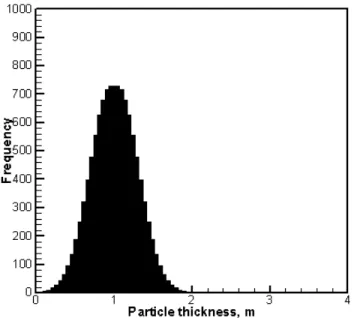
Particle ridging methods were tested using 10000 particles. The initial thickness was assigned according to a Gaussian distribution with a mean of 1m. A histogram of the initial particle thickness is shown in Figure 1. The bin size used in all histograms presented below is 0.05 m. Each particle was assigned an initial area of unity (e.g. 1 km2). A time step of 2000 seconds was used in all calculations. Tests were done for uniform convergence of 10-7s-1 ( 1
•
e = 2 •
e = 0.5x10⁻⁷s-1), and 2000 time steps. The
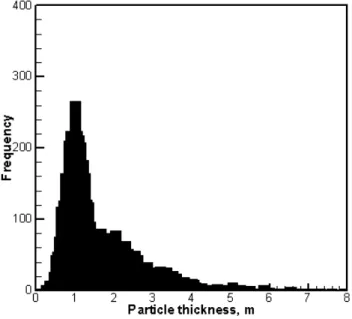
resulting particle thickness distributions for methods 1 to 4 are shown in Figures 2, 3, 4, and 5.
The uniform ridging of all particles (method 2) appears to preserve the Gaussian distribution as shown in Figure 2. Comparison of Figures 1 and 2 indicates that both values of the mean and width (or standard deviation) of the distribution increase, which may be intuitively expected.
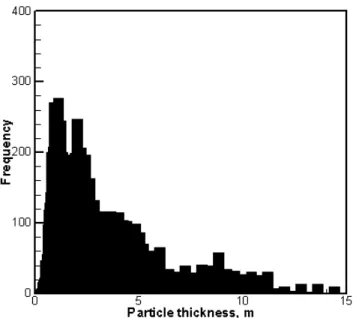
Figure 3 shows tha t ridging random pairs of particles (method 1) produces thickness distribution shapes in agreement with the results of Thorndike (2000) and Savage (2000). It also displays characteristics observed in field measurements (Prinsenberg et al., 1996). In particular, the distribution exhibits the exponential decay for large thickness values. The distribution also shows a peak at 1 m thickness, which is the mean of the initial distribution. An interesting second peak appears at 2 m thickness. This second peak may be attributed to rafting of particles with the initial mean thickness. The third method displays the same general characteristics as shown in Figure 4.
Figure 2: Thickness distribution obtained by uniformly ridging all particles, method 1.
Thickness distribution according to the continuum function, discussed in section 3, is also evaluated here. The present initial Guassian distribution, strain rates, time step, and duration are used in a numerical integration of Equation 9 . The resulting thickness distribution function g(h) is plotted in Figure 6. The integration was done using a thickness increment of 0.05 m. Obviously, that distribution is in accord with the present method 2, which combines pairs of particles chosen at random.
Figure 4: Thickness distribution obtained by ridging individual random particles, method 3.
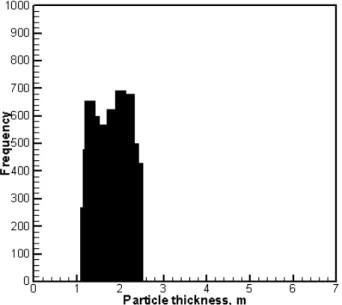
It is often assumed in ice forecasting literature that thinner ice is most likely to ridge. The physical justification for this assumption is obvious. The thickness distribution in Figure 5 (for method 4) follows that assumption. It is interesting to note that the distribution does not display the expected features of exponential decay for larger thicknesses, nor the peaks at the 1 m and 2 m values (seen in Figure 6).
CONCLUSION
The preceding results compared the evolution of ice thickness distribution based on different Monte Carlo simulation methods based on ridging discrete particles. Only mechanical deformation of the ice cover was considered. Thermodynamic effects were not included.
The approach of using a large number of discrete particles was proposed by Thorndike (2000) as an alternative to the continuum formulation of a thickness distribution function. It is extended here to examine the influence of various methods of ridging those discrete
physically plausible. The objective is to use simple efficient rules to reproduce the observed distributions.
Figure 5: Thickness distribution obtained by ridging the thinnest particles, method 4.
Figure 6: Continuum thickness function.
The results show that ridging (or combining) pairs of particles, chosen at random, produces a thickness distribution with the main features of those obtained from the continuum formulation of the distribution function. Those features also agree with field observations. In particular, the resulting thickness distribution exhibit the exponential decay for large thicknesses.
Another somewhat unexpected conclusion concerns biasing the ridging towards thin ice. Although physically plausible, ridging the thinnest particles led to thickness distributions that do not display appropriate characteristics. It is also interesting to note that relatively small variations between the chosen ridging methods produced significantly different results.
ACKNOWLEGEMENT
The support of the Panel on Energy Research and Development (PERD) is gratefully acknowledged.
REFERENCES
Flato, G.M., and Hibler III, W.D. (1995). “Ridging and strength in modeling the thickness distribution of Arctic sea ice”, J. Geophys. Res., Vol.100 (C9), pp. 18,611- 18,626.
McLaren, A.S. (1989). “The under- ice thickness distribution of the Arctic Basin as recorded in 1958 and 1970”, J. Geophys. Res., Vol.94, pp. 4,971-4,983.
Prinsenberg, S.J., Peterson, I.K., and Holladay, S. (1996). “Comparison of airborne electromagnetic ice thickness data with NOAA/AVHRR and ERS-1/SAR images”, Atmosphere-Ocean, Vol. 34(1), pp. 185-205.
Savage, S.B. (2000) “Analyses for evolution of ice thickness distributions”, Technical Report 2000-04, Contract KM149-0-85-016 for Canadian Ice Service, Environment Canada, 43 pp.
Sayed, M., and Carrieres, T. (1999). “Overview of a new operational ice forecasting model”, Proc. Int. Offshore and Polar Eng. Conf. (ISOPE), Brest, France, May 30- June 4, Vol. II, pp. 622-627.
Thorndike, A.S., Rothrock, D.A., Maykut, G.A., and Colony, R. (1975). “The thickness distribution of sea ice”, J. Geophys. Res., Vol.80, pp. 4,501-4,513.
Thorndike, A.S. (2000). “Sea ice as a stochastic process”, J. Geophys. Res., Vol.105 (C1), pp. 1,311-1,313.
Wadhams, P. (1992). “Sea ice thickness distribution in the Greenland Sea and Eurasian Basin”, J. Geophys. Res., Vol.94(C4), pp. 5,331-5,348.
Weeks, W.F., Ackley, and Govoni, J. (1989). “Sea- ice ridging in the Ross Sea, Antarctica as compared with other sites in the Arctic”, J. Geophys. Res., Vol.94(C4), pp.