HAL Id: hal-03136568
https://hal.inria.fr/hal-03136568
Submitted on 11 Feb 2021
HAL is a multi-disciplinary open access
archive for the deposit and dissemination of
sci-entific research documents, whether they are
pub-lished or not. The documents may come from
teaching and research institutions in France or
abroad, or from public or private research centers.
L’archive ouverte pluridisciplinaire HAL, est
destinée au dépôt et à la diffusion de documents
scientifiques de niveau recherche, publiés ou non,
émanant des établissements d’enseignement et de
recherche français ou étrangers, des laboratoires
publics ou privés.
Predicting symptom onset in Parkinson’s disease with
latent mixed-effect model
Pierre-Emmanuel Poulet, Stanley Durrleman , Jean Christophe Corvol
To cite this version:
Pierre-Emmanuel Poulet, Stanley Durrleman , Jean Christophe Corvol. Predicting symptom onset in
Parkinson’s disease with latent mixed-effect model. AD/PD 2021 - 15th International Conference on
Alzheimer‘s & Parkinson‘s Diseases, Mar 2021, Barcelone / Virtual, Spain. �hal-03136568�
PREDICTING SYMPTOM ONSET IN PARKINSON’S DISEASE
WITH LATENT MIXED-EFFECT MODEL
Poulet Pierre-Emmanuel
1,2, Durrleman Stanley
1,2, Corvol Jean-Christophe
2, 3 1INRIA Paris, Aramis Lab,
2Paris Brain Institute,
3NSPark consortium
1
Objectives
Due to their slow evolution, neurodegenerative diseases can be observed on long periods with several measurements of various biomarkers. Statistical models can fit such longitudinal data to describe the disease’s evolution. We show how such a model can predict the onset of symptoms in a study on Parkinson’s disease.
2
Methods
We used data from patients included in the NS-PARK cohort collecting longitudinal motor and non-motor symptoms from patients with Parkinson’s disease followed in the 25 expert centers in France and updated at each visit at the center. Only patients with at least 3 visits were included into the analysis. We modelled the observations with a non-linear mixed-effect model called Leaspy describing the latent evolution of the disease. The model is composed of population parameters which represent the average disease trajectory. This trajectory can then be personalized for each subject, with an individualized evolution of the disease which we used to predict the future onset of symptoms for new patients.
3
Results
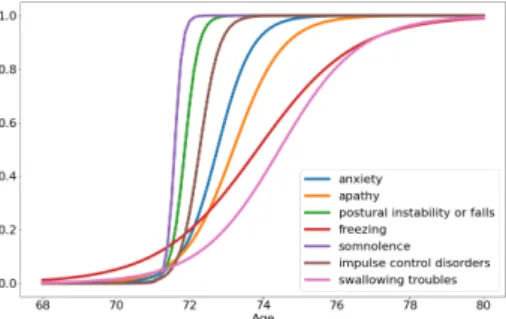
2821 patients from the NS-PARK cohort were included into the analysis (mean age : 66+/-11; follow-up duration : 2.6+/-1.3). Analysis of the model helps us to understand the variability of each symptom and the prediction task separates symptoms in two groups : symptoms which we can roughly predict (dementia, postural instability...), and symptoms which are unpredictable (insomnia, impulse control disorders...).
Figure 1: Average population model for latent evolution of symptoms
4
Conclusions
Our model allows to decipher between symptoms which are due only to the disease and symptoms which depend on external factors. In the first case we are able to partially predict symptom onset.