Calibration and Performance of a Selective Catalytic Reduction (SCR) Bench Rig for NOux Emissions Control
by
Sebastian Castro Galnares
MASSACHUSETTS INSTITUTE C)r TECHNOLOGY
AUG 1
4
2008
U.BRARIES
SUBMITTED TO THE DEPARTMENT OF MECHANICAL ENGINEERING IN PARTIAL FULFILLMENT OF THE REQUIREMENTS FOR THE DEGREE OFBACHELOR OF SCIENCE IN MECHANICAL ENGINEERING AT THE
MASSACHUSETTS INSTITUTE OF TECHNOLOGY
JUNE 2008
©2008 Sebastian Castro Galnares. All rights reserved.
The author hereby grants to MIT permission to reproduce and to distribute publicly paper and electronic copies of this thesis document in whole or in part in any medium not
known or hereafter created.
Signature of Author:
All, '- Department ofiMe~Tiaical Engineering May 9, 2008
Certified by:
Victor W. Wong Principal Rsse*t-&eientist, Manager of Sloan Automotive Laboratory
Accepted by:_
John H. Lienhard V Professor of Mechanical Engineering Chairman, Undergraduate Thesis Committee
ARCHNES
Calibration and Performance of a Selective Catalytic Reduction
(SCR) Bench Rig for NOx Emissions Control
by
Sebastiain Castro Galnares
Submitted to the Department of Mechanical Engineering on May 9, 2008 in partial fulfillment of the requirements for the Degree of Bachelor of Science in Mechanical
Engineering
ABSTRACT
A laboratory test rig was designed and built to easily test SCR (Selective Catalytic Reduction) technology. Equipped with three 6 kW heaters, connections for liquid N2 and
an assortment of test gases, and a connection with an MKS NOx Analyzer, the rig allows for a vast range of SCR test conditions, and can easily be adapted for degreening, aging, and the implementation of other technologies onto the rig.
To calibrate the test rig, baseline parameterization of a Cu-based zeolite (aluminosilicate) core was performed, including a temperature sweep and an NO/NO2 concentration
sweep, while always maintaining a 1:1 ratio between NOx and NH3 reductant. The
catalyst was found to have a peak deNOx efficiency of 99.8% between 250 'C and 300
'C, and maintained 98% efficiency with NO/NO2 < 1, while minimizing pollutant N20
generation.
Thesis Supervisor: Victor W. Wong
Introduction
As it becomes more apparent that greenhouse gases are contributing to global warming, reducing the emission of gases from vehicle exhaust becomes paramount. In the automotive industry, NOx gases produced in most combustion processes as a result of elevated temperature have been shown to contribute significantly to the greenhouse effect. Originally designed for use in heavy industry [6], selective catalytic reduction (SCR) provides a means of converting NOx gases to harmless N2 and H20 components
through the use of a reductant. In the last decade, adapting SCR technology for use in the diesel automotive industry has been an important topic of research; several technical barriers prohibit the direct transplant of the technology. In industrial SCR applications anhydrous or aqueous NH3 is used, both of which require large storage vessels that would
be difficult to reduce to the appropriate sizes for automotive applications. Additionally, NH3 or in solution can be extremely toxic and corrosive [4]; therefore, an alternate
reductant which can be easily stored on a vehicle platform, can be metered out with relative ease, and most importantly, can be reduced to NH3 in situ to be used as the main
reductant of NOx gases is needed. Most studies focus on the use of urea as this reductant.
Chemistry of urea decomposition and NOx reduction
To obtain the NH3 necessary for the catalytic reduction of NOx, urea decomposes
as shown in the following reactions:
(NH2)CO - NH3 + HNCO (1)
A necessary condition for these reactions to go to completion is a sufficiently elevated temperature of the exhaust gas [3], as inefficiency results in unhydrolized urea depositing itself on the catalyst surface, blocking reaction sites and decreasing the efficiency of the overall catalytic activity. A major part of catalyst design for SCR applications is determining the temperature ranges at which the urea is fully decomposed, and avoiding the passing of excess uncatalyzed reductant, or slip, of both urea and NH3 through the catalyst.
With this in mind, consider the following reactions of NH3 and NOx gases:
4NH3 + 4NO + 02 4N2 + 6 H20 (3)
2NH3 + NO + NO2 -- 2N2 + 3H20 (4)
8NH3 + 6NO2 --+ 7N2 + 12H20 (5)
The rate of these reactions and their prevalence are determined in large part by the ratio of NO2/NO gases in the exhaust stream. Reaction (3) dominates when no NO2 is
present. Reaction (4) dominates when NO2/NO < 1 and is a fast reaction, while reaction
(5) dominates when N02/NO > 1, and is a slow reaction. Secondary, pollutant-forming
reactions (or reactions that prevent NOx from decomposing to N2 and H20) can also
occur: 4NH3 + 4 02 -+ 2N20 + 6 H20 (6) 2NH3 + 2NO2 - N20 + N2 + 3H20 (7) 4NH3 + 4 NO + 3 02 -- 4N20 + 6 H20 (8) 4NH3 + 302 - 2N2 + 6H20 (9) 4NH3 + 502 - 4NO + 6 H20 (10) 4NH3+ 702 - 4N02+ 6H20 (11)
The actual chemistry on the catalytic surface is complex and can involve the evolution of phosphates, sulfates, and other species in the catalyzed exhaust both from the urea itself and from any impurities in the exhaust of a real engine [7]. However, because the metering of urea into an exhaust stream requires bulky, closed loop controlled equipment, simulated exhaust gas is often used and NH3 is injected into this
mixture to establish the baseline behavior of new catalysts. Thus, the above formulae provide a useful theoretical basis for analyzing the baseline behavior of catalysts tested in this manner.
Test Rig Specifications
Much of the work of this thesis focuses on the creation of a practical test rig for the testing of the baseline performance parameters of SCR catalysts. As shown in Figure
1, the developed rig is well suited for this goal, but can also be easily adapted to run
Fig 1. Catalyst bench rig schematic [8]
Because of the high space velocities that many catalyst testing procedures
implement (i.e. above 30k hr -1), a dedicated, insulated input line is used to draw nitrogen gas from a 250 L liquid N2 dewar pressurized at 230 psig. This input line runs through a 6
kW Sylvania heater, which operates at 208 V and can draw up to 60 amperes of current. This heater is used to heat the N2 gas to about room temperature before it enters the
exhaust gas-mixing manifold. Five input ports are used to feed cylinder gases into the mixing manifold, and both these ports and the insulated line have flow meters used to control the volume of gas per unit time being mixed into the system. Just downstream of the mixing manifold are two additional 6 kW Sylvania heaters in series, which are used to heat the exhaust mixture to the desired testing temperature. An Athena Series 16C and an Extech 48VTR temperature controller are used in conjunction with a power relay to control the heaters, with thermocouples placed just downstream of the N2 input line and just upstream of the catalyst section. An additional thermocouple was placed just downstream of the catalyst section, but was not used for temperature control of the
exhaust gas. The catalyst section itself has sampling ports controlled through ball valves just upstream and downstream of the position of the catalyst. These sampling ports lead to an MKS Multigas 2030 FTIR (Fourier transform infrared spectroscopy) NOx analyzer capable of discerning all major exhaust gas species (with the exception of diatomic species, although for 02 there is an built-in dedicated sensor) at a maximum rate of one sample per second. Once exhaust goes through the catalyst section, it is carried through a gate valve that is used to generate a pressure differential to ensure proper gas flow, and subsequently through an exhaust port that removes the gases from the system.
Experimental
Catalyst preparation: For the initial test rig experiment, a proprietary
copper-based formulation on a zeolite (hydrated aluminosilicate) matrix was obtained through suppliers at Ford. From the original sample, a 2.5" diameter, 5" long piece was cored with a diamond bit. The catalyst was characterized by 400 cpsi (cells per square inch).
Testing parameters and procedures: The base exhaust mixture used in all
experiments was 14% 02, 1500 ppm NH3, and the balance in N2. Before each test
procedure, the system was purged with pure N2 gas at 1500 C for 20 minutes. Two
distinct experiments were carried out.
To analyze NOx conversion as a function of catalyst inlet temperature, a temperature sweep scheme was performed. Outlet composition data was taken until the outlet compositions reached a steady state, starting at 150 oC catalyst inlet temperature and increasing the temperature by 50 'C for each data point, up to 500 'C. With each successive temperature increment, data was also taken from the catalyst inlet to ensure
that the desired gas composition of 750 ppm NO and 750 ppm NO2 was maintained at
steady state.
The second procedure focused on the effects of NOx composition itself. Keeping the catalyst inlet temperature at a nominal 300 oC, 1500 ppm of NOx was mixed into the
exhaust stream at a ratio of 0.5 NO/NO2. After recording catalyst outlet data at steady
state, the ratio of NO/NO2 was increased with steady state data taken for each additional
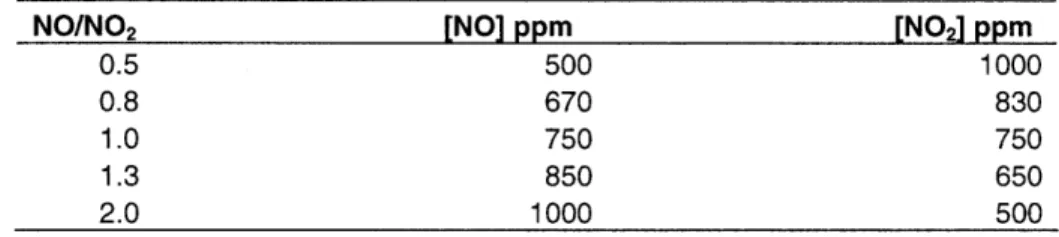
concentration as shown in Table 1, always maintaining the total NOx levels at 1500 ppm. As in the first procedure, catalyst inlet data was taken between each data point to ensure that the desired exhaust gas composition was maintained.
NO/NO2 [NO] ppm [NO2] ppm
0.5 500 1000
0.8 670 830
1.0 750 750
1.3 850 650
2.0 1000 500
Table 1. NO/NO2 ratio sweep procedure exhaust stream composition
Results and Discussion
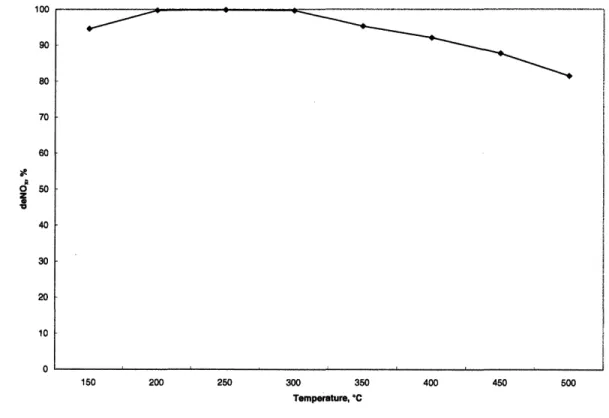
The results for NOx conversion efficiency are shown in Figure 2. As the temperature was ramped up from 150 oC, the NO, conversion efficiency increased and then began dropping at higher temperatures. This kind of behavior is typical for many catalysts [1], and although a peak efficiency of 99.8% is achieved between 250 'C and 350 'C, it should be noted that as a baseline measurement, the catalyst has yet to be degreened or loaded. Under loading, fuel and lubricant pollutants such as sulfates, nitrates, and heavy metals can block catalysis by reacting with the surface copper and deactivating catalyst sites.
100 90 80 70 60 Ss50 z 40 30 20 10 n 150 200 250 300 350 400 450 500 Temperature, *C
Figure 2. NO, conversion efficiency as a function of catalyst inlet temperature
To ensure that the reductant is being consumed in its entirety, as given by the predicted chemistry of reaction based on equation (4), the amount of NH3 going
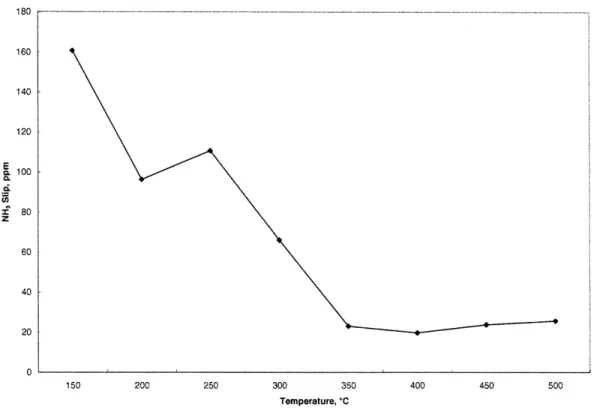
unreacted through the catalyst, or NH3 slip, is plotted in Figure 3. Slip is highest when the
temperature is lowest, which is expected as there is not enough heat in the exhaust stream to activate the catalytic reactions and decompose the NOx. This slip, however, continues to decrease and eventually levels out past the temperatures at which NOx conversion is at its highest.
160 140 120 E S100 x' 80 z 60 40 20 0 150 200 250 300 350 400 450 500 Temperature, 'C
Figure 3. NH3 slip as a function of catalyst inlet temperature
It is theorized that the steady state achieved in slip at higher temperatures can be attributed to an adsorption/desorption process in which NH3 adsorbs to the catalyst surface at lower temperatures, and then begins NO and NO2 forming reactions at higher temperatures once desorption begins [5]. The authors of this study suggest that when used with low to medium (200 oC - 350 oC) temperature transients such as those found in heavy duty cycles, this mechanism can be used to improve overall deNOx efficiency, provided that the temperature is carefully regulated to avoid the formation of additional NOx as can be seen in reactions (9) - (11).
Pollutant formation is also relevant to the efficiency tradeoffs of any catalyst baseline performance, particularly since the susceptibility to form N20 in the catalyst
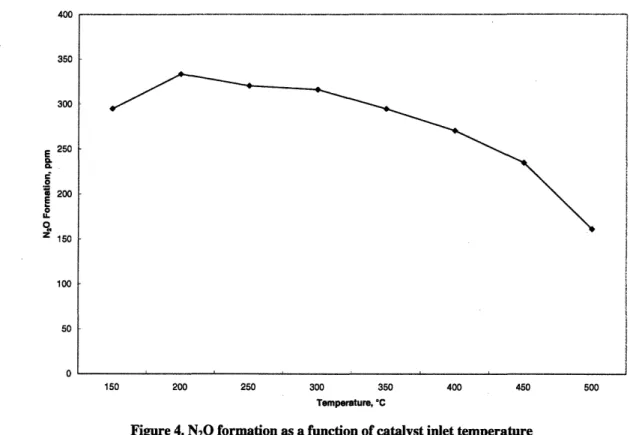
outlet stream is relatively simple, as seen in reactions (6) - (8). As shown in Figure 4, N20 formation is well matched to increase in deNOx conversion.
r i i i i i i i
350 300 E 250 200 Z 150 100 50 0OO v - -150 200 250 300 350 400 450 500 Temperature, *C
Figure 4. N20 formation as a function of catalyst inlet temperature
Transient imbalances in NO2 concentration, along with elevated temperature, are
particularly prone to produce N20 in the catalyzed exhaust stream. However, once the
exhaust temperature is sufficiently elevated, NO and NO2 formation is favored, as can be
appreciated from the decrease in deNOx activity.
Varying the NO/NO2 ratio is well established in the literature as a way of testing
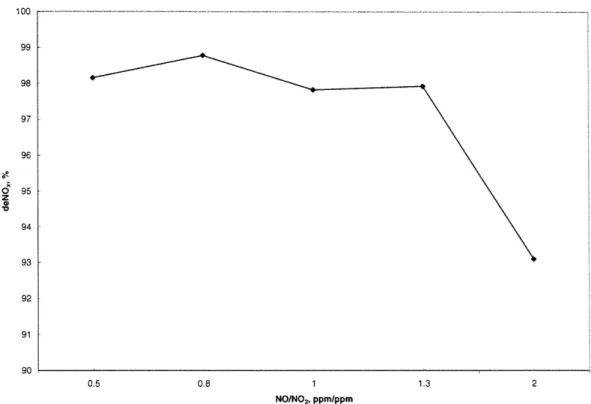
catalyst behavior when exposed to different types of engine systems, and also when fine tuning other technologies to work in conjunction with SCR, such as LNT (lean NOx trap) and DPF (diesel particulate filter) [7]. Figure 5 shows deNOx conversion when exposed to varying levels of NO/NO2 but maintaining both the total NOx concentration and the
100 99 98 97 96 0 95 z 94 93 92 91 90 0.5 0.8 1 1.3 2 NONO2, ppm/ppm
Figure 5. NO, conversion as a function of NO/NO2 ratio in catalyst inlet
The deNOx conversion percentage remains relatively constant under low to moderate levels of NO concentration, but begins to fall dramatically once it is predominant in the NOx stream. Studies show that high concentrations of NO will compete with NH3 for adsorption on copper catalysis sites on the catalyst and will result
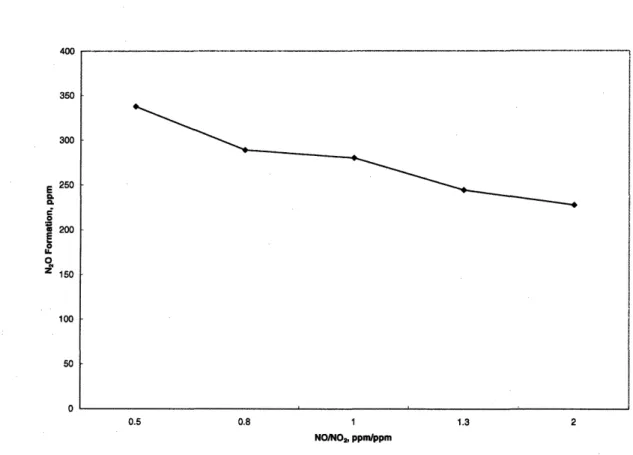
in decreasing deNOx capability [2]. However at lower NO/NO2 ratio we incur a penalty
in the form of N20 production as shown in Figure 6.
350 300 E 250 10050 0 A 0.5 0.8 1 1.3 2 NONOO2, ppm/ppm
Figure 6. N20 formation as a function of NO/NO2 in catalyst inlet
Again, N20 pollution becomes an issue as the concentration of NO2 decreases.
The problem is simpler to adjust for here as better efficiencies for NOx reduction are achieved with less NO in the exhaust stream, which also produces fewer pollutants. As mentioned previously, increasing NO2 concentration in the exhaust stream is beneficial
from an outright efficiency standpoint, but also from an adsorption/desorption one [5], as NO2 that might adsorb to the catalyst is more easily released in a transient cycle and
decomposes more readily to N2; conversely, NO binds more readily to the Cu catalysis
sites and is more selective to oxidizing to NO2.
__ ____________ _·IIUIIIIII··______-L··-·--l~·--·llll
Conclusions
The tested Cu-based catalyst was found to have an appropriate baseline performance in comparison with other catalyst types [1], and has the advantage of not possessing any vanadium-containing compounds in its structure. Used extensively until
recently, studies have shown health risks involved with breathing in released vanadium when the catalyst core's integrity has been compromised [8].
The true test of a catalyst lies in the preservation of its NOx reduction qualities even after extensive loading. The design of the test rig proves multifaceted in this regard: not only can one establish the baseline performance of the catalyst, but by mixing more demanding mixtures of simulated diesel exhaust and submitting the catalyst to many hours of duty simulating cycles, in situ performance can be characterized and compared to the baseline.
The literature has shown that much of the promise in SCR technology is its combination with other mechanisms to further enhance the SCR reactions [7]. An
example of this is with DPF technology; when placed upstream of an SCR, it can be a source of NO2 emissions that in general increase the NOx reduction efficiency of the SCR
reaction, although it should be noted that it can also provide higher temperature gas which can lead to lower efficiencies and durability issues with the catalyst itself. The versatility of the SCR test rig is such that it could be easily adapted to 'piggy back' on a motor with DPF technology, or even adapt a DPF into the test rig itself, making the scope of possible test procedures vast, and the rig itself a valuable tool.
Acknowledgements
The work for this thesis was performed at the Sloan Automotive Laboratory at the Massachusetts Institute of Technology. The author would like to acknowledge Dr. Victor Wong for his providing a platform for this project to take place and for his expertise. Special regards to Mike Giansiracusa and Alex Sappok for their help in immersing the author in the workings of Sloan Auto Lab and the many discussions surrounding the topic of this thesis. The author also extends to many thanks to Thane DeWitt, Yuichi Kodama and Simon Watson for their invaluable knowledge, patience, and assistance, without which this project would not have been possible. A heartfelt thank you to Natalia Rodriguez for her insightful comments in editing this thesis' content.
References
[1] J. Huang, Z. Tong, Y. Huang, J. Zhang, "Selective catalytic reduction of NO with
NH3 at low temperatures over iron and manganese oxides supported on
mesoporous silica", Applied Catalysis B: Environmental 78 (2008).
[2] L. Olsson, H Sj6vall, R.J. Blint, "A kinetic model for ammonia selective catalytic reduction over Cu-ZSM-5", Applied Catalysis B: Environmental 81 (2008). [3] Y. Cheng, J. Hoard, C. Lambert, J.H. Kwak, C.H. Peden, "NMR studies of Cu/zeolite
SCR catalysts hydrothermally aged with urea", Catalysis Today (2008).
[4] J.A. Sullivan, J.A. Doherty, "NH3 and urea in the selective catalytic reduction of NOx
over oxide-supported copper catalysts", Applied Catalysis B:Environmental 55
(2005).
[5] L. Xu, R.W. McCabe, R.H. Hammerle, "NOx self-inhibition in selective catalytic reduction with urea (ammonia) over a Cu-zeolite catalyst in diesel exhaust", Applied Catalysis B: Environmental 39 (2002).
[6] Wikipedia contributors, "Selective catalytic reduction," Wikipedia, The Free
Encyclopedia,
http://en.wikipedia.org/w/index.php?title=Selective catalytic reduction&oldid=2 09435612 (accessed April 20, 2008).
[7] W.A. Majewski, "SCR Systems for Mobile Engines", DieselNet Technology Guide, http://www.dieselnet.com/techlcat scr mobile.html (accessed April 20, 2008). [8] M. Giansiracusa, "Test-rig Evaluation and Catalyst Analysis of SCR Systems",
Powerpoint presentation for the MIT Consortium to Optimize Lubricants and Diesel Engines for Robust Emission Aftertreatment Systems, November 2007.
![Fig 1. Catalyst bench rig schematic [8]](https://thumb-eu.123doks.com/thumbv2/123doknet/14194947.478875/6.918.225.720.135.505/fig-catalyst-bench-rig-schematic.webp)