Community Participation in
Boston's Southwest Corridor Project: A Case Study
by
Mauricio Miguel Gaston A.B. Princeton University
(1968)
SUBMITTED TO THE DEPARTMENT OF PLANNING AND URBAN STUDIES IN PARTIAL FULFILLMENT OF THE REQUIREMENTS OF THE DEGREE OF
MASTER OF CITY PLANNING at the
MASSACHUSETTS INSTITUTE OF TECHNOLOGY June 1981
@ Mauricio Miguel Gaston 1981
The author grants permission to M.I.T. to reproduce and to distribute copies of this thesis document in whole or in part.
Signature of Author
Department of APlanning and Urban
Certified by Studies May 18, 1981 T un ney Ii Thesis Supervisor Accepted by I, 1 9
ARCHIES
Professor Langlev C. Keyes MASSACHUSETTS MASSCHUE~SINSTITU:TEIChairman,
Departmental CommitteeOF TECHNOLOGY
JUL 2 7
1981
MIT Libraries
Document Services
Room 14-0551 77 Massachusetts Avenue Cambridge, MA 02139 Ph: 617.253.2800 Email: [email protected] http://libraries.mit.edu/docsDISCLAIMER OF QUALITY
Due to the condition of the original material, there are unavoidable
flaws in this reproduction. We have made every effort possible to
provide you with the best copy available. If you are dissatisfied with
this product and find it unusable, please contact Document Services as
soon as possible.
Thank you.
Both the Library and Archives copies of this
thesis contains poor grayscale image
repro-ductions. This is the best available copy.
COMMUNITY PARTICIPATION IN
BOSTON'S SOUTHWEST CORRIDOR PROJECT: A Case Study
by
Mauricio Miguel Gaston
Submitted to the Department of Planning and Urban Studies on May 18, 1981, in partial fulfillment of the requirements for the degree of Master of City Planning.
ABSTRACT
The literature about participation was reviewed. An analysis of participation under State Monopoly Capitalism was followed by analysis of reformist and administrative_
theories, and of the relationship between participation and alienation and decentralization. The Southwest Expressway was analyzed in historical context and the gradual
institu-tionalization of participation was traced through a 10-year period. Participation during the design and engineering phase of the project was then studied, followed by detailed
analysis of participation in the programming and design of a particular section of the project.
The study demonstrates the complex relationship between a popular movement, the state, and various planning profes-sionals around a major urbanistic transformation in the Boston Metropolitan Region, and draws a series of lessons for both activists and progressive planners.
CONTENTS
Page
INTRODUCTION CHAPTER I
PARTICIPATION: THE ISSUES AND THE LITERATURE
Participation Under State Monopoly
1.2 Capitalism
1.11 Participation and Ideological Struggle 1.14 Reformist Theories of Participation 1.25 Administrative Goals in Promoting
Participation
1.27 Participation and Alienation
1.29 Participation in Programming and Design
1.32 Decentralization
1.35 On the Recent History of Participation in Boston
1.43 Lessons and Tentative Conclusions
CHAPTER II
THE STRUGGLE AGAINST URBAN EXPRESSWAYS II.1 Interstate Highways and the
Rationaliza-tion of the Monopoly City
11.15 The Fight in the Neighborhoods of the Southwest Corridor
CONTENTS
Page
CHAPTER II, continued
11.24 The Coalition Against the Highways
11.33 The BTPR
11.53 The Environmental Impact Process
CHAPTER III
THE DESIGN AND ENGINEERING PHASE
111.3 Project Structure
111.7 Structure of Participation 111.15 Committee Structure
111.25 Who Participated, When, and How 111.29 Participation and Technical Issues 111.33 The Nature of the Agenda
CHAPTER IV
THE CASE OF THE SECTION I COVER The Issue of Turf in the South End/
St. Botolph
Participation in the South End Around the Issue of the Corridor
Institutionalization
Controversy in the Design of the Section I Cover
Participation from an Administrative Perspective
Technical Issues in Programming and Design Socio-Political Issues in Programming and De-sign of the Section I Cover
.w ~ - 2~7 - _ ---- i- --s . . w - - Id-- - F 71.4 2 -. ab I. -'-"3 -'K L'p
GRAPHIC No.
i
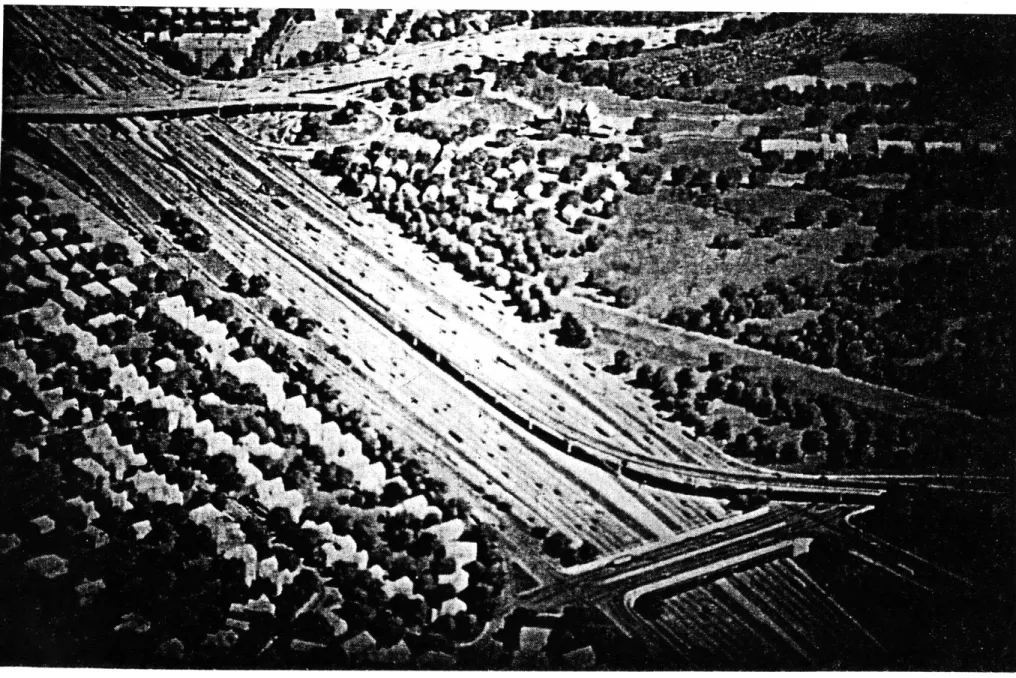
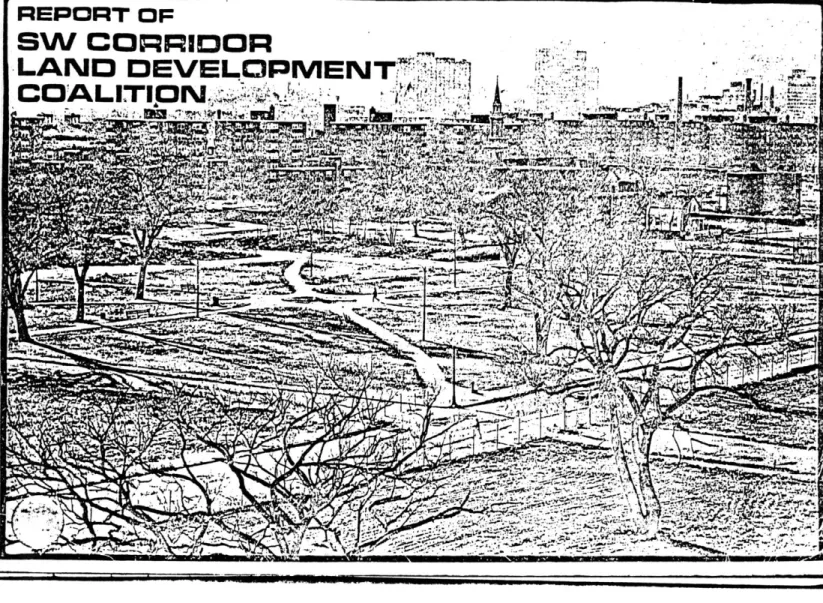
Aerial view of Southwest Corridor Project. (Section I Planning Profile, WFEM Archives).
INTRODUCTION
In the late 1960's, bulldozers began to tear down hous-ing along a swath of Boston's workhous-ing class and minority communities. Jamaica Plain, an Irish working class commun-ity, and Roxbury, a working class Black community were suf-fering this demolition as part of a project to build an 8-lane expressway -- called Interstate 95 -- from the
peri-pheral roads to near the center of Boston; 1-95 was to -be one of several major radial spurs emanating from an inner
belt. At that time it was known as the Southwest Express-way.
The bulldozers did not work unopposed, however, the late '60's being a period of intense political struggle in major American cities. Across the country, neighborhood groups campaigned to halt urban renewal and highway con-struction, to demand civil rights legislation, to integrate public education, for equal access to institutions and social services. There were picket lines, squatters in vacant buildings, confrontations with the police, rent strikes, mass marches and rallies. Starting in 1964, Black and Latino ghettoes rebelled in dozens of U.S. cities and the "Urban Crisis", previously a word used in government circles and academia to refer to the fiscal crisis of
municipal governments, became one of the "buzz words" of
the media and the popular vocabulary; its meaning had deep-ened beyond an economic crisis to a social and political crisis as well. Boston was no exception, and the
transpor-tation plans of the State -- of which the Southwest
Express-way was a part -- were the object of intense struggle in
the political arena as well as the technical and professional
fields of urban planning. In that process, the expressway
became the Southwest Corridor.
The Corridor was born out of a drastic -- in the
context of the U.S. -- form of "community participation";
working class and nationally oppressed communities were the prime force in a movement which forced the state to abandon plans for a major transformation of the city -- Interstate 95 -- and replace it with another. This movement generated
a coalition which included academics, environmentalists,
professionals, which succeeded to a great extent in
achiev-ing the reform sought. Instead of the highway, a rapid
transit line is being built. The 100-odd acres of densely populated urban land cleared for the highway are being redeveloped with a variety of projects aimed at "re-weaving
the urban fabric", in the words of a planner prominent in
the battle against the highway. The Corridor is currently
the largest project of its kind in the country, with the
most wide-ranging, officially instituted community
Perhaps the most compelling reasons for a case study
of participation in the Corridor is its very "success" in
attaining its goals. The relationship of popular movements to projects undertaken by the State apparatus is a question of vital importance to both activists and concerned profes-sionals, and a situation where working class communities
I
were able to decisqvely influence a major project during
many significant stages is a lesson to be learned and
treas-ured. The same can be said of the Project's shortcomings.
A second set of reasons why the Southwest Corridor
Project is an important case to study may be grouped together
by recognizing the magnitude and complexity of the Project.
It is, of course, beyond the scope of a thesis to alight all of these issues; it is, however, possible to focus on those aspects of the Project which pertain to participation and shed clarity on them. Without pretending to resolve
theoretical dilemmas which would require concentration on
one or two specific issues, participation in the Project may be treated as a case study, as empirical evidence which can illustrate a number of theoretical postulates.
Among the problems on which a case study of the South-west Corridor can shed some light are the following:
* Are urban struggles a good vehicle for advancing the
interests of the classes and oppressed nationalities
* Is the technical process an arena where popular move-ments are inherently at a disadvantage, or can an
al-liance of progressive professionals and working and
oppressed people be capable of engaging in it and gain
benefits without getting derailed?
* How have contradictions always found in participatory
situations -- empowering vs. cooptation, legitimization
of the State vs. rate of social change, the neighbor-hood as a unit vs. the city as a unit -- been played
out in the Corridor and what forces have been
determin-ant in resolving them?
This paper will begin with a review of the issues
in-volved in participation and an overview of the most
signifi-cant literature written about them. This will allow us to lay a theoretical basis for an analysis of the Southwest
Corridor as well as presenting a position vis-a-vis
partici-pation which will guide the rest of the paper.
Next the paper will give a theoretical overview of
participation in the Corridor and place the Corridor in
the context of urbanistic history of the city of Boston.
This section will be organized as an historical narrative,
building on the chronology of events as a basic structure, but departing from it in order to reflect on the
perspective. It will cover the origins of the 1948
Massa-chusetts State Highway Plan, through the 1960's when the
entire road plan became the object of intense struggle, until the 1970 moratorium on highways began to institution-alize participation. There will be short sections on the
1970-72 Boston Transportation Planning Review (BTPR) and
the 1975-76 Environmental Impact Assessment process. The major sources for this section will be a series of books written on the history of the Corridor, as well as books and articles on the development of U.S. cities. Interviews with participants and planning documents produced in the process will also be used, as well as my recollections as a minor actor in the fight against 1-95.
The third chapter of this paper will begin in 1977, when community struggles forced the State to implement com-munity participation as an integral "component" of the pro-ject. Known in the project as the "Design and Engineering
Phase", it has to be approached from a different angle.
Be-cause of the technical complexity, chronology will not suf-fice. A description of the participation component as it
was designed and as it has evolved over the last three years will replace chronology as the structure of the paper, with theoretical discussion diverting from it whenever per-tinent or ne.cessary, as in the first half. My sources will be the documents produced by the Southwest Corridor Project
Office and consultants, interviews with different. actors,
and my experience as part of the central planning staff.
The final part will consist of a study of the design of the Project in Boston's South End, particularly the effects of participation in the programming and design of a deck covering the rapid-transit and railroad tracks in that neighborhood. Sources for this part will be the records of meetings of the community and consultants where the program
and design of the deck were discussed, as well as interviews
I.
PARTICIPATION: THE ISSUES AND THE LITERATURE
"How promiscuous is the term participation, it is mistress to many masters"
Discussing "participation" is very much like
discus-sing "democracy"; it means different things to different
people. For some it's sacred; for other it is the useful currency of demagoguery. Different classes and social groups advocate it for different reasons, depending on cir-cumstances. Since our purpose here is to shed some light
on- the process of participation in the Southwest Corridor
Project, we first need to define the parameters of our
literature search.
Several important issues come to mind. First of all
participation has to be discussed in a context -- historical,
political and economic -- since only then will the term have some meaning. The context of the Southwest Corridor Project is a major city in the U.S. in the last 30 years.
Politically, the U.S. is a bourgeois democracy. As a social
formation it is the most developed example of State Monopoly
Capitalism, a concept which will be explained later in this chapter. Our search for pertinent literature would therefore
lead us first into a study of participation under State Monopoly Capitalism. In that context, what is the function of participation for the system? Under what conditions can the working classes and oppressed peoples benefit from par-ticipation? Why does the state promote participation, an
apparent contradiction on the surface? What have bureaucrats
pursued by participation?
Since participation is such an ambiguous term, and since it can serve different social groups for different purposes, ideas about participation are loaded with ideo-logical implications which need to be explored briefly.
We will look at the ideological role of some of these ideas.
Then, we will briefly analyze some of the literature writ-ten by bureaucrats on participation, and see how they pro-mote it for their own ends.
Since participation is often peddled as a remedy to alienation we will explore the conditions under which this
may be in fact true and under which it may be misleading.
Decentralization is also often proposed as a more democratic
and participatory scheme. Since planning for the corridor was, in 1973-1977, relatively centralized, and since 1977 relatively decentralized, we will pause for a look at this
issue.
Finally, we will consider some of the historical
ante-cedents in Boston to participation in the Corridor before
drawing some lessons from the literature and a discussion of the issues to orient the rest of our society.
PARTICIPATION UNDER STATE MONOPOLY CAPITALISM
Participation in the context of State Monopoly
of a theoretical foundation prior to an inquiry. In the context of Marxist theory, participation is essentially a political phenomenon. Conceptually, it therefore has to be understood as part of the superstructure of the social for-mation of which it is part.
Schematically, what ultimately determines the nature of a society is the level of the productive forces -- the means of production, and the productive capacity of the labor force -- and the relations of production. Taken together these can be conceived as the base or infrastruc-ture of society. The superstructure consists of all the ideas, institutions, cultural, religious and philosophical patterns which in any given society tend to reproduce the social foundation. Neither the base nor the superstructure is ever static but in a constant process of transformation,
driven by antagonisms inherent in the social relations of
production. One class controls the means of production and exploits the others, accumulating the surplus wealth.
This class is also dominant in the superstructure:. it
organizes, controls and influences institutions, ideas, political events in order to maintain control and continue to extract the surplus. Classes and social groups which are exploited or oppressed, however, also create their own institutions, ideas and political channels which further their interests and therefore necessarily come into conflict
with the oppressors. This conflict is the motor of change. The major institutions of the dominant groups in
maintain-ing the social order convenient to them is the state.
While the ultimately determinant factor is the
infrastruc-ture, at any one time the realm of ideas, of laws, of poli-tics may become dominant in deciding the outcome of a par-ticular historical moment. (Cornforth, 1977; Harneker,
1975)
Any society can be analyzed as a social formation,
where the ultimately determinant factor is the dominant
mode of production and the corresponding social formation. Capitalism, where the bourgeoisie is the ruling class, is based on wage labor and on the extraction of surplus value
from workers at the point of production. It is the dom-inant mode of production in the U.S. State Monopoly Capi-talism, however, is a term which refers to the particular form which the U.S. economy and state have taken in the last 40 years or so. It is therefore important to briefly touch on its historical development.
During the economic crisis of the 1890's in the U.S., capitalism went through a significant change. The monopol-ies absorbed a significant part of the productive economy, and finance capital was able to use the crisis to establish
its dominance over other sectors of capital. Growing beyond
capitalism pushed beyond its national borders imperialist
expansion, and into the - so-called "Spanish-American War".
Western European nations followed a similar process culmin-ating in the First World War. (Lenin, 1968)
Internally, these nations went through a parallel pro-cess. In the first thirty years or so of the century, with
the exception of the devastation caused by the World War I
years, capitalist economies grew at a fast clip until the Great Depression of the thirties made capitalists wary of the future prospects of the system. In the U.S., under the
New Deal, the state began to play a greater role in the
economy, and consequently in the political life of the country, leading to the particular form of capitalism called State Monopoly Capitalism.
The Great Depression led to the Second World War, from which the U.S. emerged as the dominant power in the world. Its productive capacity was reinforced and domestically the
U.S. embarked on a massive reorganization of its physical
infrastructure. Part of this process was the construction of a huge new limited-access highway system, of which Bos-ton's Southwest Expressway was a small segment. This
expressway led to the Southwest Corridor Project. Therefore,
the conditions from which the Corridor arose can definitely be traced to changes in socio-economic formation of the
United States.
What concerns us first, however, is the superstructure,
since it is in the realm of institutions, politics and
ideas that participation occurs and where it can be under-stood. The major institution in the superstructure of any
society is of course the state, the major instrument by
which the dominant classes maintain control. A suitable place to begin a discussion of the state's role in partici-pation is Lenin's The State and Revolution. (Lenin, 1969)
Written just before the 1917 revolution, it is a polemic
against Social Democratic parties of Europe who had taken an excessively parliamentarian approach to political activ-ity and who had taken a right-nationalist track in support-ing their own national governments in W.W.I. rather than militate against the war. The book begins by quoting Engels in arguing that the state is an organ for domination by the ruling class, rather than of reconciliation among classes and groups. (Lenin, 1969, p. 9) The book's emphasis is on the ultimate recourse of the state -- the power of an appar-atus of armed men and prisons who guarantee the supremacy of the interests of those in power, although we can note that it usually enforces the existing order through the judicial structures and promotes its dominance through in-stitutions for the propagation of ideas akin to its inter-ests. The thrust of State and Revolution is a warning
against expecting that participation in the institutions sponsored by the ruling class, particularly the bourgeois
parliament, will advance the interests of the working class and the oppressed to the point of hastening the day when they come to power. But even the Lenin of this book saves
some of his lash for those who make non-participation in these institutions a matter principle, such as the anarch-ists. Dialectically, the circumstances of participation
in the machinery of the state are held to be critical. "Marx knew how to break with anarchism ruthlessly for its
inability to make use even of the 'pigsty' of bourgeois
parliamentarianism, especially when the situation was obviously not revolutionary..." (Lenin, 1969, p. 43)
There are several points about the position mentioned above which need comment. Lenin was writing based mainly on the Russian experience, where the state was autocratic and highly repressive, leaving little room for participa-tion. He was writing in a period when the capitalism state was relatively young, striving to form a permanent bureau-cracy as part of the state apparatus. Participation in the affairs of the state was limited to the parliament or to electoral politics at best; it has been impossible to find
evidence of attempts by the state to sponsor wide
participa-.tion in "projects" such as urban renewal, which did take
place in the 19th century, notably in Paris. We have to assume that if such a practice existed it took place at
the level of informal class connections outside the
The capitalism of the United States in the century is substantially different from that of Eastern Europe in the 1910's. Monopoly of capital accumulation in which the state takes a significantly greater role than it did in com-petitive capitalism. (O'Connor, 1973) Moreover, the United States is a bourgeois democracy which puts it in the cate-gory of western industrial bourgeois democracies, but also with its own particular democratic traditions. These simple
facts raise a host of issues which are important to touch
upon.
Under Monopoly Capitalism, the reproduction of the
sys-tem takes place on many levels. Economically, simple
repro-duction of the labor force is carried on privately and is
financed through wages. At a more complex level, as capital
becomes more concentrated there is a tendency for the rate of profit to fall (Rumiatzen, 1980); the state invests at a loss to keep the average rate of profit from falling. A
larger share of social reproduction is financed through state expenditures and takes place at the level of social consumption (Castells, 1978, p. 30). Among these we can
count added expenditures to subsidize housing, education,
socio-cultural facilities and transportation. This in turn has several consequences. The state maximizes its regula-tory function, increasing the role of planning. Because the state is a political entity, urban issues which tended
in the past to be treated as technical problems become highly
politicized. (Castells, 1976) Furthermore, the realm of
consumption takes on added importance in determining the social status and class of urban dwellers. At the private level this translates into the "keeping up with the Joneses" syndrome (Ashton, 1978) an attitude which strengthened the organization of a consumer society. But the increased level of social consumption means that issues of public consumption, such as the housing policies of the state, become the object of political struggle. No wonder the
demolition of working class housing to make way for highways
became such a hot potato. The state itself politicizes areas of life previously upoliticized, giving birth to what have been called urban social movements. (Castells,
1976).
This politicization is promoted by the state in
dif-ferent ways. The government of the U.S. is, of course,
dominated by a ruling class, despite fitful arguments to the contrary. But it does not rule merely by repression.
A bourgeois democracy depends to a large extent on
accep-tance of the status quo by those without state power, on
the hegemony of the rulers over the society through a vari-ety of institutions in the state and civil socivari-ety. (Gram-sci, 1971). This is done ideologically, disguising the
hide the rule. All of the myths of "American democracy"
are the most clear evidence of this. But it is also done politically, through the granting of reforms by the state. The state plays, therefore, the role of mediator not only
among divergent interests among the rulers, but to some
degree also between the rulers and the ruled. The working classes and oppressed groups are encouraged to keep their political activity within the bounds of legality by the
granting of reforms which convince the oppressed that it
is worthwhile to "work within the system" (the carrot)
--while repressing those who outstep the bounds of
permis-sible activity (the stick).
This means that the state is less a monolithic block and more a complex and at times contradictory organism; it
appears to have a "relative autonomy" from direct class
rule. (Poulantzas, 1974) An often quoted example of this is legal aid offices funded by the federal government which
engage in class-action suits against "the feds" on behalf
of poor clients. It is the same kind of complexity that allows federal funds to finance advocate planners who
pro-vide technical assistance to "grassroots" groups engaged
in opposing government policies. The important factor in this theory is that this contradictory behavior by the
state does not imply that the state is an impartial
negotiations, building consensus, "buying out" insurgent
leadership, funneling political activity into convenient
bounds, etc. rather than by naked coercion. (Castells,
p. 84) The capitalist state, then, promotes participation
as a political means to reproducing itself, using a flexible policy of granting the reforms which are afordable, pro-vided that the working class and oppressed groups can be convinced to carry out their political activities within
the structures which it provides for this purpose. By
ac-cepting these conditions, participation legitimizes the state.
PARTICIPATION AND IDEOLOGICAL STRUGGLE
The state under Monopoly Capitalism is a complex animal, but certain features of it can be identified. We have already mentioned its role in promoting accumulation and social reproduction of the system, and its doing this through a process of negotiation in which planning takes a significant role. A further function of the state is in
the realm of ideas -- the legitimation of particular policies
(O'Connor, 1973), the obscurity of class rule. In this
task urban planning also takes on a prominent place. Manuel
Castells, in the first chapter of The Urban Question (Cas-tells, 1977), detailed a critique of current ideas about i4eas-about "urban" problems. These ideas present "the
urban" as a phenomenon which can be studied apart from the social foundation, as spatial, technological phenomenon. In this light, the ideas promoted by the state in a planning situation are part of the ideological task of the state and other bourgeois institutions. Interpreting policies such as highway construction as "neutral" technical needs of
so-ciety without taking into account socio-economic basis of
such policies, is an example of the ideological tasks of
planners functioning for the state.
Participation is the object of considerable political and ideological attention by the state. On the one hand,
participation may be seen as a forum for the struggle of opposites. The working classes and the oppressed partici-pate under certain conditions in order to further their interests. In order for this participation to be worthwhile,
according to Marx, these main ingredients are important: numbers, a clear consciousness, or ideological clarity, and "that bond of brotherhood which out to exist between workmen
or different countries." (Kasperson, 1980) For the oppressed
to benefit from participation, ideology, among other factors must play a crucial role. Participation is seen by reform-ists, on the other hand, as a vehicle for reconciliation of opposites. The monopoly state, complex and contradictory, promotes participation for the sake of funneling activity into the channels which benefit dominant groups. Piven has
written, for example, of the wave of participation promoted
by the federal government in the 60's as an effort by the
Democratic Party -- an instrument of the rulers -- to funnel
the activity of minorities away from politics, where it was relatively successful, to the arena of technical planning, where the edge would go to those with technical resources. The civil rights movement would then be confined within the limits of planning debates and electoral politics where the Democrats could harvest the major benefits. (Piven, 1970) The cost was the Great Society Reform program, which the state could afford given a period of economic expansion. Such a strategy for participation needed ideological
ammu-nition; the "reconciliatory" function of participation had
to become prominent, and therefore a series of ideas about
"participatory democracy" had to be developed and
cultiv-ated.
This task was not filled so much by the state, but by what Gramsci called "civil society". The (uling class
exer-cises hegemony not only through the state, but through the
institutions outside the state which forge ideas,
cultur-al habits and patterns which are essenticultur-al to the
repro-duction of the system. Through this, the rulers govern with the consent of the governed, but this consent is incul-cated in the population through the active involvement of institutions under the influence of the rulers. In the case of participation a vast volume of literature was
developed which placed participation within the bounds of
bourgeois democratic ideas in gneeral and within the "Amer-ican" tradition in particular. Most of this work was done
by intellectuals within universities and a significant
por-tion of it pertains to the planning profession. Because they are based on a variety of theoretical frameworks --functionalism, empiricism, ethnomethology, etc., it is dif-ficult to categorize them. Despite this, some of the
liter-ature is genuinely helpful in studying participation, either
because they document the process in the last few decades in the U.S. or because they clearly illustrate an important point of view.
REFORMIST THEORIES OF PARTICIPATION
Before the 1960's, planning theory in the U.S. was gen-erally dominated by people like Rexford Tugwell, a brilliant
intellectual, part of Roosevelt's Brain Trust and appointed governor of Puerto Rico at the launching of massive govern-ment planning efforts in the 40's. He sought to justify
the massive growth of the state sector by appealing to
plan-ning as the instrument to guarantee "the common good" (Good-man, 1976; Kasperson, 1979), as an instrument of
rationali-zation above the forces of the market. It worked for awhile as the ideological principle of state planning. Several
obsolete. The reorganization of State Monopoly Capitalism just after the war, as we have mentioned, increased the conciliatory functions of the state, its apparent autonomy, the granting of reforms, etc. Urbanistically, the strati-fication and geographic segregation of working people by income, race and ethnicity became more acute. (Gordon,
1978) The politics of interest groups gained prominence
(Mollenkopf, 1978) and the urban question was politicized. As the 60's advanced, the struggle of black people for equality made the myth of "common good" patently a myth. A theoretical perspective was needed to account for the new condition. Political scientists worked on new definitions of democracy and planners began to talk about Pluralism and Advocacy.
It was precisely the urban movements against projects like highways and urban renewal that sparked the search for new ideas. Using the example of the battle against 1-95,
Lisa Peattie (Peattie, 1970) wrote "Reflections on
Advo-cacy Planning". The original state-sponsored highway plans claimed to be a technical promotion of the common good. The technical studies by Urban Planning Aid in this struggle exposed the emptiness of this claim, demonstrating the political nature of planning. There were hundreds of
situations like this one in every city of the United States,
ideology which could take into account the reality of social conflict in the planning arena and still recognize the legitimacy of the system and the viability of struggling for more just and democratic planning. Society began to be
explained as a multiplicity of social and ethnic groups com-peting freely for the benefits of society, except for the
fact that some groups were denied equal access to sources
of power, like the electoral process and technical resources.
(Davidoff, 1965) What was necessary for the correction of "failures of democracy" and "market failures" was political and technical intervention aimed at making the system work as it should. Planners began to take sides, allying them-selves with groups struggling against state plans. Peattie
describes this process as that of planners looking for a new
client, which was partially true, and raises the question
of the degree to which advocates manipulated the groups they
worked for in order to further their own interests. In the case of the fight against the Corridor, there were numerous groups working against the road for different purposes; it was professional advocates led by Jim Morey who eventually forged the coalition which defeated the highway.
This contradictory role of advocates -- at once helping and manipulating the poor and minority communities -- has been the subject of some controversy. We have already men-tioned Piven's critique of advocacy as funneling minorities into the Democratic Party. Myrna Breitbart's (1979) article
on advocacy traces the roots of the professional practice to efforts to educate citizens to policies already formul-ated. Participation in this context meant using people to further decisions of powerful interests. Later it became
common practice to organize "blue ribbon" committees to
legitimate these decisions, usually drafted from the upper strata of the affected neighborhood. As movements against plans gained strength, those who had been excluded demanded access to institutions of power. Through conflict, nego-tiation and agreements, degress of participation were a-chieved in different situations. Given the fact that under these conditions participation could vary enormously from one situation to another, some literature explores the degrees to which participation may be meaningful to the participants. Sherry Arnstein (1969) defines partici-pation as:
The redistribution of power that enables the have-not citizens, presently excluded from the political and economic processes to be included in the future. It is strategy by which the have-not/s join in determin-ing how information is shared, goals and policies are set, tax resources are allocated, programs are
oper-ating, and benefits like patronage and contracts are
parcelled out. In short, it is the means by which
they can induce significant social reform which
en-ables them to share in the benefits of the affluent society.
It is important to note that this defintion is though
far-reaching, es.sentially reformist and liberal, since it does
not posit participation as a route to a structural trans-formation of society but to a larger piece of the pie. She
then produces a useful and famous "ladder of participation"
which requires very little comment:
Citizen Control - Degrees of Citizen Power
Delegated Power Partnership
Placation -Degrees of -Tokenism
Consultation Informing
Therapy Non-participation
Manipulation
While Arnstein leaves out any discussion- of popular
or-ganization, the only source of power capable of allowing an oppressed group the possiblity of "climbing" on her ladder, her scheme provides a useful checklist for analyzing any particular participatory situation, since often reforms granted by the state or the bureaucracy strive to keep par-ticipation at the lower rungs.
The specific situations of participation are more com-plex than Arnstein's ladder would allow us to think: the purpose of participation, the characteristics of the parti-cipants are left out. There are other writers, however,
iho have pursued what can be called a multivariant problem
and proposed useful schemes. Jon Vantil and Sally Bould Vantil (1970) propose one such scheme which also requires relatively little explanation.
Participation focuses on:
Participation Administrative Political and admin-concerns only istrative concerns
Elites only Elite coalition Politics of reform
Elites and Citizen advice Pluralist
partici-non-elites pation
Non-elites Citizen partici- Grassroots
partici-only pation pation
While slightly more powerful as tool of analysis than
Arn-stein's ladder, there are serious problems with this scheme.
It does not allow for the process by which participation
oc-curs to enter into the analysis, and since any political process is essentially historical, the scheme falls apart
as soon as we seek to apply it.
Jose Olives (1973), using a Marxist analysis, gives us
another scheme, a more complex and useful one. He
deals-with slightly different variables, since he is not so con-cerned with race and classes differences within the urban movement, merely with the political results of such strug-gles. He derives four categories: Urban Effect, Mobili-zation, Organization and Type of Action, and Political Ef-fects. Urban effect is limited to the achievement or non-achievement of a reform. Mobilization includes successful
Social Process of the production of a political effect by urban struggle according to observations of the struggles against urban renewal in Paris.
Urban Effect Mobilization.
Organization/ Type of Action.
rei vi ndi cati ve
reivindicative Satisfied
Rei vindi cation and political
reivindicative
reivindicative and political
Continuation of reivindi-1
cative action without. 1 politicizing the struggle.
-'1
2
33Urban Effect Mobilization
Type of Action/ Organization. Unsatisfied reivindication reivindicative --- > Demobilization
Discouragement
Radicalization political SPolitical Repression reivindicative Individual .... Withdrawal *\ political Maintenance of reivin-dicative/political level. Higher stage of politi-cal struggle. Social Integration. (Paternalism). Political decomposition " (political integration to institutions) Political Effects.T4
Political Effects}
GRAPHIC No.2
Oliva's Analysis of struggles against urban renewal in the Parisor unsuccessful mobilization. Organization and type of action are divided into merely reformist and reformist-and-political-at-once. He then charts the different combina-tions possible and predicts the political results of each one. It's actually based on a survey of urban struggles in Paris. (See Graphic No. 2)
What is most striking about this scheme compared to the previous two is the emphasis it places on the
relation-ship between the purely reformist and what is political as
well as reformist. We have already discussed the importance
of the consciousness of participants in making participation
a valuable vehicle for advancing their interests. The goal of an immediate reform may be won or lost, but the longer
range benefits to the oppressed groups may be more political:
is there a deeper understanding of the functioning of
insti-tutionalized oppression? Is there a higher level of popular
organization among participants in an urban movement, or
does the movement achieve a reform and dissolve without a
lasting political benefit? In the case of the Southwest Corridor, the victory over the highway resulted in a highly
modified project which is having the effect of raising
prop-erty values in the surrounding housing stock. This in turn
means that the dreaded displacement may be taking place
any-way, only through a different mechanism -- the market
instead of the road. Given this possibility, an evaluation
of participation of the SWCP must take into account the political and indeological effects of the process on the
surrounding communities which would increase their ability
to fight against displacement.
Some of the other literature pertinent to a study of
participation is basically in the same tradition of Arnstein
and the Vantils. This tendency is reformist in that it
accepts the parameters of the established order, pluralistic
in that it recognizes diversity of interests and claims that the state is harmonizing them. Charles Lindbloom
(1963), the well-known father of "incremental planning",
bases his theory on a rejection of goal-oriented planning. He decries comprehensiveness as unrealistic and instead
argues that the test of a good policy is the level of
agree-ment among participants. His basic argument in The
Intel-ligence of Democracy (1965) is that the virtue of the U.S.
political system is precisely its ability to embody a "pro-cess of partisan mutual adjustment". Participation by op-pressed groups in this context is merely the smooth func-tioning of democracy. The question of "who participates"
in this context becomes very important, however, because if
certain groups participate at a significantly lower rate
than the rest of the population the state will not be able to carry out its function. In the 60's, with increasing
dissatisfaction and rebellion by blacks and other minorities,
promoting the participation of minorities within the system became a strategic question.
Allan Altshuller, in Community Control (1970), argues that the value of giving power to the black community lies in the subsequent "socialization" of black Americans to the values and practices of mainstream U.S. society. Blacks
would benefit from having a "s take in the system," whites
from "the peace of reconciliation." It is tempting to call
this approach cynical, but in fact it is perhaps a more
can-did expression of the kinds of views of participation -we
have been reviewing. Besides honesty it has the value of sharpening the awareness of the aims of the defenders of the system in promoting the participation of the oppressed within the system: "socializing" the oppressed into accept-ing the parameters of bourgeois democracy. The empirical counterpart of this theoretical position is an endless series of studies about rates of participation among blacks, Latinos, and working people in general based on income, background, status, psychological make-up, shade of skin and other factors (May, 1971, pp. 6-8, pp. 61-69). Other literature argues that people make crude cost-benefit stud-ies of the efforts and benefits from participation before
deciding the degree to which they will be involved. These
studies can be used as empirical evidence of the kinds of barriers placed on people's attempts to determine their
at a difuse cultural and institutional level. They are also useful for organizers in that they can heighten aware-ness of the many ways political and participatory efforts can be derailed. Finally, the importance of technical knowledge in opening or closing doors is pertinent to the efforts of advocates and organizers alike and will prove
important in the Southwest Corridor Project.
Other literature focuses on the effects of participat-ing in protest on the participants themselves. Those in-volved in Alinsky-style efforts apparently derived great
benefits in tightening neighborhood support networks,
chang-ing damagchang-ing and self-defeatchang-ing habits even if the goals of the movement resulted in few results. (May, 1971, p. 8) While we may disagree with the negativity about proletarian and minority cultures implied in this view, it is true than any intense process transforms both participants and groups involved. It would be more useful to study changes in abil-ity to confront the power structures, knowledge of pertinent
technical issues, increased hope in the possibility of win-ning through struggle. In parallel arguments, others argue
that the poor, in participating, change their attitudes,
"adapting" them to those of more middle-class residents
and planners, making urban renewal easier. (Loring, et al.,
1957) Conversely, others see participation by "the poor"
as threatening the goals of urban renewal by introducing
An interesting case study of participation in Newark around opposition to a Medical Center expansion led by the Newark Area Planning Association (NAPA) is discussed in an article by Junius Williams. (1970) The thrust of this article is that the main measure of participation should be goal-attainment. While refreshingly direct, this approach
leaves out the long-range political and ideological effects of the process on participants, and is, therefore, not that useful.
A different set of issues is dealt by literature which
seeks to study more structural factors affecting participa-tion, such as local political variables and local political structure. As local political variables are included in the political history of the local city in question. A strong political party organization, for example, implies a fairly difficult process of influencing the machinery. Where a mayor is elected by loose reform coalitions the
situation may be more maleable to popular pressure and hence
more promising for participation. (Greenstone and Peterson,
1968) What this means is that the specific political
his-tory of the city being studied is important to the outcome of participation, a useful lesson. The formal political structure, or city charter, the level of corruption, the role of the mayor, etc. have effects on participation. Piven and Cloward, in "Black Control of Cities," argue that
current efforts at "metropolitization" of the administration
of metropolitan regions is a first step in diluting the
pol-itical power of blacks in central cities. (May, 1971, p. 34)
ADMINISTRATIVE GOALS IN PROMOTING PARTICIPATION
Literature on participation written from the point of view of administrators is substantially different and worth noting. Edmund Burke, for example, establishes a morphology for participation which is worth quoting at some length: Education-therapy focuses upon the presumed need to improve the individual citizen and institutes parti-cipation programs as a form of citizenship training. Behavioral change aims at influencing individual be-havior through group membership. Changing the
behav-ior of the system's members or leaders becomes the vehicle for overall system change. Staff supplement, as the term suggests, simply involves supplementing the expertise of particular citizens. Usually this type of participation is restricted to task-oriented advice and does not include citizen involvement in the determination of goals and priorities. Cooptation is a means for capturing or neutralizing opposition by including the dissenters as participants without sur-rendering decision process. The inclusion of these participants also wins consent and legitimacy from the
populace as a whole. Finally, community power,
accord-ing to Burke, involves the creation of new power cen-ters to confront established cencen-ters as ameans of.gen-erating social change. Size and dedication are their resources conflict their tactic. (Burke, 1971, in
Kasperson, 1971, p. 6)
Cold. A very clear picture of a cynical state
bureau-crat's approach to citizen participation. Not surprisingly,
Burke favors "behavior change" and "staff supplement" as
mind when analyzing why and how the state promotes
"partic-ipation" in certain moments, or responds to pressures for
participation by instituting it in bastardized ways. There is a significant amount of literature in this vein. Judith
May (1971) reviews several books written from the perspective
of organizational theory which recommends participation as a strategy for improving organization effectiveness. She
groups them into several categories. Under Goal Attainment,
Theodore Kaplow develops a byzantine mdtrix of variables to analyze behavior of the individual in organizations,
recom-mending participation as a means of increasing the control
of the individual by organizations with the purpose of reaching organizational goals. Under Integration she dis-cusses Chris Argyris' thesis that the conflicts between individuals and organizations can be eliminated by
partici-pation while encouraging "individual growth". Under
Adap-tation participation is seen as a method for promoting
group-consciousness among workers and supervisors. Under Socialization, May reviews a book by Alexander Leighton on
what he learned from running a "relocation" camp for the
Japanese in the U.S. During World War II. This is perhaps the greatest travesty of the term "participation" in print, but in its extreme way it is a powerful reminder of the fact that participation is a double edged sword. No wonder
many activists, including planners, refused to "participate"
at 'all in the activities organized by the state. Bob
Goodman warned that planners could become "soft cops"
manip-ulating the oppressed for the benefit of the rulers and counseled conscious activists to fight to stay outside the system in their efforts. (Goodman, 1974)
PARTICIPATION AND
ALIENATION
Still another issue often related to participation is alienation. Particularly in the 60's, there was considerable
dissatisfaction with the anonymity of large cities, their promotion of isolated individuals with no social ties.
Par-ticipation was thought to be a remedy to alienation, even
within the existing social structure.
From the point of view of liberalism, alienation was related primarily to centralized, unresponsive bureaurcra-cies. The concept also recognizes degrees of empowerment and marginality -- some social groups, such as Blacks and
Latinos were "left out" of the political processes in
which the majority participated. The remedy therefore was to decentralize bureaucracy and to establish programs for the effective participation of the disempowered in
deci-s ion-mak ing .
From Marxist point of view, alienation is the result of the existing social structure. It is rooted in
labor appropriated and put on the market. The value of
his production is not only its "use value" but its
"ex-change value". But alienation also takes place in the super-structure, since the oppressed groups are not only kept from power by force, but constantly bombarded with ideas which are against their interest. A social nature in this
view, participation is a remedy of alienation only to the degree that it heightens consciousness of the oppressed about their oppressed state, and improves their ability to fight against oppression.
Marxists recognized different levels of consciousness among groups in any given class and oppressed groups. Thus
while massive participation is deemed necessary, it also
stresses a dialectical relationship between more conscious sectors -- the leadership -- and less conscious, more num-erous group. The degree to which leadership can strengthen
its ties to a mass movement raising its consciousness in the process of struggle is also a measure of extent to
which participation is a remedy to alienation. The
qual-ity of participation is critical. Alienation is combatted when the working class and oppressed become aware of their true time situation in society, but actually begins to be eradicated only when they consciously and actively struggle
to change society.
In this light, participation under capitalism through making the bureaucracy more responsive can create the
appear-ance of diminishing alienation, but by hiding the reality
of oppression and class rule, citizens can be further
alien-ated from the true state of society. Only through struggle can alienation be overcome.
PARTICIPATION IN PROGRAMMING
AND DESIGN
During the Design and Engineering phase of the Southwest
Corridor Project, participation in the project entered what I call its most institutionalized phase. By this time the Corridor Project, through consultants, structured and
regu-lated aspects of participation, mainly involving programming
and design. Since these tasks are relatively technical, the political considerations become less prominent, although they are by no means unimportant. In order to inform our case study well, it therefore becomes important to review some of the issues and literature involved in participatory
programming and design. Our main guide in this will be
Gary Hack's Ph.D. thesis, Environmental Programming:
Creat-ing Responsive SettCreat-ings, 1976, MIT.
Hack defines programming as "the process of arriving
at a set of specifications about what to build or change in the way of man-occupied- settings. This activity takes
various forms, including preparation of architectural pro-grams, the development of environmental development
stan-dards, and on-going management of built settings. Design
may be defined as the transformation of program into plans and specifications for built form. In the Corridor, both
of these activities predominated during the institutional-ized phase of participation. The task of programming has only recently been approached in a systematic way; tradi-tionally it was an intuitive or personal focus that was used. Hack uses a couple of case studies, particularly that of Marvin Gardens, a low income housing development in Roxbury, to show the potentially disastrous results of this. He then proceeds to group programming tasks around
four environmental definitions: 1) environmental packages,
2) environmental patterns, 3) performance guidelines, and 4) clientship.
By packages, he refers to the scale and mix of
activi-ties that will take place in a mixed environment. In some cases, as in a shopping center, this mix will be determined primarily by economic calculations. In other cases there
are "rule-of-thumb" guidebooks, such as "x-parking spaces
per apartment". In still other cases, as in designing a
new community, the mix cannot be derived so readily from
given criteria but flows instead from patterns or perform-ance standards. (Hack, 1976, pp.. 117-42)
Performance standards are a series of normative state-ment of what should be. They have been commonly applied to
buildings which can be derived from a prototype, such as
schools. Again, transit stations must meet a set of MBTA guidelines. Hack finds them useful in "structuring the dia-logue in participatory settings." (Hack, 1976, pp. 175-98)
Clientship is also important for our purposes. In most
pub-lic environments there is a potential contradiction among the client who is paying -- the state and its representa-tives -- and the user clients -- the people who will use
the environment. He proposes the use of "scenarios" or
imagined complex situations, in order to better define clients. Participation brings both patrons and users into the programming and design process.
Participation in programming and design is seen to
include a number of important issues: 1) who to include,
2) how should people be organized to work together, 3) how
should sessions be arranged, 4) how can analysis be grounded
in accurate data and experience, 5) how can normative views be encouraged, 6) how can there be a transition from wishes
to firm proposals, 7) who should be the managers and leaders
of the process? These seven issues are a very useful set of guides for analyzing participation in both programming and design.
It is important to note that the approach to
partici-pation outlined, however, has certain necessary implications. First of all, its major aim is one of conflict resolution leading to a concrete program and design. Raising the
con-sciousness, improving the organizational level and technical
knowledge of the participants is not an explicit goal;
rather, the program or design product is the priority. In
the light of other literature, the politics of participation
in this stage are not addressed, but t'hey remain critical.
Another useful tool introduced by Hack is a typology of participants. He groups them as being impacted directly
or indirectly, and as imparting financially,
programmatical-ly, experientially. When we explore the mechanics of
par-ticipation in the Corridor, these distinctions will become useful.
Finally, the relationship between professional
program-mers and designers as reflections of class, race and ethnic groupings are critically important.
DECENTRALIZATION
Decentralization is another "buzz word" with totally
ambiguous meaning. Since it is closely tied to participation
and is a very relevant concept in the context of the South-west Corridor, it deserves consideration.
Rhetorically, decentralization attempts to "restore
government to the people". It also aims at more efficient
functioning of the bureaucratic machines, lessening aliena-tion, more effective project design. For years it has been recommended by government blue-ribbon commissions, the most famous one being the 1968 National Advisory Commission on Civil Disorders. One third of major U.S. cities have tried
it in some way (Kasperson, 1979, p. 27) and it has of course
affected the structure of state-sponsored projects like the Southwest Corridor.
In France a very useful distinction is made between de-centralization and deconcentration (Kasperson, 1979, p. 28), the latter term seen to be a reorganization of the
bureau-cracy to permit a better link between the center and the
citizens affected. In fact it is seen as a "penetration"
of the periphery by the center. In the U.S. much of what passes for decentralization can more accurately be called deconcentration. Practices like BRA site offices and Little
City Halls in Boston are best seen in this light.
Some efforts at a more genuine decentralization have been tried, notably under the auspices of the Ford Founda-tion. The decentralization of the public educational
struc-ture of New York City, for example, led to long and bitter
struggles, particularly on the Lower East Side, but resulted in significant involvement and participation by Puerto Ricans
in that area of the city, as well as to some temporary,
minor empowerment of that community which has been rolled back with the years. The experience remains, though. Michael Lipsky argues that decentralization is an antidote
to "bureaucratic breakdown", based on an analysis of the
relationship of "street level" bureaucrats to their clients and central offices. (Kasperson, 1974, p. 32) It can in fact allow for more efficient and frictionless
communica-tion than a more centralized structure. This is not, however, good in itself, since it depends on the question of who stands to gain by this efficiency. The specifics of the situation must be considered.
Decentralization is supposed to yield more democracy, make government more representative, reduce alienation.
This is dubious, in light of experience. It also omits
issues such as "what are the stakes in participation" and
"what are the technical issues involved". It can under some
circumstances make the delivery of services more equitable.
In theory, it is possible to use decentralization to
create "enclaves" of power for oppressed groups, and has
been used this way. But by the same token, it can divide groups and areas by fostering parochial concerns over general issues that unite. This dynamic is present in the design and engineering phase of the. Corridor Project and