HAL Id: tel-00905186
https://tel.archives-ouvertes.fr/tel-00905186
Submitted on 17 Nov 2013HAL is a multi-disciplinary open access
archive for the deposit and dissemination of sci-entific research documents, whether they are pub-lished or not. The documents may come from teaching and research institutions in France or abroad, or from public or private research centers.
L’archive ouverte pluridisciplinaire HAL, est destinée au dépôt et à la diffusion de documents scientifiques de niveau recherche, publiés ou non, émanant des établissements d’enseignement et de recherche français ou étrangers, des laboratoires publics ou privés.
Distribution and storage in networks
Remigiusz Modrzejewski
To cite this version:
Remigiusz Modrzejewski. Distribution and storage in networks. Other. Université Nice Sophia Antipolis, 2013. English. �NNT : 2013NICE4075�. �tel-00905186�
UNIVERSIT´E DE NICE - SOPHIA-ANTIPOLIS
´
ECOLE DOCTORALE DES SCIENCES ET TECHNOLOGIES DE L’INFORMATION ET DE LA COMMUNICATION
P H D
T H E S I S
to obtain the title of
Docteur en Sciences
de l’Universit´e de Nice Sophia Antipolis
Mention : Informatique
Defended by
Remigiusz MODRZEJEWSKI
Distribution and Storage in
Networks
COATI Project (I3S (CNRS/UNS), Inria)
Advisor:
Jean-Claude BERMOND
Jury: Reviewers:
Annie GRAVEY - TELECOM Bretagne (Brest, France)
Joseph G. PETERS - Simon Fraser University (Vancouver, Canada) Laurent VIENNOT - Inria (Paris, France)
Examinators:
Laurent LEF `EVRE - Inria (Lyon, France)
Jean-Claude BERMOND - CNRS (Sophia Antipolis, France) St´ephane P ´ERENNES - CNRS (Sophia Antipolis, France) Fr´ed´eric GIROIRE - CNRS (Sophia Antipolis, France) Invited:
Acknowledgments
First of all, I want to thank all the persons who worked with me on this text. My reviewers: Annie Gravey, Joseph Peters and Laurent Viennot. My advisor, Jean-Claude Bermond, as well as St´ephane P´erennes and Fr´ed´eric Giroire who helped me forge it chapter by chapter. Thanks to all the coauthors of the studies the thesis is based on.
I thank my wife, my parents and my sister for all the support that kept me going for these years. I also thank all the MASCOTTE/COATI team for making the doctoral studies so pleasant. Thanks to Issam and Julio for all the times I would be lost without your help. Special thanks to Patricia, without whom I would never succeed with any office.
Abstract
In this thesis we study multiple approaches to efficiently accomo-dating for the future growth of the Internet. The exponential growth of Internet traffic, reported to be as high as 41% in peak throughput in 2012 alone, continues to pose challenges to all interested parties. Therefore, to accommodate this growth, smart management and communication protocols are needed.
The basic protocols of the Internet are point-to-point in nature. How-ever, the traffic is largely broadcasting, with projections stating that as much as 80-90% of it will be video by 2016. This discrepancy leads to an inefficiency, where multiple copies of essentially the same messages travel in parallel through the same links. In this thesis we study multiple approaches to mitigating this inefficiency.
The contributions are organized by layers and phases of the network life. We look into optimal cache provisioning during network design. Next, we move to managing an existing network. We look into putting devices to sleep mode, using caching and cooperation with Content Dis-tribution Networks. In the application layer, we look into maintaining balanced trees for media broadcasting. Finally, we analyze data surviv-ability in a distributed backup system, which can reduce network traffic by putting the backups closer to the client than if using a data center.
Our work is based on both theoretical methods, like Markov chains and linear programming, as well as empirical tools, like simulation and experimentation.
Abstract
Dans cette th`ese, nous ´etudions divers probl`emes dont l’objectif est de g´erer la croissance d’internet plus efficacement. En effet celle-ci est tr`es vive : 41% pour le pic en 2012. Afin de r´epondre aux d´efis pos´es par cette ´evolution aux divers acteurs du r´eseau, des protocoles de gestion et de communication plus intelligents sont n´ecessaires.
Les protocoles de l’Internet furent con¸cus comme des protocoles point `
a point. Or, la part de la diffusion de m´edia dans le trafic est pr´epond´erante et en nette hausse, et des projections indiquent qu’en 2016 80-90% du trafic sera engendr´e par de la diffusion vid´eo. Cette divergence entraˆıne des inefficacit´es, car des multiples copies d’un message transitent par un
lien. Dans cette th`ese, nous ´etudions comment remedi´er `a cette
ineffi-cacit´e.
Nos contributions sont organis´ees selon les couches et les phases de d´eploiement du r´eseau. Nous ´etudions le placement de caches lors de la conception du r´eseau. Ensuite, pour la gestion d’un r´eseau, nous regar-dons quand placer des appareils en veille, en utilisant un m´ecanisme de cache et en coop´eration avec des r´eseaux de distribution. Puis, au niveau de la couche application, nous ´etudions un probl`eme de maintenance d’arbres ´equilibr´es pour la diffusion de m´edia. Enfin, nous analysons la probabilit´e de survie des donn´ees dans un syst`eme de sauvegarde dis-tribu´ee.
Notre travail se fonde `a la fois sur des m´ethodes th´eoriques (Chaˆınes de Markov, Programmation Lin´eaire), mais aussi sur des outils em-piriques tels que la simulation et l’exp´erimentation.
Contents
Contents 6
1 Introduction 9
1.1 Motivation . . . 9
1.2 Network transmission taxonomy . . . 10
1.3 Content popularity and caching . . . 13
1.4 Content distribution models . . . 16
1.5 Metrics studied . . . 21
1.6 Techniques used . . . 23
1.7 Contributions . . . 24
1.8 Bibliography . . . 27
2 Energy Efficient Cache Provisioning 33 2.1 Preliminary: modelling content flow over a network . . . 33
2.2 Preliminary: modelling energy consumption in a network 35 2.3 Preliminary: algorithmic approach . . . 36
2.4 Publication . . . 40 2.5 Introduction . . . 40 2.6 Related Work . . . 41 2.7 Problem Description . . . 43 2.8 GCT Algorithm Description . . . 46 2.9 Results . . . 50 2.10 Conclusions . . . 59
2.11 Addendum: cache hierarchies and the filter effect . . . 60
2.12 Bibliography . . . 61
3 Energy Efficient Routing 67 3.1 Preliminary: Linear programming . . . 67
3.2 Preliminary: rounding . . . 70 3.3 Publication . . . 71 3.4 Introduction . . . 71 3.5 Related Work . . . 73 3.6 Problem Modeling . . . 75 3.7 Instance generation . . . 81 3.8 Results . . . 82
3.9 Conclusions and further research . . . 93
3.10 Bibliography . . . 93
4 Maintaining Balanced Trees For Structured Distributed Streaming Systems 99 4.1 Preliminary: live streaming overlay networks . . . 99
4.2 Publication . . . 101
4.3 Introduction . . . 101
4.4 Problem and Balancing Process . . . 104
4.5 Worst case analysis . . . 110
4.6 Adding an extra global knowledge to the nodes . . . 113
4.7 Simulations . . . 114
4.8 Conclusions and future research . . . 115
4.9 Bibliography . . . 116
5 Analysis of the Repair Time in Distributed Storage Sys-tems 119 5.1 Preliminary: Queues and Markov chains . . . 119
5.2 Publication . . . 120
5.3 Introduction . . . 120
5.4 System Description . . . 123
5.5 Preliminary: Impact of Disk Asymmetry . . . 126
5.6 The Queueing Model . . . 132
5.7 Results . . . 138
5.8 Experimentation . . . 146
5.9 Conclusion . . . 150
5.10 Bibliography . . . 150 6 Conclusions and perspectives 155
A.1 Publication . . . 159
A.2 Introduction . . . 159
A.3 General Results . . . 163
A.4 Squares of Particular Graphs . . . 169
A.5 Integer Linear Programming Formulations, Algorithms and Results . . . 181
A.6 Conclusion, Open Problems and Future Directions . . . . 189
CHAPTER
1
Introduction
In this thesis we study multiple approaches to optimizing the current and future Internet. In this introduction we motivate these approaches, mention the techniques used and finally enumerate our main contribu-tions.
1.1
Motivation
The impact of the Internet on our lives has been becoming more and more evident in recent years. Nowadays, people are using it in work, in free time and in the commute between them. It is gradually replacing printed press, radio and television. This results in an exponential-like growth in network traffic, that is likely to last in the foreseeable future. According to a report by Cisco [Cis13], the peak global throughput has increased by 41% through the year 2012 alone. Sustaining such a growth, while min-imizing investments and energy consumption, requires new approaches to how the networks comprising the Internet are used and operated.
In parallel to the increase of traffic volume, we see a shift in its nature. An increasing part of the traffic is media broadcasting. In fact, according to projections in the same Cisco report, video traffic alone will constitute 69 percent of all consumer traffic in 2017, up from 57 percent in 2012. Together with file sharing, this should approach 90% of all traffic. These kind of flows share the property that they are not concerned by which
server serves the client. This motivates the main questions of the thesis, which are concentrated on the study of content dissemination and peer-to-peer systems. Particularly, it is beneficial to all involved parties if a client is served from a location as close as possible. We study three different classes of such close locations:
• a mirror server located closer in the network, what is the case for Content Distribution Networks (CDN),
• a cache located at a nearby network device (in-network caching), • or another client sharing his own resources, as in Peer-to-Peer
net-works (P2P).
They are described in more detail in Section 1.4 and studied in various chapters of this thesis, utilizing a set of techniques described in Sec-tion 1.6.
In this thesis I study multiple models of communication over Inter-net. I also look into multiple phases of the network life, from conception of physical layer, dimensioning, management, to using it in a more dis-tributed way.
1.2
Network transmission taxonomy
Due to convergence of communications, computer networks transmit any kind of files and streams. Observing the nature of network traffic, in general one can divide the volume into three main categories: video streaming, file sharing (includes video files) and everything else. The historical and projected traffic amounts are plotted in Figure 1.1. In this section, we classify the bulk of the traffic into a few more categories and briefly describe them in terms of: volume of traffic, delay sensitivity and whether they may be cached, relocated or multicasted.
Conversations First, there is a broad category of communication be-tween users. This may include emails, instant messages, video chat as well as many specific applications, e.g. computer games. All messages in this category have two given endpoints and are unique, transmitted only once. All the other characteristics vary from application to applica-tion. Email is usually low traffic and very tolerable towards transmission
2008 2009 2010 2011 2012 2013 2014 2015 2016 2017 Year 0 500 1000 1500 2000 2500 3000 Global Consumer T raffic [PB/da y] Video streaming File sharing Other
Figure 1.1: Traffic evolution according to [Cis13], historical data taken from [Cis09, Cis10, Cis11, Cis12].
delays and failures. Computer games are low traffic, but very sensitive towards delay. Video chat is high traffic and somewhat sensitive towards delay. Other applications can be any mixture of above. Flows belong-ing into this category generally cannot be cached nor relocated and they would not benefit from any form of multicasting.
Web This category contains the huge interlinked collection of objects, known as the World Wide Web. While it may be used as a front-end to the other categories, its main purpose is publishing. Traffic requirements depend on the type of viewed content, from tiny in case of plain text to huge in case of rich multimedia. Delay tolerance is medium, real time transmission is not required, but quick delivery is crucial for client satisfaction. Many objects are static and common across web sites, like logos or other images, and can be cached. However, the transmissions connected to a single location are usually relatively small and predicting the next location visited by the user is not a trivial problem. This has led to numerous studies on pre-fetching, surveyed in [Wan99].
Live streaming Live streaming can be seen as television over internet. A source broadcasts live media and clients display it after a short delay. This delay accommodates for buffering, transmissions and eventual
re-transmissions. It also serves as a deadline – it is useless for a client to receive a fragment of the stream delayed by more, as its playback time already passed and it will never be used again. Along this delay bound, these kind of flows often have very big bandwidth. The fact that we have a big number of clients interested in receiving exactly the same content at the same time makes a perfect match for multicasting.
On-demand streaming On-demand is another type of streaming, where user chooses a media file from a previously offered collection. While transmission requirements are roughly the same as in live streaming, the user may choose to pause and resume the playback at will. Optimizing this kind of streaming raises more challenges. The sizes of collections are usually much larger than number of live channels. Additionally, two users watching the same file may be too far apart in playback time to treat them as watching the same thing.
File sharing A big part of Internet’s bandwidth is used by file shar-ing. In this kind of application users typically share single big files. As download times are often counter in hours, there is not much pressure on delays. However, as the user typically wants to receive the file as soon as possible, there is demand for practically unlimited bandwidth.
Cloud computing One use case for computer networks, that has been gaining on importance in the recent years, is cloud computing. This is a broad category, containing any kind of tasks performed server-side, con-trolled by a remote operator. These might be as different as multimedia editing, distributed computing or simply data storage. The main moti-vation is moving computing resources from the client, which can become simpler, towards centralized facilities, where economies of scale can be leveraged.
Delay tolerance depends on the actual application and cloud com-puting flows rarely refer static data that could be cached. However, as the operator is already remote to the servers performing the tasks and is usually oblivious to their location, the servers themselves can be placed at a possibly close location to the client.
Category Traffic volume Delay tolerance Optimization
Conversations Variable Low —
Web Variable Medium Caching
Live streaming High Low Multicasting
On-demand streaming High Low Caching
File sharing High High Caching,
relocating Cloud computing Variable Variable Relocating Table 1.1: Summary of the network flow classes, their properties and natural optimizations.
Table 1.1 summarizes the above classification. Note that the only class without a natural way of optimization, from network perspective, are conversations. On the other hand, there is little redundancy in this class. Thus, we can state that in most cases if there is an inefficiency, we can attempt to address it.
1.3
Content popularity and caching
As discussed in previous section, the majority of transmissions over In-ternet are expected to be video streaming. In both live and on-demand streaming, the same content is received by multiple users. For live streaming this opens the possibility of multicasting, either by IP mul-ticast or peer-to-peer networks, studied in Chapter 4. For on-demand streaming caching can be employed. It plays important roles in Chap-ters 2 and 3.
In general, caching means storing a subset of a collection of objects in another place, from where retrieval is significantly cheaper than from said collection. Caches are ubiquitous in all areas of computing. A remarkable example are CPU caches. A small amount of static RAM located on the CPU, usually a few megabytes, mirrors some parts of the main memory, usually a few gigabytes of dynamic RAM. If data accessed by the processor is present within a cache, we say it is a cache hit and the access takes a few nanoseconds. Otherwise, we face a cache miss and the access is directed towards the main memory, what is measured hundreds of nanoseconds. Therefore the probability of the required data
being present in the cache, called cache hit ratio, is crucial for the overall efficiency of the system. An in-depth explanation of caching in hardware can be found in [JNW10].
In networking, a well known usage of caching are web proxies. They are servers usually located in the same network as their clients. Proxies essentially cache any web content. They are either enabled explicitly in client’s browser configuration, or the network is configured to redirect requests to a proxy, possibly without client’s knowledge. In the latter case we say the proxy is transparent. Another notable example of a cache is a server of a Content Distribution Network, as described in Section 1.4. Such a server is located at a network close to the client, but in case of a miss it needs to forward the request to the original content provider, which may be very far. In this thesis we look into in-network caches, also described in Section 1.4.
The interest in caching in networking is to allow many clients to obtain some data from a nearby cache, thus saving multiple redundant long-range transmissions. This implies that the effectiveness of caches depends on popularity, understood as the number of clients requesting for an object (web page, song, movie, etc.) over some time. It is often stated in the literature that it follows a power-law. This means that there are very few objects that are very popular and a lot objects that are not popular.
Zipf’s law is proposed to described popularity of objects in the Inter-net. In was proposed in [Zip32], in order to study natural languages. It states that the frequency of any word is inversely proportional to its rank in the frequency list. More formally, the popularity f of object ranked k is:
f (k, β) = 1
kβ (1.1)
where β is a positive real parameter. A probability distribution of ac-cessing a given object is obtained by simply dividing the above by the sum for all objects. This distribution was found to be a good fit for Web traffic in [BCF+99], where it was found that the value of β falls within
the range [0.6, 0.8], depending on the collection and viewers population. More recent studies, specializing on video traffic, tend to confirm this, e.g. [CDL08, GHM13]. However, values observed can be as low as 0.56 in [GALM07] and as high as 1.5 in [CKR+07].
10−5 10−4 10−3
Collection size / Cache size
10−1 100 101 102 Hit rate[%] β = 0.6 β = 0.7 β = 0.8
Figure 1.2: Hit rates in function of cache size relative to the size of the col-lection it caches, for three different values of the distribution’s exponent β. Computed for n = 107 objects in collection. Note the log-log scales.
Assume that we know the object popularity for a period of time, we store in the cache the most popular content for that time and the period is long enough to make any initial cache misses insignificant. Then, we obtain the formula for the hit rate of a cache mirroring s objects of a collection of n objects: h(s, n, β) = Ps k=1k−β Pn k=1k−β , (1.2)
which is plotted in Figure 1.2. It shows the hit rates obtained, with conservative values of β, by a single cache that can store up to 1/200
of the collection. For example, if the collection is 10PB1 of video clips
100MB each, with β = 0.8, we would obtain 22.4% hit ratio with a 10TB cache, 12.8% with a 1TB and 6.7% with a 10GB one. An important observation in the plot is that, even within this conservative range, small variations of the β parameter have a huge effect on cache efficiency.
1 PB = 103 TB = 106 GB = 109 MB = 1015 B
1.4
Content distribution models
The majority of current internet traffic is delivered using a protocol stack built on the Internet Protocol (IP), which takes its name from being the one used to deliver messages between hosts that may be connected to different networks. Below it we have the link layer, which governs communications of devices sharing a link. Above there is the transport layer, which ensures continuity of host-to-host communication, mainly by the Transmission Control Protocol (TCP) protocol, and the applica-tion layer, which engulfs any communicaapplica-tion abstracting over the layers below.
The TCP/IP stack is conversational by design. On the other hand, most of the data flows through today’s networks are either content dis-tribution or, starting recently and gaining momentum, cloud based ser-vices. This mismatch creates a range of opportunities to introduce more efficient architectures for the future Internet. In this section we briefly characterize the main ones.
Server . . .
Network
Client
Figure 1.3: A communication flow between a server and a client, passing a network comprised of multiple routers.
Client-server
TCP/IP assumes communication between two points. These usually are a single client and a single server. This is depicted in Figure 1.3. Distinction between both endpoints comes down to the fact, that it is the client who initiates the communication. Thus, he must know the address of the server. This reflects how actual users use network services. Even if ultimately they want to send a message to another user, usually they will do so, e.g., by the service provided by email servers.
Inefficiency arises if the communication is one-to-many by nature. Extreme, but increasingly significant, example of such communication is
media broadcasting. In this case, multiple copies of essentially the same messages flow in parallel through the network, often sharing and proba-bly congesting the same links. This is shown in Figure 1.4. Furthermore, media broadcasting requires high and ever-growing bandwidth. There-fore, mitigating this redundancy is particularly important.
Server . . .
Network Client
Client
Client
Figure 1.4: Multiple communication flows between a server and its clients, passing in parallel through the same routers in the network.
IP multicast
Server . . .
Network Client
Client
Client
Figure 1.5: A single flow is multicasted at IP routers towards all interested clients using IP multicast.
The first solution to this inefficiency is IP multicast. It was proposed in [DEE88]. It is implemented in standard IP routers. Every broadcast channel is assigned a multicast address. Clients interested in receiving it subscribe using the Internet Group Management Protocol, or the Mul-ticast Listener Discovery component of IPv6. A router, seeing such a subscription, will forward any messages related to this channel towards the client. This is illustrated in Figure 1.5. If it is not receiving it yet, it will also signal to its default route that it has clients interested. The
broadcaster is simply sending single messages to the multicast address, it is not responsible for multicasting or retransmissions.
This solution is obviously limited to live broadcasting. Due to lack of applications, following a mismatch between protocol and popular needs, economic reasons and security issues, IP multicast is not widely deployed. In practice it is restricted to specific services, like providing traditional television inside an operator’s network. IP multicast traversing multiple networks is rare.
Content distribution networks
Content
Provider . . .
Transit Networks
CDN . . .
ISP Network Client Client
Client
Figure 1.6: Multiple clients request the same content from a Content Provider. Only one copy of the content is passed, traversing possibly multiple transit networks, to a CDN server. This server, located on an edge of an ISP network, distributes the content to all the clients connected to it.
One response to aforementioned inefficiency, widely deployed in the wild, are Content Distribution Networks (CDNs). This solution leverages a particular socio-economical phenomena: in case of media distribution, both clients and providers are willing to pay anybody who can ensure swift transmission, not only to network operators giving them connectiv-ity. In fact, clients pay, probably indirectly by watching advertisements, for the received content to big Content Providers (CPs). CDNs install themselves as a man-in-the-middle. They are paid by the CPs and serve to clients content previously obtained from the CPs. Aggregating mul-tiple CPs, they can afford to put their servers in the edges of many networks.
When a client wants to access some content of a CP, he is redirected towards the nearest CDN server. If it is the first request for this content
in some time, the CDN server obtains a copy from original CP, stores it and provides to the client. On subsequent requests the copy stored by the server will be used, unless it is deleted due to too long time between re-quests, thus eliminating the need for parallel long-haul communications. This is shown in Figure 1.6.
Arguably the most notable CDN is Akamai, founded in 1998. By their own claim in [Aka13], they serve 15-30% of the world’s Internet traffic on a daily basis. This is achieved using a global network of more than 85,000 servers in 70 countries. Less is known about other major CDNs, like Level 3 or Limelight. Some ISPs maintain their own CDNs. These, like IP multicast for live streaming, usually serve their own on-demand streaming offerings. The Cisco report [Cis13] estimates that CDNs currently account for 34% of Internet traffic. That number should rise to 51% by the year 2017.
Content Distribution Networks play a major role in Chapter 3.
Peer-to-Peer
Source . . .
Network Peer
Peer
Peer
Figure 1.7: A source providing a single peer, who then shares with multiple local peers.
If the content provider cannot, or is unwilling to, employ a CDN, then efficient content distribution can be undertaken by the clients. The basic principle of Peer-to-Peer (P2P) networks is that most of its users are clients and servers at the same time. Hence, they are called peers. After receiving a fragment of media, a peer is expected to pass it to others, as shown in Figure 1.7. The obvious exception is the original source of the media, or more generally any peer that is not interesting in receiving, but has some data to serve.
P2P networks got some popularity in multiple areas. Arguably the one with biggest mindshare is the file sharing network Bit Torrent, pro-posed in [Coh03]. A popular solution for amateur video broadcasting is SopCast, investigated in [LFK+09]. A commercial success in China
was achieved by the P2P broadcaster PPTV, formerly PPLive, stud-ied in [HLL+07]. As they claim in [PPL13], PPTV has more than
260 million users. A number of P2P storage systems have been pro-posed [DR01, BTcC+04, KBC+00]. However, the only well-known
com-mercial system, Wuala, has switched to a purely client-server architec-ture. According to [MBM12], this was dictated by a significant drop in data center prices, making this easier design economically feasible. Ac-cording to the Cisco report [Cis13], just P2P file sharing constitutes 23% of current Internet traffic.
Note that many popular P2P networks do not explicitly optimize for locality. However, prioritizing peers with high throughput, like in Bit Torrent, indirectly favors peers which are closer network-wise. Addition-ally, many popular clients implement the Local Peer Discovery extension, see [Bit13].
Peer-to-Peer networks are analyzed in Chapters 4 and 5. In-network caching and Content Centric Networking
Server . . .
Network
Client
Client
Client
Figure 1.8: Object dissemination over a network of caching routers. Each router on a path between a client and source server stores the object in its cache. When other clients request the same object, it needs to be disseminated only from the closest router common to their paths to the source server.
Finally, network operators can battle the inefficiency by deploying in-network caches. A scenario, where each router is augmented with a
cache and on a missed request passes it to the next cache on the path to-wards a server, is depicted in Figure 1.8. Unlike in IP multicast, caching is not restricted to live streaming. Any popular objects can be stored in-network, to be accessed at client’s convenience. The motivation for an ISP to undertake such an investment is twofold. First, caches reduce the latency, making its clients happier. Second, they reduce long-haul traffic, thus saving money to the operator. While both of these are achieved, to some extent, by the third-party operation of CDNs (which essentially can be seen as caches themselves), there are some advantages to operator’s caches. First, they can be provider-agnostic, therefore optimizing the savings of the operator, disregarding the nature of the source of the con-tent. However, note there may be possible copyright issues, as providers want to be in control of who and when can access their content. Second, placement and dimensioning can be tailored to benefit the particular network (Chapter 2 studies this problem). Third, it is the ISP who con-trols the operation, allowing it to respond to current network conditions (studied in Chapter 3).
In-network caching is attracting research interest thanks to Content Centric Networking (CCN), proposed in [JST+09]. It uses the concept
of nearest replica routing, where requests are propagated towards the nearest cache containing the data, instead of going along the shortest route towards a known host. This broadcast-centric approach allows for massive reuse of media chunks, virtually eliminating redundant parallel transfers seen before. CCN’s network layer can be used as an alternative to the Internet Protocol, as well as be layered over it (or over UDP) for easier deployment. Also, unlike TCP which concerns connection, CCN ensures that the content is received intact and as requested.
1.5
Metrics studied
In different studies we are interested in optimizing or evaluating different metrics. These need to be defined and modeled in a clear and simple way. In this section we briefly describe them.
One concern that has been growing throughout the recent years, be-cause of rising prices of electricity and worries about global warming, is energy consumption. According to [LVHV+12], the Information and
elec-tricity and experiences 10% of yearly increase. In Chapters 2 and 3, both concerned in network layer, we optimize power consumption.
When it comes to telecommunication networks, we see huge improve-ments in energy efficiency achieved by device manufacturers. In [LKWG11] it is shown that power consumed per unit of data transmitted is halved every four or five years. However, as we know from [Cis13], the amount of data transmitted is at least tripled over the same period. Furthermore, the trend towards decreasing per bit energy efficiency can slow down significantly. As discussed in an ICC 2013 keynote [Win13], per-fiber capacities are approaching the Shannon limit computed in [EFKW08]. On the other hand, there is no clear reason to believe traffic growth will come to a standstill. Thus, we arrive at the conclusion that improving network power efficiency is of global importance.
Three ways of achieving this are considered in this thesis. The first is shortening the routes travelled by traffic, either by caching or choos-ing a server that is closer to the client. The second is puttchoos-ing unused components into sleep or low-power modes. This has been first proposed in [GS03]. The third way is aggregating the traffic. It has been shown, in the influential paper of Chabarek [CSB+08], that the energy
consump-tion of network equipment is not proporconsump-tional to the volume of traffic. Thus, using fewer devices with higher load may lead to significant sav-ings. This may happen both in network deployment, or by putting more devices to sleep mode.
For Peer-to-Peer broadcasting in Chapter 4, we look into the time between a failure and finishing repair of the tree. The time is expressed in number of turns, where a turn is the time needed for each node in the tree to perform a single operation. For the simulations we can look into other metrics, like the average delay or fraction of media received correctly. Both the values are improved by the algorithm. The delay is the time between the source sending some content and the nodes receiving it. It depends on the distance of the node from the source; thus balancing the tree minimizes delay. When a node has too many children, it cannot sustain streaming to every one of them. Thus nodes that have overloaded ancestors do not receive all the media. Our algorithm improves this as well.
In Chapter 5, we look into Peer-to-Peer backup systems. To ensure data survival, such a system employs a continuous self-repair process.
Whenever a fragment of the data is lost, it is being reconstructed from redundant data in the network. To achieve it, peers need to upload the data. Thus, the system continuously uses bandwidth and we evaluate its usage. If available bandwidth is too low to accommodate all the losses, we arrive at a probability of losing some data. This probability is the most important characteristic for such a system.
When solving frequency assignment problem in Appendix A, we want to minimize either the number of radio channels needed or the interfer-ences between nodes. Radio channels, modeled as the colours in a graph colouring, are a monetary cost to obtain. Interference, induced by other nearby devices using the same channel, has to be kept below a threshold to keep transmission reliable.
1.6
Techniques used
Over the course of this thesis we faced different problems, calling for different solutions. The main techniques used, ordered from the more theoretical to more empirical, are:
• Queueing and Markov chain analysis, in Chapter 5, described in Section 5.1
• Integer Linear Programming approaches, in Chapter 3 and Ap-pendix A, described in Section 3.1
• Rounding or fractional relaxations of mixed integer linear programs, in Chapter 3, described in Section 3.2
• Branch-and-bound methods, in Appendix A • Discrete event simulation, in Chapter 5 • Cycle based simulation, in Chapter 4
• Experiments, using commercial software2 on a testbed platform3,
in Chapter 5
2
http://www.ubistorage.fr/
3
A sizeable part of the work presented here does not fall into this classification. For example the analysis in Chapter 2 relies only on basic probability and algebra, leading to a straightforward exact algorithm. In Chapter 4 we use a potential function approach, similar to the ones used to prove the convergence to a Nash Equilibrium in game theory. In Appendix A it is a case-by-case analysis.
1.7
Contributions
The remainder of this thesis is organized around my contributions. What follows in this section are their short descriptions. Following the cus-toms in our team, the alphabetic order of authors is employed for every paper other than Energy Efficient Content Distribution in an ISP Net-work [MCT+13].
Chapters begin with preliminary sections, setting up some context for the contribution. The bodies of chapters mainly correspond to research report versions of the respective publications. These are more detailed than the published articles.
Chapter 2: Energy Efficient Cache Provisioning
We look into saving the energy in the network design phase, by min-imizing the requirements for deployed devices. The main contribution itself is lead by some general insights on caching and deriving power models of networks. Then, we study the problem of reducing power con-sumption in an Internet Service Provider (ISP) network by designing the content distribution infrastructure managed by the operator. We pro-pose an algorithm to optimally decide where to cache the content inside the ISP network. We evaluate our solution over two case studies driven by operators feedback. Results show that the energy-efficient design of the content infrastructure brings substantial savings, both in terms of energy and in terms of bandwidth required at the peering point of the operator. Moreover, we study the impact of the content characteristics and the power consumption models. Finally, we derive some insights for the design of future energy-aware networks.
The results of this chapter have been accepted for publication in GLOBECOM 2013 [MCT+13].
Chapter 3: Energy Efficient Routing
In this chapter, we move to the management of an already deployed net-work. We consider saving the energy by aggregating traffic and putting some devices to sleep or low power modes. We study the impact of using in-network caches and content delivery network (CDN) cooperation on an energy-efficient routing. We formulate this problem as Energy Effi-cient Content Distribution and propose an integer linear program (ILP) and an efficient heuristic algorithm to solve it. The objective is to find a feasible routing, so that the total energy consumption of the network is minimized subject to satisfying all the demands and link capacity. We exhibit the range of parameters (size of caches, popularity of content, demand intensity, etc.) for which caches are useful. Experimental re-sults show that by placing a cache on each backbone router to store the most popular content, along with well choosing the best content provider server for each demand to a CDN, we can save about 20% of power in the backbone, while 16% can be gained solely thanks to the use of caches.
The results of this chapter have been accepted for publication in ICC 2013 [AGL+13].
Chapter 4: Maintaining Balanced Trees For Structured Distributed Streaming Systems
In this chapter, we move to content distribution in the application layer. As discussed before, peer-to-peer networks reduce the broadcasting re-dundancy by allowing clients to share the content among themselves. We deal with some concerns about robustness of such a setup. We propose and analyze a simple localized algorithm to balance a tree. The moti-vation comes from live distributed streaming systems in which a source diffuses a content to peers via a tree, a node forwarding the data to its children. Such systems are subject to a high churn, peers frequently joining and leaving the system. It is thus crucial to be able to repair the diffusion tree to allow an efficient data distribution. In particular, due to bandwidth limitations, an efficient diffusion tree must ensure that node degrees are bounded. Moreover, to minimize the delay of the streaming, the depth of the diffusion tree must also be controlled. We propose here a simple distributed repair algorithm in which each node carries out local operations based on its degree and on the subtree sizes of its children.
In a synchronous setting, we first prove that starting from any n-node tree our process converges to a balanced tree in O(n2) turns. We then
describe a more restrictive model, adding a small extra information to each node, under which we adapt our algorithm to converge in Θ(n log n) turns. Finally, we exhibit by simulation that the convergence is much faster (logarithmic number of turns in average) for a random tree.
The results of this chapter have been accepted for publication in SIROCCO 2013 [GMNP13].
Chapter 5:Analysis of the Repair Time in Distributed Storage Systems
In the final chapter, we move from content distribution to distributed applications. One such application, with big bandwidth requirements, are online backups. A conservative approach to this task employs data centers. However, these usually are far away from the users. Instead, it is possible to use storage located at the perimeters of other nearby users of a distributed system. This, again, raises questions about reliability. To that end, these storage systems introduce redundancy to preserve the data in case of peer failures or departures. To ensure long-term fault tolerance, the storage system must have a self-repair service that continuously reconstructs lost fragments of redundancy. The speed of this reconstruction process is crucial for the data survival. This speed is mainly determined by available bandwidth, a critical resource of such systems. We propose a new analytical framework that takes into account the correlation of concurrent repairs when estimating the repair time and the probability of data loss. Mainly, we introduce queuing models in which reconstructions are served by peers at a rate that depends on the available bandwidth. The models and schemes proposed are validated by mathematical analysis, extensive set of simulations, and experimentation using the Grid’5000 test-bed platform.
The results of this chapter have been published in Globe 2013 [GGM+13].
Appendix A: Weighted Improper Colouring
Appendix A contains work that is not concerned by reducing redundancy in network traffic. Instead, it is motivated by frequency assignment in satellite networks. Thus, it concerns link layer. In wireless networks, a
node interferes with other nodes, the level of interference depending on numerous parameters: distance between the nodes, geographical topog-raphy, obstacles, etc. We model this as a new graph colouring problem. We find some general bounds and optimal solutions for infinite grids. We model the problem using integer linear programming, propose and test heuristic and exact Branch-and-Bound algorithms on random cell-like graphs.
The results of this chapter have been published in IWOCA 2011 [ABG+11]
and JDA 2012 [ABG+].
1.8
Bibliography
[ABG+] J. Araujo, J-C. Bermond, F. Giroire, F. Havet, D.
Mazau-ric, and R. Modrzejewski. Weighted improper colouring. In Journal of Discrete Algorithms volume 16, pages 53–66. [ABG+11] J. Araujo, J-C. Bermond, F. Giroire, F. Havet, D. Mazauric,
and R. Modrzejewski. Weighted improper colouring. In 22nd International Workshop on Combinatorial Algorithms, pages 1–18, 2011.
[AGL+13] J. Araujo, F. Giroire, Y. Liu, R. Modrzejewski, and
J. Moulierac. Energy efficient content distribution. In IEEE International Conference on Communications 2013 (ICC 2013), 2013. Accepted.
[Aka13] Akamai Technologies, Inc. The akamai internet, June 2013. URL: http://www.akamai.com/html/riverbed/ akamai_internet.html.
[BCF+99] Lee Breslau, Pei Cao, Li Fan, Graham Phillips, and Scott
Shenker. Web caching and zipf-like distributions: Evi-dence and implications. In INFOCOM’99. Eighteenth An-nual Joint Conference of the IEEE Computer and Commu-nications Societies. Proceedings. IEEE, volume 1, pages 126– 134. IEEE, 1999.
[Bit13] BitTorrent, Inc. Basic bittorrent features, June 2013. URL: http://www.bittorrent.com/help/manual/
appendixa0206#Basic_BitTorrent_Features.Enable_ Local_Peer_Discovery.
[BTcC+04] Ranjita Bhagwan, Kiran Tati, Yu chung Cheng, Stefan
Sav-age, and Geoffrey M. Voelker. Total recall: System sup-port for automated availability management. In Proc. of the USENIX NSDI, pages 337–350, 2004.
[CDL08] Xu Cheng, Cameron Dale, and Jiangchuan Liu. Statistics and social network of youtube videos. In Quality of Service, 2008. IWQoS 2008. 16th International Workshop on, pages 229–238. IEEE, 2008.
[Cis09] Cisco Systems, Inc. Cisco visual networking in-dex: Forecast and methodology, 2008-2014, June 2009. URL: http://www.cisco.com/web/BR/assets/ docs/whitepaper_VNI_06_09.pdf.
[Cis10] Cisco Systems, Inc. Cisco visual networking index: Fore-cast and methodology, 2009-2014, June 2010. URL: http://large.stanford.edu/courses/2010/ph240/ abdul-kafi1/docs/white_paper_c11-481360.pdf.
[Cis11] Cisco Systems, Inc. Cisco visual networking index: Fore-cast and methodology, 2010-2015, June 2011. URL: http://www.df.cl/prontus_df/site/artic/20110602/ asocfile/20110602113637/white_paper_c11_481360_1_ .pdf.
[Cis12] Cisco Systems, Inc. Cisco visual networking index: Forecast and methodology, 2011-2016, May 2012. URL: http://ec.europa.eu/information_society/newsroom/ cf/dae/document.cfm?doc_id=2037.
[Cis13] Cisco Systems, Inc. Cisco visual networking index: Forecast and methodology, 2012-2017, May 2013. URL: http: //www.cisco.com/en/US/solutions/collateral/ns341/ ns525/ns537/ns705/ns827/white_paper_c11-481360_ ns827_Networking_Solutions_White_Paper.html.
[CKR+07] Meeyoung Cha, Haewoon Kwak, Pablo Rodriguez,
Yong-Yeol Ahn, and Sue Moon. I tube, you tube, everybody tubes: analyzing the world’s largest user generated content video system. In Proceedings of the 7th ACM SIGCOMM confer-ence on Internet measurement, pages 1–14. ACM, 2007. [Coh03] Bram Cohen. Incentives build robustness in bittorrent. In
Workshop on Economics of Peer-to-Peer systems, volume 6, pages 68–72, 2003.
[CSB+08] Joseph Chabarek, Joel Sommers, Paul Barford, Cristian
Es-tan, David Tsiang, and Steve Wright. Power awareness in network design and routing. In INFOCOM’08: the 27th IEEE Conference on Computer Communications., pages 457–465, 2008.
[DEE88] S DEERING. Host extension for ip multicasting. RFC 1112, 1988.
[DR01] Peter Druschel and Antony Rowstron. Past: A large-scale, persistent peer-to-peer storage utility. In Hot Topics in Op-erating Systems, 2001. Proceedings of the Eighth Workshop on, pages 75–80. IEEE, 2001.
[EFKW08] Ren´e-Jean Essiambre, Gerard J Foschini, Gerhard Kramer, and Peter J Winzer. Capacity limits of information transport in fiber-optic networks. Physical review letters, 101(16):163901, 2008.
[GALM07] Phillipa Gill, Martin Arlitt, Zongpeng Li, and Anirban Ma-hanti. Youtube traffic characterization: a view from the edge. In Proceedings of the 7th ACM SIGCOMM conference on Internet measurement, pages 15–28. ACM, 2007.
[GGM+13] F. Giroire, S. K. Gupta, R. Modrzejewski, J. Monteiro, and
S. P´erennes. Repair time in distributed storage systems. In 6th International Conference on Data Management in Cloud, Grid and P2P Systems, pages 99–111, 2013.
[GHM13] Fabrice Guillemin, Thierry Houdoin, and St´ephanie Moteau. Volatility of youtube content in orange networks and conse-quences. In 2013 IEEE International Conference on Com-munications (ICC2013), June 2013. Accepted.
[GMNP13] F. Giroire, R. Modrzejewski, N. Nisse, and S. P´erennes. Maintaining balanced trees for structured distributed streaming systems. In 20th International Colloquium on Structural Information and Communication Complexity (SIROCCO 2013), 2013. Accepted.
[GS03] Maruti Gupta and Suresh Singh. Greening of the internet. In Proceedings of the 2003 conference on Applications, tech-nologies, architectures, and protocols for computer commu-nications, pages 19–26. ACM, 2003.
[HLL+07] Xiaojun Hei, Chao Liang, Jian Liang, Yong Liu, and
Keith W Ross. A measurement study of a large-scale p2p iptv system. In IEEE Transactions on Multimedia, volume 9, pages 1672–1687, 2007.
[JNW10] Bruce Jacob, Spencer Ng, and David Wang. Memory sys-tems: cache, DRAM, disk. Morgan Kaufmann, 2010. [JST+09] Van Jacobson, Diana K Smetters, James D Thornton,
Michael F Plass, Nicholas H Briggs, and Rebecca L Bray-nard. Networking named content. In Proceedings of the 5th international conference on Emerging networking exper-iments and technologies, pages 1–12. ACM, 2009.
[KBC+00] J. Kubiatowicz, D. Bindel, Y. Chen, S. Czerwinski, P. Eaton,
D. Geels, R. Gummadi, S. Rhea, H. Weatherspoon, C. Wells, et al. OceanStore: an architecture for global-scale persis-tent storage. ACM SIGARCH Computer Architecture News, 28(5):190–201, 2000.
[LFK+09] Y. Lu, B. Fallica, F.A. Kuipers, R.E. Kooij, and P.V.
Mieghem. Assessing the quality of experience of sop-cast. International Journal of Internet Protocol Technology, 4(1):11–23, 2009.
[LKWG11] C. Lange, D. Kosiankowski, R. Weidmann, and A. Glad-isch. Energy consumption of telecommunication networks and related improvement options. Selected Topics in Quan-tum Electronics, IEEE Journal of, 17(2):285–295, 2011. [LVHV+12] S. Lambert, W. Van Heddeghem, W. Vereecken, B.
Lan-noo, D. Colle, and M. Pickavet. Worldwide electricity consumption of communication networks. Optics Express, 20(26):513–524, 2012.
[MBM12] Thomas Mager, Ernst Biersack, and Pietro Michiardi. A measurement study of the wuala on-line storage service. In Peer-to-Peer Computing (P2P), 2012 IEEE 12th Interna-tional Conference on, pages 237–248. IEEE, 2012.
[MCT+13] R. Modrzejewski, L. Chiaraviglio, I. Tahiri, F. Giroire,
E. Le Rouzic, E. Bonetto, F. Musumeci, R. Gonzalez, and C. Guerrero. Energy efficient content distribution in an isp network. In IEEE Global Communications Conference 2013 (Globecom 2013), 2013. Accepted.
[PPL13] PPLive, Inc. Pptv, June 2013. URL: http://www.pptv. com/aboutus/en/.
[Wan99] Jia Wang. A survey of web caching schemes for the inter-net. ACM SIGCOMM Computer Communication Review, 29(5):36–46, 1999.
[Win13] Peter Winzer. Optical transport is going mimo. In 2013 IEEE International Conference on Communications (ICC2013), June 2013. Keynote address.
[Zip32] George Kingsley Zipf. Selected studies of the principle of relative frequency in language. 1932.
CHAPTER
2
Energy Efficient Cache
Provisioning
In this chapter we look into saving energy by optimizing the dimension-ing of the network infrastructure. Dimensiondimension-ing is the phase of design after deciding the connection structure, when the numbers and capac-ities of deployed devices are decided. The network is augmented by in-router caches. The caches are organized into a hierarchy, what has been previously discredited in the literature. Thus, in the first prelimi-nary to the chapter, we discuss why hierarchy of caches can be beneficial, when taking into account traffic aggregation. In the second preliminary, we discuss the multiple possible approaches towards constructing power models. This is relevant both for this and the next chapter.
2.1
Preliminary: modelling content flow over a
network
The real ISP network design that we take into consideration is divided into the core network, which ensures long-range connectivity, and mul-tiple metropolitan networks, which cover geographical regions to give access to the clients. The core is a two-connected graph of some tens of nodes. Metropolitan network is comprised of two core routers, that are its connection to the core network, an optical ring consisting a number
metro
metro content provider
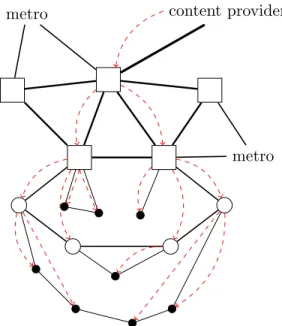
Figure 2.1: Example network comprising a core and three metropolitan net-works, out of which one is displayed. Core routers are depicted with squares, metropolitan routers with circles and access nodes with solid dots. An exam-ple routing from a single content provider towards the visible access nodes is overlaid in red dashed lines.
of edge routers and some access nodes connected to each edge router, usually also in some two-connected arrangement. Optical bypass is of-ten used in the metropolitan networks, creating a logical topology where nodes that are distant in the physical topology can have a direct connec-tion in the network layer.
However, the setting becomes much simpler when considering media coming from a single content provider. Note that most media comes from big providers and enters the considered network through some peering point. By looking at shortest routes between this point and all clients, we obtain a tree over which the data is disseminated. This is depicted in Figure 2.1.
Looking at the trees obtained for the networks studied in this work, we found some distinctive levels. For example in the France Telecom network, we have a level of core routers that connect only to core routers, core routers that are edge to metropolitan networks, some more
metropoli-tan routers and access nodes. The fan-out of nodes within a level does not vary too much. Thus, we simplify the network as a rooted tree, where all nodes that have the same distance from root have the same degree. Note that while we have a tree for each possible content provider, all the trees are independent and have the same structure. Therefore, we treat them as a single aggregated tree, without affecting the results.
2.2
Preliminary: modelling energy consumption in
a network
Expressing power consumption of a system as complex as a computer network in terms simple enough to be an optimization metric is not a trivial task. In a study focused on minimizing the number of active devices of single kind, it may be abstracted simply as the number of devices running. One example of such study is [GMM12], where the optimization metric is simply the number of links turned on.
However, assuming a device’s power usage is constant is a simpli-fication, which may be imprecise for some device types. Some modern electronics are known to switch to lower power consumption modes when under moderate load. One well known example of such a solution is CPU Throttling. Some devices may also enter low power mode on short in-activity. Overall, this promises that in future devices we will see power consumption approach proportionality to the load.
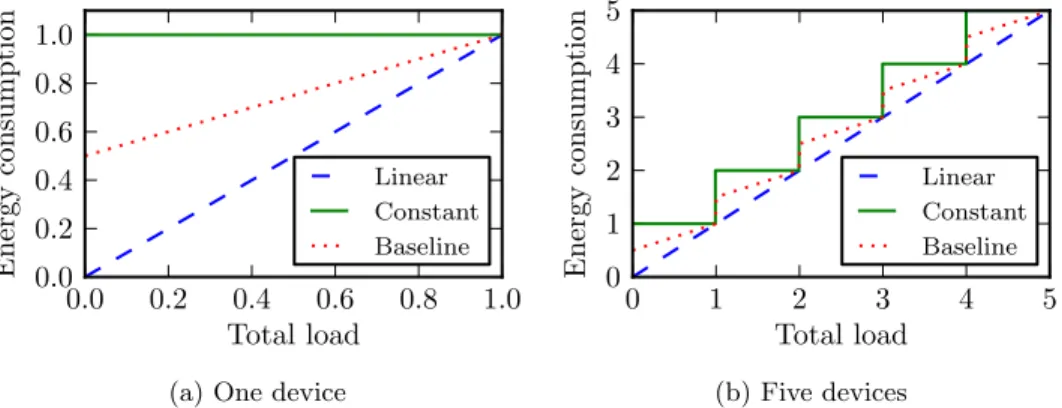
Nowadays a middle ground model is closer to reality. Whenever a de-vice is turned on, it consumes a baseline power. This power is committed to spinning disks, fans and overall upkeep of an idle system. Figure 2.2 shows a comparison of these 3 models. Note that if we consider multiple devices sharing the same load, when the number of devices turned on is kept to a minimum, we approach the linear model, as shown on plot 2.2b. Thus, when considering a provisioning problem like in this chapter, the linear model can be an acceptable approximation.
Once the model considers multiple device types, or absolute figures on energy consumed are required, a need arises for knowing the actual characteristics. This is where databases like Powerlib [VHI12] come in handy. However, the data presented therein contains only capacities and producer rated peak power consumption. This allows using either con-stant or linear models, as described in the previous paragraph. A number
0.0 0.2 0.4 0.6 0.8 1.0 Total load 0.0 0.2 0.4 0.6 0.8 1.0 Energy consumption Linear Constant Baseline
(a) One device
0 1 2 3 4 5 Total load 0 1 2 3 4 5 Energy consumption Linear Constant Baseline (b) Five devices
Figure 2.2: Three power models of a device, shown for one and five devices. The baseline power consumption is assumed to be half of the peak.
of measurement studies aimed at getting more insight were conducted, e.g. [VHILR+12] or [VLM+09a]. These studies show that baseline power
usages, for a handful of current devices, tend to be over 80% of the maximum.
However, each such study is limited only to devices available to its authors; there are methodology differences between separate works. Fur-thermore, some of the numbers get outdated quickly. For example Solid State Drives are still in explosive growth phase, where each next gener-ation is faster, bigger, cheaper and consumes less power. When looking into total server energy consumption for a unit of transfer, numbers found in the literature [VLM+09b, GAKG11] are over 200J/Gb. However, for the
results of this chapter we obtained current numbers from an innovative company 1, which turned out to be around 20J/
Gb. Therefore it is
im-portant to consider the power model carefully for each separate problem and attempt to obtain the most current data possible.
2.3
Preliminary: algorithmic approach
The general problem that underlies this section, Copy Placement, can be defined as follows.
1
Input We are given a digraph G = (V, A) modelling the network, a set of files F and a set of demands D. Each file can be served from a source according to a function s : F → V . Each demand d ∈ D is characterized by the requesting vertex, a file identifier and request rate, d = (vd, fd, rd), vd ∈ V, fd ∈ F, rd ∈ R. We are also given the cost
functions for: transmission of a file over an arc t : A → R, placement of a copy of a file in a vertex p : V → R and access to a copy of a file in a vertex a : V → R.
Output A solution consists of copy placement C and routing R. Copy placement assigns to each file f ∈ F a subset of nodes Cf ⊂ V in which
copies of f are placed. Routing determines for each demand d ∈ D a directed path in the digraph Rd ⊂ A, that begins in wd ∈ Cfd∪ {s(fd)}
and ends in vd.
Metric The solution should minimize the cost, determined by: X f ∈F X v∈Cf p(v) +X d∈D X e∈Rd rdt(e) + X d∈D ( rda(wd) if wd6= s(fd) 0 otherwise (2.1) Above problem is, in general digraphs, hard to compute. In fact we can show inapproximability with a simple reduction from the Set Cover problem, defined as follows.
Set Cover Given an universe U = {u1, u2, . . . , un}, a collection of
sub-sets of U , S = {S1, S2, . . . , Sk}, and a cost function c : S → R, find a
minimum cost subcollection of S that covers all elements of U .
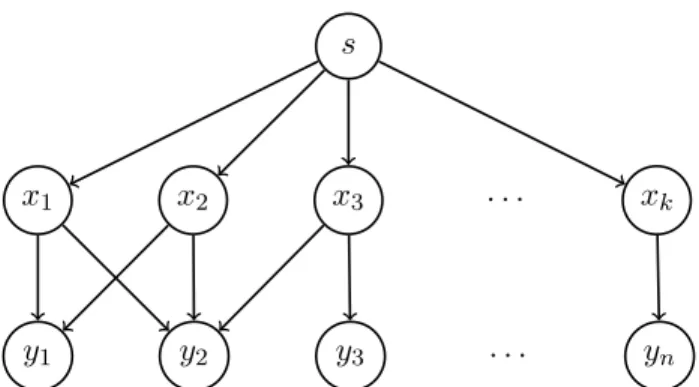
Now, we show how to transform an instance of the Set Cover prob-lem into an instance of Copy Placement. Take two sets of vertices, X = {x1, . . . , xk} and Y = {y1, . . . , yk}, corresponding respectively to
elements of S and U and a source vertex s. Put an arc from any ver-tex in X to one in Y if the corresponding element of Y belongs to the corresponding subset from S and an arc from s to every vertex in X. An example of such graph is shown in Figure 2.3. Let there be a single file served from the vertex s and requested once from each vertex in Y , with rate equal to one. Let M > P
S∈Sc(S). For the cost functions, let
x1 x2 x3 · · · xk
y1 y2 y3 · · · yn
s
Figure 2.3: An example Copy Placement digraph obtained by transforming a Set Cover instance, where S = {{u1, u2}, {u1, u2}, {u2, u3}, . . . , {un}}.
any v ∈ V , and p be equal to the cost of corresponding elements of S for vertices in X and M for other vertices.
Consider an optimal solution to the instance of Copy Placement. For any demand d ∈ D, it can be routed either from vd or s for a cost of
M , or from a vertex x ∈ X for a, possibly shared, cost of p(x) < M . Thus, in an optimal solution, each demand is routed from a vertex in X, that is a neighbour of requesting vertex. The solution is determined by placing copies of the file in a minimum cost subset of X that domi-nates Y . Choosing the corresponding subsets from S directly gives us an optimal solution of Set Cover with the same cost. Following the results in [AMS06], this can not be approximated within a ratio better than O(log |X|).
As explained in Section 2.1, for content distribution we can model net-work as a tree. The data is requested by the leaves and can be served by any node on the path between requesting leave and root. This has been solved in [LGI+99] using dynamic programming. However, the solution
takes O(|V |3) time to place a single file. Thus, we make an additional assumption, that is in line with what we observed in Section 2.1: nodes on the same level (at the same distance from root) have an equal degree. An example of such a tree is shown in Figure 2.4. Data is requested according to a static distribution and we statically place data in the op-timal levels. If a file i is stored at level j, the total cost of serving it to all the leaves is:
1 2 3 4 5 6 7 8 3 2 7 10 9 1 2 3 9 8 7 6 5 4 1 6 1 2 3 INT 8 5 4
Figure 2.4: A tree representing the France Telecom network. All devices residing at the same distance from root of the tree have the same degree. For clarity of presentation, only a subset is drawn. The last level of the tree, representing consumers’ premises, is omitted as there are 5000 such nodes per DSLAM node (the last level shown).
where nj is the number of nodes on level j, oj is the overhead cost to place
the data in a node on level j, ri is the total number of requests for file i
and dj is the cost of delivery from a device on level j to a leaf. In practice,
dj is nearly proportional to the distance between j and leafs and oj is
nearly constant. Thus, as we show in Section 2.8, the optimal placement depends on a file’s popularity. We can efficiently compute for each level a request rate interval, such that files with rate within this interval are
optimally stored in each node in this level. This means that we can optimally place any number of files in time O(h2), where h is height of
the tree. We define a simple algorithm to perform that placement. The main contribution of this study is determining practical values of all the factors of equation 2.2, obtaining the results and sensitivity analysis.
2.4
Publication
The remainder of this chapter corresponds to Energy Efficient Content Distribution in an ISP Network by R. Modrzejewski, L. Chiaraviglio, I. Tahiri, F. Giroire, E. Le Rouzic, E. Bonetto, F. Musumeci, R. Gonzalez and C. Guerrero, which is accepted for publication in the proceedings of IEEE Global Communications Conference 2013.
2.5
Introduction
The electricity consumption of the Information and Communication Tech-nology (ICT) sector represents today almost 2% of the world electricity [LVHV+12], having observed an annual increase of 10% from 2007 to
2012. In this context, data centers and backbone networks will expe-rience the highest energy consumption growth rates in the forthcoming years [LKWG11], due to the increase of traffic, especially for multimedia content. As an example, Cisco estimates that the sum of all forms of videos will represent 86% of the global consumer traffic by 2016 [Cis12]. In order to mitigate this trend, different solutions have been proposed in the literature for the design and the management of energy-efficient backbone networks (see [BBDC11] for an overview).
Recently, the problem of reducing power consumption in a backbone network by moving the contents accessed by users has attracted attention of the research community. In particular, in [CM10] we have studied the problem of reducing power consumption of an Internet Service Provider (ISP) and a Content Provider (CP) jointly, showing that considerable energy savings can be obtained when the CP and the ISP cooperate to minimize the total power consumption. In [LRH10] authors propose an architecture based on Content Centric Networking (CCN) to reduce the power consumption. Additionally, in [VLM+09b] an architecture
managed by the ISP is proposed and evaluated. Finally, the energy trade-offs of an architecture based on immersive video centric services are evaluated in [LGAK12]. All these works prove that a huge amount of power is saved when the ISP takes control of the content and caches it considering the energy consumed to move the information across the network.
In this work we study the problem of reducing power consumption in an ISP network by considering the design of a content distribution infras-tructure managed by the ISP. Our aim is to study where to cache content inside the network in order to reduce the overall power consumption of the system composed by the network elements and the installed storage. In current ISP networks a huge amount of traffic is exchanged between the users and the data centers owned by large CPs, such as as Google, Yahoo, Amazon, and Limelight. Normally, the data centers of large CPs are located close to the peering points of the ISP [GALM08].Therefore, the traffic originated from the data centers has to traverse a number of hops in the ISP network before reaching the users. We therefore study the optimal content caching inside the ISP, rather than sending the content from the data centers to the users. In our scenario, we consider a hier-archical logical topology composed of different levels (e.g. core, metro, and access), and we optimize the energy consumption by choosing the best level where to put each content.
The benefits of the energy-efficient design of content distribution ar-chitectures inside the ISP are multiple. First of all, it is possible to reduce jointly the electricity costs of the storage and of the network, as their energy is explicitly taken into account during the design phase. Secondly, the ISP reduces the amount of traffic that is exchanged across the network. This in turn may decrease the maintenance costs incurred by the ISP, since network elements are upgraded less frequently and less new switching devices need to be installed. Third, the monetary costs for sending/receiving information from outside the network are also reduced, since less bandwidth is required.
2.6
Related Work
There have been several works tackling the problem of web object efficient caching. Most of these works were not focusing on energy savings but
rather reducing the latency, the network traffic and/or the server load. In [LDGS98], authors studied the optimal placement (for reducing either latency or network traffic) of M multiple web proxies among N potential sites under a given traffic pattern. They considered a simple path of N + 1 nodes where the extremity of it corresponds to the original web server and the other nodes correspond to the potential sites. In case of no data replication, all the requests coming from the different sites would need to go until the main web server before being fulfilled. Dispatching some web proxies efficiently among the N potential sites can reduce the latency and the traffic load. Authors give an algorithm to find the best solution in O(N2M ) time. In [LGI+99] they extended
this algorithm to the case where the topology is a rooted tree, the main server is in the root and potential sites are all the other tree nodes. Again they show that the best solution can be found using a polynomial algorithm with time complexity O(N3M2).
[BRS08] focuses on a more general case. Instead of having only one web object as in the previously cited papers, several objects should be simultaneously taken into account by the optimization. They considered also a set of caches that have a limited capacity and a cost for storing each of those objects. Finally they assume a set of clients that have demands for different objects and to each client they assign a cost for getting a specific object when it is stored in a specific cache. For efficiently solving this NP-complete problem, on a general topology, they presented a 10-approximation algorithm.
We want to mention also that some works investigated the possibility of managing the caches in a distributed scheme. In [TC02], authors pro-pose a novel caching scheme that integrates both object placement and replacement policies and which makes caching decisions on all candidate sites in a coordinated fashion.
The closest papers to our work are [SK09, JNWC11, MLG+11]. In
[SK09] authors detail an analytical model for caching considering the cost for transporting information and the cost for storing the content. How-ever, the model is derived for a simple scenario (a metro network), with at most three levels in the topology as possible locations to cache content. Moreover, the evaluation of savings in terms of energy is not performed. In [JNWC11] authors propose a model for caching that integrates en-ergy costs. The evaluation is performed considering five possible levels
for caching. Finally, in [MLG+11] an ILP model and two simple
heuris-tics for the energy-efficient content distribution are detailed. However, authors do not consider the energy consumed for sending the content to the possible locations inside the network and a limited number of levels is also assumed.
In contrast to previous work, in this paper we go one step further by: a) defining a model with a generic number of levels and not only restricted to specific values or specific segments of the network, b) proposing an optimal algorithm to decide where to cache the content and compute the total energy consumption, c) evaluating the results over two case studies. Moreover, we consider the impact of the topology properties on the content caching, and we derive some insights for the design of future energy-aware networks.
The rest of the paper is organized as follows. In Sec. 2.7 we describe the problem. Sec. 2.8 details the algorithm we propose to solve the problem. Results are presented in Sec. A.5. Finally, Sec. 2.10 concludes our work.
2.7
Problem Description
We assume that the network is organized in a hierarchical structure com-posed of different levels. In particular, we assume a tree-like network to represent the collection of paths between each user and the Internet peer-ing node. Nodes are grouped accordpeer-ing to a hierarchy, and each level of the tree corresponds to a different level of the hierarchy. The content data is delivered towards the clients following a path on the tree from the root, i.e., the Internet peering point. A storage cache can be located at each node of the network, providing a potential facility for storing data. Moreover, caches are organized in a hierarchical structure: if a requested content is not available in a given cache, the request is for-warded to the parent cache of the hierarchy, without any collaboration among the caches located in the same level of the tree. Finally, we do not impose a given cache size, i.e., the cache size is an output of our approach.2
2In our scenarios the obtained cache size is always lower than the maximum capacity of

![Table 2.1: Main parameters for the considered scenarios. Parameter FT Moroccan L [units] 6 6 N Dj [units] [1 8 24 216 216 2160] [1 20 20 20 200 10000] C S [W/Gb] 9.375·10 − 4 9.375·10 − 4 C R [J/Gb] 24.3 24.3 C Hj [J/Gb] [12.5 25 30 35 200 300] [12.5 25 30](https://thumb-eu.123doks.com/thumbv2/123doknet/13151267.389245/52.918.190.654.228.495/table-main-parameters-considered-scenarios-parameter-moroccan-units.webp)