HAL Id: inria-00425150
https://hal.inria.fr/inria-00425150
Submitted on 22 Jan 2010
HAL is a multi-disciplinary open access
archive for the deposit and dissemination of
sci-entific research documents, whether they are
pub-lished or not. The documents may come from
teaching and research institutions in France or
abroad, or from public or private research centers.
L’archive ouverte pluridisciplinaire HAL, est
destinée au dépôt et à la diffusion de documents
scientifiques de niveau recherche, publiés ou non,
émanant des établissements d’enseignement et de
recherche français ou étrangers, des laboratoires
publics ou privés.
Enabling advanced simulation scenarios with new
software engineering techniques.
Judicaël Ribault, Olivier Dalle
To cite this version:
Judicaël Ribault, Olivier Dalle. Enabling advanced simulation scenarios with new software engineering
techniques.. 20th European Modeling and Simulation Symposium (EMSS 2008), Sep 2008, Briatico,
Italy. �inria-00425150�
ENABLING ADVANCED SIMULATION SCENARIOS WITH NEW SOFTWARE ENGINEERING TECHNIQUES Extended Abstract
Judica¨el Ribault Olivier Dalle
MASCOTTE project-team, INRIA Sophia Antipolis & I3S, Universit´e de Nice-Sophia Antipolis, CNRS B.P. 93, F-06902 Sophia Antipolis Cedex, FRANCE.
ABSTRACT
1 INTRODUCTION
In the 1970’s, Zeigler introduce the DEVS formalism ( Zei-gler, Kim, and Praehofer 2000): a hierarchical component approach to separate modelling concerns. In DEV/SES, Zeigler introduce the notion of Experimental Framework (Zeigler, Kim, and Praehofer 2000). This Experimental Framework divides the computer simulation in two parts: on one hand the model of the System Under Testing (SUT) and on the other hand, the Experimental Frame. Here-after, we will refer to the part of the Experimental Frame that generates exogenous events for the model part, as the scenario part. This approach has benefits and drawbacks. The benefits are a better separation of concerns that favors reusability of components. The drawbacks are twofold: (i) it prohibits direct interactions between the scenario part and components deeply burried in the model part; (ii) it does not support building scenario based on structural changes of the model.
In this paper, we introduce new techniques to get around these limitations while enforcing the separation of concerns approach of the Experimental Framework. In fact, separat-ing models and scenario allow a better reuse of components in both parts: reuse a model with a lot of Experimental Frame, or reuse an Experimental Frame with a lot of model depending on the goals of the simulation. In particular, a model that can be reused multiple times or used in combi-nation with other models can save a many time, money, and human effort (Davis and Anderson 2003). From a method-ological point of view, reuse allows to: (i) build reference model used in several studies, particularly to compare dif-ferent solutions and (ii) benefit from user feed-back and/or improvements. There are also situations in wich reuse can simply not be avoided. Indeed, we may distinguish two levels of component reuse: (i) reuse at source level offers enough flexibility to allow reusing with modifications of the sources. But this modifications can cost a lot of time and
money in terms of verification and validation. (ii) Reuse at execution level prohibits modifications because sources code are not provided. The sources code was not provided when the model must remain secret: to protect an industrial secret, for security reasons, and so on.
Section 2 present the software background involved in this paper. Section 3 present the use case in wich we present the use of ADL (section 3.2) and AOP (section 3.3). 2 Background
This section present Open Simulation Architecture (OSA) (Dalle 2007): a discrete-event simulator that provides a process-oriented programming model and the software in-volved in this implementation.
2.1 Open Simulation Architecture
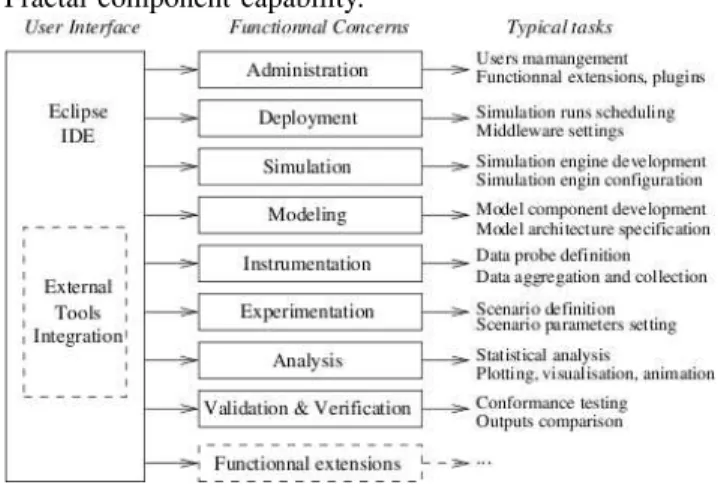
The goal of OSA is to help users in their simulation activities like building models, developping simulations campaigns, running experiences plans, or analyzing data results. Also, OSA aims at becoming framework for the modelling and simulation community by favoring the integration of new or existing contributions at all levels architecture. Figure 1 represents the OSA architecture. In the left part, the front end-users GUI based on Eclipse framework. In the center part, the functional concerns and in the right part the simulation tasks. Functional concerns resolve one or more typical simulation tasks. Each functional concerns are part of the OSA software components and must be considered optional and replaceable independently from one another. In OSA, handling are almost always hidden in the controller component thus significantly reduce the modelling process, but also simplifies the replacement of any part of the simulation engine. OSA allows to model component-based systems using Fractal component (Bruneton, Coupaye, and Stefani 2004). AOKell, an open implementation in Java of the Fractal component model, provides an aspect-oriented approach to integrate control concerns in component. In
2.3 Aspect-Oriented Programming Ribault and Dalle practice, the real system is represented by a FractalADL
application. This application can then be instrumented using Fractal component capability.
Figure 1: OSA functionnal architecture.
2.2 Fractal component
Fractal basis development lies in writing components and connections that enable components communication. Frac-tal specification is based on: (1) hierarchical components that provide a uniform view of applications at different levels of abstraction, (2) shared components that allow modelling and sharing of resources, while preserving hierarchical com-ponents, (3) introspection to observe the performance of a system, and (4) (re)configuration capabilities that enable deployment and dynamic system configuration. Further-more, Fractal is an extensible model because it allows the developer to customize the control capabilities of each ap-plication’s component. A Fractal component is an unit of deployment that have one or more interfaces. An interface is an entry point to the component. An interface implements an interface type, which specifies the operations supported by the interface. There are two types of interfaces: server interfaces that correspond to the services provided by the component and client interfaces that correspond to services required by the component. A Fractal component is nor-mally composed of two parts: a membrane which possesses functional interfaces and interfaces allowing introspection and (dynamic) configuration of a component, and a content that is made up of a finite set of sub-components.
Figure 3 shows an example of Fractal component. Com-ponents are represented by rectangles. The bold line cor-responds to the membrane component. The inner part corresponds to the content of the component. Interfaces are represented by round for clients interfaces, and by empty half-round for servers interfaces. Note that internal inter-faces allow a hierarchic component to control the exposure of its external interfaces to its sub-components. External
sub−component
content
binding external
interface componentshared membrane
Figure 2: Fractal component example.
interfaces appearing at the top of the components are com-ponent control interfaces. dashed line represent connections among components. Fractal provide a Architecture Descrip-tion Language (ADL) (Clements 1996), (Medvidovic and Taylor 2000) to describe applications architecture. 2.2.1 Fractal ADL
FractalADL is a XML language to describe the architecture of a Fractal application: components topology (or hierarchy), relationship between client and server, name and initial value of components attributes. A FractalADL definition can be divided into several subs definitions and several files. Moreover, the language supports a mechanism to ease the extension and redefinition through inheritance. The motivation for such scalability is twofold. On the other hand, the component model itself is extensible, it is possible to attach an arbitrary number of components controllers. There are multiple uses for a given ADL definition: deployment, verification, analysis, and so on. FractalADL allows to separate concerns because model definition can be split in multiple files. ADL language is interpreted by a specialized component of Fractal called a Factory: to read completely (recursively) a description of a Fractal application, just send a request to the Fractal Factory to read and instantiate the root component of the application. To instantiate the various components, the factory creates a Fractal Abstract Syntax Tree (AST), where each node corresponds to a XML entity of the ADL.
2.3 Aspect-Oriented Programming
Aspect-Oriented Programming (AOP) (Elrad, Filman, and Bader 2001) is a new paradigm for modularizing applica-tions with many concerns. AOP goals are (i) separation of concerns: the goal is to design systems so that functions can work independently of other functions, and so it is easier to understand, design and manage complex interde-pendent systems; (2) crosscutting interactions: it is not easy to modularized common-interest concerns used by several modules, like logging service; (3) dependencies inversion:
3 REUSE COMPONENT-BASED MODEL Ribault and Dalle instead module use well-known services, the well-know
service shall use modules.
3 Reuse component-based model
EE A B Scenario Model Scenario X Model C EE A C B
X
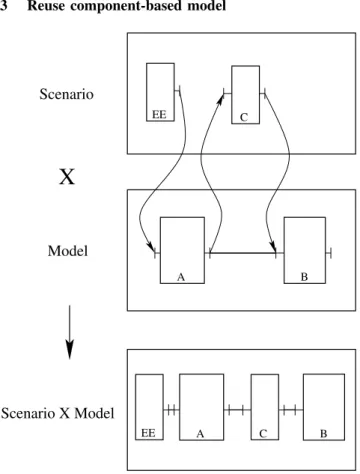
Figure 3: Reuse and adapt a model of reference. We present in this paper new techniques to build scenar-ios from existing component models. We focus on reusing model at execution level. Starting from an existing model we want to preserve (for example because it came after a long validation and verification process, or because we want to keep the source code secret), we build a complex scenario. Figure 3 show the composition of the complex scenario and the reference model. Reference model con-tains two components A and B. Complex scenario add a new component C between A and B, and a new component EE wich generate exogeneous events. The composition is the result of the model and the scenario. To obtain this composition, we propose to use in two originals ways: (i) an Architecture Description Language (ADL) with overloading capability like FractalADL and (ii) Aspect-Oriented Pro-gramming (AOP) like AspectJ to extend the reusability of a model thru a simple case study : user authentication on server thru a not secure file transert protocol (FTP).
ClientImpl
ServerImpl
Client
Server
cftp
sftp
Figure 4: Components layout of File Transfers Protocol case study.
3.1 Case study
As described previously, we propose to use AOP and ADL in an original way to override difficulties in reusing models. We choose in this paper to show the cost and benefits thru a simple case study. First, let us assume that we have a model we want to reuse to test different security flaws. There is a model representing the Basic operation of a server File Transfer Protocol (FTP). This simple model has not been developed in order to be used in this study, we are not supppose to have the source code, and even we need to test the safety of this protocol. Figure 4 shows the architecture of the model, and Listing 1 details its implementation in FractalADL. Line 4 specifies the name of this model, line 6-11 correspond to the client definition and line 12-19 to the server definition. Line 7-9 and 14-16 describe client and server interfaces used by the binding on line 20-21. Listing 1 Fractal ADL definition used to implement layout of figure 4.
01<?xml version="1.0" encoding="ISO-8859-1" ?> 02<!DOCTYPE definition skipped ... >
03 04<definition name="ftp"> 05 06 <component name="Client"> 07 <interface name="cftp" 08 role="client" 09 signature="FTPService"/> 10 <content class="ClientImpl"/> 11 </component> 12 12 <component name="Server"> 14 <interface name="sftp" 15 role="server" 16 signature="FTPService"/> 17 <content class="ServerImpl"/> 18 </component> 19 20 <binding client="Client.cftp" 21 server="Server.sftp"/> 22</definition>
The protocol represented by this model is a two-party protocol. We will denote the two parties by the name Client and Server (Client want to be authenticated on Server). The model works like this : the client send the users login and password to the server to be authenticated. To do this, client ask his interface (cftp, declared line 07) to obtain
3.3 Spyware with aspect-oriented programming Ribault and Dalle connection with the server. In this study, we focus on the
login process to test security flaw.
From this model, we propose a new reusing approach. First, we will show how to add a man in the middle attacker in this model using the overload capability of FractalADL. Second, we will show how to simulate spyware on client using the overload capability of FractalADL and AOP. 3.2 Man-in-the-middle attacker with Fractal ADL
ClientImpl
ServerImpl
Client
Server
cftp
sftp
AttackerImpl
asftp
acftp
Attacker
Figure 5: Components layout of Fractal’s MITM attack. From the original model describe in section 3.1, we want to test the ftp login process security. We decide to test the security against a man-in-the-middle attacker. In the man-in-the-middle setting (MITM), there is a third party called Adversary. All the communication between Client and Server are intercepted by Adversary. Thus both Client and Server talk to Adversary and cannot communicate directly with each other. Adversary need to transmit information between Client and Server, but it’s the security break -he can read, change, or drop transmit depending on his settings.
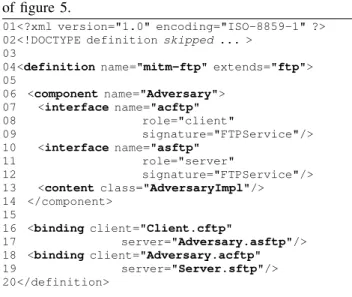
What makes this case interesting is to modify the original FTP topology (figure 4) to obtain the new topology describe in figure 5. In practice, we need to add a new component inside a model. Like in reality, Adversary need to mimic Server interface and Client Interface. In fact, Adversary need to imitates Server for the Client, and imitates Client for the Server. Figure 5 show the new architecture we want to obtain compared to figure 4 section ??. Since model is locked, we cannot change his topology directly in source code. Listing 2 shows how to use the FractalADL overload capability to overload the topology. Line 04 show we extend the original ftp model in a new model called mitm-ftp. Line 06-14 represent the declaration of the new Adversary component. And line 16-19 demonstrate how overload the original binding between Client and Server by a new binding between Client and Adversary, and between
Listing 2 Fractal ADL definition used to implement layout of figure 5.
01<?xml version="1.0" encoding="ISO-8859-1" ?> 02<!DOCTYPE definition skipped ... >
03
04<definition name="mitm-ftp" extends="ftp"> 05 06 <component name="Adversary"> 07 <interface name="acftp" 08 role="client" 09 signature="FTPService"/> 10 <interface name="asftp" 11 role="server" 12 signature="FTPService"/> 13 <content class="AdversaryImpl"/> 14 </component> 15 16 <binding client="Client.cftp" 17 server="Adversary.asftp"/> 18 <binding client="Adversary.acftp" 19 server="Server.sftp"/> 20</definition>
Adversary and Server. With this topology, communication between the Client and the Server pass thru the Adversary. This example shows how to modify a model to include new component or change topology. The overload capa-bility of Fractal ADL permit to reuse and change some specification of the model like topology. In fact, in our example, communication between the Client and the Server go thru the Adversary but the FTP model have not been modified. We build a new model extending the original FTP model, and overload the binding between the Client and the Server. In the next section, we use FractalADL to add a new component and change the topology, but we also demonstrate how to use AOP. The next section described the FTP model with a spyware inside the client.
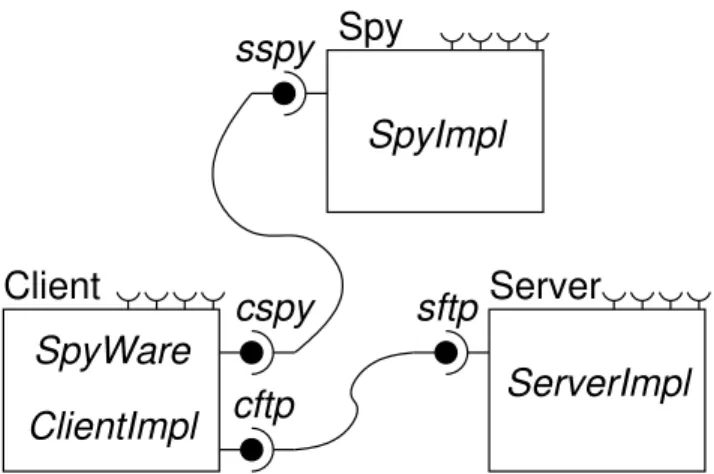
3.3 Spyware with aspect-oriented programming In this section, we demonstrate how using Fractal ADL and aspect-oriented programming we can add a spyware (Stafford and Urbaczewski 2004) into the Client from the original FTP model. Spyware is the name given to the class of software that is surreptitiously installed on a computer and monitors users activities and reports back to a third party on that behavior [Anon, 2004; Daniels, 2004; Doyle, 2003; Taylor, 2002]. We want to model a spyware inside the Client of the FTP model. The goal of this attack is to take the user login and password when typed in. Spyware send all information to a third party using the network. The model architecture we want to obtain is shown in figure 6. We see the Client is connected to a third entity (Spy) and contain a SpyWare inside his implementation.
Listing 3 shows a solution using Fractal ADL and AOP to introduce spyware in original FTP model. Using the extension capability of Fractal ADL, we add a new spy interface to the Client component, we add a Spy component
4 CONCLUSION Ribault and Dalle
ServerImpl
Client
Server
sftp
cftp
sspy
cspy
SpyImpl
ClientImpl
SpyWare
Spy
Figure 6: FTP model with SpyWare in Client.
and we bind the Client and the Spy together. Line 04 show how to create a new model extending the original FTP model. Line 06-17 represent the Spy component, line 07-09 represent the interface for connecting with the Spy component. Line 13-17 represent the Client component declared in the original FTP model, line 14-16 show the new interface added to the Client component. Line 19-20 represent the binding to connect the Client with the Spy component.
Listing 3 Fractal ADL used to implement layout of figure 6.
01<?xml version="1.0" encoding="ISO-8859-1" ?> 02<!DOCTYPE definition skipped ... >
03
04<definition name="spyware-ftp" extends="ftp"> 05 06 <component name="Spy"> 07 <interface name="sspy" 08 role="server" 09 signature="SpyService"/> 10 <content class="SpyImpl"/> 11 </component> 12 13 <component name="Client"> 14 <interface name="cspy" 15 role="client" 16 signature="SpyService"/> 17 </component> 18 19 <binding client="Client.cspy" 20 server="Spy.sspy"/> 21</definition>
AOP allows us to introduce new code into objects without the objects is needing to have any knowledge of that introduction. The FTP model has been validated and we don’t have the source code so we can’t change it to introduce some concerns about spyware. The Listing 4 show how using AOP we can add some concerns inside a model. Line 01 explain we want to intercept a method call, and do something before the method was called. Line 02 show the method we want to intercept, it’s all methods from
Listing 4 Fractal ADL used to implement layout of figure 6.
01 before(ClientImpl b) :
02 call(* FTPService.*(..)) && this(b) 03 && if(isBinding(b)) {
04 try{
05 SpyService spyS = b.lookupFc("cspy"); 06 spyS.send(thisJoinPoint.getArgs()[0]+""); 07 } catch (NoSuchInterfaceException nsie) { 08 ...
09 } 10 }
the FTPService java interface called by a ClientImpl class. Line 03 add a condition, only component binded with a Spy component are concerned. Line 05 ask the Client interface connected to the Spy component to have this one. Line 06 call thru the connection with the Spy the send method to send data. This aspect (written in AspectJ) represent the Spyware, the Spy component represent the third party waiting for data to analyze.
This example shows how to modify a model to include new component, change topology and instrument a com-ponent. The capability of AOP to inject some code inside the model allow to read variables of the model. Here we demonstrate how a third component can access the login and password field during the login process of the client on server.
4 CONCLUSION
We have shown how ADL and AOP techniques can be used to extend the reusability of a model. Both techniques offer new way to create a complex scenario without modifying the original model. So, the model remain valid and thus economize a lot of works and moneys. ADL allow to build a composition of the model and the scenario by overloading some model definition like bindings. AOP helps to add some code into the model to allow other component reads model’s variables. But we need to build a tools that automaticaly verify if the code injected does not modify the model’s content. In fact, if the code injected have some edge effect, it would be preferable to replace it by a new component or concider it as a new component. Future works could be to study the possibility to build a DEVS engine for OSA. This means that OSA could offer the DEVS formalism with the capability to build complexes scenarios by reusing models. But we need to answers some questions first like is DEVS formalism compliant with AOP ? Another interesting works could be to build bigger models and complexes scenarios, particularly in the security domain.
Ribault and Dalle ACKNOWLEDGMENTS
REFERENCES
Bruneton, E., T. Coupaye, and J. Stefani. 2004, February. The fractal component model specification. Available from http://fractal.objectweb.org/specification/. Draft version 2.0-3.
Clements, P. C. 1996. A survey of architecture description languages. 16: IEEE Computer Society.
Dalle, O. 2007, Februray. Component-based discrete event simulation using the fractal component model. In AI, Simulation and Planning in High Autonomy Systems (AIS)-Conceptual Modeling and Simulation (CMS) Joint Conference. Buenos Aires, AR.
Davis, K. P., and A. R. Anderson. 2003. Improving the composability of department of defense models and simulations. RAND Technical report available at http://www.rand.org/publications/MG/MG101/ (last ac-cessed April 2008).
Elrad, T., R. E. Filman, and A. Bader. 2001. Aspect-oriented programming: Introduction. Commun. ACM 44 (10): 29–32.
Medvidovic, N., and R. N. Taylor. 2000. A classification and comparison framework for software architecture description languages. IEEE Trans. Softw. Eng. 26:70– 93.
Stafford, T. F., and A. Urbaczewski. 2004. Spyware: The ghost in the machine. 291–306: Commun. AIS 14. Zeigler, B. P., T. G. Kim, and H. Praehofer. 2000. Theory