HAL Id: tel-00920184
https://tel.archives-ouvertes.fr/tel-00920184
Submitted on 17 Dec 2013
HAL is a multi-disciplinary open access
archive for the deposit and dissemination of sci-entific research documents, whether they are pub-lished or not. The documents may come from teaching and research institutions in France or abroad, or from public or private research centers.
L’archive ouverte pluridisciplinaire HAL, est destinée au dépôt et à la diffusion de documents scientifiques de niveau recherche, publiés ou non, émanant des établissements d’enseignement et de recherche français ou étrangers, des laboratoires publics ou privés.
Dependent Time Series
Azadeh Khaleghi
To cite this version:
Azadeh Khaleghi. On Some Unsupervised Learning Problems for Highly Dependent Time Series. Statistics [math.ST]. Institut national de recherche en informatique et en automatique (INRIA), 2013. English. �tel-00920184�
Université Lille I - UFR Scientifique de Lille - INRIA Lille - Nord Europe
École Doctorale Sciences pour l’Ingénieur
Thèse de Doctorat
Spécialité : Mathématiques
présentée par Azadeh KHALEGHI
SUR QUELQUES PROBLÈMES NON-SUPERVISÉS
IMPLIQUANT DES SÉRIES TEMPORELLES
HAUTEMENT DÉPENDANTES
dirigée par Daniil RYABKO
Rapporteurs: M. Francis BACH INRIA Paris M. Jean-Philippe VERT Mines ParisTech
Soutenue publiquement le 18 Novembre, 2013 devant le jury composé de:
M. Francis BACH INRIA Paris Rapporteur M. Christophe BIERNACKI Université Lille I Examinateur M. Olivier CATONI École Normale Supérieur Paris Examinateur M. Patrick GALLINARI Université Paris 6 Examinateur M. Daniil RYABKO INRIA Lille Directeur M. Jean-Philippe VERT Mines ParisTech Rapporteur
In loving memory of my dad,
whom I miss so dearly, and
whose absence I feel evermore
deeply.
Acknowledgements
An enormous debt of gratitude is due to many without whom the present work would not have been possible.
I am deeply grateful to my advisor, Daniil Ryabko, for his guidance, generosity, availability and kindness. I have always valued the opportunity to work with such a wonderful researcher, whose knowledge and vision have been fundamental to this thesis. Daniil, I cannot thank you enough!
It is a pleasure to recognize my dissertation committee members, Francis Bach, Jean-Philippe Vert, Christophe Biernacki, Olivier Catoni and Patrick Gallinari, for taking interest in my research and accepting to examine my work. Special thanks to Francis and Jean-Philippe for their thorough reviews and insightful comments. I also gratefully acknowledge INRIA for financing my PhD studies, and for doing a great job at facilitating research.
I would like to thank the SequeL team for making the past three years of my life so amazingly memorable. I have always enjoyed our time spent both inside and outside the lab, from exchanging research ideas to simply grabbing a drink after work, playing football, or attending concerts held by some of you! Listing all the individual permanents, students, post-docs and visiting fellows, all of whom have, in one way or another, contributed to this unique experience, certainly carries a risk I refuse to take! but you all know who you are, so, thank you all! De plus, les francophones de l’équipe, je vous remercie sincèrement pour tout ce que vous m’avez appris; merci pour votre générosité, votre patience et votre gentillesse.
Last, but never least, I would like to thank my family. I dedicate this dissertation to my lovely mom, to the loving memory of my dad, and to my brother, Khashyar. My gratitude for their endless love, support and encouragement over the years is beyond words.
Résumé
Cette thèse est consacrée à l’analyse théorique de problèmes non supervisés impliquant des séries temporelles hautement dépendantes. Plus particulièrement, nous abordons les deux problèmes fondamentaux que sont le problème d’estimation des points de rup-ture et le partitionnement de séries temporelles. Ces problèmes sont abordés dans un cadre extrêmement général où les données sont générées par des processus stochas-tiques ergodiques stationnaires. Il s’agit de l’une des hypothèses les plus faibles en statistiques, comprenant non seulement, les hypothèses de modèles et les hypothèses paramétriques habituelles dans la littérature scientifique, mais aussi des hypothèses clas-siques d’indépendance, de contraintes sur l’espace mémoire ou encore des hypothèses de mélange. En particulier, aucune restriction n’est faite sur la forme ou la nature des dépendances, de telles sortes que les échantillons peuvent être arbitrairement dépen-dants. Pour chaque problème abordé, nous proposons de nouvelles méthodes non paramétriques et nous prouvons de plus qu’elles sont, dans ce cadre, asymptotique-ment consistantes.
Pour l’estimation de points de rupture, la consistance asymptotique se rapporte à la capacité de l’algorithme à produire des estimations des points de rupture qui sont asymptotiquement arbitrairement proches des vrais points de rupture. D’autre part, un algorithme de partitionnement est asymptotiquement consistant si le partitionnement qu’il produit, restreint à chaque lot de séquences, coïncides, à partir d’un certain temps et de manière consistante, avec le partitionnement cible.
Nous montrons que les algorithmes proposés sont implémentables efficacement, et nous accompagnons nos résultats théoriques par des évaluations expérimentales.
L’analyse statistique dans le cadre stationnaire ergodique est extrêmement difficile. De manière générale, il est prouvé que les vitesses de convergence sont impossibles à obtenir. Dès lors, pour deux échantillons générés indépendamment par des processus
ergodiques stationnaires, il est prouvé qu’il est impossible de distinguer le cas où les échantillons sont générés par le même processus de celui où ils sont générés par des processus différents. Ceci implique que des problèmes tels le partitionnement de séries temporelles sans la connaissance du nombre de partitions ou du nombre de points de rupture ne peut admettre de solutions consistantes.
En conséquence, une tâche difficile est de découvrir les formulations du problème qui en permettent une résolution dans ce cadre général. La principale contribution de cette thèse est de démontrer (par construction) que malgré ces résultats d’impossibilités théoriques, des formulations naturelles des problèmes considérés existent et admettent des solutions consistantes dans ce cadre général. Ceci inclut la démonstration du fait que le nombre de points de rupture corrects peut être trouvé, sans recourir à des hypothèses plus fortes sur les processus stochastiques. Il en résulte que, dans cette formulation, le problème des points de rupture peut être réduit à du partitionnement de séries temporelles.
Les résultats présentés dans ce travail formulent les fondations théoriques pour l’analyse des données séquentielles dans un espace d’applications bien plus large.
Abstract
This thesis is devoted to the theoretical analysis of unsupervised learning problems involving highly dependent time-series. Two fundamental problems are considered, namely, the problem of change point estimation as well as that of time-series clustering. The problems are considered in an extremely general framework, where the data are assumed to be generated by arbitrary, unknown stationary ergodic process distributions. This is one of the weakest assumptions in statistics, because it is more general than the parametric and model-based settings, and it subsumes most of the non-parametric frameworks considered for this class of problems. These assumptions typically have the premise that each time-series consists of independent and identically distributed observations or that it satisfies certain mixing conditions.
For each of the considered problems, novel nonparametric methods are proposed, and are further shown to be asymptotically consistent in this general framework. For change point estimation, asymptotic consistency refers to the algorithm’s ability to produce change point estimates that are asymptotically arbitrarily close to the true change points. On the other hand, a clustering algorithm is asymptotically consistent, if the output clustering, restricted to each fixed batch of sequences, consistently co-incides with the target clustering from some time on. The proposed algorithms are shown to be efficiently implementable, and the theoretical results are complemented with experimental evaluations.
Statistical analysis in the stationary ergodic framework is extremely challenging. In general, rates of convergence (even of frequencies to respective probabilities) are provably impossible to obtain for this class of processes. As a result, given a pair of samples generated independently by stationary ergodic process distributions, it is provably impossible to distinguish between the case where they are generated by the same process or by two different ones. This in turn, implies that such problems as
time-series clustering with unknown number of clusters, or change point detection, cannot possibly admit consistent solutions. Thus, a challenging task is to discover the problem formulations which admit consistent solutions in this general framework. The main contribution of this thesis is to constructively demonstrate that despite these theoretical impossibility results, natural formulations of the considered problems exist which admit consistent solutions in this general framework. Specifically, natural formulations of change-point estimation and time-series clustering are proposed, and efficient algorithms are provided, which are shown to be asymptotically consistent under the assumption that the process distributions are stationary ergodic. This includes the demonstration of the fact that the correct number of change points can be found, without the need to impose stronger assumptions on the process distributions. It turns out that in this formulation the change point estimation problem can be reduced to time-series clustering.
The results presented in this work lay down the theoretical foundations for the analysis of sequential data in a broad range of real-world applications.
List of author’s related publications
Parts of the results presented in this thesis have appeared in the following publications.
A. Khaleghi, D. Ryabko, J. Mary, and P. Preux. Online clustering of processes. In the international conference on Artificial Intelligence & Statistics (AI & Stats), La Palma, Canary Islands, 2012.
A. Khaleghi and D. Ryabko. Locating changes in highly dependent data with unknown number of change points. In Neural Information Processing Systems (NIPS), Lake Tahoe, Nevada, United States, 2012.
A. Khaleghi and D. Ryabko. Nonparametric multiple change point estimation in highly dependent time series. In the Proceedings of the 24th International Conference on Algorithmic Learning Theory (ALT), Singapore, 2013.
(Received the E.M. Gold award for the best student paper.)
A. Khaleghi and D. Ryabko. Asymptotically consistent estimation of the num-ber of change points in highly dependent time series. In proceedings of the 31st International Conference on Machine Learning (ICML), Beijing, China, 2014.
A. Khaleghi and D. Ryabko Nonparametric change point estimation in stationary ergodic time series. submitted for publication in a journal.
A. Khaleghi, D. Ryabko, J. Mari, P. Preux, Consistent algorithms for clustering time series. submitted for publication in a journal..
List of main theorems
Theorem. Algorithm1is an asymptotically consistent multiple change point estimator: given a sequence x with a known number κ of change points θkn, k = 1..κ, where n
denotes the length of x and the sequence between every pair of consecutive change points is generated by an (unknown) stationary ergodic process distribution, we have
lim
n→∞k=1..κsup |bθk(n) − θk| = 0 a.s.
Theorem. Algorithm2 is an asymptotically consistent list-estimator: given a sequence x with (an unknown) number κ of change points θkn, k = 1..κ and a parameter λ ∈
(0, λmin] (where λmin ∈ (0, 1) denotes the (unknown) minimum separation of the true
change points), it produces a list of at least, but possibly more than, κ estimates such that
lim
n→∞k=1..κsup |bθk(n) − θk| = 0 a.s.
Theorem. Algorithm3is an asymptotically consistent multiple change point estimator: given a sequence x with (an unknown) number κ of change points, and the total number r of process distributions that generate x, it finds the correct number of change points and estimates the changes so that w.p.1 for large enough n on we have bκ = κ and
lim
n→∞k=1..κsup |bθk(n) − θk| = 0 a.s.
Theorem. Algorithm 5 is an asymptotically consistent online time-series clustering algorithm: for every fixed batch sequences, each generated by one of κ stationary ergodic process distribution, w.p.1, from some time on it groups together those and only those sequences that are generated by the same process distribution, provided that κ is known.
Contents
1 Introduction 17
1.1 Stationary ergodic framework . . . 19
1.2 Proposed formulations and main results . . . 21
1.3 Methodology . . . 26
1.4 Related work . . . 29
1.5 Summary of main contributions . . . 37
1.6 Organization . . . 39
2 Preliminaries 41 2.1 Notations and definitions . . . 41
2.2 The Distributional distance and its empirical estimates . . . 42
2.3 Some theoretical impossibility results in the stationary ergodic framework 46 3 Change point analysis 49 3.1 Introduction . . . 50 3.2 Problem formulation . . . 54 3.3 Main results . . . 59 3.4 Proofs . . . 70 4 Time-series clustering 95 4.1 Introduction . . . 96 4.2 Preliminaries . . . 99
4.3 Main result: a consistent online time series clustering algorithm . . . . 104
5 Experimental evaluations 111
5.1 Synthetic time series generation . . . 112
5.2 Change point estimation . . . 112
5.3 Time series clustering . . . 116
6 Discussion 121
6.1 Change point analysis . . . 121
6.2 Online clustering . . . 123
6.3 Extensions of the general framework . . . 124
Chapter 1
Introduction
The common objective in all unsupervised learning problems is to infer underlying structures in a given dataset, while no information is available beyond the raw data. This class of problems appears in a broad range of real-world scenarios. In many modern applications, vast amounts of data are produced. It is usually the practitioners’ objective to put the data into effective use with no a priori knowledge as to how to achieve this purpose. In other scenarios the goal of the analysis is predefined, but there is little or no access to the correct solution. Clearly in these situations, any theoretical assumption on the nature of the data may prove infeasible. Indeed, the main purpose of the analysis is to use the data in order to extract information about the unknown underlying phenomena, rather than to confirm the model used. This calls for general unsupervised learning methods that are guaranteed to work with little assumptions.
A familiar and fundamental example of unsupervised learning problems is clustering. Here the objective is to find a few natural and meaningful groups (clusters) in a large data set, with the hope that the resulting set of clusters would help the domain experts gain more insight into the nature of the data. Another example is change point analysis where it is desired to identify the point in time at which the process distribution of a given sequence of observations has changed. Blind-source separation is yet another example, where it is required to separate a set of source signals from a given mixed signal with limited information on the processes that generate the data. Other examples include density estimation and outlier detection.
In this thesis we focus on unsupervised learning problems concerning time series where data are in the form of one or several sequences of observations. The analysis of
time series is motivated by many scientific applications from a variety of disciplines such as marketing and finance, biological and medical research, speech processing, social and environmental sciences, and many more. We consider a statistical approach where the data are viewed as samples generated by discrete-time stochastic process distributions. A large body of work exists on the statistical analysis of time series. However, the considered frameworks are usually restricted by strong assumptions. The process dis-tributions are either assumed to come from parametric families or, in non-parametric settings it is typically assumed that the data are composed of independently and iden-tically distributed (i.i.d) observations, or that they satisfy certain mixing conditions. Efficient algorithms have been developed that are guaranteed to work in these frame-works. However, such methods may not be useful in many practical situations, as such strong statistical assumptions do not necessarily hold in most real-world scenarios.
An important question forming the basis of our perspective in this thesis is whether it is possible to solve unsupervised learning problems without the need to make strong assumptions. That is, we investigate the possibilities and limitations of unsupervised learning methods involving time series data when as little assumptions as possible are made. To this end, we consider an extremely general framework, which subsumes most of the assumptions traditionally imposed in statistical time series analysis. The pro-cess distributions that generate the data are unknown. Our only assumption is that the data are generated by stationary ergodic process distributions. We constructively demonstrate that appropriate formulations of two classes of unsupervised learning prob-lems, namely, change point estimation and online time series clustering admit solutions which, as we further show, are guaranteed to be asymptotically correct in the general framework considered.
Before proceeding to a more detailed exposition of our results, let us provide some motivating examples. In modern consumer markets, customer behaviour is usually monitored over time through, for example, fidelity reward cards. This type of infor-mation is further used to develop profitable market attribution strategies. Appropriate strategic insights may be obtained by grouping the consumers based on, for instance, their purchase records. In this example the collected data are in the form of time series of possibly highly dependent observations where there may even be some dependence between the different sequences. Moreover, there is no a priori knowledge as to what type of groups are to be identified. As another practical example, let us consider the
1.1. Stationary ergodic framework 19
problem of author attribution in a large text written collaboratively by a fixed number of authors. For simplicity, assume that the text is composed of individual blocks writ-ten separately by each individual author. It may be desired to separate these blocks. To this end, the text may be considered as a long sequence (of letters) with change points. The change points signify the parts of the text where a block of text written by one author ends, and another block written by a different author begins. The parts of the text generated by different authors may be thought of as sequences generated by different (unknown) process distributions. The series are obviously highly dependent, and the difference between the process distributions is very likely to be only in the un-known dependence structure of the individual segments, which can possibly be in the long-range form. This may be reflected, for example, by each author’s unique writing style. As a result, it is important to consider a framework that takes such dependencies into account. The differences in the marginal distributions (of letters), if present at all, are negligible and not likely to be identifiable. Such potential applications can be suc-cessfully modelled by the general statistical framework that we consider in this thesis, while the settings with stronger assumptions may prove impractical in addressing such problems.
1.1
Stationary ergodic framework
The main and only statistical assumption that we make is that each time series is generated by a stationary ergodic process distribution. Intuitively, stationarity means that the time index does not bear any information. That is, the time index at which the observations have started to be recorded is not important. Ergodicity means that asymptotically, any realization of the time series reveals complete information about its distribution. The assumption that a process distribution is stationary ergodic is one of the weakest assumptions in statistics. Indeed, by the ergodic decomposition, any stationary process can be represented as a mixture of stationary ergodic processes. This means that any realization of a stationary process can be considered a realization of a stationary ergodic process (Billingsley, 1961). By this argument, we can safely state that the setting considered in this thesis is characterized by no other assumption than stationarity, which is in turn extremely mild. Note that we make no such assumptions as independence within the samples in each sequence, or between the different sequences.
Moreover, the process distributions need not satisfy any mixing conditions: the data may have long-range dependence, and infinite memory.
Clearly this framework, however general, is still not assumption-free and cannot possibly address all real-world applications, as not all time series are expected to be modelled by stationary ergodic process distributions. For example, consider time series corresponding to video recordings of human locomotion. While the act of “running” can be thought of as an ergodic motion, a “single jump” can not. Note, however, that the stationary ergodic assumption is still rather mild as compared to the statistical as-sumptions typically made in the literature. As a result, this framework can be suitable for a broader range of applications. At the same time, this general setting calls for a very different kind of analysis. The methods designed for the more restrictive settings typically considered in the literature, make extensive use of rates of convergence. In contrast, rates of convergence (even of frequencies to respective probabilities) are im-possible to obtain for stationary ergodic process distributions; see for example, (Shields,
1996). This entails such strong impossibility results as the non-existence of consistent tests for homogeneity. Specifically, as shown in (Ryabko, 2010b), given two samples generated by stationary ergodic process distributions, it is impossible to distinguish between the case where they are generated by the same source or by two different ones; this result holds even if the given samples are binary-valued. Due to these restrictions, for many statistical problems it is unclear whether consistent solutions even exist in this setting. Thus, one of the main challenges when considering the stationary ergodic framework consists in finding the appropriate problem formulations that, without the need for stronger assumptions, can admit consistent solutions. Moreover, the theo-retical guarantees obtained for algorithms involving this class of processes, cannot be beyond asymptotic results. As a result, the algorithms developed for this framework are forced not to rely on rates of convergence. A possible downside of this scenario is that the asymptotic results obtained for these methods cannot be strengthened and in particular, rates of decrease of error cannot be obtained. On the bright side, however, this limitation may be seen as an advantage in the sense that the rate-free methods designed to work in this general framework are potentially applicable to a much wider range of real-world scenarios.
1.2. Proposed formulations and main results 21
1.2
Proposed formulations and main results
In this section we give an overview of the proposed formulations along with a brief description of our results. A summary of our main contributions is also provided in Section1.5.
In light of the theoretical impossibility results discussed above, not every statistical problem involving time series can be expected to admit a consistent solution in the stationary ergodic framework. Some examples of the problems that, as follows from the results of (Ryabko,2010b), are provably impossible to be solved in this setting include time series clustering for unknown number of clusters, change point detection, and change point estimation when the number of change points is unknown. In this thesis we consider two classical problems namely, change point estimation and online time series clustering, introduced in Sections 1.2.1 and 1.2.2 respectively. For each problem we provide appropriate formulations that, as we demonstrate, admit asymptotically correct solutions under the assumption that the data are stationary ergodic. An overview of our formulations follows.
1.2.1
Change point estimation
Change point estimation involves an a posteriori analysis of a given heterogenous time series, as a means to locate the point in time where the process distribution that gen-erates the samples has abruptly changed. This is an important tool in many practical applications. Indeed, solutions to many real-world problems are directly or indirectly related to the inference of changes in distribution of sequential observations. A num-ber of application areas include bioinformatics (Picard et al.,2005,Vert and Bleakley,
2010), financial modeling (Talih and Hengartner, 2005, Lavielle and Teyssiere, 2007), network traffic data analysis (Tartakovsky et al., 2006, Lévy-Leduc and Roueff, 2009,
Lung-Yut-Fong et al., 2012), fraud and anomaly detection (Bolton and Hand, 2002,
Akoglu and Faloutsos, 2010) and speech segmentation (Fox et al.,2011).
The problem of change point estimation may be introduced as follows. A given sequence x := X1, . . . , Xn is formed as the concatenation of κ + 1 non-overlapping
seg-ments where the consecutive segseg-ments are generated by different process distributions. The index where one segment ends and another starts is called a change point. Specif-ically, a change point refers to the index at which the process distribution of x has
changed. Thus, x has κ change points, which are unknown and have to be estimated. In this work we consider the problem of change point estimation in the general sta-tionary ergodic paradigm discussed in Section 1.1. Our only assumption is that each segment is generated by some (unknown) stationary ergodic process distribution. The joint distribution over the samples can be otherwise arbitrary. The marginal distri-butions of any given fixed size (e.g. single-dimensional marginals) before and after a change point are allowed to be the same. For example the mean, variance etc. may remain unchanged throughout the entire sequence. This means that we consider the most general and perhaps the most natural notion of change, that is, change in the distribution of the data. We also do not make any conditions on the densities of the marginal distributions (the densities may not exist). Since little assumptions are made on how the data are generated, this setting is especially suitable for highly dependent time series, potentially accommodating a variety of new applications.
The objective is to construct algorithms that simultaneously estimate all κ change points in x. The algorithms must be asymptotically consistent in the sense that their estimation error on all κ change points must be arbitrarily small if the sequence is sufficiently long. Note that the asymptotic regime is with respect to the length n of the sequence. In other words, the problem is considered offline and the sequence does not grow with time. As follows from the theoretical impossibility results discussed earlier, the number of change points cannot be estimated under these general assumptions. Usually in the literature, stronger statistical assumptions are imposed on the process distributions so that with the aid of rates of convergence it would be possible to estimate κ. However, rates of convergence are not available in this setting; thus, a natural question would be whether there exist formulations for which consistent solutions can be obtained, without the need to place any restrictions (beyond the stationarity and ergodicity) on the process distributions. To address this question, we consider three different formulations of change point problem, for each of which we provide a consistent solution; our methods are presented in Chapter 3. An overview of our formulations follows.
1. In the first formulation, we assume that the correct number κ of change points is known and provided to the algorithm. The objective is to have an algorithm that is asymptotically consistent in the general statistical framework described above. This scenario may arise in many applications. For example, the objective of a medical
1.2. Proposed formulations and main results 23
study may be to investigate the causes of seizures, using electroencephalography (EEG) recordings of patients. The number of seizures that each patient has suffered may be known a priori, and the goal may be to identify the changes in the brain activity as reflected by the EEG recordings. Another example involves searching within a long text, or a long speech signal, in order to identify the points at which the subject of discussion, the writers or the speakers have changed. In many situations, while such change points are unknown, the total number of such changes may be known in advance. We propose an efficient change point estimation algorithm, and prove it to be asymp-totically consistent, under the assumption that the process distributions that generate the data are stationary ergodic, and that the correct number of change points is pro-vided.
2. In the second formulation, we assume that κ is unknown, but we make no attempt to estimate it. Instead, our goal is to produce a list of at least κ candidate estimates, sorted in such a way that its first κ elements converge to the true change points. We call a method that achieves this goal for long enough x, an asymptotically consistent “list-estimator”. The idea of producing a list of potential answers as a relaxation to producing the exact solution has previously appeared in the literature. In error-control coding theory, a so-called “list-decoder” is used to produce a set of possible codewords as output (Sudan, 2000). A list model for clustering has been proposed by (M. et al.,
2008) where the objective is to produce a small number of clusterings such that at least one has an arbitrarily small error with respect to the ground-truth. Note that our objective is somewhat stronger since the produced list of candidate change points is sorted in such a way that its first κ elements are consistent estimates of the true change points.
List-estimation can prove useful in practice. Indeed, in many scenarios the number of change points can be unknown. However, once provided with the sorted list produced by a consistent list-estimator, the domain expert will be able to identify the true change points much faster. A list-estimator can be especially useful when the input sequence is long. This is due to the fact that after list-estimation, a much smaller portion of the data (i.e. that specified by the output of the list-estimator) will be left for analysis. If the list-estimator is consistent, the first κ elements converge to the true change points. At this point, the task of the expert would be merely to reject the tail of redundant estimates. This in turn requires a smaller amount of time and effort as compared to the
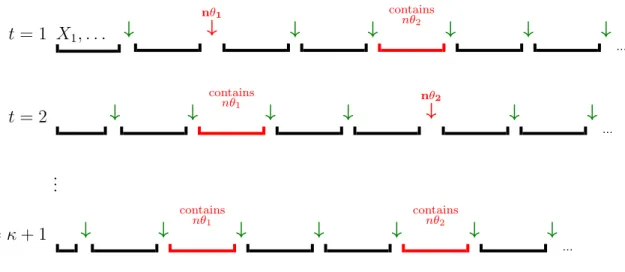
brute-force inspection of the entire data. Let us revisit the example of inspecting a long text (or speech recording), as a means to identify the points in the data that correspond to changes in topic. Assume that, in contrast to the scenario discussed above, we have no a priori knowledge of the number of change points in this case. Thus, every point in the sequence is a potential change point. Using a list-estimator we can identify the changes by confining our inspection to the list-estimator’s output, potentially saving substantial time and effort in the overall analysis. Specifically, noting that the first κ elements of the list correspond to the true change points, we can sequentially inspect the list of candidate estimates produced by the list-estimator, stopping the process as soon as an estimate does not seem to correspond to a true change of topic. In much the same way, the list-estimator can be used in almost all other such applications as video surveillance, bioinformatics, market analysis, etc., where it is required to locate an unknown number of change points within a long sequence of highly dependent observations and an expert is available to further inspect the list of candidate estimates.
We show that consistent list-estimation is possible under the assumption that the process distributions generating the time series are stationary ergodic. Specifically, we propose an efficient list-estimator that generates a (sorted) list of change point estimates. As we further show, the proposed method is asymptotically consistent: the first κ elements of its output list converge to the true change points, provided that the unknown process distributions that generate the data are stationary ergodic.
3. In the third formulation, we assume that while κ is unknown, an additional parameter, namely the total number of process distributions that generate the data is provided. For instance, there may only be two distributions that generate the time series; however, they may be alternating many times so that κ is much larger than 1. In this case, we are able to construct an asymptotically consistent algorithm that finds κ and locates the changes. This additional parameter has a natural interpretation in many real-world applications. The simple example where a pair of distributions alter-nate in generating a sequence with many change points, may correspond to a system whose behaviour over time alternates between normal and abnormal. This may also be a suitable model for video surveillance or fraud detection. Another application is to identify the coding vs. non-coding regions of DNA sequences. Recall the problem of author attribution mentioned earlier, where the objective is to find the points in a collaboratively written text at which the author has changed. In this case, the
knowl-1.2. Proposed formulations and main results 25
edge of the number of participating authors amounts to knowing the total number of process distributions. Similarly, this model may be suitable for the problem of speech segmentation, in the case where the total number of speakers is known. In the example motivating the previous two formulations, we depicted a natural scenario where it is desired to locate the points in a given long text (or speech signal) that correspond to changes in the topic of discussion. While the number of such change points may be unknown, we may have a priori knowledge of the total number of topics covered, which may have been revisited many times over the course of discussion (in the text or speech data).
We provide an efficient change point estimation algorithm, that given the correct number of process distributions that generate the data, finds the number of change points, and locates the changes; the proposed method is shown to be asymptotically consistent under the assumption that the process distributions that generate the data are stationary ergodic. We show that in this formulation, the change point estimation problem can be reduced to time series clustering.
1.2.2
Online time series clustering
Clustering is a well-explored problem in machine learning, and is key to many appli-cations in almost all fields of science. The goal is to partition a given dataset in a natural way, potentially revealing an underlying structure in the data. In this thesis we consider the problem of time series clustering, where the data to be clustered are sequences generated by discrete-time stochastic process distributions. The problem is online, meaning that the data arrive in an online fashion so that new data are revealed at every time-step, either as subsequent segments of previously observed sequences, or as new sequences. This version of the problem has many real-world applications. In-deed, in many cases the data arrive dynamically, with both new sources being added and previously available sources generating more data. It is important for a clustering algorithm to cluster recently observed data points as soon as possible, without changing its decision on the points that have already been clustered correctly. At the same time, some of the previous clustering decisions made about the sequences observed earlier may be incorrect, and may need to be updated given new observations. For instance, in the marketing attribution application discussed earlier, new customers are dynamically introduced to the market. A marketing strategy based on a batch clustering algorithm
may not be effective in this case as the offline method may be constantly confused by the continuous arrival of new information. As a result, intelligent online methods must be used that are robust with respect to the dynamic nature of the data.
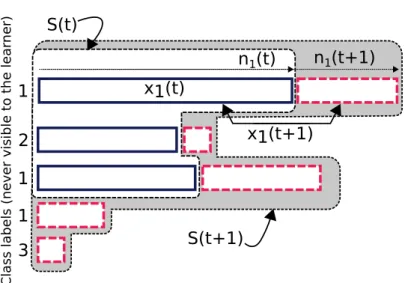
We consider the following formulation of the problem. A growing body of sequences of data is given, where the number of sequences as well as the sequences themselves grow with time. We have no control over this evolution; it is only assumed that the length of each individual sequence tends to infinity. Each sequence is generated by one of κ unknown, stationary ergodic process distributions. At every time-step new samples are observed, which either extend a previously received sequence, or form a new one. Our objective is to cluster the sequences based on the process distributions that generate them. That is, we define the target clustering as the partitioning of the samples into κ clusters, where two samples are grouped together if and only if they are generated by the same process distribution. We define a clustering algorithm to be asymptotically consistent, if the clustering restricted to every fixed batch of sequences, coincides with the target clustering from some time on. As in the previously considered problems, the samples are allowed to be highly dependent; the dependence between the samples may be thought of as adversarial.
We provide an easily implementable, online clustering algorithm that as we show, is asymptotically consistent given that the marginal distribution of each sample is sta-tionary ergodic, and that the correct number κ of clusters is provided.
1.3
Methodology
In this section we describe the common ingredients and ideas used in our approach to each of the considered problems.
1.3.1
Distance measure
In both change point estimation and time-series clustering, we need to analyze the process distributions that generate the data based on the provided samples. In change point estimation we wish to determine the point at which the process distributions generating the samples start to differ. Our clustering objective is to group the samples based on their generating distributions. Therefore, we require an appropriate measure
1.3. Methodology 27
of distance that reflects the distance between the process distributions that generate a given pair of sequences.
It turns out that an appropriate distance function can be obtained by the con-sistent estimation of the so-called distributional distance (Gray, 1988). The distri-butional distance d(ρ1, ρ2) between a pair of process distributions ρ1, ρ2 is defined as
P
i∈Nwi|ρ1(Ai) − ρ2(Ai)| where, wi are positive summable real weights, e.g. wi =
1/i(i + 1), and Ai range over a countable field that generates the sigma-algebra of the
underlying probability space. For a discrete alphabet Ai range over the set of all
pos-sible tuples. For example, in the case of binary alphabets, the distributional distance is the weighted sum of the differences of the probability values (measured with respect to ρ1 and ρ2) of all possible tuples 0, 1, 00, 01, 10, 11, 000, 001, . . . . In this work we
con-sider real-valued processes so that the sets Ai range over the products of all intervals
with rational endpoints (i.e. the intervals, all pairs of such intervals, triples, etc.). The formal definitions are given in Section 2. Asymptotically consistent estimates of this distance can be obtained by replacing unknown probabilities with the corresponding frequencies. As shown by (Ryabko,2010a), these empirical approximations consistently estimate the distributional distance, provided that the corresponding process distribu-tions are stationary ergodic. This property makes the empirical estimates of the dis-tributional distance suitable for our purposes, allowing us to construct asymptotically consistent algorithms in the stationary ergodic framework. The distributional distance and its empirical estimates have also proved useful in other statistical problems involv-ing stationary ergodic time series (Ryabko and Ryabko, 2010, Ryabko, 2012). From a practical perspective, although the distributional distance involves infinite summations, its empirical approximations can be easily and efficiently calculated (Ryabko, 2010a). In principal we can use other distance functions between the sequences as well, provided that the distance used reflects the distance between the underlying process distribu-tions. In the case of change point analysis, the distance is required to satisfy convexity; a more detailed discussion on other choices for the distance function is provided in Chapter 6.
It is important to note that the distinction between the underlying process dis-tributions is not reflected by string metrics, such as the Hamming distance, or the Levenshtein distance, etc. The Hamming distance between two sequences is defined as the minimum number of substitutions required to transform one sequence into
an-other, and the Levenshtein distance corresponds to the smallest number of deletions, insertions and substitutions needed to achieve the same objective, see e.g. (Stephen,
1994). More generally, a string distance between a pair of sequences is 0 if and only if the two sequences are exactly the same. However, what we require is for the distance to converge to 0 for long enough samples, if and only if both sequences are generated by the same process distribution. Consider a simple example where the elements of the sequences x := X1, . . . , Xn and y := Y1, . . . , Yn are drawn independently from a
Bernoulli distribution with probability p := 1/2. Regardless of the value of n, on aver-age, the Hamming distance between the two sequences is 1/2 while they are generated by the same process distribution. At the same time, the empirical estimate of the distributional distance between x and y becomes arbitrarily small for large enough n.
1.3.2
Some common ideas behind the proposed methods
When addressing the problems considered in this thesis, it is not possible to directly evaluate the candidate solutions. This is due to the following two reasons. First, the considered problems are unsupervised, and second, the rates of convergence are provably impossible to obtain for stationary ergodic process distributions. This means that performance guarantees are not available for the potential solutions. Therefore, we make no attempt to select a single candidate solution. Our approach consists in having the algorithm produce a set of potential solutions, assigning each a performance weight. The final decision is made either as a weighted combination of the candidate solutions or as a list of solutions sorted based on their assigned performance weights. We design the weights so that they converge to zero on the solutions that are asymptotically incorrect, and to non-zero constants on the asymptotically correct solutions. This property ensures that a weighted combination of the candidate solutions stabilizes on those that are asymptotically correct, or that the top elements of a list of solutions ordered based on performance weight converge to the correct answers.
As an example, let us consider the problem of time series clustering. An asymp-totically consistent solution to the offline formulation of the problem (for stationary ergodic time series) has already been proposed by (Ryabko,2010a). The online formu-lation introduced in Section1.2.2can be carefully reduced to a series of offline clustering problems. However, since new data arrive dynamically, the entire batch of sequences observed at a given time step may potentially contain sequences for which sufficient
1.4. Related work 29
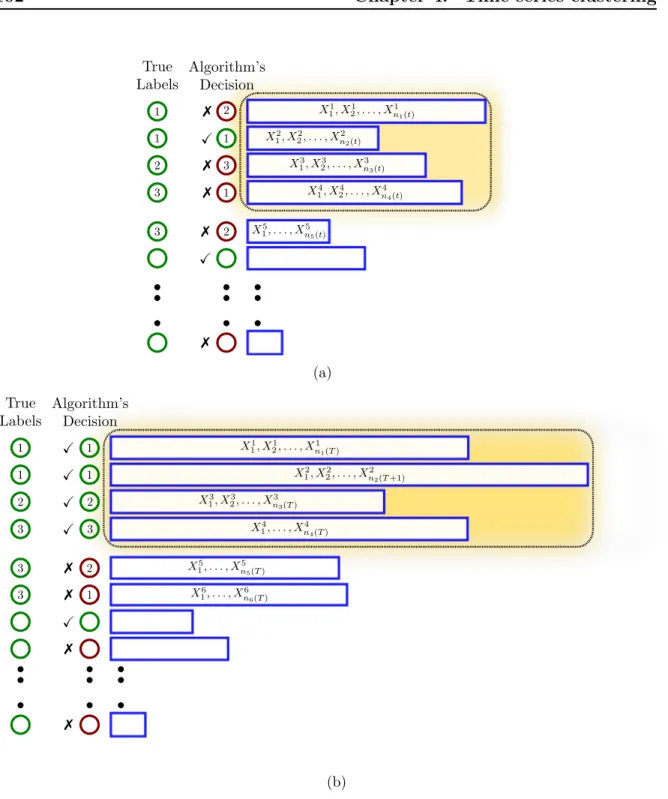
information has not yet been collected, and for which the estimates of the distance (with respect to any other sequence) are bound to be misleading. Such “bad” sequences can confuse any (consistent) offline algorithm (e.g. that of (Ryabko,2010a)), rendering the clustering procedure useless in an online setting. Therefore, the naive approach of applying an offline algorithm to the entire data observed at every time step is bound to fail. Another approach would be to cluster a fixed selected set of (reference) samples, using a consistent offline method, and assign the remaining samples to the nearest clus-ter. However, this procedure would be asymptotically consistent only if the selected reference set contains at least one sequence sampled from each and every one of the κ process distributions. In the considered formulation, it is not possible to directly iden-tify such appropriate reference set. Our solution is based on a weighted combination of several clusterings, each obtained by running a consistent offline algorithm on different portions data. To this end we use two sets of weights: the first is to penalize for large batches, reducing the effect of “bad” sequences in the algorithm’s decision; the second is calculated as the minimum inter-cluster distances between the candidate cluster centers obtained at every iteration of running the offline algorithm. This way, if a batch does not contain samples from all κ process distributions, its corresponding output will be assigned a performance weight that from some time on converges to zero. Therefore, from some time on the online clustering algorithm will base its decisions on the offline clustering of appropriate batches. This approach is described in Chapter 4. Similarly, we reduce the multiple change point estimation problem to a series of single change point problems and weight the sets of candidate estimates obtained sequentially. See Chapter 3for detailed descriptions of our change point estimation algorithms.
1.4
Related work
In this section, we start our review of related literature with a non-exhaustive list of other general approaches to statistical learning problems involving time series. Next, we present the related work on the concrete problems addressed in this thesis, namely, change point estimation and time series clustering.
1.4.1
Some related results on stationary ergodic time series
Even though sequential analysis has a vast literature, consistent non-parametric meth-ods to address inference problems for highly dependent time series are rather scarce. In particular, apart from the results of (Ryabko, 2010a, Ryabko and Ryabko, 2010) discussed in the next section, unsupervised learning for time series has not been consid-ered in this framework before. An incomplete list of some results on statistical learning problems concerning stationary ergodic time series (other than the problems addressed in this thesis) include sequence prediction (Ryabko, 1988, Morvai et al., 1996, 1997a,
Algoet, 1992, Ryabko, 2010c), hypothesis testing (Csiszar and Shields, 2004, Nobel,
2006,Ryabko,2012,Ryabko and Ryabko,2010), and classification and regression (pre-diction with side information) (Algoet, 1999, Morvai et al., 1997b, Adams and Nobel,
2012). Moreover, many natural problems turn out to be impossible to solve in the stationary ergodic framework. For example, as mentioned previously (Ryabko, 2010b) proves the impossibility of homogeneity testing; (Adams and Nobel, 1998) show that no procedure can consistently estimate the one-dimensional marginal density of every stationary ergodic process for which such a density exists; in the context of sequence prediction, it has been shown that asymptotically accurate prediction at every step is impossible (Ryabko,1988).
1.4.2
General non-stochastic approaches
A different approach to obtain general results is to make absolutely no statistical as-sumptions about the data. Instead, the data is viewed simply as an arbitrary deter-ministic sequence. The algorithm is a sequential decision maker whose performance is measured with respect to a given set of reference methods called experts. Thus, instead of making stronger assumptions on the process distributions that generate the data, assumptions are made on the comparison class of methods. In a typical formulation, the set of experts is finite or countably infinite. At time step t the algorithm makes a decision as a weighted average of the experts’ decisions, and its output is compared against the true outcome to calculate a loss. Each expert also incurs a loss in the same way and is assigned a performance weight calculated as the exponential decay of its cumulative loss up to time t. Thus, the experts with smaller cumulative loss are weighted more. This results in keeping as small as possible the algorithm’s so-called
1.4. Related work 31
cumulative regret with respect to each expert, measured as the difference between the its cumulative loss, and that of the expert’s. To the best of our knowledge, the prob-lems of change point estimation and time series clustering have not been studied under the general paradigm of expert advice. This approach is used in sequential prediction and bandit problems. The reader is referred to the monograph of (Cesa-Bianchi and Lugosi,2006) for a comprehensive overview. It is worth noting that clustering is often considered as a purely combinatorial problem, and the data is not assumed to be gener-ated by some probability distribution. Specifically, a similarity measure is usually fixed and a particular combinatorial objective, for example k-means, is optimized. Thus, the common approach to clustering is only loosely related to the problems considered in this thesis; see more discussion in Section1.2.2.
Interestingly, our methods bear some similarity to those based on experts advice. As discussed earlier (in Section1.3) in order to arrive at the final solution (e.g. estimation, clustering, etc.) we use decision strategies that rely on weights. That is, we maintain an exhaustive list of potential solutions, assigning each solution a performance weight. We produce a weighted combination of the candidate solutions or a list sorted in decreasing order of performance weight at the output. However, an important difference is that the quality of potential solutions cannot be evaluated directly in our formulations. Therefore, we cannot select a single candidate solution based on performance. As discussed in Section 1.3, we use appropriate weights that asymptotically reflect the performance of each potential solution. The weights are designed to converge to zero on the asymptotically incorrect decisions, and to non-zero constants on the candidate solutions that are asymptotically correct, indirectly reflecting the quality of candidate solutions in asymptotic. The similarity between the two approaches is not surprising, as solutions based on weighted combinations arise in many learning and statistical problems. The distributional distance between the process distributions discussed in Section 1.3.1 is already an example of such approach: the distance is calculated as a weighted sum of the differences in probabilities of sets in a collection that generates the Borel sigma algebra. Other examples of such weighted-based methods that concern sequential prediction literature, including probabilistic approaches of (Solomonoff,1978,
1.4.3
Work on change point analysis
Change point analysis is a classical problem in statistics, with a vast literature in both parametric and non-parametric settings (Basseville and Nikiforov, 1993, Brodsky and Darkhovsky, 1993, 2000, Müller and Siegmund, 1994, Csörgö and Horváth, 1998,
Chen,2012). A typical parametric formulation of the problem involves the estimation of a single change in the mean, while the data are assumed to be independently and identically distributed in each segment, and the process distributions come from specific known families, (e.g. Gaussian). More general settings have also been considered. However, even in the case of stationary ergodic time series, change point estimation has rarely been addressed to the same extent of generality as that considered in this thesis. In this section we provide a non-exhaustive review of some related non-parametric approaches.
Most non-parametric approaches to estimating a single change point in a given sequence x := X1, . . . , Xn are usually based on the following idea. Initially, every
possible index i ∈ {1, . . . , n} is considered a potential change point. The difference between the empirical expectation of the two segments X1, . . . Xi and Xi+1, . . . , Xn on
either side of every fixed i ∈ {1, . . . , n} is calculated, and the change point estimate is chosen as the index that maximizes this difference in absolute value. A more general approach is based on maximizing the difference between the empirical distributions of the two segments under a given norm. Different norms give rise to different test statistics. The commonly used distances include the Kolmogorov-Smirnov statistics, obtained when the difference is calculated under the L∞ norm, the Cramér-von Mises
statistics corresponding to the use of L2 norm, and the generalizations thereof.
Change point estimation for independent sequences has been widely studied (see the references above for comprehensive reviews). The problem of single change point estimation has also been considered under more general non-parametric assumptions. A body of work described by (Brodsky and Darkhovsky,1993) involves non-parametric change in the mean estimators for stationary ergodic process distributions satisfying strong mixing conditions; their single-dimensional marginals are different. More recent results on both online and offline single change point analysis for observations satisfying mixing conditions include (Kokoszka and Leipus,2002,Hariz et al., 2007,Brodsky and Darkhovsky,2008, Papantoni-Kazakos and Burrell, 2010).
1.4. Related work 33
in the general multidimensional distribution of a random sequence can be conveniently reduced to locating changes in the mean of single dimensional distributions. The argu-ment is as follows. Consider the case where the sequence x ∈ Rn has a single change point. If there is a change in the general distribution, then there is some m ∈ N such that the m-dimensional marginals before and after the change are different. We can par-tition the space Rm into a set of finite non-overlapping subsets A1, A2, . . . , Al for some
finite integer l ∈ N, and obtain the empirical estimate of each of the m-dimensional dis-tributions. Since the distributions are different, for appropriate l and set Aj, j = 1..l,
the empirical distributions are also different, and this difference can be made arbitrarily close to the difference between the distributions. We can define lm indicator sequences reflecting all possible crossings of x with the sets Aj, j = 1..l. The probability of each
set Aj can be estimated as the expected value of these indicator sequences. Since the
distributions are different, at least one of the indicator sequences must have a change in the mean. Therefore, the problem of change in the distribution can be reduced to that in the mean of one of the lm indicator sequences. However, this argument is help-ful only if the distinguishing sets, or the parameters m and l are known in advance. For the case where this information is not available, they propose a recurrent selection procedure for different values of m, where the procedure is to be stopped if a priori re-quirements on the quality of detection are satisfied. However, such rere-quirements, (e.g. rates of convergence) are not available for the general case of stationary ergodic process distributions considered in this thesis. Moreover, even when the process distributions satisfy stronger assumptions (e.g. mixing conditions) and can have rates of convergence, due care must be taken when combining estimates from different dimensions m, and quantization levels l, since the direct combination of estimates obtained for all values of m and l would result in uncontrollable estimation errors.
More general notions of change have also been considered. However, the assump-tion that the single-dimensional marginals are different is prevalent in the literature. For independent observations, (Carlstein, 1988, Dumbgen, 1991) proposed consistent methods to estimate a change in the single-dimensional distribution of a given time series, and determined their rates of convergence. In a more general setting, (Giraitis et al., 1995) proposed a Kolmogorov-Smirnov type statistic to estimate a change in the single-dimensional marginals of dependent (not necessarily mixing) observations. Their method relies on known asymptotic rates as well as the limiting distribution of
the statistic used to estimate the change point. Among the set of assumptions usually made in the literature, perhaps the framework considered by (Carlstein and Lele,1993) is closest to our statistical setting. They proposed a consistent change point estimator for general stationary ergodic process distributions. Their method is based on a class of the so-called “mean-dominant” norms, which includes both the Kolmogorov-Smirnov and the Cramér-von Mises statistics. However, unlike the formulation considered in this thesis, they consider the problem of single change point estimation and assume that the one-dimensional marginals before and after the change are different.
The objective of estimating a change in the distribution of stationary ergodic process time series has recently been considered by (Ryabko and Ryabko,2010). They proposed a method to estimate a single change point in the distribution of observations, and proved it to be asymptotically consistent provided that the process distributions that generate the data are stationary ergodic. In order to consistently estimate the change point, they need not rely on rates of convergence or on any such a priori requirements on performance. The change point estimate is obtained as the maximizer of the empirical estimate of the distributional distance discussed in Section1.3.1. By this approach, the problem of selecting the appropriate distinguishing sets discussed above is solved using a weighted sum of the differences in all m-dimensional marginals, and all quantization levels l, penalizing for higher values of m and l. Thus, in order for consistency to hold, it is not required for the finite-dimensional marginals of any given fixed size before and after the change to be different. We generalize the work of (Ryabko and Ryabko, 2010) to the case of multiple change points. This extension turned out to be much more complex.
The problem of multiple change point estimation is not as widely explored as that concerning single change point analysis. An approach proposed by (Vostrikova, 1981) is based on the recursive application of a single-change point estimator to the segments formed by breaking the sequence at the change point is estimated at the previous it-eration. The multiple change point problem has also been addressed from a global optimization perspective. Both parametric and non-parametric approaches have been considered, and the formulations concern the change in the single-dimensional distribu-tions over independent samples (Yao, 1988, Lebarbier, 2005, Vert and Bleakley, 2010,
Lung-Yut-Fong et al., 2011, Lévy-Leduc and Roueff, 2009) as well as over dependent observations satisfying mixing conditions (Lavielle,1999, Lavielle and Teyssiere, 2007).
1.4. Related work 35
In particular the latter approaches are based on minimizing a so-called contrast func-tion. The form of the contrast function depends on the specific family of distributions considered or on the specific form of change sought. The problem for the unknown number of change points is addressed by adding a penalization term to the function that has to be optimized. In this framework the problem of finding the change in the structure of dependence, that is not in the finite dimensional marginals, but in the time series distribution has also been addressed . However this only concerns parametric settings, specifically changes in the spectrum (Lavielle, 2005) and the so-called long memory parameter in a certain parametric family (Kokoszka and Leipus, 2002).
1.4.4
Work on clustering
Clustering is a well-known problem in learning theory, and has been extensively studied in the literature. Unlike in the case of time series clustering, as follows from the results of (Kleinberg, 2002) the mere notion of good clustering is difficult to formally define in the general case. The main challenge with this problem is that, its intuitive objective is hard to properly formalize. Thus, a common approach to clustering is to fix a distance (or similarity) measure, and consider a specific combinatorial objective to optimize, such as k-means, see for example, (Jain, 2010) and references therein. It is worth noting that some combinatorial objectives that are considered to be natural, turn out to be computationally difficult, see for example (Mahajan et al., 2009).
As discussed earlier, our focus in this thesis is on a sub-problem of clustering, where the data are samples generated by discrete-time stochastic processes. For this particu-lar clustering problem, a natural notion of consistency is proposed by (Ryabko,2010a), which is further shown to be achievable under the only assumption that the process distributions generating the data are stationary ergodic. Thus, as mentioned in Sec-tion1.2.2, the correct ground-truth readily exists as a natural part of this version of the problem. The proposed notion of consistency requires that the sequences generated by the same process distribution be grouped together, and can be achieved in asymptotic as the length of the individual sequences tend to infinity. Since the regime of asymptotic is with respect to the sequence lengths, and not with respect to the number of sequences to be clustered, consistency can be achieved even if the number of observed sequences is finite. Hence, this particular clustering problem is not affected by the impossibility result of (Kleinberg, 2002). We extend this notion of consistency to the online setting,
where as discussed in Section 1.2.2, we call an algorithm asymptotically consistent if its output clustering confined to every fixed batch of sequences has the property that from some time on those and only those sequences that are generated by the same process distribution are in the same group. Note that as discussed in Section 1.2.2, the method of (Ryabko, 2010a) which is designed for the offline formulation cannot be directly applied as a solution to the online setting considered in this work.
The clustering problem formulation considered in this thesis bears some similarity to the work of (M. et al., 2008, Balcan and Gupta, 2010). While they consider the combinatorial version of the problem with a fixed similarity measure, in their setting as well as in ours an unknown underlying ground-truth clustering exists. Under this assumption, (M. et al., 2008,Balcan and Gupta, 2010) provide a sufficient set of prop-erties that make a similarity function useful for clustering. One such property is the so-called “strict separation” which requires that for a fixed similarity measure, the points within the same cluster are more similar to each other, than to the points in the other clusters. They show that if a similarity measure satisfies the strict separation prop-erty, it is possible to produce a hierarchical clustering tree such that the ground-truth clustering is a pruning of the tree. They also provide stability conditions for the case where this property is satisfied for all but a subset of the data points. In our formula-tion, every fixed batch of sequences, from some time on satisfies the strict-separation property (when the empirical distributional distance is used as the distance between the samples). Moreover, our online algorithm must be stable with respect to the newly received samples for which sufficient information has not been collected yet, and as such may not result in consistent estimates of the distance between their generating distributions, and other distributions.
Some probabilistic formulations of the time series clustering problem may be related to our formulation. Perhaps the closest would be mixture models where observations are assumed to be samples from a finite mixture of probability distributions (Smyth,1997,
Dasgupta,1999,Biernacki et al.,2000,Cadez et al.,2000,Li and Biswas,2002,Panuccio et al.,2002,Kumar et al.,2002,Shi and Joydeep,2003,Achlioptas and McSherry,2005,
Bouguila and Ziou,2006,McCullagh and Yang,2008). In these problems, each sequence is assumed to have been generated independently according to one of k distributions. The model of the data is well-specified a priori, that is the distributions are assumed to have known forms, e.g. Gaussians, Dirichlet or hidden Markov models (HMMs).
1.5. Summary of main contributions 37
As such, the data may be clustered using likelihood-based distances (along with for example, the k-means algorithm), or Bayesian inference. Another typical approach is to estimate the parameters of the distributions in the mixture rather than actually clustering the data points. Clearly, the main difference from our setting is in that we do not assume any known model of the data. We do not even assume independence between the different sequences.
To the best of our knowledge we are the first to consider the online clustering of highly dependent time series from the perspective of asymptotic consistency.
1.5
Summary of main contributions
We have shown that under minimal statistical assumptions, consistent, easily imple-mentable solutions exist for some classical unsupervised learning problems. More specif-ically, we summarize the contributions of this thesis as follows.
• Change point estimation. Three formulations of the change point estimation problem are proposed, which are constructively shown to admit asymptotically con-sistent solutions in the framework described. The common assumption in all these problems is that each sequence is generated by stationary ergodic process distribu-tions.
1. Estimating the change points (when the number κ of change points is known). A change point estimation algorithm is proposed that is shown to be asymptotically consistent, provided that the correct number of change points is given. This means that the difference between each change point and its estimate is arbitrarily small for a long enough sequence.
2. Estimating the change points when the number κ of change points is unknown and the algorithm does not attempt to find it. A so-called “list-estimator” is proposed that generates a (sorted) list of change point estimates. The first κ elements of this list converge to the true change points, while κ is unknown.
3. Finding the number of change points and locating the changes. An al-gorithm is proposed that given the correct number of process distributions that generate the data, finds the correct number of change points, provided that the
sequence is long enough. In addition, asymptotically consistent change point es-timates are provided.
• Online time series clustering. An efficient algorithm is proposed, that is asymp-totically consistent in the online setting provided that the marginal distribution of each sample is stationary ergodic, and the correct number of clusters is known. This means that for every batch of sequences the output of the clustering algorithm re-stricted to this batch, from some time on groups together those and only sequences that are generated by the same process distribution.
• Experimental evaluations. The main contribution of this thesis is theoretical. However, we also provide some experimental evaluations of our algorithms. In order for the experimental setup to reflect the generality of our framework, we generated the data by time series distributions that, while being stationary ergodic, do not belong to any “simpler” general class of time series, and are difficult to approximate by finite-state models. The considered processes are classical examples in the lit-erature on ergodic time series (Billingsley, 1961) . In particular, they are used by (Shields, 1996) as an example of a class of stationary ergodic processes that are not B-processes. Such time series cannot be modelled by a hidden Markov model by a finite or countably infinite set of states. Moreover, k-order Markov or hidden Markov approximations of this process do not converge to it in ¯d distance, a distance that is stronger than d, and whose empirical approximations are often used to study gen-eral (non-Markovian) processes. The single-dimensional marginals of the different distributions generated through this procedure are the same. To the best of our knowledge we are the first to use this general class of time series in experimental evaluations. Moreover, at least in the case of change point analysis, and time series clustering, no consistent non-parametric method exists for this experimental setup. To demonstrate the applicability of this general statistical framework to real data, we have tested the offline clustering algorithm of (Ryabko, 2010a), which was not implemented before, on motion-capture sequences of human locomotion. The clus-tering approach of (Ryabko, 2010a) achieved better performance as compared to the state of the art.
1.6. Organization 39
1.6
Organization
The remainder of this thesis is organized as follows. We provide some preliminary notations and definitions in Chapter 2. This includes definitions and properties of the distributional distance, as well as a brief overview of the impossibility result of (Ryabko, 2010b) which plays an important role in our search for solvable problem formulations in the stationary ergodic framework. In Chapter 3 we provide our main theoretical results on multiple change point estimation. In this chapter we give provide three formulations of the problem and constructively show that they admit consistent solutions in the stationary ergodic paradigm. Chapter4 addresses the problem of time series clustering, where we provide an algorithm for the online version of the problem, and prove its asymptotic consistency in the general framework introduced above. In Chapter5, we provide some experimental results. We conclude the thesis in Chapter6, providing some closing remarks on open problems and future directions.
Chapter 2
Preliminaries
2.1
Notations and definitions
Let X be a measurable space (the domain); in this work we let X = R but extensions to more general spaces are straightforward. For a sequence X1, . . . , Xn we use the
abbreviation X1..n. Consider the Borel σ-algebra B on X∞ generated by the cylinders
{B × X∞: B ∈ Bm,l, m, l ∈ N}
where the sets Bm,l, m, l ∈ N are obtained via the partitioning of Xm into cubes of dimension m and volume 2−ml (starting at the origin). Let also Bm := ∪l∈NBm,l. Process distributions are probability measures on the space (X∞, B). For x = X1..n ∈
Xn and B ∈ Bm let ν(x, B) denote the frequency with which x falls in B, i.e.
ν(x, B) := I{n > m} n − m + 1 n−m+1 X i=1 I{Xi..i+m−1 ∈ B} (2.1)
A process ρ is stationary if for any i, j ∈ 1..n and B ∈ Bm, m ∈ N, we have
ρ(X1..j ∈ B) = ρ(Xi..i+j−1∈ B).
A stationary process ρ is called stationary ergodic if for all B ∈ B with probability 1 we have
lim