HAL Id: tel-01247696
https://hal.inria.fr/tel-01247696
Submitted on 22 Dec 2015
HAL is a multi-disciplinary open access
archive for the deposit and dissemination of
sci-entific research documents, whether they are
pub-lished or not. The documents may come from
teaching and research institutions in France or
abroad, or from public or private research centers.
L’archive ouverte pluridisciplinaire HAL, est
destinée au dépôt et à la diffusion de documents
scientifiques de niveau recherche, publiés ou non,
émanant des établissements d’enseignement et de
recherche français ou étrangers, des laboratoires
publics ou privés.
First-Class Code Changes
Martín Dias
To cite this version:
Martín Dias. Supporting Software Integration Activities with First-Class Code Changes .
Program-ming Languages [cs.PL]. Laboratoire d’Informatique Fondamentale de Lille, 2015. English.
�tel-01247696�
D´epartement de formation doctorale en informatique Ecole doctorale SPI Lille´ UFR IEEA
Supporting
Software Integration Activities
with First-Class Code Changes
TH`
ESE
pour l’obtention du
Doctorat de l’Universit´
e des Sciences et Technologies de Lille
(sp´
ecialit´
e informatique)
par
Mart´ın Dias
Composition du jury
Pr´
esident :
Alain PLANTEC
Rapporteur :
Tom MENS, Andreas ZELLER
Examinateur :
Alain PLANTEC
Directeur de th`
ese :
St´
ephane DUCASSE
Co-Encadrant de th`
ese :
Damien CASSOU
Laboratoire d’Informatique Fondamentale de Lille — UMR CNRS 9189 INRIA Lille - Nord Europe
Num´ero d’ordre : 41872
Centre de Recherche en Informatique, Signal et Automatique de Lille
RMoD
Inria Lille – Nord Europe
Parc Scientifique de la Haute Borne 40, avenue Halley
59650 Villeneuve d’Ascq France
http://rmod.inria.fr/
This work is licensed under a Creative Commons
I wish to thank first to my supervisors Stéphane and Damien, from whom I learnt valuable things during this work. I deeply appreciate your support, encourage-ment and advice. Many thanks to Stef, Inria and the Nord-Pas de Calais region for giving me the opportunity to experience this great three-year adventure in Lille, which included doing fascinating work and making awesome friends (no need to mention your names).
I thank the RMoD team in general for sharing discussions, efforts, and nice moments everyday. For example, the support from Nicolas Anquetil and Anne Etien. I am also very grateful other Inria members such as Matias Martinez. The Pharo and Smalltalk communities have really cool people too, such as Max Leske. Respecting this manuscript and my defense, I’d like to express my gratitude to Tom Mens, Andreas Zeller, and Alain Plantec for being part of my Ph.D. commit-tee. I was honored to count with your presence and appreciated your feedback. Also, I’d like to thank Anne and Vincent for their help in the translation of the ab-stract of this thesis. Special thanks also to Matias, Anne, Damien, Pablo, Santiago and Nata to prepare the defense.
I thank to researchers involved in collaboration works: Guille Polito, Nicolas Anquetil, Verónica Uquillas-Gomez, Alberto Bacchelli and Georgios Gousios.
I am indebted to the public education systems in Argentina and France which allowed meeting amazing persons and being a more complex and happier person. Finally, thanks to Nataly, who was a key support along these years, and to my family in Burzaco.
Software codebases change for many reasons: for example, domain rules might evolve and codebase dependencies, such as used libraries, might be updated. As Lehman’s laws suggest, software must continuously change to be useful, often leading systems to grow in size and complexity. Several developers collaborate in the evolution of a complex system. Developers typically change codebases in parallel from each other, which results in diverging codebases. Such diverging codebases must be integrated when finished.
Integrating diverging codebases involves difficult activities. For example, two changes that are correct independently can introduce subtle bugs when integrated together. Integration can be difficult with existing tools, which, instead of deal-ing with the evolution of the actual program entities bedeal-ing changed, handle code changes as lines of text in files.
Tools are important: software development tools have greatly improved from generic text editors to integrated development environments (IDEs) by providing high-level code manipulation such as automatic refactorings and code com-pletion. This improvement was possible by the reification of program entities,
i.e., by their explicit modeling as first-class entities. Nevertheless, whereas the
reification of program entities in IDEs improved productivity in programming practice, integration tools miss reified change entities to improve productivity in integration.
In this work, we study the activities involved in codebase integration, and pro-pose approaches to support integration. First, we conducted an exploratory study to understand what are the most relevant problems in integration activities that have little tool support. We used such information as guidelines to propose:
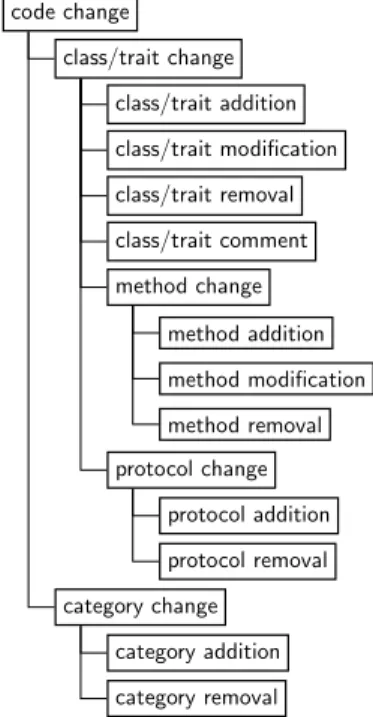
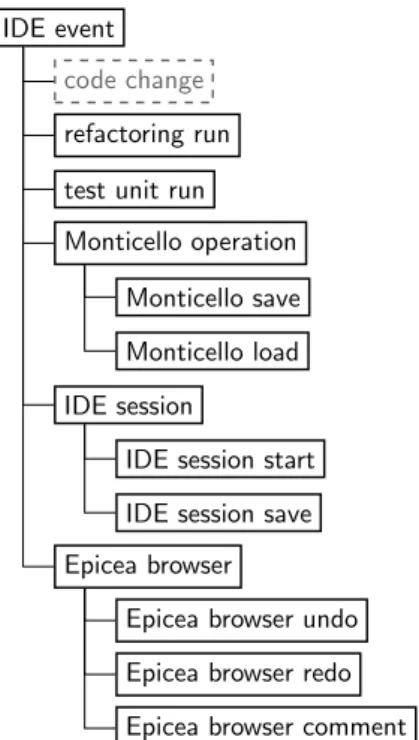
• Epicea, a first-class change model and associated IDE tools. Epicea model includes: low-level code changes such as class addition and method modification;
high-level code changes such as the method rename refactoring; and IDE interac-tion data such as unit-test run.
• EpiceaUntangler, an approach to help developers share untangled commits (aka. atomic commits) by using fine-grained code change information gath-ered from the IDE through Epicea model and tools.
Epicea model and tools allowed evaluation of our thesis in real-world scenar-ios. EpiceaUntangler’s results showed that three Epicea features are especially important to perform clustering of fine-grained code changes: the time between the changes; the number of other modifications between the changes; and whether the changes modify the same class. EpiceaUntangler is based and tested on a large Epicea dataset that we make publicly available.
Keywords: Software evolution, first-class code changes, integration activities, untangling changes.
Le code source des logiciels changent pour de nombreuses raisons: par exemple, les règles du domaine peuvent évoluer, ou les dépendances entre les différentes parties du système, telles les bibliothèques, peuvent être mises à jour. Comme les lois de Lehman le suggèrent, le logiciel doit changer pour être en permanence opérationnel, souvent conduisant les grands systèmes à croître en taille et en plexité. Plusieurs développeurs collaborent dans l’évolution d’un système com-plexe. Les développeurs changent généralement le code source en parallèle des uns des autres, ce qui entraîne des divergences dans le code. Ces divergences se doivent d’être fusionnées.
L’intégration de code source divergent est une activité complexe. Par exem-ple, deux changements qui sont corrects indépendamment peuvent introduire des bugs subtils lorsqu’ils sont intégrés ensemble. L’intégration peut être difficile avec les outils existants, qui, au lieu de faire face à l’évolution des entités réelles du pro-gramme modifié, gère les changements de code au niveau des lignes de texte dans des fichiers sources.
L’outillage est importants: les outils de développement de logiciels se sont grandement améliorés en partant d’éditeurs de texte génériques à des
environ-nements de développement intégrés (IDE), qui fournissent de la manipulation de
code de haut niveau tels que la refactorisation automatique et la complétion de code. Cette amélioration a été possible grâce à la réification des entités de programme, à savoir, leur modélisation explicite comme des entités de première classe. Néanmoins, alors que la réification des entités de programme dans les IDEs ont amélioré la productivité dans la pratique de la programmation, les entités de changement réifiées manquent dans les outils pour améliorer la productivité dans l’intégration.
Dans ce travail, nous étudions les activités impliquées dans l’intégration de code source, et proposons des approches pour faciliter l’intégration. Tout d’abord, nous avons mené une étude exploratoire pour comprendre quels sont les prob-lèmes d’outillage les plus pertinents dans les activités d’intégration. Nous avons utilisé de telles informations comme lignes directrices pour proposer:
• Epicea, un modèle de changement de première classe et des outils d’IDE associés. Le modèle d’Epicea comprend: des changements de code de bas niveau tels que l’ajout de classe et la modification de méthodes; des modifications du
code de haut niveau tels que le refactoring de changement de nom de méthode;
et des données d’interaction avec l’IDE tels que l’exécution de tests unitaires. • EpiceaUntangler, une approche pour aider les développeurs à démêler les
commits (par une décomposition en commits atomiques) en se basant sur des changement de code à grain fin recueillis auprès de l’IDE grâce au mod-èle et aux outils d’Epicea.
Le modèle et les outils d’Epicea permettent l’évaluation de notre thèse dans les scénarios du monde réel. Les résultats d’EpiceaUntangler ont montré que trois caractéristiques d’Epicea sont particulièrement importantes pour regrouper les changements de code à grain fin: la durée entre les changements; le nombre d’autres modifications entre les changements; et si les changements modifient la
même classe. EpiceaUntangler est basé et testé sur un grand ensemble de don-nées provenant d’Epicea que nous mettons à la disposition du public.
Mot clés: évolution de logiciels, réification des changement de code, intégration de branches, démêlage de changements de code.
1 Introduction 1
1.1 Integration Activities . . . 1
1.2 Integration Tools . . . 2
1.3 Thesis . . . 2
1.4 Contributions and Roadmap . . . 3
1.5 The Case of Pharo/Smalltalk . . . 5
2 Integration Activities 7 2.1 Related Work . . . 8
2.2 Methodology . . . 11
2.3 Catalog of Integrator’s Questions . . . 12
2.4 Results . . . 15
2.4.1 Participant and System Profiles . . . 15
2.4.2 Integrator’s Questions . . . 18
2.4.3 Threats to Validity . . . 18
2.5 Discussion: Top Important Questions without Tool Support . . . 20
2.6 Conclusion . . . 23
3 First-Class Code Changes 25 3.1 Version Control Systems . . . 26
3.2 Reconstructing First-class Evolution . . . 27
3.3 Recording First-Class Evolution . . . 28
3.4 Change Management in Pharo . . . 29
3.5 Epicea . . . 31
3.6 Epicea Model . . . 31
3.6.1 Code Change Model . . . 32
3.6.2 IDE Event Model . . . 33
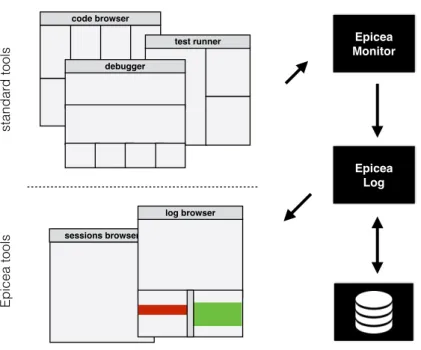
3.7 Epicea Tools . . . 34
3.8 Conclusion . . . 36
4 Untangling Code Changes 37 4.1 Problem Description . . . 39
4.1.1 Existing Solutions for Tangled Changes . . . 39
4.1.2 Addressing the Current Limitations . . . 41
4.2 Proposed Solution: EpiceaUntangler . . . 42
4.2.1 Gathering Fine-Grained Changes and IDE Events . . . 42
4.2.2 Voters . . . 42
4.2.3 Machine Learning Approaches . . . 46
4.2.4 Clustering . . . 46 4.3 Research Method . . . 47 4.3.1 Research Questions . . . 47 4.3.2 Research Settings . . . 48 4.3.3 Research Steps . . . 48 4.4 Results . . . 53
4.4.1 What Are the Dominant and Significant Voters? . . . 53
4.4.2 How Effective Is Random Forests with the Dominant Voters? 54 4.4.3 How Effective Is EpiceaUntangler for Developers? . . . 57
4.5 Discussion . . . 58
4.5.1 Results . . . 58
4.5.2 Threats to Validity . . . 59
4.6 Related Works . . . 60
4.7 Conclusion . . . 62
5 Conclusion and Future Work 63 5.1 Summary . . . 63
5.2 Future Work . . . 65
5.2.1 Interaction Data to Improve Modern Code Review . . . 66
5.2.2 Interaction Data to Mitigate Ripple Effects . . . 67
5.3 Publications . . . 69
Bibliography 73 A Appendix 83 A.1 Pharo Programming Language . . . 83
A.1.1 Minimal Syntax . . . 84
A.1.2 Message Sending . . . 84
A.1.3 Precedence . . . 85
A.1.4 Cascading Messages . . . 86
A.1.5 Blocks . . . 86
1
Introduction
Contents
1.1 Integration Activities . . . 1
1.2 Integration Tools . . . 2
1.3 Thesis . . . 2
1.4 Contributions and Roadmap . . . 3
1.5 The Case of Pharo/Smalltalk . . . 5
Software systems are indispensable in today’s world. Computing devices are ev-erywhere, and continue gaining in popularity. This increases the challenges of software development [Mens 2005, v. Deursen 2008], e.g., evolving domains that require program adaptation, new technologies and libraries that require program migration, etc. As Lehman’s laws suggest [Lehman 1980], software must be con-tinuously adapted to be useful. Software is in constant evolution, leading systems to grow in size and complexity. Behind a complex system, numerous developers collaborate in the evolution of the system’s codebase. Due to this complexity of software evolution, developers need as much help as they can get from tools.
During its lifetime, a system’s codebase changes due to concerns such as bug fixes, new features, and migrations [Demeyer 2002]. According to best practices, the implementation of such concerns happen in isolation from each others, to avoid potential interferences while they are not ready. This means that codebases temporarily diverge during development and must be integrated back when fin-ished.
1.1
Integration Activities
In the development team of a software system, the integrators have the crucial role of integrating developers’ code changes. Also known as project maintainers or integration managers, their work involve diverse integration activities such as pre-venting introduction of bugs, keeping code conventions, avoiding code duplica-tion, and keeping architectural decisions.
For each code change ∆, integrators ask themselves questions such as:
• What program entities (e.g., packages, classes, methods) does ∆ change? • Is the content of ∆ cohesive? Or should it be split?
• Will client systems need to change their codebases because of ∆?
• Have program entities related to ∆ suffer other changes since the codebase diverged?
Those questions illustrate some inherent difficulties in integration activities. They involve understanding somebody else’s changes, to be integrated in a code-base that is often different than the original one where the developer worked.
1.2
Integration Tools
At the technical level, software developers manage the evolution of a system code-base in a version control system (VCS) such as Git, Mercurial, SVN or Monti-cello. Most VCS version files and directories. Basic versioning operations are
com-mit (store or check-in) files, checkout (restore or clone) files, or diff (compare) file
versions. Other fundamental operations are: branch, which creates a copy of the versioned files, allowing isolated changes; and merge, which reconciles multiple branches.
VCS merging tools implement semi-automatic algorithms to facilitate integra-tion, which make optimistic assumptions about the internal structure of the files. In some cases, an automatic merge can be successfully performed, while in other cases, a person must decide exactly what the resulting files should contain.
In any case, current merging tools manage the evolution of files instead of pro-gram entities, which can lead to either wrong automatic tool decisions or wrong integrator decisions. We argue that the semantic gap between the program en-tities (reality) and the files (representation) is substantial, hindering integration activities and, by consequence, the whole software development process.
1.3
Thesis
Taking a look at the history of software development tools, we find that they have greatly improved from generic text editors to integrated development environments (IDEs). Modern IDEs use abstract syntax trees (ASTs) to provide high-level code manipulation (such as automatic refactorings [Fowler 1999b]), only possible by the
reification of the domain entities, i.e., by the explicit modeling of first-class program
entities.
However, while the reification of domain entities as first-class objects in IDEs improved developers’ productivity, modern VCS tools still miss reifying their do-main entities to improve integrators’ productivity.
In short. We claim that the reification of domain entities of software evolution provides a more comprehensive support to integration activities.
1.4
Contributions and Roadmap
Following, we state the main contributions of this work together with a pointer to the corresponding chapter.
Key integration activities without comprehensive tool support. Since we orient
our work to tackle real-world integration problems, we needed to know the key (most relevant) integration activities without comprehensive tool support. How-ever, we found that there is no quantitative information in that regard in literature. Thus, we performed an exploratory study to discover which are the key integra-tion activities and the level of tool support for each. (In Chapter 2.)
Requirements for a model of software evolution. We want to narrow the
seman-tic gap present in nowadays’ management of software evolution. Then, we present the state-of-the-art in modeling software evolution and mark limitations. We con-clude that such limitations can be better addressed with a first-class change model and developer interaction data gathered from the IDE when working. (In
Chap-ter 3.)
Epicea model. We report on a model of software evolution which includes explicit
entities for:
• low-level code changes, such as class addition and method modification; • high-level code changes, such as method rename refactoring;
• IDE interaction data, including extra developer’s actions in the IDE such as
unit test run.
We propose this model as a means to overcome limitations of traditional software engineering approaches which mine software repositories to reconstruct the his-tory of a software. (In Chapter 3.)
Epicea monitor and associated tools. The Epicea change model requires
informa-tion that is absent in VCS, hindering reconstrucinforma-tion from VCS data. However, such information can be gathered from the developer when working. Thus, we imple-mented an Epicea monitor, that listens developer actions from the IDE and records them as Epicea model instances. We report on the implementation of Epicea moni-tor and other associated tools, that allow us to evaluate our approaches in realistic scenarios. (In Chapter 3.)
EpiceaUntangler. After working for some time, developers commit their code
changes to a VCS. When doing so, they often bundle unrelated changes (e.g., bug fix and refactoring) in a single commit, thus creating a so-called tangled commit.
Sharing tangled commits is problematic because it makes review, reversion, and integration of these commits harder and historical analyses of the project less reli-able. We report on a novel approach, EpiceaUntangler, to help developers share untangled commits (aka. atomic commits) by using fine-grained code change in-formation gathered from the IDE through Epicea model and tools. (In Chapter 4.)
EpiceaUntangler public dataset. EpiceaUntangler is based and tested on a
pub-licly available dataset. This dataset of untangled code changes was created with the help of two developers who accurately split their code changes into self con-tained tasks over a period of four months. (In Chapter 4.)
EpiceaUntangler evaluation. We evaluated EpiceaUntangler by deploying it
to 7 developers, who used it for 2 weeks. We recorded a median success rate of 91% and average one of 75%, in automatically creating clusters of untangled fine-grained code changes. (In Chapter 4.)
In Chapter 5 we conclude this work by summarizing and discussing our work. Additionally, we outline future research plans using Epicea model of developer’s activities in the IDE (i.e., interaction data). We draw up research tracks using in-teraction data in two case studies: improve modern code review and mitigate change
1.5
The Case of Pharo/Smalltalk
As stated above, integration of code changes involves hard activities that miss comprehensive tool support. In particular, we point that VCS integration tools treat code changes as lines of text in files instead of dealing with the evolution of actual programs and the entities that constitute them. Then, we propose to im-prove integration tools with semantic awareness of the program entities involved in the changes.
Our work is empirical in nature, since we focus on real-world integration problems. For this work we chose the Pharo project [Black 2009]1as a case study. Pharo is a dynamic language based on Smalltalk [Goldberg 1989] with its own open-source programming environment.2 Pharo not only illustrates the integration problems but also serves us as a source of professional developers, researchers, and students to evaluate our approaches. This provides us with real feedback from developers that actually face the inherent problems of branching and merging.
Pharo is used by more than 25 universities3worldwide to teach programming, by 15 research groups to build tools, and more than 50 companies are using it in production4.
Why Pharo? There are two main motivations to use Pharo as a case study for our work on integration activities. First, the versioning system is tightly integrated in the IDE and already provides some first-class capabilities. Second, an important aspect in our decision is that the Pharo community of developers has been recep-tive, since its inception, to welcome and thoroughly evaluate research tools [Reng-gli 2010, Verwaest 2011, Hora 2014, Uquillas Gómez 2012b].
It might be considered a drawback to choose a dynamically-typed language whereas most research approaches rely on static analysis of programs that are statically-typed (Java, C#, etc.). Certain types of static analysis, e.g., accurate call graph analysis, is not possible for dynamically-typed languages (Javascript, Ruby, Python, etc.). Therefore, our approaches cannot strongly rely on such static anal-ysis. However, the broad use of dynamic-languages nowadays makes worth to explore this less-explored setting.
1
Pharo: http://pharo.org/ 2
An overview of the Pharo language is provided in Appendix A. 3List of universities teaching Pharo: http://pharo.org/Teachers 4
2
Integration
Activities
Contents
2.1 Related Work . . . 8
2.2 Methodology . . . 11
2.3 Catalog of Integrator’s Questions . . . 12
2.4 Results . . . 15
2.5 Discussion: Top Important Questions without Tool Support . . . 20
2.6 Conclusion . . . 23
Introduction
Software is in constant evolution [Demeyer 2002] [Lehman 1980]. In a software project, code changes represent bug fixes, enhancements, new features and adap-tations due to changing domains. The evolution of a project codebase is usually managed in a VCS supporting branches. Developers perform code changes in a branch and often such changes should be integrated into another branch. Inte-gration of changes is a difficult activity and poses substantial challenges [Uquil-las Gómez 2012a, Gousios 2014]. Focused on understanding development chal-lenges, several research works [LaToza 2010, Premraj 2011, Sillito 2008, Fritz 2010] systematically characterize what questions developers need to answer when work-ing. These works present catalogs (i.e., lists) of questions that serve as a basis for research on new tools to improve the workflow of developers. Besides the results are useful to understand development activities, the results specifically focused on integration activities are scarce. A recent survey [Gousios 2014] proposes some questions to characterize GitHub’s pull requests. However the authors do not fo-cus on a systematic characterization of questions that integrators ask themselves.
The main contributions of this chapter are:
1. A catalog of 46 questions that integrators ask when performing integration of changes. The main motivation behind obtaining these questions is to iden-tify and understand which are the information needs and tool support of developers that deal with integration activities (Section 2.3).
2. An evaluation of each question of this catalog. For each question, the par-ticipants had to rank the importance and the support that tools offer. In a period of 5 months we received the answers of 42 integrators who integrate changes on diverse software projects (Section 2.4).
3. An analysis of the evaluation results, where we identified three key integra-tion activities without comprehensive tool support. These results serve as guidelines to focus efforts on new approaches to improve everyday’s work of integrators (Section 2.5).
2.1
Related Work
Questions about Code. LaToza and Myers conducted a survey to investigate the questions that developers consider hard-to-answer [LaToza 2010]. From the answers of 179 developers at Microsoft, the authors collected 371 questions like “Are the benefits of this refactoring worth the time investment?”, “Is this func-tionality already implemented?” or “How does this code interact with libraries?”. The authors classified these questions in 10 categories: rationale, debugging, poli-cies, history, implications, implementing, refactorings, teammates, building and branching, and testing. They concluded that having a better understanding of de-velopers’ information needs may lead to new tools, programming languages, and processes that make hard-to-answer questions less time consuming or error prone to answer.
Study on Pull-Request. Gousios et al. performed a study focused on the qual-ity model that developers have in mind when they accept pull-requests on GitHub [Gousios 2014]. Some questions characterize the projects (frequency of pull-requests, tools used to assess and perform the merge, kind of requests). Then they asked developers to rank factors of acceptance or rejection: presence of tests, number of commits, comments, etc. They asked how the code is reviewed, how the pull-requests are sorted. The work style of the developer is also considered. While the poll focuses on pull-requests, it is difficult to classify the underlying questions according to different perspectives.
Study on Integration Decisions. Phillips et al. performed a study focused on how developers of a large-scale system make branching and integration decisions while managing releases [Phillips 2012]. They evaluated a survey they previously elaborated [Phillips 2011] by conducting semi-structured interviews with seven developers of a company. The authors found that developers making decisions need to consider 10 factors, such as potential conflicts, bug counts, and depen-dencies between branches. The authors also identified the information needed to support integration. Release decision makers need to predict storms of conflicts, detect pressure building up from non-integrated changes, monitor code flow be-tween branches (what is the frequency of integrations), and track branch health (metrics such as test results, bugs, and task completion at branch level).
Empirical Study on Branching and Merging. Premraj et al. presented an em-pirical study that observed developers branching without considering the conse-quences on merging [Premraj 2011]. The goal of the study was to understand the implications of such branching for the cost of merging changes. The study had two parts: 1) A qualitative study where 16 developers were surveyed (5 questions ori-ented to branchers and 3 questions oriori-ented to integrators) to learn their views on branching and merging files, and their experience with the development overhead from branching and merging; 2) a quantitative study that calculated the number of branches, the number of merges on a number of files, and the time spent on merging files. From the study they established (a) the roles of the branchers and mergers (i.e., architects, configuration managers, integrators and developers), and (b) the types of files that dictate the cost of merging (e.g., configuration files). They concluded that VCS tools and VCS best practices (e.g., branch only when necessary,
branch late, propagate early and often) are not sufficient to share files in an agile
de-velopment environment. They also suggested that contents of shared files must be aligned with the responsibilities of the primary owners of those files, as a way to decrease conflicts of branching and merging files.
Questions related to Evolution Tasks. Sillito et al. proposed a catalog of 44 types of questions programmers ask during software evolution tasks [Sillito 2008]. The authors aim to understand what a programmer needs to know about a code base when performing a change task, how a programmer goes about finding that in-formation, and how well today’s programming tools support evolution. They per-formed two qualitative studies [Sillito 2005, Sillito 2006] observing 9 and 16 pro-grammers respectively, making changes to medium and large codebase. From the analysis of the empirical information collected during both studies, they estab-lished the used tools, types of change tasks, paired versus individual program-ming, and the level of prior knowledge of the code base. 44 questions were clas-sified in 4 categories: (a) finding focus points (e.g., “Where in the code is the text in this error message or UI element?”), (b) expanding finding points (e.g., “Where is this method called or type referenced?”), (c) understanding a subgraph (e.g., “How are instances of these types created and assembled?”), and (d) questions over groups of subgraphs (e.g., “What will the total impact of this change be?”). They also established that 34% of the questions was fully addressed by tools and 66% of the questions only partially addressed. From the results, they found that programmers need better tool support for asking more refined or precise ques-tions, maintaining context, and piecing information together.
Information Fragment Model. Fritz and Murphy conducted a study in which
they interviewed 11 professional developers to identify different kinds of questions they need answered during development, but for which support is
weak [Fritz 2010]. From the results, they established a catalog of 78 questions classified in several categories such as: (a) people specific (12 questions e.g., “Which code reviews have been assigned to which person?”); (b) code change specific (35 questions e.g., “What are the changes on newly resolved work items related to me?”); and (c) work item progress (11 questions e.g., “Which features and functions have been changing?”). Alongside this study, they introduced the information fragment model (i.e., a subset of development information for the system of interest) and associated prototype tool built on top of Eclipse for answering the identified questions by composing different kinds of information needed. This model provides a representation that correlates various software artefacts (source code, work items, team membership, comments, bug reports, and others). By browsing the model, developers can find answers to particular development questions.
Catalog of Integrator’s Questions. Uquillas-Gomez presented a catalog of
inte-grator’s questions in her Ph.D. dissertation [Uquillas Gómez 2012a]. To compile a list of questions, the author conducted an open call to the developers of three Smalltalk communities to compile the questions (VisualWorks Users1, European Smalltalk User Group2, and Pharo project3). In such call, she requested integra-tors in the communities what questions they ask themselves when integrating changes. 20 integrators responded the call in a period of 10 days. The participants integrated changes on small, medium and large Smalltalk projects. Moreover, Uquillas-Gomez took into account related studies presented above [Fritz 2010,La-Toza 2010, Sillito 2008], extending the findings from the call with 8 extra questions taken from these studies. Finally, a Pharo integrator helped her to refine the ques-tions, yielding to a catalog of 64 questions.
As summarized in this section, several related works present catalogs of ques-tions as a means to understand development activities (e.g., maintenance or code comprehension) and to identify the developers’ information needs. However, these works: (1) except Uquillas-Gomez’s work, in general they do not focus on integration activities specifically but on development activities in general; (2) they do not provide a qualitative analysis to understand what are the key integration activities without comprehensive tool support.
2.2
Methodology
Integration of changes is a difficult and tedious activity. We want to tackle real-world integration problems, thus we want to know the key (most relevant) in-tegration activities with little tool support. We found that there is no qualitative nor quantitative information in that regard in literature. Thus, we established a 2-steps investigation to learn about integration activities: As a first step, we pre-pared a catalog of questions that integrators ask when performing integration of changes. By knowing which real questions are raised during integration and are troublesome to answer, we can identify what activities need more tool support. As a second step, we performed a study to discover which are the key integration activities and the level of tool support for each.
First Step: Prepare a Catalog of Integrator’s Questions
The elaboration of the catalog for validation is result of a collaboration with Verónica Uquillas-Gomez, and based on a catalog published in her Ph.D. disser-tation [Uquillas Gómez 2012a] (described in Related Work). The original catalog was too long for a survey, therefore we carefully condensed some redundant questions. The result was a catalog composed by 46 questions.
Second Step: Rank Integrator’s Questions
The questions of the elaborated catalog represent integrator’s needs to perform their everyday’s activities. Such integration questions may have different impor-tance, and some of such questions may be currently supported by development tools whereas others may not. Then, we conducted a survey to quantitatively rank each question of the catalog in two dimensions:
• Importance: Nothing, Little, Moderate, and Extreme. • Tool support: No, Partially, and Yes.
We called for participation in several software development communities, which include Smalltalk-related mailing-lists, the Twitter accounts of the Apache Software Foundation and the Eclipse Foundation. In a period of 5 months we received the responses of 42 participants who integrate changes on very diverse software projects. The survey included a “Participant Profile” part to categorize participants and their projects. We start by structuring the results of this part because of its impact on the results. The full and detailed results of this study are available in a technical report [Dias 2014].
2.3
Catalog of Integrator’s Questions
Following, we present our catalog of integrator’s questions. The questions are grouped into 5 categories: (a) authorship/ownership, (b) structural change char-acterization, (c) behavioral change charchar-acterization, (d) bug tracking infrastruc-ture, and (e) temporal and change sequence. We briefly describe each category prior to introducing its respective questions. Each question is accompanied by an identifier (e.g., A1) that is used to refer to the question in later sections.
Authorship/Ownership. The first category of questions is related to the owner of the original code, to the author of the changes, and to the committer. These questions assess the author’s quality and the reliability level of his changes.
Authorship/Ownership questions
A1 Who is the author of this changed code?
A2 Who was the previous owner of the changed code? A3 Has my own code been changed?
A4 What is the general quality of the change committer?
A5 How many people have contributed to this group of commits?
Structural change characterization. The second category of questions is related to the structure of the original code as well as the changes. They cover various as-pects in terms of volume, impact volume, dependencies (which packages, classes should be loaded before), and so on. From that perspective, they are not tailored to a sequence of changes but more to a single commit [Uquillas Gómez 2010b].
Structural change characterization questions
S1 How large is the change?
S2 How many entities (packages/classes/methods) are impacted by the commit? (Impacted in the sense they can stop compiling, for example) S3 Is this commit confined to a single package or spread over the entire
system?
S4 What is the complexity of the changes?
S5 Do all the changes within the commit belong together? (Can we split the commit?)
S6 Are there other packages that will need to change as well to integrate this commit? (Can we identify the users of the changed code?) S7 Will the code compile after applying this commit?
S8 Is the commit conflict free? (Does this change generate any syntactic merge conflicts when integrating?)
. . . continued from previous page
Structural change characterization questions
S9 Which entities (packages/classes/methods) have been changed? S10 Does this change depend on other changes (in the source branch) to
be functional (in the target branch)?
Behavioral change characterization. The third category of questions is related to the nature, behavior and intent of a change. Such questions can be mostly ap-plied to changes within a single delta. Note that some of these questions are open-ended and therefore inherently difficult to answer automatically. Moreover they may require up-front knowledge of the system as well.
Behavioral change characterization questions
B1 Does this commit follow rules and conventions?
B2 Is the vocabulary used in the commit consistent with the one on the system?
B3 Does this commit improve the quality of the system?
B4 Does this commit correctly fulfil its goal? (Does it fix correctly a par-ticular problem?)
B5 What is the intention of this commit?
B6 In a commit with ’strange code’, was the strange code intentional (it has to be like that to turn around a special aspect of the system), or accidental (the author did not really know what he was doing)? B7 What kind of commit is it? (Bug fix/New
feature/Refactoring/Doc-umentation/...)
B8 Does this commit fix/break tests? Which tests?
B9 Is the commit covered by tests? What is the coverage? How can I test it?
B10 If I apply the commit, what are the parts of my current system that it affects? What are the users (classes/methods/functions) potentially impacted by this change in the destination branch/fork?)
B11 What are the implications of this commit on the (potentially unde-clared) API? (Are there any unknown users of the API that will be impacted by the changes?)
Bug tracking infrastructure. The fourth category of questions is related to bug
Bug tracking infrastructure questions
I1 To which bug entry does this change relate?
I2 What bug fixes also affected the part of the system that is being im-pacted by this change?
Temporal and change sequence. The final category of questions is related to
situ-ating changes within the context of a sequence of changes, as well as to the time at which the changes occurred. Indeed, often a change does not happen in isolation, other changes may depend on it and fork analysis requires to understand change dependencies [Uquillas Gómez 2014]. In particular, when working on a sequence of changes, these questions capture the place of a change within the sequence.
Temporal and change sequence questions
T1 How old is this commit (compared to the version to which it should be integrated)?
T2 In which commit/version of the system was this method/function previously changed?
T3 Did this class/method/function change (a lot) recently/in the past? T4 Is this change to a class/method/function the most recent one (in the
branch)?
T5 Is there any pending change in the sequence of commits (in the branch) that supersedes this one?
T6 Is this commit part of a whole series of commits?
T7 Does this commit depend on previous ones? (What are the other com-mits needed first to merge this commit?)
T8 Is the change to a class/method/function ever used in subsequent changes?
T9 Is this change to a class/method/function reverting the code to an old state?
T10 What else changed when this code was introduced or modified (e.g., documentation, website, database schema)?
T11 What other classes/methods/functions changed when this code was introduced or modified?
T12 What are the changes made by the same authors/during the same time period?
T13 Did the changing classes/methods/functions of this commit change together in a previous commit?
. . . continued from previous page
Temporal and change sequence questions
T14 If there were changes to class/methods/functions happening to-gether in the past, can we suspect that there is still something missing in the current commit?
T15 Were the classes/methods/functions affected by this change re-named in the past and, if so, in which version of the system?
T16 What were the users (callers) of a changed method/function in a par-ticular version of the system?
T17 What are the current users (callers) of a changed method/function? T18 What commits of another branch have been integrated into this
branch?
2.4
Results
In this section we present a summary of the results from our survey. We start by an analysis of the integrator’s profiles and systems they work on. Next, we analyze the ranking of integrator’s questions from the catalog. We remind that the detailed report of the collected data is available as a technical report [Dias 2014]. Finally, we analyze threats to validity of our results.
2.4.1
Participant and System Profiles
The results show that participants’ experience is quite diverse and serious, both in development (Figure 2.1) and in integration (Figure 2.2). Compared with de-velopment experience, integration experience has a smaller spread period: from 2 to 20 years compared to the 5 to 45 years.
Most of the participants (88%), answered they are (or they were) developers of the system where they integrate changes; this is a result that we expected due to the complexity of integration activity, which requires a deep knowledge of the codebase of a project that generally only a developer working on it has. Turnover and open-source projects may change such fact.
System characterization. Most of participant’s systems involve between 3 and
16 developers (Figure 2.3). About the frequency of integrations, participants an-swered performing them mostly on demand, i.e., not regularly but when necessary. Around 20% of the participants answered that they never perform integrations be-tween forks. In the answers, approximately half of the systems are open-source. About the size in lines of code (LOC), most of the projects have between 10k and 450k LOC. When we asked for the kind of software where developers integrate
changes, three quarters answered they work in End user applications, and the same number of responses for Libraries, frames and platforms. This means that many par-ticipants integrated changes both in client- and in provider-side of their software.
0 10 20 30 40 50 ● ● ● ● ● ● ● ● ● ● ● ● ● ● ● ● ● ● ● ● ● ● ● ● ● ● ● ● ● ● ● ● ● ● ● ● ● ● ● ● ● ●
Figure 2.1: How many years have you been developing software? 0 5 10 15 20 25 ● ● ● ● ● ● ● ● ● ● ● ● ● ● ● ● ● ● ● ● ● ● ● ● ● ● ● ● ● ● ● ● ●
Figure 2.2: How many years have you been integrating changes? 0 20 40 60 80 ● ● ● ● ● ● ● ● ● ● ● ● ● ● ● ●● ● ● ● ● ● ● ● ● ● ● ● ● ● ●● ● ● ● ●
Figure 2.3: How many
de-velopers are working on this
system? (we removed two outliers: 250 and 600) 0 2 4 6 8 10 ● ● ●● ● ● ● ● ● ● ● ● ● ● ● ● ● ● ● ● ● ● ● ● ● ● ● ● ● ● ● ● ● ●
Figure 2.4: How many
inte-grators are working on this
system? (we removed one outlier: 60)
Approximately 26% of participants answered they are not the main integrator of their system. This percentage shows how much the role of integration is shared by several project members. In fact, Figure 2.4 reveals that there is a median of 2 integrators per system. 93% of participants reported that they interact with de-velopers when integrating changes. In the survey we asked what are the reasons of such interaction with developers. The main reason participants answered was solving merging conflicts. They answered as well that understanding the changes, and giving feedback about the quality of the changes are other reasons for inter-acting. Figure 2.5 shows that “Development” and “Release” are the most used types of branches, although “Feature”, “Bug fix” and “Experimental/Prototype”
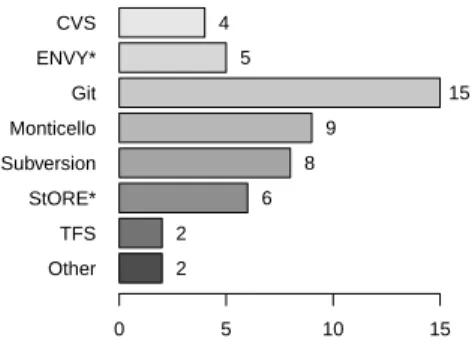
are common as well. Figure 2.6 shows that the participants consider merge con-flicts and regressions as the most significant problems. In the results, we observe the same number of participants use general VCS (CVS, Git, SVN and TFS) and Smalltalk-specific VCS (Monticello, StORE and ENVY) (Figure 2.7).
Customer−specific* Platform Contributor/Personal Experimental/Prototype Release Merge Bug fix Feature Development 0 10 20 30 2 3 9 15 23 9 15 16 29
Figure 2.5: What types of branches are defined for this system? The “*” category (i.e., “Customer specific”) was ex-tracted from “Other” field.
Other Compilation errors Cross−cutting regressions Test regressions Merge conflicts 0 10 20 3 10 17 22 23
Figure 2.6: What are the most sig-nificant problems that you have had with merges?
Other TFS StORE* Subversion Monticello Git ENVY* CVS 0 5 10 15 2 2 6 8 9 15 5 4
Figure 2.7: Which versioning tool(s) are using for this system? The “*” categories (i.e., “StORE*” and “ENVY*”) were ex-tracted from “Other” field.
2.4.2
Integrator’s Questions
In this section, we classify the questions and report only the questions identified as important and with little tool support. From this analysis we will get insights on how to improve the integration toolset.
Importance: If a question’s responses are concentrated among No and Little
im-portance, we say the question has Agreed No-Importance; if responses are con-centrated between Moderate and Extreme importance, we say the question has Agreed Importance. Instead, when there is not a clear agreement among the answers, we say the question has Disagreed Importance.
Tool Support: If a question’s responses are concentrated around No, we say the
question has Agreed No-Support; if responses are concentrated around Yes, we say the question has Agreed Support. Instead, when there is not a clear agreement among the answers, we say the question has Disagreed Support.
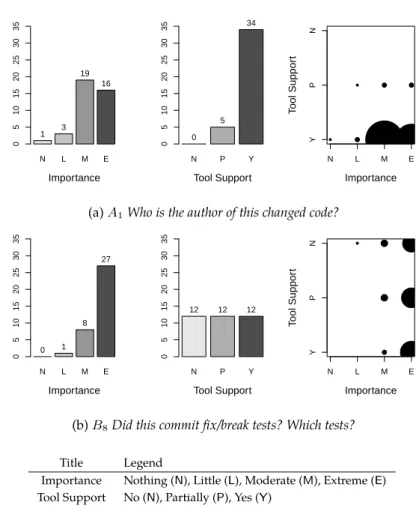
We illustrate our classification criteria in Figure 2.8, which presents the re-sponses to two integration questions:
A1 : Who is the author of this changed code? B8 : Does this commit fix/break tests? Which tests?
For A1, participants mostly agreed that this question has from moderate to extreme importance, and that it does have tool support. Thus, we classify A1 as a question with Agreed Importance and Agreed Support. For B8, participants also agreed that it is an important question, but they disagreed in the tool support. Then, we classify B8as a question with Agreed Importance and Disagreed Support.
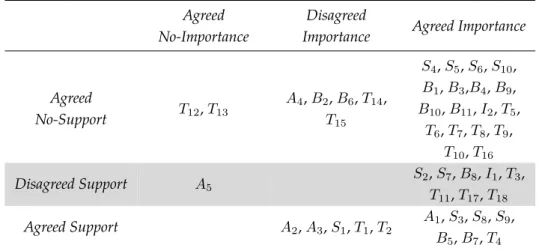
We applied these criteria to all the questions of the catalog. Results are pre-sented in Table 2.1. Overall, in the dimension of Importance, 33 questions (72%) have Agreed Importance, 10 have Disagreed Importance (21%), and only 3 have Agreed
No-Importance (7%). In the dimension of Tool Support, 12 questions (26%) have Agreed Support, 9 have Disagreed Support (20%), and 25 have Agreed No-Support
(54%). In the following section, we use this categorization to discuss the most rel-evant results.
2.4.3
Threats to Validity
The result of the first step of our research work, i.e., the catalog of integrator ques-tions, was originally compiled from surveying Smalltalk community members, and thus it might be biased to the integration of changes in Smalltalk projects. However, integration tools used in these Smalltalk communities have similar characteristics than in other communities. Then, this fact should not represent a threat for our catalog.
N L M E Importance 0 5 10 15 20 25 30 35 1 3 19 16 N P Y Tool Support 0 5 10 15 20 25 30 35 0 5 34 ● ● ● ● ● Importance T ool Suppor t N L M E Y P N
(a) A1Who is the author of this changed code?
N L M E Importance 0 5 10 15 20 25 30 35 0 1 8 27 N P Y Tool Support 0 5 10 15 20 25 30 35 12 12 12 ● ●
●
●●
● Importance T ool Suppor t N L M E Y P N(b) B8Did this commit fix/break tests? Which tests?
Title Legend
Importance Nothing (N), Little (L), Moderate (M), Extreme (E) Tool Support No (N), Partially (P), Yes (Y)
Figure 2.8: Examples of our classification criteria for two participant’s responses.
The results of our second research step, i.e., the survey responses, indicate that the participants profile were diverse in a number of relevant aspects (Sec-tion 2.4.1): development and integra(Sec-tion years of experience, used VCS tools. Also, the participants work on both academic and industrial Smalltalk projects that follow different development policies. In addition, the profiles showed that par-ticipants’s experience includes several programming languages. Finally, we think the population size of this survey (42 integrators) is enough to extract reliable gen-eral conclusions even thought we let as future work to repeat the survey with a larger population.
Agreed No-Importance
Disagreed
Importance Agreed Importance
Agreed No-Support T12, T13 A4, B2, B6, T14, T15 S4, S5, S6, S10, B1, B3,B4, B9, B10, B11, I2, T5, T6, T7, T8, T9, T10, T16 Disagreed Support A5 S2, S7, B8, I1, T3, T11, T17, T18 Agreed Support A2, A3, S1, T1, T2 A1, S3, S8, S9, B5, B7, T4
Table 2.1: Classification of the questions according to surveyed integrators.
2.5
Discussion: Top Important Questions without
Tool Support
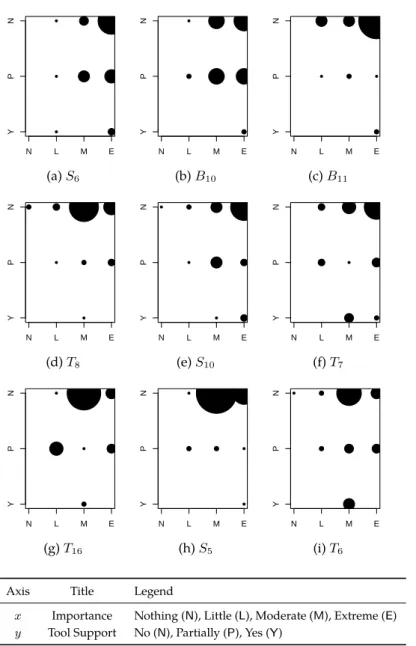
The goal of the survey is to identify key integration activities without comprehen-sive tool support. To that end, we performed a thorough interpretation of the 18 questions identified as important with little tool support (in the upper-right corner of Table 2.1). The result was a selection of 9 questions (summarized in Figure 2.9). We found three conceptual axis in these questions, which we use to interpret the survey results: understanding change impact; understanding change dependencies with
cherrypicking; and understanding change scattering.
Understanding Change Impact
Understanding the impact of applying a code change on the current system is a key concern of integrators. The effects of a change are of crucial importance since it can introduce unexpected behavior in the system. The following questions capture the problems faced by integrators when assessing the impact of code changes. S6 : Are there other packages that will need to change as well to integrate this
commit? (Can we identify the users of the changed code?)
B10 : If I apply the commit, what are the parts of my current system that it af-fects? What are the users (classes/methods/functions) potentially impacted by this change in the destination branch/fork?)
B11 : What are the implications of this commit on the (potentially undeclared) API? (Are there any unknown users of the API that will be impacted by the changes?)
N L M E Importance 0 5 10 15 20 25 30 35 0 3 9 21 N P Y Tool Support 0 5 10 15 20 25 30 35 17 12 4 ● ● ● ●
●
● ● Importance T ool Suppor t N L M E Y P N (a) S6 N L M E Importance 0 5 10 15 20 25 30 35 0 3 14 18 N P Y Tool Support 0 5 10 15 20 25 30 35 17 16 2 ●●
●
●● ●
● Importance T ool Suppor t N L M E Y P N (b) B10 N L M E Importance 0 5 10 15 20 25 30 35 0 6 7 19 N P Y Tool Support 0 5 10 15 20 25 30 35 26 4 2 ● ● ● ● ● ● Importance T ool Suppor t N L M E Y P N (c) B11 N L M E Importance 0 5 10 15 20 25 30 35 2 4 16 10 N P Y Tool Support 0 5 10 15 20 25 30 35 25 6 1 ● ●●
● ● ● ● Importance T ool Suppor t N L M E Y P N (d) T8 N L M E Importance 0 5 10 15 20 25 30 35 1 3 11 18 N P Y Tool Support 0 5 10 15 20 25 30 35 20 9 4 ● ● ● ● ● ● ● ● Importance T ool Suppor t N L M E Y P N (e) S10 N L M E Importance 0 5 10 15 20 25 30 35 0 6 11 17 N P Y Tool Support 0 5 10 15 20 25 30 35 20 8 6 ●●
● ● ● ● ● Importance T ool Suppor t N L M E Y P N (f) T7 N L M E Importance 0 5 10 15 20 25 30 35 0 7 18 9 N P Y Tool Support 0 5 10 15 20 25 30 35 21 11 2 ● ●●
● ● ● Importance T ool Suppor t N L M E Y P N (g) T16 N L M E Importance 0 5 10 15 20 25 30 35 0 3 20 12 N P Y Tool Support 0 5 10 15 20 25 30 35 29 5 1 ● ● ● ● ● Importance T ool Suppor t N L M E Y P N (h) S5 N L M E Importance 0 5 10 15 20 25 30 35 1 4 20 9 N P Y Tool Support 0 5 10 15 20 25 30 35 19 10 5 ● ● ● ● ● ● ● Importance T ool Suppor t N L M E Y P N (i) T6Axis Title Legend
x Importance Nothing (N), Little (L), Moderate (M), Extreme (E) y Tool Support No (N), Partially (P), Yes (Y)
T8 : Is the change to a class/method/function ever used in subsequent changes? T16 : What were the users (callers) of a changed method/function in a particular
version of the system?
These five questions share the need of understanding the impact of integrat-ing a change in the destination branch. However, these questions do not refer to the same kind of impact: In one hand, B10 and T8refer to the local impact, i.e., which are the entities in the codebase (in the target branch) that are affected by the change. In the other hand, S6and B11refer to the external impact, i.e., which entities in other codebases are affected with the change. The latter is usually called
ripple effect. [Yau 1978]
Questions T8and T16complement each other: the former talks about impact in future commits of a branch, while the latter talks of impact in past commits. These questions address important issues when the commits around a change have to be understood.
Understanding Change Dependencies when Cherrypicking
Sometimes an integrator has to apply in a branch (i.e., target or destination branch) some code changes selected from another branch (i.e., source branch). This action is known as cherrypicking code changes. The main difference with a plain merge is that not every change from the source branch is applied in the destination branch, but only a selection of such changes.
Cherrypicking is a difficult activity: consider cherrypicking a modification in a method which adds a reference to a class that does not exist in the destination branch (leading to compilation errors). In general, a change can depend on other changes in the branch, and the identification of such dependencies is difficult. The following questions capture such problems.
T7 : Does this commit depend on previous ones? (What are the other commits needed first to merge this commit?)
S10 : Does this change depend on other changes (in the source branch) to be func-tional (in the target branch)?
These two questions have much in common, since both focus in the under-standing of the dependencies of a change. The main difference is in the granular-ity of changes: while T7is clearly a commit granularity, S10dissolves the commit boundaries when it references to changes in general.
Understanding Change Scattering
Developers often bundle changes of unrelated tasks (e.g., bug fix and refactoring) in a single commit, thus creating a so-called tangled commit. In a study, Herzig and
Zeller [Herzig 2013] analyzed several open-source projects and found that 20% of the bug-fixing commits are tangled, i.e., these commits contain unrelated changes apart of the bug fix changes. In other cases, however, developers perform a single task (e.g., implementing a new feature) spread over several commits, which also poses difficulties to understand changes.
The following questions can be interpreted as two sides of the same problem: the wrong spread of code changes along commits.
S5 : Do all the changes within the commit belong together? (Can we split the commit?)
T6 : Is this commit part of a whole series of commits?
Question S5is related to understanding changes in a tangled commit. Question T6is about understanding changes related to one task, that are spread in several commits.
Question S5is the most important question without tool support according to the participants of our survey. Unlike the other questions discussed above, S5and T6have no direct reference to change dependencies or impact.
2.6
Conclusion
Since we orient our work to tackle real-world integration problems, we needed to know the key (most relevant) integration activities without comprehensive tool support. After an analysis of the literature, we found that there is no quantitative information at this respect. Thus, we performed an exploratory study to rank the importance of integration activities and the level of tool support for each.
The most important contribution of this chapter to our thesis results from the analysis of the collected survey responses, where we identified three key integra-tion activities without comprehensive tool support:
1. understanding change scattering;
2. understanding change dependencies when cherrypicking; and 3. understanding change impact.
These results serve as guidelines to focus our efforts on new approaches to improve everyday’s work of integrators.
3
First-Class Code
Changes
Contents
3.1 Version Control Systems . . . 26 3.2 Reconstructing First-class Evolution . . . 27 3.3 Recording First-Class Evolution . . . 28 3.4 Change Management in Pharo . . . 29 3.5 Epicea . . . 31 3.6 Epicea Model . . . 31 3.7 Epicea Tools . . . 34 3.8 Conclusion . . . 36
Introduction
Often software engineering researchers resort to the data available in VCS to uncover information about software systems. Examples include extracting mi-gration rules [Hora 2013, Hora 2014], automatic bug repair [Martinez 2014], inference of association rules between software artifacts to prevent defects [Zim-mermann 2005], discovering software quality issues [Eick 2001] and predicting which parts of a software system are fault-prone, to focus reviewing and testing efforts [Nagappan 2005].
Mining Software Repositories [Herzig 2010] is an empirical software engineer-ing research field that exploits the information that developers produce, that is stored in software repositories (such as a VCS or an issue tracking system). By carefully using scientific methods, researchers extract laws and build approaches that end in better development tools [Zeller 2013].
However, empirical studies are only as reliable as the data they rely on. Most of these studies depend on the accuracy of the mined evolution data, which is threatened by noise and incomplete data [Herzig 2013,Robbes 2005,Negara 2012]. Following, we go deeper into the causes of these problems in VCS.
3.1
Version Control Systems
Most popular VCS, such as SVN, Git1and Mercurial2, hold the following prop-erties:
State-based evolution. VCSs store little or nothing of the operations that lead
from one version to the next one. They represent the evolution of a system as a graph of versions. Then, the operations from a version to another is com-puted by comparing the snapshotted files. However, some operations are not trivial to reconstruct, and can only be estimated.
Text-based evolution. VCSs version file and directory structures, and represent
a file change as a set of inserted, deleted and updated text lines. Due to this property, generally the program entities of a codebase are represented as text files. Thus, a developer that wants to understand the evolution of a sys-tem has to mentally decode text-line operations that the VCS handle into program entity operations. The substantial semantic gap between the pro-gram entities (reality) and the files (representation) hinders understanding of a system’s evolution [Uquillas Gómez 2014] and raises merging prob-lems [Mens 2002].
Commit-based evolution. The commit time is the only moment in which the
VCSs record actions of the developer to the codebase. However, an arbitrary amount of developer actions might take place before a commit: for example, what looks like a one-line change in a commit might have been the result of a bug-tracking session that lasted several days [Robbes 2005]. Negara
et al. detected that 37% of code changes performed by the developer are shadowed, i.e., overriden by subsequent changes in the same line, file and
commit [Negara 2012]. Such shadowed changes can not be reconstructed from the VCS data. Then, VCSs loose important data from the system’s evolution.
These properties of most popular VCS lead us to classify the related works of software evolution tools into two main groups of approaches:
• Reconstructing first-class evolution approaches, that tackle problems of
text-based evolution by recovering evolution from VCS data as program entity
and/or change models.
• Recording first-class evolution approaches, that start with a clean slate by recording fine-grained developer actions from the IDE to tackle problems related to state-based evolution and commit-based evolution properties.
1
Git: http://git-scm.com 2
Next, we describe such related works. We show that whereas in the approaches in first point mitigate the aforementioned significant semantic gap in VCS data
pre-cise evolution data, the approaches in the second point aim at obtaining a complete
evolution data.
3.2
Reconstructing First-class Evolution
FAMIX change models. FAMIX [Ducasse 2000,Tichelaar 2000] provides first-class
models for program entities of diverse languages such as Smalltalk, Java, Python and Cobol. First-class code change models have been proposed on top of FAMIX: Hismo and Orion.
Gîrba proposed Hismo [Gîrba 2005, Gîrba 2006], which uses FAMIX to model the history of a software system, providing facilities for reasoning over versions.
Laval presented Orion, a history model [Laval 2009, Laval 2011] that extends FAMIX to support larger systems and histories than Hismo. Its design allows a more optimal memory usage, by sharing program entity models between system versions. Orion provides an interactive tool for software reengineering that allows simulation of changes and compare their impact on the system.
Ring change models. Ring [Uquillas Gómez 2012b, Uquillas Gómez 2010a] is
a first-class model for Smalltalk program entities whose objective is to serve as a unified infrastructure for building IDE tools in Pharo. On top of Ring, Uquillas Gómez et al. model history as first-class citizens in two complementary models: RingH and RingC [Uquillas Gómez 2012a]. Using these models, the author built tools for change and history analysis: Torch and JET. Torch [Uquil-las Gómez 2014] is a visual tool that helps to understand changes based on semantic characteristics of changes, such as scope and size in terms of program entities involved (e.g., package, class, method).
ChangeDistiller and Evolizer, by Fluri and Gall et al., process Java source code files to reconstruct code changes [Fluri 2007, Gall 2009]. They represent evolution as series of AST changes (insert, delete, move and update node). To extract changes between two versions of a codebase, their algorithm matches AST nodes between the versions and approximate what operations can trans-form one tree into the other. Falleri et al. proposed GumTree, which computes shorter edit scripts, and thus are closer to the original developer’s intent [Fal-leri 2014]. All these approaches are inspired on an existing tree differencing algorithm [Chawathe 1996].
Several approaches recover refactorings from VCS histories and highlight the importance of this information to understand the evolution of a system.
Demeyer et al. infer refactorings by comparing two versions of a codebase. They propose an heuristic algorithm based on low-level software metrics such as method size, class size, and inheritance levels [Demeyer 2000].
Weissgerber and Diehl presented a technique to detect refactoring candidates with high recall and precision [Weissgerber 2006].
Dig et al. presented a technique based on program entity references such as method calls and type imports [Dig 2006].
Prete et al. presented REF-FINDER, a template-based approach that can infer a wide variety of refactorings [Prete 2010]. Their templates build upon semantic analysis performed on program entities, such as method calls and inherited fields.
3.3
Recording First-Class Evolution
Rather than mining evolution data from VCS repository, the following approaches instrument IDEs to access a more complete data. Instead of just analyzing the end result of several hours or days of work, tools can know what exact changes were performed, whether there were pauses in the development, etc., in order to perform a given task [Maalej 2014].
Lippe, in an early work, presented his approach which records operations from the IDE and implements an advanced merging algorithm [Lippe 1992].
Cheops [Ebraert 2007] records developer’s actions using a change model built on top of the above-mentioned FAMIX model.
Robbes’ SpyWare captures developer fine-grained code changes in a central-ized repository [Robbes 2008b]. SpyWare records detailed changes such as a line added in a method, as well as more high-level changes such as some automatic refactorings. He proposes a multiple-language model and abstract syntax tree (AST) change operations, as well as some high-level operations like ‘class rename’.
Dig et al. present MolhadoRef, a VCS that is aware of program entities and refactoring operations [Dig 2008]. This tool mixes operation-based and state-based merging to capture the semantics of refactoring operations. It records the refac-torings performed by the developers, and calculates deltas that represent other changes. Therefore, it can merge changes that involve a combination of logged refactorings and textual editing.
CoExist [Steinert 2012] preserves fine-grained intermediate states of the sys-tem during a development session, allowing back-in time browsing and execution. A distinguished feature of CoExist is the possibility of easily executing arbitrary
code in any past intermediate version of the system during a development ses-sion. CoExist is a step-forward from Changeboxes [Zumkehr 2007], which is a similar approach but misses proper tools for navigating and manipulating the history (e.g., search and replay changes). However, the evolution data that both approaches preserve is restricted to the IDE runtime since they miss an external persistence mechanism for the code changes. This limits the possibility of per-forming long-term history analysis.
In parallel, three similar approaches were developed which gather developer actions from Eclipse IDE:3Negara et al. presented CodingTracker [Negara 2012, Negara 2014], Ge et al. presented BeneFactor [Ge 2012] and Foster et al. presented WitchDoctor [Foster 2012]. These tools monitor code changes and detect manual refactorings, i.e., refactorings performed by the developer without using the IDE automated refactorings.
3.4
Change Management in Pharo
Since we decided to validate our thesis in Pharo community, we performed an analysis on the most relevant tools for change management in the Pharo IDE: Monticello and Change List.
Monticello. In Pharo, as in other Smalltalk systems, Monticello is the most
popular VCS. Monticello is a distributed VCS, such as Git or Mercurial, that enables a developer to version snapshots of the program, and easily branch and merge. To the effects of our work, Monticello has no substantial differences with the other distributed VCS aforementioned:
• the intermediate states of the codebase in the development session are lost; • developer’s actions are not reified.
Change List. Most Smalltalk systems provide the Change List tool, which acts
as a tape recording of source code changes. This tool writes down to disk code changes immediately after any editing operation. For Pharo developers, Change List is a useful complement to Monticello. It allows navigation of the different versions of the program entities with finer granularity than a traditional VCS. Additionally, a Change List can be replayed: if the developer forgets to save changes before quit, or the system execution is accidentally interrupted (e.g., the virtual machine crashes or the process is killed), then the developer can explore the Change List to replay unsaved changes.
3