HAL Id: tel-02467581
https://hal.archives-ouvertes.fr/tel-02467581
Submitted on 5 Feb 2020
HAL is a multi-disciplinary open access
archive for the deposit and dissemination of
sci-entific research documents, whether they are
pub-lished or not. The documents may come from
teaching and research institutions in France or
abroad, or from public or private research centers.
L’archive ouverte pluridisciplinaire HAL, est
destinée au dépôt et à la diffusion de documents
scientifiques de niveau recherche, publiés ou non,
émanant des établissements d’enseignement et de
recherche français ou étrangers, des laboratoires
publics ou privés.
Modélisation et analyse de la criticité mixte pour le
Systèmes embarqués temps réel
Luca Santinelli
To cite this version:
Luca Santinelli. Modélisation et analyse de la criticité mixte pour le Systèmes embarqués temps
réel. Sciences de l’ingénieur [physics]. INSTITUT NATIONAL POLYTECHNIQUE DE TOULOUSE,
2019. �tel-02467581�
Toulouse
Habilitation `
a diriger les recherches
pr´
epar´
ee au
D´
epartment Traitement de l’Information et Syst`
emes de l’ONERA
pr´esente et soutenue publiquement, le 20/05/2019, par
LUCA SANTINELLI
Title:
Mixed Criticality Modeling and
Analysis Paradigms for Real-Time
Jury:
Mme. Isabelle Puaut Rapporteur Professeur Universit´e de Rennes I (France) M. Alan Burns Rapporteur Professeur University of York (UK)
M. Joel Goossens Rapporteur Professeur Universit´e Libre de Bruxelles (Belgique) M. Luis Almeida Examinateur Professeur Universidade do Porto (Portugal) M Laurent George Examinateur Professeur ESIEE Paris (France)
M Yves Sorel Examinateur Directeur de recherche INRIA Paris (France)
Preamble
This manuscript motivates and details the research project chosen for investigating today’s and future real-time embedded systems. In it, the research activities as well as the research perspectives are described in order to outline project challenges, achievements already made, and future works. The manuscript and the research project are also for preparing and defending the ”Habilitation Diriger des Recherches” (HDR).
As research project, it has been chosen to investigate mixed criticality real-time embedded systems. In few words, the project aims at guaranteeing timing constraint and schedulability of applications with different requirements/criticality that are running together. Mixing criticality tries to reconcile efficient resource usage and safety assurance, thus it is critical with today’s and future multi-core and many-core implementations for real-time embedded systems. It is a complex problem and has some interesting open problems that requires to be studied.
The project is presented with respect to works already made, and more importantly with perspectives that will be elaborated with future achievements. Previous research on non-mixed critical real-time embedded systems for timing analysis and schedulability analysis is also described; it is background work for mixed criticality achievements.
The manuscript is organized into three parts: i) the first is for presenting the professional experience made before the PhD as well as the academic experience in the real-time community made since the PhD; ii) the second is for detailing with some publications the research topics approached so far and the research problem under investigation; iii) the third, concludes the manuscript with observations on works already made for the research project, and ideas for future work.
The first part of the document is where it is detailed the curriculum vitae from the Master thesis up until today. In it, there are presented the training, the different positions hold, and every involvement in the scientific community. There are also listed the students supervised, the research and technology transfer projects worked on, and the collaborations made.
The second part is more technical since there is presented the past research and some early works on mixed criticality. The past works do not approach the mixed criticality problem, but are used as background for developing solutions for mixed criticality. Moreover, there are presented recent works which contributes to timing analysis and schedulability analysis for mixed criticality.
The third part concludes the manuscript with a discussion on the mixed criticality research project. There are illustrated limitations of already existing solutions, and there are discussed future research for more effective resource usage, for reducing pessimism and complexity, and for flexible safety guarantees. In particular, it is discussed the opportunities as well as the challenges that multi- and many-core platforms brings to mixed criticality.
The research project is the results of the twofold motivation from professional as well as academic experience made on real-time embedded systems. In it, both academic and industrial perspectives to mixed criticality are considered with solutions that will benefit both. The achievements will continue to come from research and technology transfer projects, from the collaborations with academic and industrial partners, and from the supervision of PhD as well as Master students.
1 Experience with real-time embedded systems 1
1.1 Professional and academic experience . . . 1
1.2 Supervising and teaching activities . . . 3
1.3 Serving within the research community . . . 5
1.4 Collaborations and international mobility . . . 6
1.5 Organization of the manuscript . . . 8
2 From safety critical real-time to mixed criticality real-time 10 2.1 Past contributions on real-time . . . 10
2.2 The mixed criticality problem . . . 13
2.2.1 Mixed critical task models . . . 16
2.2.2 Mixed criticality scheduling . . . 18
2.2.3 The industry perspective to mixed criticality: partitioning and isolating . . . 19
2.2.4 Dynamic systems: toward mixed criticality . . . 20
2.3 Mixed criticality as research perspective . . . 22
2.3.1 Some thoughts about timing analysis for mixed criticality . . . 25
2.3.2 Some thoughts about schedulability for mixed criticality . . . 26
3 Contributions to timing analysis and schedulability analysis 29 3.1 Computational models . . . 30
3.1.1 Deterministic models . . . 30
3.1.2 Probabilistic models . . . 33
3.2 Probabilistic timing analysis . . . 37
3.2.1 Static probabilistic timing analysis . . . 39
3.2.2 Measurement-based probabilistic timing analysis . . . 44
3.2.3 Some conclusions on probabilistic timing analysis . . . 47
3.3 Deterministic and probabilistic schedulability analysis . . . 49
3.3.1 Abstract models for sensitivity analysis . . . 49
3.3.2 Dynamic real-time systems . . . 51
3.3.3 Real-time calculus and probabilities . . . 56
3.3.4 Probabilistic schedulability analysis . . . 59
3.3.5 Formal methods for probabilistic real-time . . . 62
3.3.6 Some conclusions on deterministic and probabilistic schedulability analysis . . . 65
4 Current state of mixed criticality research 68 4.1 Deterministic approaches to mixed criticality . . . 69
4.1.1 Sensitivity analysis for mixed criticality . . . 70
4.1.2 Mixed criticality scheduling with limited hi-criticality behaviors . . . 76
4.1.3 Some conclusions on deterministic approaches to mixed criticality . . . 78
4.2 Probabilistic approaches to mixed criticality . . . 78
CONTENTS
4.2.2 Probabilistic sensitivity analysis for mixed criticality . . . 82
4.2.3 Open problems with probabilistic sensitivity analysis . . . 84
4.2.4 Fault-aware sensitivity analysis for probabilistic real-time systems . . . 87
4.2.5 Probabilistic scheduling for mixed criticality . . . 91
4.2.6 Formal methods and mixed criticality . . . 96
4.2.7 Some conclusions on probabilistic approaches to mixed criticality . . . 101
5 Concluding remarks, lessons learned, and future perspectives on mixed criticality 103 5.1 Lessons learned on mixed criticality . . . 104
5.1.1 Probabilistic timing models for mixed criticality . . . 105
5.1.2 Deterministic schedulability approaches to mixed criticality . . . 109
5.1.3 Probabilistic schedulability approaches to mixed criticality . . . 112
5.2 On the future of mixed criticality . . . 117
5.3 Future projects . . . 123
Bibliography 126
Table of acronyms
ASIL Automotive Safety Integrity Level
BCET Best-Case Execution Time
BM Block Maxima
CDF Cumulative Distribution Function
COTS Commercial Off The Shelf
CTMC Continuous Time Markov Cahin
CUDA Compute Unified Device Architecture
DAG Directed Acyclic Graph
DAL Design Assurance Level
diagXtrm DIAGnostic tool for estimating the pWCET with the eXTReMe value theory
DM Deadline Monotonic
DTMC Discrete Time Markov Cahin
EDF Earliest Deadline First
EDF-VD Earliest Deadline First Virtual Deadline
EI Extremal Index
ET Execution Time
ETP Execution Time Profile
EVT Extreme Value Theory
FP Fixed Priority
FPGA Field Programmable Gate Array
FPU Floating Point Unit
GEV Generalized Extreme Value
GPD Generalized Pareto Distribution
GPU Graphical Processor Unit
ICDF Inverse Cumulative Distribution Function
KPSS Kwiatowski Phillips Schmidt Shin
MBPTA Measurement Based Probabilistic Timing Analysis
MC Mixed criticality
Mc Markov chain
MCFS Mixed-Criticality Federated Scheduler
MDA Maximum Domain of Attraction
MIT Minimum Inter-arrival Time
MLE Maximum Likelihood Estimator
NC Network Calculus
NOC Network On Chip
OCBP Own-Criticality-Based-Priority
POT Peaks Over Threshold
pCalculus probabilistic Calculus
pCRPD probabilistic Cache Related Preemption Delays
pET probabilistic Execution Time
pRTS probabilistic Real-Time system
pWCET probabilistic Worst-Case Execution Time
pWCRT probabilistic Worst-Case Recution Time
RM Rate Monotonic
RR Round Robin
RTC Real-Time Calculus
RTOS Real-Time Operating System
SPTA Static Probabilistic Timing Analysis
STA Static Timing Analysis
TDMA Time Division Multiple Access
Chapter 1
Experience with real-time embedded
systems
I am PhD Luca Santinelli research engineer at the DTIS-SEAS ONERA, and Assistant Professor at the Institut Superieur de l’Aeronautique et de l’Espace (ISAE). I work in Toulouse, 2 Edouard Belin 31400 Toulouse, France; phone: (+33) (0)5.62.25.28.60, fax: (+33) (0)5.62.25.25.93, email: [email protected], and home page: https://www.onera.fr/staff/luca-santinelli.
Fellow research engineer at the ONERA, Office national d’´etudes et de recherches a´erospatiales – French AereospaceLab since 2012, working in the SEAS team within the DTIS department, traitement de l’information et systemes departement.
Graduated in Electronic Engineering, with specialization in Computer Science, at the Polytechnic University of Marche in 2003. Master thesis on artificial intelligence approaches implemented on embedded systems.
From 2003 to 2007, professional experience at the MTS Group (now ARISTON Thermo) as software de-veloper in the R&D department. Specialized on microcontroller, control systems, and safety critical embedded systems.
In 2010, PhD in Computer Science, curriculum in Innovative Technologies of Info. & Com. Eng. and Robotics, at the Scuola Superiore Sant’Anna working on real-time systems at the RETIS laboratory. PhD thesis on adaptive resource mechanisms for real-time systems. During the PhD thesis, in 2008− 2009, visiting student at the ETH Zurich working within the TIK laboratory. Research activity on real-time calculus, and real-time scheduling for adaptive real-time systems.
In 2011−2012, Postdoc at LORIA, a joint unit within INRIA Nancy-Grand Est, CNRS and Nancy University. Working within the TRIO team on probabilistic timing analysis and probabilistic schedulability analysis for real-time systems.
The main research interests include real-time operating systems, schedulability and scheduling algorithms, energy aware scheduling, dynamic and adaptive resource reservation/allocation policies, probabilistic real-time modeling and analysis, real-time controls, formal methods and artificial intelligence. The research activity at the ONERA involves modeling and analysis of avionic safety critical real-time systems, performance analysis of multi- and many-core platforms, and certification arguments for mixed critical applications.
1.1
Professional and academic experience
Here the list of steps taken since 1994, the year of high school graduation; the list is in chronological order. - 10/1994− 06/2003 - Master in Electronic Engineering with specialization in Computer Science at the
Polytechnic University of Marche, Ancona Italy. The Master studies were mainly Mathematics and Physics in the first two years, then they become more specific to Electronic and Computer Science in the last three years. The Master thesis under the supervision of Prof. Guido Tascini has been defended in 06/2018;
it is entitled: ”Analysis and development of techniques for fingerprint matching”; Master thesis grade of 110/110 cum laude. In the thesis, have been proposed artificial intelligence algorithms such as neural networks, and applied for fingerprint recognition implemented with embedded systems. A tool has been developed and tested with real fingerprints, while in [181] the publication that recaps the achievements. During the Master, 03/1995− 10/1997, it has been completed the Military service and as Policemen, at the time mandatory. It has been exploited in Italian cities like Torino, Roma, and Napoli.
- 10/2003− 12/2006 - Professional experience as research engineer in the private sector for the MTS group (now Ariston Thermo) company, Fabriano Italy. Main activities were on embedded systems research and development, embedded system networks and protocol development, and certification issues for safety critical embedded systems like wall-hung boilers and heating systems. During that period, collaborations and research projects with ELCO Engineers, Chaffoteaux & Maury Engineers, TUV Netherlands for SW and HW certification, and Rinnai Japan Engineers.
- 01/2007− 12/2010 - PhD candidate at the Scuola Superiore Sant’Anna, RETIS lab, Pisa Italy. The
PhD program was on Innovative Technologies and focused on Embedded Systems and the thesis has been supervised by Prof. Giorgio Buttazzo. The PhD has been about schedulability analysis, component-based design of real-time embedded systems, and adaptive real-time and resource reservation. In 12/2010, the PhD degree with the thesis entitled: ”Adaptive Resource Reservation”. The thesis has been focused on resource management issues for real-time embedded systems; in there, the notion of adaptivity has been developed and applied to different applications. During the thesis period, collaborations with Marconi-Ericsson, the CNR in Pisa for the IPERMOB project, and other Scuola Superiore Sant’Anna departments. Also, the collaboration with ETH Zurich and Prof. Lothar Thiele while visiting the ETH for one year. In 2008− 2009, during the PhD, the visit at the ETH for one year under the supervision of Prof. Lothar Thiele; the research visit insisted on component-based design of real-time embedded systems and the use of real-time calculus for modeling and schedulability analysis. Last 6 months of the thesis (06/2010−12/2010) has been spent visiting INRIA Nancy, and under the supervision of Ph.D Liliana Cucu-Grosjean. In that period, the beginning of works and contributions on EU FP7 project PROARTIS.
- 01/2011−05/2012 - Postdoc on ”Probabilistic Real-Time Systems” at the INRIA Nancy (LORIA lab), Trio Team, Nancy France. The Postdoc was under the supervision of PhD Liliana Cucu-Grosjean, and it has been focused on developing reliable probabilistic time modeling and efficient probabilistic schedulability analysis for real-time systems. During the Postdoc, the collaboration with Barcelona Supercomputing Center, University of Padova, RAPITA in York, and the University of York on the probabilistic timing analysis topic for real-time embedded systems. In the Postdoc period the contributions to EU research project like PROARTIS and TIMMMO-2-USE. In 2012, while Postdoc in Nancy, qualification to ”maitre du conference” in computer science, class ”Informatique 27”.
- 06/2012− today - Research engineer at the ONERA Toulouse within the DTIM department first, now at the DTIS department. The research activities relate to real-time embedded systems for timing analysis and schedulability analysis. Safety critical and mixed critical [networked] real-time systems are investigated, efficient resource reservation mechanisms are proposed. The research activity couples with technology transfer for ONERA industrial partners mainly in the Avionic and Space domains; the projects with contributions are listed in the following. The collaborations in this period have been extended to French and International partners, both academic and industrial.
Past and present professional as well as academic experiences intertwine and contributes toward the defini-tion, the implementadefini-tion, and the verification of real-time embedded systems.
The professional approaches driven by practical needs such as cost reductions, low complexity, low com-putational costs, and resource efficiency. Besides, the academic approaches focus on worst-case modeling, and analytical approached to timing guarantees. Combining both ends up into a constant focus on practical moti-vations, and solutions which are able to trade efficiency with worst-case guarantees.
1.2 Supervising and teaching activities
Figure 1.1: Time-line of the path from the Master thesis graduation to today.
Figure 1.1 zooms in on the time-line of professional and academic paths since the Master thesis. The pro-fessional experience at MTS group is included because it is about the development, validation, and certification of embedded systems, as the rest of the academic activities. In the time-line are also listed the main research that are related to embedded systems and real-time development.
1.2
Supervising and teaching activities
Since 2009, 3 PhD students, 6 Master students, and 1 Postdoc have been supervised. Here the details of the supervision activity made.
The PhD students supervised are:
1. Tomasz Kloda at ONERA Toulouse. Thesis subject on ”Conditions dordonnancabilit pour un langage dirig par le temps”; defense in 2016 and thesis director PhD Bruno d’Ausbourg. At the beginning of the thesis, Bruno D’Ausbourg was director and supervisor; at my arrival at the ONERA, I begun a strong collaboration with Tomasz Kloda and Bruno D’Ausbourg such that I become thesis supervisor. Collaboration and supervising were on ”adaptive guarantees for real-time systems” were for developing schedulability analysis for multi-mode real-time systems. In 2016 as member of the Tomasz Kloda’s thesis jury as supervisor. With Thomaz Kloda, the main publications were on deterministic scheduling with time triggered languages and adaptive behaviors guarantees for real-time systems. Thomaz Kloda is actually a Postdoc at the University of Modena and Reggio Emilia Italy.
2. Fabrice Guet at ONERA Toulouse. Thesis subject on ”Etude de lapplication de la thorie des valeurs extremes pour lestimation fiable et robuste du pire temps dexcution probabiliste”; defense in 2017. Nom-inated supervisor by the ONERA and EDMITT PhD school while thesis director was PhD Jerome Morio
from the ONERA. Publications and collaborations with Fabrice Guet were based on probabilistic timing analysis and statistical approaches to worst-case models to task execution. Fabrice Guet is actually an Embedded System Engineer at SII group.
3. Jasdeep Singh, ONERA Toulouse. Thesis subject on ”Probabilistic schedulability analysis of safety critical embedded systems”. The thesis is ongoing with a possible defense in 2019. For Jasdeep Singh thesis, director (with derogation) from the EDMITT PhD school, co-supervisors are PhD Guillaume Infantes and PhD Jean-Loup Farges from the ONERA. The collaborations and publications with Jasdeep Singh are on formal methods applied to schedulability analysis of probabilistic real-time systems.
The Master students supervised at the ONERA for internships of at least 4 months are the following.
1. 03/2013− 08/2013 - Alessandra Melani, Master student at Scuola Superiore Sant’Anna. Stage with
subject: ”Accuracy in Worst-Case Execution time”; During the stage, there has been a publication [180] and the contributions made to SchedMcore (https://forge.onera.fr/projects/schedmcore).
2. 03/2016− 07/2016 - Corentin Damman, Master M2AE student at the ISAE – Ingegnerie aerospatiale,
aeronautique et astronautique. PIR project with subject: ”Architectural performance analysis”. During the stage, there has been a publication [157] and the contributions made to SchedMcore as well and FPGA implementation tools.
3. 03/2016−07/2016 - Gregory Edison, Master M2AE student at ISAE Ingegnerie aerospatiale, aeronautique et astronautique. PIR project with subject: ”Architectural performance analysis”. During the stage, there has been a publication [157] and the contributions made to SchedMcore as well and FPGA implementation tools.
4. 03/2017− 07/2017 - Gregor Vindry, Master M2AE student at the ISAE – Ingegnerie aerospatiale, aero-nautique et astroaero-nautique. PIR project with the subject on: Subject: ”Timing analysis for multi-core architectures”. Contribution made to multi-core embedded systems running under Linux.
5. 05/2016− 09/2016 - Jasdeep Singh, Master International student at ISAE – Ingegnerie aerospatiale, aero-nautique et astroaero-nautique. Stage with subject: ”Schedulability analysis for probabilities and with prob-abilities”. The stage has been about studying the applicability of formal methods to real-time modeling and analysis.
6. 5/2018− 10/2018 - Julien Durand, Master M2AE student at ISAE – Ingegnerie aerospatiale, aronautique et astronautique. Stage with subject: ”Toward predictable many-core real-time systems”. The stage studied the predictability of multi-core and many-core platforms while running real-time applications. It has been developed a statistical analysis for average and worst-case task modeling.
Since 12/2017, supervision of Postdoc Phavorin Guillaume with subject: ”Probabilistic timing analysis of multi-core platforms”. The 18 months Postdoc contract comes from the IRT Saint Exupery in Toulouse and the ANR project CAPHCA. During the Postdoc, there are investigated the predictability and the deterministic levels of multi-core architectures with probabilistic/statistical approaches to timing analysis.
The research activity has been accompanied with the teaching activity:
- 2008− 2009: Assistant Professor for the ”Sistemi Real-Time” course of Prof. Dragoni, Polytechnic Uni-versity of Marche Ancona. The course was about real-time systems and networks for real-time systems. - 2012: Assistant Professor for the course ”Real-Time Operating Systems” of Prof. Jerome Hugues at the
ISAE Toulouse.
- 2012-today: Assistant professor at the ISAE Toulouse. Courses are on:
1.3 Serving within the research community
2. Real-Time Operating Systems (International Master and Master third year), 10 hours classes; 3. Worst-Case Execution Time (Master third year), 3 hours classes as part of the real-time embedded
system course;
4. Object oriented programming - Java theory and practice - (Master second year), 40 hours classes; 5. Multi-core scheduling (Master third year), 6 hours classes as part of the real-time embedded system
course;
6. C language (International Master), 12 hours classes.
All the ISAE teaching are in English and French; the teaching in Italy were in Italian.
1.3
Serving within the research community
Participation to PhD and Master thesis juries as a reviewer or examiner:
- In 2013 the Master M2R Mathematique appliqu´ees thesis of Alexandra de Cecco at the ONERA Toulouse; - In 2013 the PhD of Francesco Prosperi and PhD Christian Nastasi at the Scuola Superiore Sant’Anna
Pisa;
- In 2014 the Master research thesis of Bestien Pasdelopup at IRISA Renne; - In 2016 the PhD thesis of Dario Socci at VERIMAG Grenoble;
- In 2017 the PhD thesis of Ignacio Sanudo Olmedo at the University of Ferrara;
The activity made for the research community is exploited, among others, with review efforts and partici-pating to technical committees.
Regularly reviewer for journals such as ACM Embedded Letters, ACM Transactions on Embedded Comput-ing Systems, SprComput-inger Real- Time Systems, Transactions on Computers, Future Generation Computer Systems, as well as JCSC and JSA Elsevier. Reviewer for conference and workshops like ETFA, SIES, ECRTS (sub-reviewer), RTNS, RTSS (sub-(sub-reviewer), ARCS, CRTS, WCET, and WMC.
Serving in the technical committee of SIES, ETFA, RTNS, and ARCS conferences, at the Workshops WMC and CRTS at RTSS conference, WCET at ECRTS, and WFCS. Program chair of the Junior Workshop at RNTS 2011, program chair for the IEEE SIES WiP session 2013, program chair for Brief Presentation session (ex. WiP) at RTSS 2017. Serving as session chair at RTNS, ETFA, and SIES.
Since 2014, review of ANR projects; also, registered as external project reviewer for the EU on real-time embedded systems. IEEE fellow from 2009.
Since the beginning of the PhD in 2003, there have been proposed different technical seminars on the research topics approached. Keynote and seminars given are:
- Seminar at ETH Zurich 2008− 2009. Department seminars about real-time calculus achievements and ap-plicability to real-time. In particular, they were about adaptive resource reservation mechanisms validated with real-time calculus;
- Seminar at LORIA Nancy, 2010− 2012. Seminars on projects and research activity results mostly on probabilistic real-time systems;
- Keynote on mixed critical embedded systems in Grenoble 2016. Seminar about probabilistic approaches for real-time task modeling and schedulability conditions;
- Seminar at the University of Missouri Science and Technology in Rolla 2016. Seminar on probabilistic approaches to real-time;
- Seminar at ISAE Toulouse in 2017. Seminar on the mathematics behind probabilistic time models and probabilistic approaches to real-time;
- Seminars ONERA from 2012, two every year. Periodic seminars about the research activity made and the results obtained on topics such as deterministic real-time and probabilistic real-time;
- Seminars for projects like EU FP7 PROARTIS, EU ITEA3 TIMMO-2-USE, DGA IREHDO2, and ANR CAPACITES.
In the last years, together with the collaborations and the students supervised, there have been developed modeling and analysis tools:
- diagXtrm – https://forge.onera.fr/projects/diagxtrm2. Measurement-based probabilistic timing analysis tools,
- RTprob – https://forge.onera.fr/projects/probscheduling. Analysis tool for the probabilistic
schedulability with Markov chain models. The tool proposed models tasks and jobs with continuous time Markov chains and interfaces with the PRISM model checker.
The tools have been realized for projects that have been carried out together with Ph.D students Fabrice Guet and Jasdeep Singh. They are for probabilistic analysis and have been published with papers; they are open source and made available for artifact evaluation and for project use.
1.4
Collaborations and international mobility
Since the PhD thesis, there have been collaborations together with: colleagues at the ONERA Toulouse within the former DTIM department and now DTIS, the IRIT Toulouse with Christine Rochange and Hugues Casse, INRIA Nancy and Paris with Liliana Cucu-Grosjean, the Scuola Superiore Sant’Anna at the RETIS lab with the Giorgio Buttazzo group, the ISAE Touloue, The Barcelone Supercomputing Center with Francisco Cazorla, Jaume Abella and Eduardo Quinones, the VERIMAG in Grenoble Claire Maize, the University of Sciences et Technologies of Lille with Giuseppe Lipari, the School of Engineering of the Polytechnic Institute of Porto and CISTER Porto with Konstantinos Bletsas, the University of North Carolina at Chapell Hill, the Malardalen University, the Ecole Polytechnique of Montreal, the University of Missouri Science and Technology Rolla (now at University of Central Florida in Orlando) with Zhishan Guo, the University of Paris Est with Laurent George, the University of Luxembourg, the University of British Columbia in Vancouver, the Texas State University, the ESIEE Paris, and the IRT Saint Exupery in Toulouse.
There exist also collaborations with companies like AIRBUS, Thales, Honeywell, Real-Time at Work (RT@W), Rapita UK, MBDA, SAFRAN, Continental, Cobham Gaisler, and Kalray.
With some PhD students and research groups there have been strong collaborations on specific scientific topics.
- Francesco Prosperi at the Scuola Superiore Sant’Anna Pisa. Thesis on ”Energy management in embedded systems under timing and resource constraints”; defense in 2013, thesis supervisor was Prof. Giorgio Buttazzo. The collaboration with Francesco Propsperi focused on adaptive behaviors for real-time sys-tems and timing guarantees during mode transitions; publications have been made as a result of such collaboration. The collaboration continued as a Postdoc; participation to the thesis jury.
- Dorin Maxim at INRIA Nancy (LORIA). Thesis on ”Probabilistic analysis of real-time systems”; defense in 2013, supervisor was PhD Liliana Cucu-Grosjean. Collaborations and publications on ”probabilistic real-time systems” i.e., probabilistic schedulability analysis, priority assignment, and distribution re-samplings with safety/pessimism guarantees. They all have been made with Dorin Maxim, Liliana Cucu-Grosjean, and other members of the TRIO team.
1.4 Collaborations and international mobility
- Chao Chen at Polytechnic University of Montreal. Thesis on ”Static probabilistic timing analysis for real-time systems in presence of faults”; defense in 2017, supervisor Prof. Giovanni Beltrame. With Chao Chen, the collaboration and publications were about Markov chains applied to static probabilistic timing analysis for random replacement caches and space applications. In particular, it has been developed and applied a Markov chain approach for probabilistic timing analysis. Chao Chen visited the ONERA for three months in 2016.
All the collaborations brought and are bringing to publications, project proposals, and research projects. The scientific production so far composes of 7 journal papers, 2 book chapters on wireless sensor networks and artificial intelligence, and 64 conference papers.
Hereby the exhaustive list of projects (EU project, Italian and French national projects, e.g. ANR projects, and ONERA internal projects) on which there have been contributions and that served as inspiration for the research made or to be made. To all of them, the contribution exploits with deliverables, publications, and technical reports. With the projects, it is also listed the role covered.
1. 2007− 2009: Scuola Superiore SantAnna and ERICSSON-MARCONI project about data logging and
monitoring for real-time networked applications - participant with the Retis Lab in Pisa.
2. 2009− 2010: Italian project IPERMOB on traffic control and mobility. The project was about the tech-nology transfer from research activity on wireless sensor networks and vision applications - participation with the Retis Lab in Pisa.
3. 2010− 2012: EU FP7 project PROARTIS ”Probabilistically Analyze Real-Time Systems”. In the project, the development of real-time embedded systems that can be easily and reliably analyzable with probabil-ities, https://www.proartis-project.eu/ - within WP3 coordinated by PhD Liliana Cucu-Grosjean at INRIA Nancy.
4. 2011−2012: EU ITEA3 projet TIMMO-2-USE as continuation of the EU TIMMO project. Model
tempo-ral, tools, algorithms, languages, methodology, and use cases; https://itea3.org/project/timmo-2-use.html. The project applies to automotive and other embedded system applications; contribution made are with modeling and analysis tools for real-time - participant with the TRIO team at INRIA Nancy.
5. 2013: DGAC French project ADCN+. The project was about avionic network performance analysis -participant with the ONERA at the former department DTIM.
6. 2014−2017: BGLE French project CAPACITE. The project was about software and hardware development for embedded real-time reviews on ”many-core” architectures;
http://capacites.minalogic.net/en/. Contributions for timing analysis and certification arguments -coordinator ONERA.
7. 2013− 2017: ONERA PRF project R2D2. The project relates to creating a deterministic mid-layer for robotic applications. In R2D2, the MAUVE tool-chain developed at the ONERA is applied;
https://forge.onera.fr/projects/mauve- participant with ONERA former DTIM and DCSD
depart-ments.
8. 2015− 2018: DGAC French project IREHDO2. Performance analysis on AFDX networks. Network
calculus and probabilities applied to evaluate and compare performance. - WP1.2.4 participant with the ONERA former DTIM department.
9. Since 2015: ONERA PRF WIRELESS. External collaboration with AIRBUS and ISAE to study appli-cability of wireless technology within avionic applications - WP2 participant with the multiple ONERA departments, included the new DTIS department.
10. Since 2015: ONERA PRF project MACSIMA. ONERA project to investigate predictability of multi-core platforms. Vision and control algorithms are considered as applications - participant within the ONERA DTIM, now DTIS, department.
11. Since 2018: ANR PRCI project CORTEVA about the development of a correct methodology by con-struction for support the variability of execution time in real-time systems. Schedulability analysis and sensitivity analysis applied to single- and multi-core platforms - coordinator ONERA, other partners are the University of Lille and RT@W.
12. Since 2018: ANR IRT Saint Exupery project CAPHCA about predictability of systems embedded real-time multi-core http://www.irt-saintexupery.com/ourprojects/caphca-project/ - within WP2, coordi-nator ONERA.
13. Since 2018: ONERA PRF project MUSIK. Contributions to big data and statistical analysis of real-time system performance - participant with the ONERA DTIS department.
14. Since 2018: Industrial collaboration project MAMA with MBDA UK and France, and Rapita York. Study of predictability for multicore architecture with statistical analysis and partitioning techniques -participant within the ONERA DTIS department.
In 2014 and 2015 two H2020 ICT project proposals with French and International partners have been coordinated. In 2014, coordinator of the H2020 ICT-1 Cyber Physical Systems project proposal named TASCOS with 10 EU partners and 4 Millions budget asked. The proposal has not been accepted, but it has been classed first in the waiting list. Noted 14.1/15. In 2015, a similar consortium has been coordinated for second H2020 ICT-4 Customized and Low Power Computing project proposal named TASCOS with 10 EU partners and 4 Millions budget asked. The proposal has not been accepted. Both TASCOS proposal were about the study of trade-off performance/predictability within multi-core platforms.
For all the projects, there has been active participation with technical reports, redacting deliverables, and developing analytical tools for the analysis, the validation, and the simulation of [networked] real-time embedded systems.
Figure 1.2 recaps the professional and academic path listing the main steps from the Master graduation up until today. There are also represented the main projects, the main achievements, and the main collaborations per step.
1.5
Organization of the manuscript
This manuscript is a research oriented document which presents the research project proposed for mixed critical real-time embedded systems. Both, manuscript and research project are also for preparing and defending the ”Habilitation Diriger des Recherches” (HDR).
This first chapter, Chapter 1, describes the path made from the Master thesis up until today. It describes the professional and academic experiences, the contributions to the real-time community, the collaborations in the academic and industry communities, and the projects worked on so far.
In Chapter 2 is presented the mixed criticality research project as a journey from past research activity, present contributions on mixed criticality, and future works to mixed criticality open problems. The first session of the chapter presents past research made on real-time during the PhD, during the Postdoc, and during the first years at ONERA. In the past research, the mixed criticality has not been considered, but it is presented in this Chapter in order to outline that I consider the mixed criticality approach as the evolution of previous understanding of embedded systems. The second section introduces the mixed criticality problem with a brief state of the art which lists methods already established. Last session presents the research project around the mixed criticality problem with an introduction to the research activity on mixed criticality since 2015. Also, research perspectives, some inspired from the past and present research, are briefly discussed.
1.5 Organization of the manuscript ! ! " ! # ! ! ! # $ # " # # % " # $% $! % & & ' ( ")*" +,- . /0 % % ! # !$ & + * / +11) +2 &, 0 !$ ! # & ' ( )%' ! 3* *3+ , 45 6 *2" +" 3* 3* / *2" "3+ 3)" * 7 85* 6 9+" 8) - : ; )2 "* "'0 .+" ,,-1&,+<- 1*&,*" - "8 8 = 1*1* ( 45 3* *3+ , 5 4 >> - 5 - ! - ? ? 3 - 1 1 -! ! 3 5 6 -' 3 > ! - ? # *% !! - !! - @ 1 1 A # 1*"3)2+ "+3,,)2 6 + "1)4 + ! 6 14 * ! ; & $ A @ " # 3 !! % B 8 " % 8 5* + ) C B B !! % ! # ! # 1 , 5 4 ! *,3), *2" ! / 14 * ! ? # - * ! # 1 - ' % ' - 3 -3 " -5 * # + ,
-Figure 1.2: Time-line of the research steps since the Master thesis graduation.
In Chapter 3 are presented some research results made before electing mixed criticality real-time embedded systems as research project i.e., the past. They are works made during the PhD thesis, during the Postdoc, and also during the first period at the ONERA. Those results define the background for timing analysis and schedulability analysis. Among them, the deterministic approaches to task schedulability analysis are defined during the PhD; there is the formalization of probabilistic approaches to task timing analysis made during the Postdoc; there are the probabilistic approaches to task schedulability analysis elaborated during the first years at the ONERA. The past research does not relate to mixed criticality, but it is applied to solve mixed criticality problems. All the works made have the twofold motivation from professional as well as academic experience made on embedded systems.
In Chapter 4 are detailed some works already published on mixed criticality i.e., the present; they are the beginning of exploration of the research problem envisioned. Those works apply the background presented in the previous chapter, and allow to address the mixed criticality problem letting it to evolve over its actual state of the art. With respect to timing analysis, the research project considers probabilistic approaches to define more flexible and less pessimistic task models for mixed criticality. With respect to schedulability analysis, the project makes use of both deterministic and probabilistic approaches in order to reduce the pessimism of already existing solutions, to cope with more realistic behavior of mixed critical systems/tasks, and to define more efficient resource usage with multi- and many-core platforms. Such solutions are motivated from both practical and theoretical needs from industry and research projects that ONERA can access.
Chapter 5 concludes the manuscript with remarks as lessons learned from the works already done on mixed criticality, including the potential and the limitations of the solutions proposed. Future work will be proposed to overcome the limitations of already existing solutions and push forward the development of mixed criticality real-time embedded systems for multi- and many-core platforms. Also, are presented future perspectives in order to continue approaching the mixed criticality problem.
From safety critical real-time to mixed
criticality real-time
In this chapter, the mixed criticality problem for real-time embedded systems is introduced as a journey from past ”understanding” of real-time systems which was not considering mixed criticality i.e., safety critical systems with only one criticality level, to present and future research which consider mixed criticality. Next chapters detail such journey with past contributions, present contributions, and research perspectives.
The chapter begins introducing the research topics approached since the Master thesis. This section defines the past research which did not considered mixed criticality. The contributions come from the PhD thesis on ”adaptive real-time systems”, and works on classical real-time modeling as well as analysis. Also, they are from the Postdoc, in which probabilistic approaches have been developed and applied to modeling and analysis of real-time embedded systems. Lastly, in this part there is the initial research at the ONERA that have considered real-time modeling and analysis for multi-core and many-core implementations.
In the middle section, the chapter presents the mixed criticality problem with solutions existing in the literature. The state of the art is in terms of task models and schedulability analyses; there are depicted the academic and industry perspectives to mixed criticality with the differences between academic and industry task models, and academic and industry scheduling approaches. As of today, the two perspectives are still conflicting.
The chapter ends detailing the research project about mixed criticality for real-time embedded systems. In the concluding section, present research and research perspectives are introduced. The project is conceived in order to approach both academic and industry perspectives to mixed criticality. Timing analysis and schedula-bility analysis are investigated within the research project; multi-core and many-core systems are tackled with since the represent the present and the future platforms for real-time embedded systems.
With the mixed criticality research project there are applied probabilistic representations. Also, it is discussed the need for less pessimistic deterministic scheduling algorithms which apply more realistic hypothesis on the behavior of the tasks. Finally, the probabilistic scheduling and its potential for mixed criticality are presented: probabilities will actively take part into scheduling decisions.
Mixed criticality for real-time embedded systems is considered as one of the key elements for developing today’s and future real-time embedded systems.
2.1
Past contributions on real-time
In this section there are introduced the works made since the master thesis graduation in 2003. Since then, research interests have always included real-time topics, and among them, real-time operating systems, schedu-lability analysis and scheduling algorithms, energy aware scheduling, dynamic and adaptive resource reserva-tion/allocation policies, probabilistic real-time modeling and analysis, real-time controls, and formal methods.
2.1 Past contributions on real-time
We name the past research as safety critical since no mixed criticality problems have been approached in that period: only application with one criticality level i.e., safety critical, have been considered. Although not related to mixed criticality, the past research is presented in this chapter in order to build the link between past approaches to real-time and a new vision of real-time based on mixed criticality. All the past experience is bringing toward the mixed criticality problem, and is providing me tools and knowledge with which effectively approach mixed criticality.
The past research focused on meeting theoretical and industrial needs related to modeling and analysis of real-time embedded systems. This comes from the professional and academic experiences. The underlying theme such past works is to guarantee the performance of real-time embedded systems, critical and non-critical, that run on single-core, multi-core and many-core platforms. With that, five main phases can be identified in order to characterize the past research activity. The phases refer respectively to the professional experience, the PhD. period, the Postdoc period, and the research engineer period at the ONERA.
- Phase 1: When the initiation to embedded system took place. The Master thesis, written in 2002− 2003 under the supervision of Prof. Tascini at the Computer Science department of Polytechnic University of Marche Italy, has supported research activity for fingerprint recognition with artificial intelligence ap-proaches. The solutions proposed applied neural networks and reactive agents: machine learning has been proposed for fingerprint recognition devices, and the algorithms have been implemented into embedded systems [181]. The Master degree in electronic engineering with specialization in computer science has allowed to make the first steps with embedded systems.
- Phase 2: During the professional experience in the private sector (2003− 2006), there has been research and development activities with safety critical embedded systems. Boilers and wall-hung boilers systems have been designed and developed, functional and non-functional requirements have been studied, and real product challenges have been approached. There have been produced certification arguments for single-core platforms, and for the software applications of such products. The collaborations with TUV Netherlands engineers has results into product certifications. The participation to the GALILEO industrial project for defining new boiling systems; in there, the definition of requirements and the implementation of safety critical embedded systems. Participation to industrial projects for introducing RTOSs and RTOS principles with single-core boards on the wall hung boilers. Also, participation to projects for defining and implementing communication protocols for distributed embedded systems. There have been collaborations with ELCO and RINNAI engineers in defining embedded system requirements and implementing time constrained embedded systems.
- Phase 3: After the professional experience, it has been chosen in 2007 the PhD program on Innovative Technologies and focused on Embedded Systems from the Scuola Superiore Sant’Anna of Pisa. During the PhD (2007−2010), real-time theory has been applied to embedded systems; there has been the study of the scheduling theory applied to single-core implementations for real-time embedded systems. Component-based design paradigms as well as resource reservation mechanisms and policies have been developed and guaranteed [155, 186, 187, 195, 196, 199, 205, 206]. Deterministic approaches have been applied, and sensitivity analysis has been proposed for adaptive real-time as well as for distributed embedded systems. As modeling and analysis tools applied to investigate real-time embedded systems, there are the analytical approaches like the processor demand criterion, the response time analysis, and the real-time calculus [167, 168, 169, 170, 171]. The real-time calculus has been studied with with the one year visit at the ETH Zurich. Initially, it was for modeling embedded systems and defined component-based feasibility theory for real-time embedded systems. During the visit, the real-time calculus become also a tool for modeling and analyzing adaptive and dynamic systems.
- Phase 4: During the Postdoc (2011− 2012), there has been developed probabilistic approaches for tim-ing analysis (worst-case execution time modeltim-ing) and schedulability analysis. The Postdoc has been financed by the EU project PROARTIS and contributions have been made on the timing analysis work
package WP3. Measurement-based probabilistic timing analysis approaches have been formalized in or-der to or-derive reliable and safe probabilistic estimates of task worst case execution time [153, 156, 177]; measurement-based probabilistic timing analysis is the intended contribution for PROARTIS project. During the postdoc, there has been developed research on static probabilistic timing analysis for random replacement cache memories [158]. Moreover, the probabilistic timing models have been applied into probabilistic schedulability analysis [172, 173, 178, 179, 189, 197]. Those works, have been inspired by the real-time calculus or other analytical approaches to schedulability analysis, and have been designed, vali-dated, and applied to both academic and industrial case studies. The whole contribution of probabilistic approaches to real-time systems is the result of collaborations within the PROARTIS project, with the support of PhD Liliana Cucu-Grosjean and PhD Rob Davis.
- Phase 5: During the ONERA fellowship (2012− today), there has been approached the study of real-time embedded systems, mostly implemented with multi-core and many-core platforms. Both deterministic and probabilistic approaches have been applied to adaptivity problems and mixed criticality under the different conditions that system can experience [151, 160, 161, 165, 166, 174, 175, 190, 193]. Deterministic and probabilistic guarantees have been proposed for those topics. The works on measurement-based probabilistic timing analysis have been extended to multi-core, many-core, and GPU architectures [148, 149, 159, 162, 163, 164, 180, 182, 192, 193]. Also, sensitivity analysis and formal methods applied to scheduling guarantees have been developed. The schedulability analysis has been approached with both tools for less complex approaches and a correct construction of the systems [152, 191, 194, 201, 202, 203]. Formal methods have been applied also to the static probabilistic timing analysis in order to improve previous results on random replacement caches [154]. Distributed embedded systems and embedded networks have been studied with approaches similar to the real-time calculus for performance analysis [150, 183]. Problems with performance guarantees and performance comparisons have been considered with both deterministic and probabilistic approaches for real-time [distributed] embedded systems. The whole contribution of this phase is the result of collaborations within the ONERA, French and International collaborations with both academic and industry, and from the supervision of PhD and Master students. Some minor contributions are not included into the list above presented; the complete list of works made can be found in https://www.onera.fr/staff/luca-santinelli.
The whole work made relates to developing tools for modeling and analysis of real-time embedded systems. What has been changed across the phases are the tools applied and the perspective adopted to tackle with pre-dictability guarantees; all the works had the twofold motivation from professional as well as academic experience made on embedded systems.
Phase 1 and Phase 2 have been important for understanding the requirements of embedded systems. In particular, Phase 2 gave the industrial perspective with more practical motivations for developing embedded systems. No notion of real-time has been maturated during those, since the experience was more oriented to performance – Phase 1, and efficient resource usage as well as safety criticality by HW and SW construction – Phase 2.
The PhD (Phase 3) served the purpose was for introducing real-time and understanding its benefit for embedded systems. It is the first structured research experience in which the deterministic schedulability analysis has been studied. Single-core and distributed real-time applications have been considered. Also, the problem of adaptivity for real-time embedded systems has been approached and solutions for schedulability analysis have been proposed.
The second research experience, Phase 4, has been for investigating alternative timing models for real-time systems i.e., the probabilistic timing models for tasks parameters. During the Postdoc, it has been developed a measurement-based approach to timing analysis. Probabilistic models have been developed with single-core platforms, but measurement-based approaches will mostly benefit multi-core platforms. Also, the probabilistic models have been applied into specifically developed probabilistic schedulability analysis. The coupling between
2.2 The mixed criticality problem
probabilistic models and probabilistic schedulability analysis allows for more flexibility and more efficient re-source usage. The motivation for investigating probabilistic approaches, is to have accurate models for describing system natural variability, a to reduce pessimism with respect to the classical deterministic analysis.
The development of probabilistic models and probabilistic schedulability analyses have continued with the third research experience, Phase 5. In it, deterministic/probabilistic sensitivity analysis and formal methods have been added to the set of tools developed for investigating real-time embedded systems. Since the objective was, and still is, guaranteeing predictability with more efficient resource usage, reduced complexity, and reduced pessimism, both sensitivity and formal methods allow to explore those.
!"! # $ $ " % $ & $ % " ' % $ % ( & & ) * + & $ % & & &
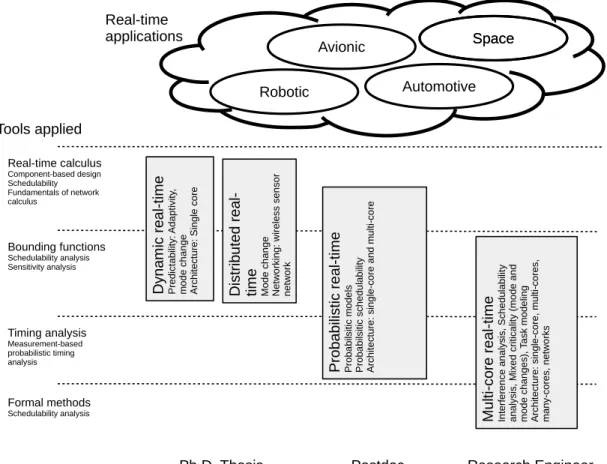
Figure 2.1: Research topics (in the middle), theoretical tools (on the left) and applications (at the top) approached during the PhD Thesis, the Postdoc, and as Research Engineer.
The research topics since the PhD are represented in Figure 2.1. There are represented also the theoretical tools applied: real-time calculus, bounding functions, timing analysis approaches, and formal methods for schedulability analysis. In particular, are represented the topics approached during the PhD i.e., dynamic and distributed real-time approached with deterministic techniques; those at the Postdoc i.e., probabilistic real-time for modeling and analysis As researcher at the ONERA, the focus is on multi-core real-time approached with both deterministic and probabilistic methods. Avionic, space, robotic, and automotive applications have be considered all along the path in both publications and research projects.
All the references in this section are my publications since the PhD; they are also not related to mixed criticality but they represent the background to approach mixed criticality research.
2.2
The mixed criticality problem
In the following an introduction to mixed criticality with its state of the art. None of my contributions are cited in this section.
Nowadays real-time systems are mostly implemented with multi-core and many-core commercial-off-the-shelf platforms. Cache memories, branch predictors, communication buses/networks and other features present in such implementations allow increasing average performance.
With multi-core and many-core implementations, it comes the opportunity to combine different applications on the same platform which may have different criticality levels, e.g. safety critical, mission-critical, non-critical. The trend of combining different criticality levels within the same system is driven by the demand for a more efficient platform resource usage.
All of the above contribute making predictability much harder to guarantee.
Criticality is a designation of the level of assurance against failure needed for a system component. A Mixed Criticality (MC) system is one that has two or more distinct levels, e.g. safety critical, mission critical and low-critical. It can have two or more distinct levels, perhaps up to five levels may be identified, see for example the IEC 61508 [81], DO-178B [59] and DO-178C [60], DO-254 and ISO 26262 [82] standards.
The fundamental research question underlying the mixed criticality problem is how to reconcile the conflicting requirements of ’partitioning’ for safety assurance and ’sharing’ for efficient resource usage. This question gives rise to theoretical problems in modeling and verification, and systems problems relating to the design and implementation of the necessary hardware and software runtime controls [35].
The mixed criticality view
For mixed criticality systems there are distinct issues to be considered. Among them, the survivability in terms of graceful degradation, the static verification, and the schedulability analysis.
In the form of fault tolerance, survivability allows for graceful degradation to occur. Graceful degradation abstractly describes the behavior in which in the event that all components cannot be serviced satisfactorily; the goal is to ensure that lower-criticality components are denied their requested levels of service before higher-criticality components are [35].
Static verification is closely related to the certification problem of safety critical systems. In safety critical systems, typically only a relatively small fraction of the overall system is actually of the highest criticality. In order to certify a system as being correct (or acceptably correct), the designers are guided by the appropriate certification standards, and must make certain assumptions about the runtime worst-case behavior of the system. The certification methods tend to be very conservative, and thus the analysis assumptions result in more pessimism than those that would typically be used if certification was not required1.
A full review of the certification standards on the subjects of mixed criticality is beyond the scope of this manuscript. For that, the reader is referred to [68, 69]. As a synopsis, few words on standard and mixed criticality. The main points from ISO 26262 [82] for automotive systems are that software safety requirements should include any necessary timing constraints. The software architecture should describe temporal constraints on the software components, including tasks [69], and software testing must include resource usage tests to confirm that the execution time allocated to each task is sufficient [82].
The standards other than the ISO 26262 say very little about timing issues related to mixed criticality. DO-178B and DO-178C (Software Considerations in Airborne Systems and Equipment Certification) are guide-line dealing with the safety of safety critical software used in certain airborne systems. Although technically guidelines, they are a de-facto standard for developing avionics software systems. The software level, also known as the Development Assurance Level (DAL) is determined from the safety assessment process and hazard anal-ysis by examining the effects of a failure condition in the system. The failure conditions are categorized by their effects on the aircraft, crew, and passengers. DO-178B alone is not intended to guarantee software safety aspects. Safety attributes in the design and implemented as functionality must receive additional mandatory system safety tasks to drive and show objective evidence of meeting explicit safety requirements.
In automotive, the risk classification defined by the ISO 26262 - functional safety for road vehicles stan-dard [82] - is from the Automotive Safety Integrity Level (ASIL). This is an adaptation of the safety integrity
1More details on mode degradation and possible notions of mixed criticality can be taken from the contributions of PhD Robert
Davis at University of York, Prof. Alan Burns at University of York, Prof. Sanjoy Baruah at Washington University St. Louis, and Prof. Zhishan Guo at University of Central Florida.
2.2 The mixed criticality problem
level used in the standard IEC 61508 [1, 81]. This classification helps defining the safety requirements necessary to be in line with the ISO 26262 standard. The ASIL is established by performing a risk analysis of a potential hazard by looking at the severity, exposure and controllability of the vehicle operating scenario.
Figure 2.2 and Figure 2.3 give some details about criticality levels according to different standards. The levels are ordered from less constraining to most constraining. The determination of criticality comes from DAL and SIL notions that are assigned to system level functionalities and to all the software elements that contribute to them [55].
For static verification and mixed criticality, it has to be shown that in the worst-case scenario i.e., all high-criticality functions simultaneously require their maximum pessimistic resource quotas, all of these functions will meet their timing requirements. For graceful degradation and mixed criticality, it has to be measured responses to varying levels of overrun: to not disproportionate the response to a small effect. Indeed for minor overruns it is possible to expect full system functionality to continue to be delivered (a requirement that is termed fail operational or fail passive).
Mixed criticality and mode changes
MC systems are typically defined to execute in a number of criticality modes. The schedulability analysis for the MC problem focuses on providing multiple assurance levels to the possible execution conditions or modes. Today’s MC schedulers tend to efficiently schedule functionalities of different criticality so that the less critical tasks may execute in the resource gaps left from the execution of high criticality tasks under normal circumstances. Instead, they may be dropped in a occasional situation where tasks of higher importance level execute beyond their estimated common case running time.
Figure 2.2: DAL criticality levels with failure
condi-tions and their interpretacondi-tions [59, 60]. Figure 2.3:criticality levels ordered from most stringent to theASIL and DAL comparisons [60, 82] with least.
Complex real-time systems are dynamic, which consists in having several behaviors and is described by a set of functionalities that are carried out by different parameter settings. Those systems are characterized by different operational modes, designed to achieve different functionalities or to respond to changes in the environment, [114, 117, 124, 130]. Each mode defines functional and not functional characteristics and consists of specific computational demands, resource requirements and resource availability. The overall computational load and the allocated resources may change over time depending on the operational mode selected for the system. For example, adding a new task into the system at runtime may result in a reduction of the computational resources allocated to the other tasks.
A typical example is that of an aircraft control system where it can be distinguished landing, take off and normal cruise modes, each with a different general objective. The current operating mode of the aircraft depends on the particular phase it is executing. A change in the system state, e.g. from start-up to normal, or from normal to energy saving, or from normal to shut-down, may also require re-allocating the computational resources among the tasks composing the application. Changing one or more parameters in the system components at runtime must also be considered a mode change, because it affects the system load and hence modifies the timing behavior of the application and the system itself.
The mode change is required to cope with the changing conditions so that the system can work properly with the new requirements. in order to change the operating mode it is necessary to switch form a set of parameters to another and this circumstance introduces a transient stage where it is not well defined what are the condition and the parameters of the system along that phase. Such an uncertainty has to be investigated to make the system predictable even during the mode changes. A mode change is initiated whenever the system detects a change either in the environment or in the internal state.
The transformation of real-time systems into MC real-time systems demands for timing analysis which is able to cope with multiple criticality levels for tasks, and schedulability analysis which can guarantee the different possible execution modes.
2.2.1
Mixed critical task models
Vestal’s work [140] launched the mixed criticality scheduling theory. In there, a criticality level is assigned to each task derived from the system function that the task is implementing or contributing to. It is the Worst-Case Execution Time (WCET) parameter of task that depends on the criticality level that has to be assured for each task.
In its most general representation, the task model of a period task τi is:
τi= ([C1,A, C1,B, C1,C, C1,E], Ti, Di, χi). (2.1)
Ti and Di are respectively the task period and deadline. With X = {A, B, C, E} an ordered set of design assurance levels, where A is the highest and E is the lowest. χi specifies the assurance level for τi. Ci={ci,χi}
with χi∈ X, specifies a set of execution times for τi, and χi is the degree of assurance that the execution time of τi will not exceed Ci,χi. It is assumed that Di≤ Tiand Ci,A≥ Ci,B ≥ Ci,C ≥ Ci,E for all i. χ is the assigned
task criticality level [140]. To note that in Equation (2.1), and in the rest of the manuscript, classical criticality level ”D” has been replaced with ”E” to resolve the ambiguity with task deadline Di.
A piece of code could have a higher WCET if it is defined to be safety critical with higher level of assurance required (Ci,A larger than the others). Instead, if the task is just considered to be mission critical its WCET requirement would be smaller, as the task demands less in terms of resource request and guarantees (Ci,B or less). Finally, if the task is considered to be non-critical, it demands even less resource request and guarantees. Its WCET requirements would be the smallest (Ci,E) [54, 140], [165].
Restricting the modeling to two criticality levels, it is possible to name the high criticality level as hi and the low criticality lo. In the following there is detailed the interpretation for C(hi) and C(lo).
- Ci(hi) (equivalently Ci,A) that models the hi-criticality behavior of the system, thus the worst possible conditions τi can suffer. Ci(hi) would be derived from the most safe timing analysis in order to guarantee the worst model and the most assurance to the execution behavior, [165]; Ci(hi) has to be the task model with maximum confidence of being the worst-case, [140]. This would be the case of safety critical applications that have to account for the worst-case behaviors that can possibly happen. The ’best’ modeling of task parameters has to assure the coverage of any of the execution conditions, including the worst-cases [55, 140].
- Ci(lo) (equivalently Ci,E) that models the lo-criticality conditions for τi; Ci(lo) is for mission critical or less-critical conditions; it does not assure against faults, at least it does not against all of them; Ci(lo) could come from less safe timing analysis and encode a certain confidence to be the worst-case model under specific execution conditions [140]. This would be the case of mission critical or low critical applications rely on less constrained/demanding models and the guarantees on them are not as strict as those for safety critical applications [55, 140].
2.2 The mixed criticality problem
In a more common two-critcality-level model, the MC paradigm it is possible to distinguish between criticality tasks from lo-criticality tasks such that: criticality tasks can have two execution modes, hi-criticality mode and lo-hi-criticality mode, represented by [Ci(hi), Ci(lo)]. The hi-criticality task τiis represented with multiple parameters:
τi def
= ([Ci(lo), Ci(hi)], Ti, Di, χi), (2.2)
where Ti is the period and Di is the deadline of the task; χi ∈ {lo, hi} is the task’s criticality level; and [ci(lo), ci(hi)] is the tuple of WCETs, where ci(lo) ≤ ci(hi). The lo-criticality task τj is represented with parameters:
τj def
= (Cj(lo), Tj, Dj), (2.3)
where Tj is the period and Dj is the deadline of the task and Cj(lo) characterizes the lo-criticality mode worst-case execution time. For lo-criticality tasks only the lo-criticality behavior is possible, as they will be discarded upon a mode switch into hi-criticality level.
The system mode will be switched from lo to hi if any hi-criticality task exhausted its lo-WCET and did not signal finishing. Form the Vestal task model it is notable the increased flexibility to represent task behaviors: with multiple WCETs per task could represent more task behavior, thus reduce pessimism. Current discussions on enhancing the classical (Vestal) MC model could make interesting future contribution to mixed criticality [35, 75].
The MC modeling resolves into a timing analysis problem. Timing analysis seeks upper bounds to the task execution time (with WCET estimates), and so the predictability required by real-time systems can be granted. Classically, the bounds are deterministic WCET which are single values able to upper bound the time needed to finish execution. Refer to [143] for definitions and a survey of approaches for WCET estimates. In order to be safe, WCETs have to account for any case/execution condition possible, including the highly improbable pathological cases such as faults. Deterministic WCETs could be very pessimistic with respect to task actual execution times, and could lead to resource under-utilization. Nonetheless, it is safe.
Traditional rigorous WCET analysis may lead to not affordable pessimism (for safety), and the occurrence of such WCET is extremely unlikely, unless under highly pathological circumstances. The gap between the actual running time and the WCET may be significantly large, which makes a strong argument for MC task modeling according to Equation (2.2).
Much prior research on mixed criticality scheduling has focused upon the phenomenon that different tools for determining WCET bounds may be more or less conservative than one another, which results in multiple WCET estimations for each individual task or piece of code. Typically in the two-criticality-level case, each task is designated as being of either higher (hi) or lower (lo) criticality, and two WCETs are specified for each hi-criticality task: a lo-WCET determined by a less pessimistic tool, and a larger hi-WCET determined by a more conservative one, which is sometimes larger than the lo-WCET by several orders of magnitude.
Safety critical systems are failure prone as any other system, and today’s system certification approaches recog-nize this with permitted system failure probabilities. The underlying idea is to certify considering more realistic system models which account for any possible behavior, included faulty conditions, and the probability of these behaviors occurring. The gap that still exists is between such enhanced models and the current conservative deterministic analyses.
Task models have to embed fault manifestations and fault effects in order to provide upper bounds to every possible condition the real-time system can experience at runtime. In the MC framework, and with the highest abstraction model, faults can be seen as task passing C(lo) thresholds. Timing analysis approaches have to take fault effects into account. System faults have a non negligible impact on worst-case models; although as pathological and improbable cases, they have to be considered with timing analysis.