S
[immm}
HJJZO .M414 no. 3/V/.
DEWEY
W/
MAY
9
1991THE
DUALITY
OF TECHNOLOGY:
RETHINKING
THE
CONCEPT
OF
TECHNOLOGY
IN
ORGANIZATIONS
Wanda
J.Orlikow;
kiJanuary
1991
CISR
WP
No.
219
Sloan
WP
No.
3141-91
CCSTR#105
Center
forInformation
Systems
Research
Massachusetts Institute ofTechnology
Sloan School ofManagement
77 Massachusetts Avenue
THE
DUALITY
OF
TECHNOLOGY:
RETHINKING
THE
CONCEPT
OF
TECHNOLOGY
IN
ORGANIZATIONS
Wanda
J.Orlikow;
kiJanuary
1991
CISR
WP
No.
219
Sloan
WP
No.
3141-91
CCSTR#105
•1991
W.J. OrlikowskiForthcoming
in OrganizationScience.
Center
forInformation
Systems Research
Sloan
School
ofManagement
M.l."
MAY
9 1991THE DUALITY
OF
TECHNOLOGY:
Rethinking
the
Concept
of
Technology
in
Organizations
ABSTRACT
This paper develops a
new
theoreticalmodel
withwhich
toexamine
the interactionbetween
technology
and
organizations. Early research studiesassumed
technology to be an objective, externalforcethatwould
havedeterministic impactson
organizational propertiessuch asstructure.Later researchersfocused
on
thehuman
aspectoftechnology, seeingitas theoutcome
ofstrategicchoice
and
social action. This paper suggests that eitherview
is incomplete,and
proposes areconceptualizationof technology that takesboth perspectivesinto account.
A
theoreticalmodel—
the structurational
model
oftechnology—isbuilton
thebasis ofthisnew
conceptualization,and
itsworkings
explored through discussion of a field study of information technology.The
papersuggests that the reformulation of the technology concept
and
the structurationalmodel
oftechnology allow adeeperand
more
dialecticalunderstandingofthe interactionbetween technologyand
organizations. This understanding providesinsight into the limitsand
opportunities ofhuman
choice, technology
development and
use,and
organizational design. Implications for futureTechnology
has always been a central variable in organizational theory, informing research andpractice. Despite years of investigative effort there is little
agreement
on
the definition andmeasurement
of technology, andno
compelling evidenceon
the precise role of technology inorganizational affairs. I will argue that the divergent definitions
and
opposing perspectivesassociated with technological researchhave limitedourunderstanding of
how
technology interactswithorganizations,and thatthese incompatibilities cannot be resolved by mutualconcession.
What
is
needed
isa reconstruction ofthe conceptof technology,which
fundamentally re-examines ourcurrent notionsoftechnology and itsroleinorganizations.
In this paper, I undertake such a reconstruction and present a
view
of technology thatdraws on
Giddens' [1976, 1979, 1984] theory of structuration.
My
re-examination leads to amodel
foranalyzingthe nature
and
roleoftechnology in organizations,which
I termthe structurationalmodel
of technology. Before proceeding to the premises and
components
of this model, prior views oftechnology arereviewed to serveas background andmotivation forthe alternative proposed here.
RETHINKING
PRIOR
CONCEPTUALIZATIONS OF
TECHNOLOGY
Prior conceptualizations of technology have each focused selectively
on
some
aspects oftechnology, at the expense of others, with the result that the current state of
knowledge
abouttechnology inorganizations is
ambiguous
and conflicting [Attewell and Rule 19£j; Barley 1990;Davis
and Taylor
1986;Hartmann
et al. 1986; Scott 1981].Two
important aspects of thetechnology concept are
scope-what
is defined as comprising technology,and
role—how
is the interactionbetween
technologyand
organizations defined.Both
these aspects inform priortechnological research,
where
theyhave been specifiedand useddiscrepantly.Differences
in
Scope
Two
views
on
the scope of technology havepervaded
(and shaped) studies of technology,reflecting the differentclaims to generalizabilitythatresearchershaveintended with theirwork.
The
one setofstudies has focused
on
technology as"hardware," that is,theequipment, machines, andinstruments that
humans
use in productive activities, whetherindustrial or informational devices[Barley 1986; Blauet al. 1976;
Bjom-Andersen,
Eason and
Robey
1986; Davis 1989;Hickson
etal. 1969;
Lucas
1975;Noble
1984;Robey
1981; Shaiken 1985;Woodward
1958;Zuboff
1988].The
range ofhardware across industries and organizations however, has led to multiple,context-specific definitionsoftechnology,
which
have inhibitedcomparisons across studiesand
settings.For example,
Woodward's
[1958] categorizationof technology as industrial production techniquesislimitedto manufacturingfirms. Alternatively, thisapproach hasalso resulted in theuseofbroad
definitionsoftechnology which, having to
accommodate
awide
range of machinery,become
sodefinition of technology, deployed in the factory and the office, is given as "the substitution of
equipment for
human
labor" [1976:21].In the
"hardware"
view, technology is a meaningful variable only in those organizations thatemploy
machinery
in theirproductive activities. This restrictionprompted
researchers to try andgeneralize the scope ofthe technology variable so as to
encompass
organizations such as servicefirms
and
educational institutions.The
technology conceptwas
thusextended
to "socialtechnologies," thereby including the generic tasks, techniques,
and knowledge
utilizedwhen
humans
engage
in any productive activities [Eveland 1986;Perrow
1967;Thompson
1967]. For example,Perrow
[1967] sees organizations as placeswhere
raw
materialsare transformed, thusdefining
what
isdone
toraw
materialsand
how
it is done, as the technology of organizations,while
Thompson
[1967] characterizes thework
flow ofdifferent organizations in terms oflong-linked, mediating, andintensive technologies.
While
useful, in that it allows technology to be a meaningful variable in all organizations, and itrecognizes that there is
more
to technology than just the hardware, this generic approach totechnologycreates
boundary
andmeasurement
ambiguity [Mintzberg 1979:250]. Italsooverlooksvaluable information aboutthemediation of
human
action by machines.Thatis,even aswe
gain ingenerality, e have lostthe ability toask questions about
how
artifactsinteractwithhuman
agents.By
aggregating task, technique,knowledge,
and
tools into a single construct - technology-interaction
among
these constitutingcomponents
and withhumans
is ignored. For example,we
cannotexamine
how
different assumptions,knowledge,
and
techniques can beembedded
indifferent kinds of artifacts or practices,
and
how
these will have differential consequences forhuman
actionand
cognition.Nor
canwe
examine
how
the rules and procedures structured into amachine
are differentially appropriated,changed, orignoredbytheagents executingwork
[Perrow1983;
Suchman
andWynn
1984;Wynne
1988].Differences
in
Role
Threestreamsof technology researchcanbe distinguished bytheirdefinitionsofthe roleplayed by technology in organizations, reflecting the philosophical opposition
between
subjective andobjectiverealmsthathasdominated the social sciences [Bernstein 1978; Burrell
and
Morgan
1979;Giddens
1979].The
earlywork
assumed
technologyto be anobjective,external force thatwould
have (relatively)deterministic impacts
on
organizationalpropertiessuchas structure. In contrast, alater group ofresearchers focused
on
thehuman
action aspectoftechnology, seeing itmore
as aproduct ofsharedinterpretationsorinterventions.
The
third,and
more
recentwork on
technology,has reverted to a "soft"
determinism
where
technology is posited as an external force havingThe
"Technological
Imperative"
Model
In this
body
ofwork, studies of technology [Aldrich 1972; Blau et al. 1976; Hickson etal. 1969;Perrow
1967; Shepard 1977;Woodward
1958] and information technology [Carter 1984; Davis1989; Foster
and
Flynn 1984; Hiltzand Johnson
1990; Leavittand
Whistler 1958; Pfeffer andLeblebici 1977; Siegel et al. 1986]
examine
the impacts of technologyon
organizationaldimensions such as structure, size, performance, and centralization/decentralization, as well as
individual leveldimensions such asjob satisfaction, task complexity, skilllevels,
communication
effectiveness, andproductivity.
The
premiseis thatthetechnologyaswellas theorganizationalandindividual variables canbe
measured
and predicted (seeFigure 1).Such
research treats technologyas an independentinfluenceon
human
behavioror organizationalproperties, thatexerts unidirectional, causal influences over
humans
andorganizations, similartothose operating in nature [Giddens 1984:207].
Some
of this research allows for the influence oftechnology to be
moderated by
contextual variables, proposing a contingencymodel
oftechnology's effects [e.g., Jarvenpaa 1989;
Lucas
1975].While
providing insight into the oftendetermining aspects of technology, this
body
ofresearch largely ignores the action ofhumans
indeveloping, appropriating,and changing technology.
As
aconsequence, this perspective furnishesan incomplete accountof technology and its interactionwith organizations.
Organizational
Dimensions
Technology
The
"StrategicChoice"
Model
This perspective suggests that technology is not an external object, but a product of ongoing
human
action, design,and
appropriation.Three
research foci within this perspective arediscemable.
One
stream focuseson
how
a particulartechnology is physically constructed throughthe socialinteractions andpolitical choicesof
human
actors.Technology
is hereunderstoodtobe adependent variable, contingent
on
other forces in the organization,most
notably powerfulhuman
actors (see Figure 2). This perspective does not accept that technology is given or immutable,focusing attention instead
on
themanner
inwhich
technology is influenced by the context andstrategiesof technology decision
makers
andusers [Child 1972; Davisand
Taylor 1986; Klingand Iacono 1984;Markus
1983;Perrow
1983; Tristetal. 1963;Zuboff
1988].Particularly relevant here are socio-technical studies,
which
arepremised
on
the belief thatoutcomes
such asjob satisfaction and productivity of workers can be manipulated by jointly"optimizing" the social
and
technical factors ofjobs [Davis and Taylor 1986;Trist et al. 1963].A
similarpremise runsthrough the socio-technical research ininformation technology [Bostrom andHeinem
1977;Mumford
1981] and thework
ofZuboff
[1988],which
calls for a re-examinationand
restructuringof organizations around the potential of information technology. Zuboffsuggeststhatbecause information technology can be designed with different intentions (to"automate" or
"infcroate" work), it will have different implications for workers (controlling
and
deskilling oremp
j,veringand upskilling, respectively).Organizational Context
Technology
Decision-Makers
These
analyses, however, rely too heavilyon
thecapabilityofhuman
agents.The
presumption ismade
thatonce
technology isdesigned toembody
the "appropriate" (optimizing or informating)objectives and
once managers
arecommitted
to this "appropriate" strategy,more
rewardingworkplaces,
more
fluid organizations, anew
division of labor, and betterperformancewill result.But, as
many
of the case studies inZuboff
[1988] reveal,how
a technology is deployed andappropriateddepends
on
social andeconomic
forcesbeyond
managerialintent [Powell 1987; Sabel1982; Shaiken 1985],
which
may
thwart any intended reconstruction of jobsand
technology.Some
of these forces include: institutional properties of the organization, micropolitics of theworkplace, features of the environment, and unintended consequences of organizational change.
Such
forcesmay
account for themixed
success that socio-technical interventions have had in arange oforganizations [Kelly 1978;
Pasmore
etal. 1982].The
second streamexamines
how
shared interpretations around a certain technology arise andaffect the
development
of and interaction with that technology. Empirical studies adopting thissocial constructionist
view
of technology have beendone by
sociologists of technology [Bijker1987; Bijker,
Hughes
and Pinch 1987; Collins 1987; Pinch andBijker 1984, 1987;Woolgar
1985;Wynne
1988], and information technology researchers [Bolandand
Day
1982; Hirschheim,Kleinand
Newman
1987; Klein andHirschheim
1983;Newman
andRosenberg
1985].While
usefullydemonstrating
how
meanings
around a technology arise and are sustained, thisbody
of researchtendsto
downplay
thematerial and structural aspectsofinteraction with technology.The
finalresearch stream in this tradition is representedby
Marxistaccountsoftechnology suchasthose of
Braverman
[1974],Cooley
[1980],Edwards
[1979],Noble
[1984],and
Perrolle [1986].While
carefully outlining themanner
inwhich
technology isdevisedand
deployed to further thepolitical and
economic
interests of powerful actors (the social construction of technology at thepointofinitiation), these studies
do
not adequatelydeal withhuman
agency in the workplace(thesocial construction oftechnology at the point ofuse).
They
consequently fail to account for thediverse
ways
inwhich
atechnology is appropriated and utilized by workers,and
the nonuniformmanner
inwhich
it structures individual andorganizational action[Burawoy
1979; Powell 1987].The
limitationhere isthe selectivity withwhich
the notionofhuman
agencyisapplied,where
onlymanagers
ortechnologydesigners have the authorityand
means
to shapethetechnology.Human
agents such as
workers
using the technology are portrayed as relatively powerless,and
theiractions
and
cognitions asdetermined by thetechnology. Yet,workeractionmay
wellchange
how
technology is interpretedand
operated, and hence the implications for organizations[Burawoy
1984; Jonsson
and Gronlund
1988;Perrow
1983;Wynne
1988].As
Mohrman
and Lawler
[1984:136] pointout:
"Because
technologies are socially constructed, theycan bereconstructed as well. ...The
technologyitselfcan bechanged
by those usingit."Model
ofTechnology
asTrigger
of StructuralChange
A
third perspectiveon
the relationshipbetween
technology and structure is provided by Barley[1986, 1990], and involves portraying technologyas anintervention into the relationship between
human
agentsand
organizational structure,which
potentially changes it (see Figure 3). Barley[1986]
employed
a longitudinal field study toexamine
the introduction ofsimilar radiographictechnology into different organizations. Within each organization, he
found
that thetechnologytriggered a
change
in departmental structureby
altering institutionalized roles and patterns ofinteraction.
By
comparing
two
organizationsanddeterminingthattheyrespondeddifferently totheimplementation
of a similar technology, Barley [1986:107] effectively demonstrated that:"Technologies
do
influence organizationalstructures inorderly ways,but theirinfluence dependson
the specific historicalprocess inwhich
theyareembedded."
Within his frame ofreference Barley posits a role for technology, not as material cause, but as a
material trigger, occasioning certain social
dynamics
that lead to anticipated and unanticipatedstructuring
consequences
(such as increased decentralization in his study).Technology
isunderstood as a social object
whose
meaning
is definedby
the contextofuse, while its physicalform and
function remain fixed across time and contexts ofuse.While
Barley asserts thatsome
featuresofthetechnologyare socially constructed, he doesnot allowfor thephysical modification
of technology during use.
Given
a technology such asCT
scanners— with relatively fixed andstandardized functionsand features-such a
view
may
beappropriate. It is, however,notgenerallyappropriate,
and
is particularly inadequate in the case of information technologies.While
technologies
may
appeartohave objective formsand functions atone
point,thesecan anddo
varyby
different users,by
differentcontextsofuse, andby
thesame
usersovertime.Reviewing
theTechnology
LiteratureThe
above
discussion hasbeena briefandsomewhat
criticalexaminationofextantresearch intothescope
and
role of technology in organizations. This examination is not original, as recentdiscussions in theorganizational literature have similarlycritiquedthis
work
[Attewelland
Rule1984;
Davis
and
Taylor 1986;Hodson
and Parker 1988;Markus and
Robey
1988;Perrow
1983;Powell 1987; Sabel 1982].
However,
while researchers have concentratedon
deconstruction to identifythe limitationsimposed by
overlydeterministicorundulyvoluntaristic perspectives, theyhave not
engaged
in the equally important task ofreconstruction.What
is still lacking is anew
conceptualizationoftechnology and itsrelationship with organizations that will allow us to
move
Organizational
Structure
atTl
(without technology)
Human
Agents
Organizational Structure
atT2
(with
technology)
Human
Agents
time
Figure
3:Barley's [1986]
Model
of Technology-triggered
StructuralChange
In this paper, I
employ
the tenetsof structuration theory to reconstructtheconcept oftechnologyand
toproposeamodel
for investigating the relationship between technologyand
organizations. Indefining
my
concept oftechnology, Irestrictitsscopetomaterialartifacts(various configurationsof
hardware
and
software). I wish to sustain a distinction--at least theoretically-between thematerial nature
of
technology and thehuman
activities that design or use those artifacts. Thisdefinition isconsistent with the
view
that overloading the technology concept is unnecessarilylimiting,butitshouldnotbe understood as anexclusive focus
on
technology as a physicalobject. In contrast, the analytic decoupling ofartifactsfrom
human
action allowsme
to conceptualizematerialartifactsas the
outcome
of coordinatedhuman
action and henceas inherently social.Italsofacilitates
my
framing ofthe role of technology in terms ofamutual interactionbetween
human
My
proposal for a structurationalmodel
of technologymakes
no
claims as tocompleteness orperfection,and ispresented asanotherin thestream of thinking aboutthetechnology
phenomenon.
It too, inevitably, is limited
by
its author's beliefsand
interests. I submit however, that there-conceptualization, whilebounded,
overcomes
certaindualisms andabstractions thatare inherentinpriorperspectives, andsensitizesus tothedialecticalinterplayoftechnologyandorganizations.
A
STRUCTURATIONAL
MODEL
OF
TECHNOLOGY
Recent
work
in social theory [Giddens 1976, 1984] and philosophy ofscience [Bernstein 1978;Bhaskar
1979] has challenged the long-standing opposition in the social sciencesbetween
subjective
and
objective dimensions in social reality,and
proposes an alternative meta-theorywhich
incorporates both dimensions. Giddens' theory of structuration [1979, 1984] is one suchalternative,and a
number
of organizational researchers have adoptedand
used the theory in theiranalyses of organizational processes [Barley 1986;
Manning
1982; Pettigrew 1985; RansoR,Hinings and
Greenwood
1980; Riley 1983; Roberts and Scapens 1985; Smith 1983;Spybey
1984;Willmott 1987]. For theseresearchers, structuration offers a solution to the
dilemma
ofchoosingbetween
subjective andobjective conceptions oforganizations, and allowsthem
toembrace
both[Dow
1988; PooleandVan
deVen
1989; Willmott 1981].The
Theory
of Structuration
Structuration is positedasa social process thatinvolvesthereciprocal interaction of
human
actorsand structuralfeaturesoforganizations.
The
theory ofstructuration recognizesthathuman
actions are enabled and constrainedby
structures, yet that these structures are the result of previousactions. In Giddens'
framework,
structure is understood paradigmatically, that is, as a genericconceptthatisonly manifestedin the structural propertiesofsocial systems [Giddens 1979:64-65].
Structural properties consist of the rules and resources that
human
agents use in theireverydayinteraction.
These
rulesand
resources mediatehuman
action, while at thesame
time they arereaffirmedthrough beingused
by
human
actors.Inthis theory, the role of
human
actors in reaffirming structural properties is highlighted soas toavoidreificatiort.
The
recognition thatactors areknowledgeable and reflexiveis a centralpremise.Giddens
notes [1984:22]: "All social actors, allhuman
beings are highly 'learned' in respect ofknowledge which
they possess and apply, in the production andreproduction ofday-to-day socialencounters."
Giddens
distinguishes betweendiscursiveand practicalknowledge,where
theformerrefers to
knowledge
the actors are able to articulate (what is said),and
the latterrefers to tacitknowledge,
which
actors are able todraw on
in action but are unableto express (what is simplyaredoing while they are doing it. It is not merely self-consciousness, but includes thecontinuous monitoringof physical and social contexts,and activities (their
own
andothers) [Giddens 1984:5].Actors'
knowledge
and reflexivity, however, is alwaysbounded
tosome
extentby
the situatednatureofaction, the difficulty ofarticulating tacitknowledge, unconscious sources of motivation,
and
unintendedconsequences ofaction [Giddens 1979:144].Through
the regularactionofknowledgeable andreflexive actors, patterns ofinteractionsbecome
established as standardized practices in organizations, e.g.,
ways
of manufacturing a product,coordinating a meeting, or evaluating an employee.
Over
time, habitual use of such practiceseventually
become
institutionalized, forming the structural properties of organizations.These
structural or institutionalized properties (structure) are
drawn
on by
humans
in theirongoing
interactions(agency),
even
as such use, in turn, reinforces the institutionalized properties. In thisformulation-known
as the dualityofstructure--Giddensovercomes
thedualismbetweenobjective,structural featuresoforganizationsand subjective, knowledgeable actionof
human
agents.When
humans
act in organizations, they createand
recreate three fundamental elements ofsocial interaction [Giddens 1976:104]: meaning, power,and
norms.While
these elements are highlyinterdependent andnot separable in practice, for analyticalpurposes
we
can treatthem
asdistinct,examining each
from
theperspectiveofhuman
agency andinstitutionalizedproperties.-
From
anagencypoint of view,human
interaction involvesthe constitution andcommunication
of
meaning.
This is achieved via interpretiveschemes
or stocks ofknowledge
thathumans
draw on
in theirongoing
interaction with the world,which
"...form
the core of mutualknowledge
whereby
an accountable universeofmeaning
is sustained through andinprocessesofinteraction" [Giddens 1979:83].
The
interpretive schemes, however,do
more
than merely enable sharedmeanings and hence
mediatecommunication.
From
the perspective ofinstitutionalized properties, interpretive
schemes
represent organizational structuresof
signification,
which
represent the organizational rules that informand
define interaction.Interpretive
schemes
are also reinforced orchanged
through social interaction, as theorganizationalrulesare reaffirmed orchallenged throughtheir use
by
human
agents. Thus,inany interaction,shared
knowledge
isnot merelypartofthebackground, butis anintegral partofthe socialencounter, in
pan
organizing it,and inpartbeingshapedby
the interactionitself.-
From
anagency
perspective,power
enters intohuman
interaction through providingorganizationalcapabilities for
humans
to accomplish outcomes.Power
is here understood as"transformative capacity," the
power
ofhuman
action to transform the socialand
materialworld
[Robertsand Scapens
1985:449]. Its use in organizations ismediated
via theorganizationalresources that participants bringto, and mobilize within, interaction [Giddens
and
allocative (extending overobjectsor materialphenomena).
While
these facilities are themeans
throughwhich
power
is exercised,from
theperspectiveofinstitutionalproperties theyconstitute organizational structures
of
domination,which
reflect the fact that all socialsystems are
marked
by
anasymmetry
of authoritativeand
allocative resources.However,
there
always
remains the potential for agents to act tochange
a particular structure ofdomination, a potentiality referredtoas the dialecticofcontrol
by
Giddens
[1984:16]: "... allforms of
dependence
offersome
resourceswhereby
thosewho
are subordinate can influencethe activitiesoftheirsuperiors."
When
agivenasymmetry
ofresourcesisdrawn on
byhuman
actors in interaction, the existing structure of domination is reaffirmed. It is onlywhen
the existingasymmetry
ofresources is changed-either through beingexplicitly alteredorthroughbeing gradually and imperceptibly shifted—that the existing structure ofdomination
may
bemodifiedorundermined.
-
From
anagency
perspective,norms
are organizational conventions or rules governinglegitimateor "appropriate" conduct. Interactioninorganizationsdoes notoccurblindly butis
guided
by
the application ofnormative
sanctions, expressed through the culturalnorms
prevailing inan organization.
From
the perspectiveofinstitutionalproperties, however,norms
constitute organizational structures
of
legitimation,whereby
amoral
order within anorganizationisarticulatedand sustainedthroughrituals, socialization practices,andtradition.
Giddens
does not explicitly address the issue of technology in his structuration paradigm, andwhile structuration theory has been
employed
tostudy technology-inducedorganizational change[Barley 1986],
and
applied to the use ofgroup decision support systems [Poole and DeSanctis1989, 1990]
and computer
conferencing systems [Robey,Vaverek and
Saunders 1989],no
attempthasbeen
made
to use structurationtheorytoreconceptualize thenotionof technology, andtoreformulate therelationshipbetween technology andorganizations. Insuggesting that
we
tryandunderstand technology
from
the point ofview
ofstructuration, I propose that it be consideredasone
kind of structural property of organizations developing and/or using technology. That is,technology
embodies and
hence is an instantiationofsome
ofthe rules andresourcesconstituting the structureof anorganization.The
detailsofastructurationalmodel
of technologyare explicatedinthefollowing section,
and
themodel
isthenillustratedby
drawingon
empiricalwork.Premises
of a
Structurational
Model
of
Technology
Technology
is createdand
changed
byhuman
action, yet itis also usedby
humans
to accomplishsome
action. This recursive notion oftechnology—which
I call theduality of technology-is thefirst ofthepremises I elaborate below.
The
second, a corollary ofthe first, is thattechnology isinterpretivetyflexible, hencethatthe interactionof technology
and
organizations isa function ofthe different actorsand
socio-historicalcontexts implicatedinitsdevelopmentand use.(i)
The
Duality ofTechnology
The
duality of technology identifies prior views of technology-as either objective force or associally constructed product—as a false dichotomy.
Technology
is the product ofhuman
action,while italso
assumes
structural properties. That is, technology isphysically constructedby
actorsworking
in a given social context, and technology is socially constructedby
actors through thedifferent
meanings
theyattach to itandthevarious featurestheyemphasize and use.However,
itisalso the case that
once developed
and
deployed, technology tends tobecome
reifiedand
institutionalized,losing itsconnection with the
human
agentsthatconstructeditorgaveit meaning,anditappears tobepartofthe objective, structuralpropertiesofthe organization.
Agency
and structure are not independent. Itis the ongoing action ofhuman
agentsin habituallydrawing on
a technology that objectifies and institutionalizes it. Thus, if agentschanged
thetechnology-physically or interpretively-every time they usedit, it
would
notassume
thestabilityandtaken-for-grantednessthat is necessary forinstitutionalization. But suchaconstantly evolving
interaction with technology
would undermine
many
of the advantages that accruefrom
usingtechnologytoaccomplish work.
We
do
not need tophysicallyorsociallyreconstruct thetelephone,elevator, or typewriterevery time
we
use it.However,
there clearly areoccasionswhere
continuedunreflectiveuse ofa technologyis inappropriate orineffective.
Wynne
[1988:159], forexample, describesthe case ofa British water-transfertunnel designedinthe seventies to serve the
huge
increase in waterdemand
expected as a result of the projectedindustrial andresidential growth of Lancashire.
At
thetimeofthedesignand implementationofthetechnology, it
was assumed
that thescheme
would
pump
continuallyand
at full capacity.However,
adecade lateritturned out thatthese social assumptions hadbeen incorrect;Lancashirewas
economically depressed and waterdemand
had not increased.As
aresult, thescheme
was
only used intermittently
and
lay stagnant for periods of several weeks.Such
operation ofthescheme
allowed the formation of a large void in the tunnel,which
eventually caused amajor
methane
explosion in the tunnel with significant loss of life.The
operation of the technologydepended
in thiscaseon
theonce-relevant, butnow-obsolete andforgotten assumptions aboutthesocio-economic
growth
of the area.Having
been designed and built into the technology, theseassumptions servedasconditions forthe"normal"operationofthetechnology. Thattheconditions
were
no
longer applicable tocurrentoperational circumstanceswas no
longerknown
to users,andunavailablefor reflection
by
them
orthe technologysponsorsand developerswho
were
long gone.As was
indicated above, a crucial aspectofhuman
action is thatitis knowledgeable andreflexive.Agency
referstocapability, notintentionality,althoughaction takenby
humans
may
haveintendedintendedconsequence ofincreasing
communication
and information sharing, and theunintendedconsequence
of reducing status barriersand
social context cues [Sproulland
Kiesler 1986].Further, whilepersonal action of
human
agents usingtechnology has a direct effect(intendedandunintended)
on
local conditions,it alsohas an indirect effect (often unintended)ontheinstitutionalenvironment
inwhich
the agents are situated. For example, a personmay
use a spreadsheetprogram
tocompute
an organization's annual revenues, or tocreate the impressionofa legitimatebusiness, but the effect of that action is to reaffirm the relevance
and primacy
of the "rules ofaccountability" established
by
theaccountingprofession.Even where
actions are directlyintendedtopreserve orchange
some
aspectofthe institutionalenvironment,theresultis notguaranteed. Forexample, managers
may
implement automated
production procedures to reposition theirorganization competitively.
The
resultmay
be that since the organization's operations arenow
much
more
dependent
on
the technology, they are alsomore
vulnerable to technologicalbreakdowns which
disruptworkflow, increasecosts anddelays, andadversely affectcustomers.(ii)
The
Interpretive Flexibility ofTechnology
As we
saw
above, the duality of technology has tended to be suppressed in organizationaldiscourse in favorofa dualism
which
emphasizes only oneview
oftechnology.To
some
extentthis
myopia
isfosteredby
the fact thatone aspect ofthedualityisoften invisible inorganizations.With
many
types of technology the processes ofdevelopment
and
use are often accomplished indifferent organizations.
That
is,many
of the actions that constitute the technology are oftenseparatedin timeand space
from
the actionsthat areconstituted bythe technology, withtheformertypically occurring in
vendor
organizations, and the latter occurring in customer sites. In thesecircumstances, itis not surprising that users ofa technology often treatit as a closed system or
"black box," whiledesigners tend toadoptan
open
systemsperspectiveon
technology.Thistime-spacediscontinuity isrelatedtothe notionsof temporalscopethat
were examined
above.The
dualisticview
of technology as fixed objectorasproduct ofhuman
action isinfluencedby
the differenttemporalstagesof technologythatinvestigators have chosen tofocuson. Recognizingthetime-spacediscontinuity
between
thedesign anduseof technologygives usinsight intohow
it haspromoted
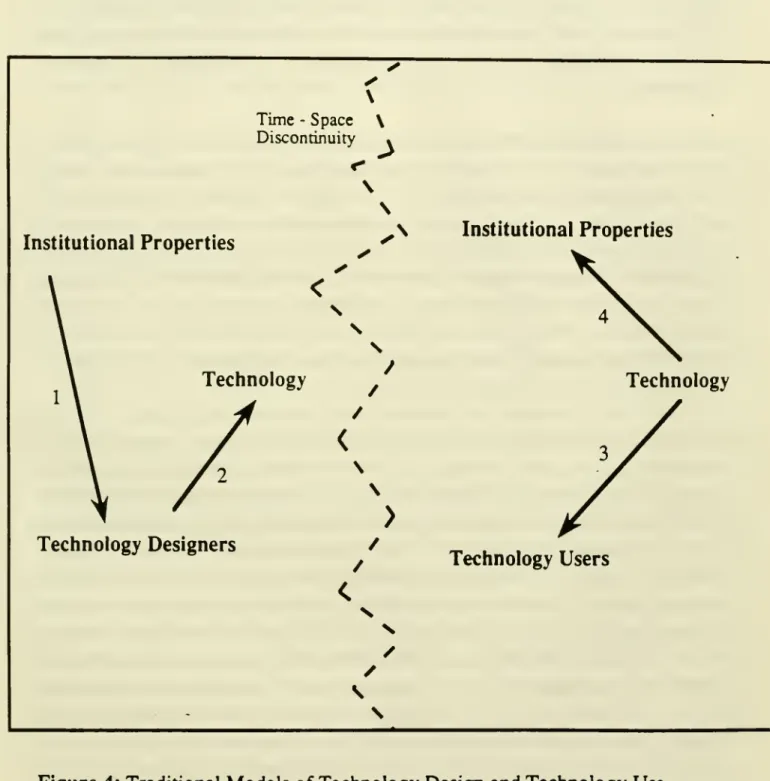
theconceptual dualism dominatingthe literature(see Figure4). Researchers examiningthedesign
and development
ofa technology (the lefthand side ofFigure4) areconfronted with theessentially constructed nature of the technology.
They
examine
how
technology designers,influenced
by
the institutional propertiesoftheir organization (arrow 1), fashionand
construct atechnologyto
meet
managerial goals (arrow 2).Such
studies are less likely to treattechnology asfixed or objective, recognizing its
dynamic and
contingent features (as in the strategic choicestudies). Researchers
examining
the utilization ofa technologyin anoffice orfactory,on
theotherhand
(the righthand
side of Figure 4), focuson
how
users of technology are influencedby
thegiven technology (arrow 3),
and
how
the technology affects institutional properties of theorganization (arrow 4).
Such
researchers are less inclined to focuson
thehuman
agency
thatinitially
produced
the technology,and
tend not to recognize theongoing
socialand
physicalconstructionof technology thatoccurs during its use.
\
Time
- Space \ Discontinuity »Institutional
Properties
Institutional
Properties
Technology
Technology
Designers
>
Technology
Technology
Users
Figure
4:Traditional
Models
of
Technology Design and Technology
Use
Rather than positing design and use as disconnected
moments
or stages in a technology'slife-cycle, the structurational
model
oftechnology positsartifacts as potentially modifiablethroughouttheir existence. In attempting to understand technology as continually socially and physically
constructed,itisuseful todiscriminateanalyticallybetween
human
actionwhich
affectstechnologyand
thatwhich
is affectedby
technology. I suggest thatwe
recognizehuman
interaction withtechnologyas having
two
iterativemodes: thedesignmode
and theusemode.
Iemphasizethat thisdistinction is an analytical convenience only, and that in reality these
modes
ofinteraction aretightlycoupled.
Even
aswe
recognize that technologies are designedand
used recursively,we
alsoneed
toacknowledge
thedifferencesamong
technologiesinthe degree towhich
userscaneffectredesign.While
we
can expecta greaterengagement
ofhuman
agents during theinitialdevelopment
ofatechnology, this does not discount the
ongoing
potential for users tochange
it (physicallyand
socially) throughout theirinteraction with it. In using a technology, users interpret, appropriate,
and manipulate it invarious ways, being influenced by a
number
ofindividualand
social factors.Despitethese opportunitiesfor
engagement
with technology, however,rigid androutinized viewsof
and
interactions with technologydo
develop.Such developments
are a function of theinteractionbetweeentechnology and organizationsand are not inherentinthe natureof technology.
For example,
many
technologies such asmanufacturing and medicaltechnologies, haveassumed
such arigidity attheirpointof deployment-thefactory floororthe hospital—that theyappearto be
fixed
means
ofproduction. But even themost
"blackbox"
technologyhas tobe apprehended andactivated
by
human
agency to be effectual,and in such interaction users shape technology anditseffects.For example, Jonsson and
Gronlund
[1988] describehow
machine
operatorsparticipate inits testing
and
adaptation, whileWynne
[1988] cites instanceswhere
operators of a range oftechnological
systems—
from
airplanes to chemical plants-routinely deviatefrom
formal,rule-bound
operating practices to deal withcomplex
interdependencies, unanticipated events, and thecontingenciesof local conditions.
The
Challenger shuttle disaster is a case in point.The
inquiryrevealed thatthe space shuttle hadoften been operated with variousmalfunctioning components,
and because O-ring
damage
and leakagehad been experienced frequentlyduringthe shuttleflighthistory, "... the experts had
come
to accept it as anew
normality"[Wynne
1988:151].Wynne
notes about this
and
the other technological cases:"The whole
system can be seen to have beenevolving uncertainlyaccordingtoinnumerable
ad
hoc judgements andassumptions. Thesecreateda
new
set ofmore
private informal 'rules' beneath the discourse of formal rulesand check
procedures" [ibid.].
Examples
of sabotage and avoidance of use inmore
rigid technologies such as assembly lines,chemical plants, arid
power
stations further illustrate the role ofusers shaping technology and itseffects[Perrow 1983; Shaiken 1985;
Wynne
1988], while studies ofoffices reveal similar patternsof users influencing technology through informal practices, avoidance behavior, or
"working
torule" [Garson 1988;
Howard
1988;Markus
1983;Zuboff
1988].MacKay
[1989] for example,describes
how
users of an electronic mail systememployed
different strategies for using it basedon
their different task contingencies and individual preferences.As
a result, the technologywas
appropriatedin diverse
ways
andcame
to have differentmeanings
andeffects for differentusers.What
iscritical indiscriminating betweenmore
orlessrigidtechnologies isthecapacityofusers tocontrol their interaction with the technology
and
itscharacteristics.Because
userscan potentiallyexercisesuch control atany timeduring atechnology'sexistence, the apparentdisjuncnire between
the design and use stages is artificial and misleading. I will use the term interpretiveflexibility,
following Pinch andBijker [1984, 1987], torefer to the degreeto
which
usersofa technologyareengaged
in its constitution (physically and/or socially) duringdevelopment
or use. Interpretiveflexibility is an attribute of the relationship
between
humans
and
technologyand hence
it isinfluenced
by
characteristics of the material artifact (e.g., the specifichardware
and
softwarecomprisingthetechnology), characteristicsofthe
human
agents(e.g.,experience, motivation), andcharacteristicsofthecontext (e.g., socialrelations, taskassignment, resourceallocations).
While
thenotionofinterpretive flexibilityrecognizes thatthereis flexibility in thedesign, use, andinterpretationoftechnology, the factors influencingitallow us to
acknowledge
thatthe interpretive flexibility ofany
given technology is not infinite.One
theone
hand, it is constrainedby
the material characteristicsofthattechnology.Technology
isatsome
levelphysicalin natureand hencebounded by
the stateofthe art in materials, energy,and so on.On
theother hand, itis constrainedby
theinstitutional contexts(structuresofsignification, legitimation and domination) anddifferent levels ofknowledge and
power
affecting actors during the technology's designand
use. For example, the initial designers of a technologyhave
tended to align with managerial objectives[Markus and
Bj0m-Andersen
1987;Noble
1984; Sterling 1982], with the result thatmany
technologies reinforce the institutional status quo,
emphasizing
standardization, control,and
efficiency.
However,
there is nothing inevitable about this alliance,and
itmay
shift as the traditionaldivision oflaborbetween
designers and users blurs withthe increaseddeployment
ofcomputer-based artifacts [Hirschhorn 1984; Shaiken 1985],
and
as users of technologygrow
innumber,
influence,and
knowledge. Itmay
also be influencedby
changingeconomic
conditionsComponents
of the Structurational
Model
of
Technology
The
structurationalmodel
oftechnology comprises thefollowing components: (i)human
agents-technology designers, users, anddecision-makers; (ii)technology-material artifactsmediating taskexecution in the workplace;
and
(iii) institutional properties of organizations, includingorganizationaldimensions such as structural arrangements, business strategies, ideology,culture,
control
mechanisms,
standardoperating procedures, division oflabor, expertise,communication
patterns, as well as environmental pressures such as
government
regulation, competitive forces,vendorstrategies, professional norms, state of
knowledge
about technology, and socio-economicconditions.
The
following discussion ofthe structurationalmodel
of technologymakes
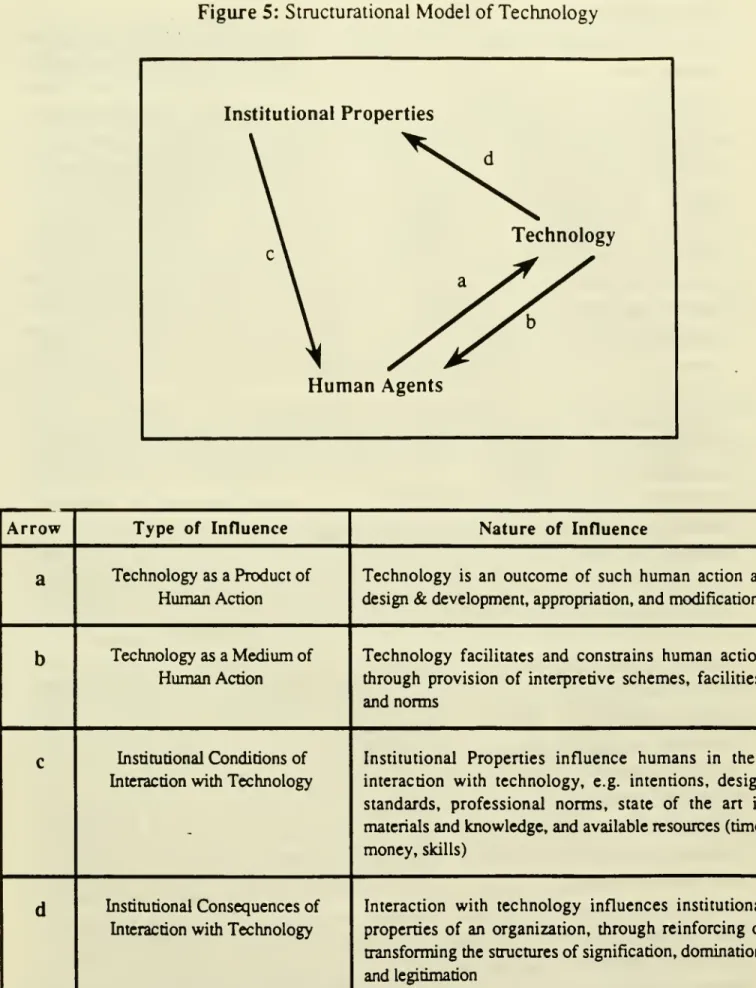
referencetothe relationshipsdepictedinFigure 5.
I.
Technology
is theproduct
ofhuman
action(arrow
a).As
ahuman
artifact, technology onlycomes
into existence through creativehuman
action,and
is sustained byhuman
actionthrough the
ongoing maintenance
and adaptation of technology (automobilesneed
servicing,typewriters require
new
ribbons,and even
pencilsneed
sharpening). Further,human
actionconstitutes technology through using it.
That
is,once
created, technology isdeployed
inorganizations but remains inanimate and
hence
ineffectual unless it is givenmeaning
and
ismanipulated—directly or indirectly-byhumans.
On
itsown,
technology isofno
import; itplays nomeaningfulrole in
human
affairs. It is only through the appropriation of technology byhumans
(whether for productive or symbolic ends), that it plays a significant role
and hence
exerts influence. Itis onlythroughhuman
action thattechnologyqua
technologycan be understood.The
interpretiveflexibilityof technologyoperatesintwo
modes
ofinteraction.In thedesignmode,human
agentsbuild into technologycertain interpretiveschemes
(rulesreflectingknowledge
ofthework
being automated), certain facilities (resources toaccomplish that work),and
certainnorms
(rules that define theorganizationally sanctioned
way
ofexecuting that work). In the usemode,
human
agents appropriate technologyby
assigning sharedmeanings
to it,which
influence theirappropriation ofthe interpretive schemes, facilities,and
norms
designed intothe technology, thusallowingthoseelements to influence theirtaskexecution. In
many
organizations, individualsmay
have
little control overwhen
orhow
to use technology,and hence
little discretion overwhich
meanings and
elements influence their interactionwith it. But, theseconstraints areinstitutional,and are not inherent in the technological artifact itself. Users can always
choose
(at the risk ofcensure) notto utilize a technology, orchoose to
modify
theirengagement
withit.The
notion thattechnology needs to be appropriated by
humans
retains the element ofcontrol that users always have (howeverslight) ininteracting with technology.Figure
5: StructurationalModel
of
Technology
Institutional
Properties
Technology
Human
Agents
II.
Technology
is themedium
ofhuman
action(arrow
b), because technology,when
usedby
workers, mediates their activities.Anyone
who
has used a typewriter, telephone, computer,hammer,
orpencilcan attest that technology facilitatesthe performanceofcertain kindsof work.That the technologyalso constrainsthe performance
by
facilitating itin a particularmanner
isanimportant corollary ofthis. This influence resembles that posited
by
earlierexaminations ofthe"impactsof technology"
on
the use oftechnology.However,
there aretwo
significant differences in the structurational model.One
is the recognition that technology cannot determine social practices.Human
agency is always needed to use technologyand
this implies the possibility of"choosing to act otherwise." Thus, technology can only condition social practices.
The
otherdifference is the
acknowledgement
that technology, in conditioning social practices, is bothfacilitating and constraining.
Technology
does notonly constrain oronly enable, butrather doesboth. This dual influence has typically not been recognized in studies that attempt todetermine
definitively
whether
technology has "positive" or"negative" effects [Attewelland
Rule 1984;Hartmann
et al. 1988]. Giddens' [1984]framework
allows us to recognize that technology-as-amedium
of social practices-necessarily has both restricting and enabling implications.Which
implicationdominatesdepends on multiple factorsincluding the actions
and
motives of designersand implementors; the institutional context in
which
technology isembedded; and
theautonomy
andcapability ofparticularusers.
Otherinfluences that reflectthe interaction between
human
agentsand structural properties arealsorelevant to a study oftechnology use in organizations.
However,
to punctuate the key aspects oftechnology, only those influences directly involving technology are discussed here.
Two
suchinfluences are particularlyimportant inthe structurational
model
of technology.HI.
One
influenceconcerns the nature ofhuman
action inorganizations,which
issituated action,and
hence
shapedby
organizational contexts (arrow c).When
actingon
technology (whetherdesigning, appropriating, modifying, or even resisting it),
human
agents are influencedby
theinstitutionalpropertiesoftheir setting.
They draw on
existing stocksofknowledge,resources,and
norms
toperform
their work. Often these influences are unarticulated, or reflectedon
onlyfleetingly
by
human
agents [Giddens 1984],and
are here referred to as the institutional conditions of interactionwith
technology.Anderson
[1988]compared
thedevelopment
ofnumerically controlled
(NC)
equipment intwo
differentcontexts, theU.S.and Norway,
and foundthat different institutional settings, funding, labor relations, socio-economic conditions,
and
cultural traditions shaped very different kinds of
NC
technologies.The
caseofthe Britishwater-transfer tunnel
[Wynne
1988] described above, tragically revealshow
particular institutionalconditions influenced thedesign and developmentofa specific technology, while Barley's [1986,
1990] examination of
how
two
different hospitals used similar medical scanning technology,shows
how
different institutionalconditions influenced theway
people interacted with technology.Technology
is builtand
used within certain social and historical circumstancesand
itsform
andfunctioningwill beartheimprint of thoseconditions.
IV.
The
final influence involves themanner
inwhich
human
actionwhen
it uses technologyactsupon
the institutional properties ofan organization (arrow d), eitherby
reinforcingthem
(moretypically) or
by
transformingthem
(less frequently).Technology
is an "enacted environment"[Weick
1979:260]whose
construction and use is conditionedby
an organization's structures ofsignification,domination, and legitimation.
The
appropriation and use of technology implies thechange
or reinforcement of these three institutional structures.These
effects—comprising theinstitutional
consequences
of interactionwith
technology-are
often not reflectedon by
users,
who
are generallyunaware
of their role in eitherreaffirming or disrupting an institutionalstatus quo.
When
usersconform
to the technology'sembedded
rulesand
resources, theyunwittinglysustaintheinstitutional structures in
which
thetechnologyis deployed.When
usersdo
not use the technology as itwas
intended, theymay
undermine and
sometimes
transform the
embedded
rules and resources,and
hence the institutional contextand
strategicobjectives of the technology's creators, sponsors,
and
implementors. Thismay
happen
more
frequentl; than
one
would
imagine.Perrow
[1983] andWynne
[1988]show
how
users operatingcomplex
technologies often have to deal with high levels of stress, ambiguity,and
unstructuredlocal situations thatdeviate
from
"normal"operatingconditions. In these situations, thenegotiated orenacted use of technology isoften verydifferent to the prescribed, mechanicaloperation ofthetechnology.
Wynne
notes [1988:152]:"Thus implementing
designcommitments
and operatingtechnological systems involves the continual invention
and
negotiation ofnew
rulesand
relationships, not
merely
theenactment
of designed ones. This develops the technology inunanticipatedways, asit is 'normalized'."Tyre's [1988] study ofprocesstechnology includesthe
case ofa
new
grindingmachine
being introduced into an automated manufacturing plant. Intitalintegration
problems
forced project engineers to install atemporary
manual
"workaround."
Although
themanual workaround
was
inefficient, operators quickly learned todepend on
it toaccomplish their work. Later,
when
the grinderwas
fully functional, operators prevented theengineers
from
dismantling the"temporary" workaround.
The
new
technology with itsworkaround had
become
so integrated into operators' routines, that itbecome
the"normal"
orinstitutionalized
mode
of operatingthegrindingmachine.In the
model
of technology proposed here, structuration isunderstoodas adynamic
processwhich
is
embedded
historicallyand contextually.While
themain components
and natureofrelationshipsvary over time. In addition to being
dynamic,
structuration is understood to be a dialecticalprocess, hence inherently contradictory. In contrast to
models
that relate elements linearly, thestructurational
model assumes
thatelements interact recursively,may
be in opposition, and thatthey
may
undermine
each other's effects.An
example
is the tendency of technology tobecome
reified in organizations, thus
becoming
detachedfrom
thehuman
action that constructed it.The
typical apprehension of technologies as given and objective directly contradicts theirinherently
constructed nature. Recognizingpotential contradictionshelps us tounderstand pointsoftension
andinstability inorganizations, and
how
thesemay
interacttochangeandtransformorganizations.USING THE
STRUCTURATIONAL
MODEL
OF
TECHNOLOGY
This sectionillustratesthe structurational
model
oftechnology byinterpretingthefindingsofafieldresearch study [Orlikowski 1988],
which
investigated the use of informationtechnology in alarge,multi-nationalsoftware consultingfirm, Beta Corporation.
Research
SiteIn 1987,Beta earned
$600
milliondollarsin worldwideconsulting feesandemployed
over 13,000consultants in
some
200
offices in over50
countries.Most
ofBeta'semployees
are "functionalconsultants"
who
engage
in the building ofcustomized application systems for clients.A
smallproportion (three percent in 1987) are "technical consultants"
who
provide tecl .ical support(expertise inhardware
and
systemssoftware) tothefunctional consultants, and engagein researchand
development
Betaconsultantsoperate in temporaryproject teams andoccupy
various levelsinthefirm hierarchy (consultant, senior consultant, manager, and seniormanager).1
Over
thelast few
yearsBetahas invested extensive
amounts
of information technologyin theproductionwork
ofitsconsultants. This investment has transformed application systems development-traditionally a labor-intensive, paper-based set of activities-into a rationalized, capital-intensive production
process.
The
specific kind ofinformationtechnology developedto automate systems developmentis
known
in the data processing industry as"Computer-Aided
Software Engineering"(CASE)
technology,
and
inBetaas"productivity tools."Research
Methodology
The
studyemployed
ethnographic techniques [Agar 1980;Van Maanen
1979, 1988] such asobservation ofparticipants, interaction with
CASE
tools, documentation review, social contact,unstructuredand semi-structured interviews. It
was
executed overeightmonths
within Beta andinthoseclient sites
where
Betadevelopers were buildingapplication systems. In thefirstphaseoftheresearch, historical data
on
the Beta corporation and its systemsdevelopment
practiceswas
1
Inthefollowing, areft•enceto"consultants"referstofunctional consultants,unless otherwiseindicated.
gathered
from
published material (inhouseand
trade press),and from
interviews with seniormanagers
who
had been involvedin Beta'straditional systemsdevelopment,aswell as itsadoptionofa capital-intensive systems
development
process.With
some
background
information on Beta and its practices, five different application projects (four largeand
one small) were selected forindepth analyses. Projects werenot selected at
random
butwere strategically identified toguaranteeexposure to the use of
CASE
tools in allmajor
phases of the systemsdevelopment
life cycle(requirements analysis,conceptualdesign, detailed design, implementation, andtesting).
An
averageoffourweeks was
spenton
eachproject, observingand interviewingteam
members
in theirdaily systemsdevelopment
work, andin theirinteraction witheachotherand theCASE
tools.One
hundred
and twenty formal interviewswere
conducted, each lastingan average ofone and ahalf hours,
and
many
more
informal meetings andexchanges
took place. Participation in theresearch
was
voluntary and while the particularprojects studiedwere
approvedby
Beta's seniormanagement,
individuals spanning all Beta's hierarchic levelswere
invited to participate in thestudy by theresearcher alone. Otherkey informantswere identified andsought out both withinand
outside Beta, such as the seniorrecruiting officer, thedirectorofresearch and development, sales
directors,
major
clientmanagers, and former Beta employees.Data
was
alsocollected throughoutthe study at
monthly
(all day)division meetings,and in project training sessionson
CASE
tools.We
canexamine
Beta'sdevelopment
and use of productivity tools in terms of the processesthrough
which
the technologywas
integrated into Beta's operations over time.These
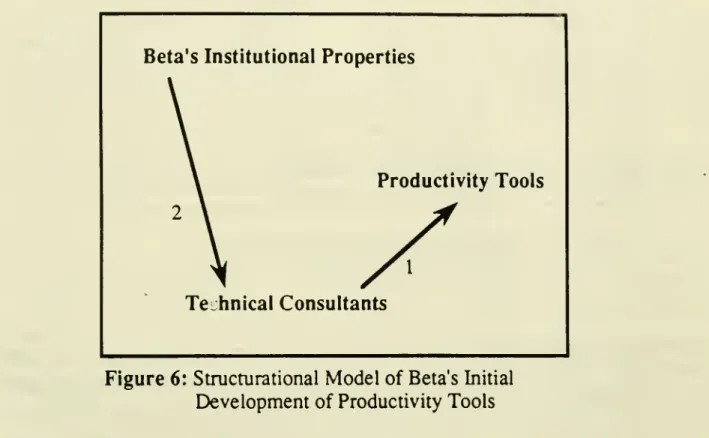
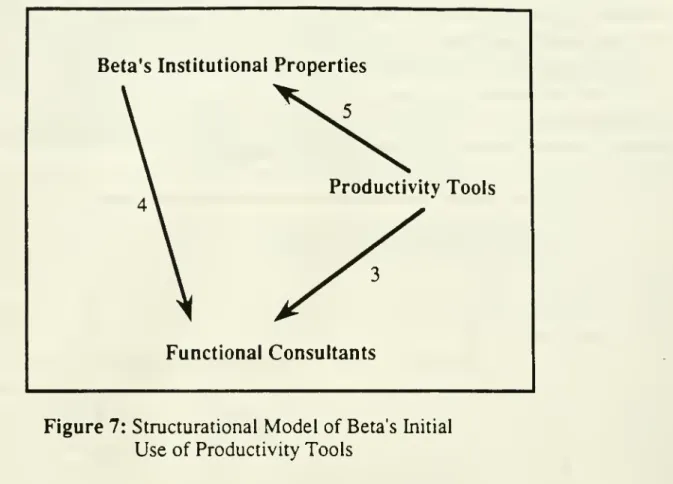
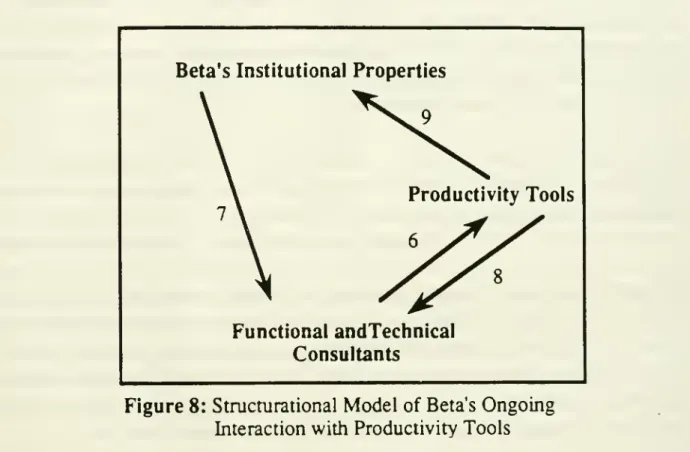
processeswill thenbe interpreted through a seriesofstructurational models,depicted inFigures 6 through 8.
Stage
I: InitialDevelopment
ofTechnology
About
adecade ago, Beta's seniormanagers
decided thatto maintain theirprofitability ratio andbeatthe competition they needed to increase productivity, hencedecreasing the length of systems development, and reducing the
number
ofconsultants requiredon
eachproject.They
alsowanted
to
improve
management
leverageby
increasing thenumber
ofconsultants per seniormanager
(expanding span ofcontrol).
They
alsowanted
to diminish theirdependence
on
the technicalknowledge
requiredforthemultipledifferentcomputer
configurationsoperatedby
their clients. Inthe past, Beta
had
toensure thatconsultantsknew
a range ofprogramming
languages, databasemanagement,
teleprocessing,and operating systems tobe sufficientlyversatile tooperate inmany
technological environments.
Such knowledge
is highly technical, idiosyncratic,and
quicklybecomes
obsoleteasnew
computer
productscontinually appearon
themarket
The
task of constructing productivity toolswas
delegated to Beta's technical consultants,who
automate Beta's systems
development
practices the technical consultants had to articulate andrationalizethe existing
manual
proceduresthat functional consultantsutilized dailyin theirwork. Inthisthey
were
helpedby
the existence within Betaofasystemsdevelopment
methodology, whichspecifiedingreatdetail the rulesand routines forexecutingeach systems developmenttask.
When
Beta first beganconsulting inthe early sixtiestherewere
no
formal standards or guidelinesby which
software consultantsconductedtheir practice.Application systemswere
built by trial anderror.
Over
time, abody
of inhouse systemsdevelopment knowledge
accumulated through thesharing of experiences,
and
some
informal checklistswere compiled and
circulated. But thesoftware consulting practice kept
growing
(about 150
percent annually) and Beta acquiredmore
personnelandclients.
The
informal tradition withwhich
Beta'spractice guidelineswere learntandcommunicated was no
longer adequate.The
guidelineswere
too open-ended,assumed
toomuch
competence, and couldnot deal with exceptional conditions. Projects had
become
bigger andmore
complex, the stakes higher, and losses
more
severe andvisible. Inresponse, Betamanagers
setupa firm-wide task force to codify the informal systems
development
heuristics,expanding
them
where
appropriate,and
formally instituting practice guidelines. Thus, Beta's official andcomprehensive
systemsdevelopment
methodology
was
created. It prescribed a sequence ofsystems
development
stages, articulated the tasks anddeliverables ofeach stage,definedthe skillsneeded to perform the tasks, established guidelines forestimating time an-'! budgetrequirements,
and
specified quality controls and process milestones.While
prescriptive in documentation, thetenets ofthe
methodology were
often overridden in practice, with consultants relyingon
theirinitiative toperform work,using the
methodology
primarilyasanorienting device.An
important condition for the rationalization of systemsdevelopment
work
and
hence thedevelopment
ofthe technologywas
the prior institutionalization of Beta's systemsdevelopment
methodology. Despite the lack ofcongruence
between
the prescriptionsofthemethodology
and systemsdevelopment
practice, the technical consultants turned to Beta's systemsdevelopment
methodology
forarational, structured, and thorough accountofsystemsdevelopment
work.While
the tools
were
intended tostandardize consulting work, in fact, the standardization had precededthe
development
ofthetools.The
tools gavemanagement
an opportunityto push standardizationfurther,
and
more
importantly, toenforceitin practice,which
had notbeenfeasible before.The
development
ofproductivity tools within Beta can bedescribed intermsofthe structurationalmodel
(seeFigure 6).Commissioned
byseniormanagement,
technicalconsultantswere
influencedin their
development
work by
their managers' strategy. Thismanagement
strategyauthorized theallocation of resources to technical consultants facilitating their construction of tools. This
construction


![Figure 3: Barley's [1986] Model of Technology-triggered Structural Change](https://thumb-eu.123doks.com/thumbv2/123doknet/14753746.581431/17.847.95.824.66.698/figure-barley-s-model-technology-triggered-structural-change.webp)