HAL Id: hal-00303399
https://hal.archives-ouvertes.fr/hal-00303399
Submitted on 7 Mar 2008HAL is a multi-disciplinary open access
archive for the deposit and dissemination of sci-entific research documents, whether they are pub-lished or not. The documents may come from teaching and research institutions in France or abroad, or from public or private research centers.
L’archive ouverte pluridisciplinaire HAL, est destinée au dépôt et à la diffusion de documents scientifiques de niveau recherche, publiés ou non, émanant des établissements d’enseignement et de recherche français ou étrangers, des laboratoires publics ou privés.
The effect of lightning NOx production on surface ozone
in the continental United States
B. Kaynak, Y. Hu, R. V. Martin, A. G. Russell, Y. Choi, Y. Wang
To cite this version:
B. Kaynak, Y. Hu, R. V. Martin, A. G. Russell, Y. Choi, et al.. The effect of lightning NOx production on surface ozone in the continental United States. Atmospheric Chemistry and Physics Discussions, European Geosciences Union, 2008, 8 (2), pp.5061-5089. �hal-00303399�
ACPD
8, 5061–5089, 2008 Effect of lightning NOxon surface ozone B. Kaynak et al. Title Page Abstract Introduction Conclusions References Tables Figures ◭ ◮ ◭ ◮ Back Close Full Screen / EscPrinter-friendly Version Interactive Discussion Atmos. Chem. Phys. Discuss., 8, 5061–5089, 2008
www.atmos-chem-phys-discuss.net/8/5061/2008/ © Author(s) 2008. This work is distributed under the Creative Commons Attribution 3.0 License.
Atmospheric Chemistry and Physics Discussions
The effect of lightning NO
x
production on
surface ozone in the continental United
States
B. Kaynak1, Y. Hu1, R. V. Martin2,3, A. G. Russell1, Y. Choi4, and Y. Wang4 1
School of Civil and Environmental Engineering, Georgia Institute of Technology, Atlanta, GA, USA
2
Department of Physics and Atmospheric Science, Dalhousie University Halifax, NS, Canada 3
Harvard-Smithsonian Center for Astrophysics, Cambridge, MA, USA 4
School of Earth and Atmospheric Sciences, Georgia Institute of Technology, Atlanta, GA, USA
Received: 22 January 2008 – Accepted: 2 February 2008 – Published: 7 March 2008 Correspondence to: A. G. Russell ([email protected])
ACPD
8, 5061–5089, 2008 Effect of lightning NOxon surface ozone B. Kaynak et al. Title Page Abstract Introduction Conclusions References Tables Figures ◭ ◮ ◭ ◮ Back Close Full Screen / EscPrinter-friendly Version Interactive Discussion
Abstract
Lightning NOx emissions calculated using the U.S. National Lightning Detection
Net-work data were found to account for 30% of the total NOx emissions for July–August
2004, a period chosen both for having higher lightning NOxproduction and high ozone levels, thus maximizing the likelihood that such emissions could impact peak ozone 5
levels. Including such emissions led to modest, but sometimes significant increases in simulated surface ozone when using the Community Multi-scale Air Quality Model (CMAQ). Three model simulations were performed, two with the addition of lightning NOxemissions, and one without. Domain-wide daily maximum 8-h ozone changes due
to lightning NOxwere less than 2 ppbv in 71% of the cases with a maximum of 10-ppbv; 10
whereas the difference in 1-h ozone was less than 2 ppbv in 77% of the cases with a maximum of 6 ppbv. Daily maximum 1-h and 8-h ozone for grids containing O3
mon-itoring stations changed slightly, with more than 43% of the cases differing less than 2 ppbv. The greatest differences were 42-ppbv for both 1-h and 8-h O3, though these
tended to be on days of lower ozone. Lightning impacts on the season-wide maximum 15
1-h and 8-h averaged ozone decreased starting from the 1st to 4th highest values (an average of 4th highest, 8-h values is used for attainment demonstration in the U.S.). Background ozone values from the y-intercept of O3versus NOzcurve were 42.2 and
43.9 ppbv for simulations without and with lightning emissions, respectively. Results from both simulations with lightning NOx suggest that while North American lightning 20
production of NOx can lead to significant local impacts on a few occasions, they will
have a relatively small impact on typical maximum levels and determination of Policy Relevant Background levels.
1 Introduction
Nitrogen oxides (NOx=NO+NO2) play a key role in tropospheric chemistry and impact
25
ACPD
8, 5061–5089, 2008 Effect of lightning NOxon surface ozone B. Kaynak et al. Title Page Abstract Introduction Conclusions References Tables Figures ◭ ◮ ◭ ◮ Back Close Full Screen / EscPrinter-friendly Version Interactive Discussion biomass burning, soil release, oxidation of atmospheric ammonia, lightning, and
strato-spheric NOx. Recent global estimates of NOx production from lightning vary from 1 to 20 Tg (N)/yr (Martin et al., 2007; Labrador et al., 2005; Boersma et al., 2005), though 5±3 Tg N/yr is applied in most global modeling (Ridley et al., 2005; Schumann and Huntrieser, 2007).
5
Lightning can lead to significant increases in NOx in the middle and upper
tropo-sphere and contribute significantly to columnar abundance of NO2 (Choi et al., 2005;
Zhang et al., 2003; Tie et al., 2002; Bond et al., 2001; Zhang et al., 2000; Pickering et al., 1998; Delmas et al., 1997; Ridley et al., 1996; Beirle et al., 2006; Martin et al., 2006). This source is particularly important in the Southeastern U.S. during the 10
summertime (Biazar and McNider, 1995; Bond et al., 2001; Hudman et al., 2007). However, such emissions often are not included in regional modeling, unlike global modeling (Choi et al., 2005; Egorova et al., 1999; Stockwell et al., 1999; Tie et al., 2002; Allen and Pickering, 2002). With further opportunities for evaluating our models using satellite measurements which indicate the importance of lightning NOx
enhance-15
ments (Boersma et al., 2005; Choi et al., 2005; Christian et al., 2003), including such emission to regional models should be considered.
Variability in background surface level ozone over the United States is a critical is-sue strongly related to air quality policy and recent ozone criteria document (E.P.A., 2006) investigated such levels in terms of the Policy Related Background (PRB). PRB 20
is defined as the distribution of O3 concentrations that would be observed in the U.S.
in the absence of anthropogenic (man-made) emissions of O3 precursors in the U.S.,
Canada, and Mexico. Estimates of background ozone range between 15–45 ppbv (Alt-shuller and Lefohn, 1996; Fiore et al., 2002; Hirsch et al., 1996; Liang et al., 1998; Lin et al., 2000; Trainer et al., 1993), though some studies suggest that natural back-25
ground ozone is higher than the 25–45 ppbv range recently used as the PRB. A higher PBR impacts how readily one can achieve the National Ambient Air Quality Standard (NAAQS) for ozone (Lefohn et al., 2001). The current NAAQS is 0.08 ppmv, calculated as the 3-yr average of the fourth-highest daily maximum 8-h average ozone
concen-ACPD
8, 5061–5089, 2008 Effect of lightning NOxon surface ozone B. Kaynak et al. Title Page Abstract Introduction Conclusions References Tables Figures ◭ ◮ ◭ ◮ Back Close Full Screen / EscPrinter-friendly Version Interactive Discussion tration measured at each monitor within an area over each year. Recently EPA has
proposed tightening the standard to 0.070–0.075 ppmv further increasing the impor-tance of how ozone production from lightning might impact levels. Fiore et al. (2003) suggested the O3background is generally 15–35 ppbv, with occasional incidences of
40–50 ppbv at high-altitude western sites in spring and these cases would not compro-5
mise the current 80 ppbv U.S. standard. Here, impacts of lightning NOx emissions on
surface ozone and contribution to PRB are investigated using the MM5-SMOKE-CMAQ system (Byun and J.K.S., 1999; Houyoux and Vukovich, 1999; Seaman, 2000) applied to July–August 2004. CMAQ simulations can give additional information because the effect of lightning might lead to high ozone at finer scales which can not be captured 10
using current global models. July–August 2004 is chosen for a variety of reasons. First, pollutant data are available not only from the routine, ground based monitors, but from satellites and airborne platforms as well [ICARTT-International Consortium for Atmospheric Research on Transport and Transformation, NASA INTEX-NA – In-tercontinental Chemical Transport Experiment-North America, Mission 2004], allowing 15
for more detailed evaluation and investigation. Second, this period had a number of ozone exceedances across the U.S. (2008b). Third, this period has frequent convec-tive events and lightning NOx formation. As such, July–August is a top candidate for
identifying the potential impact of lightning NOx formation on high ozone levels and
non-attainment. 20
2 Method
2.1 Model description
The Community Multi-scale Air Quality Model (CMAQ) (Byun and Schere, 2006) with the SAPRC99 Chemical Mechanism (Carter, 2000) is used in this study. CMAQ is an advanced, atmospheric chemical transport model widely used for both research and 25
res-ACPD
8, 5061–5089, 2008 Effect of lightning NOxon surface ozone B. Kaynak et al. Title Page Abstract Introduction Conclusions References Tables Figures ◭ ◮ ◭ ◮ Back Close Full Screen / EscPrinter-friendly Version Interactive Discussion olution covering the continental United States, Southern Canada and Northern Mexico
including 13 vertical layers reaching up to approximately 15 km. The Fifth-Generation NCAR/Penn State Mesoscale Model (MM5) (Seaman, 2000) is used to develop the me-teorological fields, and the Sparse Matrix Operator Kernel Emissions (SMOKE) (Houy-oux and Vukovich, 1999) is used to prepare input emissions for CMAQ. The emission 5
inventory used for the year 2004 is projected from the emissions inventory for the year 2002 (VISTAS2002) prepared as part of Visibility Improvement State & Tribal Asso-ciation of the Southeast (VISTAS) (MACTEC, 2005). Emission projection use growth factors from the Economic Growth Analysis System (EGAS) Version 4.0, and control ef-ficiency data obtained from EPA for the existing federal control strategies which were in 10
place in 2004. Additionally, actual NOxemissions in 2004 from U.S. power plants (i.e. electricity generating units, or EGUs) which are obtained from the continuous emis-sions monitoring (CEM) database from EPA website (2008a) are integrated into the emission inventory.
MM5 is run with 34 vertical levels to produce highly resolved meteorological infor-15
mation. The Grell scheme (Grell et al., 1995) is used to simulate cumulus (cloud) dynamics. The Four-Dimensional Data Assimilation (FDDA) (Dudhia et al., 2005) with the Pleim-Chang planetary boundary layer (PBL) scheme (Pleim and Chang, 1992) and Pleim-Xiu Land Surface Model (Xiu and Pleim, 2001) are also used. Simulated ozone is compared with ground observations for performance evaluation (Fig. 1). 20
2.2 Lightning NOxemissions
Typical emission inventories, e.g. U.S. EPA’s 1999 and 2002 National Emission In-ventories (NEI) do not account for lightning NOx emissions. Here, observed lightning
strikes (U.S. National Lightning Detection Network, NLDN) are correlated to MM5 re-sults, and used to enhance the traditional emission inventory. Three simulations were 25
ACPD
8, 5061–5089, 2008 Effect of lightning NOxon surface ozone B. Kaynak et al. Title Page Abstract Introduction Conclusions References Tables Figures ◭ ◮ ◭ ◮ Back Close Full Screen / EscPrinter-friendly Version Interactive Discussion using a vertical distribution based on Pickering (2007)1 for July–August 2004 and
an-other for sensitivity purposes using an older profile where more NOx is emitted near
the ground for August 2004. Detailed analysis shows how including those emissions impacts simulated ozone, particularly with respect to whether this more complete treat-ment impacts regulatory applications of air quality models.
5
Lightning NOx emissions are estimated by using U.S. NLDN lightning flash data. NLDN coverage includes the continental U.S. and extends 200–300 km off the coast-line, though includes only the cloud-to-ground (CG) lightning flashes. The detection efficiency for that data ranges from 80% to 90% for events with peak currents above 5 kA varying slightly by region over U.S. and decreases gradually away from the coast 10
(Cummins et al., 1998). As such, the actual number of flashes is either the same or more than the reported values. Previous studies (Bond et al., 2001; Price and Rind, 1993; Schumann and Huntrieser, 2007) suggested that the number of intra-cloud (IC) flashes is about 3 times that of CG flashes, and we adopt this ratio in this study. This value is also consistent with the results that are derived from satellite lightning mea-15
surements from the Optical Transient Detector (OTD) for 1995–1999 over the contigu-ous U.S. (Boccippio et al., 2001). Even though this ratio might be on the upper range for some regions, we chose to use it to conservatively estimate the maximum likely im-pact on ozone. The vertical profile used for allocation of NOx emissions is a modified
form of widely used vertical profile for mid-latitudes (Pickering et al., 1998). The “older” 20
vertical profile is based on the assumption that IC flashes produce approximately 10 times less NO than CG flashes (Price et al., 1997). More recent studies suggest that the production of NO by an IC flash is approximately equal to that of a CG flash (De-Caria et al., 2005; De(De-Caria et al., 2000; Fehr et al., 2004; Ott et al., 2007). The new scheme puts much less NOx in boundary layers versus the previous profile (Pickering,
25
2006). The difference in the amount of NO produced per flash for IC and CG flashes increases NO from IC flashes in the upper troposphere. As mentioned above, the
orig-1
ACPD
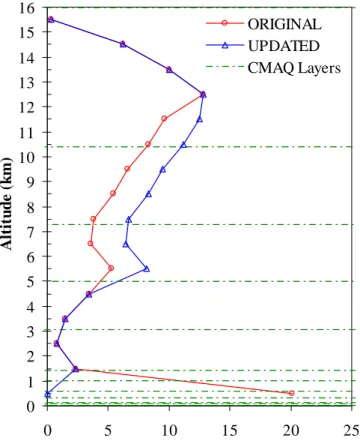
8, 5061–5089, 2008 Effect of lightning NOxon surface ozone B. Kaynak et al. Title Page Abstract Introduction Conclusions References Tables Figures ◭ ◮ ◭ ◮ Back Close Full Screen / EscPrinter-friendly Version Interactive Discussion inal vertical distribution is modified by removing a fraction of lightning mass from the
surface layers (0–1 km) and re-distributing this amount evenly to the layers between 5 and 12 km (Fig. 2) (Pickering, 2006).
Using DeCaria et al. (2005) led to an average of around 500 moles on NO per flash for both IC and CG flashes (DeCaria et al., 2005; Pickering, 2006). This value is also 5
used for FLEXPART (Cooper et al., 2006) and GEOS-Chem (Hudman et al., 2007) sim-ulations over North America during Summer 2004 and good comparisons with aircraft data have been obtained. Even though this value is in the upper range for the literature (Schumann and Huntrieser, 2007), results obtained from this assumption will likely give us an upper limit for the effects, so we can be more certain about the potential effects 10
of lightning NOxon surface O3.
To develop a spatially and temporally detailed NOx inventory, the emissions
esti-mates, along with lightning events were processed to obtain hourly and gridded light-ning emissions. NO emissions from lightlight-ning were located into model layers according to the modified vertical profile scaled to the cloud top of the particular clouds at each 15
CMAQ grid cell. Cloud occurrence (cloud cover) and cloud top are obtained from MM5 predictions at each CMAQ grid cell. Cloud occurrences are compared with locations of lightning events. Predicted cloud information and actual lightning data from NLDN are combined to allocate the lightning NOx emissions. Allocation uses either (1) the
actual grid’s cloud information if its cloud cover is not zero or (2) averaged non-zero 20
neighbor grids’ cloud information if cloud cover is zero in the location of an observed flash. Occurrence of lightning where no cloud is predicted was very rare: 0.18% of the time on average, with a 1.37% maximum on a specific day for the episode.
3 Results and discussion
Lightning NOxemission is a significant fraction of the total (Fig. 3), accounting for 30%
25
of the total emissions for July–August 2004. This amount is higher than what would be found for an annual average because summer months are the most lightning active
ACPD
8, 5061–5089, 2008 Effect of lightning NOxon surface ozone B. Kaynak et al. Title Page Abstract Introduction Conclusions References Tables Figures ◭ ◮ ◭ ◮ Back Close Full Screen / EscPrinter-friendly Version Interactive Discussion times of the year. The assumed NOx production rate per flash and the IC to CG ratio
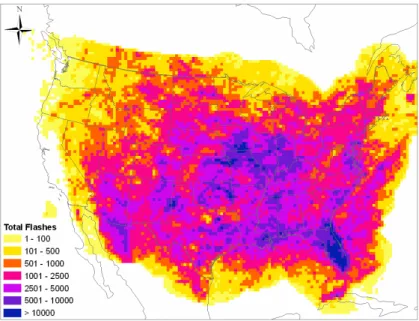
also have a significant effect on this fraction and are still rather uncertain. The spatial distribution of the lightning NOx emissions shows high intensity in three regions; the
Southeast, Texas and its surrounding, and the Midwest (Fig. 4).
Model results using the baseline and lightning enhanced inventories found that in-5
cluding lightning NOx typically had a small impact on domain-wide, maximum 8-h O3,
with more than 71% of the daily peak concentrations being affected by less than 2 ppbv (Fig. 5). There are only 2 days with a significant difference with around 10 ppbv being the maximum. Impacts on 1-h O3are similar, with more than 77% of the domain-wide
daily maximum ozone concentrations being within 2 ppbv (Fig. 5). The largest impact 10
is 6.4 ppbv. On average, the difference in domain-wide peak was 1.1 ppbv and 1.7 ppbv for 1-h and 8-h averages, respectively.
Further investigations into how lightning might impact ozone attainment in the U.S. were carried out with the model results at the 692 grid cells where one or more routine ozone monitoring stations are located. Daily maximum 1-h and 8-h O3 with lightning
15
emissions are generally, but not always, higher than the base case (Fig. 6). For grids with monitors, differences due to lightning ranged from –16.7 to 41.5 ppbv for 1-h O3
and –6.4 to 42.4 ppbv for 8-h O3. When the base model O3is either quite high (more
than 100 ppbv) or low (less than 40 ppbv) the differences are smaller (Fig. 7). This shows that the maximum impacts do not occur when ozone is the maximum in the 20
domain in cities where the anthropogenic emissions dominate. The distribution of the differences between two scenarios shows that for more than 43% of both 1-h and 8-h O3, the difference is less than 2 ppbv (Fig. 6), though there are some extreme cases of more than 20 ppbv. This suggests that not including lightning NOx emissions will
typically, but not always, have little impact. 25
The simulated first, second, third, and fourth highest daily O3 values for the simu-lation period are also compared at each of these 692 grid cells (Fig. 8). The impact of lightning on the 4-highest values of 8-h O3 is smaller than for daily maximum
ACPD
8, 5061–5089, 2008 Effect of lightning NOxon surface ozone B. Kaynak et al. Title Page Abstract Introduction Conclusions References Tables Figures ◭ ◮ ◭ ◮ Back Close Full Screen / EscPrinter-friendly Version Interactive Discussion decreases and the correlation between the base case and lightning case ozone
in-creases going from the 1st to 4th highest values (Fig. 8). Out of the 2768 (4×692) cases, a total of 219 (77 for 1st, 73 for 2nd, 36 for 3rd and 33 for 4th highest values) oc-curred where including lightning NOxled to an exceedance of the NAAQS that was not
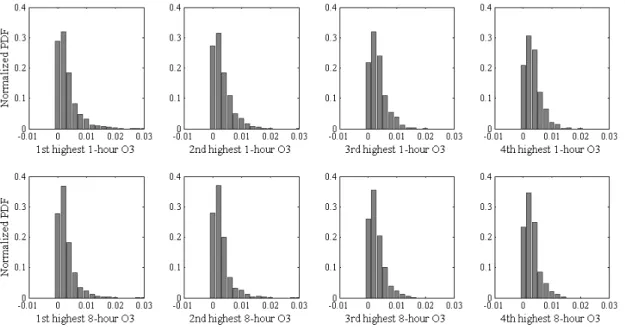
simulated otherwise. Differences between the two cases narrows from the 1st to 4th 5
highest values (Fig. 9) suggesting the effect of lightning on 4th highest values is less than on the highest values, and that significant impacts of lightning on peak ozone lev-els is infrequent. The maximum difference in the 4th highest values is around 14 ppbv whereas it is around 38 ppbv for the 1st highest value. 1-h O3follows a similar pattern
as 8-h O3 (Fig. 9) and the maximum difference in the 4th highest values is around
10
19 ppbv whereas it is around 36 ppbv for 1st highest value. While this work does find cases where including lightning NOxleads to additional simulated exceedances of the
NAAQS, the approach now used for demonstrating future attainment using a “Relative Reduction Factor” (RRF) will minimize the impact of lightning NOxin such effects. RRF is the ratio between the modeled future year and basecase 8-h daily maximum O3
con-15
centrations at a given monitor averaged over the simulation period used for calculating the future design value by multiplying it with the current design value (E.P.A., 2005) The spatial distribution of the lightning effects in the 1st highest daily 1-h and 8-h O3
shows that the most highly affected regions are high intensity lightning regions where biogenic VOC’s are relatively abundant and O3production is limited by NOx (Fig. 10).
20
A sensitivity simulation for August 2004 using the older vertical profile showed less O3 on the surface than the modified profile even though it allocates the maximum
amount of NOx on the surface. Reasons for the depressed O3 come from the timing
of those emissions and the level of NOxproduction. Much of the lightning-derived NOx is due to strong convective activity and found later in the afternoon into the evening 25
and night. Such periods have decreased photolysis from cloud cover or high solar zenith angles, and large amounts of fresh NOxemissions do not immediately contribute to photochemical ozone production and can lead to ozone decreases by both direct titration and nighttime chemistry that further reduces ozone as well as depletes much of
ACPD
8, 5061–5089, 2008 Effect of lightning NOxon surface ozone B. Kaynak et al. Title Page Abstract Introduction Conclusions References Tables Figures ◭ ◮ ◭ ◮ Back Close Full Screen / EscPrinter-friendly Version Interactive Discussion the NOxproduced (Russell et al., 1986). Accordingly, the sensitivity simulation resulted
in higher daily maximum domain-wide O3 values for some days, and lower on others
depending upon the timing and extent of NOx production. The destruction effect is
more obvious if AIRS monitoring stations are investigated. These results from AIRS monitors are focused on urban areas, and as such have higher NOx levels. Including
5
lightning emissions in the sensitivity case results in somewhat greater decreases with few increases in the first, second, third and fourth highest values compared to the updated profile. Overall, the net additional exceedances from lightning with the older lightning NOxdistribution profile are either zero or negative for virtually all cases.
The effect of North American lightning NOxemissions on average background ozone
10
can also be investigated by finding the y-intercept of O3versus NOz(Hirsch et al., 1996; Trainer et al., 1993) which gives the background ozone as 42.2 and 43.9 ppbv without and with lightning NOx emissions, respectively (Fig. 11). The simulated difference,
1.7 ppbv, is statistically significant at the 95% confidence level. The slope of the line in Fig. 11 suggests overall ozone production efficiency (OPE) of about 5.47 for the base 15
case and 5.66 for the lightning case showing that addition of lightning NOxresulted in
a decrease in overall OPE’s for ground level ozone. As discussed above, injection of NOx in the late afternoon and night increases NOz, but can decrease ozone due to
direct titration and nighttime chemistry.
4 Conclusions
20
Lightning NOx emissions estimated in this study account for 30% of the final total U.S.
emissions for July–August 2004 with the assumed NOx production rate per flash and
IC/CG ratio. Spatial distributions show emissions are significant in three main regions in the U.S.: the Southeast, Texas and surrounding and the Midwest. Resulting differ-ences in daily maximum 1-h and 8-h O3were typically small, with more than 77% and
25
71% of concentrations being within 2 ppbv, respectively. On average, the difference in the domain-wide peak was 1.1 ppbv and 1.7 ppbv for 1-h and 8-h O3 values. While
ACPD
8, 5061–5089, 2008 Effect of lightning NOxon surface ozone B. Kaynak et al. Title Page Abstract Introduction Conclusions References Tables Figures ◭ ◮ ◭ ◮ Back Close Full Screen / EscPrinter-friendly Version Interactive Discussion infrequent, there were a few days with significant increases in the domain-wide peaks
(up to 6 ppbv in 1-h and 10 ppbv in 8-h levels). However, these did not occur on days of high maximum ozone.
In the 692 grids with ozone monitors, daily maximum 8-h O3with lightning emissions
are usually, but not always, higher than the base case. Differences in the grids with 5
monitors ranged from –16.7 to 41.5 ppbv for 1-h and –6.4 to 42.4 ppbv for 8-h O3. For
more than 43% of the cases, the differences were less than 2 ppbv, but there are a few cases of more than 20 ppbv increases for 1-h and 8-h O3. The 1st to 4th highest values for these grids experienced a smaller simulated impact. The correlation between base case and lightning case ozone increased going from the 1st to 4th highest values 10
showing the effect of lightning on the 4th highest is less than on the highest. The maximum difference in the 4th highest ozone in the domain is around 19 ppbv (36 ppbv for 1st highest) for 8-h O3. These results indicate lightning NOx can cause significant
increase of ozone in some extreme cases but its effect on ozone decreases if these extreme cases are excluded.
15
Allocating more NOx on the surface with the sensitivity simulation for August 2004
showed less O3on the surface. The destruction effect is more obvious for AIRS mon-itoring stations which focus on urban areas. Overall, the net additional exceedances from lightning with the older lightning NOxdistribution profile are either zero or negative
for virtually all cases. 20
Even though the North American emission of NOxfrom lightning is significant, its
im-pact on daily maximum 8-h O3for entire U.S. and policy relevant background ozone is
typically small. There was only a 1.7 ppbv increase in regional background ozone. On the other hand, spatial distribution of these emissions and some occasions of higher ozone increases in our results suggest that these can lead to significant lo-25
cal impacts on a few occasions, especially in the southern U.S., and analysis of ozone exceedances should consider if lightning may be a contributing factor. Lightning else-where in the world may also contribute to background ozone over North America through long-range transport.
ACPD
8, 5061–5089, 2008 Effect of lightning NOxon surface ozone B. Kaynak et al. Title Page Abstract Introduction Conclusions References Tables Figures ◭ ◮ ◭ ◮ Back Close Full Screen / EscPrinter-friendly Version Interactive Discussion Given the rather minor impacts of lightning NOx on ground level ozone found here,
reducing the assumed emissions would lead to a nearly linear reduction in the ozone impact calculated (Cohan et al., 2005).
Acknowledgements. We thank K. E. Pickering for insightful comments. NLDN data provided
by the NASA Lightning Imaging Sensor (LIS) instrument team and the LIS data center via
5
the Global Hydrology Resource Center (GHRC) located at the Global Hydrology and Climate Center (GHCC), Huntsville, Alabama through a license agreement with Vaisala, Inc. This work was supported by NASA Project SV6-76007 (NNG04GE15G), and EPA grants (RD83096001, RD83107601 and RD83215901).
References
10
Clean air markets: available at:http://camddataandmaps.epa.gov/gdm, last access: 8 January 2008, 2008a.
Air quality system (aqs): available at: http://www.epa.gov/ttn/airs/airsaqs, last access: 8 Jan-uary 2008, 2008b.
Allen, D. J. and Pickering, K. E.: Evaluation of lightning flash rate parameterizations
15
for use in a global chemical transport model, J. Geophys. Res., 107(D23), 4711, doi:10.1029/2002JD002066, 2002.
Altshuller, A. P. and Lefohn, A. S.: Background ozone in the planetary boundary layer over the united states, J. Air Waste Manage., 46, 134–141, 1996.
Beirle, S., Spichtinger, N., Stohl, A., Cummins, K. L., Turner, T., Boccippio, D., Cooper, O.
20
R., Wenig, M., Grzegorski, M., Platt, U., and Wagner, T.: Estimating the nox produced by lightning from gome and nldn data: A case study in the gulf of mexico, Atmos. Chem. Phys., 6, 1075–1089, 2006,
http://www.atmos-chem-phys.net/6/1075/2006/.
Biazar, A. P. and McNider, R. T.: Regional estimates of lightning production of nitrogen-oxides,
25
J. Geophys. Res., 100, 22 861–22 874, 1995.
Boccippio, D. J., Cummins, K. L., Christian, H. J., and Goodman, S. J.: Combined satellite- and surface-based estimation of the intracloud-cloud-to-ground lightning ratio over the continental united states, Mon. Weather Rev., 129, 108–122, 2001.
ACPD
8, 5061–5089, 2008 Effect of lightning NOxon surface ozone B. Kaynak et al. Title Page Abstract Introduction Conclusions References Tables Figures ◭ ◮ ◭ ◮ Back Close Full Screen / EscPrinter-friendly Version Interactive Discussion
Boersma, K. F., Eskes, H. J., Meijer, E. W., and Kelder, H. M.: Estimates of lightning nox production from gome satellite observations, Atmos. Chem. Phys., 5, 2311–2331, 2005, http://www.atmos-chem-phys.net/5/2311/2005/.
Bond, D. W., Zhang, R. Y., Tie, X. X., Brasseur, G., Huffines, G., Orville, R. E., and Boccippio, D. J.: Nox production by lightning over the continental united states, J. Geophys. Res., 106,
5
27 701–27 710, 2001.
Byun, D. and Schere, K. L.: Review of the governing equations, computational algorithms, and other components of the models-3 community multiscale air quality (cmaq) modeling system, Appl. Mech. Rev., 59, 51–77, 2006.
Byun, D. W. and J.K.S., C.: Science algorithms of the epa models-3 community multi-scale air
10
quality (cmaq) modeling system, Research Triangle Park, NC.EPA/600/R-99/030, 1999. Carter, W. P. L.: Implementation of the saprc-99 chemical mechanism into the models-3
frame-work, United States Environmental Protection Agency, 2000.
Choi, Y., Wang, Y. H., Zeng, T., Martin, R. V., Kurosu, T. P., and Chance, K.: Evidence of light-ning NOxand convective transport of pollutants in satellite observations over north america,
15
Geophys. Res. Lett., 32, L02805, doi:10.1029/2004GL021436, 2005.
Christian, H. J., Blakeslee, R. J., Boccippio, D. J., Boeck, W. L., Buechler, D. E., Driscoll, K. T., Goodman, S. J., Hall, J. M., Koshak, W. J., Mach, D. M., and Stewart, M. F.: Global frequency and distribution of lightning as observed from space by the optical transient detector, J. Geophys. Res., 108(D1), 4005, doi:10.1029/2002JD002347, 2003.
20
Cohan, D. S., Hakami, A., Hu, Y. T., and Russell, A. G.: Nonlinear response of ozone to emissions: Source apportionment and sensitivity analysis, Environ. Sci. Technol., 39, 6739– 6748, 2005.
Cooper, O. R., Stohl, A., Trainer, M., Thompson, A. M., Witte, J. C., Oltmans, S. J., Morris, G., Pickering, K. E., Crawford, J. H., Chen, G., Cohen, R. C., Bertram, T. H., Wooldridge,
25
P., Perring, A., Brune, W. H., Merrill, J., Moody, J. L., Tarasick, D., Nedelec, P., Forbes, G., Newchurch, M. J., Schmidlin, F. J., Johnson, B. J., Turquety, S., Baughcum, S. L., Ren, X., Fehsenfeld, F. C., Meagher, J. F., Spichtinger, N., Brown, C. C., McKeen, S. A., McDermid, I. S., and Leblanc, T.: Large upper tropospheric ozone enhancements above midlatitude north america during summer: In situ evidence from the ions and mozaic ozone measurement
30
network, J. Geophys. Res., 111, D24S05, doi:10.1029/2006JD007306, 2006.
Cummins, K. L., Krider, E. P., and Malone, M. D.: The us national lightning detection network (tm) and applications of cloud-to-ground lightning data by electric power utilities, IEEE T.
ACPD
8, 5061–5089, 2008 Effect of lightning NOxon surface ozone B. Kaynak et al. Title Page Abstract Introduction Conclusions References Tables Figures ◭ ◮ ◭ ◮ Back Close Full Screen / EscPrinter-friendly Version Interactive Discussion
Electromagn. C., 40, 465–480, 1998.
DeCaria, A. J., Pickering, K. E., Stenchikov, G. L., Scala, J. R., Stith, J. L., Dye, J. E., Ridley, B. A., and Laroche, P.: A cloud-scale model study of lightning-generated nox in an individual thunderstorm during sterao-a, J. Geophys. Res., 105, 11 601–11 616, 2000.
DeCaria, A. J., Pickering, K. E., Stenchikov, G. L., and Ott, L. E.: Lightning-generated NOx
5
and its impact on tropospheric ozone production: A three-dimensional modeling study of a Stratosphere-Troposphere Experiment: Radiation, Aerosols and Ozone (STERAO-A) thun-derstorm, J. Geophys. Res., 110, D14303, doi:10.1029/2004JD005556, 2005.
Delmas, R., Serca, D., and Jambert, C.: Global inventory of NOx sources, Nutr. Cycl. Agroe-cosys., 48, 51–60, 1997.
10
Dudhia, J., Gill, D., Manning, K., Wang, W., and Bruyere, C.: Psu/ncar mesoscale modeling system tutorial class notes and users’ guide (mm5 modeling system version 3), National Center for Atmospheric Research, 2005.
E.P.A., U. S.: Guidance on the use of models and other analyses in attainment demonstrations for the 8-h ozone naaqs, Research Triangle Park, NC.EPA-454/R-05-002, 2005.
15
E.P.A., U. S.: Air quality criteria for ozone and related photochemical oxidants, Research Trian-gle Park, NC., 2006.
Egorova, T., Zubov, V., Jagovkina, S., and Rozanov, E.: Lightning production of nox and ozone, Phys. Chem. Earth Pt. C, 24, 473–479, 1999.
Fehr, T., Holler, H., and Huntrieser, H.: Model study on production and transport of
20
lightning-produced NOx in a EULINOX supercell storm, J. Geophys. Res., 109, D09102, doi:10.1029/2003JD003935, 2004.
Fiore, A. M., Jacob, D. J., Bey, I., Yantosca, R. M., Field, B. D., Fusco, A. C., and Wilkinson, J. G.: Background ozone over the united states in summer: Origin, trend, and contribution to pollution episodes, J. Geophys. Res., 107(D15), 4275, doi:10.1029/2001JD000982, 2002.
25
Grell, G. A., Dudhia, J., and Stauffer, D. R.: A description of the fifth generation penn state/ncar mesoscale model (mm5), National Centre for Atmospheric Research, Boulder, Colorado, USA, 1995.
Hirsch, A. I., Munger, J. W., Jacob, D. J., Horowitz, L. W., and Goldstein, A. H.: Seasonal variation of the ozone production efficiency per unit NOxat harvard forest, Massachusetts, J. 30
Geophys. Res., 101, 12 659–12 666, 1996.
Houyoux, M. R. and Vukovich, J. M.: Updates to the sparse matrix operator kernel emissions (smoke) modeling system and integration with models-3, The Emission Inventory: Regional
ACPD
8, 5061–5089, 2008 Effect of lightning NOxon surface ozone B. Kaynak et al. Title Page Abstract Introduction Conclusions References Tables Figures ◭ ◮ ◭ ◮ Back Close Full Screen / EscPrinter-friendly Version Interactive Discussion
Strategies for the Future, Raleigh, NC, 1999,
Hudman, R. C., Jacob, D. J., Turquety, S., Leibensperger, E. M., Murray, L. T., Wu, S., Gilliland, A. B., Avery, M., Bertram, T. H., Brune, W., Cohen, R. C., Dibb, J. E., Flocke, F. M., Fried, A., Holloway, J., Neuman, J. A., Orville, R., Perring, A., Ren, X., Ryerson, T. B., Sachse, G. W., Singh, H. B., Swanson, A., and Wooldridge, P. J.: Surface and lightning sources of nitrogen
5
oxides in the united states: Magnitudes, chemical evolution, and outflow, J. Geophys. Res., 112, D12S05, doi:10.1029/2006JD007912, 2007.
Labrador, L. J., von Kuhlmann, R., and Lawrence, M. G.: The effects of lightning-produced NOx and its vertical distribution on atmospheric chemistry: Sensitivity simulations with match-mpic, Atmos. Chem. Phys., 5, 1815–1834, 2005,
10
http://www.atmos-chem-phys.net/5/1815/2005/.
Lefohn, A. S., Oltmans, S. J., Dann, T., and Singh, H. B.: Present-day variability of background ozone in the lower troposphere, J. Geophys. Res., 106, 9945–9958, 2001.
Liang, J. Y., Horowitz, L. W., Jacob, D. J., Wang, Y. H., Fiore, A. M., Logan, J. A., Gardner, G. M., and Munger, J. W.: Seasonal budgets of reactive nitrogen species and ozone over the united
15
states, and export fluxes to the global atmosphere, J. Geophys. Res., 103, 13 435–13 450, 1998.
Lin, C. Y. C., Jacob, D. J., Munger, J. W., and Fiore, A. M.: Increasing background ozone in surface air over the united states, Geophys. Res. Lett., 27, 3465–3468, 2000.
MACTEC: Documentation of the revised 2002 base year, revised 2018, and initial 2009
emis-20
sion inventories for vistas, Visibility Improvement State and Tribal Association of the South-east (VISTAS), 2005.
Martin, R. V., Sioris, C. E., Chance, K., Ryerson, T. B., Bertram, T. H., Wooldridge, P. J., Cohen, R. C., Neuman, J. A., Swanson, A., and Flocke, F. M.: Evaluation of space-based constraints on global nitrogen oxide emissions with regional aircraft measurements over and
down-25
wind of eastern north america, J. Geophys. Res., 111, D15308, doi:10.1029/2005JD006680, 2006.
Martin, R. V., Sauvage, B., Folkins, I., Sioris, C. E., Boone, C., Bernath, P., and Ziemke, J.: Space-based constraints on the production of nitric oxide by lightning, J. Geophys. Res., 112, D09309, doi:10.1029/2006JD007831, 2007.
30
Ott, L. E., Pickering, K. E., Stenchikov, G. L., Huntrieser, H., and Schumann, U.: Effects of lightning nox production during the 21 july european lightning nitrogen oxides project storm studied with a three-dimensional cloud-scale chemical transport model, J. Geophys. Res.,
ACPD
8, 5061–5089, 2008 Effect of lightning NOxon surface ozone B. Kaynak et al. Title Page Abstract Introduction Conclusions References Tables Figures ◭ ◮ ◭ ◮ Back Close Full Screen / EscPrinter-friendly Version Interactive Discussion
112, D05307, doi:10.1029/2006JD007365, 2007.
Pickering, K. E., Wang, Y. S., Tao, W. K., Price, C., and Muller, J. F.: Vertical distributions of lightning NOx for use in regional and global chemical transport models, J. Geophys. Res., 103, 31 203–31 216, 1998.
Pleim, J. E. and Chang, J. S.: A nonlocal closure-model for vertical mixing in the convective
5
boundary-layer, Atmos. Environ., 26, 965–981, 1992.
Price, C. and Rind, D.: What determines the cloud-to-ground lightning fraction in thunderstorms, Geophys. Res. Lett., 20, 463–466, 1993.
Price, C., Penner, J., and Prather, M.: NOx from lightning, 1. Global distribution based on lightning physics, J. Geophys. Res., 102, 5929–5941, 1997.
10
Ridley, B. A., Dye, J. E., Walega, J. G., Zheng, J., Grahek, F. E., and Rison, W.: On the production of active nitrogen by thunderstorms over new mexico, J. Geophys. Res., 101, 20 985–21 005, 1996.
Ridley, B. A., Pickering, K. E., and Dye, J. E.: Comments on the parameterization of lightning-produced no in global chemistry-transport models, Atmos. Environ., 39, 6184–6187, 2005.
15
Russell, A. G., Cass, G. R., and Seinfeld, J. H.: On some aspects of nighttime atmospheric chemistry, Environ. Sci. Technol., 20, 1167–1172, 1986.
Schumann, U. and Huntrieser, H.: The global lightning-induced nitrogen oxides source, Atmos. Chem. Phys., 7, 3823–3907, 2007,
http://www.atmos-chem-phys.net/7/3823/2007/.
20
Seaman, N. L.: Meteorological modeling for air-quality assessments, Atmos. Environ., 34, 2231–2259, 2000.
Stockwell, D. Z., Giannakopoulos, C., Plantevin, P. H., Carver, G. D., Chipperfield, M. P., Law, K. S., Pyle, Y. A., Shallcross, D. E., and Wang, K. Y.: Modelling NOx from lightning and its impact on global chemical fields, Atmos. Environ., 33, 4477–4493, 1999.
25
Tie, X. X., Zhang, R. Y., Brasseur, G., and Lei, W. F.: Global NOx production by lightning, J. Atmos. Chem., 43, 61–74, 2002.
Trainer, M., Parrish, D. D., Buhr, M. P., Norton, R. B., Fehsenfeld, F. C., Anlauf, K. G., Botten-heim, J. W., Tang, Y. Z., Wiebe, H. A., Roberts, J. M., Tanner, R. L., Newman, L., Bowersox, V. C., Meagher, J. F., Olszyna, K. J., Rodgers, M. O., Wang, T., Berresheim, H., Demerjian,
30
K. L., and Roychowdhury, U. K.: Correlation of ozone with noy in photochemically aged air, J. Geophys. Res., 98, 2917–2925, 1993.
ACPD
8, 5061–5089, 2008 Effect of lightning NOxon surface ozone B. Kaynak et al. Title Page Abstract Introduction Conclusions References Tables Figures ◭ ◮ ◭ ◮ Back Close Full Screen / EscPrinter-friendly Version Interactive Discussion
mesoscale meteorological model, J. Appl. Meteorol., 40, 192–209, 2001.
Zhang, R. Y., Sanger, N. T., Orville, R. E., Tie, X. X., Randel, W., and Williams, E. R.: Enhanced NOx by lightning in the upper troposphere and lower stratosphere inferred from the uars global no2 measurements, Geophys. Res. Lett., 27, 685–688, 2000.
Zhang, R. Y., Tie, X. X., and Bond, D. W.: Impacts of anthropogenic and natural nox sources
5
ACPD
8, 5061–5089, 2008 Effect of lightning NOxon surface ozone B. Kaynak et al. Title Page Abstract Introduction Conclusions References Tables Figures ◭ ◮ ◭ ◮ Back Close Full Screen / EscPrinter-friendly Version Interactive Discussion
Table 1. The number and percentage of exceedances of 1st, 2nd, 3rd and 4th highest 1-h and
8-h maximum O3values for model grids with AIRS ozone monitoring stations for July–August 2004 with and without lightning. (prior O3NAAQS 1-h: 0.12 ppmv, 8-h: 0.085 ppmv).
Ozone Base case Lightning case Increase/decrease exceedances exceedances due to lightning
Number % Number % Number %
1-h 1st 37 2.67 41 2.96 4 0.29 2nd 25 1.81 28 2.02 3 0.22 3rd 22 1.59 23 1.66 1 0.07 4th 18 1.30 20 1.45 2 0.14 Total 102 1.84 112 2.02 10 0.18 8-h 1st 210 15.17 287 20.74 77 5.56 2nd 150 10.84 223 16.11 73 5.27 3rd 100 7.23 136 9.83 36 2.60 4th 77 5.56 110 7.95 33 2.38 Total 537 9.70 756 13.66 219 3.96
ACPD
8, 5061–5089, 2008 Effect of lightning NOxon surface ozone B. Kaynak et al. Title Page Abstract Introduction Conclusions References Tables Figures ◭ ◮ ◭ ◮ Back Close Full Screen / EscPrinter-friendly Version Interactive Discussion -30 -20 -10 0 10 20 30
1-Jul 11-Jul 21-Jul 31-Jul 10-Aug 20-Aug 30-Aug
N o r m a li z e d B ia s a n d N o r m a li z e d G r o ss E r r o r ( % ) NB = +/- 15% NE = 30%
MNB base MNE base
MNB light MNE light
Fig. 1. Domain-wide daily normalized bias and error for O3 in CMAQ when compared with AIRS, CASTNET and SEARCH O3measurements (for all pairs of O3>40 ppbv).
ACPD
8, 5061–5089, 2008 Effect of lightning NOxon surface ozone B. Kaynak et al. Title Page Abstract Introduction Conclusions References Tables Figures ◭ ◮ ◭ ◮ Back Close Full Screen / EscPrinter-friendly Version Interactive Discussion 0 1 2 3 4 5 6 7 8 9 10 11 12 13 14 15 16 0 5 10 15 20 25
Percentage of Total Lightning N Mass
A lt it u d e ( k m ) ORIGINAL UPDATED CMAQ Layers
Fig. 2. Original and updated vertical profiles used for allocating lightning NOx emissions into model layers.
ACPD
8, 5061–5089, 2008 Effect of lightning NOxon surface ozone B. Kaynak et al. Title Page Abstract Introduction Conclusions References Tables Figures ◭ ◮ ◭ ◮ Back Close Full Screen / EscPrinter-friendly Version Interactive Discussion 0 20 40 60 80 100 120 140
1-Jul 6-Jul 11-Jul 16-Jul 21-Jul 26-Jul 31-Jul 5-Aug 10-Aug 15-Aug 20-Aug 25-Aug 30-Aug
Date N O x e m is si o n s ( 1 0 0 0 t o n s N O 2 /d a y
) Baseline NOx inventory
Lightning NOx inventory Revised NOx inventory
Fig. 3. Domain-wide baseline, lightning, and revised NOxemissions (as tons NO2/d) for July– August 2004.
ACPD
8, 5061–5089, 2008 Effect of lightning NOxon surface ozone B. Kaynak et al. Title Page Abstract Introduction Conclusions References Tables Figures ◭ ◮ ◭ ◮ Back Close Full Screen / EscPrinter-friendly Version Interactive Discussion
ACPD
8, 5061–5089, 2008 Effect of lightning NOxon surface ozone B. Kaynak et al. Title Page Abstract Introduction Conclusions References Tables Figures ◭ ◮ ◭ ◮ Back Close Full Screen / EscPrinter-friendly Version Interactive Discussion
Fig. 5. Temporal evolution of domain-wide daily maximum 1-h (left panel) and 8-h (right panel)
O3values with versus without lightning for July–August, 2004 (One grid with the maximum 1-h and 8-h O3is selected throughout the whole domain for each day).
ACPD
8, 5061–5089, 2008 Effect of lightning NOxon surface ozone B. Kaynak et al. Title Page Abstract Introduction Conclusions References Tables Figures ◭ ◮ ◭ ◮ Back Close Full Screen / EscPrinter-friendly Version Interactive Discussion
Fig. 6. Distribution of the change in daily 1-h and 8-h maximum O3values for model grids with AIRS ozone monitoring stations for July–August 2004.
ACPD
8, 5061–5089, 2008 Effect of lightning NOxon surface ozone B. Kaynak et al. Title Page Abstract Introduction Conclusions References Tables Figures ◭ ◮ ◭ ◮ Back Close Full Screen / EscPrinter-friendly Version Interactive Discussion
Fig. 7. Daily 1-h (left panel) and 8-h (right panel) maximum O3values and corresponding 8-h NOzvalues for model grids with AIRS Ozone monitoring stations for July–August 2004 (692×31 points, red lines indicate 1:1 line and ±%10 lines.
ACPD
8, 5061–5089, 2008 Effect of lightning NOxon surface ozone B. Kaynak et al. Title Page Abstract Introduction Conclusions References Tables Figures ◭ ◮ ◭ ◮ Back Close Full Screen / EscPrinter-friendly Version Interactive Discussion Cases where including lightning lead to an exceedance i.e. O3 lightning > 120ppbV and O3 base < 120ppbV y = 1.001x - 0.003 R2 = 0.952 y = 1.011x - 0.004 R2 = 0.961 y = 1.009x - 0.004 R2 = 0.961 y = 1.013x - 0.004 R2 = 0.957 0.00 0.04 0.08 0.12 0.16 0.20 0.00 0.04 0.08 0.12 0.16 0.20
Lightning case maximum 1-hour O3 (ppmV)
B a s e c a s e m a x im u m 1 -h o u r O 3 1st 2nd 3rd 4th Cases where including lightning lead to an exceedance i.e. O3 lightning > 85ppbV and O3 base < 85ppbV y = 0.988x - 0.002 R2 = 0.943 y = 0.991x - 0.002 R2 = 0.951 y = 0.985x - 0.002 R2 = 0.951 y = 0.977x - 0.001 R2 = 0.937 0.00 0.04 0.08 0.12 0.16 0.20 0.00 0.04 0.08 0.12 0.16 0.20
Lightning case maximum 8-hour O3 (ppmV)
B a s e c a s e m a x im u m 8 -h o u r O 3 1st 2nd 3rd 4th
Fig. 8. The 1st, 2nd, 3rd and 4th highest 1-h (left panel) and 8-h (right panel) maximum
O3 values for model grids with AIRS ozone monitoring stations for July–August 2004. (2768 (692×4) points).
ACPD
8, 5061–5089, 2008 Effect of lightning NOxon surface ozone B. Kaynak et al. Title Page Abstract Introduction Conclusions References Tables Figures ◭ ◮ ◭ ◮ Back Close Full Screen / EscPrinter-friendly Version Interactive Discussion
Fig. 9. Distribution of the difference (Lightning case-Base case) in the 1st, 2nd, 3rd and 4th
highest 1-h (top) and 8-h (bottom) maximum O3 values for grids with AIRS Ozone monitoring stations (PDF’s are normalized and differences in units of ppmV).
ACPD
8, 5061–5089, 2008 Effect of lightning NOxon surface ozone B. Kaynak et al. Title Page Abstract Introduction Conclusions References Tables Figures ◭ ◮ ◭ ◮ Back Close Full Screen / EscPrinter-friendly Version Interactive Discussion
Fig. 10. Differences in (a) 1-h and (b) 8-h maximum O3values for model grids with AIRS Ozone monitoring stations for July–August 2004 (Difference in maximum daily first highest values are selected for each grid).
ACPD
8, 5061–5089, 2008 Effect of lightning NOxon surface ozone B. Kaynak et al. Title Page Abstract Introduction Conclusions References Tables Figures ◭ ◮ ◭ ◮ Back Close Full Screen / EscPrinter-friendly Version Interactive Discussion
Fig. 11. Daily 8-h maximum O3versus corresponding daily 8-h NOz (NOy–NOx) for grids with AIRS Ozone monitoring stations for July–August 2004. Shown are results for the base case (no lightning emissions) and lightning case.