HAL Id: hal-00301908
https://hal.archives-ouvertes.fr/hal-00301908
Submitted on 9 Nov 2005HAL is a multi-disciplinary open access
archive for the deposit and dissemination of sci-entific research documents, whether they are pub-lished or not. The documents may come from teaching and research institutions in France or abroad, or from public or private research centers.
L’archive ouverte pluridisciplinaire HAL, est destinée au dépôt et à la diffusion de documents scientifiques de niveau recherche, publiés ou non, émanant des établissements d’enseignement et de recherche français ou étrangers, des laboratoires publics ou privés.
Estimating the NOx produced by lightning from GOME
and NLDN data: a case study in the Gulf of Mexico
S. Beirle, N. Spichtinger, A. Stohl, K. L. Cummins, T. Turner, D. Boccippio,
O. R. Cooper, M. Wenig, M. Grzegorski, U. Platt, et al.
To cite this version:
S. Beirle, N. Spichtinger, A. Stohl, K. L. Cummins, T. Turner, et al.. Estimating the NOx produced by lightning from GOME and NLDN data: a case study in the Gulf of Mexico. Atmospheric Chemistry and Physics Discussions, European Geosciences Union, 2005, 5 (6), pp.11295-11329. �hal-00301908�
ACPD
5, 11295–11329, 2005 Estimating lightning NOxfrom GOME/NLDN S. Beirle et al. Title Page Abstract Introduction Conclusions References Tables Figures J I J I Back CloseFull Screen / Esc
Print Version Interactive Discussion
EGU Atmos. Chem. Phys. Discuss., 5, 11295–11329, 2005
www.atmos-chem-phys.org/acpd/5/11295/ SRef-ID: 1680-7375/acpd/2005-5-11295 European Geosciences Union
Atmospheric Chemistry and Physics Discussions
Estimating the NO
x
produced by lightning
from GOME and NLDN data: a case study
in the Gulf of Mexico
S. Beirle1, N. Spichtinger2, A. Stohl3, K. L. Cummins4, T. Turner4, D. Boccippio5, O. R. Cooper6, M. Wenig7, M. Grzegorski1, U. Platt1, and T. Wagner1
1
Institut f ¨ur Umweltphysik, Universit ¨at Heidelberg, Germany
2
Department of Ecology, Technical University of Munich, Germany
3
Norsk institutt for luftforskning NILU, Kjeller, Norway
4
Vaisala, Tucson, Arizona, USA
5
Global Hydrology and Climate Center, NASA Marshall Space Flight Center, Huntsville, Alabama, USA
6
NOAA Aeronomy Laboratory, Boulder, Colorado, USA
7
NASA Goddard Space Flight Center, Greenbelt, Maryland, USA
Received: 12 October 2005 – Accepted: 26 October 2005 – Published: 9 November 2005 Correspondence to: S. Beirle ([email protected])
ACPD
5, 11295–11329, 2005 Estimating lightning NOxfrom GOME/NLDN S. Beirle et al. Title Page Abstract Introduction Conclusions References Tables Figures J I J I Back CloseFull Screen / Esc
Print Version Interactive Discussion
EGU
Abstract
Nitrogen oxides (NOx=NO+NO2) play an important role in tropospheric chemistry, in particular in catalytic ozone production. Lightning provides a natural source of nitrogen oxides, dominating the production in the tropical upper troposphere, with strong impact on tropospheric ozone and the atmosphere’s oxidizing capacity. Recent estimates of
5
lightning produced NOx (LNOx) are of the order of 5 Tg [N] per year with still high uncertainties in the range of one order of magnitude.
The Global Ozone Monitoring Experiment (GOME) on board the ESA-satellite ERS-2 allows the retrieval of tropospheric vertical column densities (TVCDs) of NO2 on a global scale. Here we present the GOME NO2measurement directly over a large
con-10
vective system over the Gulf of Mexico. Simultaneously, cloud-to-ground (CG) flashes are counted by the U.S. National Lightning Detection Network (NLDN™), and extrapo-lated to include intra-cloud (IC)+CG flashes based on a climatological IC:CG ratio de-rived from NASA’s space-based lightning sensors. A series of 14 GOME pixels shows largely enhanced TVCDs over thick and high clouds, coinciding with strong lightning
15
activity. The enhancements can not be explained by transport of anthropogenic NOx and must be due to fresh production of LNOx. A quantitative analysis, accounting in particular for the visibility of LNOx from satellite, yields a LNOx production of 77 (27–230) moles of NOx, or 1.1 (0.4–3.2) kg [N], per flash. If simply extrapolated, this corresponds to a global LNOxproduction of 1.5 (0.5–4.5) Tg [N]/yr.
20
1. Introduction
Nitrogen oxides (NOx=NO+NO2) play an important role in atmospheric chemistry. In the troposphere, they drive catalytic ozone production. Furthermore, NOx controls OH concentration and thus the atmosphere’s oxidizing capacity. In total, about 44 Tg [N] of nitrogen oxides are released annually, half of which are due to fossil fuel combustion
25
ACPD
5, 11295–11329, 2005 Estimating lightning NOxfrom GOME/NLDN S. Beirle et al. Title Page Abstract Introduction Conclusions References Tables Figures J I J I Back CloseFull Screen / Esc
Print Version Interactive Discussion
EGU emissions (≈7 Tg [N]/yr).
Lightning produced NOx (hereafter denoted by LNOx) is estimated to contribute about 5 Tg [N]/yr (Lee et al., 1997). However, the best estimates of recently published studies still vary between 0.9 and 12.2 Tg [N]/yr (Nesbitt et al., 2000; Price et al., 1997), and the given uncertainties typically are one order of magnitude. Thus lightning is the
5
least known important source of nitrogen oxides. Furthermore, in contrast to other sources, LNOx is directly released also in the upper troposphere where background levels of NOx are low and the lifetime of NOx is about some days, i.e. several times longer than for the boundary layer (≈hours). Hence both tropospheric ozone as well as OH concentrations are particularly sensitive to LNOx (e.g. Stockwell et al., 1999;
10
Labrador et al., 2004). For the correct assessment of NOx inventories, a prerequisite for reliable model calculations of atmospheric chemistry, better knowledge on LNOxis essential.
Over the last decades, several studies using different methods have been performed to estimate LNOx production. A common bottom-up approach is to assess (a) the
15
production of NOx per energy unit, (b) the released energy per flash and (c) the global frequency of flashes, and to estimate the global LNOx production as the product of these quantities. Literature values range over some orders of magnitude, as a result of the many assumptions and necessary extrapolations of laboratory measurements involved (see Price et al., 1997, for an overview). Further complications arise from
20
differences in lightning frequency as well as the relative NOx production for cloud-to-ground (CG) and intra-cloud (IC) flashes.
In-situ measurements of LNOx have been performed in several aircraft campaigns, where global LNOx estimates range from 0.9–220 Tg [N] per year (for overview see Huntrieser et al., 1998). In their own study, Huntrieser et al. (1998) found annual LNOx
25
production to be 4 (0.3–22) Tg [N].
Also chemical transport models (CTMs) have been used to restrict the range of LNOx production by comparing modeled NOx concentrations for different LNOx scenarios with local field measurements. The studies by Levy et al. (1996), Tie et al. (2002), and
ACPD
5, 11295–11329, 2005 Estimating lightning NOxfrom GOME/NLDN S. Beirle et al. Title Page Abstract Introduction Conclusions References Tables Figures J I J I Back CloseFull Screen / Esc
Print Version Interactive Discussion
EGU Jourdain and Hauglustaine (2001) find about 5 Tg [N], 2–6 Tg [N], and 3.5–7 Tg [N],
respectively, as best estimates for yearly global LNOxproduction.
The fact that several independent approaches result in a global LNOxproduction of about 5 Tg [N] per year confirm that at least the order of magnitude can be expected to be correct. However, the uncertainties of the different methods are still quite high,
5
indicating the need of further, independent information.
Satellite based measurements of atmospheric trace gases are a powerful addition to measurements from conventional platforms. They provide a global dataset with uni-form instrumental features, and meanwhile span several years of measurements. The spectral data from the Global Ozone Monitoring Instrument GOME allow to determine
10
column densities of various trace gases, in particular NO2 (e.g. Leue et al., 2001; Richter and Burrows, 2002; Martin et al., 2002). By estimating and subtracting the stratospheric column, and accounting for radiative transfer, tropospheric NO2 column densities can be derived from GOME data (e.g. Leue et al., 2001; Richter and Burrows, 2002; Beirle et al., 2003; Martin et al., 2003; Boersma et al., 2004).
15
The global view offered by satellite observations provides new insights on the spatial distribution of NOx sources (e.g. Velders et al., 2001; Leue et al., 2001; Richter and Burrows, 2002; Martin et al., 2003; Beirle et al., 2004b, d). The analysis of characteris-tic temporal and spatial patterns has been used to identify and quantify the magnitude of different NOxsources, e.g. continental anthropogenic emissions (Martin et al., 2003;
20
Beirle et al., 2003), ship emissions (Beirle et al., 2004c; Richter et al., 2004), biomass burning (e.g. Richter and Burrows, 2002; Spichtinger et al., 2004), or soil emissions (Jaegl ´e et al., 2004).
On account of this successful use of GOME NO2 data it is obvious to investigate LNOx from GOME as well. However, while the signal of e.g. industrial sources is often
25
unambiguous, the clear detection of LNOx is more complex: In contrast to anthro-pogenic emissions, the occurrence of lightning is highly variable in space and time. Furthermore, lightning occurs predominantly in the late afternoon or evening, whereas GOME measurements take place before local noon. Due to the longer lifetime of NOx
ACPD
5, 11295–11329, 2005 Estimating lightning NOxfrom GOME/NLDN S. Beirle et al. Title Page Abstract Introduction Conclusions References Tables Figures J I J I Back CloseFull Screen / Esc
Print Version Interactive Discussion
EGU of several days in the upper troposphere (Jaegle et al., 1998), LNOxcan accumulate to
detectable amounts, but these aged LNOx plumes are diluted, and the spatial patterns are faint compared to the sharp NO2maxima of boundary layer sources.
Moreover, thunderstorms are extreme weather events. As a consequence of deep convection and downdraft motions, the profile of lightning produced NOx as well as
5
NOx from boundary layer sources is strongly modified. A large fraction of the pro-duced LNOxis uplifted in the anvil, resulting in a pronounced C-shaped profile of LNOx (e.g. Pickering et al., 1998; Fehr et al., 2004). Furthermore thunderstorms are accom-panied by high and thick clouds. Both factors strongly affect the visibility of NO2 from satellite.
10
Despite these difficulties, some studies report a correlation of lightning activity and increased NO2 column densities. Zhang et al. (2000) used NO2data from the Upper Atmosphere Research Satellite (UARS) to substantiate a (rather qualitative) link be-tween lightning activity and high levels of NO2 in the upper troposphere. Richter and Burrows (2002) report enhanced NO2column densities above clouds due to lightning
15
for Africa. Beirle et al. (2004a) analyzed correlations of monthly means of lightning activity and GOME NO2column densities for Australia and estimated the global LNOx production as 2.7 (0.8–14) Tg [N]/yr. Boersma et al. (2005) compared the 1997 GOME NO2 TVCDs to model output for different tropical regions and give a range for annual LNOxproduction of 1.1–6.4 Tg [N]/yr.
20
Besides these statistical approaches, studies on particular lightning events have also been reported. Hild et al. (2000) analyzed a lightning event south from Africa coinciding with enhanced NO2VCDs from GOME measurements nearby. Choi et al. (2005) found evidence for lightning enhancements of NO2over North America and the western North Atlantic.
25
Here we present the direct GOME measurement of enhanced NO2column densities over a large convective system in the Gulf of Mexico, while flashes are counted by the U.S. National Lightning Detection Network simultaneously.
ACPD
5, 11295–11329, 2005 Estimating lightning NOxfrom GOME/NLDN S. Beirle et al. Title Page Abstract Introduction Conclusions References Tables Figures J I J I Back CloseFull Screen / Esc
Print Version Interactive Discussion
EGU
2. Methods
2.1. NO2column densities from GOME
For this study we have used data from the Global Ozone Monitoring Experiment (GOME) (Burrows et al., 1999). GOME orbits the earth onboard the ERS-2 satellite, flying in a sun-synchronous nearly polar orbit and crossing the equator at 10:30 a.m.
lo-5
cal time. The GOME instrument consists of four spectrometers measuring the radiation reflected by the earth in the UV/vis spectral range (240–790 nm) with a resolution of 0.2–0.4 nm. The extent of a GOME ground pixel is 320 km east-west and 40 km north-south (size and orientation of a GOME pixel are illustrated in Fig. 1). Within three days, global coverage is achieved at the equator.
10
Applying the established Differential Optical Absorption Spectroscopy (DOAS) (Platt, 1994), the GOME spectra are analyzed at 430–450 nm to derive slant column densi-ties, i.e. integrated concentrations along the light path, of NO2 (Wagner, 1999). The stratospheric fraction of the total NO2 column is estimated in a reference sector over the remote Pacific (e.g. Richter and Burrows, 2002) where the tropospheric pollution
15
is negligible. Assuming the stratospheric NO2 being independent on longitude, the stratospheric column can be subtracted from the total column, resulting in tropospheric slant column densities of NO2.
The slant column densities are commonly converted to vertical column densi-ties (VCDs), i.e. vertically integrated concentrations, via the air mass factor (AMF)
20
(Solomon et al., 1987). The AMF (A) is defined as the ratio of SCD (S) and VCD (V), hence VCDs are derived according to
V=S/A. (1)
The stratospheric AMF depends mainly on the geometric light path, i.e. the solar zenith angle. In the troposphere, the effects of Rayleigh and Mie scattering become more
25
important. Hence tropospheric AMFs depend on the trace gas profile, the ground albedo, the aerosol load and especially on clouds. Tropospheric AMFs are derived
ACPD
5, 11295–11329, 2005 Estimating lightning NOxfrom GOME/NLDN S. Beirle et al. Title Page Abstract Introduction Conclusions References Tables Figures J I J I Back CloseFull Screen / Esc
Print Version Interactive Discussion
EGU from radiative transfer modeling. According to Richter and Burrows (2002), Fig. 2, the
tropospheric AMF at 437.5 nm is close to 1 for cloud free conditions, a homogeneous mixing in a boundary layer of 1.5 km height, maritime aerosols, and a surface albedo of 0.05. We apply the tropospheric AMFs from Richter and Burrows (2002) for the cloud free pixels of our study.
5
Conditions for NO2 from lightning, however, are quite different: deep convection causes high and thick clouds and leads to modified vertical NOxprofiles. Both factors strongly affect the NO2visibility from satellite. The calculation of appropriate AMFs for NO2from lightning in the current study is described in Sect. 4.1 in detail.
After subtraction of the stratospheric column and AMF correction, the final data
prod-10
ucts are tropospheric VCDs that are denoted with TVCDs hereafter. 2.2. Cloud data
Cloud information is essential for the calculation of AMFs for given satellite measure-ments as they shield the boundary layer, but enhance the visibility for absorbers at the cloud top due to multiple scattering and above due to the high albedo. Cloud data are
15
retrieved on global scale from various satellite borne VIS, IR and microwave sensors. Hourly infra-red satellite images were available from the NOAA GOES-8 geostationary satellite. Channel 4 of the imager on board the satellite measures the intensity of the radiation emitted by the Earth between 10.2 and 11.2 µm, providing the temperature of the Earth’s surface and cloud tops at 4 km resolution.
20
In addition to data from such meteorological satellites, cloud information can be ob-tained from the GOME measurement itself. This has the advantage that the cloud data match the NO2 observation exactly in space and time. At the IUP Heidelberg, cloud fractions are derived from intensity measurements of the polarization monitoring de-vices (PMDs) by the HICRU algorithm (Grzegorski et al., 20051). The spatial PMD
25 1
Grzegorski, M., Wenig, M., Platt, U., Stammes, P., and Wagner, T.: The Heidelberg iter-ative cloud retrieval utilities (HICRU) and its application to GOME data, Atmos. Chem. Phys.
ACPD
5, 11295–11329, 2005 Estimating lightning NOxfrom GOME/NLDN S. Beirle et al. Title Page Abstract Introduction Conclusions References Tables Figures J I J I Back CloseFull Screen / Esc
Print Version Interactive Discussion
EGU resolution (20×40 km2) is 16 times higher than that of the GOME groundpixel. Thus
HICRU provides also information on cloud heterogeneity across the GOME pixel. 2.3. Lightning detection: NLDN
The U.S. National Lightning Detection Network (NLDN™) was the source of the archived CG lightning information. At the time of the case evaluated in this study
(Au-5
gust 2000), the NLDN was comprised of 106 ground-based electromagnetic sensors operating in the VLF/LF frequency range. These sensors were configured to detect emissions produced by return strokes in CG lightning, and to locate these discharges using a combination of time-of-arrival and magnetic direction finding techniques (Cum-mins et al., 1998). The median location accuracy was 500 m, and the flash detection
10
efficiency for events with peak current above 5 kA was estimated to be 80–90% over the continental U.S., falling off steadily out to about 500 km outside the network perimeter. Due to the fall-off of detection efficiency in the area of interest for this study, model-based corrections provided by Vaisala (Tucson, Arizona) were employed to correct for performance fall-off.
15
2.4. Transport modeling: FLEXPART
GOME measurements at a given location are “snapshots” once in 3 days. For the clear identification of NOxsources, effects of transport have to be taken into account. In this study, transport simulations of various NOx tracers are performed with the Lagrangian particle dispersion model FLEXPART (version 6.2) (Stohl et al., 1998, 2005) (see also
20
http://zardoz.nilu.no/∼andreas/flextra+flexpart.html), which simulates the transport and dispersion of non-reactive tracers by calculating the trajectories of a multitude of par-ticles. FLEXPART was validated with data of various large scale tracer experiments (Stohl et al., 1998) and the model results were compared to different kinds of satellite Discuss., in preparation, 2005.
ACPD
5, 11295–11329, 2005 Estimating lightning NOxfrom GOME/NLDN S. Beirle et al. Title Page Abstract Introduction Conclusions References Tables Figures J I J I Back CloseFull Screen / Esc
Print Version Interactive Discussion
EGU data. In detail, with respect to this paper, it was already successfully used to study the
advection of forest fire NOxfrom Canada to Europe (Spichtinger et al., 2001), to simu-late a power plant plume of NOx traveling from South Africa towards Australia (Wenig et al., 2003), and to model the transport of anthropogenic NOxfrom the US eastcoast towards Europe within a meteorological bomb (Stohl et al., 2003).
5
FLEXPART is driven by data from the European Centre for Medium-Range Weather Forecasts (ECMWF, 1995). The data set has a temporal resolution of 3 h (analyses at 00:00, 06:00, 12:00, and 18:00 UTC; 3-h forecasts at 03:00, 09:00, 15:00, and 21:00 UTC), a horizontal resolution of 1◦×1◦ and 60 vertical levels. Although the ECMWF model reproduces the large-scale effects of convection, they do not resolve
in-10
dividual deep convective cells. In order to account for subgrid-scale convection, FLEX-PART was recently equipped with a convective parameterization scheme (Emanuel and Zivkovic-Rothman, 1999; Emanuel, 1991).
FLEXPART does not model chemical processes. The chemical decay of NOx is considered by assigning the NOx tracer with a constant e-folding lifetime. The NOx
15
tracer is converted into NO2 TVCDs by vertical integration and assuming a constant NO/NO2ratio of 1. More information on the NOxtracers simulated is given in Sect. 4.2.
3. Case study: a thunderstorm in the Gulf of Mexico
Lightning frequency is highest in late afternoon, while GOME measurements are taken at 10:30 a.m. local time. Nevertheless, the direct observation of lightning during an
20
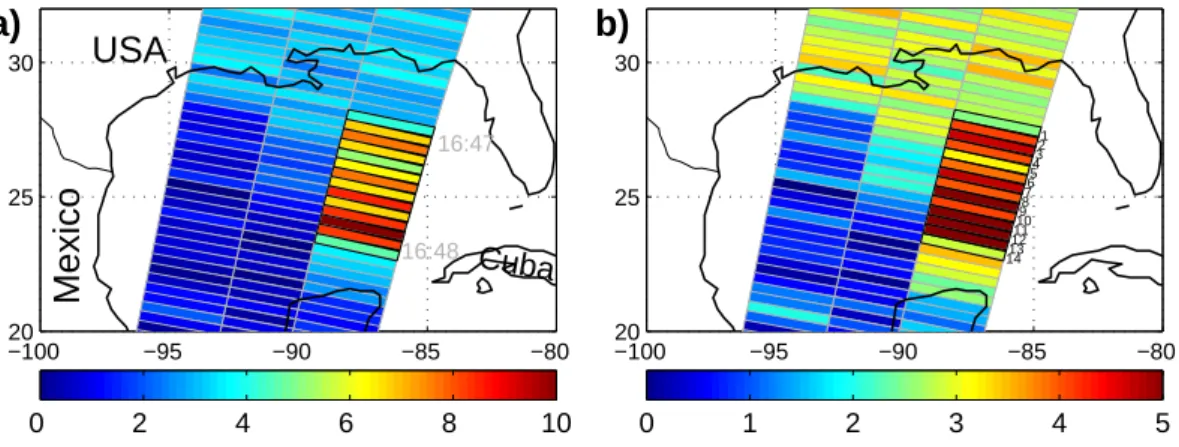
ERS-2 overpass occasionally occurs within the large amount of GOME data. An unique event of GOME capturing LNOxjust produced is found on 30 August 2000 over the Gulf of Mexico: A sequence of about 14 pixels, measured at 16:47–16:48 UTC, shows high tropospheric NO2SCDs (Fig. 1a) and TVCDs (Fig. 1b), respectively, that by far exceed normal levels over ocean.
25
These high TVCDs coincide with a strong convective system causing high lightning activity. Figure 2a depicts the flashes detected by the NLDN on 30 August 2000 before
ACPD
5, 11295–11329, 2005 Estimating lightning NOxfrom GOME/NLDN S. Beirle et al. Title Page Abstract Introduction Conclusions References Tables Figures J I J I Back CloseFull Screen / Esc
Print Version Interactive Discussion
EGU the ERS-2 overpass at 16:48 UTC. For better comparison, the GOME pixel grid is
overlaid in all subplots. To illustrate the temporal coincidence of flashes and GOME measurement, Fig. 2b displays the time of the latest flash occurrence. More than half of the detected flashes occurred less than 3 h before ERS-2 overpass. Black dots indicate flashes with less than 8 min time difference to the GOME measurement.
5
Figure 3 shows cloud fractions (a) and cloud top temperatures (b) measured from HICRU and GOES, respectively. HICRU cloud fractions reveal a large cluster of totally clouded PMD pixels, covering an area of ≈500 km north-south and up to 300 km east-west. CTTs from GOES IR measurements at 16:15 UTC are about 200–220 K. This corresponds to cloud top heights of 12.5–16 km according to ECMWF temperature
10
profiles.
This particular event is unprecedented as the lightning activity coincides perfectly with the GOME measurement both in space (the area affected by lightning fits in the eastern GOME pixels) and in time (most flashes have occurred during the last 3 h). The lightning event took place over sea and remote from polluted regions. The
en-15
hanced NO2 TVCDs can not be explained with transport of anthropogenic emissions (see Sect. 4.2.1). The observed enhanced NO2TVCDs are thus unambiguously due to LNOx. As far as we know, such a clear and direct detection of LNOx from satellite has never been reported before.
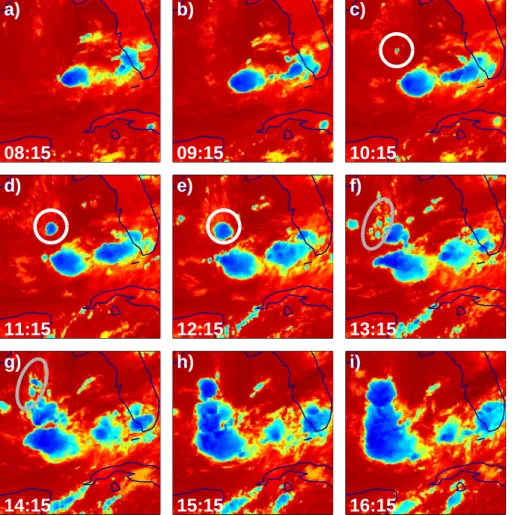
A closer look on the meteorological situation reveals that the convective complex
20
originates from at least two systems of different history. This is illustrated in Fig. 4 that displays hourly GOES CTTs for 30 August. Figure 4a depicts a convective cell at ≈25◦N, 85◦W, moving WSW and growing during the next hours, becoming the south-ern part of the large complex detected at 16:15. In fact, this system has already existed several hours before 08:15 (see the blue/cyan dots in Fig. 2b), and was even active on
25
29 August at the western coast of Florida.
The northern part of the 16:15 complex, however, is rather young. Tracking it back reveals that it stems from a small, singular cell emerging at about 10:15 and growing rapidly (see white marks in Figs. 4c, d, e), and some smaller systems in the north (gray
ACPD
5, 11295–11329, 2005 Estimating lightning NOxfrom GOME/NLDN S. Beirle et al. Title Page Abstract Introduction Conclusions References Tables Figures J I J I Back CloseFull Screen / Esc
Print Version Interactive Discussion
EGU marks in f, g).
For the quantitative estimation of LNOxgiven in Sect. 4, we concentrate our analysis to the northern part of the convective complex, i.e. north from ≈25◦N corresponding to the GOME pixels 1–9, since the northern convection cells are young and, thus, in contrast to the southern part, free from aged LNOx. Furthermore, the detection
5
efficiency (DE) by NLDN is above ≈30% in the northern part, while it decreases to zero further south (see DE contour lines in Fig. 2a). Nevertheless, we add a discussion of the southern part also in Sect. 4.5.
4. Estimate of LNOxproduction
We use this particular lightning event to estimate the in-situ produced LNOx. For this
10
task, the totally produced NOx in the northern part of the convective complex is esti-mated and set in relation to the actual number of flashes.
For this quantitative analysis, the following aspects have to be discussed:
First, the sensitivity of GOME for this particular event, i.e. appropriate AMF for fresh LNOx, will be discussed in Sect. 4.1.
15
Second (Sect. 4.2), the role of transport processes has to be considered. NOx from anthropogenic sources in the USA, as well as aged LNOxfrom the previous days, may be transported into the considered region and interfere with the freshly produced LNOx. On the other hand, the fresh LNOx may be partly transported away.
Third, the actual number of flashes has to be estimated (Sect. 4.3). The flashes
20
detected by NLDN have to be upscaled since detection efficiency fades over sea and NLDN is insensitive for IC flashes.
Finally (Sect. 4.4), the total amount of LNOx produced will be determined and set in relation to the total number of flashes. Our results will be compared to literature values and errors will be discussed in Sect. 5.
ACPD
5, 11295–11329, 2005 Estimating lightning NOxfrom GOME/NLDN S. Beirle et al. Title Page Abstract Introduction Conclusions References Tables Figures J I J I Back CloseFull Screen / Esc
Print Version Interactive Discussion
EGU 4.1. What is the appropriate AMF for the clouded pixels?
As mentioned in Sect. 2.1, the tropospheric AMF for NO2under usual cloud free con-ditions is about 1 (Richter and Burrows, 2002). This AMF is applied for the cloud free GOME pixels in Fig. 1b. But the considered GOME pixels 1–9 are covered by high and thick thunderstorm clouds that strongly impact the visibility of NO2from GOME. Clouds
5
have two competing effects: On the one hand, NO2 below the cloud is shielded. Es-pecially for thick thunderstorm clouds, the boundary layer is effectively invisible from GOME. On the other hand, multiple scattering at the cloud top leads to extended light paths. Thus absorbers at the bright cloud top show an increased visibility from satellite. For the calculation of AMFs for the clouded pixels we apply the box AMFs published
10
by Hild et al. (2002), Fig. 3, that have been derived for cumulonimbus clouds. They thus specifically match conditions for lightning events.
The box AMFs have been calculated for NO2layers of 1 km thickness. To derive total AMFs, these box AMFs have to be convolved with the actual trace gas profile, which is different for different NOx sources. NOx from ground sources, here dominated by
15
anthropogenic emissions in the U.S., is mainly located in the boundary layer. Parts of it are lifted due to deep convection, but the fraction remaining in the lowermost kilome-ters is almost invisible from GOME. Taking the vertical profile derived from FLEXPART simulations for anthropogenic emissions transported to pixels 1–9 (see Sect. 4.2.1), we derive an overall AMF of 0.17 for anthropogenic NOx.
20
The situation is different for NOx from lightning: LNOx is directly released in the free troposphere, at the very places where updraft takes place. As a result, a large amount of LNOxis lifted up in the thunderstorm anvil, resulting in profiles often denoted as “C-shaped” (e.g. Pickering et al., 1998; Fehr et al., 2004). For the calculation of AMFs for LNOx we convolve the box AMFs with the LNOx profile for tropical marine
25
thunderstorms published by Pickering et al. (1998), Table 2. This results in an AMF of 1.63. Hence LNOx has a high visibility due to multiple scattering at the cloud top. The profile of Pickering et al. (1998), Table 2, was retrieved as mean of three single
ACPD
5, 11295–11329, 2005 Estimating lightning NOxfrom GOME/NLDN S. Beirle et al. Title Page Abstract Introduction Conclusions References Tables Figures J I J I Back CloseFull Screen / Esc
Print Version Interactive Discussion
EGU measurements. Taking these three profiles for the AMF calculation results in 2.27, 1.63,
and 1.59, respectively. The LNOx profile published by Fehr et al. (2004) (modified to a CTH of 13 km) leads to an AMF of 1.90. As the measurements from Pickering et al. (1998) match tropical marine conditions, we take an AMF of 1.63 as best estimate with an uncertainty range from 1.5 to 2.3. The high AMFs >1.9 result for profiles having
5
large fractions of NOx at the cloud top.
As will be shown in the next section, the high NO2 TVCDs detected on 30 August cannot be explained by transport of anthropogenic emissions, but is rather due to the release of fresh LNOx. We thus apply the AMF of 1.63 (1.5–2.3) for the clouded pixels 1–9 in Fig. 1b and for our quantitative estimate.
10
4.2. What is the impact of transport?
For a quantitative view, the role of transport of NOx has to be considered. Anthro-pogenic NOx, in particular from the US, may have been transported in the considered region and uplifted (Sect. 4.2.1). Also aged LNOxfrom lightning events of the previous days may in principle contribute to the detected NO2 plume, because of the NOx
life-15
time of several days in the upper troposphere (Sect. 4.2.2). Finally, the produced LNOx is partly transported outside the considered area (Sect. 4.2.3).
Transport is modelled with the Lagrangian tracer model FLEXPART (see Sect. 2.4). The capability of FLEXPART to track NOx transport events has been demonstrated in several studies (Spichtinger et al., 2001; Wenig et al., 2003; Stohl et al., 2003).
20
4.2.1. Anthropogenic emissions
The transport of NOx from anthropogenic emissions is simulated with FLEXPART us-ing the inventory for North America compiled by Frost et al. (2005) based on the U.S. EPA NEI-99 (National Emissions Inventory, base year 1999, version 3) (U.S. EPA, 2004a). This inventory was derived at 4-km horizontal resolution from spatial
surro-25
ACPD
5, 11295–11329, 2005 Estimating lightning NOxfrom GOME/NLDN S. Beirle et al. Title Page Abstract Introduction Conclusions References Tables Figures J I J I Back CloseFull Screen / Esc
Print Version Interactive Discussion
EGU ozone season day (June through August) county level estimates of on-road, off-road,
area, and point sources. The 4-km resolution emissions are also available through a graphics information system interface (Frost and McKeen, 2004). In FLEXPART, emis-sions were released on the original 4-km grid in regions with high emission densities and from the 300 largest point sources. Grid cells with low emission densities and
5
small point sources were aggregated into lower-resolution grid cells by degrading the resolution in several steps.
The e-folding lifetime for NOx was set to 24 h, what is a rather conservative assump-tion, as the lifetime of boundary layer NOx is of the order of several hours (e.g. Martin et al., 2003; Beirle et al., 2003). The tracer (a total of 5.5 million particles) was
per-10
manently released in the box 60◦–170◦W and 25◦–75◦N over the time period of 25 to 30 August 2000, i.e. 5 days prior the strong lightning event. To consider the verti-cal transport within this convective system, FLEXPART was run with the implemented convection scheme.
Figure 5 displays the resulting distribution of anthropogenic NO2 TVCDs, both in
15
ECMWF resolution of 1◦×1◦ (Fig. 5a) as well as on GOME grid resolution (Fig. 5b). Comparison with Fig. 1b reveals that the TVCDs close to the source regions (mainly New Orleans and Houston) are overestimated in the FLEXPART run. Main reason is probably that the assumed lifetime of 24 h is too long at ground (see above) what can easily explain a factor of 2.
20
Over the convective complex, on the other hand, the modelled anthropogenic NOx TVCDs are low (<1.3×10¹⁵molec/cm2). The simulated anthropogenic NO2 TVCDs, however, seem to generally underestimate the measured NO2 TVCDs of the eastern GOME pixels. Possible reason might be that the emission inventory overestimates hot spots like New Orleans compared to the anthropogenic emissions smoothly distributed
25
along the coast. We thus take the FLEXPART TVCD as lower limit for the actual TVCD due to anthropogenic emissions for pixels 1–9.
To derive an upper limit for the impact of anthropogenic NOxwe assume a maximum background level of anthropogenic NO2 TVCDs of 2.5×10¹⁵molec/cm2 over the
con-ACPD
5, 11295–11329, 2005 Estimating lightning NOxfrom GOME/NLDN S. Beirle et al. Title Page Abstract Introduction Conclusions References Tables Figures J I J I Back CloseFull Screen / Esc
Print Version Interactive Discussion
EGU sidered area, i.e. twice as much as modelled by FLEXPART. This value corresponds
to the TVCD measured by GOME north from the convective complex for cloud free conditions. Thereby, we ignore the probable decrease of anthropogenic NOx levels southwards the coast as detected for the western and middle GOME pixels. But even for an actual anthropogenic TVCD of 2.5×10¹⁵molec/cm2at the eastern pixels, the
ex-5
pected measured TVCD would be only 0.4×10¹⁵molec/cm2, since the strong shielding effect of the high and thick cloud cover leads to a tropospheric AMF of 0.17 for an-thropogenic NO2(see Sect. 4.1). The upper limit of anthropogenic NO2is thus below 13% of the actually detected TVCDs, while the lower limit, taking FLEXPART TVCDs, is half this value, i.e. 7%. We take the average, i.e. 10% as most probable value for
10
the fraction of anthropogenic NOx. The high NO2 TVCDs in Fig. 1a/b can thus by no means be explained with transport of anthropogenic NOx alone.
4.2.2. Aged LNOx
Besides anthropogenic NOx, aged LNOxmay contribute to the detected NO2plume as well. In fact, NLDN detected several flashes on 29 August west from Florida. However,
15
as discussed in Sect. 3, part of this LNOx is only transported to the southern part of the large complex on 30 August, while LNOx in the northern part is freshly released.
The possible impact of aged LNOx was estimated with FLEXPART using the NLDN flash counts from 27 August on. For every flash, a fixed amount of NO2 (artificial units) was released in the respective grid box according to the vertical profile given by
20
Table 2 (tropical marine) in Pickering et al. (1998). The e-folding lifetime was set to 4 days (Jaegle et al., 1998). This run was performed twice: the first run involves all flashes detected till 30 August, 16:48 UTC and stopped at 18:00 UTC (Fig. 6a). The second run simulates the same time period, but stops the release of fresh LNOxon 30 August 00:00 UTC (Fig. 6b). I.e. run 1 shows the combination of aged and fresh LNOx,
25
while run 2 only considers aged LNOx (i.e. LNOx prior to 30 August). The comparison of both runs, i.e. the ratio of run 2 and run 1, allows to assess the fraction of aged LNOx. For the LNOxin the area covered by the GOME pixels 1–9, the fraction of aged
ACPD
5, 11295–11329, 2005 Estimating lightning NOxfrom GOME/NLDN S. Beirle et al. Title Page Abstract Introduction Conclusions References Tables Figures J I J I Back CloseFull Screen / Esc
Print Version Interactive Discussion
EGU LNOx is 11%. It has to be noticed that this relative number depends neither on the
assumptions about the LNOx released per flash nor on the DE of NLDN. 4.2.3. Outflow of LNOx
In the northern part of the convective complex, more than half of the flashes have oc-curred within 3 h before GOME measurement. But that also means that nearly half of
5
the produced LNOxis older than 3 h. Parts of the LNOxproduced in the area of GOME pixels 1–9 are thus transported outside. According to ECMWF windfields, main trans-port occurs in southerly direction. We estimate the amount of outflow using FLEXPART. Similar to the run performed in Sect. 4.1.2, the distribution of LNOx was modelled by releasing an arbitrary fixed amount of LNOxfor every flash, starting from 30 August at
10
00:00 UTC with infinite lifetime. The resulting distribution of LNOx is compared to the hypothetical distribution of LNOxin the absence of transport, i.e. the distribution of the flash locations itself. The comparison reveals that 80% of the released LNOxremained inside the GOME pixels 1–9.
Overall, 21% of the detected NO2 plume are due to anthropogenic NOx and aged
15
LNOx, thus 79% are due to the release of fresh LNOx. To correct for the outflow of fresh LNOx, the detected NO2TVCDs have to be scaled by 100/80. Thus, in total, the measured TVCDs have to be scaled by a factor of 0.99 with an uncertainty of about 0.10 due to the different effects of transport.
4.3. How many flashes occurred?
20
The NLDN detects CG flashes over the US with high detection efficiency (DE). But as the measurement stations are bound to the continent, DE decreases with distance from the shore (see Fig. 2a). In the southern part of the convective complex, the estimated DE is below 5%. The clouded area (Fig. 3) reaches further south than the detected cluster of flashes (Fig. 2a), and it is very likely that flashes at the southern end are
25
ACPD
5, 11295–11329, 2005 Estimating lightning NOxfrom GOME/NLDN S. Beirle et al. Title Page Abstract Introduction Conclusions References Tables Figures J I J I Back CloseFull Screen / Esc
Print Version Interactive Discussion
EGU number of flashes detected in this area is 4.3×10⁴. Scaling this number according to
the respective DE results in 9.4×10⁴flashes.
As NLDN did not report IC flashes in 2000, this number refers to CG flashes only. To derive the total number of flashes, the number of IC flashes has to be estimated. Information on the ratio of IC/CG flash frequencies can be derived from long-term
5
comparisons of NLDN measurements with the satellite born instruments OTD (Opti-cal Transient Detector) and LIS (Lightning Imaging Sensor) detecting both IC and CG flashes (Boccippio et al., 2000). According to the climatology for 16 July–14 October, the IC/CG ratio is 2.7 (1.8–4.0) in the considered region. I.e., the number of CG flashes has to be scaled by a factor of 3.7 (2.8–5.0). Hence, we estimate the total number of
10
flashes on 30 August 2000 in the area covered by the GOME pixels 1–9 to be 3.49 (2.64–4.72)×105.
4.4. What is the total quantity of LNOxproduced?
The detected NO2plume can be directly assigned to the release of fresh LNOx. Since the northern part of the convective complex is quite young (few hours), chemical decay
15
of the produced LNOx can be neglected due to the long lifetime of NOxin the upper troposphere (Jaegle et al., 1998). Hence the detected NO2 TVCDs can be converted directly to the LNOxproduced.
To derive the total NO2 produced in the convective complex north from 25◦N, the respective TVCDs have to be integrated across the area of the convective system. But
20
due to their large extent the GOME pixels cover the convective system and the cloud free, rather unpolluted ocean, at the same time. I.e. the true TVCD over the cloud is higher than the GOME TVCD that represent an average over a large area. However, this effect is quite small as the clouded part of the GOME pixel is much brighter than the cloud free part, i.e. the measured light (and hence the detected absorption structures)
25
stems from the area covered by the convective system. A quantitative estimation, given in Appendix A, leads to a correction factor of 1.2 for pixel 1, having a cloud fraction of
ACPD
5, 11295–11329, 2005 Estimating lightning NOxfrom GOME/NLDN S. Beirle et al. Title Page Abstract Introduction Conclusions References Tables Figures J I J I Back CloseFull Screen / Esc
Print Version Interactive Discussion
EGU 29%, and 1.05 on average for pixels 1–9. Hence we derive a mean corrected TVCD of
4.24×10¹⁵molec/cm2.
The area of the convective system for pixels 1–9 is determined by counting the re-spective PMD subpixels with a HICRU CF>0.5. This results in 79 pixels of 20×40 km2 each, i.e. 63 200 km2 in total. Integration of the respective corrected TVCDs over the
5
clouded area results in 4.46×10⁶moles of NO2 that are produced by this lightning event.
Finally, the total amount of NO2 has to be extrapolated to total amount of NOx. The partitioning of NOxin NO and NO2depends on several parameters like temperature, O3 concentration, and actinic flux. In the upper troposphere, most NOx is present as NO
10
due to the low temperatures and high NO2 photolysis rates. Direct measurements of the NOxpartitioning within thunderstorm clouds over New Mexico have been performed by Ridley et al. (1996). Conditions for these thunderstorms are similar to the event on 30 August 2000, as they take place in August on similar latitude and close to local noon. Ridley et al. (1996), Tables 2 and 4, find a NO2/NOxratio of about 1/6 in the anvil
15
and upper core region. With this number, 2.68×10⁷moles of NOx have been released by the particular lightning event in total. However, as we cannot exclude that conditions are different for the convective system under consideration, we allow a rather large range of uncertainty of 50% for the NO2/NOxratio.
Combining both numbers, the total NOx release and the total number of flashes,
20
results in a LNOx production of 77 moles/flash, or 1.1 kg [N]/flash for this particular event. Errors are discussed in detail in Sect. 5.
4.5. The southern part
Combining measured NO2 TVCDs and NLDN flash counts, we estimated the produc-tion of LNOx for pixels 1–9. This approach is not feasible for pixels 10–14 due to low
25
NLDN DE. Nevertheless, we give a rough estimate of LNOxproduction for pixels 10-14 using the CTTs measured by GOES.
ACPD
5, 11295–11329, 2005 Estimating lightning NOxfrom GOME/NLDN S. Beirle et al. Title Page Abstract Introduction Conclusions References Tables Figures J I J I Back CloseFull Screen / Esc
Print Version Interactive Discussion
EGU related to cloud top heights (Price and Rind, 1992). We use the fraction of the GOME
pixels covered by clouds with a CTT below 220 K as proxy for high clouds. This tem-perature corresponds to a CTH above 12.5 km. Figure 7 displays the flashes detected by NLDN (scaled accordingly to DE) in dependency of the fraction of high clouds for pixels 1–9. The correlation is R=0.79, and a linear fit (forced through zero) results in a
5
slope of 2.47×10⁴.
We use this relation for a simple estimate of the number of flashes for pixels 10-14, resulting in 5.4×10⁴ flashes. Taking the same factors for IC/CG ratio and NOx partitioning as above, and neglecting transport, this results in a LNOx production of 120 moles/flash. This number is about 50% higher than that derived for pixels 1–9.
10
Main reason is probably an underestimation of the number of flashes for pixels 10– 14, where lightning has taken place for several hours before the ERS-2 overpass (see Fig. 4), while the relation shown in Fig. 7 has been derived for the relatively young convective system covered by pixels 1–9.
5. Discussion
15
In our estimate, resulting in a LNOx production of 77 moles/flash, several assumptions on different parameters are involved that are discussed in detail in the following. The single errors/uncertainties are not gaussian and in particular not symmetric. We thus give a conservative error range for our estimation by considering the extreme values for the effects of transport, the derived AMF, the IC/CG ratio and the NO2/NOxratio. This
20
results in a range of 27–230 moles/flash, i.e. 0.4–3.2 kg [N]/flash, for LNOxproduction. Simple extrapolation, assuming a mean flash rate of 44 flashes per second globally (Christian et al., 2003), gives a global LNOx production of 1.5 (0.5–4.5) Tg [N]/yr. This number is in good agreement with current literature values, but lower than the often cited number of 5 Tg [N]/yr. However, this particular event is not necessarily
represen-25
tative for global lightning.
ACPD
5, 11295–11329, 2005 Estimating lightning NOxfrom GOME/NLDN S. Beirle et al. Title Page Abstract Introduction Conclusions References Tables Figures J I J I Back CloseFull Screen / Esc
Print Version Interactive Discussion
EGU using up to date emissions and an improved convection scheme. Nevertheless, we
cannot rule out that the upward transport is underestimated by FLEXPART in partic-ular for such a rapidly evolving system. If FLEXPART underestimates the amount of anthropogenic NOxuplifted in the anvil, we would also underestimate the AMF for an-thropogenic NOx. But on the other hand, in this case the NOxwould be shifted towards
5
NO and the assumed NO/NO2ratio for anthropogenic NOxwould have to be modified. For the extreme scenario of all anthropogenic NOxlifted up and mixed homogeneously between 7 and 13 km, leading to an AMF of 1.4, and a NO2/NOx ratio of 1/6, anthro-pogenic NOxstill could only explain one fourth of the observed NO2TCVDs.
Our quantitative estimation of LNOx production is in particular depending on the
10
actual AMF, the IC/CG ratio, and the NOx partitioning. An AMF above 2.2 is quite unlikely, since this would require almost all NOxbeing at the cloud top. Our AMF could be overestimated, however, if the underlying box AMFs by Hild et al. (2002) are wrong, in particular, if the true box AMFs below the cloud top decrease faster. Lower AMFs would result in a higher estimated LNOxproduction and could easily lead to a factor of
15
2. Hence further effort has to be put on additional AMF calculations with independent models.
The climatological IC/CG ratio is a good first guess, but it has been reported in litera-ture, that individual thunderstorms may show a very high IC/CG ratio of up to 100 (Dye et al., 2000). For such an extreme event, we would have underestimated the actual
20
number of flashes drastically, thus overestimated the LNOxproduction. However, such a scenario is rather unlikely, since the LIS measurement on 30 August, overpassing the detected convective system at 14:07–14:09 UTC, shows no increased number of flashes compared to NLDN.
The NOx partitioning in thunderstorm clouds of geolocation, season, and local time
25
similar to the lightning event under consideration was measured by Ridley et al. (1996). Nevertheless, we cannot exclude that the actual NOx partitioning differs. Uncertainty is expressed by the large range of 50%, i.e. the NO2/NOx ratio being 1/12 up to 1/4, assumed in Sect. 4.4.
ACPD
5, 11295–11329, 2005 Estimating lightning NOxfrom GOME/NLDN S. Beirle et al. Title Page Abstract Introduction Conclusions References Tables Figures J I J I Back CloseFull Screen / Esc
Print Version Interactive Discussion
EGU
6. Conclusion and outlook
In past, GOME NO2 data has been used to estimate LNOx production by statistical approaches (Beirle et al., 2004a; Boersma et al., 2005). The direct observation of active convective systems, however, has several advantages: Due to deep convection, the NOxis lifted up to the cloud top, where its sensitivity for satellite measurements is
5
quite high. The LNOxplume is not yet diluted, hence local NOxlevels are high. Spatial patterns can be identified and compared to flash rate patterns. And shortly after the LNOxproduction, its chemical loss is rather negligible, simplifying the calculation of the total NOxproduction.
Within this study, we could identify NOx from lightning with GOME data for a
par-10
ticular convective system, matching the GOME observation in space and time. The LNOxproduced is estimated as 77 (27–230) moles of NOxper flash, corresponding to 1.5 (0.5–4.5) Tg [N]/yr globally. This case study impressively illustrates the fundamen-tal feasibility of LNOx detection and quantification with satellite NO2 measurements. Hence space borne spectrometers provide a new and independent approach for the
15
estimation of LNOx.
The lightning data from NLDN is limited to the USA, where anthropogenic sources are often interfering the quantification of LNOx. The recently established World Wide Lightning Location Network WWLLN (Lay et al., 2004), as well as the long-range light-ning detection networks operated by Vaisala (Pessi et al., 2004; Demetriades et al.,
20
2005), will allow similar case studies to be carried out on a global scale and hence to fully use the potential of satellite data. Since WWLLN is partly sensitive to IC flashes, the uncertainty arising from the IC/CG ratio is also reduced.
In future, similar case studies will be performed systematically using the improved spatial resolution of the SCanning Imaging Absorption SpectroMeter for Atmospheric
25
CHartographY SCIAMACHY, the Ozone Monitoring Instrument OMI, and the GOME successor GOME-2. Of particular interest will be the analysis of LNOx plumes from strong convective systems that are subsequently overpassed by different
satel-ACPD
5, 11295–11329, 2005 Estimating lightning NOxfrom GOME/NLDN S. Beirle et al. Title Page Abstract Introduction Conclusions References Tables Figures J I J I Back CloseFull Screen / Esc
Print Version Interactive Discussion
EGU lite instruments, e.g. GOME-2 (09:30 a.m.), SCIAMACHY (10:00 a.m.) and OMI
(01:45 p.m.). Such scenarios allow the study of LNOx plume evolution that hold – if combined with meteorological data – valuable information on LNOx profile, NOx life-time, and the LNOxproduced in thunderstorms.
For the reduction of errors, it would be a milestone to have simultaneous
measure-5
ments from aircraft (providing NOxprofile and NOxpartitioning) and satellite (capturing the whole system at once) for a strong convective complex.
Further efforts will have to be assigned to the modeling of radiative transfer and the calculation of AMFs for fresh LNOxin thunderstorm clouds.
Appendix A: Correction for partly clouded pixels
10
The GOME NO2measurements are taken with a rather large footprint of 320×40 km2, hence they represent mean SCDs of generally inhomogeneous NO2 distributions and cloud fractions.
To estimate the SCD above the convective complex, we assume the GOME pixels being divided in a cloud free and a totally clouded part. Let f be the fraction of the pixel
15
being clouded, S0 the true SCD for the cloud free part and Sc the true SCD for the clouded part of the GOME pixel. The total SCD S measured by GOME is the mean of S0 and Sc weighted by the area and the brightness of the cloud free and the clouded part, respectively:
S= Ic× f × Sc+ I0× (1 − f) × S0 Ic× f+ I0× (1 − f)
(A1)
20
where Ic and I0are the intensities one would measure for a totally clouded/cloud free scene, respectively. Solving Eq. (A1) for Sc, the true SCD over the clouded part is
Sc = S +Io Ic ×
1 − f
ACPD
5, 11295–11329, 2005 Estimating lightning NOxfrom GOME/NLDN S. Beirle et al. Title Page Abstract Introduction Conclusions References Tables Figures J I J I Back CloseFull Screen / Esc
Print Version Interactive Discussion
EGU The ratio I0/Ic is gained by comparing the maximum and minimum intensities of the
PMD subpixels in the blue spectral range, resulting in Ic≈7×I0. S0 is estimated taking
the SCD of the respective neighboring, cloud free center GOME pixel. With these numbers, Sc is on average higher than S by 5% for pixels 1–9. The measured SCD S has thus to be corrected by a factor of 1.05. The extreme cases of S0,min=0 and
5
S0,max=3×10¹⁵ (i.e. the maximum SCD of the center GOME pixels) lead to a range of 1.04–1.10 for the correction factor.
Acknowledgements. This study was funded by the German Ministry for Education and
Re-search as part of the NOXTRAM project (Atmospheric ReRe-search 2000). We would like to thank the European Space Agency (ESA) operation center in Frascati (Italy) and the “Deutsches
10
Zentrum f ¨ur Luft- und Raumfahrt” DLR (Germany) for providing GOME spectra. We thank the “Deutscher Wetterdienst” for kindly providing access to ECMWF. GOES-8 satellite images were kindly provided by UNIDATA internet delivery. We thank S. A. McKeen and G. J. Frost from NOAA for making available their inventory of anthropogenic emissions in North America in a format suitable for incorporation into FLEXPART.
15
References
Beirle, S., Platt, U., Wenig, M., and Wagner, T.: Weekly cycle of NO2by GOME measurements: a signature of anthropogenic sources, Atmos. Chem. Phys., 3, 2225–2232, 2003,
SRef-ID: 1680-7324/acp/2003-3-2225.
Beirle, S., Platt, U., Wenig, M., and Wagner, T.: NOx production by lightning estimated with
20
GOME, Adv. Space Res., 34(4), 793–797, 2004a.
Beirle, S., Platt, U., Wenig, M., and Wagner, T.: Highly resolved global distribution of tropo-spheric NO2 using GOME narrow swath mode data, Atmos. Chem. Phys., 4, 1913–1924, 2004b,
SRef-ID: 1680-7324/acp/2004-4-1913.
25
Beirle, S., Platt, U., von Glasow, R., Wenig, M., and Wagner, T.: Estimate of nitrogen ox-ide emissions from shipping by satellite remote sensing, Geophys. Res. Lett., 31, L18102, doi:10.1029/2004GL020312, 2004c.
ACPD
5, 11295–11329, 2005 Estimating lightning NOxfrom GOME/NLDN S. Beirle et al. Title Page Abstract Introduction Conclusions References Tables Figures J I J I Back CloseFull Screen / Esc
Print Version Interactive Discussion
EGU Boccippio, D. J., Cummins, K. L., Christian, H. J., and Goodman, S. J.: Combined
Satellite-and Surface-Based Estimation of the Intracloud-Cloud-to-Ground Lightning Ratio over the Continental United States, Mon. Wea. Rev., 129, 108–122, 2000.
Boersma, K. F., Eskes, H. J., and Brinksma, E. J.: Error analysis for tropospheric NO2retrieval from space, J. Geophys. Res., 109, D04311, doi:10.1029/2003JD003962, 2004.
5
Boersma, K. F., Eskes, H. J., Meijer, E. W., and Kelder, H. M.: Estimates of lightning NOx production from GOME satellite observations, Atmos. Chem. Phys., 5, 2311–2331, 2005,
SRef-ID: 1680-7324/acp/2005-5-2311.
Burrows, J., Weber, M., Buchwitz, M., Rozanov, V. V., Ladst ¨adter-Weissenmayer, A., Richter, A., de Beek, R., Hoogen, R., Bramstedt, K., Eichmann, K.-U., Eisinger, M., and Perner,
10
D.: The Global Ozone Monitoring Experiment (GOME): Mission concept and first scientific results, J. Atmos. Sci., 56, 151–175, 1999.
Choi, Y., Wang, Y., Zeng, T., Martin, R. V., Kurosu, T. P., and Chance, K.: Evidence of light-ning NOxand convective transport of pollutants in satellite observations over North America, Geophys. Res. Lett., 32, L02805, doi:10.1029/2004GL021436, 2005.
15
Christian, H. J., Blakeslee, R. J., Boccippio, D. J., Boeck, W. L., Buechler, D. E., Driscoll, K. T., Goodman, S. J., Hall, J. M., Koshak, W. J., Mach, D. M., and Stewart, M. F.: Global frequency and distribution of lightning as observed from space by the Optical Transient Detector, J. Geophys. Res., 108(D1), 4005, doi:10.1029/2002JD002347, 2003.
Cummins, K. L., Murphy, M. J., Bardo, E. A., Hiscox, W. L., Pyle, R. B., and Pifer, A. E.: A
20
combined TOA/MDF technology upgrade of the U.S. National Lightning Detection Network, J. Geophys. Res., 103(D8), 9035–9044, doi:10.1029/98JD00153, 1998.
Demetriades, N. W. S., Murphy, M. J., and Holle, R. L.: Long range lightning nowcasting appli-cations for meteorology, in: World weather research program symposium, Toulouse, France, 2005.
25
Dye, J. E., Ridley, B. A., Skamarock, W., Barth, M., Venticinque, M., Defer, E., Blanchet, P., Thery, C., Laroche, P., Baumann, K., Hubler, G., Parrish, D. D., Ryerson, T., Trainer, M., Frost, G., Holloway, J. S., Matejka, T., Bartels, D., Fehsenfeld, F. C., Tuck, A., Rutledge, S. A., Lang, T., Stith, J., and Zerr, R.: An overview of the Stratospheric-Tropospheric Experiment: Radiation, Aerosols and Ozone (STERAO)-Deep Convection experiment with result from the
30
July 10, 1996 storm, J. Geophys. Res., 105, 10 023–10 045, 2000.
ECMWF: User Guide to ECMWF Products 2.1, Meteorological Bulletin M3.2, Reading, UK, 1995.
ACPD
5, 11295–11329, 2005 Estimating lightning NOxfrom GOME/NLDN S. Beirle et al. Title Page Abstract Introduction Conclusions References Tables Figures J I J I Back CloseFull Screen / Esc
Print Version Interactive Discussion
EGU Emanuel, K. A.: A scheme for representing cumulus convection in large-scale models, J.
At-mos. Sci., 48, 2313–2335, 1991.
Emanuel, K. A. and Zivkovic-Rothman, M.: Development and evaluation of a convection scheme for use in climate models, J. Atmos. Sci., 56, 1766–1782, 1999.
Fehr, T., H ¨oller, H., and Huntrieser, H.: Model study on production and transport of
5
lightning-produced NOx in a EULINOX supercell storm, J. Geophys. Res., 109, D09102, doi:10.1029/2003JD003935, 2004.
Frost, G. and McKeen, S. A.: Emission inventory mapviewer, http://map.ngdc.noaa.gov/
website/al/emissions/viewer.htm, 2004.
Frost, G. J., McKeen, S. A., Trainer, M., Ryerson, T. B., Holloway, J. S., Sueper, D. T., Fortin,
10
T., Parrish, D. D., Fehsenfeld, F. C., Peckham, S. E., Grell, G. A., Kowal, D., Cartwright, J., Auerbach, N., and Habermann, T.: Effects of Changing Power Plant NOx Emissions on
Ozone in the Eastern United States, J. Geophys. Res., in press, 2005.
Hild, L., Richter, A., and Burrows, J. P.: Measurements of lightning-produced NO2 by GOME and LIS, Symposium 2000 in G ¨oteburg – Session: Atmosphere UV Radiation, Trace Gases
15
Other Than Ozone, ID Nr. 349, 2000.
Hild, L., Richter, A., Rozanov, V., and Burrows, J. P.: Air Mass Calculations for GOME Mea-surements of lightning-produced NO2, Adv. Space Res., 29(11), 1685–1690, 2002.
Huntrieser, H., Schlager, H., Feigl, C., and H ¨oller, H.: Transport and production of NOx in electrified thunderstorms: Survey of previous studies and new observations at midlatitudes,
20
J. Geophys. Res., 103, 28 247–28 264, 1998.
Jaegl ´e, L., Jacob, D. J., Wang, Y., Weinheimer, A. J., Ridley, B. A., Campos, T. L., Sachse, G. W., and Hagen, D.: Sources and chemistry of NOx in the upper troposphere over the United States, Geophys. Res. Lett., 25, 1709–1712, 1998.
Jaegl ´e, L., Martin, R. V., Chance, K., Steinberger, L., Kurosu, T. P., Jacob, D. J., Modi, A. I.,
25
Yoboue, V., Sigha-Nkamdjou, L., and Galy-Lacaux, C.: Satellite mapping of rain-induced ni-tric oxide emissions from soils, J. Geophys. Res., 109, D21310, doi:10.1029/2004JD004787, 2004.
Jourdain, L. and Hauglustaine, D.: The global distribution of lightning NOxsimulated on-line in a General Circulation Model, Phys. Chem. Earth (C), 26, 585–591, 2001.
30
Labrador L. J., von Kuhlmann, R., and Lawrence, M. G.: Strong sensitivity of the global mean OH concentration and the tropospheric oxidizing efficiency to the source of NOx from light-ning, Geophys. Res. Lett., 31, L06102, doi:10.1029/2003GL019229, 2004.
ACPD
5, 11295–11329, 2005 Estimating lightning NOxfrom GOME/NLDN S. Beirle et al. Title Page Abstract Introduction Conclusions References Tables Figures J I J I Back CloseFull Screen / Esc
Print Version Interactive Discussion
EGU Lay, E. H., Holzworth, R. H., Rodger, C. J., Thomas, J. N., Pinto Jr, O., and Dowden, R. L.:
WWLL global lightning detection system: Regional validation study in Brazil, Geophys. Res. Lett., 31(3), L03102, doi:10.1029/2003GL01888203, 2004.
Lee, D. S., K ¨ohler, I., Grobler, E., Rohrer, F., Sausen, R., Gallardo-Klenner, L., Olivier, J. G. J., Dentener, F. J., and Bouwman, A. F.: Estimations of global NOxemissions and their
uncer-5
tainties, Atmos. Environ., 31, 1735–1749, 1997.
Leue, C., Wenig, M., Wagner, T., Klimm, O., Platt, U., and J ¨ahne, B.: Quantitative analysis of NO2emissions from GOME satellite image sequences, J. Geophys. Res., 106, 5493–5505, 2001.
Levy II, H., Moxim, W. J., and Kasibhatla, P. S.: A global three-dimensional
time-10
dependent lightning source of tropospheric NOx, J. Geophys. Res., 101(D17), 22 911– 22 922, doi:10.1029/96JD02341, 1996.
Martin, R. V., Chance, K., Jacob, D. J., Kurosu, T. P., Spurr, R. J. D., Bucsela, E., Gleason, J. F., Palmer, P. I., Bey, I., Fiore, A. M., Li, Q., Yantosca, R. M., and Koelemeijer, R. B. A.: An improved retrieval of tropospheric nitrogen dioxide from GOME, J. Geophys. Res., 107(D20),
15
4437, doi:10.1029/2001JD001027, 2002.
Martin, R. V., Jacob, D. J., Chance, K., Kurosu, T. P., Palmer, P. I., and Evans, M. J.: Global inventory of nitrogen oxide emissions constrained by space-based observations of NO2
columns, J. Geophys. Res., 108, 4537, doi:10.1029/2003JD003453, 2003.
Nesbitt, S. W., Zhang, R., and Orville, R. E.: Seasonal and global NOx production by lightning
20
estimated from the Optical Transient Detector (OTD), Tellus, 52B, 1206–1215, 2000.
Pessi, A., Businger, S., Cummins, K. L., and Turner, T.: On the relationship between light-ning and convective rainfall over the central pacific ocean, in: ILDC 2004 18th Interna-tional Lightning Detection Conference, http://www.soest.hawaii.edu/MET/Faculty/businger/
personnel/pessi/Pessi-Pacnet.doc, ref. no. 21, Helsinki, Finland, 2004.
25
Pickering, K. E., Wang, Y., Tao, W.-K., Price, C., and M ¨uller, J.-F.: Vertical distributions of lightning NOx for use in regional and global chemical transport models, J. Geophys. Res., 103, 31 203–31 216, 1998.
Platt, U.: Differential optical absorption spectroscopy (DOAS), in: Air Monitoring by Spectro-metric Techniques, edited by: Sigrist, M., John Wilsy, New York, pp. 27–84, 1994.
30
Price, C. and Rind, D.: A Simple lightning parameterization for calculating global lightning distributions, J. Geophys. Res., 97(D9), 9919–9933, doi:10.1029/92JD00719, 1992.
ACPD
5, 11295–11329, 2005 Estimating lightning NOxfrom GOME/NLDN S. Beirle et al. Title Page Abstract Introduction Conclusions References Tables Figures J I J I Back CloseFull Screen / Esc
Print Version Interactive Discussion
EGU lightning physics, J. Geophys. Res., 102, 5929–5941, 1997.
Ridley, B. A., Dye, J. E., Walega, J. G., Zheng, J., Grahek, F. E., and Rison, W.: On the production of active nitrogen by thunderstorms over New Mexico, J. Geophys. Res., 101, 20 985–21 005, 1996.
Richter, A. and Burrows, J.: Retrieval of Tropospheric NO2 from GOME Measurements, Adv.
5
Space Res., 29(11), 1673–1683, 2002.
Richter, A., Eyring, V., Burrows, J. P., Bovensmann, H., Lauer, A., Sierk, B., and Crutzen, P. J.: Satellite measurements of NO2from international shipping emissions, Geophys. Res. Lett., 31, L23110, doi:10.1029/2004GL020822, 2004.
Solomon, S., Schmeltekopf, A. L., and Sanders, R. W.: On the interpretation of zenith sky
10
absorption measurements, J. Geophys. Res., 92, 8311–8319, 1987.
Spichtinger, N., Wenig, M., James, P., Platt, U., and Stohl, A.: Satellite detection of a continental-scale plume of nitrogen oxides from boreal forest fires, Geophys. Res. Lett., 28, 4579–4582, 2001.
Spichtinger, N., Damoah, R., Eckhardt, S., Forster, C., James, P., Beirle, S., Wagner, T., Novelli,
15
P. C., and Stohl, A.: Boreal forest fires in 1997 and 1998: a seasonal comparison using transport model simulations and measurement data, Atmos. Chem. Phys., 4, 1857–1868, 2004,
SRef-ID: 1680-7324/acp/2004-4-1857.
Stockwell, D. Z., Giannakopoulos, C., Plantevin, P.-H., Carver, G. D., Chipperfield, M. P., Law,
20
K. S., Pyle, J. A., Shallcross, D. E., and Wang, K.-Y.: Modelling NOx from lightning and its impact on global chemical fields, Atmos. Environ., 33, 4477–4493, 1999.
Stohl, A., Hittenberger, M., and Wotawa, G.: Validation of the Lagrangian particle dispersion model FLEXPART against large scale tracer experiment data, Atmos. Environ., 32, 4245– 4264, 1998.
25
Stohl, A., Huntrieser, H., Richter, A., Beirle, S., Cooper, O. R., Eckhardt, S., Forster, C., James, P., Spichtinger, N., Wenig, M., Wagner, T., Burrows, J. P., and Platt, U.: Rapid intercontinental air pollution transport associated with a meteorological bomb, Atmos. Chem. Phys., 3, 969– 985, 2003,
SRef-ID: 1680-7324/acp/2003-3-969.
30
Stohl, A., Forster, C., Frank, A., Seibert, P., and Wotawa, G.: Technical note: The Lagrangian particle dispersion model FLEXPART version 6.2, Atmos. Chem. Phys., 5, 2461–2474, 2005,
ACPD
5, 11295–11329, 2005 Estimating lightning NOxfrom GOME/NLDN S. Beirle et al. Title Page Abstract Introduction Conclusions References Tables Figures J I J I Back CloseFull Screen / Esc
Print Version Interactive Discussion
EGU Tie, X., Zhang, R., Brasseur, G., and Lei, W.: Global NOx production by lightning, J. Atmos.
Chem., 43, 61–74, 2002.
U.S. EPA: EPA Clearinghouse for inventories and emissions factors: 1999 National Emis-sion Inventory Documentation and Data – Final VerEmis-sion 3.0, http://www.epa.gov/ttn/chief/
net/1999inventory.html, 2004a.
5
U.S. EPA: EPA Clearinghouse for inventories and emissions factors: Related Spatial Alloca-tion Files – “New” Surrogates;http://www.epa.gov/ttn/chief/emch/spatial/newsurrogate.html, 2004b.
Velders, G. J. M., Granier, C., Portmann, R. W., Pfeilsticker, K., Wenig, M., Wagner, T., Platt, U., Richter, A., and Burrows, J.: Global tropospheric NO2column distributions: Comparing
10
3-D model calculations with GOME measurements, J. Geophys. Res., 106, 12 643–12 660, 2001.
Wagner, T.: Satellite observations of atmospheric halogen oxides, PhD thesis, University of Heidelberg,http://www.ub.uni-heidelberg.de/archiv/539, 1999.
Wenig, M., Spichtinger, N., Stohl, A., Held, G., Beirle, S., Wagner, T., J ¨ahne, B., and Platt, U.:
15
Intercontinental transport of nitrogen oxide pollution plumes, Atmos. Chem. Phys., 3, 387– 393, 2003,
SRef-ID: 1680-7324/acp/2003-3-387.
Zhang, R., Sanger, N. T., Orville, R. E., Tie, X., Randel, W., and Williams, E. R.: Enhanced NOx by lightning in the upper troposphere and lower stratosphere inferred from the UARS global
20
ACPD
5, 11295–11329, 2005 Estimating lightning NOxfrom GOME/NLDN S. Beirle et al. Title Page Abstract Introduction Conclusions References Tables Figures J I J I Back CloseFull Screen / Esc
Print Version Interactive Discussion EGU 0 2 4 6 8 10 −10020 −95 −90 −85 −80 25 30
a)
USA
Mexico
Cuba 16:47 16:48 0 1 2 3 4 5 −100 −95 −90 −85 −80 20 25 30b)
1 2 3 4 5 6 7 8 9 10 11 12 13 14Fig. 1. GOME NO2observations on 30 August 2000 in the Gulf of Mexico.
(a) Tropospheric NO2SCDs (1015molec/cm2). From 16:47–16:48, a series of 14 eastern pixels (marked in black and numbered in b) shows enhanced values above 4×10¹⁵molec/cm2.
(b) NO2 TVCD (1015 molec/cm2). The tropospheric AMFs are 1 for cloud free pixels (see Sect. 2.1) and 1.6 for the clouded pixels (see Sect. 4.1).