HAL Id: hal-01526070
https://hal.archives-ouvertes.fr/hal-01526070
Submitted on 22 May 2017HAL is a multi-disciplinary open access archive for the deposit and dissemination of sci-entific research documents, whether they are pub-lished or not. The documents may come from teaching and research institutions in France or abroad, or from public or private research centers.
L’archive ouverte pluridisciplinaire HAL, est destinée au dépôt et à la diffusion de documents scientifiques de niveau recherche, publiés ou non, émanant des établissements d’enseignement et de recherche français ou étrangers, des laboratoires publics ou privés.
Multiple-Star System Adaptive Vortex Coronagraphy
Using a Liquid Crystal Light Valve
Artur Aleksanyan, Nina Kravets, Etienne Brasselet
To cite this version:
Artur Aleksanyan, Nina Kravets, Etienne Brasselet. Multiple-Star System Adaptive Vortex Coronag-raphy Using a Liquid Crystal Light Valve. Physical Review Letters, American Physical Society, 2017, 118 (20), pp.203902. �10.1103/PhysRevLett.118.203902�. �hal-01526070�
Multiple-Star System Adaptive Vortex Coronagraphy Using a Liquid Crystal Light Valve
Artur Aleksanyan, Nina Kravets, and Etienne Brasselet*
Université Bordeaux, CNRS, LOMA, UMR 5798, F 33400 Talence, France
We propose the development of a high contrast imaging technique enabling the simultaneous and selective nulling of several light sources. This is done by realizing a reconfigurable multiple vortex phase mask made of a liquid crystal thin film on which local topological features can be addressed electro optically. The method is illustrated by reporting on a triple star optical vortex coronagraphy laboratory demonstration, which can be easily extended to higher multiplicity. These results allow considering the direct observation and analysis of worlds with multiple suns and more complex extrasolar planetary systems.
Two decades after the first indirect detection of extra-solar planets (i.e., exoplanets) around a Sun-like star[1]by Doppler velocimetry, astronomers are nowadays equipped with a large set of techniques enabling the identification of planets and planetary systems [2]. The current observing campaign of the second mission of the Kepler space telescope is one example of the tools that have been designed to discover Earth-like planets hosted in the so-called habitable zone [3]. Among the various methods to find a planet [4] such as Doppler velocimetry, transit, gravitational microlensing, timing, or astrometry, the detec-tion of light from a planet itself via direct imaging is a prime choice since it provides detailed information about its surface or its atmosphere. The first direct image of an exoplanet was reported more than one decade ago[5]from terrestrial observations at the Very Large Telescope, at the same time when the concept of so-called vortex coronag-raphy emerged[6,7], roughly 70 years after Lyot invented the coronagraph in the 1930s in the framework of his studies on the corona of the Sun.
A coronagraph is an instrument that provides selective starlight rejection, hence, allowing the direct observation of fainter nearby astronomical objects. The original idea of Lyot was to selectively occult sunlight by placing an opaque disk in the focal plane of a telescope followed by a pupil diaphragm[8]. Since then, several coronagraphs have been developed and installed in terrestrial and space telescopes. In particular, the first direct image of an exoplanet by a Lyot coronagraph was taken by the Hubble Space Telescope in 2008 [9], while the first exoplanetary image from a vortex coronagraph was reported in 2010 using the Hale Telescope[10]. The kind of coronagraph of interest in the present study is the vortex coronagraph, which relies on a phase mask imparting a spiraling phase profile to the starlight. Ideally, such a mask has a complex amplitude transmission function of the form τidealðϕÞ ¼ expðilϕÞ where l is an even integer and ϕ is the
azimuthal angle in the focal plane. By placing such an ideal vortex mask in the focal plane of a telescope with a
uniformly illuminated circular-shaped entrance pupil and centering it on a starlight intensity pattern, one gets peripheral redistribution of the latter outside an area of null intensity in the exit pupil plane. Therefore, starlight can be suppressed by merely placing an iris in the exit pupil plane, while the off-axis signal is almost unaffected for angular separation larger than the diffraction limit [11]. Although vortex coronagraphy emerged only one decade ago [6,7], this technique now equips all of the main telescopes (e.g., Hale, Keck, Large Binocular Telescope, Subaru, and Very Large Telescope)[12] and its develop-ment thus represents great technological interest.
Now that more than 3500 planets have been confirmed, among which around 600 are multiple-planet systems[13], optical vortex coronagraphy has a bright future. However, a vortex coronagraph can reject one star at a time while the fraction of multiple-star systems in the Milky Way is not yet precisely ascertained but is expected to be non-negligible. This implies a shortcoming in terms of the number of exoplanets that could be imaged in a direct manner since the detection of worlds with two suns[14] and more complex planetary systems [15] started a few years ago. In this context, a coronagraph enabling the simultaneous and selective nulling of multiple-star systems would be desirable. To date, only a few attempts have been made to null multiple-star systems, in particular, binary stars. One can mention the on-sky demonstration at the Palomar Observatory [16] using a linear band-limited coronagraphic mask, which is, however, restricted to one-dimensional obscuration of faint companions along the mask axis. A dual-mask apodized pupil Lyot corona-gaph was also proposed[17]as well as multistar wavefront control[18]. Still, previous studies are all limited to the case of binary stars and the assets of optical vortex coronag-raphy have not yet been implemented in that context.
Here we address multiple-star system optical vortex coronagraphy. For this purpose, liquid crystals (LCs) are interesting candidates since efficient field-induced optical vortex masks with jlj ¼ 2 can be realized from LC
topological defects with strength s ¼ $1 (i.e., the optical axis winds by $2π over a full turn around the defect core). Several demonstrations of LC optical vortex masks have been reported in recent years, e.g., via purely optical[19], purely electrical[20], optoelectrical[21,22], and optother-mal[23]strategies. Remarkably, all these examples corre-spond to self-engineered vectorial vortex masks whose potential in vortex coronagraphy has been recently dis-cussed[24]. Although promising, the latter demonstration is, however, hardly generalizable to create position-controlled multiple-vortex masks. Indeed, the obtained material vortices are randomly distributed and may be distorted and unsteady. In contrast, by using a liquid crystal light valve (LCLV) [25], here we report on the optical vortex coronagraphy laboratory demonstration of a simu-lated triple-star system, whose extension to higher multi-plicity is straightforward.
The LCLV consists of a L ¼ 13-μm-thick nematic LC layer (MLC6608, from Merck, characterized by a negative relative dielectric permittivity ϵa≃ −4.2 at 1 kHz frequency
and 20 °C temperature) sandwiched between a 1-mm-thick slab of bismuth silicon oxide (BSO) photoconductive crystal and a 1-mm-thick glass slab, which are both of which have transparent electrodes, see Fig.1(a). The inner walls of the cell are treated with a surfactant (cethyl-trimethyl-ammonium-bromide) that provides uniform LC orientation along the normal to the slab without applied external field. According to Ref.[21], a localized umbilic with s ¼ 1 can be generated in the presence of an applied voltage by a light beam owing to the photorefractive properties of BSO. As shown in Fig. 1(a), we use a circular-shaped uniform writing illumination with diameter
D≃ 250 μm from a laser at wavelength λW ¼ 532 nm and
total power PW≃ 0.36 mW. This is made by imaging a
2 mm diameter iris (I) on the LC layer with a lens (L), while the applied voltage is set at U≃ 11.1Vrms≃ 0.9Uth where
Uthrefers to the threshold value below which the whole LC
layer remains at rest in the absence of light. The obtained localized vortex mask placed between crossed circular (linear) polarizers [XCPOL (XPOL)] is then imaged on a camera (Cam) by another lens (L0) as shown in Figs.1(b)
and1(c). The dark spot in the XCPOL image is reminiscent of the nonsingular core of an umbilical defect that is associated with zero LC reorientation, while the four dark brushes in the XPOL are the signature of an umbilic with unit strength. We notice that the observed spontaneous broken axisymmetry [i.e., off-axis defect core see Fig. 1(b)] and chiral broken symmetry [i.e., swirled in-plane reorientation pattern, see Fig.1(c)] are general features of LCLVs already mentioned in earlier works[21,26].
Anticipating later simulations, we propose a simplified, yet robust attempt to describe the created vortex mask by characterizing the inhomogeneous anisotropic slab by an axisymmetric birefringent phase retardation ΔðrÞ, and a swirled distribution for the optical axis orientation angle ψðr; ϕÞ. In experiment, the settings are chosen to maximize XCPOL transmission of an incident circularly polarized “star” light beam (at 633 nm wavelength) centered on an umbilic. Accordingly, the optoelectrically written umbilic is described by a mask having a piecewise retardance profile of the formΔðrÞ ¼ Δ∞a2ðr=r
cÞ for r < D=2 and
zero otherwise, where aðρÞ is a monotonous function derived by Rapini satisfying the partial differential equation d2a=dρ2
þ ð1=ρÞda=dρ þ ð1 − 1=ρ2
Þa − a3
¼ 0 where að0Þ ¼ 0 and að∞Þ ¼ 1 [27,28] and rc is the external
field-dependent core radius. Using the XCPOL intensity expression IXCPOLðrÞ ∝ sin2½ΔðrÞ=2', maximal XCPOL
transmission at 633 nm is found for Δ∞≃ 1.1π and
rc≃ 4 μm. On the other hand, we choose a Gaussian
swirl ansatz for the optical axis profile, namely, ψðr; ϕÞ ¼ ϕ þ ψ0expð−2r2=w2ψÞ, with ψ0≃ −1.1 and
wψ ≃ 140 μm, which gives a XPOL intensity pattern of
the form IXPOLðr; ϕÞ ∝ sin2½2ψðr; ϕÞ'. The latter
descrip-tion of the localized umbilic is compared with experiments in Fig.1.
Then, we show that the obtained localized optical vortex mask has some potential in terms of optical vortex coronagraphy despite the exhibited spontaneous broken axial and chiral symmetries. The demonstration is made by using the setup shown in Fig.2that is a typical setup for the laboratory demonstration of a coronagraph. At first, the coronagraphic capabilities of the LCLV, which is placed in the focal plane of the telescope, is tested by using a single on-axis writing beam (W1). The disk-shaped illumination
from the beam W1is adjusted in order to obtain an overlap
between the core of the generated LC defect and the Airy spot obtained from a quasiplane wave laser beam
FIG. 1. (a) Localized vortex mask setup. I, iris; PO, polarization optics; L and L0, lenses; LCLV, liquid crystal light valve; Cam,
camera; U, quasistatic applied voltage. (b) Image under crossed circular polarizers (XCPOL) of the sample illuminated by a uniformly illuminated circular shaped mask beam at 532 nm wavelength. (c) Same as panel (b) but in the case of crossed linear polarizers (XPOL). Panels (d) and (e) are the simulated counter parts of panels (b) and (c) assuming an axisymmetric retardance profile.
at wavelength λS¼ 633 nm that mimics starlight (S1).
Starlight S1 is clipped by the input pupil of the telescope
(lenses L1 and L2 of focal length f1¼ f2¼ 200 mm)
defined by the circular iris I1of radius R1¼ 2 mm, which
gives an Airy spot radius r0¼ 0.61λSf1=R1≃ 39 μm.
As in practice, the vortex conversion efficiency is ≃80%, the LCLV is placed between crossed circular polarizers (CP and CA). Starlight rejection is ensured by placing an iris (I2, also called the Lyot stop) with radius
R2¼ 0.75R1f2=f1in the exit pupil plane (whose location
at a distance f2ð1 þ f2=f1Þ from the second lens (L2) of
the telescope is derived following the description provided by Collins based on the Fresnel diffraction integral [29]) where R1f2=f1is the radius of the disk of null intensity in
the exit pupil plane in the case of an ideal amplitude transmission function τideal [11].
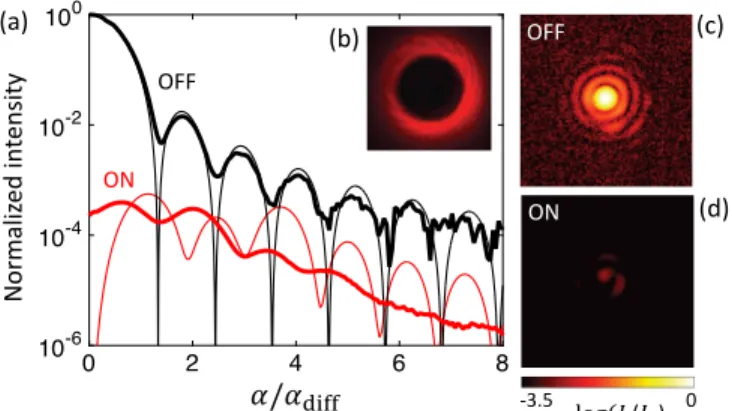
The azimuth-averaged intensity distribution of the reim-aging source S1(i.e., the focal plane of the lens L4, see Fig.2)
when the coronagraph is ON (starlight and umbilic core are centered) and OFF (starlight is offset, but within the writing beam area) is plotted as a function of the reduced angular coordinate α=αdiffwhere αdiff¼ 0.61λS=R1is the diffraction
limit, see Fig.3. The experimental data (thick curves) are supported by simulations (thin curves) accounting for the transmission function of an umbilical vortex mask [24], τðr; ϕÞ ¼ sin½ΔðrÞ=2' exp½2iψðr; ϕÞ þ iΔðrÞ=2', where the above formulations for ΔðrÞ and ψðr; ϕÞ are used. The images of S1when the coronagraph isOFFandONare then
calculated via a sequence of successive Fourier transforms [30] that describe the propagation of light from the input pupil plane to the camera, see Fig. 2. Namely, IS∝
jF ½circðr=R2ÞF 1
[
τF ½circðr=R1Þ']
'j2where F (F 1) refersto the (inverse) Fourier transform and circðxÞ ¼ 1 for x < 1 and zero otherwise.
As a writing beam can be steered on-demand, a given defect can be precisely pinned at any location. Therefore, by using N independently steerable writing light beams Wi,
i ¼ ð1; 2; …; NÞ, one can create N vortex masks Mi
adapted to a system of N stars Si, as depicted in Fig.2.
This is illustrated by considering a triple-star system (N ¼ 3), as shown in Fig.4 where the Airy spots of the three stars in the focal plane of the telescope are shown in panel (a) when the LCLV is at rest (i.e., without applied electric field). The three writing beams are then positioned to overlap the defect core of each vortex mask when the electric field is applied, as shown in Fig.4(b).
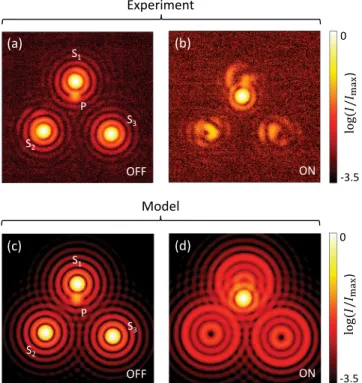
The obtained multiple-vortex mask is then used to perform an optical vortex coronagraphy laboratory dem-onstration of a system that consists of a triple star plus a planet. This is done by adding a faint off-axis illumination (the “planet,” see P in Fig. 2) at an angular separation of≃2αdiff from the star S1. In practice, the values of the
ratios between the maximal intensity of the stars (S1, S2, S3) and that of the planet are ð20.7∶19.4∶19.2Þ,
with an average total power for each star PSi≃ 13μW and the average total power for each writing beam is PWi≃ 0.39 mW. We note that we checked that the starlight has no detectable influence on the vortex mask writing. Experimental data are displayed in Fig.5where the panel (a) refers to theOFFstate of the coronagraph while the panel
(b) refers to theON state. The observations are compared
with simulations taking the same conditions as in experi-ments, see in Figs.5(c) and5(d).
Regarding present results, there is of course some room for improvement. In particular, both the spontaneous broken axial and chiral symmetries should be improved, for instance, by alternative topological structuring strategies and the development of novel optical materials. The total transmission of the instrument is another aspect that should
FIG. 2. Multiple star vortex coronagraph laboratory demon stration setup. Wi, writing beams generating on demand localized
vortex masks; Si, starlight beams mimicking pointlike sources; Ii,
irises; Li, lenses with focal length fi; CP, CA, circular polarizer
and analyzer; UBS, unpolarized beamsplitter; F, Notch filter at 532 nm; Cam, camera. Light sources are mutually incoherent.
FIG. 3. (a) Azimuth averaged angular intensity distribution when the single star coronagraph isOFF(black curves) and ON
(red curves) as a function of the reduced angular coordinate α=αdiff. Thick curves: experimental data; thin curves: simulations.
(b) Ring of fire in the exit pupil plane. Experimental reimaged pointlike sources when the coronagraph isOFFandONare shown
on panels (c) and (d) with I0being the maximal intensity in the OFFstate and where the logarithmic intensity range refers to the
4096 camera levels. The incident starlight is right handed circularly polarized.
be optimized, especially by improving the purity of the generated vortex. In addition, the existence of dead zones for off-axis planet detection when carrying out observations between crossed circular polarizers and the possible inter-action between two nearby vortex masks are two issues that also require further work. Finally, we note that the non-singular nature of umbilical defects (i.e., the XCPOL
transmission drops continuously to zero in the defect core area) allows self-adapted central apodization of each vortex mask. This is associated with a perfect unit charge topo-logical structuring down to the central part of the defect, as discussed in Ref. [24], which is not the case with any artificial LC vectorial vortex coronagraphs reported so far that require additional central obscuration disks [12,31–33]. We also note that the use of starlight as the writing beam itself would be in vain in the present case due to unavoidable mismatch between the defect and the center of the illuminated area. Still, such an attractive self-eclipsing option has been recently discussed by taking advantage of the photoelastic phenomenon[34].
Summarizing, we have introduced the use of optical vortex coronagraphy to address the issue of direct observa-tion of faint companions nearby multiple-star systems, which remains so far a challenge to astronomical observations. A proof-of-principle laboratory demonstration has been made on a simulated system that consists of a triple star plus a planet by using three independently steerable light beams enabling the generation of three independent vortex masks in a liquid crystal light valve. The proposed technique can be easily implemented on an arbitrary number of sources thus extending previous efforts to develop smart optical vortex coronagraphs [24]. We also note that the future of direct imaging of exoplanets will not rely on a single technique but instead will rely on the combination of complementary instrumental developments covering coronagraphy, adaptive optics, sensors, and image processing, in conjunction with the next-generation giant telescopes (e.g., Extremely Large Telescope, Giant Magellan Telescope, and Thirty-Meter Telescope) endowed with unprecedented resolution.
This study has been carried out with financial support from the French National Research Agency (ANR) in the frame of the Investments for the future Programme IdEx Bordeaux LAPHIA (ANR-10-IDEX-03-02) and HYPERPHORB project (ANR-15-CE30-0018). A. A and N. K contributed equally to this work.
Note added.—Recently, we became aware of a work reporting on the direct imaging discovery of a Jovian exoplanet within a triple-star system[35] and of a work dealing with the laboratory demonstration of high-contrast coronagraphy of simulated binary-star systems[36]using a pair of multiple-quadrant transmission phase masks.
*etienne.brasselet@u bordeaux.fr
[1] M. Mayor and D. Queloz, A Jupiter mass companion to a solar type star,Nature (London) 378, 355 (1995). [2] F. Pepe, D. Ehrenreich, and M. R. Meyer, Instrumentation
for the detection and characterization of exoplanets,Nature (London) 513, 358 (2014).
[3] J. F. Kasting, D. P. Whitmire, and R. T. Reynolds, Habitable zones around main sequence stars,Icarus 101, 108 (1993). FIG. 4. (a) Airy spots of a triple star system (S1, S2, S3) in the
focal plane of the telescope. (b) XPOL focal plane image of the corresponding vortex masks (M1, M2, M3) generated by the
writing beams (W1, W2, W3) where the dashed circles indicate the
contours of the illumination disks.
FIG. 5. Optical vortex coronagraphy laboratory demonstration of a system that consists of a triple star plus a planet. Reimaged light sources (S1, S2, S3) and planet P with lens L4 of focal
length f4¼ 500 mm when the coronagraph is OFF
(a) and ON (b) with Imax being the maximal intensity of each
image and where the logarithmic intensity range refers to the 4096 camera levels. Note that higher noise level in panel (b) results from limited exposure time of the camera, which limits the dynamic range of the image. The incident starlight is right handed circularly polarized. The simulated counterparts of panels (a) and (b) are shown on panels (c) and (d).
[4] M. Perryman, The Exoplanet Handbook (Cambridge University Press, Cambridge, England, 2014).
[5] G. Chauvin, A. M. Lagrange, C. Dumas, B. Zuckerman, D. Mouillet, I. Song, J. L. Beuzit, and P. Lowrance, Giant planet companion to 2massw j1207334 393254, Astron. Astrophys. 438, L25 (2005).
[6] D. Mawet, P. Riaud, O. Absil, and J. Surdej, Annular groove phase mask coronagraph,Astrophys. J. 633, 1191 (2005).
[7] G. Foo, D. M. Palacios, and G. A. Swartzlander, Optical vortex coronagraph,Opt. Lett. 30, 3308 (2005).
[8] B. Lyot, A study of the solar corona and prominences without eclipses,Mon. Not. R. Astron. Soc. 99, 580 (1939). [9] P. Kalas, J. R. Graham, E. Chiang, M. P. Fitzgerald, M. Clampin, E. S. Kite, K. Stapelfeldt, C. Marois, and J. Krist, Optical images of an exosolar planet 25 light years from earth,Science 322, 1345 (2008).
[10] E. Serabyn, D. Mawet, and R. Burruss, An image of an exoplanet separated by two diffraction beamwidths from a star,Nature (London) 464, 1018 (2010).
[11] G. A. Swartzlander, The optical vortex coronagraph,
J. Opt. A: Pure Appl. Opt. 11, 094022 (2009).
[12] O. Absil et al., Three years of harvest with the vector vortex coronagraph in the thermal infrared,Proc. SPIE Int. Soc. Opt. Eng. 9908, 99080Q (2016).
[13] The Extrasolar Planets Encyclopaedia,http://exoplanet.eu/ catalog/.
[14] R. Doyle et al., Kepler 16: A transiting circumbinary planet,
Science 333, 1602 (2011).
[15] J. A. Orosz et al., Kepler 47: A transiting circumbinary multiplanet system,Science 337, 1511 (2012).
[16] J. Crepp, E. Serabyn, J. Carson, J. Ge, and I. Kravchenko, On ky demonstration of a linear band limited mask with application to visual binary stars,Astrophys. J. 715, 1533 (2010).
[17] E. Cady, M. McElwain, N. J. Kasdin, and C. Thalmann, A dual mask coronagraph for observing faint companions to binary stars,Publ. Astron. Soc. Pac. 123, 333 (2011). [18] S. Thomas, R. Belikov, and E. Bendek, Techniques for high
contrast imaging in multi star systems. I. Super Nyquist wavefront control,Astrophys. J. 810, 81 (2015).
[19] E. Brasselet, Spin orbit optical cross phase modulation,
Phys. Rev. A 82, 063836 (2010).
[20] E. Brasselet and C. Loussert, Electrically controlled topo logical defects in liquid crystals as tunable spin orbit encoders for photons,Opt. Lett. 36, 719 (2011).
[21] R. Barboza, U. Bortolozzo, G. Assanto, E. Vidal Henriquez, M. G. Clerc, and S. Residori, Vortex Induction via Anisotropy Stabilized Light Matter Interaction, Phys. Rev. Lett. 109, 143901 (2012).
[22] I. A. Budagovsky, A. S. Zolotko, M. P. Smayev, and S. A. Shvetsov, Formation of the light beam with wavefront screw
dislocation at the photorefractive effect in nematic liquid crystal, Bulletin of the Lebedev Physics Institute 42, 319 (2015).
[23] I. A. Budagovsky, A. S. Zolotko, D. L. Korshunov, M. P. Smayev, S. A. Shvetsov, and M. Barnik, Generation of spiral dislocation of wave front in absorbing nematic liquid crystal,Opt. Spectrosc. 119, 280 (2015).
[24] A. Aleksanyan and E. Brasselet, Vortex coronagraphy from self engineered liquid crystal spin orbit masks, Opt. Lett. 41, 5234 (2016).
[25] P. Aubourg, J. P. Huignard, M. Hareng, and R. A. Mullen, Liquid crystal light valve using bulk monocrystalline Bi12SiO20 as the photoconductive material, Appl. Opt. 21, 3706 (1982).
[26] R. Barboza, U. Bortolozzo, M. G. Clerc, S. Residori, and E. Vidal Henriquez, Light matter interaction induces a single positive vortex with swirling arms,Phil. Trans. R. Soc. A 372, 20140019 (2014).
[27] A. Rapini, Umbilics: Static properties and shear induced displacements, J. Phys. USSR 34, 629 (1973).
[28] E. Brasselet, Tunable Optical Vortex Arrays from a Single Nematic Topological Defect,Phys. Rev. Lett. 108, 087801 (2012).
[29] S. A. Collins, Lens system diffraction integral written in terms of matrix optics, J. Opt. Soc. Am. 60, 1168 1177 (1970).
[30] J. W. Goodman, Introduction to the Fourier optics (Roberts and Company Publishers, Englewood, CO, 2005). [31] D. Mawet, E. Serabyn, K. Liewer, C. Hanot, S.
McEldowney, D. Shemo, and N. E. O’Brien, Optical vectorial vortex coronagraphs using liquid crystal polymers: theory, manufacturing and laboratory demonstration,
Opt. Express 17, 1902 (2009).
[32] D. Mawet, J. T. Trauger, E. Serabyn, D. C. Moody, K. M. Liewer, J. E. Krist, D. M. Shemo, and N. A. O’Brien, Vector vortex coronagraph: first results in the visible, Proc. SPIE Int. Soc. Opt. Eng. 7440, 74400X (2009).
[33] D. Mawet, E. Serabyn, K. Liewer, K. Burruss, J. Hickey, and D. Shemo, The vector vortex coronagraph: Laboratory results and first light at Palomar observatory,Astrophys. J. 709, 53 (2010).
[34] A. Aleksanyan and E. Brasselet, Self eclipsing: alignment free vortex coronagraphy,Opt. Lett. 42, 1237 (2017). [35] K. Wagner, D. Apai, M. Kasper, K. Kratter, M. McClure, M.
Robberto, and J. L. Beuzit, Direct imaging discovery of a Jovian exoplanet within a triple star system, Science 353, 673 (2016).
[36] J. Kühn and P. Patapis, Digital adaptive coronagraphy using SLMs: Promising prospects of a novel approach, including high contrast imaging of multiple stars sys tems, Proc. SPIE Int. Soc. Opt. Eng. 9912, 99122M (2016).