22 AuG1939 LIRRAP.7 CREEP ELASTIC HYSTERESIS AND DAMPING IN BAKELITE
by
Herbert Leaderman
B. A., Hons., University of Cambridge
1934
B. Sc. (Eng.), University of London 1934
Submitted in Partial Fulfillment of the Requirements for the Degree of
MASTER OF SCIENCE from the
Massachusetts Institute of Technology
1938
Signature of Author ... --- - -- - - -- - ...
Department of Mechanical Engineering, October 3, 1938. Signature of Professor in
Charge of Research . ...
Signature of Chairman of DepartmentCommittee on Graduate Students ...
Cambridge, Massachusetts.
October 3, 1938.
Professor George W. Swett,
Secretary of the Faculty,
Massachusetts Institute of Technology.
Dear Professor Swett:
I submit herewith a thesis, in partial fulfillment of the requirements for the degree of Master of Science, entitled,
CREEP, ELASTIC HYSTERESIS AND DAMPING IN BAKELITE.
Your faithfully,
Herbert Leaderman.
CONTENTS
Preface
Part I. Introduction
I. Importance of the Problem
II. Nature of Problem III. Scheme of Thesis
IV. Conclusions
Part II. Theory
I. Creep Superposition and Equivalent Time
II. Separation of Creep and Elastic Hysteresis
III. Damping due to Hysteresis and Creep Part III. Experimental
I. Description of Materials Used
II. Description of Apparatus III. Method of Conducting Tests
IV. Results of Creep Tests
V. Results of Hysteresis Tests
VI. Damping Capacity Results Part IV. Conclusion
I. Experiments on Non-Recoverable Creep II. Suggestions for Further Work
III. List of References
iv 1 2 3
5
6
6 13 2937
37
39
44 4769
85
94 94 100 101Preface.
This work deals with an experimental study of the inelastic properties of four types of bakelite material. It is
shown that the damping of free torsional oscillations is accounted for by two phenomena, namely logarithmic creep and elastic hysteresis. Due to the presence of creep, a theory has to be developed to show how the existence of elastic hysteresis may be determined experimentally. This theory is developed in
Part II. In Part III is given first an experimental proof of the
assumptions of the theory, and also the study of the inelastic properties by both static and dynamic methods. Part IV deals
with a few experiments suggested by the results of Part III.
I wish to express my appreciation of the encouragement and advice Professor A. V. de Forest gave me during the course of this work. I also wish to acknowledge the assistance of
Professor J. T. Norton, Mr. R. Fanning, and Mr. W. Walsh.
I am indebted to Messrs. Bakelite Limited of England and
the Bakelite Corporation of America for the supply of materials.
In particular, I wish to express my gratitude to the London County Council for the award of a Robert Blair Fellowship, enabling me to undertake this work.
gREEP, HYSTERESIS, AND DAMPING IN BAKELITE.
Part I. Introduction.
I. Importance of the Problem.
An important property of materials which recently has received much attention is .dmping_capacity, or the
ability to dissipate mechanical energy as heat in the
working range. This dissipation, though small for ordinary metals in the normal condition, is very sensitive to structure and to strain history, and the study of damping capacity
is throwing much light on the differences in behaviour of materials under the same conditions.
The origin of damping in metals is understood to be due mainly to two causes, elastic hysteresis and primary creep. By elastic hysteresis is meant the appearance of a
narrow stress-strain loop when the stress is varied cyclically either in steps or continuously; it is a phenomenon independent of time. It has been shown by Rowett that for cold drawn
steel, the energy dissipated under free torsional oscillations up to two-thirds of the elastic limit is exactly accounted for by the areas of the hysteresis loops determined by static experiments.
By primary creep is meant that part of creep which proceeds at a decreasing rate with time. It has been shown
2
by Bennewitz that the creep of glass is of this nature and that the damping of glass is entirely accounted for by primary creep.
Owing to the difficulties of experimentation, the phenomenon of creep in metals at room temperature is not well understood; similarly, the inelastic properties of metals at stresses where both primary creep and elastic hysteresis are present has not yet been explored. It is therefore of interest to examine in detail the inelastic properties of synthetic resins (in particular, bakelite) where these properties, being of a large magnitude, can be easily studied. In addition, apart from the contribution to the general understanding of the properties of materials a
study of bakelite would give, such a study would be of importanoe in the production of synthetic materials with better elastic
properties, and in giving a clearer knowledge of allowable working stresses in such materials.
II. Niature of Problem.
If a hysteresis test be made on bakelite by taking a specimen (say) in torsion around a stress cycle, a stress-strain loop will be obtained. The following questions then arise:
of it due to an elastic hysteresis, of a static nature as explained above?
2. If the loop is due to creep, we must be able to demonstrate that this is so; to do this, we must know the law of primary creep for load applied (or removed) in increments at different times. This law we will call the superwposition law of creep.
3. If both elastic hysteresis and creep are present, then the area of the loop obtained from a stress-strain test made under
definite conditions is greater than the area due to creep deduced from the superposition law. From such a test, we can calculate the damping due both to creep and to elastic
hysteresis; this should agree with the damping measured by the decrement of free oscillations of the specimen.
III. Scheme of Thesis.
It is now agreed that the creep of materials can be divided into two components, one proceeding at a decreasing
rate with time and proportional to the stress (primary creep) and the other proportional to time but not to stress (plastic flow). For the time being, we will neglect the second component; we will show later that with certain precautions we can
eliminate the effect of plastic flow. The main problem is therefore to study the laws of superposition of primary creep, and the application of these laws to the separation of creep components from true elastic hysteresis in a cyclic stress-strain test. This work is divided into a theoretical part
Boltzmann, in such a manner that plastic flow will not be an interfering factor in the experiment; and secondly with the calculation of the deflections that would be obtained if
primary creep only were present, the load being varied cyclically and in steps. By this means we can determine if elastic
hysteresis is present in addition to creep. Finally, we have to calculate the damping due to primary creep on the basis of the superposition law, and then to calculate the total damping due to primary creep and hysteresis.
On the experimental side, the problem was to devise an apparatus by which creep, hysteresis, and damping could be measured on the same specimen. The method chosen was
that of torsion of a cylindrical specimen with squared ends, one end being fixed and the other fastened to a torsion bar pivoted about the axis of the specimen. The experimental work in Part III is concerned, first, with the testing of the superposition law according to the schemes developed
in Part II for each of the materials investigated; and secondly, with stress-strain observations for loads applied
cyclically, in increments. Damping measured directly is shown to agree well with that predicted from stress-strain
5.
Part IV of this thesis gives an account of
experiments which shed some light on the nature of creep.
Previous Work.
4
5
De Bruyne and also Parzich have measured the
damping of reinforced bakelite; they do not explain the origin
6
of the damping. Jordan has studied the creep of soft metals under pure bending with superposed loading. His results are plotted on the basis of the logarithm of time elapsed from the beginning of the experiment. When replotted on the basis of
logarithm of equivalent tme (see p. 7), his results suggest that Boltzmann s law is true.
IV. Conclusions.
Four types of material were tested in torsional shear. l. Using a concept of equivalent time, it is shown that the creep
follows Boltzmann a superposition law.
2. By means of observations of deflection obtained when the load is varied cyclically in equal increments in equal intervals of time, it is shown that the area of the stress-strain loop is greater than that due to creep calculated from the Boltzmann law; hence
an elastic hysteresis exists in bakelite.
3. Measurement of the decrement of free oscillations shows that
the measured specific damping capacity at a surface shear stress of
2520 lbs./in! agrees well with the value deduced from the magnitude
P art -II.
Theory.-I. Creep SuperPosition and Equivalent Time.
Boltzmann a superposition law of primary creep can be summarised as follows:
1. Creep under Single Load. The deflection at time t due to a single load W applied at time to is given by:
x = Wlb + a log(t - to)] ... (1)
i.e., it consists of a part proportional to the load and independent of the time, and a part proportional to the load and to the logarithm of the time elapsed since the load was applied. In considering creep under complex loading, we may omit for simplicity the quasi-elastic or time-independent part of the deflection.
2. Creep Recovery. If at any subsequent time the load W be
removed there will be a creep recovery or negative creep. It is assumed that the effect of removing the load W is that of
applying a negative load of magnitude W, at the same time the creep due to the original loading continuing indefinitely. The material is thus assumed to possess a memory for all past
loading actions. If the load be removed at time tj the creep recovery at a subsequent time t will be given by:
W[b + a log(t - to)] - W[b + a log(t - tl)J , i.e., by
7.
3. Increase or Decrease of Load. If the load be increased or decreased suddenly, then the effect on the creep is that of
adding the increment or removing the decrement of load, the creep due to previous loading actions being assumed as before to
continue indefinitely. If for example loads WQ, W1, W2, be
applied at times to, tl, t2, the creep at a subsequent time t, neglecting the time-independent deflection, is:
Woa log(t - to) + (WI - WO)a log(t - tl) + (W2 - Wl)alog(t - t2)
.*0 . .*. . (3)
If we apply a single load to a specimen of bakelite, say in torsion, the creep deflection is not found to be
logarithmic with time. We can assume either that Boltzmann s law is untrue for bakelite, or that alternatively the
logarithmic creep is masked by an additional plastic effect. This plastic effect might be analogous to fluid flow, and
therefore in existence whenever the specimen is under load;
alternatively, it might represent an initial plastic adjustment. If now we remove this load that we have applied
above, the creep recovery indeed gives a straight line when plotted against log (t - to)/(t - ti) as indicated by equation (2); but this is not sufficient (as has been assumed many times In the past) for assuming the correctness of Boltzmann a
superposition law. If however we consider the creep and creep recovery due to repeated application and removal of the load at difterent time instants, then by comparison with the creep and creep recovery as expected by the superposition law we can determine the validity of the law.
squivalent Time.
In carrying out the experiments to confirm Boltzmann s
theory it is expedient to add or remove loads which are of the same magnitude or at least simple multiples of each other; for example, if in equation (3) above, W1 = 2W,, W2 = 3W0,
then the theoretical creep at time t is given by:
Woa log(t - to)(t - tl)(t - t2)o
i.e., the creep is proportional to the logarithm of a simple
function of time. A simple method of checking the superposition law for any complex loading therefore presents itself; let
us plot the observed creep (or creep recovery) deflection against the logarithm of the appropriate time function.
Then for any set of tests we should obtain a set of parallel
straight lines, the distance between any two lines corresponding to the elastic together with any hysteretic deflection. We
thus have a very powerful means of checking the superposition law.
Let us call this function of time the equivalent time. The procedure is thus to calculate the equivalent time
corresponding to each observation, and to plot the scale
deflections against equivalent times on semi-logarithmic paper. In this way, deviations from the superposition law can be
9.
Confirmation of the-Superposition Law, Usi ce of -Equivalent Time.
Three tests will be considered which together are sufficient to confirm the superposition law, and to indicate the nature of the departures therefrom.
0 +
ti 2ti 3ti 4ti 5ti 6ti
Fig. 1.
Test I. Repeated LoadinA.
Fig. 1 represents a load-time diagram for an experiment in which a load W is applied and removed
repeatedly. The equivalent times are therefore as follow:
If t lies in time interval: expression for equivalent time is:
0- ti t t - 2t 1 t/(t - t ) 1 2t, 3t t Mt - 2t )/( t - ti 3tl 4ti t( t - 2t1)/( t -tl) (t - 3tj) 4t, -5t, t( t -2tj) '( t - 4tl) /(t - tl) t - 3tl) 5ti 6tl t( t - 2tl) (t -4tl) ( t - tl) (t - 3tl) (t - 5ti)
If the theory is rigidly true, we expect that all the creep deflections when plotted against the logarithms of the
corresponding equivalent times to fall on one straight line; and the same be true for observations of creep recovery. These two lines should be parallel and separated by a distance
corresponding to the elastic deflection due to a load W.
Test II. Qreep and Stress.
We can show that creep is proportional to load by repeating any experiment, with, say, half the load. We then expect the slopes of all the lines to be halved.
2W0
0 4-+ x
0 t1 2ti 3ti 4t, 0 ti 2ti 3ti 4t1
Fig. 2a. Fig. 2b.
Loading diagrams according to figs. 2a and 2b represent
experiments which could be made to test the proportionality of logarithmic creep with applied load. This proportionality is important. If experiments carried out by torsion of cylindrical
specimens show a proportionality of creep with load, we can say that the creep is proportional to stress; furthermore, the stress must be always linearly distributed across any cross-section, and therefore primary creep would not cause a redistribution of stress. The results of a torsion experiment would then
11.
Test III. Memory Action.
According to the superposition law, the creep due to each loading action persists indefinitely, i.e., the material remembers past loading actions. The purpose of
the following experiment is to demonstrate this effect
in such a manner that plastic flow will not be an interfering factor; the experiment is to show that if a specimen be
loaded first in one sense and then in the other, and then the load removed, the material will tend to recover in opposite senses from the two loading actions. The times can be so arranged that in fact after a certain instant the memory of the first loading action outweighs that of the second,
i.e., that creep recovery proceeds first in one direction and then in the other. Such an experiment demonstrates qualitatively the memory action, and is well known. We are now going to use the concept of equivalent time to demonstrate
that in fact Boltzmann s law is obeyed quantitatively.
Mathematically, the condition that the creep recovery should stop and then reverse its direction is that the equivalent time for the recovery should possess a maximum (or minimum).
W
oi
8t 9tl0tF 12tThe loading diagram in fig. 3 represents the application of a load W from t = 0 to t = 8ti, and the application of a load -W from t = 9t1 to t = lOt1 . The equivalent time for the subsequent recovery is therefore:
t(t - lo 1)
(t - 8t 1)(t - 9t 1)
This has a stationary value at t = 12t1 , hence at this instant we would expect the direction of the creep
recovery to reverse. Furthermore, we would expect all the creep recovery observations from t = lot1 onwards when plotted against the logarithm of the equivalent time to fall on a straight line, retracing the line backwards from t = 12ti onwards. This in fact happened in all the materials tested. In an otherwise ideally elastic material, the creep recovery observations from t = 8ti to t = 9t 1
should fall on the same line. In actual fact, they fall on a parallel line, indicating the existence of an elastic hysteresis loop.
The above is an account of the ideal behaviour of a material under experiments to check the validity of the superposition law of primary creep. In Part III
is given an account of the behaviour of various commercial types of bakelite under these tests. Results were such as to show that plastic flow was not, after the first application of load, a seriously interfering factor.
13.
II. Separation of Creep and Elastic Hysteresis.
The next stage in the investigation is the demonstration of the existence of an elastic hysteresis loop, and
the experimental determination of its magnitude. Let us assume first that elastic hysteresis is absent, and let us imagine that a material which possesses the property of primary creep obeying the superposition law is loaded cyclically by applying (or removing) equal increments of load in equal intervals of time. Then the
deflections due to creep at the end of each of these intervals could be calculated, if the magnitude of the creep be
known; this latter can be obtained from a repeated loading test. All the observed deflections obtained in the cyclic test could be corrected for creep by means of the calculated
creep deflections.In the absence of elastic hysteresis, the experimentally observed loop widths at each load
station should be the same as the corresponding theoretically calculated widths, that is, the calculated stress-strain
loop due to primary creep should be the same as the experimentally determined loop. If the width of the measured loop at any
load station is greater than the calculated width, the difference must be the width of the loop due to elastic hysteresis at that load.
Thus if we take a sufficient number of steps in the cycle, it is possible to find the shape and area of the
checked in two ways. First, we can repeat the experiment, using different values of time interval between the load increments. The observations corrected for creep should then be the same for all tests, and the hysteresis loop area
should be the same; this has been found to be true within the order of accuracy of the experiment. Secondly, the
internal energy absorption (or damping capacity) as measured by the decrement of free oscillations should agree with the area of the hysteresis loop and the magnitude of the
primary creep as measured statically: again in the experiments reasonable agreement was found.
Stress-Strain LooP due to Creep.
We now have to calculate the deflections which would be obtained, due to creep, if a material be loaded cyclically. We assume:
1. Boltzmann s superposition law to be true.
2. The load to be applied (or removed) in equal amounts in equal intervals of time.
3. The deflections to be read at the end of each time interval. In the experimental work, there were four loading steps, i.e., sixteen loading operations per cycle. However we will at first keep the investigation general by assuming that
there are n loading steps, and that each load increment is of magnitude W. The creep constant is to be a as before, and the time interval between load changes t
Time-variable part of deflection.
At the outset, we are confronted by a great difficulty: it appears impossible to separate the deflection into
an instantaneous component and a subsequent creep component; the deflection follows a logarithmic law with time, and this seems to be true for the smallest measurable values of
deflection and time. In other words, the curve of deflection against time is as shown in fig. 4(b) and not as shown in fig. 4(a).
Deflection Deflection
Time Time
Fig. 4(a) Fig. 4(b)
Of course the logarithmic law cannot hold down to zero time, since the deflection would then have an infinitely
negative value. It is not possible to say where the logarithmic law ceases to hold, and therefore to find any value of
instantaneous deflection.
Since the deflection due to a single load according to Boltzmann's law varies with time according to the equation:
where t is the elapsed time and T is the value of the time unit, then we may conceive the deflection as consisting of a time-independent part B, and a time-dependent
part A log(t/T). Y Y YQ P B 3 3 BB22 0 0 02 0.1 1.0 10 mins. Fig. 5.
Let PQ in fig. 5 represent the relation between the deflection (plotted vertically) and the logarithm of the elapsed time in minutes (plotted horizontally). If the time unit T is chosen to be 1 minute, we draw the axis of ordinates 0 Y through the point corresponding to t = 1 minute. The intersection of this line with the line PQ gives us the value of B1 , the time-independent part of the deflection.
If however we choose our time unit T equal to 10 minutes or to 0.1 minute, the time-independent part of the deflection
becomes B, or B . Thus the values of the time-independent and time-dependent parts of the deflection depend on the value we choose for our time-unit.
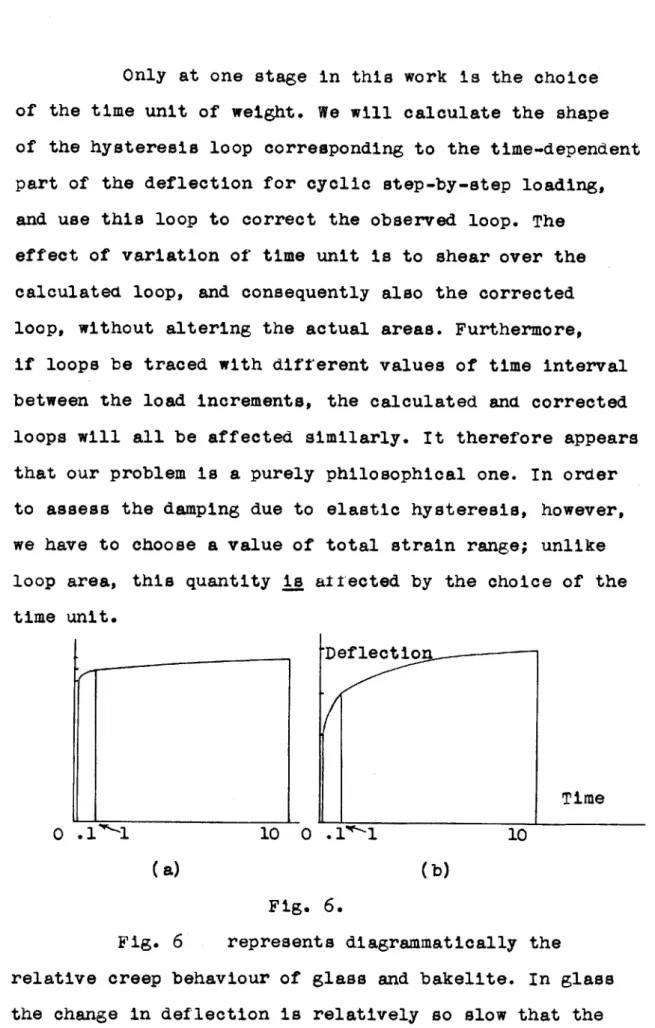
Only at one stage in this work is the choice of the time unit of weight. We will calculate the shape of the hysteresis loop corresponding to the time-dependent part of the deflection for cyclic step-by-step loading, and use this loop to correct the observed loop. The effect of variation of time unit is to shear over the calculated loop, and consequently also the corrected loop, without altering the actual areas. Furthermore, if loops be traced with different values of time interval between the load increments, the calculated and corrected loops will all be affected similarly. It therefore appears
that our problem is a purely philosophical one. In order to assess the damping due to elastic hysteresis, however, we have to choose a value of total strain range; unlike loop area, this quantity is attected by the choice of the time unit. Deflection Time O 1 " 10 0 .11 10 (a) (b) Fig. 6.
Fig. 6 represents diagrammatically the
relative creep behaviour of glass and bakelite. In glass the change in deflection is relatively so slow that the
value of the time-unit is not of significance; in the case of bakelite, however, where the deflection changes relatively more rapidly with time, the problem is a practical and not merely a philosophical one.
Two values of time unit suggest themselves. The first is that value corresponding to the stiffness as given by the natural frequency of oscillation; the second is the period of this oscillation. In general, a value of time unit T of 1 minute will be chosen except (as in the case above) where this unit is of importance;
"03
it will then be taken to be 10 minute, which is of the order of magnitude of the natural period of oscillation.
In the experiments, stress-strain loops were measured by applying four equal loads in equal intervals of time, which were 2, 1, or 0.5 minutes. The general investigation assumes that there are n loading steps, at intervals of time ti. Each increment of load is of magnitude W.
Let deflection due to load W applied at zero time be W(b + a log t)
at current time t. Let an additional load W be applied at a subsequent time t . Then the deflection at time t, where 2t17 t >t, is
W[2b + a log t + a log(t - ti)]
Similarly, deflection at time t, where 3t 1 >t >2t1, is
19.
After the n th load increment has been applied, deflection at time t where (n - ±)t 1 t<nt, is
W jnb + a log t + a log(t - ti) +....+ a log (t - n - 1t )] From these expressions, we can find the deflections at
the end of each time interval, by substituting the appropriate value of t. The first three deflections are given in the
table below.
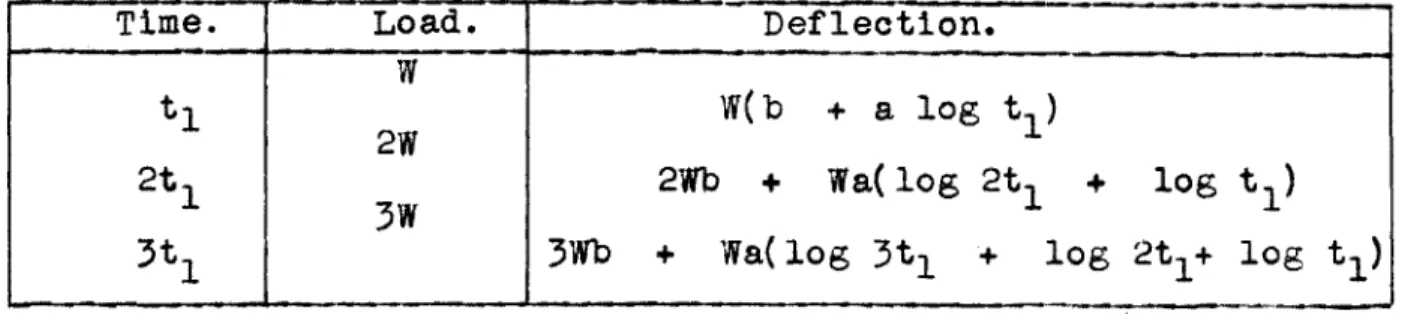
Time. Load. Deflection.
W
ti 2W W(b + a log t 1)
2t1 2Wb + Wa(log 2t1 + log t1)
3t1 3Wb + Wa(log 3ti + log 2t 1+ log t1)
This last
The above
expression can be 3W(b + a log table can thus be
written:
t 1) + W.a lobL3
rewritten as follow:
Time. Deflection
t Wlb + a(log t + logl)L
2t WE2b + a(2log tj + log2)]
3t1 W[3b + a(3log ti + log3) nt1 W[nb + a(n log t1 + log R)]
These are the deflections for a material which possesses the property of primary creep only, for the
first quarter of the first loading cycle. It is observed that the deflection at a load k.W is givem by the independent deflection k.W.b together with a
is an expression containing factorial quantities, dependent on the loading history.
Unlo-adIng n.W to 0.
Proceeding similarly, we can find the deflections from t = nti to t = 2nt1 , during which period the load is being reduced in steps from n.W to 0.
Deflection at time t, where (n + 1)t 1> t> nt, is
W.b(n - 1) + W.allog t +...+ log(t - n - 1 t 1 ) - log(t - nt1)
Deflection at time t, where (n + 2)t > t> (n + 1)t1 , is
W.b(n - 2) + W.a log t +...+ log(t - n - 1 t 1)
- log(t - nt1) - log(t - n + 1 ti)]
iinally, deflection at time t, where 2nt1> t> (2n - 1)tj, is
W-allog t +...+ log(t - n - 1 t )
- log( t - nti) -....- log( t - 2n - 1 t 9
Substituting t = (n + 1)tl, (n + 2)t 1 , ... 2nt1 , in the above expressions (corresponding to the elapsed time at the end of each of the time intervals), we obtain the
corresponding deflections if primary creep only is present. lElapsed Time. Load. Deflection.
(n + 1) ti ( 1)W Wb(n-1) + W.a[(n-l)log t 1+ log I
(n + 2)t 1 (n -2)W W.b(n-2) + W.a[(n-2)log t 1 + log n+2.
0 2nt
Comparing these deflections with the deflections for the loading period, we see that the deflections
during unloading are greater; in other words, a stress-strain loop due to creep has begun to appear. At any given stress level, the time-independent deflections are the same, and proportional to load. It is clear then, as stated previously, that the effect of change of time-unit is to alter the time-independent and time-dependent parts by amounts proportional to the load, i.e., to
shear over the diagram of time-dependent deflections. For the time being, we are interested only in hysteresis loop widths, and hence we need not be interested in the value of the time unit.
For the first half-cycle, the time-dependent part of the deflection, dropping the factor W.a, can be tabulated as follow:
Deflection.
Load. Load Increasing. Load Decreasing.
n.W n log tj + login
(n-l)W (n-l)log t + log~nl (n-l)log t1 + log ln+.
2W 2 log t1 + log L 2log t1 + log( 2n-2 -2In-2) W log t1 + log GL log t1 + log(jn-l/ iIn-)
The difference between these pairs of quantities is the loop width due to creep, and this difference is seen to be merely the logarithm of a function of factorial quantities dependent on the load history, multiplied
by the slope of the logarithmic creep plot W.a. The unit of time measurement T and the time interval t
are eliminated; we can thus say that the loop width due to creep is independent of time considerations, and must be the same (if plastic flow is not an interfering factor) irrespective of the value chosen for the time interval; furthermore, the time-dependent deflections at zero load appear to be independent of the time interval, but dependent on the load history. Thus we can conclude:
1. Due to primary creep, a stress-strain loop appears. The observations at zero load depend upon the loading history, but are independent of ti.
2. The observations at other loads depend on the time interval also. The loop widths are always independent of time
interval, the effect of change of t1 being merely to shear
over the observed loop by an amount proportional to the logarithm of the time interval. In this way loops traced with different values of t1 can be compared.
The next section will show how these theoretical predictions are borne out by experimental results. By
continuing now the theoretical development, we will trace the variation of the time-dependent deflections for the first two complete loading cycles. From these deflections
the loop widths at each station and hence the loop area due to primary creep can be obtained. Attention in the experimental section will be concentrated on the second complete loop: it will be assumed that in the actual experiment all plastic adjustment takes place in the first loading cycle, and that the second loading cycle represents solely the action of elasticity, primary
creep, and elastic hysteresis. If the observed loop width at any station is greater than the calculated value,
the difference must be due to the static effect which we call elastic hysteresis.
Our object therefore is to find the values of time dependent deflections for the first two complete loading cycles, at first generally with n loading steps at intervals t, apart, and then with four loading steps
at intervals 0.5, 1, and 2 minutes apart. This time dependent deflection, as has been remarked above, contains a part
k.W.a log t1 (when the load is k.W) and a part W.a log F where F is a factorial function. In the calculations, we may omit the first term, and reintroduce it later,
for the cases where the time interval t differs from one minute. The following are the factorial expressions for the first complete loading cycle.
Time. tl 2t1 nt1 Unloading, (n + 1)ti (n + 2)ti 2nt 1 Loading, 0 (2n + 1)t 1 (2n + 2)t 1 3nt1 Unloading, 4nt1 Load. W 2W 3W nW to 0.
(n
1)W
(n -2)W (n-3) W to -nW. W 2W -nW to 0. Factorial.L
Sn .+ _1 n + 2/ L2 12n + 1 In + lln + 1 12n + 2 n + 2 1n + 2 12n 12n U~n QnThe third quarter of the loading cycle
is obtained as before by adding the appropriate terms to the memory function and substituting for the current
value of time t as before. It will be noticed that the shape of the factorial expression changes on passing through
the maximum load points, where a discontinuity in the
25.
From this observation, it is possible to write down the factorial expressions for the zero and maximum load points for the second cycle. The factorial expression
for any intermediate loading can then be obtained from the nearest subsequent expression tabulated.
Zecond Loading__Cycle. Factorial.
Numerical Evaluation.
function
The following table gives the value of the factorial F evaluated for n = 4 for the first two loading cycles.
First Cycle. Second Cycle. Time. 5nt (Lijn \2Ln
Lgn)
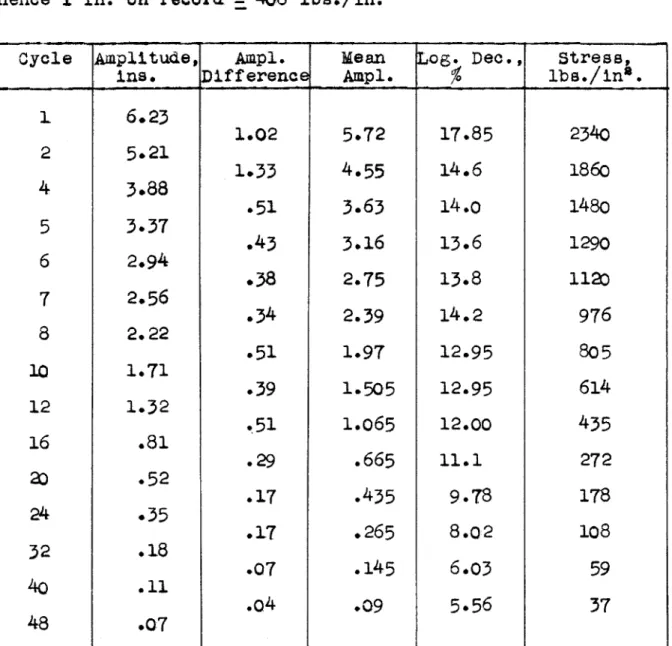
/(L-n ALn) 6nti (~ n1n 5n1nL nn () 17 8nt 5L T ime/t F Time/tl F 1 1 17 1/7.57 2 2 18 1/2.29 3 6 19 1.81 4 24 20 9.04 5 120 21 53.2 6 180 22 90.2 7 140 23 77.3 8 70 24 41.7 9 25.2 25 16.o 10 7.0 26 4.67 11 1.57 27 1.1 12 1/3.4 28 1/4.67 13 1/21.2 29 1/28.1 14 1/37.8 30 1/48.8 15 1/33.9 31 1/42.7 16 1/19.1 32 1/23.6The values of log10F are tabulated below. These figures, multiplied by the slope of the logarithmic creep plot
for load W (that is, W.a), give the time-dependent deflections for step-by-step cyclic loading, when the time interval
is equal to one minute.
Load. First Cycle. Second Cycle.
4w 1.380 .956 3W .778 2.079 .257 1.725 2W .301 2.255 -.360
1.954
W 0 2.146 -.879 1.888 0 1.845 -1.280 -1.280 1.620 -1.376 -W 1.401 -1.530 1.204 -1.630 -2W .845 -1.577 .668 -1.688 -3W .196 -1.326 .041 -1.449-4W
-.- 530-.
671When t differs from 1 minute, we have to add the quantity k.W.alog t1 when the load is k.W to obtain the coefficients of time-dependent deflection. The values for ti = 2 minutes and for t1 = O.5 minute for the second loading cycle are given below.
ti = 0.5 min. .822 1.352 1.587 1.620 1.505 1.270 .944 ti = 2 mins. -1.376 -i.
329
-1.086 -. 546.533
1.160
.242 -. 578 -1.280 2.160 2.628 2.556 2.189 1.620 -1.376 .903 -1.931 .066 -2.290 -.862 -2.352 -1.875 Load. -. 248 -. 646 -.962 -1.180 -1.2804w
3W 2W W 0 -W -2W -3W -4wFIG. 7 TIME-DEPENDENT DEFLECTIONS 0 C
-I
T04W
/o 00zi
-2W
-3W
2-3'-4W
-2
DEFLE..CTIONS.
-2
/
.vJ
+ 0 + \.3W
+:-)
:3W
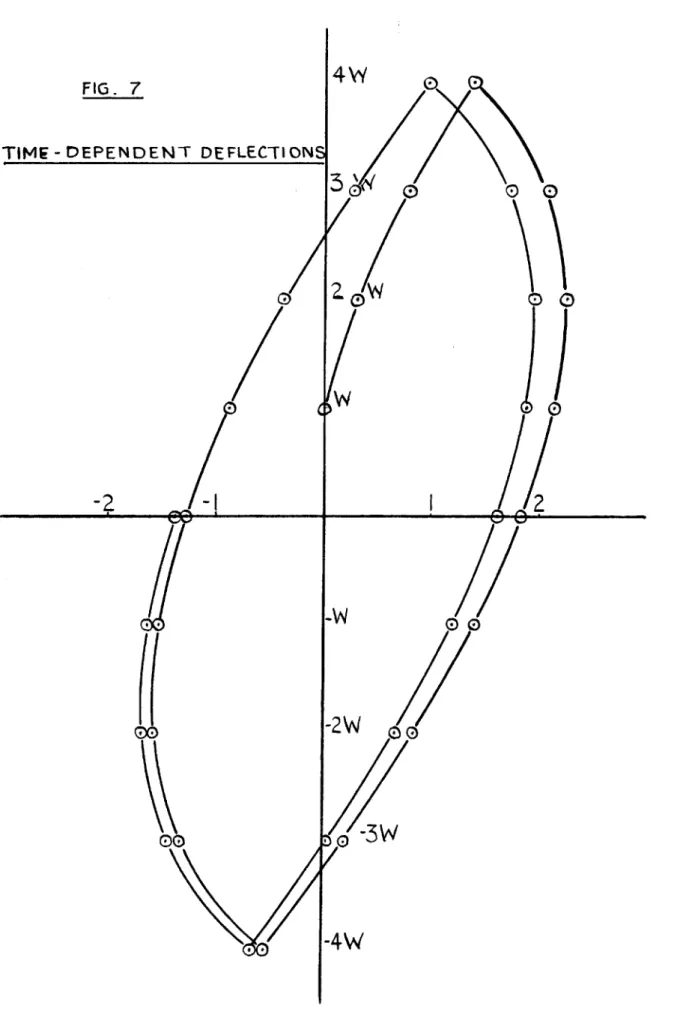
0 I LIV 1.Fig. 7 is a plot of the first table on p. 26; fig. 8 is a plot of the second. Each point represents of course a
time-dependent deflection, which is the difference between the deflection obtained at a given load after the loading history
corresponding to the point in question, and that deflection which would be obtained one minute after an equal load were placed instantaneously in position (the time-independent deflection). This assumes primary creep according to
Boltzmann's law to be the only inelastic effect. In Part III it will be shown that only part of the observed loop
can be accounted for by creep, and the remainder must therefore be ascribed to elastic hysteresis.
III. Damping due to Hysteresis and Creep.
The decrement of free torsional oscillations of a system, of which the material under test in the form of a cylinder forms the elastic member, is due in the absence of mechanical friction and air damping (and these can be made very
small) to the material damping of the specimen. In the case of the bakelite specimens under consideration, damping appears to be due to primary creep and to elastic hysteresis. To confirm this quantitatively, we wish to measure the damping directly, and compare this with the value computed from the magnitudes of the primary creep and of the elastic hysteresis
obtained from the cyclic loading test.
energy in the cycle. In the case of torsional shear of solid cylindrical specimens, each annulus is working through a strain cycle of different range. The ratio of the energy dissipated in one cycle to the maximum strain energy in the
specimen at a given range of surface shear strain thus
represents a mean value over the cross-section; this value we refer to as the mean specific damping capacity \V . If we
m
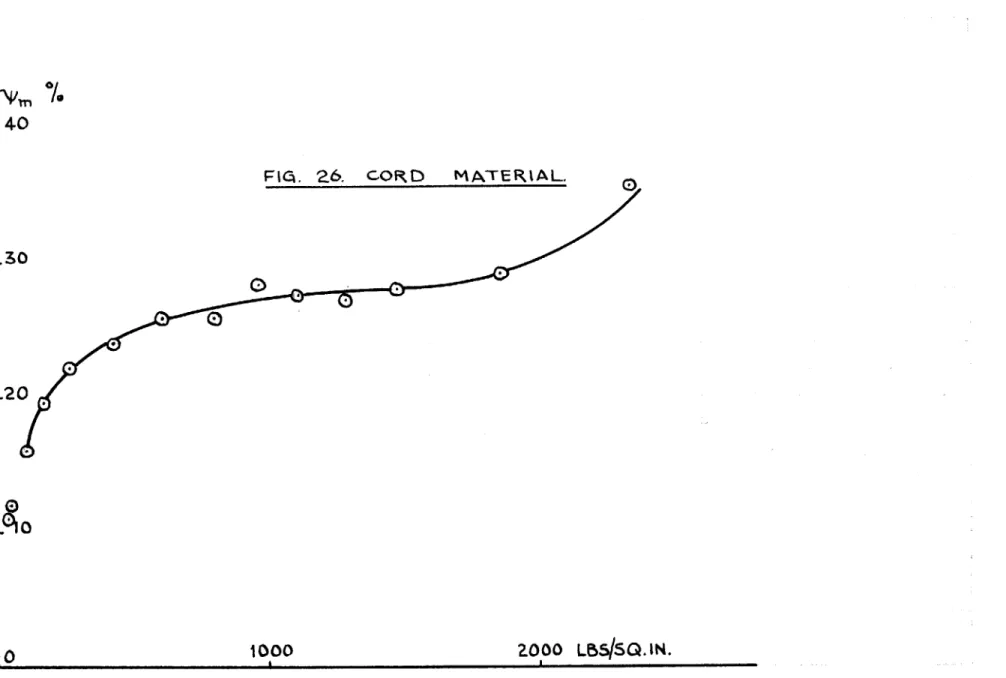
consider a thin tube of the same diameter working through the same range of twist per unit length, the damping capacity of the tube will be different from that of the solid cylinder, though they be working through the same strain range, since the damping capacity of the thin tube represents the value for the annulus of material on the surface only of the solid cylinder, and therefore we expect this to be different from the mean specific damping capacity '\/. The damping capacity of this surface annulus is called accordingly the surface specific dampIng apacity '\O. The ^9e curve can be derived from the
ap curve.While in general the Wcurve is of greater scientific importance, we are here interested only in the 4 curve,
since we are measuring the mean value of elastic hysteresis over the cross-section.
31.
Logarithmic Decrement.
If A1 and A2 are successive amplitudes of free oscillation, then the logarithmic decrement is
S = ln A
1/A 2.
This value is taken to refer to the strain corresponding to 1/2(A1 + A2), though this may not be strictly true when the decrement is high, as in bakelite. If we write 6
according to the formula:
S=
Al - A2=
Difference in Amplitude 1/2(Al + A2) Mean Amplitudethen
S
represents the value of the logarithmic decrement within 1% up to8
= 0.35; the expression6(1 + 6 2/12)
represents the decrement accurately over the whole working range. Loqgarithmic Decrement and Mean Specific Damping Capacity.
If the damping is small, then Hooke's Law
is very nearly obeyed, and the strain energy is therefore proportional to the square of the amplitude. The strain
2 energies corresponding to amplitudes A1 and A2 are k.A1
2
and k.A2, say. The mean specific damping capacity is then
2 2
1/2.k(A + A2 d A2
Then V = (A, - A2)(A, + A2)
1/4 (A, + A2) + (A, -A 2
(Al A2)
1/4(Al + A2) 1 (Al A2]
Al + A 2
26 2S
1+ 6/
where
&
is as before the ratio of the difference in amplitude to the mean amplitude. Thus the mean specific damping capacity is equal to twice the logarithmicdecrement within 1% if 8 is less than .20, provided that the strain energy is proportional to the square of the amplitude; the reasons we have for assuming that this is so are given below. We will find in our tests that
S
will not exceed .20, and hence we will use the above formula for finding .Relgtion between Strain Ener n Strain
We wish to show that in the case of bakelite, it is reasonable to assume that the strain energy for
specific damping capacity purposes is proportional to the square of the strain. If we can do this, then we may use the formula obtained above for the mean specific damping capacity. Furthermore, we have a basis for assessing the strain energy corresponding to the observed hysteresis loop, so that the contribution of elastic hysteresis to the specific damping capacity may be computed.
5).
The Static Loading Curve and Free Oscillations.
Let us assume at first that creep is absent. When the damping due to hysteresis is high, Hooke' s
Law is no longer even approximately obeyed, and the strain energy given to the specimen in loading up to a
given value of surface stress is appreciably greater
than the strain energy recovered on unloading, the difference of course corresponding to half the area of the hysteresis loop. Let us consider the known behaviour of metals which possess the property of elastic hysteresis to a large degree.
Load A
/I I
0 Deflection
Fig. 9.
If the material originally free from any permanent set
be loaded from 0 to A, then on unloading a permanent set OB is produced. If on the other hand the specimen be provided with a mass or inertia bar so that it can execute free oscillations with a starting amplitude corresponding to A, the oscillations will gradually die away, and the specimen will finally be left without any permanent set; this is
analogous to the demagnetisation of a magnetised specimen by placing it in an alternating field of intensity
decreasing to zero.
It is assumed that the successive amplitude maxima of the free oscillation, when plotted on the load"
extension diagram (fig. 9), lie on the original static loading curve OA. We take the mean strain energy corresponding
to any given deflection to be equal to the area
under the original loading curve up to that deflection. In the case of metals, this curve is linear up to a certain point and then (under certain conditions)
becomes distinctly curved. It is assumed that the total
strain consists of an elastic part e and an inelastic part Xe, the ratio & increasing rapidly at a critical stress.
In the case of bakelite, N appears to be nearly constant, and therefore the tips of successive hysteresis loops lie on a straight line passing through the origin. The strain energy is then proportional to the square of the amplitude.
The reason for this statement is as follows. If c is the ratio of the mean to the maximum width of the hysteresis loop, then we have approximately
"pm =8..
and c is a function of Xt. Damping tests show that V.
for bakelite is nearly constant over a wide range of stress; hence )k may be assumed nearly constant.
35.
g~pecific Damp._g_;apacity due to Creep.
The specific damping capacity due to logarithmic creep following the superposition law of Boltzmann has been calculated for sinusoidal oscillations by different methods,
3 2 7
by Boltzmann, by Bennewitz, and by Becker. Boltzmann
calculated the decrement of free (torsional) oscillations. Bennewitz and Becker calculated the specific damping capacity under forced harmonic vibrations. The conclusions were
the same: the specific damping capacity was independent of amplitude and of frequency. If the logarithmic creep be given by:
x = B + A log10t
where B is the deflection in unit time, then the specific damping capacity due to creep is given by:
-
-A , where M = loglO.M.B
Then = 4.28 A/B.
Here B will be taken to be the elastic part of the deflection, that is, half the difference between the total strain range and the hysteresis loop width at
zero load. The total strain range will be the value observed in the hysteresis tests, corrected for time-dependent
Specific Dam agpacity due to Elastic Hysteresis.
The difference between each pair of observations at the same stress level, corrected for time-dependent deflection, gives the elastic hysteresis loop width; the sum of these widths multiplied by the mean distance between the stations gives a measure of the area of the loop. If P is the total corrected strain range,
--3
adjusted for a time unit of 10 minute, and 4W the
maximum load, the value of the strain energy corresponding to the maximum load can be represented by P.W. The specific damping capacity due to hysteresis is then given by
loop area., strain area
The mean damping at a given stress range computed from the creep and from the elastic hysteresis tests
thus becomes 'a + k'h. Owing to the theoretical and experimental difficulties involved, we would expect only a fair agreement of the computed value with the observed value of damping at the same stress range.
37.
Part III. Experimental.
I. Description of Materials Used.
Four types of material with bakelite (phenol or cresol formaldehyde) base were used: transparent
resin, wood-flour filled resin, cord-reinforced material and fabric-filled moulding material. To explain the
differences in structure of these materials, it would be well to describe briefly the mode of manufacture.
Phenol formaldehyde and cresol formaldehyde resins are made by heating phenol (or cresol) with an aqueous solution of formaldehyde in the presence or a suitable catalyst. After some time an amber-coloured
fluid separates out: this fluid is formed by a polymerisation process, and has the characteristics of a resin in that
it has no definite melting point or molecular weight, and that when solid is amorphous in structure. On
further heating, the degree of polymerisation increases, and this resin solidifies to a brown mass which is insoluble in most solvents and infusible, but which chars slowly
at an elevated temperature. This is called the C stage resin; the first stage is referred to as the A stage. In practice, the process is arrested at the first stage, and the resin run off and allowed to solidify.
It can then be cast or moulded under temperature and
pressure to the desired shape. This is the usual transparent bakelite resin as used for photoelasticity work. One
of the specimens tested was of this type. It is doubtful whether the material as supplied is completely polymerised.
Alternatively, the A stage resin can be ground, and mixed with wood flour, accelerator, and dye, thus forming the commercial moulding powder. From a slab of material moulded from such a powder a second specimen was prepared. In order to obtain higher strength, it is possible to
reinforce the resin with textile material. The A stage
resin is dissolved in alcohol, and the textile reinforcement drawn through the solution until sufficiently impregnated; it is then baked in ovens to remove the solvent and to cause a partial polymerisation. The textile material is then moulded under pressure and temperature in the usual way; the resin changes to the infusible form, acting as a bond for the textile reinforcement. By using cotton cloth, the familiar laminated material is obtained.
By using a material consisting almost entirely of parallel cotton cords, we obtain a moulded material of increased strength and stiffness; this is cord material, a specimen of which was used for the tests. Finally, if small pieces of fabric be used instead of cotton cloth, the resulting material possesses a certain amount of flow when under pressure and temperature. It is therefore marketed as
39.
to mechanical shock is much greater than that of the wood flour material. Of the four specimens used,
three were isotropic, and the fourth (cord material) had an axis of symmetry along the axis of the specimen.
II. Description-of Apparatus.
The method of reversed torsion was chosen
as being the simplest method of obtaining reversed static and dynamic loading, in which creep, elastic hysteresis, and damping could all be measured without removing the specimen. Possible trouble from temperature fluctuations was greatly reduced by the use of specimens in shear; this method enabled the deflections to be projected
optically on to a large graduated scale, so that corresponding values of time and deflection could be observed and recorded by a single observer. Solid cylindrical specimens,
with squared ends, as shown in fig. 10, were used.
5/16" 38
K-
<[~
*11
41.
Torsion Apparatus
A sketch of the apparatus, approximately half size, is shown in fig. 11. A photograph of the apparatus is shown in fig. 12. The specimen A was in many cases double-ended. The specimen was clamped to the bar B by means of the piece C. The lower surface of the piece D contained the axis of the specimen produced. This piece rested on a knife-edge E consisting of a razor-blade, the razor-blade being fixed in a holder F which in turn was fixed to a length of duralumin girder G. The fixed end of the specimen lay on a block H. A stiff brass strip K was passed through a hole in the web of the girder, and another strip L was laid on top of the squared end of the specimen and on a block J (not shown in the front
elevation in fig. 11). This block was of the correct height so that the bar L was horizontal. By means of two clamps (not shown in fig. 11) over the block J and the specimen respectively, the fixed end of the specimen could be firmly clamped to the girder. Before clamping down, care was
taken to align the specimen accurately so that the axis of the specimen produced lay along the edge of the blade. A small steel ball M was fixed to one end of the bar B. The front-silvered mirror P was attached to the bar in such a way that it could easily be removed without disturbing the
r
specimen. The bar B was provided on its upper surface
with two grooves exactly 7.5 inches from the vertical plane containing the axis of the specimen; a scale pan with
knife edge support wighing exactly 2 ozs. was constructed. The girder G was clamped down to a lathe-bed, where it was free from disturbance and reasonably free from building vibration.
OptIal Arrangement.
All observations were obtained using optical methods: the creep and hysteresis readings were made on a long graduated scale, the mirror P being used to reflect
a light beam: the damping tests were recorded on 35 mm. cinematographic film, a high-light reflected from the
steel ball tracing the record.
A metal plate having a sharp straight lower edge was used to cover the upper half of the lens of a
projection lamp. The light from the lamp was passed through a focussing lens on to the mirror P, and then reflected back to a vertical scale about five feet long divided into gradations of .05 inch. By means of the focussing lens a sharp image of the horizontal edge of the metal plate could be
focussed on the scale, and thus deflections corresponding to .01 inch on the scale could be read. The optical lever arm was 148.4 inches. Hence a deflection of .01 inch on the scale
corresponded to a twist of 6.73 x 10⁻⁵ radian, and to a surface -16
shear strain (bar diameter .312 inch) of 5.25 x 10
-For the damping tests, the lamp was placed several
feet away, in the left hand direction with respect to the front elevation in fig. 11. The light was adjusted to shine on the steel ball. A box placed over the apparatus was provided with two vertical slits, one at the side to allow the light from the lamp to fall on the steel ball, and one at the front facing the end of the bar B. An
electrically driven cinematograph camera with the intermittent motion removed was placed in front of this slit, and focussed
so that a sharp image of the high-light on the ball was formed on the film. In order to obtain a reference line,
a pin was fixed to an iron rod clamped to the girder, so that the head of the pin lay as near as possible to the steel
ball, and also reflected light from the lamp into the camera. This light from the pin traced a straight line on the film, which was used as a reference line.
III. Method of Conducting Tests.
In the hysteresis tests, the load increments were 8 ozs. each, the weights being applied and removed in the same order. In the case of high creep materials, difficulty was experienced when the specimen was carrying large torque. The theory requires that the load be changed immediately
the scale be read. In practice, two or three seconds were required to effect this change, by which time the deflection
45.
must have altered appreciably. With the low damping materials each change of load set up a slight vibration which caused some difficulty in making the subsequent
reading. The former difficulty could have been overcome by making the readings in the middle of the load interval, and modifying the theory accordingly. In all the creep
tests a load of 2 lbs. was used (corresponding to a torque of
15 lbs. ins. and a nominal surface shear stress of 2520 lbs./sq.in.). Before conducting a damping test, the laboratory
was darkened as far as possible. In order to take a record a length of cotton was attached to the scale pan and to the torsion bar, the cotton being lightly secured by plasticine in the groove in the bar. The motor driving the camera was started, and the scale pan allowed to hang freely. The
load was released by burning through the cotton with a match. The oscillations of the bar were then recorded on the moving
film by means of the high light reflection from the steel ball. The runs were usually repeated several times, good agreement being obtained between successive runs.
Since the static hysteresis tests were carried out with a maximum load range of +2 lbs. on the torsion bar, it was required to find the damping at a deflection corresponding to this load range. It will be realised that with high
damping materials, a certain amount of extrapolation is
necessary to obtain the damping at the stress range corresponding to the deflecting load. The precaution was usually taken,
therefore, of making damping runs with a deflecting load slightly in excess of 2 lbs. One or two dummy runs
were made before the recorded runs in order to condition the specimen.
Reduction of Observations.
The developed film was placed in a photographic enlarger and the record focussed on to a sheet of
paper. The successive deflections as well as the base line were then marked on the paper. From this record, the
perpendicular distances of the marked points from the
base line were measured, and hence the successive amplitudes obtained. By measuring also the distances from the base
line of the original deflection and of the ultimate position of rest, a length corresponding to the applied load could be obtained. Since linear distribution of stress has been assumed in the theoretical section, this length gives a scale for surface stress, since the length corresponding to a deflecting load of 2 lbs. is equivalent to a surface shear stress of 2520 lbs./sq.in.
By comparison, an actual photographic enlargement was made of one record, and the damping calculated from measurements taken from this enlargement. No appreciable divergence was found between this and the other method. It was accordingly decided that the preparation of
47.
Neither the speed of the film, frequency of vibration, nor the actual magnitude of the deflections have been measured, since these quantities were not essential.
Arrangement of Experimental Work.
The first part of the experimental work is concerned with the testing of the superposition laws of creep by
means of the three creep tests of Part I (figs. 1, 2, and 3) for each of the four materials. The second part of the
experimental work involved for each material three tests, the tests for each material being carried out on the
same day, to reduce the effect of temperature and humidity variations. These tests comprised at least two step-by-step
cyclic loading tests of two complete cycles. A creep test was carried out with the maximum load, following the scheme
of fig. 2(a), to determine the creep constant for correcting the observations, and finally a damping test was made.
IV. Results of Creep Tests.
In figs. 13 to 24 are shown the results of creep tests I, II, and III (figs. 1, 2, and 3) on cord material,
fabric moulding material, wood-flour filled material,
and transparent (unfilled) resin. For Test I, each loading
period was of 10 mins. duration, the load being 2 lbs. at 7.5 ins. radius, except in the case of bakelite resin, when the load
loads of 21bs. and of 1 lb., the load being applied and
removed twice. The creep and recovery intervals were of
10 mins. each, with the exception of the case of the bakelite resin, when they were of 15 mins. duration. In this test, observations in the first creep period have not
been plotted. In Test III, a load of 2 lbs. was applied
from t = 0 mins. to t = 16 mins., and then removed; the load
was then applied on the opposite arm of the torsion bar from t = 18 mins. to t = 20 mins., and then removed. Deflections were obtained for the original and reversed creep, and for the
first and second recovery periods.
The creep results show the connection between
scale reading in inches and equivalent time. The tables below give the equivalent times corresponding to the observed times
for Test I, Test II (time interval 15 mins.), and Test III. The table for Test I refers also to Test II for the first three materials. In all cases, the scale or scales of
deflection referring to creep are plotted on the left-hand side, and those referring to recovery on the right-hand
side. Semi-logarithmic paper was used to facilitate plotting,
the equivalent times of 0.1, 1, 10, and 100 mins. being marked in. A consistent symbolism was used on all the graphs;
the symbol referring to each creep or recovery period will be found on reference to figs. 1, 2, and 3. The arrows on
each line indicate the direction in which the equivalent
49.
Observed and EQuivalent Times. Test I and Test II.
Loading and recovery intervals are of 10 mins. duration.
First Recovery 31 21 14.3 11 7.7 6 4.3 3 2.43 2 Second Creep .66 .98 1.45 1.91 2.8 3.7 5.3 8.3 11.1 14*7 Second Recovery 46*2 31.2 21.2 16.2 11.2 8.7 6.2 4.2 3*33 2.7 Third Creep .87 1.3 1.92 2.5 3.7 4.8 6.9 10*7 14*1 18.4 Third Recovery 57.6 39 26.4 20.2 14.0 10.*8 7.7 5.1 4.03 3.2 Test II.
Loading and recovery intervals of 15 mins. duration. Equivalent Times in Minutes.
ime from eginning of loading interval, mins. .33 .50 .75 1.0 1.5 2 3 5
7
9*75Time from Equivalent Times. beginning
of loading First Second Second interval, Recovery Creep Recovery
mins. .33 46 .66 68.8 .50 31 .98 46.3 .75 21 1.46 31.2 1.0 16 1.94 23.8 1.5 11 2.86 16.2 2 8.5 3.76 12.5 3 6 5.5 8.72 5 4 8.75 5.71 7 3.14 11.8 .42 10 2.5 16.0 3.44 14.75 2 22.5 2.67
Time from beginning of test, mins. Equivalent mins. First 16.17 97 Recovery 16.33 49 16.50 33 16.75 22.3 17 17 17.5 11-7 17.75 10.1 Reversed Loading 18.17 50.3 18.33 23.6 18.5o 14.8 18.75 9.1 19 6.3 19.5 3.7 19.75 3.0 Second 20.17 .37 Recovery 20.33 .67 20.50 .91 20.75 1.19 21 1.4 21.5 1.67 22 1.83 23 1.97 24 2.00 26 1.95 28 1.87 30 1.79 32 1.68 36 1.60 40 1.51 50 1.38 60 1.30 70 1.25 time, Test ILI.
±_L % __ pT it t I 0000 -T --~ -7000 --l To -7- r000 --T -2 tr T49o~' ~000 ~~~~Ti P -- --t- -1 -4LP174 I A 24J1 4jK XT I-000 I I I I -j I 4-11 I _, IiI III I I I H 1 f 1 T!--4t 4N-t ± -I T IF ik-i--H7 T--I+ Iir 121 f 0 -~ I500 -44 v-Fl II t ETI tr V4IT 400 --I I~I L1 PRINTED ON TRACING PAPER N182S &E CO., 14.Y. VVTFIIT
-7
~iThH-~444~~H
10000 T~i F -000 4- 7000 I-i LH to00 -T-4 Ii- -I 40Tt -1~l L 5000 -4 -'T4t 4 00 + TM:2000 LILI Fit' I jj1 r, 00 -~0~ -1000 I j~z900 J-1C F H 8--00 -1 -I -* i 1 f I700 4 jj --4 -T 1-r 300 -I-I -C-- C + -F400 ITI -IT -8 90 -A --1 1 -1 -F F F F -1 +I -fT -4 T 50 -LF --0 I--F+ -C-IH -~ CH I F 4j It 1 III 1-7I I I, 10 Ti