READ THESE TERMS AND CONDITIONS CAREFULLY BEFORE USING THIS WEBSITE. https://nrc-publications.canada.ca/eng/copyright
Vous avez des questions? Nous pouvons vous aider. Pour communiquer directement avec un auteur, consultez la
première page de la revue dans laquelle son article a été publié afin de trouver ses coordonnées. Si vous n’arrivez pas à les repérer, communiquez avec nous à [email protected].
Questions? Contact the NRC Publications Archive team at
[email protected]. If you wish to email the authors directly, please see the first page of the publication for their contact information.
NRC Publications Archive
Archives des publications du CNRC
This publication could be one of several versions: author’s original, accepted manuscript or the publisher’s version. / La version de cette publication peut être l’une des suivantes : la version prépublication de l’auteur, la version acceptée du manuscrit ou la version de l’éditeur.
Access and use of this website and the material on it are subject to the Terms and Conditions set forth at
A brittle point test for low temperature studies of bitumens
Jones, P. M.
https://publications-cnrc.canada.ca/fra/droits
L’accès à ce site Web et l’utilisation de son contenu sont assujettis aux conditions présentées dans le site LISEZ CES CONDITIONS ATTENTIVEMENT AVANT D’UTILISER CE SITE WEB.
NRC Publications Record / Notice d'Archives des publications de CNRC:
https://nrc-publications.canada.ca/eng/view/object/?id=9392d257-5823-4857-b8fe-81b5c52e3d9f https://publications-cnrc.canada.ca/fra/voir/objet/?id=9392d257-5823-4857-b8fe-81b5c52e3d9fSer
TH1 N2lr2 no. 205 c. 2BLDG
NATIONAL
RESEARCH
COUNCIL
CANADADIVISION O F BUILDING RESEARCH
A
BRITTLE POINT TEST FOR LOW TEMPERATURE STUDIES
O F BITUMENS
BY
P.
M.JONES
REPRINTED WITH PERMISSION FROM T H E
PROCEEDINGS O F THE SEVENTH ANNUAL CONFERENCE O F CANADIAN ASPHALT ASSOCIATION, VOL. VII, NOVEMBER 1962, P. 15
-
2 4 .RESEARCH PAPER NO. 205 O F T H E
DIVISION O F BUILDING RESEARCH
PRICE 2 5 CENTS
OTTAWA
NOVEMBER 1963
T h i s publication i s being d i s t r i b u t e d by the Division of Building R e s e a r c h of the National R e s e a r c h Council. It should not be r e p r o d u c e d in whole o r in p a r t , without p e r m i s - s i o n of the o r i g i n a l publisher. T h e Division would be glad to be of a s s i s t a n c e in obtaining s u c h p e r m i s s i o n .
Publications of the Division of Building R e s e a r c h m a y be obtained by m a i l i n g the a p p r o p r i a t e r e m i t t a n c e , ( a Bank, E x p r e s s , o r P o s t Office M ~ n e y O r d e r o r a cheque m a d e pay- able a t p a r in Ottawa, to the R e c e i v e r G e n e r a l of Canada, c r e d i t National R e s e a r c h Council) to the National R e s e a r c h Council, Ottawa. S t a m p s a r e not acceptable.
A coupon s y s t e m has been introduced to m a k e p a y - m e n t s for publications r e l a t i v e l y s i m p l e . Caupons a r e a v a i l - able i n denominations of 5 , 2 5 and 50 c e n t s , and m a y be ob- tained by m a k i n g a r e m i t t a n c e a s indicated above. T h e s e coupons m a y be u s e d for the p u r c h a s e of a l l National R e s e a r c h Council p ~ b l i c a t i o n s including specifications of the Canadian Government Specifications B o a r d .
A
Brittle
Point Test
For
Low
Temperature
Studies
o
Bi turnens
By P. M. JONES" ABSTRACT
I n order t o study t h e low temperature performance of asphalts, im- provements have been niade to the Institute of Petroleum Sl)ecification I P 80/53, f o r determining the brittle point of bitun~inous materials. A new procedure for preparing the coated plaques is proposed which enables a film of asphalt of lcnown thickness t o be prepared. The apparatus has been mechanized and t h e spring steel plaque replaced with a clear polyvester film. The brittle point unit is cooled a t any desired rate using alcohol a s t h e coolant. Studies have been made of effect of film thickness and r a t e of cooling upon t h e brittle point temperature. S t u d y of t h e effect of over- heating a dead-level roofing asphalt i s shown t o be one of t h e uses of t h e instrument.
It
is desirable t h a t bitumens used in road construction and in built-up roofing possess some ductility a t t h e lowest temperature to which they a r e liable to be subjected. I t has recently been brought to t h e attention of t h e Division of Building Research t h a t many cases of splitting have occurred in built-up roofing and this prompted a study by t h e Division of the low temperature characteristics of the components of built-up roofing. Although these investigations were primarily concerned with bitumens a s used in built-up roofing, the results a r e applicable t o bitumens a s used in road construction.A t low temperatures, the brittleness of bitumen is a measure of ductility. Brittleness itself, however, is not a n absolute property because i t is dependent on t h e geometric dimension of the material and also on t h e magnitude and r a t e of defornlation. In engineering studies of these roofing failures a knowledge is required of t h e ability of t h e materials t o withstand deformation. To estimate this, a brittle point test was made on t h e bitumin- ous portion of built-up roofing.
A brittle point t e s t devised by F r m s s has been in use in Europe f o r a nuntber of years. This test is described in t h e Institute of Petroleum Specification I P 80/53 (1). In this t e s t a spring steel plaque is coated with a specific amount of bitumen and placed in a n apparatus in which i t is flexed by turning a handle operating a conical cam. The flexing apparatus is suspended in a n inner vessel and cooling is produced by blowing air over ether o r adding solid carbon dioxide to acetone. The handle is turned dur- ing t h e test, to produce one flex of t h e plaque every minute a n d the r a t e of cooling is adjusted to exactly 1 . 8 O F change per minute. The cooling and
flex in^
o ~ e r a t i o n s a.se continued until the first apaearance of a crack in t h e bitumen-coating. The temperature a t which this occurs is known as t h e "brittle point".I t is very difficult to perform all of these simultaneous operations in practice and leads to very poor reproducibility. A new apparatus was designed by Pickles (2) to simplify t h e operation of this test. I n t h e study now reported t h e apparatus used is basically t h a t designed b y Pickles with modifications to improve t h e use of t h e instrument. I t will be shown t h a t t h e thickness of bitumen applied and r a t e of cooling have a n effect upon t h e brittle point temperature recorded a n d a technique has been
*P. M. JONES, Research Ofticer, Organic Materials Section, Division of Building Research, National Research Council, Ottawa.
developed t o produce coated plaques suitable f o r obtaining reproducible results.
EXPERIMENTAL Apparatus
T h e a p p a r a t u s uses t h e same principle a s in t h e F r a a s s test. I n t h e modification by Pickles a n electrical drive was used f o r flexing, a cooling liquid was circulated t o produce the required temperature drop a n d t r a n s - parent plaques of polyester film were used
to
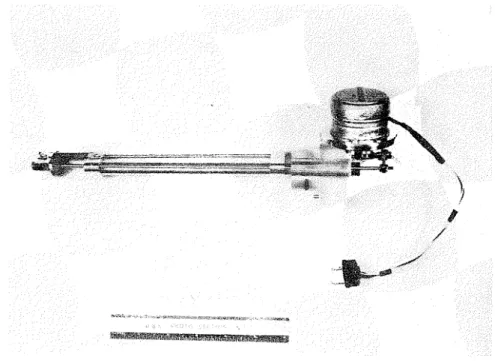
permit obsel-vation of t h e cracks by transmitted light. F u r t h e r modifications were made by t h e Division t o t h e bearings a n d rods of t h e flexing mechanism t o produce easier operation.T h e flexing mechanism is shown in Fig. 1. T h e Teflon plug approxi- mately 2 in. in diameter carries a central stainless steel tube a t t h e end of which is fixed t h e upper clamp f o r t h e t e s t plaque. T h e lower movable clamp is carried by twin stainless steel rods which pass through Teflon sleeve bearings in t h e upper clamp a n d in a brass bloclc mounted h i g h e r u p on t h e stainless steel tube. The rods a r e joined above t h e Teflon plug by a s t i r r u p t o which is fixed a rectangular frame. A Synchron motor with a spindle speed of 1 r p m is fitted with a circular eccentric cam whose c e n t r e is displaced 0.069 in. f r o m t h a t of the spindle. T h e cam t u r n s in t h e f r a n l e a n d causes a total separation of 0.138 in.
The plaques a r e made from Mylar polyester film 0.007 in. thiclc a n d a r e fixed to t h e top a n d bottom clamps by plugs passing through holes in t h e clamps, a n d by plates secured by single screws. A 3-degree t a p e r on t h e faces of t h e clamps i m p a r t s a slight outward curvature t o the plaque and ensures t h a t t h e plaques bend outwards when flexed. T h e plaques a r e j i g drilled t o ensure t h a t t h e holes in t h e plaques coincide with t h e pins on t h e clamps at n l a x i n ~ u m separation.
T h e temperature of t h e plaque is indicated and recorded by a copper- constantan thermocoul)le placed i n a glass well through t h e centre of t h e stainless steel tube such t h a t the thermocouple junction is located
at
t h e r e a r of t h e plaque. T h e o u t p u t of t h e thermocouple is recorded on a Leeds a n d N o r t h r u p single-point continuous recorder. T h i s facilitates determina- tion of t h e r a t e of tem1)erature drop by drawing a predetermined line upon t h e recorder c h a r t and manually controlling the r a t e of cooling to follow t h i s line.Preparation of Plaques
In t h e I n s t i t u t e of Petroleuln Specification I P 80/53 O . 4 O p . l g m of bitumen is applied t o a surface having a n a r e a of 1.27 sq. in. whereas Pickles uses a plaque having a n a r e a t o b e covered of 0.725 sq. in. If t h e 0.40 g m of bitunlen is applied to this 0.725 sq. in. in a uniform film, t h e resultant film thiclmess is 0.026 in. if a density of approximately 1.0 gm/cc is assumed f o r t h e bitumen. A s o t h e r studies upon asphalt under- taken by t h e Division use bituminous films 0.025 in. in thiclcness i t was decided t o use this value. T h e effect of film thiclcness upon t h e brittle
point will 1)c c!i:.cusscd l:~t.c!r. To prepare t h e coated plaques a hydraulic press method is used. Five plaques a r e prel)al.ed a t a t i l ~ i e ; tliesc it1.c lnasli- ed to present t h e specified urea f o r application of t h e bitumen. 'l'he bitunlen is heated in a glass heating mantel until i t is a t a pouring consistency. T h i s minimum pouring temperature i s held f o r about half a n hour t o remove a i r bubbles. T h e bitunlen is poured onto t h e plaques a n d covered with a n anti-sticlc sheet, consisting of e i t h e r Teflon-coated glass fabric or a n aluminum foil treated with silicone. T h i s arrangenlent is placed in a Carver Laboratory Press with heated platens. T h e platens a r e heated to about 2 5 ° F above t h e softening point of t h e bitumen. Spacers a r e used t o produce t h e thickness of 0.025 in. of bitumen, additional spacers being required t o account f o r t h e contraction of t h e b i t u ~ n i n o u s film a f t e r cooling t o room terriperature. A pressure of 10,000 lbs. i s applied f o r about 30
seconds t o cause t h e bitumen t o flow t o the desired thickness. A f t e r t h e samples have been cooled and trimmed thcy a r e stored in a room a t 77OF and 50 per cent relative humidity until tested.
Cooling
Pickles demonstrated t h a t direct liquid cooling was preferable t o using a i r a s t h e coolant. Two concentric vessels a r e used, t h e flexing mechanism being immersed in t h e coolant in the centre of these vessels. T h e coolant is methanol and t o reduce t h e slight solvent effect of pure methanol upon bitumens a mixture of 7 volumes of methanol and 3 volumes of water is used.
A stainless stccl liquid metel-ina pump was used t o circulate t h e coolant. T h e motor has a rating of 1/26 h.p. and is metered t o deliver 0.4 t o 26 ml per sec. T h e coolant is in a closed circuit including a coil immersed in a Dewar Vessel containing acetone and d r y ice and the vessel containing t h e flexing mechanism. I n t h e flexing chamber t h e coolant is s t i r r e d by a i r bubbling. The r a t e of cooling is predetermined on t h e recorder c h a r t and intermittent use of t h e pump ensures this steady rate.
Procedure
Following assembly of the apparatus flexing and c
t h e latter a t a r a t e of l.g°F per minute. Flexing and cooling a r e continued until the brittle point is reached. This is taken t o be a crack half-way across t h e plaque such t h a t i t is visible from both sides of the plaque.
A
plaque with a split across t h e entire surface is shown in Fig. 2. Initially 1 0 determinations of each brittle point were made b u t i t h a s been found t h a t 5 such determinations a r e sufficient. The plaques a r e cleaned w i t h toluene a f t e r use but i t is wise to discard t h e plaques a f t e r about 1 0 determinationsTest Conditions
est conditions were two built-up roof-
ing grade asphalts. T h e reproducibility under a s e t of specified conditions was studied by using a straight run 140°F softening point asphalt. Effects of film thicltness and r a t e of cooling were studied using a n oxidized 140°F softening point asphalt.
Rate of Cooling '
Using plaques coated with a film of asphalt 0.025 in. thick, values for t h e brittleness were obtained f o r cooling rates varying f r o m O.lg°F per minute t o 7.2OF per minute. T h e reported brittle point temperature is t h e arithmetic mean of five determinations. F i g u r e 3 shows t h a t t h e brittle point reaches a peak value a t a r a t e of about 1.8 to 2.7OF per minute.
Thickness of Bitumen
A series of plaques were prepared having various thicknesses of asphalt. Each s e t consisted of five plaques and series of 0.010, 0.015, 0.020, 0.025, 0.030 and 0.040 in. in thicltness were tested using a cooling r a t e of l.g°F per minute. Figure 4 shows t h e variation in t h e brittle point with film thickness, and i t would appear t o be fairly constant in t h e range of 0.015 t o 0.030 in. but large variations occur outside these limits.
Accuracy
A series of ten plaques of a 140°F softening point straight-run asphalt were tested using a thickness of 0.025 in. and a r a t e of cooling of l.g°F per minute. An average value of 20.3OF was obtained with a standard deviation of 1 . 3 O F .
Test Theory
The theory of the brittle fracture of bitumens by the F r ' s s
test
method has been studied by Rigden and Lee ( 3 ) and by Van der Poel (4). Rigden and Lee calculated stress-strain relationships in the test from an elastic theory of a bent beam. Van der Poel uses t h e breaking strength of the bitumen, but both conclude t h a t the test is a n equiviscous tempera- ture test corresponding to a viscosity of 4
X
100 poise or, expressed a s stiffness, 1.1X
100 dyne/cm2 (1.6X
104 psi). I t is thus feasible to report values directly as breaking temperature without f u r t h e r conversions ns has been done by other workers.Brittle Point of Asphalts and Tars
Seventeen bitumens were investigated to determine t h e brittle point temperature. The bitumens consisted of five 140°F softening point roofing asphalts, four 170°F softening point roofing asphalts, six 85/100 penetra- tion paving asphalts and two coal t a r roofing pitches. The bitumens and their brittle point temperatures are recorded in Table I.
The brittle point temperature was obtained as t h e mean of five deternlinations using plaques having a 0.025 in. thickness of film and tested using a rate of cooling of 1.8OF per minute.
From Table I i t can be seen t h a t the dead-level roofing asphalts vary from $20.3 to - 4 . g ° F , the 170°F softening point roofing asphalts from $11.0 to -0.4OF and the 85/100 penetration paving asphalts from +8.6 to -1.7"F. The coal t a r pitches are similar to each other in regard to the brittle point temperature, but are very different to t h e asphalts having values in the f 53°F.
Overheating
A preliminary study of t h e effects of bitumens overheating upon t h e low temperature properties has been made using several of the dead-level roofing asphalts and 170°F softening point roofing asphalts.
In this study the asphalts were heated to fusion and maintained in a
fluid state a t about 320°F until all bubbles were removed. A sample was talcen f o r softening point determinations and five plaques 0.025 in. each in thicltness were ]),repared. The asphalt was then raised in temperature to 500°F and maintained a t that temperature for one hour, another series of plaques was prepared and a softening point sample removed. The asphalt was then raised to G O O 0 F and maintained a t t h a t temperature f o r 1 hour and another set of plaques prepared, together with a softening point sample. Finally the asl~lialt was heated to green smolce and main- tained a t this condition for 1 5 minutes and again samples for brittle point and softening point determinations were removed. In each case the sample was cooled before preparing the brittle point plaques because a t too high a temperature the asphalt flows under t h e maslcing tape and uneven samples a r e obtained.
The softening point determinations were made in accordance with ASTM D36-25. Brittle point measurements were made using a cooling r a t e of 1.6"F per minute.
In Fig. 5 several of t h e asl)lialts a1.e sllown with the changes of soften- ing point after heating through the described cycle and plotted against t h e brittle point temperature.
Several points a r e demonstrated by this experiment. A definite relationship is shown to exist between softening point and brittle point f o r a particular asl)lialt. This is to be expected as each are equiviscous temperatures. The brittle point increases with an increase in softening point due to overheating. I t is also apparent that moderate overheating does not have
a
very marlted effect upon the brittle point of the asphalt a s measured in this test. One hour of heating a t 500°F has only a slight effect upon t h e brittle point of the asphalts. Values of t h e brittle pointtemperature a r e increased by 4 t o 5 ° F although t h e s t r a i g h t r u n material actually sllowed a slight apparent decrease of 0.9"F. The decrease, how- ever, is within t h e standard deviation of 1.3OF. Heating a t 500°F f o r one hour followed by one hour of heating a t G O O 0 F h a s a marlted effect upon t h e brittle point (and consequently tlie softening point), but t h e values a r e still sufficiently low to cause a reasonable degree of flexibility.
A
subsequent heating to green smoke f o r 15 minutes, however, is sufficient t o destroy t h e desirable properties of tlie asphalt and in most cases t h e samples break a t room temperature. The tenil,erature of green smoke was about G50°F f o r tile samples tested. A notable exception to tliese changes was t h e straight-run asl~lialt. This had a liigli initial brittle point but changed very little in this clial-acteristic a s tlie sample was over- Iieatcd.
The 85/100 penetrating paving asphalts show a significant difference between their brittle point tenlperatures. No ove~.heating e x p e r i i ~ ~ e n t s have been performed with these samples and considerable f u r t h e r experi- mental work is necessary before t h e brittle point t e n ~ p e r a t u r e could be
a
specified parameter in tlie design of paving asphalts.There is a wide difference between roofing grade asphalts a n d coal-L?r roofing pitch with respect t o t h e brittle point t e s t in measuring t h e equiviscous temperature of 4
X
10:' poise. The significance of t h e difference should also require additional experinlental work.Self-healing
I n t h e accumulation of information on the brittle point t e s t i t was accidentally demonstrated t h a t t h e teclinique can be used t o measure the self-healing qualities of tlie bitumens. Only two samples have been tested.
A
coal-tar pitch sample had a brittle point of 55.B°F. A t t h e conclusion of t h e t e s t tlie sample was allowed t o remain at 77OF f o r 3 h o u r s a f t e r which time i t was again tested and gave a n identical value f o r t h e brittle point tenlperature. A similar type of result was obtained f r o m a dead- level rooting asplialt having a brittle point ternl~erature of 9.3OF; a f t e r remaining a t 77OF f o r about 4 hours a value of 12.0°F was ohtaineCONCLUSION
The brittle point tempel.ature provides a useful test f o r t h e study of t h e low temperature charactel-istics of asphalts. I n tlie described procedure a satisfactory method has been developed t o obtain reliable a n d repro- ducible results. The actual value is dependent upon t h e r a t e of cooling and t o a lesser extent upon t h e thicltness of material. M e a s u r e n ~ e n t s of t h e brittle point temperature of nine roofing asphalts show considerable variation in t h e value ranging f r o m 4-21.2 to ----4.O0F. A series of six 85/100 penetration paving asphalts showed smaller variations f r o m +8.0 to -1.7OF. Two coal-tar roofing pitclies had values in the order +53.G°F wliich is considerably higher t h a n results obtained f o r asphalts. T h e brittle point temperature is a n equiviscous t e n ~ p e r a t u r e (4
X lo!) poise). Studies
of t h e effect of overheating upon roofing asphalts show t h a t all of t h e asphalts can undergo moderate overheating (one hour a t 500°F) with little change in t h e brittle point temperature, b u t lose flexibility a f t e r prolonged overheating. Heating a t green sinolte even f o r a short. time causes severe changes in the essential properties of asphalts. The t e s t should be of considerable help in assessing t h e low t e n ~ p e r a t u r e properties of t a r s a n d asphalts and in studying t h e effects of overheating a n d weather- ing upon these properties and a s a measure of self-healing.ACKNOWLEDGMENTS
T h e author is grateful f o r the assistance given by Mr. G. Quenneville in performing t h e experimental portion of this paper. This paper is a
contribution from t h e Division of Building Research, National Research Council, and is published with t h e approval of tlie Director of t h e Division.
REFERENCES
1. Institute of Petroleum Specification I P 80/53, Standard methods f o r testing petro- leum nnd i t s products.
2. Pickles, S. A n improved brittle point test f o r tars. Journal of Applied Chemistry, Vol. 9. A ~ r i l . 1959. . P. - 219-223.
3. Rigden, P. J., a n d A. R. Lee. T h e Brittle fracture of t a r s nnd bitumens. Journal of Applied Chemistry, Vol. 3, 1953, p. 62-70.
4. Van dcr Poel, C. A general system describing t l ~ c visco-elastic properties of bitumens and it8 relation to routine test data. Journal of Applied Chemistry, Vol. 4, 1954, p. 221-236.
TABLE
I
BRITTEE POINT TEMPERATURES O F BITUMENS
No.
Description Brittle Point0 l 3
I'
1 140°F
S.
Pt."
B.U.R. Oxidized Asphalt (mid Saslc.) +5.2 2 140°F S.Pt.
B.U.R. Straight-Run Asphalt (south Sask.) +20.3 3 140°F S.Pt.
B.U.R. Oxidized Asphalt (Venezuelan) -0.94 140°F S.
Pt.
B,U.R. Oxidized Asphalt (Pcmbina) -4.95 140°F S.
Pt.
B.U.R. Oxidized Asphalt (Lloydminster) +10.4 6 170°F S.Pt.
Oxidized Roofing Asphalt (mid Sask.) +l4.0 7 170°F S.Pt.
Oxidized Roofing Asphalt (Venezuelan) -0.98 170°F S.
Pt.
Oxidized Roofing Asphalt (Peinbina) +8.69 170°F S.
Pt.
Oxidized Roofing Asphalt (Lloydminster) 4-5.510 85/100 Penetration Paving Asphalt (Venezuelan) f l . 0
11 85/100 Penetration Paving Asphalt (Lloydminster) f0.5
12 85/100 Penetration Paving Asphalt (Pembina) f8.6
1 3 85/100 Penetration Paving i?spllalt (Snsk. Weyburn) f0.3
14 85/100 Penetration Paving Asphalt (south Sask.) +3.2
15 85/100 Penetration Paving Asphalt Experimental -1 7
16 Coal-Tar Pitch #1 +54.3
17 Coal-Tar Pitch #2 +50.9
Figure 1 The brittle point unit
Figure
2
Brittle point
apparatus in
FIGURE 3
EFFECT OF COOLING RATE. UPON BRITTLE POINT OF ASPHALT
THICKNESS OF ASPHALT FILM, INCHES
FIGURE 4
/
140 'F S. SASH. # 2 STRAIGHT RUN I I I I I II
140 150 160 170 180 190 ZOO SOFTENING POINT, 'F FIGURE 5SOFTENING POINT