HAL Id: hal-03007123
https://hal.archives-ouvertes.fr/hal-03007123
Submitted on 16 Nov 2020
HAL is a multi-disciplinary open access
archive for the deposit and dissemination of sci-entific research documents, whether they are pub-lished or not. The documents may come from teaching and research institutions in France or abroad, or from public or private research centers.
L’archive ouverte pluridisciplinaire HAL, est destinée au dépôt et à la diffusion de documents scientifiques de niveau recherche, publiés ou non, émanant des établissements d’enseignement et de recherche français ou étrangers, des laboratoires publics ou privés.
over multiple generations of exposure
C. Cornwall, S. Comeau, Q. D’alexis, T. Decarlo, E. Larcombe, K. Giltrow, B.
Moore, F. Puerzer, M. Mcculloch
To cite this version:
C. Cornwall, S. Comeau, Q. D’alexis, T. Decarlo, E. Larcombe, et al.. A coralline alga gains toler-ance to ocean acidification over multiple generations of exposure. Nature Climate Change, Nature Publishing Group, 2020, 10 (2), pp.143-146. �10.1038/s41558-019-0681-8�. �hal-03007123�
A coralline alga gains tolerance to ocean acidification over multiple generations of exposure
1
C. E. Cornwall1,2,3,*†, S. Comeau1,2,4,†, T. M. DeCarlo1,2, E. Larcombe1, B. Moore1, K.
2
Giltrow1,F. Puerzer1, Q. D’Alexis1, M. T. McCulloch1,2
3
1Oceans Institute and Oceans Graduate School, The University of Western Australia, 35
4
Stirling Hwy, Crawley 6009, Australia.
5
2ARC Centre of Excellence for Coral Reef Studies, The University of Western Australia, 35
6
Stirling Hwy, Crawley 6009, Australia.
7
3School of Biological Sciences, Victoria University of Wellington, Wellington, New Zealand
8
4Sorbonne Université, CNRS-INSU, Laboratoire d’Océanographie de Villefranche, 181
9
chemin du Lazaret, F–06230 Villefranche-sur-mer, France
10
*For correspondence email: [email protected]
11
†These authors contributed equally
12
Crustose coralline algae (CCA) play a crucial role in the building of reefs in the photic zones
14
of nearshore ecosystems globally and are highly susceptible to ocean acidification1-3. Yet the
15
extent to which CCA can gain tolerance to ocean acidification over multiple generations of
16
exposure is unknown. We show that while calcification of juvenile CCA is initially highly
17
sensitive to ocean acidification, after 6 generations of exposure the effects of ocean
18
acidification disappears. A reciprocal transplant experiment conducted on the 7th generation
19
where half of all replicates were interchanged across treatments confirmed that they had
20
acquired tolerance to low pH and not simply to laboratory conditions. Neither exposure to
21
greater pH variability, nor chemical conditions within the micro-scale calcifying fluid
22
internally, appeared to play a role in fostering this capacity. Our results demonstrate that
reef-23
accreting taxa can gain tolerance to ocean acidification over multiple generations of
24
exposure, suggesting that this cosmopolitan species could maintain its critical ecological role
25
in reef-formation.
26 27
Introduction:
28
A growing body of evidence suggests ocean acidification will greatly reduce the capacity of
29
major reef-forming species to continue calcifying and hence to accrete the calcium carbonate
30
building blocks of reefs2. CCA are ecologically important calcareous red macroalgae that
31
help create and cement reefs from the tropics to the poles and provide a settlement substrate
32
for marine invertebrate larvae such as corals, abalones and sea urchins. Coralline algae
33
precipitate high magnesium calcite, one of the most soluble forms of calcium carbonate, and
34
are therefore expected to be highly susceptible to increased dissolution rates under ocean
35
acidification4. Juvenile coralline algae are at particular risk, with extremely reduced
36
abundance under ocean acidification5,6. Ocean acidification decreases both linear extension
37
and calcification (hereafter termed growth) of CCA by altering the calcifying fluid chemistry
38
of adult CCA to become less favorable for precipitation of calcium carbonate7-9. Adult
39
coralline algae that are most resistant to ocean acidification tend to be those that can alter
40
their mineralogy10 or resist changes to their calcifying fluid7-9.
41
It is currently unknown whether benthic calcifying organisms gain tolerance to ocean
42
acidification after exposure for multiple generations. Our understanding of these processes in
43
marine species is limited to either evolutionary responses of short-lived, non-reef-building
44
species such as phytoplankton and non-calcareous polychaete worms over multiple (five to
45
hundreds) generations11-13, or acclimatization responses of longer-lived species over 1 or 2
46
generations14,15. Most reef-forming species have slower growth rates and generation times
47
than microalgae, which has limited our ability to test whether they can gain tolerance to
48
ocean acidification. However, some tropical reef-building and cementing CCA grow
49
extremely fast to colonize available space after disturbance16, occupying a broad range of
50
habitats that requires high phenotypic plasticity17. Some CCA also reproduce sexually or
51
asexually within weeks of settlement, even while still microscopic18. These traits make CCA
52
valuable model organisms to test whether reef-accreting calcifying species can potentially
53
gain tolerance to ocean acidification over multiple generations of exposure.
54
In many shallow-water reef environments, night-time declines in pH due to local
55
metabolic activity often exceed the changes in open-ocean pH predicted to occur by 2100
56
under business-as-usual CO2 emissions scenarios (e.g. Representative Concentration Pathway
57
8.5, 0.4 pH units)7,20,21. It has been proposed that this natural diurnal variability may impart
58
tolerance to low pH for resident calcifying species via selection for individuals that are better
59
adapted to survive in these envrionments20,22. Additionally, transgenerational acclimation can
60
occur via a variety of epigenetic or maternal effects after exposure of subsequent generations
to stressors14,23, and could be promoted by prior exposure of individuals to greater variability
62
in that stressor24.
63
We investigate whether the cosmopolitan reef-accreting and cementing species
64
Hydrolithon reinboldii (synonymous with Hydrolithon boergesenii) can increase its tolerance
65
to ocean acidification after multiple generations of exposure via mineralogical changes in
66
skeletal formation or conversely the ability to resist seawater induced chemical changes to
67
their calcifying fluid. We also test whether this tolerance can be gained faster in individuals
68
with prior or regular exposure to low pH. We grew CCA for 8 generations under present-day
69
(pH 8.00) and future ocean acidification treatments (pH 7.70), with both high (± 0.37) and
70
low (± 0.07) pH variability, using populations from sites with either naturally low or high pH
71
variability (see materials and methods and Table S1) and tracked complex changes in their
72
calcification mechanisms. For the first time, we demonstrate that a species of coralline algae
73
can gain tolerance to ocean acidification after 6 generations of exposure, but neither exposure
74
to greater pH variability, nor changes in their calcification physiology related to mineralogy
75
or chemistry in the calcifying fluid influence this capacity.
76 77
Changes in sensitivity to ocean acidification
78
The resistance of juvenile CCA to ocean acidification increased incrementally over
79
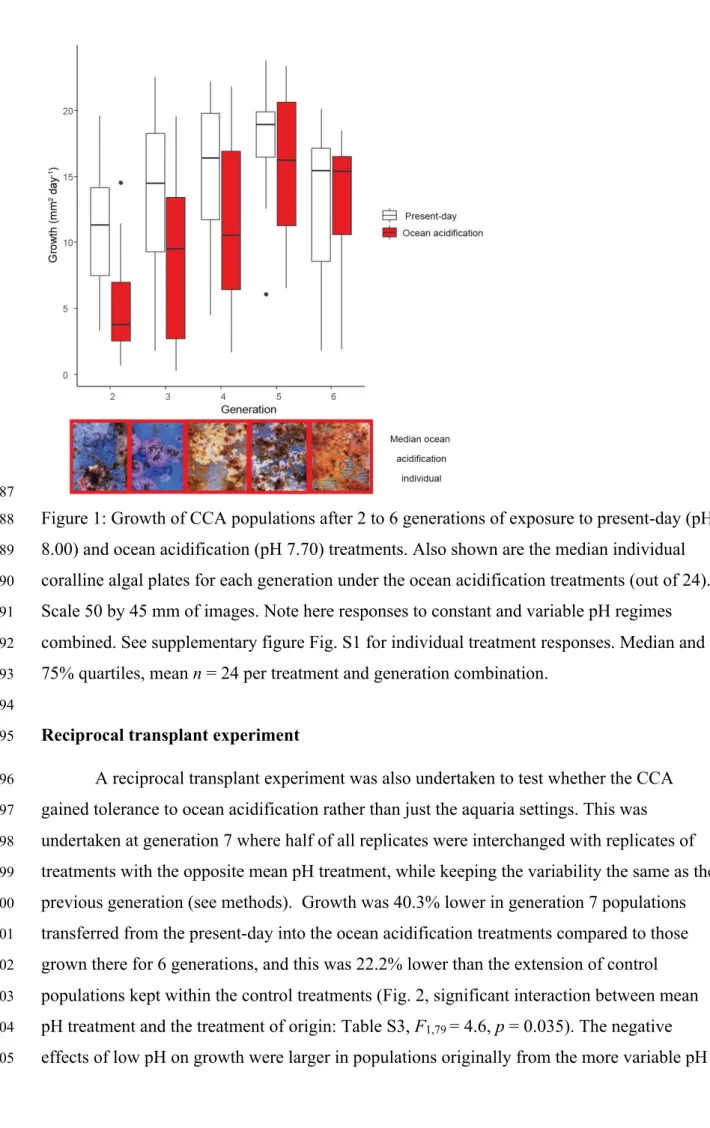
each generation during this 423-day experiment. Second generation CCA grew 56.1% slower
80
across all ocean acidification treatments relative to the present-day treatments (Fig. 1). This
81
sensitivity to lower mean pH declined over subsequent generations to 33.1, 29.7, 12.8, and
82
2.0% between generation 2 to 6, supported by the significant interaction between mean pH
83
and generation in the general linear model (Table S2, F1,224 = 8.60, p = 0.004). The difference
84
further decreased to 0.6% when compared to the generation 7 populations kept in their
85
original treatments (Fig. 2).
87
Figure 1: Growth of CCA populations after 2 to 6 generations of exposure to present-day (pH
88
8.00) and ocean acidification (pH 7.70) treatments. Also shown are the median individual
89
coralline algal plates for each generation under the ocean acidification treatments (out of 24).
90
Scale 50 by 45 mm of images. Note here responses to constant and variable pH regimes
91
combined. See supplementary figure Fig. S1 for individual treatment responses. Median and
92
75% quartiles, mean n = 24 per treatment and generation combination.
93 94
Reciprocal transplant experiment
95
A reciprocal transplant experiment was also undertaken to test whether the CCA
96
gained tolerance to ocean acidification rather than just the aquaria settings. This was
97
undertaken at generation 7 where half of all replicates were interchanged with replicates of
98
treatments with the opposite mean pH treatment, while keeping the variability the same as the
99
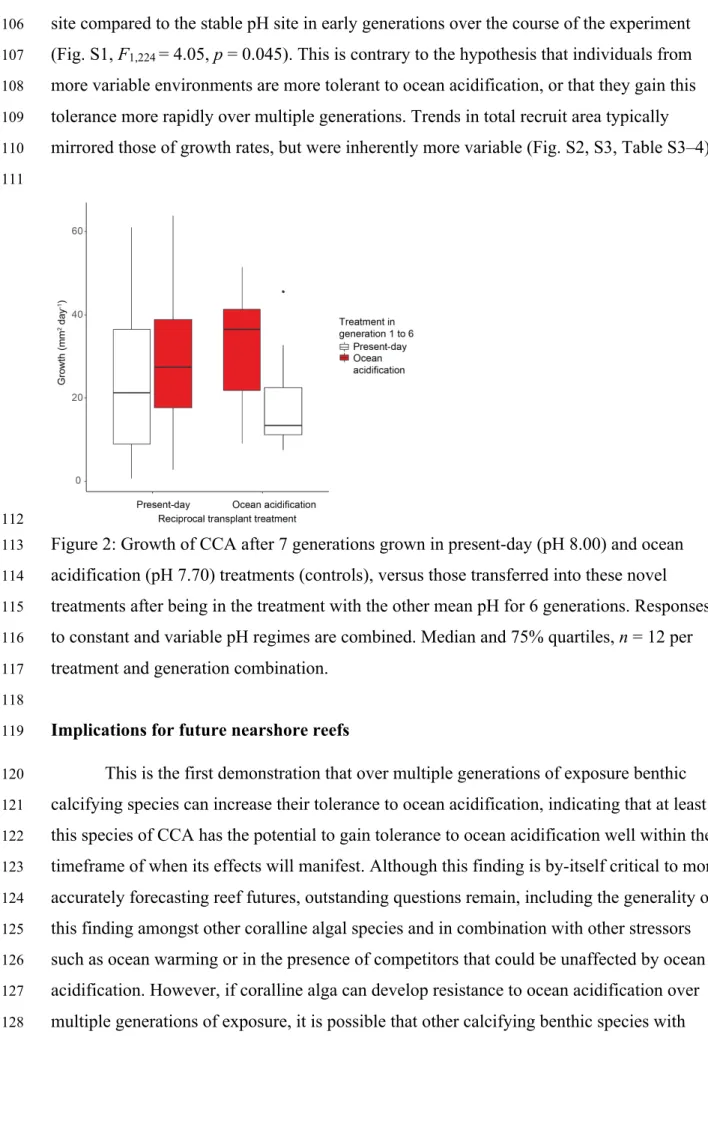
previous generation (see methods). Growth was 40.3% lower in generation 7 populations
100
transferred from the present-day into the ocean acidification treatments compared to those
101
grown there for 6 generations, and this was 22.2% lower than the extension of control
102
populations kept within the control treatments (Fig. 2, significant interaction between mean
103
pH treatment and the treatment of origin: Table S3, F1,79 = 4.6, p = 0.035). The negative
104
effects of low pH on growth were larger in populations originally from the more variable pH
site compared to the stable pH site in early generations over the course of the experiment
106
(Fig. S1, F1,224 = 4.05, p = 0.045). This is contrary to the hypothesis that individuals from
107
more variable environments are more tolerant to ocean acidification, or that they gain this
108
tolerance more rapidly over multiple generations. Trends in total recruit area typically
109
mirrored those of growth rates, but were inherently more variable (Fig. S2, S3, Table S3–4).
110 111
112
Figure 2: Growth of CCA after 7 generations grown in present-day (pH 8.00) and ocean
113
acidification (pH 7.70) treatments (controls), versus those transferred into these novel
114
treatments after being in the treatment with the other mean pH for 6 generations. Responses
115
to constant and variable pH regimes are combined. Median and 75% quartiles, n = 12 per
116
treatment and generation combination.
117 118
Implications for future nearshore reefs
119
This is the first demonstration that over multiple generations of exposure benthic
120
calcifying species can increase their tolerance to ocean acidification, indicating that at least
121
this species of CCA has the potential to gain tolerance to ocean acidification well within the
122
timeframe of when its effects will manifest. Although this finding is by-itself critical to more
123
accurately forecasting reef futures, outstanding questions remain, including the generality of
124
this finding amongst other coralline algal species and in combination with other stressors
125
such as ocean warming or in the presence of competitors that could be unaffected by ocean
126
acidification. However, if coralline alga can develop resistance to ocean acidification over
127
multiple generations of exposure, it is possible that other calcifying benthic species with
similar calcification mechanisms9 could have the same capability. This information is crucial
129
for coral reefs, for example, where many coral species are long-lived and experimentally
130
testing their capacity to gain tolerance over multiple generations is logistically challenging,
131
requiring years or decades of exposure to ocean acidification in controlled laboratory settings.
132 133
Evolutionary and physiological mechanisms promoting tolerance
134
The diminishing effect of ocean acidification on growth over each subsequent
135
generation supports the premise that successive cohorts of CCA are subject to strong
136
selection for resistance to ocean acidification, or that transgenerational acclimation occurred
137
on individuals within each tank. We did not aim to determine the underlying evolutionary
138
processes that could alter tolerance to ocean acidification. Previous research indicates that
139
species can gain complete tolerance after a full generation of exposure to climate change
140
stressors14. Our evidence indicates slower, more incremental increases in tolerance to climate
141
change stressors could also occur in select taxa in the future. However, the trends observed
142
here were also rapid in the context of evolutionary adaption. The rapid (less than two years),
143
yet incremental, nature of these changes, and the predominately asexual reproduction,
144
indicate that transgenerational acclimatory processes could have played a large role in
145
inducing the changes observed. However, the effects of ocean acidification were particularly
146
strong on the recruitment of the first generations of CCA, and because selective pressure is a
147
combination of the effect size of the stressor selected against and the heritability of the trait,
148
we cannot rule out that selection for individuals better able to calcify under these treatments
149
occurred. While not our aim here, the next step is to further understand the contributions of
150
genetic versus epigenetic processes that contribute to changing tolerance under climate
151
change in reef-building and accreting species.
152
Regardless of the eco-evolutionary processes involved, exposure to greater variability
153
in pH did not foster the capacity to gain tolerance to ocean acidification faster24. This is
154
surprising given that organisms from these habitats tend to respond more positively to ocean
155
acidification22,25, and that phenotypic or transgenerational plasticity is predicted to be higher
156
on these populations17,24. Therefore, transplanting organisms from highly variable pH
157
environments into habitats with constant pH regimes, as has been suggested regarding ocean
158
warming and temperature variability26, might not be a successful strategy to combat against
159
ocean acidification. The CCA also did not alter their calcifying fluid toward conditions
traditionally considered favorable for precipitation8. Hence, physiological mechanisms that
161
allow for tolerance in adult CCA could have no bearing on their persistence in future reefs.
162
The physiological mechanisms responsible for reduced sensitivity under the ocean
163
acidification treatments are complex. Raman spectroscopy analyses indicated that changes in
164
the mineralogy from high magnesium calcite into less readily dissolved polymorphs such as
165
dolomite did not occur here (Table S5, Figure 3). Similarly, neither δ11B (pH
cf proxy) or
166
Raman full width at half maximum (FWHM: proxy of the calcite saturation state in the
167
calcifying fluid [Ωcf] when precipitation occurs) were elevated in individuals kept for 8
168
generations under mean low pH compared to generation 2 individuals (Table S6, S7, Figure
169
3). In fact, both δ11B and FWHM decreased between generations 1, 2 and then the
170
experimental endpoint, and they tended to be lower in ocean acidification treatments
171
generally. The physiological ability to maintain elevated pHcf or Ωcf under low pH in adult
172
coralline algae and corals are traits related to resistance to ocean acidification, and we
173
hypothesized a priori that any CCA here that gained resistance to ocean acidification would
174
have done so via improving these traits. However, changes in these calcification-related
175
parameters (δ11B, FWHM, Mg) do not match changes in growth rates over successive
176
generations under ocean acidification. The inverse relationship between FWHM and growth
177
throughout the course of the experiment (Figure S5), together with lack of changes in other
178
geochemical parameters, indicates that CCA tolerant to ocean acidification here were those
179
which could calcify when carbonate chemistry is suboptimal for precipitation within the
180
calcifying fluid, when compared to that of adults or controls. This is likely caused by both the
181
rapid use of calcium and carbonate during calcification in the semi-enclosed space28, and
182
declining pHcf via ocean acidification 8. Additionally, traits such as increasing organic matrix
183
proteins involved in calcification29 could also contribute to trends observed here.
184
Figure 3: a) δ11B (proxy for pH in the calcifying fluid), b) FWHM (proxy for calcite
186
saturation state in the calcifying fluid), c) and Mg content of CCA over 6 generations under
187
present-day or ocean acidification treatments. Median and 75% quartiles, mean n = 24 per
188
treatment and generation combination.
189 190
Conclusions
191
These results highlight that we cannot predict which species will be winners or losers
192
under climate change based solely on their responses to short-term exposure to acute
193
stressors. We demonstrate for the first time that some coralline algae are capable of rapidly
194
gaining tolerance to ocean acidification over six generations. If this capacity is present in
195
other select species of coralline algae, then as a group they could be the largest contributors
196
to global reef accretion in future oceans, given their already high abundance in temperate
197
nearshore reefs, tolerance to ocean warming30, and the recent large-scale declines in the
198
abundance of the longer-lived tropical scleractinian corals 31.
199 200
Methods
201
Collection and treatment design
202
We collected adult coralline algae, Hydrolithon reinboldii (synonymous with boergesenii 32),
203
rhodoliths from Western Australia’s northern Kimberley locations of Tallon (16°40S,
204
123°14E) and Shell Islands (16°48S, 123°04E) in October 2016. These two sites are
205
characterised by similar thermal regimes, but different pH regimes. Tallon Island is a
206
seaweed and seagrass dominated reef with strong diel pH variability (up to 1.06 units daily).
207
Shell Island is dominated by Acropora spp. corals and experiences a low range in pH
208
variability (typically < 0.10 units daily). This species was chosen because it is the most
209
common species at both sites, and because it was the only species that lives at both sites that
210
can be identified using morpho-anatomical methods, hence retaining intact and undamaged
211
individuals that would not occur if molecular sequencing was required prior to the
212
experiment starting. This species is common in the Indo-Pacific region33, and was identified
213
with assistance by staff at the Western Australian Museum. Samples are lodged both at
214
Victoria University of Wellington and the University of Western Australia. The collection,
215
environmental variables at the collection sites, and experimental design and monitoring are
216
described in detail within the initial segment of the research on the adults in Cornwall et al.7.
217
Briefly, we created 4 treatments, within which each of the two source population were
218
placed: 1) control means (8.00) and low pH variability (daily range of 0.14), or 2) high pH
variability (0.58 daily range); 3) ocean acidification means (7.70) and low pH variability
220
(0.20 range daily), or 4) high pH variability (0.89 daily range). See Table S1 for full details,
221
or Figure 1 from Cornwall et al.7 for schematic of details. There were 6 independent
222
experimental tanks per treatment combination per population, for a total of 48 experimental
223
tanks per generation. This allows us to determine the interactive effects of changes in both
224
mean and variability in pH. As recommended by all best practices guides34-37, we used CO 2
225
gas to lower pH/elevate CO2 concentrations, and CO2-free air to increase pH/lower CO2.
226
Seawater was pumped from an area of soft-sediment bottom 100m offshore at Watermans
227
Bay, Perth, then filtered to 25 µm using a series of sand filters, and then subsequently ran into
228
a header tank where pH conditions were modified before moving into each experimental
229
tank. There were 3 header tanks per treatment. Temperature was maintained in a series of
230
waterbaths at 26 to 27 °C, 4°C warmer than the summer maximum outside of our
231
experimental facility. No recruitment of coralline algae occurred within this header tank,
232
allowing us to be certain that coralline algal recruits throughout our experiment where not
233
sourced from local populations. This temperature (26 to 27 °C) roughly matches that of the
234
collections site in the Kimberley region in Winter38 or is slightly higher, and was chosen to
235
limit the stress that the CCA here would be exposed to. We chose to hold temperature
236
constant during the duration of the experiment to avoid any confounding effects of
237
temperature variations between generations.
238 239
Multigenerational experiment
240
On collection, only healthy adult coralline algae were selected that possessed extensive
241
numbers of conceptacles (i.e. reproductive structures where spores are formed). On day 0 (i.e.
242
the collection date), adult coralline algae were extensively cleaned of epiphytes and scrubbed
243
to limit carry-over of other coralline algal spores from the field into the experimental set up.
244
On day 78, coralline algal recruits were visible and on day 128 the adults were removed and
245
the process of creating the generation 3 and subsequent generations began. This involved
246
cutting out two 4.5 by 5 cm (L × W) sections of the tank containing the highest cover of
247
coralline algae recruits and placing these into completely new tanks, attached vertically (Fig.
248
S7). Four of the generation 2 ocean acidification (both high and low variability) replicate
249
tanks contained no visible recruits. For these tanks, populations from different tanks were
250
used to create the third and subsequent generations. Therefore, we used 44 distinct
251
populations of CCA to source the subsequent generations. We repeated this process once
252
CCA recruits in the control treatment obtained the same estimated size as the 2nd generation,
roughly every 41 to 51 days. Once visible, CCA grew rapidly, approaching 1 cm diameter per
254
week. The CCA on plates would then develop conceptacles and release spores which disperse
255
into the water column around 2 weeks after being placed into brand new experimental tanks
256
not previously used. A standardised size was used rather than a standardised time because of
257
slight seasonal differences in the duration required to reproduce during each generation. This
258
was process was continued until generation 7. This resulted in using 336 separate
259
experimental tanks (7 ×48) throughout the course of this study.
260
We acknowledge that it is possible that reproduction could be occurring in recruits even when
261
microscopic (e.g.18), so in theory each generation could possibly be comprised of small
262
amounts of differing generations. This would result in the number of generations here being
263
more than the 8 recorded. However, we consider that extremely unlikely. This is because the
264
experimental tanks were monitored daily, and we did not observe more rapid recruitment than
265
would be expected if the recruits were reproducing before they became visible (i.e. weeks), or
266
if time to reproductive maturity was variable, as recruits became visible in all tanks within the
267
same weekly time frame when recruitment occurred. This consistent time to visible
268
recruitment also means it was highly unlikely that recruitment occurred in generation 2 from
269
spores of other species carried-over from the field. All coralline algal recruits possessed
270
similar morphoanatomical features, including similarly sized and shaped conceptacles that
271
aligned with the adults’ identification39. Thousands of conceptacles were produced in each
272
generation, and all that we analyzed contained multiple spores indicating that they were
273
asexually reproducing40. Damaged conceptacles were not analyzed. In other words, the algae
274
were asexually reproducing which is most common in coralline algae41, especially for this
275
species for which only these life history stages have been noted39. The probability of skipping
276
sexual reproduction in many species has previously been suggested41. A proportion of
277
conceptacles were not fully formed at the end of each generation or their contents were
278
already emptied or they were damaged, for these we cannot fully confirm the life stage or
279
nature of reproduction.
280
We measured the linear extension of CCA on the created replicate plates using images
281
taken every two weeks and analysed in ImageJ. This step involved analyzing 2496 images.
282
We also assessed the total cover of recruits at the end of every generation. The trends in total
283
area occupied by coralline algae in the tanks, and the growth on monitored plates were
284
similar. However, it became apparent that the total area of recruitment was affected by both
285
the treatment effect (mean pH) on growth and random variability in the number of recruits.
286
Therefore, we used the change in total area of the individuals of created plates as the focal
measurement of interest, as it contained one response variable and not two (i.e. growth and
288
recruitment success). See supplementary Figure 2 for these data, which follow similar trends
289
but are inherently more variable. This step involved analyzing 1440 images. A random
290
selection of more than 10% of all images were analyzed twice to check for consistency
291
between multiple assessors.
292 293 294 295
Reciprocal transplant experiment
296
The process of exposing subsequent generations to their original treatment was continued in
297
the 48 populations until generation 7, whereupon we conducted a reciprocal transplant to
298
determine whether improved growth in ocean acidification treatments over time were
299
representative of altered response to the treatments themselves, or an interaction between lab
300
effects and altered response to treatments23. We exchanged half of the ocean acidification
301
replicates with half of the ambient replicates within the same variability treatments, i.e. pH
302
7.70 low pH variability replicates interchanged with pH 8.00 low pH variability replicates
303
and vice versa. We did this because of the observed changing effects of mean pH over
304
subsequent generations and lack of effects of pH variability. Therefore, we were not
305
interested in the effects of switching individuals’ treatments with differences in pH
306
variability, only in how switching them between different mean pH treatments would
307
influence fitness. When we create the additional novel or original treatments (i.e.
308
“transferred” into novel treatments or placed in the same treatment as “controls”) we have 16
309
different treatment combinations. We assessed growth over the first 2 weeks after transferring
310
the generation 7 individuals into novel and control treatments, before they became limited for
311
further space. We also measured total recruitment of their offspring after 61 days. We
312
removed all standardised coralline algal plates from their tanks for the same length of time
313
irrespective of whether they were transferred into a new treatment or placed into a control
314 treatment. 315 316 Measurement metrics 317
We also measured proxies to aid in understanding changes in calcification physiology of the
318
coralline algae at the completion of the experiment. δ11B, a proxy for pH at the site of
319
calcification, was measured on generations 1, 2, 6, 7 and 8 to determine trends over
320
generations and due to treatments using previously published methods7-9, with the only
difference being bleaching durations of 3 times as long. We also measured Raman
322
spectroscopy on every generation as a proxy of the saturation state of calcium carbonate
323
(based on n1 Full Width at Half Maximum; FWHM) and magnesium content (based on n1
324
wavenumber), following previously described protocols7,9.
325 326 327 328 Statistical analysis 329
We used general linear models in R to determine differences in growth, recruit area, and
330
geochemical proxies across all available generations assessing the full interaction between
331
mean pH (control or ocean acidification), pH variability (low or high), generations (2, 3, 4, 5,
332
6), and site of origin (Shell or Tallon). Waterbath was used a random factor in models to
333
account for this potential source of variability. For generations 7 and 8, we used the same
334
model structure, except the generation factor was replaced with the transfer (novel treatment
335
or original control treatment) treatment and each generation was assessed separately, and
336
waterbath was removed from the model. We used a log-fit mixed model for recruit area of
337
generations 2 to 7, due to non-normally distributed data.
338 339
Data availability
340
Data is available at dryad: https://doi.org/10.5061/dryad.pzgmsbcfq.
341 342
Code availability
343
All R code will be available upon request.
344 345
Acknowledgments
346
We thank A.-M. Nisumaa-Comeau and J.P. D'Olivo for laboratory assistance. V. Schoepf and
347
S. McCoy for comments on a previous version. R. Townsend from the Western Australian
348
Museum for training in species’ identification. Funding: MTM was supported by an
349
Australian Research Council (ARC) Laureate Fellowship. CEC, TMD and CEC by the ARC
350
Centre of Excellence for Coral Reef Studies (CE140100020). SC was supported by an ARC
351
Discovery Early Career Researcher Award (DE160100668). CEC was also supported by a
352
Rutherford Discovery Fellowship from The Royal Society of New Zealand Te Apārangi
353
(RDF-VUW1701).
355
Author contributions
356
CEC and SC conceived and ran the experiment and wrote the manuscript. CEC ran the
357
statistical analysis and conducted the boron isotope measurements. MTM conceived the
358
experiment, provided vital laboratory equipment, facilities and resources. TMD conducted
359
the Raman spectroscopy. EL, BM, KG, FP, and QD all ran the experiment and measured
360
seawater carbonate chemistry. All authors edited the manuscript, provided intellectual input,
361
and agreed to its submission.
362 363
Conflicting interests
364
We have no conflicts of interest.
365 366
References:
367
1 Nelson, W. A. Calcified macroalgae - critical to coastal ecosystems and vulnerable to
368
change: A review. Marine and Freshwater Research 60, 787-801 (2009).
369
2 Kroeker, K. J. et al. Impacts of ocean acidification on marine organisms: quantifying
370
sensitivities and interaction with warming. Global Change Biology 19, 1884-1896
371
(2013).
372
3 Heyward, A. & Negri, A. Natural inducers for coral larval metamorphosis. Coral
373
Reefs 18, 273-279 (1999).
374
4 Ries, J. B. Skeletal mineralogy in a high-CO2 world. Journal of Experimental Marine
375
Biology and Ecology 403, 54-64 (2011).
376
5 Fabricius, K., Kluibenschedl, A., Harrington, L., Noonan, S. & De'Ath, G. In situ
377
changes of tropical crustose coralline algae along carbon dioxide gradients. Scientific
378
reports 5, 9537, doi:10.1038/srep09537 (2015).
379
6 Ordoñez, A., Kennedy, E. V. & Diaz-Pulido, G. Reduced spore germination explains
380
sensitivity of reef-building algae to climate change stressors. PLOS ONE 12,
381
e0189122, doi:10.1371/journal.pone.0189122 (2017).
382
7 Cornwall, C. E. et al. Resistance of corals and coralline algae to ocean acidification:
383
physiological control of calcification under natural pH variability. Proceedings of the
384
Royal Society B: Biological Sciences 285, doi:10.1098/rspb.2018.1168 (2018).
385
8 Cornwall, C. E., Comeau, S. & McCulloch, M. T. Coralline algae elevate pH at the
386
site of calcification under ocean acidification. Global Change Biology 23, 4245-4256
387
(2017).
388
9 Comeau, S., Cornwall, C. E., DeCarlo, T. M., Krieger, E. & McCulloch, M. T.
389
Similar controls on calcification under ocean acidification across unrelated coral reef
390
taxa. Global Change Biology 24, 4857-4868, doi:10.1111/gcb.14379 (2018).
391
10 Nash, M. C. et al. Dolomite-rich coralline algae in reefs resist dissoltuion in acidified
392
conditions. Nature Climate Change 3, 268-272 (2013).
393
11 Lohbeck, K. T., Riebesell, U. & Reusch, T. B. H. Adaptive evolution of a key
394
phytoplankton species to ocean acidification. Nature Geoscience 5, 346,
395
doi:10.1038/ngeo1441 (2012).
12 Schlüter, L. et al. Adaptation of a globally important coccolithophore to ocean
397
warming and acidification. Nature Climate Change 4, 1024,
398
doi:10.1038/nclimate2379 (2014).
399
13 Gibbin, E. M., Massamba N’Siala, G., Chakravarti, L. J., Jarrold, M. D. & Calosi, P.
400
The evolution of phenotypic plasticity under global change. Scientific Reports 7,
401
17253, doi:10.1038/s41598-017-17554-0 (2017).
402
14 Donelson, J. M., Munday, P. L., McCormick, M. I. & Pitcher, C. R. Rapid
403
transgenerational acclimation of a tropical reef fish to climate change. Nature Climate
404
Change 2, 30-32 (2012).
405
15 Putnam, H. M. & Gates, R. D. Preconditioning in the reef-building coral Pocillopora
406
damicornis and the potential for trans-generational acclimatization in coral larvae
407
under future climate change conditions. Journal of experimental Biology 218,
2365-408
2372, doi:10.1242/jeb.123018 (2015).
409
16 Smale, D. A. & Wernberg, T. Ecological observations associated with an anomalous
410
warming event at the Houtman Abrolhos Islands, Western Australia. Coral Reefs 31,
411
441-441 (2012).
412
17 Boyd, P. W. et al. Biological responses to environmental heterogeneity under future
413
ocean conditions. Global Change Biology 22, 2633-2650,
414
doi:DOI:10.1111/gcb.13287 (2016).
415
18 Roleda, M. Y. et al. Effect of ocean acidification and pH fluctuations on the growth
416
and development of coralline algal recruits, and an associated benthic algal
417
assemblage. PLoS ONE 10, e0140394, doi:DOI:10.1371/journal.pone.0140394
418
(2015).
419
19 Rengefors, K., Kremp, A., Reusch, T. B. H. & Wood, M. Genetic diversity and
420
evolution in eukaryotic phytoplankton: revelations from population genetic studies.
421
Journal of Plankton Research (2017).
422
20 Rivest, E. B., Comeau, S. & Cornwall, C. E. The role of natural variability in shaping
423
the response of coral reef organisms to climate change. Current Climate Change
424
Reports 3, 271-281 (2017).
425
21 Anthony, K. R. N., A. Kleypas, J. & Gattuso, J.-P. Coral reefs modify their seawater
426
carbon chemistry – implications for impacts of ocean acidification. Global Change
427
Biology 17, 3655-3666, doi:10.1111/j.1365-2486.2011.02510.x (2011).
428
22 Kapsenberg, L. & Cyronak, T. Ocean acidification refugia in variable environments.
429
Global Change Biology 0, doi:10.1111/gcb.14730 (2019).
430
23 Torda, G. et al. Rapid adaptive responses to climate change in corals. Nature Climate
431
Change 7, 627, doi:10.1038/nclimate3374 (2017).
432
24 Donelson, J. M., Salinas, S., Munday, P. L. & Shama, L. N. S. Transgenerational
433
plasticity and climate change experiments: Where do we go from here? Global
434
Change Biology 24, 13-34, doi:10.1111/gcb.13903 (2018).
435
25 Vargas, C. A. et al. Species-specific responses to ocean acidification should account
436
for local adaptation and adaptive plasticity. Nature Ecology & Evolution 1, 0084
437
(2017).
438
26 van Oppen, M. J. H., Oliver, J. K., Putnam, H. M. & Gates, R. D. Building coral reef
439
resilience through assisted evolution. Proceedings of the National Academy of
440
Sciences 112, 2307-2313 (2015).
441
27 Gruber, R. K., Lowe, R. J. & Falter, J. L. Metabolism of a tide‐dominated reef
442
platform subject to extreme diel temperature and oxygen variations. Limnology and
443
Oceanography (2017).
28 Ross, C. L., DeCarlo, T. M. & McCulloch, M. T. Environmental and physiochemical
445
controls on coral calcification along a latitudinal temperature gradient in Western
446
Australia. Global Change Biology, doi:doi:10.1111/gcb.14488 (2018).
447
29 Mass, T. et al. Cloning and characterization of four novel coral acid-rich proteins that
448
precipitate carbonates in vitro. Current Biology 23, 1126-1131 (2013).
449
30 Cornwall, C. E., Diaz-Pulido, G. & Comeau, S. Impacts of Ocean Warming on
450
Coralline Algal Calcification: Meta-Analysis, Knowledge Gaps, and Key
451
Recommendations for Future Research. Frontiers in Marine Science 6,
452
doi:10.3389/fmars.2019.00186 (2019).
453
31 Hughes, T. P. et al. Global warming and recurrent mass bleaching of corals. Nature
454
543, 373, doi:10.1038/nature21707 (2017).
455
32 Rösler, A., Perfectti, F., Peña, V. & Braga, J. C. Phylogenetic relationships of
456
corallinaceae (Corallinales, Rhodophyta): taxonomic implications for reef-building
457
corallines. Journal of Phycology 52, 412-431, doi:10.1111/jpy.12404 (2016).
458
33 Comeau, S. et al. Pacific-wide contrast highlights resistance of reef calcifiers to ocean
459
acidification. Proceedings of the Royal Society B-Biological Sciences 281,
460
doi:10.1098/rspb.2014.1339 (2014).
461
34 Gattuso, J. P., Gao, K., Lee, K., Rost, B. & Schulz, K. G. in Guide to best practices
462
for ocean acidification research and data reporting (eds U. Riebesell, V. J. Fabry, L.
463
Hansson, & J. P. Gattuso) Ch. 2, 41-51 (Publications Office of the European Union,
464
2010).
465
35 Hurd, C. L., Hepburn, C. D., Currie, K. I., Raven, J. A. & Hunter, K. A. Testing
466
methods of ocean acidification on algal metabolism: consideration for experimental
467
designs. Journal of Phycology 45, 1236-1251 (2009).
468
36 Cornwall, C. E. & Hurd, C. L. Experimental design in ocean acidification research:
469
problems and solutions. ICES Journal of Marine Science 73, 572-581,
470
doi:10.1093/icesjms/fsv118 (2015).
471
37 Barry, J. P., Hall-Spencer, J. M. & Tyrrell, T. in Guide to best practices for ocean
472
acidification research and data reporting (eds U. Riebesell, V. J. Fabry, L. Hansson,
473
& J. P. Gattuso) (Publications Office of the European Union, 2010).
474
38 Schoepf, V. et al. Stress-resistant corals may not acclimatize to ocean warming but
475
maintain heat tolerance under cooler temperatures. Nature Communications 10, 4031,
476
doi:10.1038/s41467-019-12065-0 (2019).
477
39 Townsend, R. A. & Huisman, J. M. in Algae of Australia: Marine benthic algae of
478
North-Western Australia Vol. 2 (ed J.M. Huisman) (CSIRO Publishing, 2018).
479
40 Harvey, A., Woelkerling, W., Farr, T., Neill, K. & Nelson, W. Vol. 57 145 p
480
(NIWA Information Series, 2005).
481
41 Miklasz, K. A. Physical contrainsts on the size and shape on microalgae PhD thesis,
482
Stanford University, (2012).
483