HAL Id: hal-02009887
https://hal.umontpellier.fr/hal-02009887
Submitted on 6 Feb 2019HAL is a multi-disciplinary open access archive for the deposit and dissemination of sci-entific research documents, whether they are pub-lished or not. The documents may come from teaching and research institutions in France or abroad, or from public or private research centers.
L’archive ouverte pluridisciplinaire HAL, est destinée au dépôt et à la diffusion de documents scientifiques de niveau recherche, publiés ou non, émanant des établissements d’enseignement et de recherche français ou étrangers, des laboratoires publics ou privés.
The Peptidoglycan Recognition Proteins PGRPLA and
PGRPLB Regulate Anopheles Immunity to Bacteria
and Affect Infection by Plasmodium
Mathilde Gendrin, Fanny Turlure, Faye Rodgers, Anna Cohuet, Isabelle
Morlais, George Christophides
To cite this version:
Mathilde Gendrin, Fanny Turlure, Faye Rodgers, Anna Cohuet, Isabelle Morlais, et al.. The Pep-tidoglycan Recognition Proteins PGRPLA and PGRPLB Regulate Anopheles Immunity to Bacteria and Affect Infection by Plasmodium. Journal of Innate Immunity, Karger, 2017, 9 (4), pp.333-342. �10.1159/000452797�. �hal-02009887�
E-Mail [email protected]
Research Article
J Innate Immun 2017;9:333–342 DOI: 10.1159/000452797
The Peptidoglycan Recognition Proteins PGRPLA
and PGRPLB Regulate Anopheles Immunity
to Bacteria and Affect Infection by Plasmodium
Mathilde Gendrin
a
Fanny Turlure
a
Faye H. Rodgers
a
Anna Cohuet
b, c
Isabelle Morlais
b, c
George K. Christophides
a
a
Department of Life Sciences, Imperial College London, London , UK; b Institut de Recherche pour le Développement,
Unité MIVEGEC, Montpellier , France; c
Laboratoire d’Entomologie Médicale, OCEAC-IRD, Yaoundé , Cameroon
Introduction
In sub-Saharan Africa, malaria parasites are mainly transmitted by 2 sibling species of mosquitoes, Anopheles
gambiae and Anopheles coluzzii . Both species mostly bite
humans and are permissive to Plasmodium , two charac-teristics that make them very efficient malaria vectors. A better knowledge on the interactions between parasites and mosquitoes is needed to identify targets for transmis-sion-blocking strategies. After ingestion during blood feeding, Plasmodium parasites undergo sexual reproduc-tion inside the midgut lumen of a female Anopheles mos-quito and differentiate into motile ookinetes. Upon tra-versing the midgut epithelium, the ookinetes transform into oocysts, where parasites multiply and differentiate into sporozoites over a period of 1–2 weeks. Oocysts rup-ture and release thousands of sporozoites that invade the salivary glands and are transmitted to humans during subsequent bites. The ookinete-to-oocyst transition is the main bottleneck of the Plasmodium passage through the
Keywords
Peptidoglycan recognition protein · Anopheles · Drosophila · Immune-deficiency pathway · Antimicrobial peptides · Plasmodium · Microbiota · Bacteria
Abstract
Peptidoglycan recognition proteins (PGRPs) form a family of immune regulators that is conserved from insects to mam-mals. In the malaria vector mosquito Anopheles coluzzii , the peptidoglycan receptor PGRPLC activates the immune-defi-ciency (Imd) pathway limiting both the microbiota load and Plasmodium infection. Here, we carried out an RNA inter-ference screen to examine the role of all 7 Anopheles PGRPs in infections with Plasmodium berghei and P. falciparum .
We show that, in addition to PGRPLC, PGRPLA and PGRPS2/ PGRPS3 also participate in antiparasitic defenses, and that PGRPLB promotes mosquito permissiveness to P. falciparum . We also demonstrate that following a mosquito blood feed-ing, which promotes growth of the gut microbiota, PGRPLA and PGRPLB positively and negatively regulate the activation of the Imd pathway, respectively. Our data demonstrate that PGRPs are important regulators of the mosquito epithelial immunity and vector competence. © 2017 The Author(s)
Published by S. Karger AG, Basel
Received: March 29, 2016
Accepted after revision: October 24, 2016 Published online: May 12, 2017
Journal of
Innate
Immunity
Prof. George K. Christophides
Department of Life Sciences, Imperial College London Sir Alexander Fleming Building
London SW7 2AZ (UK)
E-Mail g.christophides @ imperial.ac.uk © 2017 The Author(s)
Published by S. Karger AG, Basel
www.karger.com/jin
M.G. and F.T. contributed equally to this work and are listed here in alphabetical order.
Th is article is licensed under the Creative Commons Attribution-NonCommercial-NoDerivatives 4.0 International License (CC BY-NC-ND) (http://www.karger.com/Services/OpenAccessLicense). Usage and distribution for commercial purposes as well as any dis-tribution of modifi ed material requires written permission.
Gendrin/Turlure/Rodgers/Cohuet/ Morlais/Christophides
J Innate Immun 2017;9:333–342 DOI: 10.1159/000452797
334
mosquito, largely due to mosquito immune reactions that drastically reduce the parasite numbers . These reactions include the NF-κB immune-deficiency (Imd) pathway that kills parasites in the midgut lumen and epithelium through an as yet uncharacterized mechanism [1, 2] and a complement-like pathway that eliminates ookinetes soon after crossing the epithelium and before transform-ing into oocysts [3] .
In Drosophila, the Imd pathway is elicited by bacterial peptidoglycan via the peptidoglycan recognition protein (PGRP) LC [4, 5] . This pathway is highly regulated in a tissue-dependent fashion. In the gut, it is regulated both positively by the nonpeptidoglycan-binding protein PGRPLA and negatively notably by the amidases PGRPLB and PGRPSCs that cleave peptidoglycan into nonimmu-nogenic fragments [6–8] . PGRPLC and PGRPLA encode transmembrane proteins while PGRPLB and PGRPSCs are secreted [7, 9, 10] . In Anopheles , the Imd pathway is induced by the microbiota growth that follows blood feeding in a PGRPLC-dependent fashion [1] . Knocking down PGRPLC by RNA interference (RNAi) reduces an-timicrobial gene induction and increases mosquito per-missiveness to Plasmodium [1] . Anopheles PGRPLC and PGRPLA, but also PGRPLB, are all predicted transmem-brane proteins.
The Anopheles genome encompasses 6 additional PGRP genes [11] , encoding the predicted amidases PGRPLB, PGRPS2, and PGRPS3, and the noncatalytic PGRPLA, PGRPS1, and PGRPLD. The PGRPLA gene is reported to encode 2 isoforms referred to as PGRPLA1 and PGRPLA2 [11] , which share an intracellular N termi-nus but differ in their C termitermi-nus that encompasses the PGRP domain [11] . Here, we investigated the role of PGRPs in regulating malaria infection in A. coluzzii mos-quitoes (formerly known as A. gambiae M form). We identify PGRPLA and PGRPS2/S3 as new Plasmodium antagonists and reveal that PGRPLB enhances mosquito tolerance to Plasmodium infection. We also show that PGRPLA1 and PGRPLB positively and negatively regu-late the Anopheles Imd pathway, respectively, similarly to their Drosophila orthologs.
Materials and Methods
Ethics Statement
Experiments performed in the UK were carried out in accor-dance with the UK Animals (Scientific Procedures) Act 1986. Mos-quito infections with Plasmodium berghei by blood feeding on par-asitized mice were approved by the Imperial College Ethical Re-view Committee and carried out under the UK Home Office
License PPL70/6347. All the procedures were of mild-to-moderate severity, and protocols were designed to minimize the numbers of animals used. Opportunities for reduction, refinement, and re-placement of animal procedures were constantly reviewed and considered.
Experiments performed in Cameroon, including volunteer re-cruitment and mosquito maintenance, were carried out following protocols approved by the WHO and the Cameroon National Eth-ics Committee (agreement 039/CNE/MP/06). Screening of human volunteers was carried out on a voluntary basis after all partici-pants and families were given extensive information on the pro-gram. Written informed consent was taken from each volunteer and/or their legal guardian prior to enrolment.
Mosquito Rearing
The Ngousso colony of A. coluzzii (formerly referred to as A. gambiae M form) was reared at 27 ° C and 80% humidity in a
12-h/12-h dark/light cycle. Plasmodium falciparum experiments in Cameroon were performed on a colony maintained on rabbit blood and 10% glucose solution. All other experiments were per-formed on a colony maintained on mouse and human blood and 10% fructose solution.
Double-Stranded RNA Preparation and Gene Silencing PCR amplification of 120- to 600-bp-long regions of the PGRP genes was performed using T7-tagged primers (online suppl. Table S1; for all online suppl. material, see www. karger.com/doi/10.1159/000452797) and Ngousso mosquito cDNA or the control bacterial gene encoding β-galactosidase (LacZ) as templates. After purification with the QIAquick PCR Purification Kit (Qiagen), PCR products were used as templates for double-stranded RNA (dsRNA) synthesis using the T7 MEGA-script kit (Ambion). Remaining DNA was degraded with 1 μl TURBO DNase (Ambion) for 15 min at 37 ° C. dsRNAs were
puri-fied using the RNeasy Mini Kit (Qiagen). One- to 2-day-old mos-quitoes were injected with 69 nL of 3 mg · mL –1 (Fig. 1–3, online
suppl. Fig. S1–S3) or 6 mg · mL –1 (Fig. 5, online suppl. Fig. S4)
dsRNA solution in the thorax using a Nano-injector (Drum-mond). For PGRPS2/S3 RNAi, dsRNA targeting each gene was de-signed separately, and both dsRNA solutions were mixed prior to injection. For regular Plasmodium infections, an infectious blood meal was offered to mosquitoes 4 days after injection. For experi-ments involving antibiotic treatment, dsRNAs were injected 24 h after the start of antibiotic feeding, and Plasmodium infections were performed 48 h after injection. For experiments involving Enterobacter cloacae oral infections, dsRNAs were injected into freshly emerged mosquitoes 48 h before bacterial oral infections, and Plasmodium infections were carried out 48 h after bacterial infections. Quantification of the efficiency of PGRPLA dsRNA tar-geting was performed on midguts 24 h after injection and 24 h af-ter a blood feed offered to the mosquitoes 30 h afaf-ter injection.
Antibiotic Treatment
Freshly emerged adult mosquitoes were fed on sterile water supplemented with 25 μg · mL –1 gentamycin (Sigma), offered on a
cotton pad that was changed every 12 h for 3 days [12] . Gentamy-cin was diluted in water rather than in sucrose to prevent its reten-tion in the crop, the mosquito sugar storage organ. Sugar cubes were provided as an alternative source of sugar. Treatment effi-cacy was checked by plating homogenized mosquitoes on LB-agar
Characterization of the Anopheles PGRPs J Innate Immun 2017;9:333–342
DOI: 10.1159/000452797 335
plates. No colony grew from the gentamycin-treated mosquitoes while many colonies were observed in the untreated control sample.
E. cloacae Oral Infections
E. cloacae cultures were grown overnight at 37 ° C in LB
medi-um, washed twice in sterile PBS, and resuspended in sterile su-crose. Bacterium-containing sucrose solutions were offered to re-cently emerged mosquitoes on cotton pads for 48 h.
P. berghei Infections
GFP-expressing P. berghei parasites [13] were injected intra-muscularly into Balb/C or CD1 mice. Two days later, parasitemia was assessed by Giemsa staining (typically 4–6%), and the presence of gametocytes was verified. Mosquitoes were allowed to feed for 10–15 min on anesthetized infected mice and maintained at 21 ° C.
Unfed mosquitoes were discarded 48 h after the blood meal. Mid-guts were dissected 7–8 days after the blood meal, fixed in 4% para-formaldehyde for 45 min, washed 3 times in PBS for 20 min, and mounted on microscope slides using Vectashield medium (Vector Laboratories). Fluorescent parasites were counted using a fluores-cence microscope. Experiments were included in the analysis if at least 1 mosquito was alive in each RNAi condition at the time of dissection ( n = 9–36 per condition, average 22).
P. falciparum Infections
Infections with P. falciparum field isolates were carried out during the rainy seasons from May to June in 2007 and 2008. School children volunteers were enrolled at the village of Mfou, near Yaoundé, Cameroon. Gametocyte carriers were identified by Giemsa staining of thick blood smears. Venous blood was drawn from antecubital fossa by venipuncture, and the serum was re-placed by malaria-naïve AB serum. Blood was maintained at 37 ° C
in a membrane-feeding device covered with Parafilm M (Bemis) as a skin substitute, and mosquitoes were allowed to feed on in-fected blood for 30 min. Blood-fed mosquitoes were separated from unfed mosquitoes 5–6 h later and subsequently kept at 27 ± 2 ° C. Mosquitoes were dissected 8 days later and their midguts
were stained with a solution of 0.4% Mercurochrome. Red-stained oocysts were counted by light microscopy. Experiments were in-cluded in the analysis if at least 15 mosquitoes were alive in each RNAi condition at the time of dissection ( n = 17–60 per condition, average 34).
Gene Expression
Gene expression was examined in the midgut, the region of the gut located between the proventriculus (included) and the malpighian tubules (excluded), and the fat body, the external part of the abdomen including the cuticle and the underlying tissue. Tissues were homogenized in TRIzol (Invitrogen) using a Precel-lys 24 homogenizer (Bertin) with 0.5-mm-wide glass beads (Bertin). RNA was extracted in chloroform and precipitated with isopropanol, washed with 70% ethanol, and resuspended in mo-lecular-biology grade water. cDNA was synthesized using Prime-Script Reverse Transcriptase (Takara) and 700 ng RNA as a tem-plate. qPCR was carried out on an ABI 7700 real-time PCR ma-chine (Applied Biosystems), using SYBR Premix Ex-Taq-Tli RNase H Plus (Takara). Primer sequences are indicated in online supplementary Table S2. The ribosomal transcript S7 was used as normalization control.
Statistical Analyses
Statistical analyses based on generalized linear mixed models (GLMM) were performed in R (version 3.2.3). Prevalence data were examined by ANOVA χ 2 test on a logistic regression (glmer).
Intensity data are based on oocyst counts of all mosquitoes, includ-ing noninfected ones; they were analyzed by Wald Z test on a zero-inflated negative binomial regression (glmmADMB). qPCR data were analyzed by ANOVA χ 2 test on a common linear regression
(lmer). GLMM analyses extract from the data the contribution of a fixed component (the covariates in question, here RNAi chal-lenge) and a random component (here experiments). The odds ratios shown in the figures were calculated as the exponential of the fixed effect estimates. Sample size was determined according to standard protocols (oocyst counts and gene expression). Mos-quitoes were excluded if they died during the experiment or did not blood feed (oocyst counts and expression data on blood-fed samples).
Accession Numbers
The accession numbers of the genes and transcript mentioned in this paper are reported in Table 1 .
Results
PGRPs Influence Mosquito Permissiveness to Plasmodium
We investigated the roles of PGRPs in mosquito per-missiveness to the rodent parasite P. berghei through an RNAi screen. We injected mosquitoes with dsRNA tar-geting each PGRP gene and challenged them with P.
ber-ghei 4 days later via blood feeding on infected mice . One
week later, we monitored infection by counting the num-ber of oocysts in each individual midgut and assessing the proportion of infected mosquitoes, referred to as preva-lence, and the number of oocysts per midgut, referred to Table 1. VectorBase accession numbers of the genes and tran-scripts mentioned in the paper
Gene or transcript Accession No.
PGRPLA AGAP005205
PGRPLA1 AGAP005205-RC = RF
PGRPLA2 AGAP005205-RA and RD
PGRPLB AGAP001212 PGRPLC AGAP005203 PGRPLD AGAP005552 PGRPS1 AGAP000536 PGRPS2 AGAP006343 PGRPS3 AGAP006342 S7 AGAP010592 CEC1 AGAP000693
Gendrin/Turlure/Rodgers/Cohuet/ Morlais/Christophides
J Innate Immun 2017;9:333–342 DOI: 10.1159/000452797
336
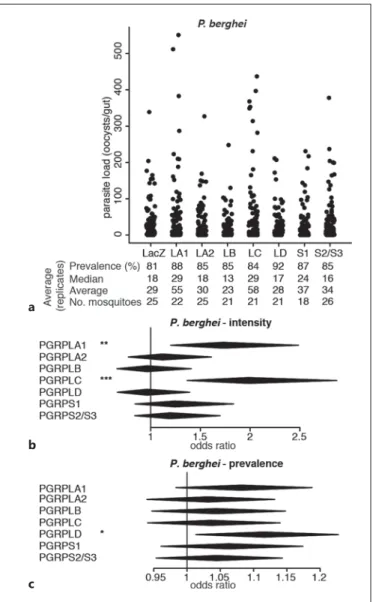
as intensity. We confirmed the previously reported in-crease in infection intensity upon PGRPLC knockdown [1] and observed that PGRPLA1 silencing had a similar effect on P. berghei infection ( Fig. 1 a, b; online suppl.
Table S1). The prevalence of infection was not affected when silencing PGRPLC or PGRPLA1 but increased when targeting PGRPLD ( Fig. 1 a, c).
Next, we screened for the effects of PGRPs on human malaria parasites P. falciparum. We chose to infect mos-quitoes with the blood of gametocyte carriers in Camer-oon as this experimental setup allows us to assess infec-tions from a naturally diverse set of parasites having de-veloped in vivo. We injected mosquitoes with dsRNA and offered them an infectious blood sample 4 days later. In addition to the strong negative impact of PGRPLC on in-fection intensity reported previously [1] , we observed that silencing PGRPLA2 , but not PGRPLA1 , also in-creased mosquito permissiveness to P. falciparum ( Fig. 2 a, b; online suppl. Table S2). Silencing PGRPS2 and PGRPS3 , which we could only target together due to their high se-quence similarity, increased P. falciparum infection in-tensity and prevalence, while silencing PGRPLB signifi-cantly decreased infection prevalence ( Fig. 2 ; online suppl. Table S2).
Together, these data indicate that beside PGRPLC, PGRPLA, PGRPLD, and PGRPS2/PGRPS3 also partici-pate in the resistance to Plasmodium , while PGRPLB may be implicated in the tolerance to parasites. The antipara-sitic function of PGRPLC is linked to the induction of the Imd pathway due to the microbial growth following a blood meal [1] . We then focused on PGRPLA and PGRPLB as their Drosophila orthologs are known to pos-itively and negatively regulate the Imd pathway, respec-tively [7, 8] . We investigated whether their effect on par-asite infections was mediated by similar regulatory roles on the Anopheles Imd pathway.
PGRPLA Is a Positive Regulator of the Imd Pathway in the Midgut
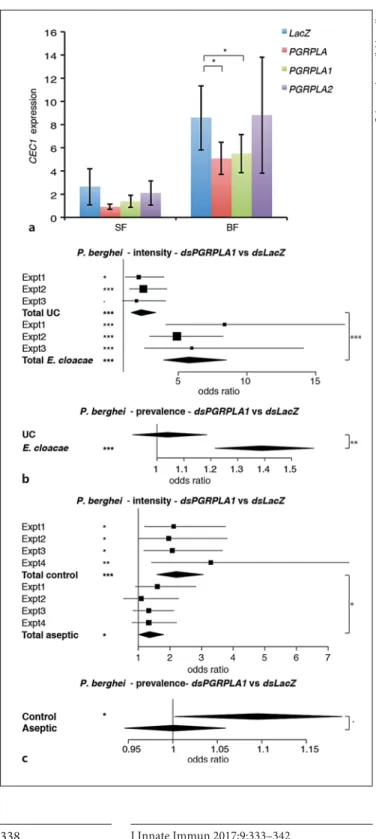
First, we investigated the role of PGRPLA in the induc-tion of antimicrobial peptides in the midgut, where its Drosophila ortholog positively affects immune responses. We followed the expression of Cecropin1 (CEC1) , an an-tibacterial gene induced by the Imd pathway, in the mid-guts of sugar- and blood-fed mosquitoes 3 and 4 days af-ter dsRNA injection, respectively, in order to follow the blood meal-induced Imd response [1] . We found that CEC1 was induced 4.9-fold in the midgut of blood-fed versus sugar-fed mosquitoes. Simultaneous knockdown of both PGRPLA1 and PGRPLA2 reduced the blood meal-induced CEC1 expression ( Fig. 3 a). The same effect was observed upon specific PGRPLA1 knockdown, while knockdown of PGRPLA2 had no effect on CEC1 expres-sion ( Fig. 3 a). These results suggested that PGRPLA1 is a
a
b
c
Fig. 1. Effect of RNAi on PGRP genes on P. berghei infections.
a Strip-chart representation of the oocyst load of P. berghei upon RNAi on the genes encoding PGRPs. RNAi targeting the bacterial gene LacZ was used as a control. Each dot shows the oocyst load in an individual gut, and data show pools of 4 independent replicates.
b , c Forest plots showing the effect of knocking down Anopheles PGRP genes on the intensity ( b ) and prevalence ( c ) of P. berghei infection, resulting from the same experiments as data shown in a . Statistical data show the result of a Wald Z test following zero-in-flated negative binomial regression model fitting. The center and horizontal diagonal of each diamond show the odds ratio of the fixed effect and its confidence interval, respectively. * p < 0.05; * * p < 0.01; * * * p < 0.001.
Characterization of the Anopheles PGRPs J Innate Immun 2017;9:333–342
DOI: 10.1159/000452797 337
positive regulator of the Imd pathway. When testing the efficiency of knockdown of PGRPLA1 and PGRPLA2 , we found that PGRPLA1 was reduced by 44 and 37% in sugar- and blood-fed mosquitoes, respectively, while PGRPLA2 was only reduced by 18 and 24%, respectively. In terms of isoform specificity, PGRPLA2 dsRNA did not consistently affect PGRPLA1 , while PGRPLA1 dsRNA slightly decreased PGRPLA2 expression by 7 and 15% pri-or to and after blood feeding, respectively. Thus, we can-not rule out that the specific effect found on PGRPLA1 and not PGRPLA2 is not due to the difference in efficien-cy and specificity of these dsRNAs.
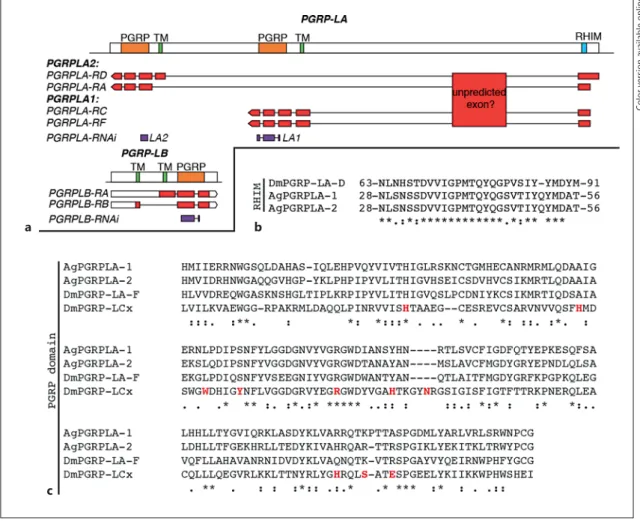
VectorBase annotation of PGRPLA suggests that this gene is transcribed as 4 transcripts, 2 of them sharing the exact same sequence encoding for PGRPLA1, while PGRPLA2 would actually correspond to 2 isoforms shar-ing the same PGRP domain, 1 of which lacks the trans-membrane and intracellular domains ( Fig. 4 a). Accord-ing to RNA-sequencAccord-ing data added to VectorBase, a whole additional region is also transcribed in PGRPLA [14–16] . As this region is ortholog to a PGRPLA region in Anopheles merus and Anopheles quadriannulatus [16] , it might be an additional unpredicted exon of the gene. This suggests that the exact sequences of PGRPLA tran-scripts may need further investigation.
In Drosophila , the receptors PGRPLC and PGRLE in-duce the Imd pathway through a RIP Homotypic Interac-tion Motif (RHIM), which is also present in Drosophila PGRPLA [17] . Alignment of this RHIM to Anopheles PGRPLA revealed a high similarity in a sequence of 27 amino acids, in a region shared by both PGRPLA1 and PGRPLA2 ( Fig. 4 b). These data suggest that both iso-forms of Anopheles PGRPLA carry a RHIM domain.
We then investigated whether PGRPLA1 promotes re-sistance to P. berghei in a bacterium-dependent fashion. Two days after dsRNA injection, mosquitoes were orally infected with E. cloacae , a Gram-negative bacterium pre-viously found in the mosquito microbiota, and infected with P. berghei 48 h later. We observed that silencing PGRPLA1 had a stronger effect on intensity and preva-lence of P. berghei infection in E. cloacae -infected than noninfected mosquitoes, as shown by a significant in-crease in the PGRPLA1 -to- LacZ odds ratios ( Fig. 3 b; on-line suppl. Fig. S3A). To examine whether the PGRPLA1-mediated response was induced by the midgut micro-biota, we orally treated mosquitoes with the antibiotic gentamycin and infected them with P. berghei 3 days lat-er. We observed that the antibiotic treatment significant-ly reduced but did not eliminate the effect of PGRPLA1 on P. berghei infection intensity, while the effect on
prev-a
b
c
Fig. 2. Effect of RNAi on PGRP genes on P. falciparum infections.
a Strip-chart representation of the oocyst load of P. falciparum upon RNAi on the genes encoding PGRPs. RNAi targeting the bacterial gene LacZ was used as a control. Each dot shows the oo-cyst load in an individual gut, and data show pools of 11 indepen-dent replicates. b, c Forest plots showing the effect of knocking down Anopheles PGRP genes on the intensity ( b ) and prevalence ( c ) of P. falciparum infection, resulting from the same experiments as data shown in a . Statistical data show the result of a Wald Z test following zero-inflated negative binomial regression model fitting ( b ) and of an ANOVA following a logistic regression model fitting ( c ). The center and horizontal diagonal of each diamond show the odds ratio of the fixed effect and its confidence interval, respec-tively. · p < 0.1; * p < 0.05; * * p < 0.01; * * * p < 0.001.
Gendrin/Turlure/Rodgers/Cohuet/ Morlais/Christophides
J Innate Immun 2017;9:333–342 DOI: 10.1159/000452797
338
alence was lost ( Fig. 3 c; online suppl. Fig. S3B). These re-sults suggested that PGRPLA1 protection is partly micro-biota independent. This prompted us to investigate whether the PGRP domain of PGRPLA1, as previously reported in Drosophila PGRPLA and Anopheles
PGRPLA2, lacks essential features for peptidoglycan
binding [8] . Indeed, sequence alignment revealed that 8/10 amino acids involved in binding peptidoglycan in PGRPLCx are absent from PGRPLA1 ( Fig. 4 c).
PGRPLB Downregulates Systemic Induction of the Imd Pathway
We also investigated whether PGRPLB is a negative regulator of the Imd pathway, similarly to its
Drosophi-la ortholog [6, 7] . According to VectorBase
annota-tions, PGRPLB encodes 2 isoforms, which share the same PGRP domain and differ in their transmembrane domains ( Fig. 4 a). We silenced PGRPLB by targeting a region shared by both predicted transcripts and moni-tored the expression of CEC1 6 h to 6 days after dsRNA injection in the mosquito midgut and fat body to exam-ine local and systemic Imd responses, respectively. We found that PGRPLB silencing had no effect on CEC1 expression in the midgut, but it significantly increased CEC1 expression in the fat body 6 days later ( Fig. 5 a, b; online suppl. Fig. S4A). As PGRPLB is highly induced in the gut after blood feeding ( Fig. 5 c), we studied its role in the induction of the immune response after a blood meal provided 30 h after dsRNA injection. Our results indicate that CEC1 is induced in the midgut, but not in the fat body, after blood feeding (online suppl. Fig. S4B). PGRPLB silencing did not affect CEC1 ex-pression in the gut but significantly induced CEC1 in the fat body 72 h after the blood meal ( Fig. 5 d, e). These data suggested that, similarly to Drosophila , PGRPLB is involved in preventing activation of a systemic immune
a
b
c
Fig. 3. Effect of PGRPLA RNAi on Imd pathway induction and on P. berghei infection. a CEC1 expression in midguts of sugar-fed mosquitoes (SF) or 24 h after blood feeding (BF) when targeting the whole PGRPLA gene or only one of its isoforms ( PGRPLA1 or PGRPLA2 ). RNAi targeting the bacterial gene LacZ was used as a control. b Effect of PGRPLA1 RNAi on P. berghei live oocyst in-tensity (upper panel) and prevalence (lower panel) in unchal-lenged (UC) or E. cloacae orally infected mosquitoes. c Effect of PGRPLA1 RNAi on P. berghei live oocyst intensity (upper panel) and prevalence (lower panel) in control or gentamycin-treated (aseptic) mosquitoes. Squares represent the odds ratio of the fixed effect for each gene in each independent replicate, and error bars represent 95% confidence intervals. In each chart, square sizes are proportional to mosquito numbers. Diamonds represent the sum-mary of independent replicates. Statistical data show the result of ANOVA following a common linear regression model fitting ( a ), a Wald Z test following zero-inflated negative binomial regression model fitting ( b , c ; intensity data), and ANOVA following a logis-tic regression model fitting ( b , c ; prevalence data). · p < 0.1; * p <
0.05; * * p < 0.01; * * * p < 0.001.
Characterization of the Anopheles PGRPs J Innate Immun 2017;9:333–342
DOI: 10.1159/000452797 339
response. Interestingly, PGRPLB expression was effi-ciently knocked down in the midgut but not in the fat body (online suppl. Fig. S4C, S4D). This is probably due to its very low expression in the fat body, which is 41- and 15-fold lower than in the midgut of sugar- and blood-fed mosquitoes, respectively (online suppl. Fig. S4C, S4D). These data suggested that PGRPLB is re-quired in the gut and/or potentially other tissues, but not in the fat body, to prevent the activation of a late systemic response.
Discussion
In this study, we identify 2 new A. coluzzii PGRPs in-volved in the vector-parasite interactions. We reveal that PGRPLA has an antiparasitic effect and positively regu-lates the Imd pathway, similar to what was shown previ-ously for PGRPLC [1] . Although our data suggest that PGRPLA1 and PGRPLA2 affect negatively P. berghei and P. falciparum , respectively, previous experiments per-formed in our laboratory using the G3 mosquito strain
a
c
b
Fig. 4. Map of PGRPLA and PGRPLB and sequence features of PGRPLA. a Map of the PGRPLA and PGRPLB gene loci. Predict-ed PGRP domains are shown in orange, prPredict-edictPredict-ed transmembrane domains (TM) in green and the predicted RHIM in turquoise (see online version for colors). The map of each VectorBase-predicted transcript is shown below each gene, including untranslated re-gions in white and coding DNA sequences in red. According to RNA-Seq data [14–16] , a transcribed region that may participate in the sequence of PGRPLA transcripts is also indicated as “un-predicted exon.” dsRNA-targeted regions are shown in purple. b ,
c Sequence alignments of PGRPLA RHIM ( b ) and PGRP domain ( c ) with their homologous sequences in Drosophila PGRPLA ( b , c )
and PGRPLCx ( c ). In Drosophila , there is no single isoform en-compassing both an RHIM and a PGRP domain, hence the se-quence of PGRPLA D isoform is shown for the RHIM and the
se-quence of PGRPLA F isoform for the PGRP domain. c Amino acids
shown in red are in direct contact with the peptidoglycan mono-mer “TCT” (tracheal cytotoxin) [18] . Sequence alignments were performed with ClustalW [19] and manually curated. * , positions
with fully conserved residues; :, positions with conservation of “strong” groups (STA, NEQK, NHQK, NDEQ, QHRK, MILV, MILF, HY, FYW);
· , positions with conservation of “weaker”
groups (CSA, ATV, SAG, STNK, STPA, SGND, SNDEQK, NDEQHK, NEQHRK, FVLIM, HFY).
Gendrin/Turlure/Rodgers/Cohuet/ Morlais/Christophides
J Innate Immun 2017;9:333–342 DOI: 10.1159/000452797
340
infected with P. berghei revealed an antiparasitic function for PGRPLA2 [20] . As both isoforms share the exons en-coding the intracellular domain, including the RHIM motif, and are predicted not to bind peptidoglycan, we hypothesize that their differential effects on Imd pathway activation and anti- Plasmodium responses depend on their expression levels rather than functional differences. Indeed, P. falciparum and P. berghei infection of the mos-quito midgut occur with different timing and at different temperatures. In that respect, published data suggest that PGRPLA1 and PGRPLA2 expression differs between mosquito strains and Plasmodium infection stages [21– 24] , and we found that PGRPLA2 expression is 14 and 10 times lower than that of PGRPLA1 in the midguts of sug-ar- and blood-fed mosquitoes of our colony, respectively. Moreover, as mentioned in the results, the observed phe-notypic difference may arise from PGRPLA1 dsRNA hav-ing a higher silenchav-ing efficiency and behav-ing less isoform specific than PGRPLA2 dsRNA. However, we cannot rule out that the differences found between PGRPLA1 and PGRPLA2 are not biologically relevant, they may notably be linked to the absence of a transmembrane domain in one of the predicted PGRPLA2 isoforms.
Oral bacterial challenge and antibiotic treatments re-vealed that the effect of PGRPLA1 is only partly bacteria dependent. Therefore, the effect of PGRPLA1 on
Plasmo-dium in aseptic mosquitoes may be due to basal induction
of the Imd pathway by PGRPLA1 dimerization. The RHIM domain of PGRPLA1 is highly conserved with that of Drosophila PGRPLA, which is shown to induce the Imd pathway [8] . The observed increase in the antipara-sitic effect of PGRPLA1 silencing upon bacterial challenge suggests that PGRPLA1 also participates in a bacterium-mediated induction of the Imd pathway, perhaps through heterodimerization with PGRPLC. Induction of the Imd pathway by heterodimerization has been reported in
Dro-sophila between PGRPLCx, which binds peptidoglycan,
and PGRPLCa, which does not [25] .
Our results also identify PGRPLB as a negative regulator of the Imd pathway, promoting tolerance to P. falciparum . More specifically, our data suggest that PGRPLB is needed in the gut and perhaps other tissues, but not in the fat body, to prevent induction of a systemic immune response. This is in contrast to what is known in Drosophila , where
PGRPLB is required both in the gut and in the fat body to control systemic responses [7] . This difference between Anopheles and Drosophila PGRPLB may relate to the fact that the former is a predicted transmembrane protein, po-tentially scavenging peptidoglycan fragments as they tra-verse the gut epithelium, while the latter is a secreted pro-tein [7] , likely scavenging peptidoglycan monomers in the gut lumen and potentially in the hemolymph. Indeed, pep-tidoglycan fragments are known to diffuse through the gut and other epithelia into the hemolymph, where they
re-a
c d e
b
Fig. 5. Effect of PGRPLB RNAi on the local and systemic activation of the Imd path-way. a , b , d , e CEC1 expression in the mid-guts ( a , d ) and fat bodies ( b , e ) of mosqui-toes after injection of PGRPLB or LacZ control dsRNA in sugar-fed (SF; a , b ) or blood-fed (BF; d , e ) conditions. c PGRPLB expression in sugar-fed mosquitoes or 24 h after blood feeding. Statistical data show the results of ANOVA following a com-mon linear regression model fitting.
· p < 0.1; * p < 0.05; * * p < 0.01; * * * p < 0.001.
Characterization of the Anopheles PGRPs J Innate Immun 2017;9:333–342
DOI: 10.1159/000452797 341
motely induce a systemic response [26] . Anopheles PGRPLB expression is enriched in the midgut and the salivary glands [27] , 2 organs harboring microbial communities, further implicating this protein in epithelial tolerance to microbi-ota. Alternatively, the effect that we report on the systemic response may also happen via an antibacterial effect of PGRPLB, which may prevent bacteria from entering the mosquito hemolymph. In the tsetse fly, PGRPLB is shown to be a negative regulator of the Imd pathway, participating in tolerance to symbionts [28] , and also to have a direct an-tiparasitic effect against trypanosomes [29] . Our results do not point to such an antiparasitic effect of Anopheles
PGRPLB against Plasmodium . In our experimental setting, the role of PGRPLB on Plasmodium infection is probably reduced due to the fact that PGRPLB is itself a target of the Imd pathway [30] ; hence, its silencing may induce Imd pathway activation leading to its overexpression. A deletion of the gene is required to determine the full effect of PGRPLB in Plasmodium infections.
Taken together, our data demonstrate that PGRPs are key regulators of the mosquito immune system and per-missiveness to Plasmodium . We reveal that PGRPLA is a positive regulator of the Imd pathway and that its anti-parasitic activity is partly bacteria dependent, while PGRPLB negatively regulates the same pathway, partici-pating in the tolerance to the gut microbiota.
Acknowledgments
We are grateful to Mfou primary school pupils and their par-ents or guardians for volunteering to participate in this study and for blood donations. We also thank Jean-Pierre Agbor, Rose Nyambam, Etienne Onana, Isaac Tchikangwa, Katarzyna Sala, and Tibebu Habtewold for technical assistance, and Engelbert Manga, Emmanuel Bodzwan, and Constance Efemba for medical assis-tance. We thank Antonio Mendes and Sandrine Nsango for help-ing with P. falciparum experiments. We also thank João Trindade Marques for insights while writing this paper.
The work was supported by the Biotechnology and Biological Sciences Research Council Project BB/K009338/1, the European Commission FP7 Collaborative Project grant “TransMalariaBloc” (HEALTH-F3-2008-223736), the NIH Program Project grant 2PO1AI044220-06A1, and the ANR-06-MIME-001-01 grant.
Author Contributions
M.G., F.T., F.H.R., and G.K.C. designed the experiments. M.G., F.T. and F.H.R. performed the experiments. A.C. and I.M. orga-nized gametocyte carrier recruitment in Cameroon and provided infrastructure and intellectual input for work on P. falciparum . M.G., F.T., and G.K.C wrote this paper. All the authors comment-ed on the paper and approvcomment-ed the final version.
References
1 Meister S, Agianian B, Turlure F, Relogio A, Morlais I, Kafatos FC, Christophides GK:
Anopheles gambiae PGRPLC-mediated
de-fense against bacteria modulates infections
with malaria parasites. PLoS Pathog 2009; 5:
e1000542.
2 Meister S, Kanzok SM, Zheng XL, Luna C, Li TR, Hoa NT, Clayton JR, White KP, Kafatos FC, Christophides GK, Zheng L: Immune sig-naling pathways regulating bacterial and ma-laria parasite infection of the mosquito Anopheles gambiae . Proc Natl Acad Sci USA
2005; 102: 11420–11425.
3 Povelones M, Bhagavatula L, Yassine H, Tan LA, Upton LM, Osta MA, Christophides GK: The CLIP-domain serine protease homolog SPCLIP1 regulates complement recruitment to microbial surfaces in the malaria mosquito
Anopheles gambiae . PLoS Pathog 2013; 9:
e1003623.
4 Gottar M, Gobert V, Michel T, Belvin M, Duyk G, Hoffmann JA, Ferrandon D, Royet J: The Drosophila immune response against Gram-negative bacteria is mediated by a pep-tidoglycan recognition protein. Nature 2002;
416: 640–644.
5 Choe KM, Werner T, Stoven S, Hultmark D, Anderson KV: Requirement for a peptidogly-can recognition protein (PGRP) in Relish ac-tivation and antibacterial immune responses
in Drosophila. Science 2002; 296: 359–362.
6 Paredes JC, Welchman DP, Poidevin M, Le-maitre B: Negative regulation by amidase PGRPS shapes the Drosophila antibacterial response and protects the fly from innocuous
infection. Immunity 2011; 35: 770–779.
7 Zaidman-Remy A, Herve M, Poidevin M, Pi-li-Floury S, Kim MS, Blanot D, Oh BH, Ueda R, Mengin-Lecreulx D, Lemaitre B: The
Dro-sophila amidase PGRP-LB modulates the
im-mune response to bacterial infection.
Immu-nity 2006; 24: 463–473.
8 Gendrin M, Zaidman-Remy A, Broderick NA, Paredes J, Poidevin M, Roussel A, Le-maitre B: Functional analysis of PGRP-LA in
Drosophila immunity. PLoS One 2013; 8:
e69742.
9 Kurata S: Peptidoglycan recognition proteins in Drosophila immunity. Dev Comp
Immu-nol 2014; 42: 36–41.
10 Neyen C, Poidevin M, Roussel A, Lemaitre B: Tissue- and ligand-specific sensing of
Gram-negative infection in Drosophila by PGRP-LC
isoforms and PGRP-LE. J Immunol 2012; 189:
1886–1897.
11 Christophides GK, Zdobnov E, Barillas-Mury C, Birney E, Blandin S, Blass C, Brey PT, Col-lins FH, Danielli A, Dimopoulos G, Hetru C, Hoa NT, Hoffmann JA, Kanzok SM, Letunic I, Levashina EA, Loukeris TG, Lycett G, Meis-ter S, Michel K, Moita LF, Muller HM, Osta MA, Paskewitz SM, Reichhart JM, Rzhetsky A, Troxler L, Vernick KD, Vlachou D, Volz J, von Mering C, Xu J, Zheng L, Bork P, Kafatos FC: Immunity-related genes and gene
fami-lies in Anopheles gambiae . Science 2002; 298:
159–165.
12 Wotton RS, Chaloner DT, Yardley CA, Mer-ritt RW: Growth of Anopheles mosquito larvae on dietary microbiota in aquatic surface
mi-crolayers. Med Vet Entomol 1997; 11: 65–70.
13 Franke-Fayard B, Trueman H, Ramesar J, Mendoza J, van der Keur M, van der Linden R, Sinden RE, Waters AP, Janse CJ: A
Plasmo-dium berghei reference line that constitutively
expresses GFP at a high level throughout the complete life cycle. Mol Biochem Parasitol
Gendrin/Turlure/Rodgers/Cohuet/ Morlais/Christophides
J Innate Immun 2017;9:333–342 DOI: 10.1159/000452797
342
14 Gibbons JG, Janson EM, Hittinger CT, John-ston M, Abbot P, Rokas A: Benchmarking next-generation transcriptome sequencing for functional and evolutionary genomics.
Mol Biol Evol 2009; 26: 2731–2744.
15 Pitts RJ, Rinker DC, Jones PL, Rokas A, Zwiebel LJ: Transcriptome profiling of che-mosensory appendages in the malaria vector Anopheles gambiae reveals tissue- and sex-specific signatures of odor coding. BMC
Ge-nomics 2011; 12: 271. 16 VectorBase: Chromosome 2L: 12,211,358-12,220,758. https://www.vectorbase.org/ Anopheles_gambiae/Location/View?db=cor e;g=AGAP005205;r=2L:12211358-12220758 (accessed January 6, 2017).
17 Kaneko T, Yano T, Aggarwal K, Lim JH, Ueda K, Oshima Y, Peach C, Erturk-Hasdemir D, Goldman WE, Oh BH, Kurata S, Silverman N: PGRP-LC and PGRP-LE have essential yet distinct functions in the drosophila immune response to monomeric DAP-type
peptido-glycan. Nat Immunol 2006; 7: 715–723.
18 Chang CI, Chelliah Y, Borek D, Mengin-Lec-reulx D, Deisenhofer J: Structure of tracheal cytotoxin in complex with a heterodimeric pattern-recognition receptor. Science 2006;
311: 1761–1764.
19 ClustalW multiple sequence alignment pro-gram, version 1.83, 2003.
20 Meister S: The Role of PGRP Proteins in In-nate Immunity Pathways in the Malaria Vec-tor Anopheles gambiae; thesis . Ruperto Caro-la University of Heidelberg, 2006.
21 Fossog Tene B, Poupardin R, Costantini C, Awono-Ambene P, Wondji CS, Ranson H, Antonio-Nkondjio C: Resistance to DDT in an urban setting: common mechanisms im-plicated in both M and S forms of Anopheles
gambiae in the city of Yaoundé Cameroon.
PLoS One 2013; 8:e61408.
22 Fossog Tene B, Poupardin R, Costantini C, Awono-Ambene P, Wondji CS, Ranson H, Antonio-Nkondjio C: VectorBase: AGAP-005205 expression in experiment ddt resis-tant field isolates. https://www.vectorbase. org/expression-browser/gene/AGAP005205/ experiment/E-MTAB-1382 (accessed Janu-ary 6, 2017).
23 Mendes AM, Awono-Ambene PH, Nsango SE, Cohuet A, Fontenille D, Kafatos FC, Christophides GK, Morlais I, Vlachou D: VectorBase: AGAP005205 expression in ex-periment Plasmodium falciparum infections. https://www.vectorbase.org/expression-browser/gene/AGAP005205/experiment/ Plasmodium%20falciparum%20infec-tions%20(Mendes%20et%20al.,%202011) (accessed January 6, 2017).
24 Mendes AM, Awono-Ambene PH, Nsango SE, Cohuet A, Fontenille D, Kafatos FC, Christophides GK, Morlais I, Vlachou D: In-fection intensity-dependent responses of
Anopheles gambiae to the African malaria
parasite Plasmodium falciparum . Infect
Im-mun 2011; 79: 4708–4715.
25 Mellroth P, Karlsson J, Hakansson J, Schultz N, Goldman WE, Steiner H: Ligand-induced dimerization of Drosophila peptidoglycan recognition proteins in vitro. Proc Natl Acad
Sci USA 2005; 102: 6455–6460.
26 Gendrin M, Welchman DP, Poidevin M, Herve M, Lemaitre B: Long-range activation of systemic immunity through peptidoglycan diffusion in Drosophila. PLoS Pathog 2009; 5:e1000694.
27 Baker DA, Nolan T, Fischer B, Pinder A, Cri-santi A, Russell S: A comprehensive gene ex-pression atlas of sex- and tissue-specificity in the malaria vector, Anopheles gambiae . BMC
Genomics 2011; 12: 296.
28 Wang J, Wu Y, Yang G, Aksoy S: Interactions between mutualist Wigglesworthia and tsetse peptidoglycan recognition protein (PGRP-LB) influence trypanosome transmission.
Proc Natl Acad Sci USA 2009; 106: 12133–
12138.
29 Wang J, Aksoy S: PGRP-LB is a maternally transmitted immune milk protein that influ-ences symbiosis and parasitism in tsetse’s
off-spring. Proc Natl Acad Sci USA 2012; 109:
10552–10557.
30 Maccallum RM, Redmond SN, Christophides GK: An expression map for Anopheles
gam-biae . BMC Genomics 2011; 12: 620.