HAL Id: hal-01542751
https://hal.archives-ouvertes.fr/hal-01542751
Submitted on 20 Jun 2017HAL is a multi-disciplinary open access archive for the deposit and dissemination of sci-entific research documents, whether they are pub-lished or not. The documents may come from teaching and research institutions in France or abroad, or from public or private research centers.
L’archive ouverte pluridisciplinaire HAL, est destinée au dépôt et à la diffusion de documents scientifiques de niveau recherche, publiés ou non, émanant des établissements d’enseignement et de recherche français ou étrangers, des laboratoires publics ou privés.
Distributed under a Creative Commons Attribution - NonCommercial - ShareAlike| 4.0 International License
Orientational order in the stable buckminster fullerene
solvate C60.2CBr2H2
J. Ye, M. Barrio, Ph. Negrier, N. Qureshi, I. B. Rietveld, R. Céolin, Josep Ll
Tamarit
To cite this version:
J. Ye, M. Barrio, Ph. Negrier, N. Qureshi, I. B. Rietveld, et al.. Orientational order in the stable buckminster fullerene solvate C60.2CBr2H2. The European Physical Journal. Special Topics, EDP Sciences, 2017, 226 (5), pp.857-867. �10.1140/epjst/e2016-60272-x�. �hal-01542751�
ORIENTATIONAL ORDER IN THE STABLE BUCKMINSTER
FULLERENE SOLVATE C
60·2CBr
2H
2J. Yea, M. Barrioa, Ph. Negrierb, N. Qureshic, I. B. Rietveldd, R. Céolina,e, J. Ll. Tamarita,*
a
Departament de Física, ETSEIB, Universitat Politècnica de Catalunya, Diagonal 647, 08028 Barcelona, Catalonia, Spain
b
LOMA, UMR 5798, F-33400 Talence, France, CNRS, LOMA, UMR 5798, Université de Bordeaux, F-33400 Talence, France
c
Institut Laue Langevin, 71 avenue des Martyrs - CS 20156 - 38042 GRENOBLE CEDEX 9, France
d
Laboratoire de Chimie Physique, CAMMAT, Faculté de Pharmacie, Université Paris Descartes, 4 avenue de l’Observatoire, 75006 Paris, France
e
LETIAM, EA7357, IUT Orsay, Université Paris Sud, rue Noetzlin, 91405 Orsay Cedex, France
* Corresponding author: [email protected]
Abstract
Crystals of the solvate C60·2CBr2H2 (monoclinic C2/m), which is stable in air, were
grown by slow evaporation of solutions of C60 in CBr2H2 at room temperature. The high
enthalpy change for the complete desolvation process, 54.9 kJ mol-1 of solvent, as well as the relatively large negative excess volume of -49.6 Å3 indicate the presence of strong intermolecular interactions between C60 and CBr2H2. The strong intermolecular interactions
are consistent with an overall orientational order for the C60 and the CBr2H2 molecules in the
1
Introduction
Fullerene C60 is known to be moderately soluble in a large number of solvents, from
small quasi-tetrahedral molecules to aromatic ones. Moreover, C60 has a strong tendency to
form co-crystals with solvent molecules, i.e. solvates [1-25].
In many cases the intermolecular interactions between C60 and the guest solvent
molecules are strong enough to form a co-crystal and weak enough to allow for the well-known orientational disorder of the C60 and solvent molecules. It has been demonstrated that
due to the relatively weak intermolecular interactions, most solvates are not stable in air and lose solvent molecules through evaporation resulting in disorder within the crystalline structure of desolvated C60 fullerene [26].
The orientational disorder in solvates can complicate the solution of structures by X-ray diffraction [27] and only in a few cases, C60 molecules were found to exhibit orientational
order as for example in the recent case of the low-temperature solvate consisting of C60 and
cubane (C8H8), which orientational order is claimed to be caused by topological molecular
recognition between the convex surface of C60 and concave cubane [28, 29]. Often, structural
refinement is only possible by allowing for several rotational orientations of the C60 molecule.
For example in certain cases, the solvate structure could be refined using site occupancy factors with two distinct orientations for C60, revealing an obstructed molecular rotation [30,
31]. Moreover, it is often seen that the solvent molecules have different orientations within the C60 interstices. It is clear therefore that the moderate interaction strength between the C60
molecules and its guest molecules is highly tunable, which makes its solvates an interesting subject of study.
In this work, the solvate formation between C60 and dibromomethane, CBr2H2, has been
investigated. Dibromomethane is a relatively small, rigid molecule with C2v symmetry and a
significant dipole moment of 1.51 D. It is expected to cause anisotropic van der Waals interactions in line with other, previously investigated molecules [32-34]. We will demonstrate that in this case the intermolecular interactions are strong enough to form a co-crystal that is stable in air and in which the host and guest molecules are orientationally ordered.
2 Experimental
Dibromomethane (CBr2H2, M= 173.835 g mol-1) was purchased from Aldrich with a
purity higher than 99%. Fullerene C60 (M = 720.64 g mol-1) was purchased from TermUSA
(purity > 99.98%). Both compounds were used as received.
Solid C60 was dissolved in CBr2H2 at room temperature in screw-cap tubes that were
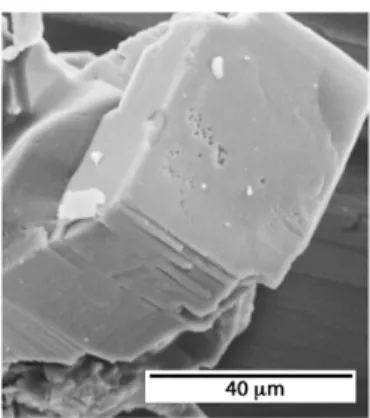
subsequently stored for several months in the dark. Black, bright, polyhedral crystals formed at the surface of the colorless solution. The morphology of the crystals (Figure 1) was examined by means of scanning electron microscopy (JEOL-7100F) with a scanning voltage of 20 kV.
Differential scanning calorimetry (DSC) and Thermogravimetry (TG) were performed under nitrogen flux at a 2K min-1 scanning rate using the Q100 and Q50 from TA Instruments (New Castle, DE, USA), respectively. Sample masses were weighed in at a precision of 0.01 mg.
Figure 1. Scanning electron microscopy (SEM) photograph of C60·2CBr2H2 crystals
High-resolution X-ray powder diffraction was carried out with a transmission mode diffractometer using Debye−Scherrer geometry equipped with a cylindrical position-sensitive detector (CPS120) from INEL (France) containing 4096 channels (0.029° 2θ angular step) with monochromatic Cu Kα1 (λ = 1.54061 Å) radiation. The generator power was set to 35 kV and 35 mA. The deviation in the angular linearity of the PSD (position-sensitive detector) was corrected following the recommended procedure by external calibration using the cubic phase of Na2Ca3Al2F4 and cubic spline fitting [35]. Peak position determinations were carried
out after pseudo-Voigt fitting. Crystals were gently crushed and introduced in a Lindemann capillary (0.5 mm diameter) rotating perpendicularly to the X-ray beam during the experiments to improve the average over the crystallite orientations.
A liquid nitrogen 700 series Cryostream Cooler from Oxford Cryosystems (U.K.) was used to control the temperature during the measurements. For the temperature dependent
measurements the heating rate in between data collection was 1.33 K min-1 and the sample temperature was equilibrated for at least 10 min after which the X-ray diffraction profiles were recorded isothermally for at least 60 min. Longer acquisition time patterns, 9 h, were recorded for structural and refinement purposes at room temperature. Pawley fits, indexing, structure solution, and Rietveld refinement were performed with the Materials Studio Program (Version 5.5) from Accelrys (San Diego, CA) [36]. An independent FullProf structural analysis was carried out to verify the refinement results.
3 Results
An X-ray diffraction pattern was obtained from the crystals (see Figure 1) extracted from the surface of the colorless solution at room temperature. After the crystals were left at room temperature in contact with air for several days, the same X-ray patterns were obtained. It can therefore be assumed that the solvate is stable in air.
Systematic absences for the space group assessment were compatible with the centered monoclinic space group C2/m. To determine the structure of the solvate, atom coordinates of the individual molecules C60 and CBr2H2 were used from the literature and fitted in the
obtained diffraction patterns. For the Rietveld refinement, a rigid-body constraint was used for CBr2H2. The position and orientation of the molecules were refined with a single overall
isotropic displacement parameter and preferred orientation using the March-Dollase formula [37]. The refinement results are depicted in Figure 2, together with the experimental pattern and the difference between the refined pattern and the experimental one. The values of the final Rietveld refinement are summarized in Table 1.
Surprisingly, the C60 molecules appeared to be orientationally ordered in the current
solvate. For confirmation, an independent Rietveld refinement of the structural model was carried out with the FullProf program. In a first step, the C60 molecule was modeled as a
spherical shell with the scattering density of 60 carbon atoms homogeneously distributed on a sphere with a radius of 3.59 Å, which represents a freely rotating molecule. The CBr2H2
molecule was modeled as a rigid body with the atom coordinates taken from Podsiadło et al. [32]. The local coordinate system was set with the 2-fold rotation axis of the CBr2H2 molecule
pointing along the local z axis (the local coordinate system is defined by x||a, y||b and z||(a x b) with θ=ϕ=χ=0), which therefore permits to rotate the molecule around its 2-fold rotation axis by the angle χ independently of its orientation in the unit cell. A first refinement clearly
shows that the CBr2H2 molecule is oriented with its 2-fold rotation axis parallel to the
monoclinic b axis, i. e. θ=ϕ=90 degrees.
In a second step, the C60 molecule was modeled as a rigid body with its 2-fold rotation
axis along the local z axis. A clear improvement of the refinement is apparent between the spherical-shell model with the agreement factor, RF, equal to 8.0 and the rigid-body model
with RF = 4.2, which strongly suggests that the C60 molecule is not freely rotating. The
resulting orientation is such that its 2-fold rotation axis is aligned with the monoclinic b axis just like the CBr2H2 molecule (i.e. θ=ϕ=90 degrees).
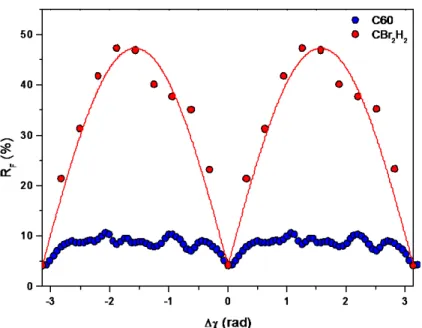
Rotating the two molecules each around their individual 2-fold rotation axes corresponding to the angle χ for both molecules exhibits a strong influence on the agreement factor, in particular for dibromomethane, however also C60 has a clear single minimum within
one π periodicity (see Figure 3). The results confirm the orientational order of dibromomethane with the same alignment of its rotation axis in relation to the monoclinic cell. A dynamic rotation of the CBr2H2 molecule around its 2-fold axis can be ruled out due to
the very strong dependence of the angle χ on RF (see Figure 3), which demonstrates that the
molecule must have a fixed orientation, i.e. with the Br ligands pointing towards the longer diagonal of the a-c plane (see Figure 4). The final structural parameters obtained from the last refinement were virtually the same as those obtained by means of the Materials Studio package. In the case of C60 the results are not as clear-cut as for CBr2H2, but the difference
between the global minimum and the local minima is convincing enough to expect C60 to be
mainly stuck in a single orientation, even if a stepwise arrested rotation cannot be excluded due to the many local minima.
Figure 2. Experimental (red circles) and calculated (black line) diffraction patterns along with
the difference profile (blue line) and Bragg reflections (vertical bars) of the monoclinic C2/m space-group of the C60·2CBr2H2 solvate at room temperature. The inset corresponds to the
scale for the data between 40 and 60° 2θ.
Figure 3. The crystallographic agreement factor, RF, as a function of the rotation angle
around the 2-fold rotation axis of C60 (blue dots) and of CBr2H2 (red dots). A clear optimal
10
15
20
25
30
35
40
2θ /
oI
(a
.u
.)
40 45 50 55 602θ /
o I (a .u .)orientation can be observed around the 2-fold rotation axes, which is more strongly pronounced for CBr2H2. The angular dependence exhibits the expected pi-periodicity,
however, due to the more complex structure of C60 and its 3-fold and 5-fold rotation axes,
additional local minima are present.
Figure 4. The molecular positions in the crystal structure of C60·2CBr2H2 approximately
along the [100] direction (left panel) and along the [010] direction (right panel).
Table 1. Crystal structure information and Materials Studio results of the Rietveld refinement for the C60·2CBr2H2 solvate
Chemical Formula C60·2CBr2H2 M / g·mol-1 1068.31 2θ-Angular Range 7 – 80o Space group C2/m a /Å b / Å c / Å α / o β / o γ / o 9.9001±0.0004 17.446±0.001 10.1013±0.0004 90 102.769± 0.002 90 V/Z / Å3 1701.5±0.4 Z (Z’) 2(1) Temperature 293 K Dx / g·cm-3 2.085± 0.001 Wavelength (Cu Kα1) λ=1.5406 Å 2θ-shift (zero correction) 0.0264 ± 0.0012
Profile Parameters
Na 0.509 ± 0.015
Rwp 6.08%
Rp 4.24%
Peak width parameters
U V W 0.124± 0.017 -0.037± 0.010 0.0175± 0.0016 Overall isotropic temperature
factor, U / Å2 0.0332 ± 0.0006 Asymmetry Correction (Finger-Cox-Jephcoat)38 H/L S/L 0.0280 ± 0.0003 0.0280 ± 0.0003 Preferred Orientation (March-Dollase)37 a* 0.517 ± 0.030 b* 0.838 ± 0.019 c* 0.189 ± 0.036 R0 1.055 ± 0.007
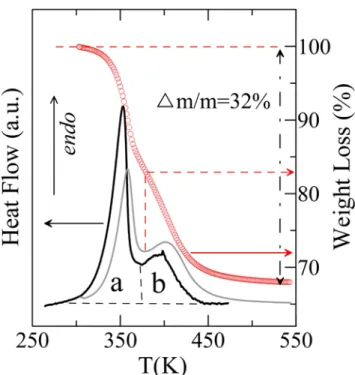
A few crystals together with a small quantity of mother liquor were subjected to thermogravimetric analyses. After the recorded mass reached a constant value at room temperature, the sample was assumed to be mother liquor free. It was subsequently heated to 550 K (Figure 5) with a constant heating rate of 2 K min-1. Experimental mass loss was found to be ca. 32%, i.e. very close to the expected value of 33% ( = 2×173.8 / 1067.7) for the C60:CBr2H2 = 1:2 molar ratio. The TG curve in Figure 5 clearly demonstrates that the
desolvation process takes place in two overlapping steps. It could indicate the formation of a solvate with a lower stoichiometry or the existence of a desorption process following the desolvation of the 1:2 solvate.
The same procedure as for the TG measurements was followed for the DSC measurements (Figure 5). Again, it can be observed that two thermal effects are convoluted as the endothermic peak (Tonset = 326 K) clearly consists of two overlapping peaks. In fact, the
derivative of the mass loss with respect to the temperature (gray curve in Figure 5, which results from the TG measurements) mimics the DSC signal even if a small shift in temperature exists.
Figure 5. Differential scanning calorimetry curve (black, left axis) and thermogravimetry
curve (red points, right axis) as a function of the temperature for the C60·2CBr2H2 solvate.
Grey curve corresponds to the derivative of the weight loss with respect to the temperature. The dashed red arrow indicates the mass loss at the minimum of the derivative (see text). The endothermic effect recorded by DSC and associated to the complete desolvation can be separated into peaks a and b, which respectively represent enthalpy changes of 73.9 J g-1 and 29.1 J g-1 related to the initial mass of the solvate.
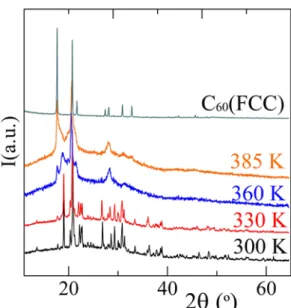
To investigate the two convoluted peaks in the desolvation process more closely, X-ray diffraction measurements were carried out on crystals in a closed capillary as a function of the temperature. Figure 6 shows several patterns between room temperature and 385 K, which is near the end of the second endothermic process. Patterns at intermediate temperatures reveal that the Bragg peaks of the monoclinic solvate remain clearly present up to 330 K above which the diffraction pattern appears of desolvated C60 partially amorphized by crystal defects
and stacking faults as commonly observed after desolvation of C60 solvates [16, 21, 22, 39]. It
Figure 6. X-ray patterns of the C60·2CBr2H2 solvate as a function of the temperature. The
pattern of pure FCC C60 is shown at the top for reference purposes.
4 Discussion
The desolvation process, which can be written as
C60·2CBr2H2 (s) → C60 (s) + 2 CBr2H2 (g) (1),
occurs in two steps as demonstrated by DSC as well as thermogravimetry by peaks a and b in Figure 5. The enthalpy change of the process is found to be 103 J g-1 of solvate (110.0 kJ mol
-1
of solvate) or 316 J g-1 of solvent (54.9 kJ mol-1 of solvent) by summing over peaks a and b as a whole. The total enthalpy is higher than the sublimation enthalpy of CBr2H2 of 46.2 kJ
mol-1 (obtained by adding the melting enthalpy, 9.2 kJ mol-1, and the vaporization enthalpy, 37 kJ mol-1 [40]). It implies that CBr2H2 and C60 attract each other relatively strongly in the
C60·2CBr2H2 solvate. The TG-curve indicates that the first peak is accompanied with a weight
loss of 16.3 % of the initial mass. This corresponds to the loss of about one of the two moles of CBr2H2 from the solvate C60·2CBr2H2 as 0.163 × 1068.31 g mol-1 = 174.1 g mol-1, which is
very close to the molar mass of the solvent of 173.8 g mol-1.
The bimodal thermal effect associated with the desolvation process was not caused by the formation of a second solvate as demonstrated by the X-ray experiments as a function of the temperature in Figure 6, because impure fcc C60 is observed in the temperature range related to peak b and no additional peaks of a possible new solvate have been observed. Because the desolvation process must occur first, the second step will be vaporization of the released solvent. Thus, after the desolvation process, CBr2H2 may first liquefy and remain temporarily
adsorbed to the C60 followed by evaporation. This can be summarized with the following two
steps:
C60·2CBr2H2 (s) → C60 (FCC) + CBr2H2 (l, adsorbed) (2)
C60 (FCC) + 2 CBr2H2 (l, adsorbed) → C60 (FCC) + 2 CBr2H2 (g) (3)
Peak a, which has an enthalpy change of 73.9 J g-1 (78.95 kJ mol-1) of initial solvate, consists of the complete destruction of the solvate network, step (2), and the evaporation of about 1 mol of solvent, half the step (3). Thus, the enthalpy change related to step (2) is found by subtracting the vaporization enthalpy of one mole of solvent (i.e. step 3) from 78.95 kJ mol-1 of initial solvate. This leads to ΔH(2) = 32.8 kJ mol-1 of initial solvate. The enthalpy change related to peak b (29.1 J g-1 of initial solvate) belongs to 83.7 % of the remaining sample, which coincidentally has a 1:1 mol ratio (one mol of solvent per mol of C60). The enthalpy
can therefore be expressed as 34.77 J g-1 of remaining sample or as 31 kJ mol-1 of desorbing and evaporating solvent. This value is of the same order as the enthalpy needed to desorb similar organic solvents from graphitized thermal carbon [41].
The X-ray diffraction results and the Rietveld refinement reveal a monoclinic (space group C2/m) crystal structure with overall orientationally ordered C60 and CBr2H2 molecules.
The structure is characterized by alternating planes consisting of either C60 or guest molecules
stacked along the c axis. The CBr2H2 molecule is located at [0, 0.2710(2), 0.5] in the unit cell,
while the position [0, 1/3, 1/2] corresponds to the prismatic void [1/3, 2/3, 1/2] of the hexagonal parent structure of C60 with space group P6/mmm. In fact, the monoclinic b axis in
the C-centered cell is approximately 2 × cos(30○) times the hexagonal a axis. Therefore, due to the identical packing and void filling, the structure of C60·2CBr2H2 can be regarded as a
distorted hexagonal one.
The refinement results appear to point to orientationally ordered molecules, both for C60
and CBr2H2 in the solvate structure. This is quite unusual, because in general in solvates with
small halogen-methane or –ethane derivatives, the C60 molecules, and often the solvent molecules too, are found to exhibit orientational disorder. For example, solvent molecules possessing C2v symmetry, such as CBr2Cl2 or CBr2(CH3)2, were found to be orientationally
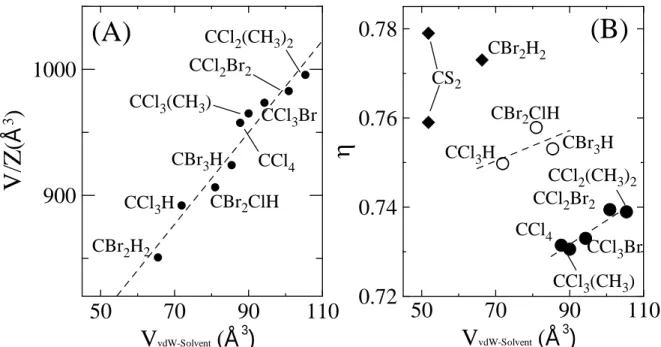
disordered in solvates with a hexagonal structure, whereas the packing of such solvates is very similar to the present one, as illustrated in Figure 7A.
The overall orientational order in the CBr2H2 solvate cannot be explained by the dipole
contrast to that of Br2CCl2 of 0.2 D, which both exhibit orientational disorder in their
respective solvates. To take a closer look at the host-guest interactions, excess volumes can be studied. Such volumes are defined as the difference between the measured volume of a solvate (defined as Vunit cell/Z, i.e. 1701.5/2=850.75 Å3) and the sum of the molecular volumes
of the C60 and solvent molecules from their respective pure structures. For C60, the molecular
volume is 710 Å3 from its FCC structure and the molecular volume of Br2CH2 was
determined as 95.175 Å3 from the structure by Kawaguchi et al. [33]. Accordingly, the excess volume is found to be negative: 850.75 – (710 + 2×95.175) =-49.6 Å3, which is relatively high and demonstrates the strong interaction between the C60 and solvent molecules.
The packing coefficient, η, of the present solvate can be determined as the van der Waals volumes of the solvate molecules divided by the measured solvate volume Vunit cell/Z. The van
der Waals volume of C60 is known to be 526 Å3 (the volume of a sphere with a ca. 5 Å radius)
and that of the CBr2H2 molecule has been determined through the Kitaigorodsky method [42]
as 66.3 Å3. With these values, a packing coefficient has been found of 0.773, which is higher than the packing coefficient of close packed C60 (η = 0.74) and that of the monoclinic (C2/m)
low-temperature ordered phase of CBr2H2 at 183 K (η = 0.70). It demonstrates that the
interaction between C60 and CBr2H2 is strong confirming the likelihood of an overall
orientational order of the solvate molecules. Figure 7B illustrates the high packing coefficient for the CBr2H2 solvate compared to other hexagonal solvates containing C60 and similar
solvent molecules. The only comparably sized solvate that exhibits orientational order for C60
and the solvent molecule too, the low-temperature orthorhombic solvate with CS2 has a
similar packing coefficient, ca. 0.78, as the present solvate (cf. Figure 7B). The corresponding high-temperature monoclinic solvate of CS2 on the other hand, which exhibits orientational
50
70
90
110
V
vdW-Solvent(Å
3)
900
1000
V
/Z
(Å
3)
CCl3H CBr2ClH CBr3H CCl4 CCl3(CH3) CCl3Br CCl2Br2 CCl2(CH3)2 CBr2H250
70
90
110
V
vdW-Solvent(Å
3)
0.72
0.74
0.76
0.78
η
CCl3H CBr2ClH CBr3H CCl4 CCl3(CH3) CCl3Br CCl2Br2 CCl2(CH3)2 CBr2H2 CS2(A)
(B)
Figure 7. (A) Measured, weighted unit-cell volumes (V/Z) of C60 solvates against the van der
Waals volume of its solvent molecule and (B) the packing coefficient as a function of the van der Waals volume of its solvent molecule. In (B), the values for the monoclinic (higher value) and orthorhombic (lower value) of 2C60·3CS2 solvate have been added. Dashed lines are
guides to the eyes.
5 Conclusions
The hexagonal solvate C60·2CBr2H2, which is stable in air, has been structurally and
thermodynamically characterized. The C60 molecules possess a hexagonal base structure,
which is deformed and becomes monoclinic due to the presence of solvent molecules. Notwithstanding the similarity of CBr2H2 with other solvent molecules that form C60
hexagonal solvates, in particular those with the same C2v molecular symmetry as CBr2Cl2 and
CBr2(CH3)2, the CBr2H2 solvate exhibits overall orientational order for both the C60 and the
CBr2H2 molecules, rarely seen in the other solvates. The orientational order is consistent with
the solvate’s stability, which has a high negative excess volume and a high desolvation enthalpy. All these physical properties demonstrate the strong host-guest interactions. Although the correct space group symmetry of the solvate is monoclinic (C2/m), the overall packing is very similar to the hexagonal packing found in many other solvates.
It is clear that the present solvate with CBr2H2 exhibits overall orientational order due to
strong interactions between C60 and its solvent molecule. This stands in clear contrast to the
cubane, which was claimed to be caused by topological molecular recognition between the convex surface of C60 and the concave cubane [28].
Acknowledgements
This work has been supported in part by the Spanish Ministry of Science and Innovation (grants FIS2014-54734-P) and the Catalan Government (grant 2014 SGR-581).
References
1. M.F. Meidine, P. B. Hitchcock, H. W. Kroto, R. Taylor, and D. R. M. Walton, J.Chem.Soc.,Chem. Commun. 20, 1534 (1992).
2. R. Céolin, V. Agafonov, D. André, A. Dworkin, H. Szwarc, J. Dugué, B. Keita, L. Nadjo, C. Fabre, and A. Rassat, Chem. Phys. Lett. 208, 259 (1993).
3. R.S. Ruoff, D.S.Tse, R. Malhotra, and D. C. Lorents, J. Phys. Chem. 97, 3379 (1993). 4. H. B. Bürgi, R. Restori, D. Schwarzenbach, A. L. Balch, J. W. Lee, B. C. Noll, and M.
M. Olmstead, Chem. Mater. 6, 1325 (1994) .
5. S. Pekker, G. Faigel, K. Fodor-Csorba, L. Gránásy, E. Jakab, and M. Tegze, Solid State Commun. 83, 423 (1992).
6. A. Graja, and R. Swietlik, Synth. Met. 70. 1417 (1995).
7. R. Céolin, V. Agafonov, B. Bachet, A. Gonthier-Vassal, H. Szwarc, S. Toscani, G. Keller, C. Fabre, and A. Rassat, Chem. Phys. Lett. 244, 100 (1995)
8. R. Swietlik, P. Byszewski, and E. Kowalska, Chem.Phys. Lett. 254, 73 (1996). 9. M. Barrio, D. O. Lopez, J. Ll. Tamarit, H. Szwarc, S. Toscani, and R. Céolin, Chem.
Phys. Lett. 260, 78 (1996).
10. H. He, J. Barras, J. Foulkes, and J. Klinowski, J. Phys. Chem. B. 101,117 (1997). 11. R. Céolin, V. Agafonov, S. Toscani, M. F. Gardette, A. Gonthier-Vassal, and H.
Szwarc, Fullerene Sci. Technol. 5, 559 (1997).
12. F. Michaud, M. Barrio, S. Toscani, D.O. López, J.Ll. Tamarit, V. Agafonov, H. Szwarc and R. Céolin, Phys. Rev. B. 57, 10351 (1998).
13. I. E. Grey, M. J. Hardie, T. J. Ness, and C. L. Raston, Chem.Commun. 12, 1139 (1999).
14. R. Céolin, J. Ll. Tamarit, D. O. López, M. Barrio, V. Agafonov, H. Alluchi, F. Mussa and H. Szwarc. Chem. Phys. Lett. 314, 21 (1999).
16. S. Toscani, H. Allouchi, J. Ll. Tamarit, D.O. López, M. Barrio, V. Agafonov, A. Rassat, H. Szwarc and R. Céolin. Chem. Phys. Lett. 330, 491 (2000).
17. F. Michaud, M. Barrio, D. O. López, J. Ll. Tamarit, V. Agafonov, S. Toscani, H. Szwarc, and R.Céolin. Chem. Mater. 12, 3595 (2000).
18. L. Wang, B. B. Liu, S. D. Yu, M. G. Yao, D. D. Liu, Y. Y. Hou, T. Cui, G. T. Zou, and B. Sundqvist, Chem. Mater. 18, 4190 (2006).
19. L. Wang, B. B. Liu, D. D. Liu, M. G. Yao, Y. Y. Hou, S. D. Yu, T. Cui, D. M. Li, and G. T. Zou, Adv.Mater.18, 1883 (2006).
20. R. Céolin, J. Ll. Tamarit, M. Barrio, D.O. López, S. Toscani, H. Allouchi, V. Agafonov, and H. Szwarc. Chem. Mater. 13, 1349 (2001).
21. P. Espeau, M. Barrio, D.O. López, J. Ll. Tamarit, R. Céolin, H. Allouchi, V. Agafonov, F. Masin and H. Szwarc, Chem. Mater. 14(1), 321 (2002).
22. M. Barrio, D.O. López, J. Ll. Tamarit, P. Espeau and R. Céolin, Chem. Mater. 15(1), 288 (2003).
23. R. Céolin, D.O. López, M. Barrio, J.Ll. Tamarit, P. Espeau, B. Nicolaï, H. Allouchi, and R. J. Papoular, Chem. Phys. Lett. 399, 401 (2004).
24. R. Céolin, J. Ll. Tamarit, M. Barrio, D. O. López, P. Espeau, H. Allouchi, and R.J. Papoular, Carbon. 43(2), 417 (2005).
25. R. Céolin, D. O. López, B. Nicolaï, P. Espeau, M. Barrio, H. Allouchi, and J. Ll. Tamarit, Chem. Phys. 342(1-3), 78 (2007).
26. H. Y. He, J. Barras, J. Foulkes and J. Klinowski, J. Phys. Chem. B. 101, 117 (1997). 27. M. Jansen and G. Waidmann, Z. Anorg. Allg. Chem. 621, 14 (1995).
28. S. Pekker, É. Kováts, G. Oszlányi, G. Bényei, G. Klupp, G. Bortel, I. Jalsovszky, E. Jakab, F. Borondics, K. Kamarás, M. Bokor, G. Kriza, K. Tompa, and G. Faigel, Nature. Mater. 4, 764 (2005).
29. M. M. Olmstead, F. Jiang, and A. L. Balch, Chem. Commun. 6, 483 (2000). 30. A. L. Balch, J. W. Lee, B. C. Noll and M. M. Olmstead, J. Chem. Soc. Chem.
Commun. 1, 56 (1993).
31. M. V. Korobov, A. L. Mirakian, N. V. Avramenko, E. F. Valeev, L. S. Neretin, Y. L. Slovokhotov, A. L. Smith, G. Olofsson and R. S. Ruo, J. Phys. Chem. B. 102, 3712 (1998).
32. M. Podsiadlo, K. Dziubek, M. Szafranski and A. Katrusiak, Acta. Cryst. B. 62, 1090 (2006).
33. T. Kawaguchi, M. Hijikigawa, Y. Hayafuji, M. Ikeda, R. Fukushima, and Y. Tomiie, Bull. Chem. Soc. Jpn. 46, 53(1973).
34. B. H. Torrie, O. S. Binbrek, I. P. Swainson, and B. M. Powell, Molec. Phys. 97, 581 (1997).
35. J. Ballon, V. Comparat, J. Pouxe, Nucl. Instrum. Methods. 217, 213 (1983). 36. MS Modeling (Materials Studio) version 5.5, http://www.accelrys.com
/mstudio/ms_modeling.
37. W. A. Dollase, J. Appl. Crystallogr. 19, 267 (1986)
38. L. W. Finger, D. E. Cox and A. P. Jephcoat, J. Appl. Cryst. 27, 892 (1994). 39. G. B. M. Vaughan, Y. Chabre, and D. Dubois, Europhys. Lett. 31, 525 (1995). 40. J. Laynez, I. Wadsö, A. Haug, J. Songstad, A. Pilotti, Acta Chem. Scand. 26, 3148
(1972)
41. N. N. Avgul and A. V. Kiselev, in Chemistry and Physics of Carbon, edited by P. L. Walker, Jr. (Dekker, New York, 1970) Vol. 6, p. 39.
![Figure 4. The molecular positions in the crystal structure of C 60 ·2CBr 2 H 2 approximately along the [100] direction (left panel) and along the [010] direction (right panel)](https://thumb-eu.123doks.com/thumbv2/123doknet/14566742.539098/8.892.119.721.275.508/figure-molecular-positions-crystal-structure-approximately-direction-direction.webp)