HAL Id: hal-00876389
https://hal.inria.fr/hal-00876389
Submitted on 24 Oct 2013
HAL is a multi-disciplinary open access archive for the deposit and dissemination of sci-entific research documents, whether they are pub-lished or not. The documents may come from teaching and research institutions in France or abroad, or from public or private research centers.
L’archive ouverte pluridisciplinaire HAL, est destinée au dépôt et à la diffusion de documents scientifiques de niveau recherche, publiés ou non, émanant des établissements d’enseignement et de recherche français ou étrangers, des laboratoires publics ou privés.
Can MDL Improve Unsupervised Chinese Word
Segmentation?
Pierre Magistry, Benoît Sagot
To cite this version:
Pierre Magistry, Benoît Sagot. Can MDL Improve Unsupervised Chinese Word Segmentation?. Sixth International Joint Conference on Natural Language Processing: Sighan workshop, Oct 2013, Nagoya, Japan. pp.2. �hal-00876389�
Can MDL Improve Unsupervised Chinese Word Segmentation?
Pierre Magistry
Alpage, INRIA & Univ. Paris 7, 75013 Paris, France [email protected]
Benoît Sagot
Alpage, INRIA & Univ. Paris 7, 75013 Paris, France [email protected]
Abstract
It is often assumed that Minimum Descrip-tion Length (MDL) is a good criterion for unsupervised word segmentation. In this paper, we introduce a new approach to unsupervised word segmentation of Man-darin Chinese, that leads to segmentations whose Description Length is lower than what can be obtained using other algo-rithms previously proposed in the litera-ture. Suprisingly, we show that this lower Description Length does not necessarily corresponds to better segmentation results. Finally, we show that we can use very basic linguistic knowledge to coerce the MDL towards a linguistically plausible hypoth-esis and obtain better results than any pre-viously proposed method for unsupervised Chinese word segmentation with minimal human effort.
1 Introduction
In Chinese script, very few symbols can be con-sidered as word boundary markers. The only easily identifiable boundaries are sentence begin-nings and endings, as well as positions before and after punctuation marks. Although the script doesn't rely on typography to define (orthographic) “words”, a word-level segmentation is often re-quired for further natural language processing. This level corresponds to minimal syntactic units that can be POS-tagged or used as input for pars-ing.
Without word-boundary characters, like whites-pace in Latin script, there is no trivial tokenization method that can yield a good enough approxima-tion for further processing. Therefore, the first step of many NLP systems for written Chinese is the Chinese word segmentation task.
A great variety of methods have been proposed in the literature, mostly in supervised machine
learning settings. Our work addresses the ques-tion of unsupervised segmentaques-tion, i.e., without any manually segmented training data. Although supervised learning typically performs better than unsupervised learning, we believe that unsuper-vised systems are worth investigating as they re-quire less human labour and are likely to be more easily adaptable to various genres, domains and time periods. They can also provide more valuable insight for linguistic studies.
Amongst the unsupervised segmentation sys-tems described in the literature, two paradigms are often used: Branching Entropy (BE) and Mini-mum Description Length (MDL). The system we describe in this paper relies on both. We introduce a new algorithm which searches in a larger hy-pothesis space using the MDL criterion, thus lead-ing to lower Description Lengths than other previ-ously published systems. Still, this improvement concerning the Description Length does not come with better results on the Chinese word segmenta-tion task, which raises interesting issues. However, it turns out that it is possible to add very simple constraints to our algorithm in order to adapt it to the specificities of Mandarin Chinese in a way that leads to results better than the state-of-the-art on the Chinese word segmentation task.
This paper is organized as follows. Section 2 describes the role of Branching Entropy in various previous works on Chinese word segmentation, in-cluding the algorithm we use as an initialisation step in this paper. In Section 3 we explain how the MDL paradigm is used amongst different Chi-nese word segmentation systems in the literature. We describe in Section 4 the way we use MDL for trying and improving the results of the initialisa-tion step. A first evaluainitialisa-tion and the error analysis given in Section 5 allow us to refine the algorithm and achieve our best results, as shown in Section 6. Finally, we discuss our findings and their implica-tions for our futur work in Section 7.
2 Branching Entropy and Word Segmentation
2.1 The Harrissian hypothesis
Branching Entropy and its discrete counterpart, Accessor Variety are commonly used indicators of linguistically relevant boundaries.
Accessors Variety (hereafter AV) is simply the number of distinct contexts (right or left) in which a given string occurs in a corpus. Branching En-tropy (hereafter BE) can be seen as a continuous version of AV that takes into account the probabil-ity distribution of cooccurrences. It is the entropy of the probability distribution of the contexts oc-curring on the right or on the left of a given string. Both measure the diversity of the contexts in which a string can occur.
The main idea behind the use of AV for unsu-pervised word segmentation was first introduced by Harris (1955) as a procedure from morpheme segmentation in phonemic transcription of speech. In 1955, Harris did not use a corpus to estimate the AV but asked native speakers of various languages how many phonemes they can think of that can fol-low or precede a given phoneme sequence. Har-ris made the hypothesis that linguistic boundaries relate with the variation of the AV and proposed algorithms to perform segmentation based on the data collected from native speakers. The under-lying idea is the following: when given a prefix of a morpheme as input, we have a certain knowl-edge of what may be the next phoneme; the vari-ety of possible continuations decreases as we add phonemes to the input string, but when reaching a linguistic boundary, the variety of what may come next suddenly increase.
2.2 Variation of Branching Entropy
Kempe (1999) adapted the method proposed by Harris to corpus linguistics and did the switch from variation of AV to variation of BE (hereafter VBE) which is a better estimation of uncertainty.
Branching Entropy (Right and Left) can be defined as follows: given an n-gram x0..n = x0..1x1..2. . . xn−1..n with a left context χ→, its
Right Branching Entropy (RBE) h→(x0..n)writes as
h→(x0..n) = H(χ→| x0..n)
=− ∑
x∈χ→
P (x| x0..n)log P (x| x0..n).
The Left Branching Entropy (LBE) is defined symetrically: if we call χ← the right context of x0..n, its LBE is defined as:
h←(x0..n) = H(χ←| x0..n).
From h→(x0..n) and h→(x0..n−1) on the one hand, and from h←(x0..n) and h←(x1..n) on the other hand, we can defined the Variation of Branching Entropy (VBE) in both directions:
δh→(x0..n) = h→(x0..n)− h→(x0..n−1) δh←(x0..n) = h←(x0..n)− h←(x1..n). 2.3 Previous work on VBE-based
segmentation
Several unsupervised segmentation algorithms and systems in the literature are based on BE or VBE. Cohen et al. (2002) use BE as an indicator in their Voting Experts system. They point the need for normalisation but use BE directly, not VBE.
Jin and Tanaka-Ishii (2006) propose a system for unsupervised Chinese word segmentation based on the VBE and evaluate it against a manually seg-mented corpus in Mandarin Chinese.
Zhikov et al. (2010) use BE to get an initial segmentation. They put a boundary at each po-sition that exceeds a threshold. This threshold is determined by an unsupervised procedure based on MDL. They refine this initial segmentation us-ing two different procedures, also based on BE, which aim at minimizing the Description Length (see next section).
Wang et al. (2011) propose ESA (Evaluation, Selection, and Adjustment), a more complex sys-tem combining two measures of cohesion and non-cohesion iteratively. The Branching Entropy is also at the root of their calculations. They achieve best published results but rely on a parameter used to balance the two measures that can be difficult to set without training data.
In Magistry and Sagot (2012), we use a nor-malized VBE to define a measure of the auton-omy of a string (word candidate). The auton-omy of a word candidate x is defined as a(x) = ˜
δh←(x) + ˜δh→(x)where ˜δh(x)denotes VBE nor-malized in order to reduce the bias related to the variation of word lengths. This autonomy function is then used in a segmentation algorithm that max-imize the autonomy of all the words in a sentence. The segmentation choosen for a given sentence s
is then chosen among all possible segmentations w∈ Seg(s) as being arg max W∈Seg(s) ∑ wi∈W a(wi)· len(wi),
Our results were slightly below ESA, but the system is simpler to implement and improve on; moreover, it does not rely on any parameter for which a value must be chosen.1
The system presented in this paper extends both the work of Zhikov et al. (2010) and of Magistry and Sagot (2012): we rely on the notion of au-tonomy introduced by the latter and use it both for computing an initial segmentation and for guiding the MDL in a way inspired by the former.
3 MDL and Word Segmentation
The Minimum Description Length was introduced by Rissanen (1978). It can be considered as an approximation of the Kolmogorov complexity or as the formalisation of the principle of least ef-fort (Zipf, 1949) by a compression model. The underlying idea behind the use of MDL for Word Segmentation is the following: once a corpus is segmented, it can be recoded as a lexicon and a sequence of references to the lexicon. A good seg-mentation should result in a more compact rep-resentation of the data. Probability distributions of lexical items in the corpus and Shannon en-tropy are used to determine the theoretically op-timal compression rate we could achieve with a given segmentation.
A segmented corpus is therefore considered as a sequence of words encoded using a lexicon, or word model, Mw, which represent each word using
a code that depends on its frequency: a frequent word is to be represented by a shorter code. The description length L(C) of a corpus C can then be computed as the length L(Mw) of the lexicon
plus the length L(D|Mw)of the sequence of word
codes:
L(C) = L(D, Mw) = L(Mw) + L(D|Mw).
1With the current impletation of our algorithm presented in (Magistry and Sagot, 2012), the results are not as good as those from the previous paper. This is due to a bug in nor-malisation which used to include values of sentence initial and final dummy tokens. This was creating a biais in favor of one-character units and yields better scores. Our latest version of the system, which is used in this paper sticks to the definitions and is thus cleaner but does not perform as well.
The content of the lexicon can be further encoded as a sequence of characters, using a model Mc
ac-counting for characters probability distributions in the lexicon. As a result,
L(Mw) = L(Dw, Mc) = L(Mc) + L(Dw|Mc). L(D|M) is given by: L(D|M) = − |M| ∑ i=1 #wilog #wi N
As shown for example by Zhikov et al. (2010), it is possible to decompose this formula to allow fast update of the DL value when we change the seg-mentation and avoid the total computation at each step of the minimization.
MDL is often used in unsupervised segmenta-tion systems, where it mostly plays one of the two following roles: (i) it can help selecting an optimal parameter value in an unsupervised way (Hewlett and Cohen, 2011), and (ii) it can drive the search for a more compact solution in the set of all possi-ble segmentations.
When an unsupervised segmentation model re-lies on parameters, one needs a way to assign them adequate values. In a fully unsupervised setup, we cannot make use of a manually segmented cor-pus to compute these values. Hewlett and Cohen (2011) address this issue by choosing the set of pa-rameters that yields the segmentation associated with the smallest DL. They show that the output corresponding to the smallest DL almost always corresponds to the best segmentation in terms of word-based f-score. In the system by Zhikov et al. (2010), the initial segmentation algorithm requires to chose a threshold: for a given position in the cor-pus, they mark the position as a word boundary if the BE is greater than the threshold. The value of this threshold is unsupervisingly discovered with a bisection search algorithm that looks for the small-est DL.
However, the main issue with MDL is that there is no tractable search algorithm for the whole hy-pothesis space. One has to rely on heuristic proce-dures to generate hypotheses before checking their DL. (Zhikov et al., 2010) propose two distinct pro-cedures that they combine sequentially. The first one operate on the whole corpus. They begin by ordering all possible word-boundary positions us-ing BE and then try to add word boundaries check-ing each position sorted by decreascheck-ing BE, and to
remove word boundaries checking each position by increasing order of BE. They accept any modifi-cation that will result in a smaller DL. The ratio-nale behind this strategy is simple: for a given po-sition, the higher the BE, the more likely it is to be a word-boundary. They process the more likely cases first. The main limitation of this procedure is that it is unable to change more than one posi-tion at a time. It will miss any optimisaposi-tion that would require to change many occurrences of the same string, e.g., if the same mistake is repeated in many similar places, which is likely to happen given their initial segmentation algorithm.
To overcome this limitation, Zhikov et al. (2010) propose a second procedure that focuses on the lex-icon rather than on the corpus. This procedure al-gorithm tries (i) to split each word of the lexicon (at each position within each word type) and re-produce this split on all occurrences of the word, and (ii) to merge all occurrences of each bi-gram in the corpus provided the merge results in an already existing word type. This strategy allows them to change multiple positions at the same time but their merging procedure is unable to discover new long types that are absent from the initial lexicon.
4 A new segmentation Algorithm based on MDL and nVBE
We propose a new strategy to reduce the DL. We use the algorithm introduced in Magistry and Sagot (2012) as an initialisation procedure fol-lowed by a DL reduction step. This step relies on an autonomy-driven algorithm that explores a larger part of the hypothesis space, which we shall now describe.
Given an initial segmentation of the corpus, we define a scoring function for boundary positions. As our initial procedure is based on the maxi-mization of autonomy, any change at any position will result in a lower autonomy of the sequence. Our scoring function evaluates this loss of auton-omy whenever a segmentation decision is changed. This can be viewed as similar to the ordered n-best solutions from Magistry's procedure.
The context of a boundary position is defined as a triple containing:
a position state between two characters, i.e., a boolean set to true if the position is a word boundary,
a prefix which is the sequence of characters
run-ning from the previous word boundary to the position,
a suffix which is the sequence of characters run-ning from the position to the next word boundary.
When scoring a position, there are two possibili-ties:
• the position is currently a word boundary (we evaluate a merge),
• the position is currently not a word boundary (we evaluate a split).
In order to compute the difference in autonomy scores between the current segmentation and the one which is obtained only by performing a merge at one particular position, we simply have to sub-tract the autonomy of the prefix and suffix and to add the autonomy of the concatenation of the two strings.
Similarly, to evaluate a splitting decision we have to add the autonomy of the prefix and suffix and to subtract the autonomy of the concatenation of the two strings.
Note that with this scoring method and this def-inition of a context as a tuple, all occurrences of a context type will have the same score, and can therefore be grouped. We can thus evaluate the ef-fect of changing the segmentation decision for a set of identical positions in the corpus in just one step. Like the lexicon cleaning procedure by Zhikov et al. (2010), we can evaluate the effect of a large number of changes at the same time. But contra-trily to Zhikov et al. (2010), because we process the whole corpus and not the lexicon, we have a broader search space which allows for the creation of large words even if they were previously absent from the lexicon.
A remaining issue is that changing a segmenta-tion decision at a particular posisegmenta-tion should result in a change of the scores of all the neighbouring positions inside its prefix and its suffix and require to rebuild the whole agenda, which is a costly oper-ation. To make our algorithm faster, we use a sim-plified treatment that freezes the affected positions and prevent further modification (they are simply removed from the agenda). As the agenda is sorted to test the more promising positions first (in terms of autonomy), this trade-off between exhaustive-ness for speed is acceptable. Indeed, it turns out
Algorithm 4.1: algorithm1(Corpus)
seg← MagistrySagot2012(Corpus) DL← DescriptionLength(seg) M inDL← ∞
Agenda← SortBoundaries(Corpus, seg)
while DL < M inDL do M inDL← DL
for each changes∈ Agenda
do
changes← removeF rozen(changes) newDL =Score(changes) if newDL < M inDL then do seg← ApplyChange(changes) freeze(changes) DL← newDL break Figure 1: DL minimization
that we still reach lower description length than Zhikov et al. (2010).
The details of our minimization of DL algorithm using this scoring method are presented in figure 4. As we shall see, this system can be further im-proved. We shall therefore refer to it as the base system.
5 Evaluation of the base system 5.1 Reference corpora
The evaluation presented here uses the corpora from the 2005 Chinese Word Segmentation Bake-off (Emerson, 2005). These corpora are available from the bakeoff website and many previous works use them for evaluation, results are therefore eas-ily comparable. This dataset also has the advan-tage of providing corpora that are segmented man-ually following four different guidelines. Given the lack of consensus on the definition of the min-imal segmentation unit, it is interesting to evalu-ate unsupervised systems against multiple guide-lines and data sources: since an unsupervised sys-tem is not trained to mimic a specific guideline, its output may be closer to one or another. The dataset includes data from the Peking University Corpus (PKU), from the LIVAC Corpus by Hong-Kong City-University (City-U), from Microsoft Research (MSR) and from the Balanced Corpus of the Academia Sinica (AS). It was initially intended for supervised segmentation so each corpus is di-vided between a training and a test set, the latter be-ing smaller. We retain these splits in order to pro-vide results comparable with other studies and to
Corpus Words Characters Tokens Types Tokens Types
AS 5 449 698 141 340 8 368 050 6 117 CITYU 1 455 629 69 085 2 403 355 4 923 PKU 1 109 947 55 303 1 826 448 4 698 MSR 2 368 391 88 119 4 050 469 5 167
Table 1: Size of the different corpora have an idea of the effect of the size of the training data. All the scores we provide are computed on the test set of each corpus. As our task is unsuper-vised segmentation, all whitespaces were of course removed from the training sets. Details about the size of the various corpora are given in Table 1. 5.2 Evaluation Metrics
The metric used for all following evaluations is a standard f-score on words. It is the harmonic mean of the word recall
Rw =
#correct words in the results #words in the gold corpus and the word precision
Pw =
#correct words in the result #words in the result , which leads to the following:
Fw =
2× Rw× Pw
Rw+ Pw
For each corpus and method, we also present the Description Length of each segmentation.
Note that, as mentioned by several studies (Huang and Zhao, 2007; Magistry and Sagot, 2012; Sproat and Shih, 1990), the agreement be-tween the different guidelines and even bebe-tween untrained native speakers is not high. Using cross-trained supervized systems or inter-human agree-ment, these studies suggest that the topline for unsupervised segmentation is beetween 0.76 and 0.85. As a result, not only the output of an un-supervised system cannot be expected to perfectly mimic a given “gold” segmented corpus, but per-formances around 0.80 against multiple “gold” segmented corpora using different guidelines can be regarded as satisfying.
5.3 Results
The results of our base system, without and with our MDL step, are presented in Table 2. We also
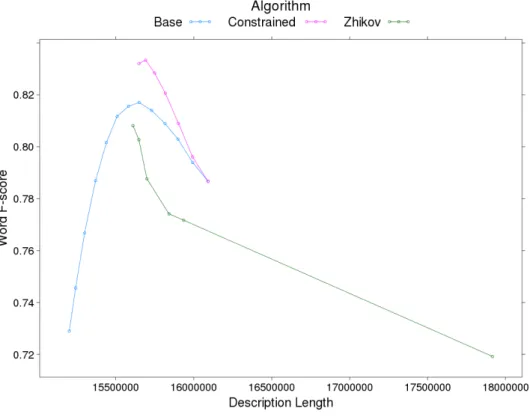
Figure 2: f-score on words as a function of description length for the three algorithms provide results for our re-implementation of the
al-gorithm by Zhikov et al. (2010), without and with their own MDL step. Our initialisation (without our MDL step) obtains very good results; on the MSR corpus, they are even as high as the results of Zhikov et al.'s full algorithm, including their MDL step. However, at a first sight, the results we get when using our MDL procedure are disappointing: it sometimes worsen the results of the initisalisa-tion step. However, we observe that our MDL step succesfully decreases the Description Lengths ob-tained after the initialisation step, and leads to De-scription Lengths lower than Zhikov et al.'s sys-tem although with lower f-scores. This tackles the common idea that lower Description Length yields better segmentation, and calls for further analysis. 5.4 Step-by-step MDL results
In both systems, ours and Zhikov et al.'s, the MDL algorithm is iterative. We therefore decided to dump intermediary results at each iteration to ob-serve the evolution of the segmentation quality as the DL gets smaller. Figure 5.3 shows the resulting f-scores as a function of the DL at different stages, on the PKU corpus (results on other corpora be-have similarly). Each iteration of one MDL algo-rithm or the other reduces the DL, which means
that a given curve on this graphic are followed by the corresponding system step after step from right to left. The leftmost dot on each curve corresponds to the point when the corresponding system de-cides to stop and produce its final output.
This graphic shows that our system produces better segmentation at some point, outperforming Zhikov et al.'s system. But it doesn't stop at that point and the f-score drops as the DL continue to decrease. This seems to mean that our algorithm, because it explores a larger search space, manages to find segmentations that are optimal as far as DL is concerned, but that do not constitute optimal word-level segmentation.
In order to better understand what is going on, we have added a logging functionality to our im-plementations, so we can check which operations are made when the f-score decreases. We shall now discuss several typical examples thereof. 5.5 Error analysis
A sample of the latest modifications made by our system while the f-score is falling is given in Ta-ble 3. We show the modification that are applied to the largest numbers of occurrences. The type of operation is either a merge (suppression of a boundary) or a split (adding a boundary). We
pro-Method f-score DL
(Mb) PKU corpus
Zhikov et al. (no MDL) 0.719 17.9 Zhikov et al. (with their MDL) 0.808 15.6 This paper (no MDL) 0.786 16.1 This paper (with our base MDL) 0.729 15.2
Gold 1.0 15.0
City-U corpus
Zhikov et al. (no MDL) 0.652 23.2 Zhikov et al. (with their MDL) 0.787 19.8 This paper (no MDL) 0.744 20.3 This paper (with our base MDL) 0.754 19.3
Gold 1.0 19.0
MSR corpus
Zhikov et al. (no MDL) 0.690 37.1 Zhikov et al. (with their MDL) 0.782 31.9 This paper (no MDL) 0.782 33.0 This paper (with our base MDL) 0.690 31.1
Gold 1.0 30.8
AS Corpus
Zhikov et al. (no MDL) 0.614 80.8 Zhikov et al. (with their MDL) 0.762 67.1 This paper (no MDL) 0.758 68.9 This paper (with our base MDL) 0.711 65.7
Gold 1.0 65.3
Table 2: Scores on different Corpora for Zhikov et al.'s (2010) algorithm (without and with their MDL-based improvement step) and for our base system (without MDL and with our base MDL al-gorithm). Final results are displayed in Table 6 vide the prefix and suffix, whether the merge or split is an error or not, as well as English glosses.
The first observation we make is that amongst highly frequent items, our system only performs merges. Splits are indeed performed on a large number of rare types for which both the prefix and the suffix exist in the lexicon. We note that for bi-grams, such splits are almost always an erroneous decision.
Merge operations include valid decisions, erro-neous decisions producing multi-word expression units (MWE), and erroneous decisions that merge a grammatical word to one of its collocations.
6 Description and evaluation of our constrained system
Given this error analysis, there are three main types of common mistakes that we would like to avoid:
• merging MWEs such as named entities; • merging function words with content words
when the co-occurrence is frequent;
Operation String Evaluation
merge 的 . 发展 error DE - development
merge 据 . 新华社 error According to - Xinhua Agency merge 新华社 . 北京 error
Xinhua Agency - Peking
merge 经济 . 发展 error (MWE) economic - growth merge 进行 . 了 error conduct - LE (-ed) merge 和 . 发展 error AND - development merge 在 . 北京 error AT - Peking
merge 邓小平 . 理论 error (MWE) Deng Xiaoping - Theories
merge 领导 . 干部 error (MWE) leading - cadre
merge 常 . 委会 error (MWE) standing - committee
merge 改革 . 开放 error (MWE) reform and opening
merge 反 . 腐败 correct anti - corruption merge 节 . 日 correct holi-day merge 党 . 中央 correct central committee
merge 金融 . 危机 error (MWE) finance - crisis
merge 新 . 世纪 error new - century
merge 副 . 总理 correct vice - premier
merge 国民 . 经济 error (MWE) national - economy
merge 北京 . 市 no
Peking - city
merge 基础 . 上 error basis - postposition (=basically) merge 副 . 主席 correct
vice-chairman
merge 结构 . 调整 error (MWE) structural adjustment
merge 产业 . 化 correct industrial - ize
merge 现代化 . 建设 error (MWE) modernization - drive
merge 人 . 大 correct Acronym for Renmin University
Table 3: Modification made (sorted by number of occurrences)
Method f-score DL
(Mb) PKU corpus
Zhikov et al. (with their MDL) 0.808 15.6 This paper (with constrained MDL) 0.832 15.6
Gold 1.0 15.0
City-U corpus
Zhikov et al. (with their MDL) 0.787 19.8 This paper (with constrained MDL) 0.801 19.8
Gold 1.0 19.0
MSR corpus
Zhikov et al. (with their MDL) 0.782 31.9 This paper (with constrained MDL) 0.809 32.1
Gold 1.0 30.8
AS Corpus
Zhikov et al. (with their MDL) 0.762 67.1 This paper (with constrained MDL) 0.795 67.3
Gold 1.0 65.3
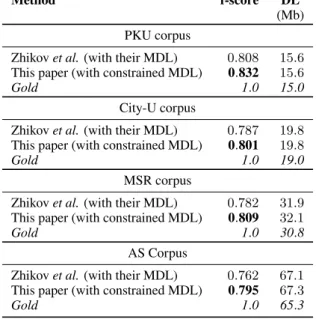
Table 4: Final results
• splitting bigrams that were correct in the ini-tial segmentation.
If we give up on having a strictly language-independent system and focus on Mandarin Chi-nese segmentation, these three issues are easy to address with a fairly low amount of human work to add some basic linguistic knowledge about Chi-nese to the system.
The first issue can be dealt with by limiting the length of a merge's output. A MWE will be larger than a typical Chinese word that very rarely ex-ceeds 3 characters. With the exception of phonetic loans for foreign languages, larger units typically correspond to MWE that are segmented in the var-ious gold corpora.2 The question whether it is a good thing to do or not will be raised in the dis-cussion section, but for a higher f-score on word segmentation, leaving them segmented does help. The second issue can be addressed using a closed list of function words such as aspectual markers and pre/post-positions. As those are a closed list of items, listing all of them is an easily manually tractable task. Here is the list we used in our experiments:
的、了、上、在、下、中、是、有、和、与、 和、就、多、于、很、才、跟
As for the third issue, since Chinese is known to favour bigram words, we simply prevent our sys-tem to split those.
2A noticeable exception are the 4-characters idioms (chengyu) but they seem less frequent than 2+2 multiword expressions.
We implemented these three constraints to re-strict the search space for our minimization of the Description Length an re-run the experiments. Re-sults are presented in the next section.
6.1 Evaluation of the constrained system The scores obtained by our second system are given in Table 6. They show a large improvement on our initial segmentation and outperform previ-ously reported results.
7 Discussion and futur work
The results presented in this paper invite for dis-cussion. It is well accepted in the literature that MDL is a good indicator to find better segmen-tation but our results show that it is possible to reach a lower description length without improv-ing the segmentation score. However, this paper also demonstrates that MDL can still be a relevant criterion when its application is constrained using very simple and almost zero-cost linguistic infor-mation.
The constraints we use reflect two underlying linguistic phenomena. The first one is related to what would be called “multi-word expressions” (MWE) in other scripts. It is unclear whether it is a limitation of the segmentation system or a problem with the definition of the task. There is a growing interest for MWE in the NLP community. Their detection is still challenging for all languages, but has already been proven useful for deeper analysis such as parsing. It is somewhat frustrating to have to prevent the detection of multi-words expressions to achieve better segmentation results.
The second restriction concerns the distinction between content words and grammatical words. It is not so surprising that open and closed classes of words show different distributions and deserve specific treatments. From a practical point of view, it is worth noting that MDL is useful for open classes where manual annotation or rule-based processing are costly if even possible. On the other hand, rules are helpful for small closed classes and represent a task that is tractable for human, even when facing the need to process a large variety of sources, genres or topics. This division of labour is acceptable for real-world applications when no training data is available for supervised systems.
References
Paul Cohen, Brent Heeringa, and Niall Adams. 2002. An unsupervised algorithm for segmenting categor-ical timeseries into episodes. Pattern Detection and Discovery, page 117–133.
Thomas Emerson. 2005. The second international chi-nese word segmentation bakeoff. In Proceedings of the Fourth SIGHAN Workshop on Chinese Language Processing, volume 133.
Zellig S. Harris. 1955. From phoneme to morpheme. Language, 31(2):190–222.
Daniel Hewlett and Paul Cohen. 2011. Fully unsu-pervised word segmentation with bve and mdl. In Proceedings of the 49th Annual Meeting of the Asso-ciation for Computational Linguistics: Human Lan-guage Technologies: short papers, volume 2, pages 540--545.
Changning. Huang and Hai Zhao. 2007. 中文分词十 年回顾 (Chinese word segmentation: A decade re-view). Journal of Chinese Information Processing, 21(3):8–20.
Zhihui Jin and Kumiko Tanaka-Ishii. 2006. Unsuper-vised segmentation of Chinese text by use of branch-ing entropy. In Proceedbranch-ings of the COLING/ACL on Main conference poster sessions, page 428–435. André Kempe. 1999. Experiments in unsupervised
entropy-based corpus segmentation. In Workshop of EACL in Computational Natural Language Learn-ing, page 7–13.
Pierre Magistry and Benoît Sagot. 2012. Unsupervized word segmentation: the case for mandarin chinese. In Proceedings of the 50th Annual Meeting of the Association for Computational Linguistics: Short Papers-Volume 2, pages 383--387. Association for Computational Linguistics.
Jorma Rissanen. 1978. Modeling by shortest data de-scription. Automatica, 14(5):465--471.
Richard W. Sproat and Chilin Shih. 1990. A statisti-cal method for finding word boundaries in Chinese text. Computer Processing of Chinese and Oriental Languages, 4(4):336–351.
Hanshi Wang, Jian Zhu, Shiping Tang, and Xiaozhong Fan. 2011. A new unsupervised approach to word
segmentation. Computational Linguistics, 37(3):
421–454.
Valentin Zhikov, Hiroya Takamura, and Manabu Oku-mura. 2010. An efficient algorithm for unsupervised word segmentation with branching entropy and mdl. In Proceedings of the 2010 Conference on Empiri-cal Methods in Natural Language Processing, pages 832--842. Association for Computational Linguis-tics.
George Kingsley Zipf. 1949. Human Behaviour and the Principle of Least-Effort. Addison-Wesley.