THE BEHAVIORAL AND BRAIN SCIENCES (1984) 7, 367-412 Printed in the United States of America
The scope of neuroethology
Graham Hoyle
Institute of Neuroscience, University of Oregon, Eugene, Oreg. 97403
Abstract: Neuroethology, an interdisciplinary subdivision of neuroscience, has emerged in recent years. Since 1976 there has been a regular session under this heading at the annual meeting of the Society for Neuroscience. In 1980 two introductory texts in English were published on the subject (Ewert 1980; Guthrie 1980), and a third (Camhi 1984) was published recently. There is widespread interest in neural mechanisms underlying behavior, but they encompass such a vast array of often unrelated topics that proponents do not share common goals. This article describes the emergence of ethology as a discipline, pointing out that its practitioners were successful because they confined their research to stereotyped, complex, nonlearned, innate behavioral acts. A limited number of profoundly significant principles emerged. Each of these is redefined. The major concepts of earlier ethology were embodied in a simple hydraulic model used by Konrad Lorenz in 1949 (Lorenz 1950). It is pointed out that this model implies the existence of common neurophysiological mechanisms and neuronal circuitry. This model has now been made obsolete by neurophysiological progress, but with appropriate modifications an updated version may still be useful in focusing attention on possible principles. The initial aim of neuroethology should be to examine the neurophysiological events in a variety of behaviors, exhibited by diverse animals from different phyla, which meet the criteria of innate behavioral acts. The behaviors should be sufficiently complex to interest ethologists, yet they should be addressable with neurophysiological methods down to the cellular level. In the case of vertebrates this may mean working with brain slices as well as whole animals, but for some invertebrates recording should be possible in the nearly intact animal during execution of the behavior. The work will be exacting and very difficult, and it is not likely to get done at all unless neuroethologists recognize that they should both train and discipline themselves and restrict their attention to well-defined goals.
Keywords: behavioral biology; behavior patterns; ethology; fixed action patterns (FAPs); instinct; learning; Lorenz; motor programs; neuroethology
Historical origins of ethology
A scientific discipline of neuroethology could not have existed either before the term "ethology" had become established or before neuroscience had developed to the point where both neuroanatomical and neurophysiologi-cal methods were available that could be used to attack ethological questions. There is a strong tendency to equate neuroethology with the neural bases of behavior in the broadest sense. To do so encompasses such a broad spectrum of phenomena that the extremes are virtually unrelated and can only be linked by the widest stretches of imagination. Such links are too tenuous. If the term "neuroethology" is to serve the useful purpose of identi-fying a group of active scholar-investigators sharing com-mon goals, to bring them together and stimulate their research, it must be relatively narrowly defined. There are clearly dangers in defining any subject too narrowly, because this can lead to the arbitrary exclusion from serious consideration of information, especially of that yet to be discovered, that is truly relevant and significant for the mainstream. But the danger is much less than that associated with using a definition that is too broad. Unless the focus is restricted, the subject matter expands into a diffuse vapor without any substance at all.
The first potential trap is to assume that the term is merely a faddish one, culled to draw attention to a previously nameless but ancient line of inquiry. The first
experimental investigations into the possible functional relations of a nervous system to behavior were undoubt-edly those of Galen made 1,800 years ago. There is a direct line from his unparalleled starts, through the ideas of Descartes and the experiments of Francis Glisson and Albrecht Haller, via Charles Bell and Francois Magen-die, to those of Johannes Miiller and his pupil Emil du Bois-Reymond, who can be considered to have founded modern experimental neuroscience. Spice the above with some Galvani, Hall, Helmholtz, Weber and Bern-stein; then mix with some Gall (no pun intended), Fechner, Wundt and Titchener, and finally, a liberal dash of Pavlov and Sherrington, bake, cool, then top off with an icing of Cajal and Golgi, and you have neuroscience cake. The point is that here we have the product of the combined histories of much of physiology, medical neu-roanatomy, and psychophysics. But still this was not nearly enough to provide a satisfactory basis for the understanding of behavior, although in many circles, especially Russian and British ones, it was considered more than adequate. Even a generation of American pioneers in the study of behavior, Whitman (1819), Craig (1918), McDougall (1923), Russell (1934) and eventually B. F. Skinner [see special issue on the work of B. F. Skinner, BBS 7(4) 1984], had failed to realize that some-thing important had been left out. Fortunately, careful and systematic examination of examples of the behavior, in natural rather than laboratory settings, of a variety of
Hoyle: Neuroethology
animal species, especially of relatively lowly forms in-cluding invertebrates (though mainly insects), enabled a group of Middle-European zoologists to detect some very important missing ingredients in the mixture.
For the animal kingdom as a whole, the majority of even the most complex behaviors, the ones with the longest sequences of coordinated movements and the subtlest interactions with other individuals of the same species, fall into the category of instinctive acts. They require no experience of the behavior in its context, nor learning, for their perfect execution. Such behavioral sequences can be broken down into a few discrete compo-nents, each a distinct act or subroutine. Some of the acts could be recognized as also being performed by related, but different, species in which they occurred in a differ-ent sequence. In a few instances it has been possible to show that Mendelian laws apply to the inheritance of the ability to perform these acts.
The realization that there is genetic involvement with chunks of behavior provided a major breakthrough in the understanding of how complex behaviors have evolved. Natural selection clearly acts on the totality of the behav-ior. But at some evolutionary stage, what eventually became a subroutine must have been a complete behav-ior. Possibly an entire subroutine can appear as a muta-tion and become incorporated in a sequence if it confers selective advantage. But in spite of the simplicity and fundamental importance of these findings, they sank into the minds of a majority of both behavioral scientists and physiologists very slowly. In fact, it was not until the 1973 Nobel Prize for physiology or medicine was awarded to Konrad Lorenz, Niko Tinbergen, and Karl von Frisch for their pioneering studies in these aspects of behavior that the majority of psychologists and biologists interested in behavior even accorded the work any attention. When the news broke in the United States, it did not receive the customary plaudits associated with Nobel prize an-nouncements in most of the relevant quarters. Quite the contrary! While the furor was still raging, students of animal behavior were crowding libraries trying to find out what these "unknowns" had discovered; indeed - what was the fuss all about? Details may be found in a fascinat-ing historical account by Thorpe (1979).
Lorenz, who was Tinbergen's source of inspiration, and who was clearly the first person to understand the signifi-cance of what the Middle-European naturalists were discovering, frequently used the term Ethologie to desig-nate the subject of his interest. He first used it in the title of a 1931 paper, published when he was 27 years old, on the behavior of crows (the uniquely European one he worked with is called a jackdaw). The term "ethology" had been around in various contexts for more than half a century before Lorenz used it. Wheeler (1902) had used it in a context somewhat similar to that of Lorenz, but it was still confused with purely descriptive natural history observations and even with ecology. Clearly Lorenz did not start out making penetrating generalizations: Indeed, his avowed first love was studying the natural history of birds, simply because he enjoyed watching them and was curious about their behavior. Such was the unlikely path which led to intellectual distinction and the ultimate in scientific recognition. It was Niko Tinbergen, however, who was responsible for the successful publicizing of ethology. The subject came to be well known shortly after
his book was published in 1951. He referred to The Study
of Instinct as a "programme for ethology" in spite of the
title.
The word "instinct" is derived from the Latin
m-stinctus, past participle ofinstinguere. The origin of this
word was associated with the use of a pointed stick, and it can mean "to prick." Instinctus, as used by Cicero, is to be incited, or fired up - doubtless equivalent to the responses engendered by being jabbed. This is very clearly a reflex action. Paradoxically, that is not what Lorenz wanted to convey. The whole "point" of the ethological movement was that it uncovered a multitude of common behaviors that are not akin to reflexes, even when triggering is involved. To emphasize the difference ethologists sometimes referred to the behavior as "en-dogenous" - generated from within. A reflex will occur at all times unless it is either habituated or centrally sup-pressed during the execution of other behavior. An in-stinctive behavior will occur only when there is a central nervous system readiness. Lorenz termed this the "ac-tion specific energy" for that particular behavior. Thorpe (1979) and others have done ethology a disservice by erroneously attributing to Lorenz the designation "reac-tion specific energy," which connotes reflex ac"reac-tion. Lorenz thought in terms of a gradual accumulation of a "reservoir of energy" for the behavior in question, which must be full, or nearly so, or the behavior will not occur at all. But no catchy word or phrase has yet been coined that adequately conveys the endogenous aspect. Since the success of the Lorenz-Tinbergen studies, the term instinct has come to be used differently from the way it was formerly, and it now carries with it the implication of at least partially endogenous generation. The aspect of releasability and the implication of spontaneous ap-pearance were, even in Roman times, associated with the word instinctus. Those were times when emperors, in particular, used to "fly off the handle."
In Germany, there had been a move toward a science of neuroethology in Erich von Hoist's Max Planck laborato-ry of Verhaltensphysiologie (founded at Seewiesen, where Lorenz already had an Abteilung); this laboratory nurtured cybernetics pioneer Horst Mittlestaedt. But this movement was content to treat the nervous system as a "black box." It was successful in uncovering some new principles about nervous system function, the most important being that for a short time a memory of motor output, the efference copy, is established and heeded. The prevalence and importance of feedback, especially the reafference, was also emphasized. But in spite of the functional importance of the efference copy, we still have no direct knowledge of its nature more than 30 years later. There was a marked lack of interest in direct neuroanatomical/neurophysiological investigation. Un-fortunately, this line of progress was finally stilled when von Hoist became preoccupied with improving the sounds produced by asymmetrical violas. Fortunately, this situation is being rectified, particularly within the last few years and especially by Lorenz's successor at Seewiesen, Franz Huber, and by Ulrich Biissler, Norbert Eisner, and Gernot Wendler.
I first began to think of the possibility of a science of neuroethology in 1951, when I was learning about and beginning to practice neurophysiology, and after I had experienced the impact of the Lorenzian/Tinbergenian 368 THE BEHAVIORAL AND BRAIN SCIENCES (1984) 7:3
Hoyle: Neuroethology concepts. The research question I was asking was a
specific, simple one, suggested to me as a thesis project by Bernard Katz, "How can a phytophagous insect pro-duce nerve impulses when its blood contains large amounts of potassium and very little sodium?" The insect I worked on was the locust, and I spent a lot of time simply observing the insect's behavior. My friend and colleague at the time, Peggy Ellis, was intensively studying the
inarching behavior of nymphal locusts. She had
dis-covered how to induce them to inarch routinely under laboratory conditions. Marching is the form of field be-havior shown by immature (flightless) locusts, in place of swarming. Huge bands of immature locusts walk to-gether, as do naturally wingless species as adults. This behavior has some aspects of the kind of stereotyped behavior, termed a "fixed action pattern" (FAP), which was the cornerstone of the ethology movement.
In marching both the posture adopted and the style of locomotion are different from those of ordinary walking. Special conditions, a fair amount of elapsed time, a minimum number of animals per unit space, and the absence of food are required before marching will com-mence, but given these circumstances, it is quite certain that marching will occur. Once it is well under way, the accessibility of food will not stop it; the insects simply pass over and ignore the food until they are exhausted. Then they stop and eat voraciously.
My physiological work showed that the neuromuscular junctions, but not the nerves, which are protected by a regulatory sheath, would be affected by the ionic com-position of the blood. Therefore, if a FAP were initiated in a locust in the manner implied by the Lorenz model, the expression of the output would be affected by the blood ion concentrations. Theoretically, the range would be from no behavior at all, through feeble mimicking, with poor posture, to supranormal intensity, depending on the potassium, which is high after feeding. Peggy Ellis and I tested this hypothesis experimentally (Ellis & Hoyle 1954; Hoyle 1954), with affirmative results: Locusts that have recently fed do not, and cannot, march. Starved ones march the most vigorously. John Pringle (1939) had shown for the cockroach, and I confirmed for the locust, that the innervation of insect muscles is extremely sim-ple, some muscles of functional importance in behavior receiving but a single excitatory axon. Therefore, the neural output is easily recordable and quantifiable. That realization was for me the beginning of a neuroethological approach. This may not have been considered to be a new field of inquiry, but it certainly felt like one. I know of no precedent for the experiments I did with Peggy Ellis, or for our interpretation, which was backed by a film shown to the Society for Experimental Biology.
The principle of a dependence of behavioral expression on peripheral as well as central factors should apply to other animals, including man. That this is true is amply evident in the behavior of persons suffering from episodic hyper- and hypokalemias. Complete motor paralysis oc-curs in humans, as it does in locusts, when blood po-tassium levels are at their highest (Creuzfeldt, Abbott, Fowler & Pearson 1963).
Peripheral neuromuscular events, which are easily and precisely understood, turned out to be key ones in locusts and humans, and it was important to have drawn atten-tion to the ability of altered peripheral transmission to
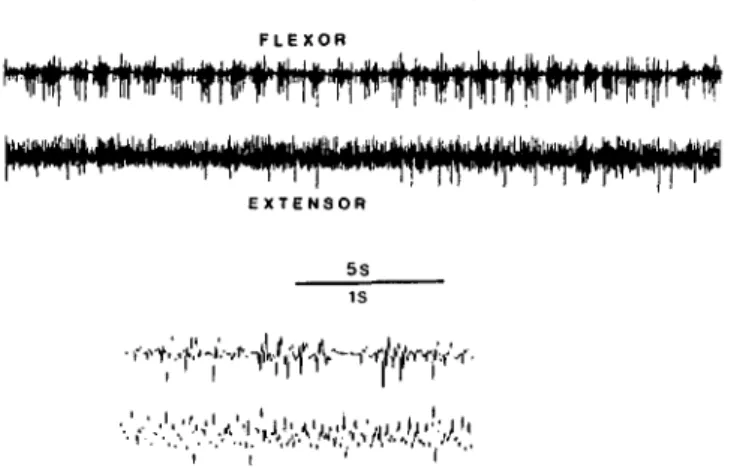
play a role in determining behavior. To my knowledge, this was a possibility that had not previously been consi-dered, and for me it derived directly from the Lorenz model. Now, how to proceed to work out the CNS (central nervous system) events? Sherrington (1906) ad-vanced knowledge of central nervous mechanisms indi-rectly by studying movements. Words to the effect that "movements provide us with a window into the nervous system" indicate the principle that guided him. I decided to adopt this principle for use with arthropods (see Hoyle 1970). It proved possible to record from several different muscles of insects at the same time, during several kinds of behavior, including courtship songs of crickets and grasshoppers, and associated movement sequences. These turned out to be perfect examples of FAPs. The study in turn helped to define the FAP concept. This line of work has since been developed by many investigators to the state of a fine art, especially by Norbert Eisner in Germany (see Eisner & Popov 1978). The myograms provide a simple, quantitative measure of precisely what the nervous system puts out in order to cause the behav-ior. From the data a great deal can be inferred about the nervous system strategies involved in determining partic-ular behaviors. Such data are of value in comparing related species (Eisner & Popov 1978; Ewing & Manning 1966; Lindberg & Eisner 1977), and in studying genetic aspects of behavior control (Bentley 1971; Bentley & Hoy 1972; Hoy & Paul 1973). There are some behaviors of some organisms, notably some nudibranch molluscs, in which the discharge of some identified interneurons is obligatorily and precisely reflected in the execution of a particular movement. Myographic data can in such cases be dispensed with in neuroethological analysis, but for arthropods and vertebrates, which have articulated skel-etons, and which therefore use a balance between forces in cooperating agonists with those in cooperating antag-onists, myograms are essential. This is because exactly similar movements are produced, at different times, by widely different, detailed motor patterns. In order to understand the rules underlying control, it is necessary to know these details and how they relate to the move-ments. In such cases the CNS must either be using proprioceptive input extensively or making very sophisti-cated calculations of the movements that should result from various combinations of motor output (see Sel-verston 1980).
These requirements place constraints on the level of analysis that is possible for any given system. There are so many motor neurons active when any vertebrate makes a movement that precise, comprehensive myography is impossible. Only in arthropods is precision possible, and then only for those muscles that have, or use in a given movement, no more than four excitatory axons per mus-cle (though with computer analysis it is possible to in-crease this limit).
The next-higher step concerns the premotor inter-neurons. Prior to the introduction of intracellular dyes in 1968, studies of this stage were restricted to guesswork except with a few molluscs that had unusually large, pigmented neurons. The latter organisms are mostly aquatic and lack limbs. Their "behavior" is restricted to the bending of their soft, unarticulated bodies in water, so it is necessarily less complex, with fewer adaptive vari-ants, than that of terrestrial animals locomoting on legs.
Hoyle: Neuroethology
This is not to say they have nothing to contribute to neuroethology. The only demonstration that any CNS can produce a FAP in the absence of inputs other than a trigger (or releaser) has come from one of them, the nudibranch Tritonia (Dorsett, Willows & Hoyle 1973). Much of our knowledge of basic cellular neuronal proper-ties has been derived from Aplysia. The technical advan-tages offered by the giant neurons of the abdominal ganglion have led to an extensive exploration of the limited movements controlled by this ganglion (Kandel 1976; 1979). But the reflex movements studied by Aply-siologists unfortunately do not represent the kind of behavior that constitutes the science of ethology.
Future research needs to combine the study of behav-iors that have been of sufficient complexity to excite the serious interest of the giant pioneers of ethology with analysis of the neuronal circuitry underlying those
behav-iors. This is a tall order, but thanks to intensive efforts
during the seventies and continuing today, the circuitry underlying one modest FAP, the leap of the grasshopper, has now been worked out. There may be neurons other than those currently known to be involved in the jump, but they are unlikely to be playing more than minor roles. A circuit diagram of the neurons is shown in Figure 1. The behavioral features of a jump have been described (Heitler 1974). The jump can be elicited by many differ-ent modalities of stimuli. A brief change in any of a wide range of external factors, such as movement in the visual field, light intensity, temperature, sound, air puff, touch, or chemical stimuli, can cause a jump. The insect will also jump spontaneously, meeting the vacuum-activity re-quirement for qualification as a FAP; unevoked jumps are likely to occur in conflict situations, for example, when a competing male appears during a courtship approach. This behavior may be analogous to what has been called displacement activity in vertebrates. It should be borne in mind that a jump is not simply a reflex response. Either flexion or fast extension of a single hind leg tibia occurs as reflex responses to appropriate stimuli but results in either kicks or preparation for jumps only. There is no known condition under which a jump is bound to occur: At times grasshoppers will fry to death on a hot plate, suffer death by crushing, or be eaten rather than jump. We do not yet know what the central factors are that determine the readiness to jump, but there is increasing knowledge about modulatory neurons that seem likely to be involved, and answers to the question should soon be forthcoming. Although it is certainly possible that a grasshopper's brain can "command" the insect to jump (or not jump), such a command is certainly not necessary for a jump. The neural machinery necessary and sufficient for a jump resides within the third thoracic ganglion alone. Lateral, ascending, and descending inputs con-verge on this circuitry and may, individually or cooper-atively, set it into motion. [See also Kupfermann & Weiss: "The Command Neuron Concept" BBS 1(1) 1978.]
It may be argued that the parallel development of interest in various aspects of neuroscience, from develop-mental (e.g., Coghill 1929) to cellular, in the 1920s, 1930s, and 1940s simply merged with ethology, so that at no stage was there a conscious emergence of neu-roethology. As it happens, we can easily see that this is incorrect. At the same Cambridge meeting in 1949 at
Figure 1. Diagram of specific identified neuron circuitry in-volved in the locust/grasshopper jump. This is a simple, unitary fixed action pattern (FAP) of behavior. Several laboratories have contributed details. The neurons are as follows:
1. Motor neurons. Fast extensor tibiae (FETi - Hoyle 1953). Three sets of flexor tibiae (Fl - Burrows & Hoyle 1973). 2. Interneurons:
Visual. Lobular giant movement detector (LGMD - O'Shea & Williams 1974). Descending contralateral movement detec-tor (DCMD - Rowell 1971).
Vibration/sound. Giant interneuron sensitive to both vibra-tion and sound with a cell body in the mesothoracic ganglion, traveling from the metathoracic ganglion up to the brain (G -Rehbein 1976).
Multimodal. (a) Supplier of coactivation to flexors and exten-sor tibiae (C - Pearson & Robertson 1981). (b) Supplier of excitation to the extensor but inhibition to the flexor, the last link in the chain, the jump-trigger interneuron (M - Pearson, Heitler & Steeves 1980).
3. Modulatory neuron. Overall humoral-type excitatory mod-ulation, both central and peripheral, is provided by a dorsal, unpaired median neuron innervating both regions of neuropil in the ganglion and the extensor muscle (DUMETi - Hoyle 1974). The substance synthesized and released is the phenolamine equivalent of norepinephrine, octopamine.
which Lorenz presented a hydraulic model (to be de-scribed below), the collected views of the traditionalists were summarized by Paul Weiss (1950). Weiss produced a rather vague diagram (Figure 2) full of cross-connecting arrows linking component "centers" for the generation of complex behavior. There are levels, from inputs to out-puts, in terms of specific motor neurons. The most signifi-cant aspect, which certainly was universally accepted at the time, was that there was a strict hierarchy, with tiers of control systems. The diagram is also notable for its open-loop character: There were no feedback elements anywhere in the system. It should be recalled, however, that this was only one year after the publication of Norbert Wiener's Cybernetics (1948), in which he took physiologists to task for not understanding the signifi-370 THE BEHAVIORAL AND BRAIN SCIENCES (1984) 7:3
Hoyle: Neuroethology
SENSORY OATA INTRASENSE INTEGR. INTERSENSE INTEGR
TOTAL MOTOR INTEGR.
INTERMEMBER COORDIN.
INTRAMEMBER COORDN MUSCLE CONTRACT
VISUAL ACOUSTIC PROPROCEPT
\ \ l / \ \ l / \WJl\\\U
TAIL TRUNK F LIMBS
i\\/A\Sl\\A
Figure 2. Early hierarchical concept of control of behaviors of a typical quadrupedal vertebrate (from Weiss 1950).
cance of the control systems they had discovered to be widespread in all forms of animals. The ethologists were as naive about the neurophysiological significance of their findings as the neurophysiologists were about the behav-ioral implications of theirs.
When stripped of the vast foliage of observations on individual behavioral acts of a wide variety of species, the core of strictly ethological knowledge boils down to a very few, profoundly simple, statements. The ethology pi-oneers left a legacy of novel classificatory terms, each of which conjures up a clear image of the relevant behaviors. Within each category, examples of these behaviors are found in men, other mammals, birds, reptiles, amphibi-ans, fish, insects, crustaceamphibi-ans, some molluscs, some flat-worms, and even some sea anemones, thereby encom-passing all levels of neuronal organization yet evolved. Therein lies the profundity of the findings. These terms are presented below, with simple, widely accepted defi-nitions, and remarks relative to the discussion that follows.
Definitions of key concepts
1. Fixed action pattern (FAP). This is a complex,
coordi-nated movement or sequence of movements that recurs in a similar manner whenever it is performed. There is a beginning, a middle, and an end for a sequence, and the components occur only in one order. A sequence never begins in the middle. The act as a whole has adaptive significance. It is generally performed only in a specific, biologically significant context. At a given temperature the time-relations of components are very nearly constant whenever the FAP occurs. Only minor variations occur in response to external stimuli applied during the move-ment. Most or all of the components of a FAP are expressions of inherited factors and are subject to the Mendelian laws of inheritance as wholes. Examples are escape swimming in some sea anemones and also in some molluscs, nest-building in some insects, fish, and birds, courtship and sexual behavior in some molluscs and many arthropods, facial expressions in primates, and a wide range of territorial, aggressive, defensive, and sex-related acts in all vertebrate orders.
FAP& are elicited only by highly specific situations or stimuli (releasers), except on rare occasions when they
may occur spontaneously or in an inappropriate, stressful situation. The recognition and specification of FAPS has been by far the most important outcome of the work of ethologists.
There are also numerous examples of behaviors that in most respects resemble FAPs, but in which a part, parts, or the whole are not always performed with equal vigor. They may have reduced excursion amplitude, reduced force, less speed, or fewer cycles of repetition. Several examples are described by Tinbergen (1951), and the matter has been specifically addressed by Schleidt (1974). Should these behaviors be given a different designation? Most ethologists say not, thinking the adjective "fixed" as best applied rather loosely. Some of these behaviors are compounded of FAPs and interspersed reflex actions or of learned actions with or without reflex components. In such cases it is better to consider the entire behavioral act as a complex that includes FAP components rather than to weaken the basic concept, which otherwise has a precise meaning. If the entire sequence is stereotyped but has components that vary a great deal in amplitude or frequency, it is still possible that it should be considered a FAP. Only a detailed study of the causes of the variations could decide the true nature of the control mechanisms. The waggle dance of the bee is a FAP that is modified quantitatively in relation to the messages to be conveyed: directions, distance, and quality of food (von Frisch 1967). However, this behavior is clearly a FAP, not a reflex. Purposive modulation of a FAP for information-transfer is a very different matter from variation in the vigor with which a male robin attacks different models of a male robin.
2. Displacement act. This term is a corollary of the FAP
concept and applies to a fixed action pattern when it is performed in a context that is definitely inappropriate. This commonly occurs when for some reason a more appropriate FAP cannot be expressed, or when the situa-tion is marginal for each of two different behaviors, or deserves the connotation "stressful." It is often difficult to make a satisfactory assessment of appropriateness or otherwise, and mistakes have been made. The important aspect is that a situation that might release a FAP is often one that causes widespread general arousal, paying atten-tion, and the like so that one or another FAP is likely to occur. If the cues are those appropriate to more than one FAP, especially FAPs that are fundamentally opposite, such as attack/withdraw, displacement acts are especially likely to occur.
3. Releaser. A key concept of ethology, a releaser may be
defined as a specific single organismic or environmental feature, complex of features, or context, or a behavioral act or sequence of behavioral acts, performed either by another individual or by a group of animals, that elicits a FAP. Releasers range from a simple sign, such as the red spot on the lower mandible of a herring gull, to an entire complex sequence of combined auditory and visual displays.
The fact that so many of the behaviors that have been studied in the name of ethology require a releaser has been the basis of the more cogent criticisms of ethological theory, because the releaser —» FAP relation appears to resemble classical reflex action (e.g., Kennedy 1954;
Hoyle: Neuroethology
Schneirla 1952). There is no difficulty when, as is often the case, FAP expression is an all-or-none one. But what about a stereotyped behavior whose amplitude is directly proportional to some quality of the releaser such as its size or color? Such behaviors have greatly occupied the re-search attention of some prominent ethologists (es-pecially Tinbergen among early ethologists, 1951), who were proud of the way they quantified the behavior. Another controversial aspect concerned the presence of more than one releaser, particularly when the releaser was an object and the released behavior directly related to the releaser. In such a situation the animal generally makes a choice and "selects" or displays a preference. This may be for an artificial object such as a pot egg rather than a real one, because it is bigger or has more spots or whatever. The artificial object may elicit constant ampli-tude behaviors, in which case the FAP concept clearly applies. The situation is moot for all behaviors in which the amplitude or intensity is proportional to releaser quality. The answer to the question, Is this a reflex?, for such behavior may be "yes," but can, in principle, only be decided on the basis of knowledge of the neurophysiologi-cal underpinnings.
4. Vacuum activity. A complex FAP may sometimes be
performed by an animal in spite of the lack of any external releaser. Although, in most cases, the possibility of an invisible internal "prick" cannot be ruled out, the sudden appearance of complex behavior suggested to Lorenz the then-new concept of "action specific energy." He chose to think of the tendency to show a behavior as propor-tional to an accumulation of its energy; that energy is confined within restraining boundaries from which it is increasingly trying to force its way out. Occasionally the restraint is overcome spontaneously and the pent-up energy rushes out, causing action that was appropriately termed "vacuum activity."
5. Consummatory act. There is often a terminal element
in a behavioral sequence that is clearly recognizable as the objective of preceding preliminary behavior. This is termed the "consummatory act," and it may be defined as a fixed or relatively fixed act that follows a FAP, a sequence of FAPs, a sequence of reflex actions, or mix-tures of FAPs and reflexes, and that is followed by quite different behavior, or none at all. The entire sequence is clearly at an end after the consummatory act. This may be, for example, completion of a nest, orgasm following mating, or feeding following capture of prey. A consum-matory act is especially common after behavior to which the adjective "appetitive" may be applied unequivocally. It is the logical climax of appetitive behavior.
The expression "consummatory act" may appear some-what quaint or old-fashioned to most modern ethologists. For many behaviors there is an entire sequence of move-ments, or the repetition of a movement, before termina-tion, and a lot of possibility for feedback influences. A small amount of good-tasting food may be as satisfactory as a huge quantity of poor-tasting stuff in quenching food-seeking behavior. Some birds overbuild their nests while others underbuild. Is it the sight of the nest, the feel of it, the amount of work done on it, the availability of nest-building material, or combinations of all of these that leads to termination? Even lowly animals seems to make
compromises. But however difficult it may be for eth-ologists trying to quantify their data to handle this partic-ular concept, it is easy to understand what is meant in general. Termination could be due to a running out of the neural substrate for drive (see below), or an inhibition based on performance, especially the consummatory act, or a combination of the two. Each of these possibilities invokes neurophysiological phenomena that are amena-ble to analysis in suitaamena-ble subjects.
6. Drive and mood. I am well aware that both of these
terms seem quaint to modern ethologists and psychol-ogists. In Gallistel's (1980) The Organization of Action, the index entry for "drive" advises the reader to "see Motivation." Nevertheless, drive is defined in the gloss-ary; mood, however, is missing from both glossary and index. Yet there is no point in dwelling on mere seman-tics: Nobody truly has any difficulty understanding both terms and translating them into their personal experience of behavior. The sight and smell of food are not going to elicit food-related behavior in an animal that has just finished filling its stomach with attractive food. There are strong fluctuations in the tendency of any measurable appetitive behavior to be expressed. Therefore, we can easily define both drive and mood and attempt to deter-mine their physiological underpinnings. [See also multi-ple book review of Gallistel's The Organization of Action
BBS 4(4) 1981.]
Drive is the probability of occurrence of an appetitive FAP. Drive is weakest immediately following the rele-vant consummatory act and strongest when the consum-matory act has not been carried out for a long time. Secondary, capricious variations in strength are superim-posed, so that even when drive is strong, a releaser may not elicit the behavior. Mood is a quantitative variation in expression of a behavior under apparently constant conditions.
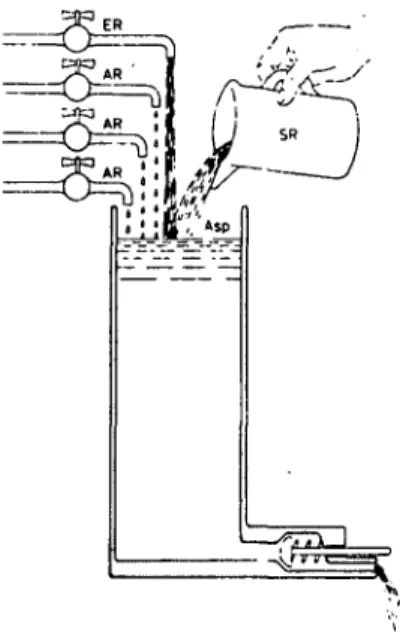
Lorenz and his model of instinctive behavior Lorenz made but one brief excursion into the larger domain of physiology, which was also the occasion of his introduction to a broader audience than that of his native land. This was in 1949, when he accepted an invitation to address the British Society for Experimental Biology at its Fourth Annual Symposium in Cambridge. The topic was "Physiological Mechanisms in Animal Behavior." Lorenz departed from his usual procedure by presenting a model summarizing ethological findings that he thought would make them clear to neurophysiologists. The model, the sole illustration of his article (Lorenz 1950), was present-ed in a stunningly powerful yet simple diagram (Figure 3). This model quickly became famous, or in some circles infamous. It is known as the "water" or "toilet" ("hydraulic") model and indeed, actual domestic por-celain objects have been used in dramatic "live" simula-tions. Lorenz wrote of his model that "it is able to symbolize a surprising wealth of facts really encountered in the reactions of animals." He further justified it with the statement, "As an instrument for the quantification of external and internal stimulation, this model has proved to be of some value" (p. 255).
The toilet model has come to symbolize neuroethology 372 THE BEHAVIORAL AND BRAIN SCIENCES (1984) 7:3
Hoyle: Neuroethology
Figure 3. The famous Lorenz (1950) hydraulic model, il-lustrating the concepts of the generation of instinctive behavior developed by ethologists.
whether persons who call themselves neuroethologists like it or not, so it can serve the purpose of providing us with a synopsis for the ethology side of our coin. The model intentionally implied a physiological underpinning for FAPs and their "release." In the model, behavior is simulated by water jets, at the lower right. The rigid sequence of component behaviors of a specific FAP is indicated by the slope of the trough (Tr.), and the actual sequence by the numbered scale (G). The central nervous system gradually builds up drive for execution of this FAP, symbolized by a trickle of water (T) gradually filling up a tank or reservoir (R) of "action specific energy" for the behavior. The energy tries to express itself as move-ment by leaving the tank and entering the trough, but is blocked by the spring-loaded valve (V). The spring (S) symbolizes neural inhibition, and it is also the route for mood, in the form of variations in its stiffness. Releaser action for the FAP is symbolized by a weight added to the scale pan (Sp.).
By putting a series of the reservoirs side by side, and allowing some parallel or "leaky" plumbing, one could bring displacement acts into the scheme. The traditional problem of explaining the utilization of the same move-ments in several different overall complex behaviors is also incorporated.
Linking the reservoirs also leads to thinking about a major problem, that of how an appropriate behavior is "selected" from the repertoire following the completion of a complex releaser signal, perhaps sharing some senso-ry components with releasers of different, inappropriate behaviors.
The delight of the Lorenz model was that one could immediately think of a large number of behaviors, in species from the lowliest diploblastic Metazoa to man (as witness The Naked Ape, by Desmond Morris, 1967) that could be fitted into the scheme. It provided all the magical joy of a great generalization: the illusion of com-prehensibility. But was it in this case no more than a poetic mirage? The water in the model is real enough, and the physiologist, though unable to specify a precise neu-rophysiological equivalent, could at least envisage some
possible candidates. The output stages in the model were very easily understood in physiological terms, since each is a muscular contraction. The releasers were in principle equally easy to translate. At their simplest they are signs that are either present or absent. The sign details often needed multiple-channel sensory coding: shape, size, color, and the like sometimes being compounded. But the final step in information processing could be a 1, 0 choice - a single bit of information. A translation of instinctive behavior into basic neurophysiology of cells loomed as a realizable possibility, at least for the simpler invertebrate nervous systems. The science of neu-roethology cannot fairly be considered to have predated the Lorenz hydraulic model of 1949. Neuroethology could thereafter be conceived of, and its principal pur-pose stated. Its pursuit could be equated with testing the model and, if validated, with the elucidation of the neural equivalents of the structural and functional features of the Lorenz model.
Seasonal, circadian
and othir overall regulators Pressure _ >erall excitatory state
L H _
Effectorsystem' cSrnStj
Figure 4. A1984 hydraulic model of behavior generation, with special reference to targets for budding neuroethologists. Ago-nists in a movement, which is part of a FAP, are indicated as Aj, A2, etc., and their reciprocating antagonists as ANj, AN2, etc.
Modulatable forms of tonus (see review by Hoyle, 1983) are indicated by T. In the simplest form of truly fixed FAPs, direct motor tape control without involvement of feedback, the stored information (simulated tape program 1) is first selected, then turned on, and via a direct pathway (indicated by dotted line) activates the relevant interneurons (symbolized by regulators directing water to appropriate effectors). Other, more varied FAPs, especially those carrying recently learned information (as in performance of the honeybee dance) involve complex central integration of inputs by a neural comparator, and subsequent modification of the "taped" instructions by a neural computer. A motor program can also be produced by reference to stored innate sensory tape information, in conjunction with incoming sensory and motor information.
Hoyle: Neuroethology
I am told by an eminent ethologist that the "flush toilet model is not taken too seriously anymore." Clearly, among other omissions, it lacks the multitude of feedback processes as well as all the modulatory influences that we now take for granted as being important factors in all nervous systems. No allowance is made for behaviors that are not diminished by performance, especially those in which there is enhancement from the first in a series of closely spaced FAP repetitions, to the next.
A modified Lorenz model, which substitutes modula-tion of neural elements of the FAP-generamodula-tion circuits for water filling the tank and incorporates secondary modula-tions via feedback, both proprioceptive and extrinsic, will do nicely as a modern substitute. In Figure 4 I have attempted to draw such a model, again using water, partly to relate to the Lorenz model but also because a flow of water is so easy to grasp, but adding a valve-controlled, pressurized basic system, with electronic controls and memory, such as we now know are built into even the simpler nervous systems.
Defining modern ethology and neuroethology
The simplest logic demands that neuroethology be the study of the neural mechanisms underlying the behaviors that constitute the science of ethology. To determine what these behaviors are the neuroscientist should first read at least the major works of professional ethologists. A survey of the behaviors and the distribution of species that are addressed in reviews and textbooks, in the name of ethology, is revealing. For example, in his classical work, The Study of Instinct, Tinbergen (1951), by my count, referred to 473 animal species. Their distribution according to major classes is shown in Table 1. There is a strong emphasis on insects and birds, which is not sur-prising, as Tinbergen loved to watch birds and to experi-ment with insects. However, in the second edition of a popular introductory text published much later, Manning (1972), referring to some 225 species, yields almost iden-tical percentages of birds, which take first place easily with 37%, and insects, with 19%, as runners-up. This was in spite of the fact that Manning trebled the proportion of mammals referred to, from a meager 10% in Tinbergen. Molluscs formed less than 3% of the total in each, and these were almost entirely cephalopods.
Table 1. Distributions by class of animals referred to in two books on general principles of ethology, Tinbergen (1951)
and Manning (1972) Class of animal Mammal Bird Reptile Amphibian Fish Insect Crustacean Mollusc Other invertebrates Tinbergen 10.0 38.0 1.7 5.0 15.0 20.0 4.6 2.5 2.1 Manning 32.6 37.0 0.4 0.9 5.0 19.0 0.4 2.2 2.2
An in-depth, independent research program has been undertaken by a neurophysiologist and his coworkers to describe the behavior of a lowly gastropod mollusc, Ap-lysia (Kandel 1979), this species being easy to study neurophysiologically. There is, nevertheless, no sign that the remarkable successes in the physiological aspects of this endeavor have won over ethologists. The ethologists were there first and are in a position to call the tunes. To reach them, and thereby promote the unquestionably exciting and important field of neuroethology, it will be necessary for neurophysiologists to address the same organisms and behaviors as do ethologists.
Before proceeding with a discussion of specific goals and strategies, let us pause to consider how modern ethologists see themselves and define their subject.
Some authors choose to define ethology very broadly. The broadest definition is that of S. A. Barnett in Modern Ethology (1981): "the scientific investigation of behavior by all means and by all kinds of people." Barnett quotes John Passmore's familiar passage from The Perfectibility of Man (1970): "To write anything worthwhile is to arouse opposition, controversy." Let me beg to disagree with him. Even though the great "ethologists" defined their field loosely, it is very clear both from the subject matter of their research and their view of their findings that they in practice came to apply a restricted meaning. Barnett defines almost everything associated with the study of behavior except the most important thing of all - he fails to define what he means by the word "behavior" itself! My dictionaries offer a variety of choices, of which the simplest is "movement." Clearly, Lorenz was not a stu-dent of movement. Another definition in Webster is "an organism's muscular or glandular responses to stimula-tion," that is, a reflex. The very word made Lorenz and Tinbergen recoil. The whole point of the ethologists' findings was that there is more to behavior than reflex action, and I doubt very much that the intellectual as-pects of gastric secretion ever stirred their minds. The dictionary does go on to qualify the definition with, "especially movements that can be observed." There are several scientists who are intensively studying ganglia such as the one that controls the internal mincing of food by lobster stomachs, which they regard as a model for the generation of behavior (e.g., Selverston, Russell, Miller & King 1976). I concede that what these investigators are discovering may provide valuable basic information about the ways in which neurons can be interconnected, and also about the properties that enable neural circuits to function efficiently. I also concede that this knowledge may some day serve to guide neuroethologists in some aspects of their studies, but I emphatically deny that such research is to be considered part of neuroethology.
An ethologist friend who thinks exceptionally clearly and whose work I admire says that he views ethology as a "broad concern with what real animals do in real situa-tions." However, close examination of what this eth-ologist takes the time to study in detail shows that it is quite restricted: The animals he studies are all furry and warm-blooded (a fraction of 1% of the animal kingdom), and only one act of behavior is targeted. It is a major disadvantage of the field that an in-depth study of even one behavior can demand the full-time attention of an investigator plus students. Never has there been a field of
Hoyle: Neuroethology scientific endeavor where cooperation by experts in
dif-ferent disciplines is more essential.
A program for would-be neuroethologists
We should start by disclaiming the notion that the behav-ior of interest to ethologists is to be equated with any kind
of movement. This route quickly leads to the absurdity of
including in neuroethology a great deal of physiology and biophysics as well as much of neuroscience. The diction-ary definitions of behavior also include "manners," "de-portment," and "moral conduct." While these again take us out of the actual realm of the research interests of Lorenz, they at least introduce the notions of complexity, of restriction to recognizable clusters, and of interaction with other behaving entities.
Let us then examine what types of events interested Lorenz. As we have seen, these were stereotyped se-quences of coordinated movements. They were always ones that were repeated exactly, or very nearly exactly, not only by any given individual, but by other individuals of the same species. They were movement clusters strongly related to survival: escape, defense, attack, ter-ritoriality, feeding, courtship/mating, cooperation. These are all behaviors that relate to the achievement of
goals, and when they occur in man, they are associated
with emotion. They are all classifiable under the term "instinctive," that is, complex goal-related innate
behaviors.
A careful consideration, and above all, one hopes, a rational acceptance, of these constraints is important if we are to agree upon a working definition of neuroethology that will promote the development of a useful body of natural knowledge. Let us enumerate those parts of physiology that can be ruled out and relegated, as they always have been in the past, to their appropriate subdivi-sions of traditional physiology, and along with them the related neuroanatomy. Neuroethology will doubtless draw strength and information from some of the rejects, but should maintain firmly its "exclusiveness." There will be many occasions on which a legitimate neuroethological study overlaps with some of the other disciplines of more limited scope. For example, I think we should exclude reflexology, even though some FAP sequences incorpo-rate reflex actions, and also all forms of fundamental and applied sensory physiology. However, the triggering of many FAPs depends upon feature extraction, so releas-ing cannot be fully understood without knowreleas-ing the details of this subsidiary action of the sense organs involved.
Neuroethologists will encounter novel as well as tradi-tional membrane processes down to the level of ion channels, synaptic transmissions, and electrical and chemical modulations. They will come across familiar, but also novel, neuronal anatomies and circuits. The involvement of nonneural cells associated with nervous systems could become a significant phenomenon for neu-roethologists. How, then, will they be distinguishable from the host of basic physiologists, biophysicists, and biochemists? Inevitably, neuroethologists wear second, third, and more hats associated with these disciplines. It will only be by their assertion of different, more global, principal goals that they will be recognized. When they
talk to other neuroethologists, all of them will know that their common purpose is understanding the generation of
particular kinds of complex behavior. There will be a
very few major goals and they will be common. It should be possible for neuroethologists to avoid losing sight of the woods because there are so many interesting trees, but only if the goals are delimited.
It may be argued that, as knowledge of neuroanatomy and cellular physiology expands, understanding of the neural bases of behavior in general, and therefore also of its subdiscipline, neuroethology, will inevitably achieve the same objectives, and that this would happen without any specific focusing on a separate endeavor labeled neuroethology. I argue against this view. Neuroethology is quite likely to revert to some earlier dogmas (such as those of reflexology), or find new ones, if left to the random pursuits favored by current neuroscience. For, in neuroscience, we are dealing with a kind of knowledge that is based on an enormous number of concurrently interactive, time-dependent variables, in biophysical sys-tems of enormous complexity. The time required to describe a nervous system adequately is something new to science. No matter how much effort is expended, it will take hundreds of years just to work out the elemental details. Perhaps, as more data accumulate, a general theoretical framework, which we lack completely at pre-sent, will be developed. There is an existing field of neural modeling that is beginning to expand because of its potential for practical use in robotics. I expect this to be highly interactive with neuroethology of the kind I shall advocate.
The advantage of defining more limited goals is that a measure of real understanding at an intellectually satisfy-ing level could probably be achieved within a human lifetime. There are other potential advantages. The in-sight of the major ethologists I have mentioned prevented a continuation of the blind following of false leads. A major outcome of their thought was the realization that there was more to complex behavior than the compound-ing of reflexes. The reflex schools of physiology, estab-lished by Sherrington and Pavlov, totally dominated both thinking and experimenting for more than half a century. Paul Weiss (1941) was thought slightly ridiculous when he dared to ask, though in a less-than-global journal, "Is the sensory influx a constructive agent, instrumental in build-ing up the motor patterns, or is it a regulatory agent, merely controlling the expression of autonomous patterns without contributing to their differentiation?" (p. 592) Sir James Gray was on much firmer ground in 1949, thanks to growing understanding of the findings of the Lorenz school, when he asked the same question in the form: "Can an animal initiate and maintain patterns of coordi-nated muscular movement without reference to the out-side world?" (Gray 1950, p. 112).
The decline in the dominance of reflexology was not far away. Major credit for experiments that led to rejection of a false dogma must go to a very small group of inverte-brate neurobiologists, especially the late Donald Wilson (1972; also see review by Delcomyn, 1980). But the way to widespread acceptance of their findings had to a large extent been prepared, albeit unwittingly, by the Euro-pean ethologists. As we have noted, ethologists mainly worked on and wrote about birds and insects; they treated
Hoyle: Neuroethology
examples from each class as if they provided equivalent variations on the common themes of animal behavior. The general principles expounded were meant to apply across the board to behaving animals, whether they had a backbone or not. These ideas about the generation of many of the behaviors the ethologists studied were clear-ly incompatible with reflexology, though they did not make a major issue of this incongruity.
As long as physiologists subscribed to the Sherringto-nian/Pavlovian dogma that the most complex behaviors could, in principle, be understood on the basis of the compounding of reflex actions, there was hardly any need for an elaborate, prolonged attack on the question of how behaviors are generated by investigators armed with microelectrodes. The relatively recent realization that many, perhaps most, complex behaviors are generated by endogenous neuronal activities has completely changed the requirements. We must now admit that we have no understanding of the neural mechanisms underlying a majority of behaviors. The only way a behavioral act can be fully understood is in terms of the actual functioning of the individual neurons producing the output/commands and of the circuits in which they operate. That is a very tall order. It is virtually unapproachable for most vertebrate behaviors: There are far too many cells and they are too inaccessible to permit obtaining the kind of information that is needed. This is not to say that we cannot obtain information of relevance to the central questions from vertebrates, but that definitive information that will allow a comprehensive understanding of all but the simplest movements may be forever beyond our reach.
For some behaviors of some invertebrates there are no known barriers to eventually obtaining all the knowledge needed. This is because the relevant neurons are ad-dressable during the execution of the behavior. By com-bining cellular neuronal knowledge from invertebrates with whatever can be obtained from vertebrates we should eventually be able to achieve a satisfactory overall understanding of the principles underlying the genera-tion and control of behavior by nervous systems. The closest we have yet come to obtaining complete explana-tions of FAPs is for a few behaviors of invertebrates from different phyla. One such behavior is the escape swim-ming of the nudibranch mollusc Tritonia (Getting 1983; Willows et al. 1973). This has the singular advantage of being obtainable in the isolated nervous system, along with being recordable from the intact animal. The pres-ence of the rest of the animal is not necessary for the swimming motor neural program to occur; nor does the rest of the animal influence the production of the program when it is present. Doubtless many small, specific cel-lular details remain unknown, but both the triggering (or releasing) mechanisms and the major details of the pat-terning are known. Although this FAP is generally elic-ited by the experimenter with a chemical agent (common salt), it can occur spontaneously. Another instance of the study of fictive behavior (i.e., motor output comparable to that occurring in the natural condition, but in a semi-isolated state) is oviposition digging by female grasshop-pers (Thompson 1982). There are some parallels between the neural mechanisms of digging and of Tritonia swim-ming. The locust/grasshopper jump, whose neural circuit was referred to above (see Figure 1), is different in every possible way from escape swimming, leading one to
wonder just what the range for arhythmic behaviors is. In spite of the relatively lowly levels of these behaviors, it is reasonable to consider these studies neuroethological.
Goals for neuroethologists
Following the lines of thinking outlined above, the prima-ry target for neuroethologists becomes the study of the cellular events underlying fixed action patterns and relat-ed instinctive acts. Although it may seem a trifle rrelat-edun- redun-dant, and certainly rather naive, it may be desirable to spell out precisely which aspects of neuroethology most need to be tackled. These are:
1. Description of motor neural circuits and the ways they function in the generation of a wide range of complex
behaviors, especially different behaviors using common
musculature.
2. The precise roles played by proprioceptive, tactile, and visual feedback in determining behavioral details. 3. The nature and location of the efference copy, which, one can deduce, plays a major role in determining motor control of some complex behaviors and in learning motor skills.
4. Neural events of association between reafference and the efference copy in behaviors using both.
5. The locations and nature of inherited stores of information, which can be called upon as "motor tapes" to produce species-specific behaviors. (Examples are un-capping of cells in a hive containing dead bees and removing the corpses, two separate behaviors, each of which is genetically determined and subject to Men-delian laws of inheritance; Rothenbuhler 1964a; 1964b). 6. The locations and nature of inherited stores of information, which can be called upon as "sensory tapes" to guide the production of species-specific behaviors. (Examples are offered by conspecific recognition of song by insects and by birds, and the "image" of the final product used in the construction of patterned webs and nests by spiders, insects, fish, and birds.)
7. Elucidation of the changes occurring in a nervous system, which determine the progressive change in the probability that a particular behavior will occur.
8. Determination of the neural factors underlying vari-ation in drive for behavior in general and for specific behaviors.
9. Identification of the neural and associated mecha-nisms generating circadian and circannual behavioral cycles.
10. Determination of neural determinants of changes in drive following execution of a consummatory act.
11. Analysis of the mechanism of "switching on" of behaviors by their releasers.
12. Determination of the locations and nature of infor-mation stores (memory) acquired by experience that are used to modulate innate behavior.
13. Determination of the means by which memory information is utilized in the execution of behaviors.
Hard choices about target animals and behaviors There has long been a debate in private, and to some extent in public, about the optimal species/behavior targets for analysis (e.g., Hoyle 1975; 1976), and the 376 THE BEHAVIORAL AND BRAIN SCIENCES (1984) 7:3
Hoyle: Neuroethology question is as far from resolution now as when it was first
raised. Many investigators refuse even to face the ques-tion, resorting to bizarre "justifications" of choices made for no good reason. I still feel that large insects offer by far the most promising compromise among interest, signifi-cance, and feasibility. I confess to feeling somewhat negative about the enormous amount of research being published on Aplysia, though the depth of the work is exemplary. Kandel and Schwartz (1982) refer to this behaviorally boring glob of squishy protoplasm as a "high-er inv"high-ertebrate." If this is so, the humblest insect must sit at the right hand of God! The research emphasis on
Aplysia has been dictated solely by the easy accessibility
of its large, naturally colored abdominal ganglion cells. If some of the immense effort devoted to Aplysia could be diverted to one or a few truly higher invertebrate(s), we might see some giant strides in neuroethology. As it is, there seem to be no principles of integrative or intrinsic neural functioning that we can extrapolate from Aplysia. The work is valuable at the cell and membrane level, of course, but can lead to oversimplifications or can even be misleading if extrapolated to the behavior of animals with legs. Cellular descriptions of events in habituation, sen-sitization, and simple classical conditioning need to be complemented with information about the cellular mech-anisms of the long-lasting forms of learning.
There are such major basic gaps in fundamental neu-robiological knowledge that some effort to channel efforts toward resolving them is justified. For example, what is an efference copy in cellular terms? Where is it located? Which neurons are addressed when a behavioral "species memory" of a simpler invertebrate is utilized in a fixed action pattern requiring specific sensory input? Exactly how do any of several well-known "command" inter-neurons evoke walking? What really is the "flight motor" of a flying insect? Where in the nervous system of a bee are the waggle dance instructions located? One could go on and on because the list is so long.
The crustacean stomatogastric ganglion and Aplysia visceral ganglion have been regarded as "model sys-tems," but models of what has not been stated. It is indeed possible that some neuronal generators of move-ment cycles in other organisms will be found to work like the neurons controlling a single locomotor movement of
Aplysia (and like others, such as the stomatogastric
gang-lion neurons). But these are at best examples of what may be found elsewhere. They cannot be taken as models of what actually happens in another system until the other system has been at least partially explored. A model-T Ford engine is a good model for even the most complex 16-cylinder Ferrari engine, but it cannot tell us anything about a turbojet. Even a cursory examination will suffice to indicate whether or not an unknown engine can be modeled by the model-T, but the direct inspection must first be made.
So neurophysiological strategy must involve the explo-ration of many systems, in addition to in-depth examina-tion of a few. My judgment is that the choice of the ganglia of Aplysia and the crustacean stomach as targets for so much attention is not justified on the basis of the signifi-cance of the behaviors they generate. The same argu-ments apply even more cogently to neural circuits con-trolling hearts, which are also intensively studied, most recently in the leech by Peterson (1983a; 1983b). Much of
our current knowledge of neural events in relation to behavior has been obtained from a few insects, notably locusts and crickets, which are rather limited in reper-toires. However, the brains of bees, whose behavior certainly commands widespread interest (and respect), have recently been shown to be amenable to study with intracellular dye-filled electrodes (Erber 1983). We should all like to know what goes on in insect brains -aside from the processing of visual, chemoreceptor, and wind sensory information - especially what roles they may play in generating and controlling behaviors. Bees, ants, and wasps are guided by species-specific "species memories" of both individual and group activities. Where in their nervous systems do they store this information? How do they utilize it to generate relevant movements? Until the bee brain has been more intensively examined, there is still a great deal that we can learn about learning, using preparations that have proven amenable to cellular analysis. With insects, we can study operant conditioning using a paradigm that eliminates many of the experimen-tal objections raised to "learning" the association of two stimuli, one or even both of which may be aversive (Forman 1982; Hoyle 1980). The results may be slower in coming, because the experiments are much harder to carry out, but the results should take us beyond such phenomena as habituation, sensitization, and short-dura-tion associashort-dura-tions.
An instinctive behavior of worker bees prompts them to "record" flight direction and distance and then to use the stored information for the subtle modulation of an inherited basic movement pattern. The latter, the waggle dance, is a good example in the best sense of a FAP. There is no difficulty recognizing it, it cannot be confused with any other behavior of the bee, and it is a set sequence of movements; however, a few key elements are capable of variations based upon recent experience. These quan-titative modifications are the critical features of the con-tribution of information: The dance (FAP) is merely a vehicle for the expression of recently acquired informa-tion, by way of the variations. The entire question of how insects acquire any form of new information, store it, and later use it to modify their behavior is wide open, but it is certainly amenable to cellular analysis in some species. Major criticisms of the FAP concept have come from experiences in which a part of the total expression of a stereotyped instinctive behavior was shown to be clearly due to learned behavior. A particularly clear example is imprinting, in which the inherited stereotyped behavior allows for a major element - the object to be followed - to be learned. There is nothing in the nature of a FAP that forbids its being altered over the long term by experi-ence, or even by immediate sensory input. Likewise, one FAP could be followed by another sometimes (but not routinely) or be mixed with reflex actions.
In addition to their jump, there are other activities of grasshoppers for which the neural events are at least partially known, including flying, maneuvering in flight, the elemental stepping of walking, digging/egg-laying, and a variety of courtship stridulations. Some of these behaviors use common motor neurons, yet the motor neurons appear in each case to be themselves participants in the circuits. The circuits are complete in headless animals, so the carrying out of these complex behaviors does not require input from the head except as a source of