Ministry of Higher Education and Scientific Research
8 MAI 1945 UNIVERSITY / GUELMA ةملاق / 1945 يام 8 ةعماج FACULTY OF LETTERS AND LANGUAGES تاغللا و بادلآا ةيلك DEPARTMENT OF LETTERS & ENGLISH LANGUAGE ةيزيلجنلااةغللا و بادلآا مسق
Option: Translation
Translating Idiomatic English Phrasal Verbs into Arabic :
The Case of Third year English students, University of
08Mai 1945 Guelma
A Dissertation Submitted to the Department of Letters and English Language in Partial Fulfillment of the Requirements for the Degree of Master in Language and Culture Presented by: Bouchra MEZIANI
BOARD OF EXAMINERS
Chairwoman: Nardjes CHAHAT University of 8 Mai 1945 Guelma Supervisor: Nadjima CHORFI University of 8 Mai 1945- Guelma Examiner: Yamina BISKRI University of 8 Mai 1945- Guelma
Dedication
-I would like to dedicate this work to my beloved mother. -To my lovely sisters: Afaf, Hanan, Zina, and their husbands. -To my gorgeous brother Rochdi.
-To my sweethearts friends Meriem, Hana, sarah, khaoula, and Imen. -To my relatives and cousines: Nadjet, Samya, Bilal, and Kamal.
Aknowldgements
I would like to express my frank appreciation to Mis. Chorfi Nadjima for her helpful constructive advices and ideal supervision. Special thanks to the other teachers as Mr. Mohammed Walid Chttiebi for the help they had offered.
Exceptional thanks to the students who have undertake the translation test and advocated their time to respond. Special gratitude for each one who has a contribution or provides a hand of assistance to produce this work.
Abstract
The present research aims at exploring the students’ problems in translating English Phrasal verbs into Arabic. Moreover, the basic format of phrasal verbs is verb plus the particle, it could be an adverb, preposition, or both of them occur successivly. The current paper based on the assumption that there are problems encountered the students to give proper accurate translations and interpretations for this aspect of language. Therefore, a test has been adopted involving 98 students as a sample from third year, English departement, University of 08 mai 1945 Guelma. The outcomes of the test revealed the majority of the students failled to achieved the appropriate translations, mainly such rendition is due to the wrong choice of translations techniques, the role of the context , and the lack of cultural background about the source language. Even more the number of blanks is another proof of their inabilities to translate phrasal verbs. This qualitative quantitative investigation corroborates the hypothesis
List of Abbrieviations
ST: source text TT : target text. SL : source language TL : target language. PV : phrasal verb.EFL : English as a foreign language.
List of Tables
pages
01.Illustration of transtive and intransitive phrasal verbs...14
02.Intransitive phrasal verbs...15
03.Semantic transparacy and figurative meaning as types of PV ...16
04.the position of the ‘particle’ according to Garies...17
05. Student ‘ translation of the EPV ‘to argue back’ into Arabic...39
06..Student ‘ translation of the EPV ‘to ask up’into Arabic...40
07.Student ‘ translation of the EPV ‘to bark out’into Arabic...41
08.Student ‘ translation of the EPV ‘beating about’into Arabic...42
09.Student ‘ translation of the EPV ‘to break in’into Arabic...45
10.. Student ‘ translation of the EPV ‘to bring around’into Arabic...43
11. Student ‘ translation of the EPV ‘to dig at’ into Arabic...44
12. Student ‘ translation of the EPV ‘to find out’into Arabic...45
13. Student ‘ translation of the EPV ‘to give up’into Arabic...45
14. Student ‘ translation of the EPV ‘to read through’into Arabic...46
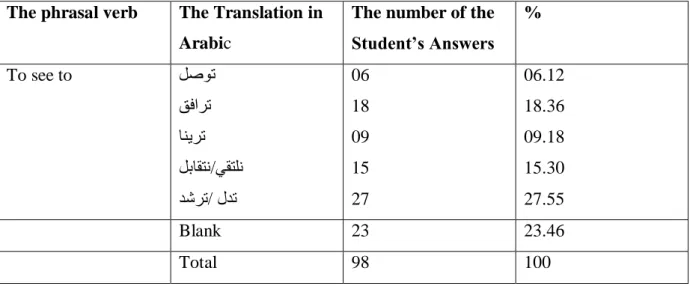
15. Student ‘ translation of the EPV ‘to see to’ into Arabic...47
16. Student ‘ translation of the EPV ‘ to write off’into Arabic...47
17. Student ‘ translation of the EPV ‘to get in on’into Arabic...48
18. Student ‘ translation of the EPV ‘to put up’into Arabic...48
19. Student ‘ translation of the EPV ‘to carry out’ into Arabic...49
List of figures
01.
The Evolution of Translation ...24The Content
pages
General Introduction...01
1.
Statement of the problem...022.Aim of the sudy...02
3.Research Question...02
4.Hypothesis...03
5.Research Methodology and Design...03
5.1.Research Method...03
5.2.The sample...03
5.3.Data Gathering...03
6.Structure of the Study...04
Chapter one : Idiomatic phrasal verbs...05
Introduction...06
1.1.Idioms and Idiomacy in English and in Arabic...06
1.1.1. Idiomacity in English ...06
1.1.2.Idiomacy in Arabic...09
1.2. Phrasal Verbs in English and Arabic...11
1.2.1.Phrasal Verbs in English...11
1.2.1.1.Syntactic Properties...13
1.2.1.2.Semantic Properties...15
1.2.2. Phrasal Verbs in Arabic...16
1.2.2.1.Syntactic Features...16
1.2.2.2.Semantic Features...17
Chapter Two
: Translation of Phrasal Verbs...20
Introduction...21
2.1.Definition of Translation...21
2.2.History of Translation...25
2.2.1.Translation in the Western World...25
2.2.1.1.The Romans...25
2.2.1.2.Translation of the Bible...26
2.2.2.Translation in the Arab World...26
2.2.2.1.Translation in the Abbasid era...26
2.3. Translation Techniques and Strategies...28
2.4. Difficulties in Translating Idiomatic English Phrasal Verbs...33
Conclusion...36
Chapter Three : Data Analysis and Findings...37
Introduction...:...38
3.1.The Sample...38
3.2. Description of The Test...38
3.3. The Methodology...38
3.4. Finding and Discussion...39
Conclusion...50
General conclusion...51
List of Reference
Appendix
Suggested Answers.
صخلملا.
General Introduction
Translation as a process is to transform the original text’s meaning to the target language. It helps to facilitate the comprehension of many works that are difficult to be understood in their original language , thus it could be considered as a means or a medium for some works to get spread over the world . Moreover; translation helps to explore the author’s culture, tradition ,religion, values ,beliefs ,life styles ,ideas…etc.
Translation has mainly two types: literal translation which deals with word by word translation and free translation which deals with rendering the meaning ,That is to say, sense by sense translation .this one has the function of searching for the accurate appropriate sense without deviating it from its intended message of the original text .Meaning as a concept in itself created a big problem among translators in general ,and in this case English as a foreign language students in particular , they have faced many obstacles while tackling such act. English phrasal verbs are one of the aspects of language that EFL student find many difficulties while translating them Into Arabic .Idiomatic English phrasal verbs are a combination of a verb and a particle( such as look for, look at ….).In which this relation seems arbitrary .i.e. there is no link or specific rules justify such combination..Phrasal verbs have more than one meaning that make EFL learners get confused while translating.
Furthermore ,they are usually considered as informal to be used in front of formal audiences. In addition , they play an integral part to be used in a natural conversation.
1.Statement of the Problem
This study is an attempt to shed light on the difficulties and problems that students encounter in translating idiomatic English phrasal verbs into Arabic. Also raise the teachers and student awareness toward these difficulties to hopefully overcome obstacles and find ways to facilitate the process of translation.
2.Aims of the Study
The main aims of this study is to explore the various difficulties that are encountered by EFL students when dealing with the translation of English phrasal verbs into Arabic .More specifically, this piece of research is trial to achieve the following objectives:
1-To look into the problems of rendering idiomatic English phrasal verbs into Arabic by investigating the translational mistakes done by EFL students .such investigation will be conducted on the empirical data collected from third year students by using translation test.
2-To suggest a number of practical ,constructive ,and theoretically based recommendations for EFL students.
3.Research Questions
This research aims at answering the following questions :
1-What are the difficulties and the challenges that EFL students encounter in translating English phrasal verbs into Arabic?.
2-To what extent EFL students were successful in providing the Arabic translation for idiomatic English phrasal verbs?.
4. Hypothesis
We hypothesize that students are not aware of the problem that arise from the lack of lexical equivalence in English Arabic translation because they have had no theoretical courses about the topic during their second year studies.Therefore, if students are more aware of trhose problems and strategies , their translation will be improved.
5.Research Methodology and Design 5.1.Research Method
This study is conducted on the basis of specific research methodology so to achieve the desired objectives .We opted for qualitative descriptive method in the process of investigation. Thus students were selected randomly to answer a written translation test .
5.2.The Sample
The test is given to 98 students of third year LMD, they have been randomly chosen from the department of foreign English languages,08Mai 1945 University of Guelma , Those students have been studying translation as a module for two years.
5.3.Data Gathering Tools
To prove the research hypothesis ,the translation test was designed by the researcher since it reflects student’s ability in translating idiomatic phrasal verbs ,the strategies they follow ,as well as the difficulties they encountered in translating the text .The test consists of an adequate number of sentences(fifteen sentences), each one contains an Idiomatic English phrasal verb ,then the students are asked to translate them into Arabic.
6. Structure of the Study
This dissertation contains three main chapters, general introduction, and general conclusion. The introduction covers general hints about the topic, aims of the study, the investigation tools, and arrangement of the dissertation.
The first chapter discusses the issue of idiomatic English phrasal verbs and clarifying the terms related to this aspect..
The second chapter deals with the process of translating idiomatic English phrasal verbs. We start with reviewing literature about translation, strategies, and the difficulties the translator may face to reach acceptable translation.
The third chapter concerned with the practical side by describe: the sample, the test, and discusses the findings. The last point is the conclusion where we place the outcome of the study.
Chapter one
Introduction
This chapter tackles first, the aspect of idioms and idiomacy in English, second, sheds light on the major types of idioms and their classifications with special emphasis on phrasal verbs in terms of their format, their syntactic and semantic features in English .
1.1Idioms and Idiomacy in English
Idiomacy has different definitions like Ssayd viewed idioms as a“nativelike” stating that, it is used as a specific aspect or feature linked to any piece of communication, also as a “lexical combination” or units of speech linked together or as an overall term of group of words within units.( Aldahesh, 2013, p.23).
many linguists who tackles this aspect such as Trask who stated that idiomacy is “a fixed expression whose meaning is not guessable from the meaning of its parts ” (cited in Aldahesh, 2013,p.25) . This means that idioms have a hidden meaning that is not revealed and difficult to be deduced.
Anther scholar stated that “idiomatic constructions can be described as complex symbols with specific formal, semantic , pragmatics and sociolinguistic characteristics” (Longlotz as cited in Othman ,2014 p.12 ).According to him idioms are special structures of language mainly , express certain meaning, function ,and situated for a certain context.
Lattey defined idioms as “as far as form of idioms is a concerned, we have groups of words and in terms of meaning we can say that dealing with new readily apparent meanings when we confront idioms” ( as cited in Aldahesh .2013.p.24).In other words, idioms forms are distanced from their intended sense .
Fraser declared that “a single constituent or series of constituents whose semantic interpretation is independent of the formatives which compose it”.(cited in Aldahesh, 2013, p.16).this means that the idea of idiomatic expression is far from the format and the linguistic
structure .Therefore, Baker stated that idioms “are frozen patterns of language which allow little or no variation in form and ...often carry meanings which cannot be deduced from their individual components”.(Aldahesh, 2013, p.16). It is not an easy task to recognize the figurative meaning expressed by such linguistic aspect.
Ghazala said that idioms” are special, metaphorical, fixed phrases whose meanings and forms are not negotiable”(cited in Aldahsh,2013, p.16 ). Idioms possess a specific criteria and features in terms of form and meaning. Also, idioms are viewed as “idioms are linguistic expressions or lexical items representing objects, concepts or phenomena material life particular to a given culture”. So, idioms are special use of language in the sense that they are related to ‘Culture’.
Larson defined idiomacy as : “A string of words whose meaning is different from the meaning conveyed by the individual words”.( Amineh &Hossien ,2011 ,p.849). This means that the idea expressed by such aspect is more distinctive than the other single structures of language .Seemingly, Johan and Smithback defined idioms mainly as : “vivid verbal images which add life and verve to speech and writing .without them language would be very bland unexiciting ” .(cited in Aldahsh, 2013, p.2 ). This means that idiomatic expressions provide a special flavor and aesthetic to speech.
According to Idioms “are a linguistic expression or lexical items representing objects, concepts, or phenomena of material life particular to a given culture” .i.e .such expressions used to convey numerous aspect in relation to each and every single thing in daily life. Furthermore, Amineh and Hossien divided idioms into:
1. Colloqualism: they define it as “is an expression not used in formal speech or writing”. It is used in daily colloquial speech mainly within a specific location.(2011, p879).
2. Proverbs: is the easiest way of language use, in which they are used to strengthen the speech and more so, to make things comprehendibale. (2011, p.879)
3. Slang: they stated that this sort does not exist in the official language .It is the up level of colloquial language use. (2011, p.879)
3. Allusions: according to them, allusions are idiomatic construction used in speech in order to refer to a certain things, objects .Therefore, this kind could be expressed in a clear manner or in a hidden way .In addition, Abrams also agreed on the same definition as he stated “a brief reference, explicit or indirect, indicates a person, place or event, or even a another piece of work or passage”. (2011, p.880)
4.phrasal verbs: ‘verb + preposition or an adverb, sometimes both of them occurs constantly .This relation is called phrasal verb as Adelina and Dastjudi mentioned also this kind of idiomatic expression is used in daily life contact; however, this lexical collocation expresses a different idea from the intended one by each part.( 2011, p.880).
Mainly the above mentioned scholars have agreed on one definition, which is idiomatic expressions are individualized in terms of their structure, their unpredictable meaning, this creates sense of curiosity to know the intended message. Ghazala also had classified idioms into categories :
Full/pure idioms, Semi idioms, Proverbs, Phrasal verbs, Metaphorical catchphrases metaphor expression.(cited in Aldahesh 2013.p.24) .
Also, they can be categorized into various classes as: the grammatical class which includes (time idioms, food idioms ....), and the semantic class includes (proverbs, allusions,... etc). Ghazala ( 1995) had picked out some features of idioms:
2. Word by word translation for idioms is not accurate.
3. They have standard format.
4. They express various interpretation.
5. They are culture specific .(cited in Aldahsh,2008, p.16)
1.1.2. Idiomacy in Arabic:
Among many scholars and linguists who study idiomacy in the Arabic language is Aldahesh. He describe the aspect of idiomatic expression as” phenomenon”, according to him idiomacy in the Arabic language expressed within many fields of study and literary works; as he had mentioned an important science which is Rhetoric. He illustrated with some works of ظحاجلا as one of the famous writers who used rhetoric styles in his works.
Concerning Rhetoric there were variety of definitions among them the one by Covino and Jolliffe(1995) who stated that : “ it is not a content area that contains a definite body of knowledge , like physics, instead ,Rhetoric might be understood as the study and practice of shaping content”. Means that rhetoric is something which is not related or confirmed with scientific truth or facts but rather it is about formulating that knowledge.
They argue that rhetoric is an “Art” with its main role which is to come out with knowledge. Therefore, it is expressed through written and oral expressions or items.(p.4-8).There are four rhetorical styles:
1. figurative expressions : Sayyed stated that it is the act of taking a word and put it in different context to mean something else .
3. Metaphor: according to Sayyed it is to put a word in unexpected place in which the revealed sense is not meant. (Aldahesh , 2013, p.26)
4. Antonomasia: Shakkour view this style as the item that represent certain meaning literally and metaphorically at once.
Aldahsh viewed that idiomacy is the common shared aspect between the above styles since the meaning is kept hidden and not directly revealed. Moreover, Awwad argued that the linguistic properties of idiomacy in English are mainly the same of that in Arabic.
Kharma had classified idioms into three major categories:
1. The idiomatic expression that are clearly stated without any diffeculty to get the overall meaning.eg: centre forwardموجهلا بلق
2. This class is around those idioms that consist such complexity to guess their meaning.
eg; by heart بلق رهظ نع .
3.The last category is about those idioms that are related to a certain cultural aspect .
Eg;نفسلا يهتشت لا امب حايرلا يرجت you cannot always have what you want.
(cited in Aldahsh, 2013, p.26-27).
Ali and Al-Rachaidi have studied this issue as well, mainly with the same point of view.Therefore, they stated that: “Arabic language is an extraordinary”(2016, p. 191).which means that it is really difficult to to deal with it especially the aspect of idiomatic expression. Moreover, they stated that there are a variety of dictionaries contain the analysis of this aspect of language .Also Ali and Al-Rachaidi gave an example of “A Dictionary of idioms in modern Arabic” by WaFaKamel (2004).they named idioms by “ta’beeratistilaheya” تاريبعت ةيحلاطصا
Quran covers a large amount of idiomatic expression as Ali and Al-Rachaidi stated. Therefore, Mustansir Mir talk about idiomatic expression of the Holy Quran in his book “verbal idioms of the Quran” . Moreover, he emphasized on the prophet Mohammed sayings as well. Furthermore, they view both the Quran and prophet Mohamed sayings as the highest source of accurate language use. Besides that, it is hard to get the meaning of the Quran idioms as they are symbolic and figurative. In addition, Ali and Al-Rachaidi illustrated with some related examples such as: هحانج ضفخي(word for word translation) becomes to lower your wings ( 2016, p.191).
1.2. Phrasal Verb in English and in Arabic 1.2.1. Phrasal Verbs in English
At the beginning phrasal verbs as a term was not used ,as MacArthur stated that “is still true, except that nowadays they stand out more because there are even more ”.often about in the20th and 18th century .Moreover, the term used in the first time by Logan, Pearsall, Smith
then by Jowett (1951).(Aldahsh,2013,p.2-3)
Others call it with distinct names such as Taha (1960) name this connection as ‘two word verbs’ .moreover, Pears claimed that the accurate term or the exact expressing name is to be called ‘verb+ particle collocation’.(cited in Aldahesh, 2008, p.3).
There are various definitions of phrasal verbs as it is a type of idiomatic expression . Folse viewed phrasal verb as specific genre of verbs that is formed by verb and particle .Therefore, he stated some features for this combination .The first criteria is that such kind of combination should consist of two items or more .The second characteristic is that those phrasal verbs are figurative in the sense that it a tough task to deduce the meaning even if by taking each part’s meaning. In addition that phrasal verbs a may have distinctive interpretations.(2015, p.04).
Phrasal verb according to Bolinger is “lexical unit in the strict sense of non additive compound or derivative, one that has a set of meaning which is not the sum of the meaning of its parts”. So, according to him the final meaning is not of what each part means.(cited in Aldahsh,2008, p.24).
Gardner and Davies stated that ”linguists and grammarians struggle with nuances of phrasal definition”. The idea is that there are distinctive definitions for phrasal verbs .They stated that the figurative meaning of phrasal verbs is related to the context and to the previous background(cited in Baker &Rosca, 2016, pp.300-303).
Besides that, Marthur viewed this aspect of language as “a phrasal verb is formed by combining a simple verb with one of a number of particles .The result is called ‘phrasal’ because it looks like a phrase rather than a single word. It is a unit”. In more words, the basic format of phrasal verb mainly is to connect items in which the first is a verb and the other called particles.(cited in Aldahsh,2008, p.24).
Darwin and Gray view phrasal verbs as: “verb +particle combination that functions as a single verb, both parts giving up meaning in order to form a new lexical item”. More so, In the Oxford advanced learner’s Dictionary(2010)a phrasal verb is “a verb combined with adverb or a preposition , or sometimes both to give a new meaning”(p.75). Also, Dictionary of contemporary English explain phrasal verb as “a group of words that is used like a verb and consists of a verb with an adverb or preposition after it”.(cited in Choorit & Supakoma ,2014,p.75).In both of these definitions the main idea is that the special connection between those parts gave birth to something different ,also this later mainly show a relation of verb +adverb or a verb +a preposition.
Dixon also agreed on the same definition of phrasal verbs as described this collocation as “a combination of verb plus preposition(s) that has meaning not inferable from the individual
meanings of verb and preposition(s) ,so that it must be regarded as an independent lexical item, and accorded a Dictionary entry of its own”. so, it is a relation of a ‘verb’ and one or more ‘prepositions’ in the sense that the overall idea is not intended by each part as they are individualized.(cited in Aldahsh,2008, p.25).
1.2.1.1.Syntactic properties of phrasal verbs
Folse determine two types of phrasal verbs “transitive and intransitive” verbs. This distinction is in terms of ‘the object’.
Make up= become friend again.
After the arrangement they made up.
No object
Make up = invert, create. They made up that story. Object=the story. (Folse,2015,p.17)
Moreover, transitive verbs are those verbs that need the object to complete the sense of the sentence. yet, this kind also is is subdivided into two kind. ’Separabal ’when the parts of the the phrasal verb are disconnected in case that the object is a pronoun. Moreover, if the object is a noun the phrasal verb parts should be put together and this sub type of transitive verbs is called the inseparable .Folse illustrate with an example; please put on your shoes. However, the intransitive verbs do not need the object to complement the idea.(2015,p.11).
Intransitive phrasal verbs that have complete thought without an object :
Phrasal verbs
Verb +No object
Break down(stop functioning) My car broke down
Break up(end a relationship) Susan and Jack broke up yesterday Catch on(begin to understand) It took me long time to catch on
Come on(stop delaying) Come on! We’re going to be late Eat out(eat in the restaurant) It’s expensive to eat out everyday
Get up(leave bed) What time do you usually get up?
Give up(stop trying) I was learning French, but I gave up.
Go off(make noise) My alarm went off at 6:30
Grow up(become an adult) I grew up in Canada
Hold on(wait) Hold on a minute
Harry up(go faster) Harry up we’ll be late
Keep on(continue) Mike kept on talking
Show up(arrive, appear at place) Not many people showed up
Slow down(go more slowly) Please slow down
Take off(leave the ground The plane didn’t take off on time Wake up(stop sleeping) I woke up when I heard the noise (folse,2015, p.18)
According to Liao and Zhang bin phrasal verbs are two kinds :
Semantic Transparency Figurative Meaning
Bring down,bring in,bring out,come around,come back,come down,come in,come out,come up, find out,get along, get away,get down, get off, get on, get out, get throught, get up, go ahead, go down, go off, go out, go up, look up, pick up, put up, put away,put down, put in, put on, put up, stand up, take apart, take back, take down,take off, take out.
Bring about, bring on, bring up, carry out, come out, come across, come along, come off, come on, get bake at, give up, go about, go, along, go in ,go on, go down, look up to, make up, put forward, put off, run out, set down, set in, set off, set up, take in, take on, take over, take up, turn down, turn in, turn on, turn out, turn up.
.(cited in Choorit & Supakoma,2014, p.75).
Moreover, Murcia and Freeman claim that there are three major characteristics of phrasal verbs:
1.Transitive/Intransitive phrasal verbs (as explained before).
2.Phrasal verbs that need prepostions: Quirk et al name this relationship as ‘phrasal – prepositional verbs’ and claim that “a common sign of idiomatic status ...is the existence of a one word paraphrase ”.which means that the tem that carry a figurative meaning is related to the preposition.
3. The separability of phrasal verbs: which is about the nature of the object if it is a pronoun the parts should be disconnected.(cited in Choorit & Supakoma,2014, p.75).
Garies(1997) gave two options for the ‘particle’s position’ within a sentence:
Construction 1 Post verb position He picked up a pencil
Construction2 Post –Do position He picked a pencil up
(cited in Zhi and Juan, 2015, p.653)
1.2.1.2.Semantic properties
Quirek et al claim that phrasal verbs can be replaced with a single item has the same meaning. Therefore, they stated that phrasal verbs have three types:
1.’Free,non idiomatic construction’: the case of clear obvious idea of phrasal verb’s parts. i.e. each part’s idea is what is meant by the phrasal verb.Eg: Put your hands up.
2. ‘Semi idiomatic construction’: from its name ,the degree of idiomacy is not highly and it is related to the particle. i.e. just one expresses the syntactic meaning the other is figurative. Eg. I will find out the truth
3. ‘Highly idiomatic construction’: carries specific, different meaning from that expressed by the parts.i.e. the meaning to be expressed is not related to the parts’ syntactic structure. Eg. I will never give up
( as cited in Aldahesh, 2008, pp.53-55).
1.2.2. Phrasal verbs in Arabic
Ibn-Aqeel and Al Ghalaiyini defines this aspect of language as a sub kind of those verbs that need the object to complete the sense of any structure. they divided it into two classes:
1. ‘هدحول يدعتملا لعفلا’ 2. ‘فرحب يدعتملا لعفلا’
The first genre is about those verbs that need the object for a full meaning but without a letter or connector eg: "كاصع قلاو.while the second genre need a ‘preposition’ to get the object. Eg: نجسلا نم هقلطا(Moubark, 2007, p.08)
1.2.2.1.Syntactic features
Moubark claimed that to reach a complete thought is related to the ‘preposition’.(Moubark, 2007, p9).Moreover, according to him, Kuffians and Bassrians share the same idea. Al Galaiyini stated that phrasal verbs are mainly related to the preposition’s meaning(2007, p.10).Furthermore, Kuffians mention that the changement of those prepositions with each other may alter the overall meaning of يدعتملا لعفلا. Therefore, Bassarian and their advocates agreed that a certain idea is achieved and only by adopting specific preposition .(cited inMoubark, 2007, p.10).
Awad allh stated that the deletion of a certain preposition in Arabic phrasal verbs will not make a change unlike in English eg. ديزب تررم, if « ب » has been removed will not alter The
meaning as it became :اديز تررم.Moreover, Ibid had a view on the topic, that the preposition can’t be replaced with another only in case there is equivalent function and similar effect.(cited in Moubark, 2007, p.11).In addition, when ‘نا’ have been added to the sentence,this will not effect the meaning as he illustrated : اوعساقتي نا تبجع-اوعساقتي نا نم تبجع (2007, p.10).Besides that and According to Ryding there are seven ‘prepositions’ in the Arabic use: نم, ىلا,نع,ىلع , يف , ءابلا , ملا, فاكلا .(cited in Moubark, 2007, p.11).
1.2.2.2Semantic features :
phrasal verbs have semantic and syntactic classification. The former kinds are mainly two: the ‘literal’ and the ‘figurative’ or symbolic.
1. ‘The figurative kinds: when they present a symbolic meaning which is kept hidden and not revealed as:
1
. . نعits equivalent in English could ‘about’ or ‘concerning’ as Moubark mentioned. .ىلع
2 has various interpretation in English according to its use.
.يف
3 has an idiomatic sense to mean or describe a way as Moubark illustrated; ههجو يف رجفنا (shouted at him).
Semantic types are used to express:
1.’Instrument’: like (ب) is a tool or a mean to show how something is done.eg : نيكسلاب هنعط(he stubbed him with the knife).
2.’Direction’: like(ملا) as Ryding stated that it is used to show the orientation .
3. ‘locative’ : as(يف) Ibid stated that it is necessary preposition to show setting eg: يف سلج ىهقملا(he sat in the cafe).
5.’Reason’ : as (ملا) to indicate cause eg:
يتردق نم قثاو يننلا انه ىلا تئج(I came to here because I am confident in my ability).
(cited in Moubark, 2007, p.12).
Syntactic types : according to Moubark there is no ‘ intransitive verbs’ in Arabic.(2007, p.12).
Some syntactic kinds in relation to the preposition use with the verb:
1.”a verb + a one letter preposition” as (ءابلا) which always linked to the next noun eg;
رملااب ىرد(He found out).
2."a verb + two letter preposition”: Ryding illustrated with “ يف, نم ,نع”
3.” A verb + three letter preposition: likeىلع– ىلاto express “on” or” upon”(cited in Moubark, 2007, p.13).
Conclusion
This chapter supplied the necessary information needed to have a clear view about idiomacy, as being one of the most important aspect of English . Furthermore, the major kinds of idiomatic expression within English language are with a variety of examples provided by different scholars. Therefore, it highlights the most important type or the core subject of this study which is phrasal verbs. Moreover, most of linguists and scholars agree upon one definition of phrasal verbs; however, they have distinctive points of view about their classification and use in English and in Arabic as well
.
Chapter Two
Translating Phrasal Verbs
Introduction
This chapter presents a variety of trantslation’s definitions by famous theorists and linguists. Furthermore, a various strategies and techniques of translation by different scholars are tackled in this chapter; then, moving to the basic element of the topic which is the difficulties and problems encountered while rendering English phrasal verbs into Arabic.
2.1.Definition of Translation
The act of rendering one text’s meaning into another language called translation ,this practice has different types. According to Jakobson’s classification, there are mainly three sorts:
1. Intralingual translation: here the transfer happens within the same language like paraphrasing and rewording.
2. Interlingual translation: it is also to transfer a piece of work but into a different language.
3. Intersemiotic translation: this type differ in the way that altering a change from a ‘verbal’ work into a ‘non verbal’ one like: renderring a written novel into a movie or play.(cited in Munday, 2007, p.05).
Newmark defined it as “ Translation is a craft consisting of the attempt to replace a written message and/ or statement in one language by the same message and/ or statement in another language”.(as cited Abbdo Rababah, 2015, p.123). This means that the practice of translation lies on rendering a work between two different language.
Moreover, Newmark declared that this kind of practice should follow certain criteria and norms, also he mentioned that the word ’Translation’ has distinctive interpretations and orientations .It can refer to the task of rendering the meaning of the subject matter into a
different language or it means the’ product’ or the result of this practice. In addition, there was a belief according to the Babel myth that there is a common language for all human beings , yet this belief was rejected by the religious people. Therefore, the nature of language mainly is much more linguistic.( Pardo, 2013, p.04).
Nida defined translation as :“Translation consists in reproducing in the receptor language, the closest natural equivalent of the source-language message. First in terms of meaning and secondly in terms of style. But this relatively simple statement requires careful evaluation of several seemingly contradictory elements”.(cited in Pardo,2013, p.04).Accordingly, the focus on both content and form of the message to produce the same effect of the source text .Furthermore, Horby viewed translation as a communication happened between the original author, the transformer who handle this act , and the receiver of that work. Patrick zabalbeasoa declared that this process is a kind of an interactional action that can be characterized as human feature and practice.(as cited in pardo, 2013, p05).
Nida pointed out that “ the role of translator is to facilitate the transfer of the message, meaning, and cultural elements from one language into another and create an equivalent response to the recievers”(as cited in Ali &Al- Rushaidi, 2016, p188).In this regard, Nida is trying to say that it is must for any translator to keep the same ideas intended by the source text in the translated work, even more he has to create the same impression in the target text’s readers.i.e the translator should have a clear comprehension in terms of the linguistic aspects, the semantic , and the cultural ones speaking of the source text, so that he would be able to convey the real intended meaning in the target language text.
Figure1:The Evolution of translation
(cited in Pardo,2013, p.05)
More explanation for the diagram he presented:
1.Literal: transferred the source text to be as much as near to the ‘target’ translated text.
2.Word for word: translation for those words that are specific to certain culture or bliefs. (cited in Pardo,2013, p.05)
3. Faithful: it means to convey the sameness meaning of SL (source text) in the TL ( target text).
4. Semantic: it means to convey the style and the aesthetic of that language in the SL.
5. Free: according to Pardo it is the practice of expressing the original text’s meaning even with a different manner . Newmark named it ‘pretentious’ which means poser or the intend to impress.
literal -free
faithful -idiomatic
word for word-adaptation
semantic-communication
6. Adaptation: it is to use different way of expression to keep the idea of the taget text culture.
7. Idiomatic: sense of figurativeness in the TT.
8. Communicative: such kind of function attempts to reproduce a meaning which is already existed in with considerable attention to the content as well.(cited Pardon, 2013, p.06).
According to J.C. Catford stated that : “Translation is the replacement of textual material in one language by equivalent textual material in another language”.( Catford, 1965, p.20).that is to say in the translation process one text should be changed in terms of its language. Moreover, Catford has mentioned two categories of equivalence in translation:
1. Rank-Bound translation: it deals with altter the transmission in the same syntactic level.i.e word with word, phrase with phrase ...etc.
2.Unbounded translation: deals with long structures and expressions (cited in Pardo, 2013, p.06).
In addition, Catford has made a distinction between ‘the formal correspondence ’ and ‘textual equivalence ’.The former is “any Tl category unit, class, structure which can be said to occupy as nearly as possible the same place in the economy of TL as the SL given category occupied in the SL”(2013, p.06).It means that the transmission would be easy if the source text words have their parallel in the target text, yet there some formats and grammatical elements missed in the target text. So, the best way is to move to the eaul equivalence’ as Catford declared that “any target text or portion of a text which is observed on a particular occasion to be equivalent of a given SL text or portion of a text”.(cited in Pardo, 2013, p.07).It means that the process of rendering happen in a holistic manner not with each single or individual units as there is no common parallel occurs.
2.2. History of Translation
2.2.1.Translation In The Western World
Much of translation theory from Cicero to the twentieth century centered on the recurring and strile debate as to whether translations should be literal (word for word) or free ( sense for sense) that is famously discussed by St Jerome in his translation of the bible into Latin. Controversy was raised over the translation of the bible and other religious texts was central to translation theory for over thousand of years. Early theorists tended to be translators who presented justification for their approach in a preface to the translation. Often paying little attention to; what others before they had said. Dryden’s proposed triad of the late seventeenth century marked the beginning of a more systematic and precise definition of translation , which Shliemarcher’s respect for the foreign text was to have considerable influence over scholars in modern times.(Munday, 2007, pp.6-13)
2.2.1.1The Romans
Writing on the subject of translation go far back in recoded history.The practice of translation was discussed by ,for instance Horace and Cicero (first century BC) and St Jerome (fourth century).Their writing were to exert an important influence up until the twenteeth century .Both Horace and Cicero in their remarks on translation make an important .the underlying principle of enriching their native language and literature through translation leads to stress on the aesthetic criteria of the TL product rather than on more rigid nations of ‘fidelity’. Horace, in his Art of poetry , warns against overcautious of the source model. The art of translation for Horace and Cicero ,then, consisted in judicious interpretation of the SL text so as to produce a TL version based on the principle of expressing not word for word, but sense for sense, and his responsibility was for the TL readers.(Munday, 2007, pp.6-13)
2.2.1.2.Translation of the Bible
With the spread of Christianity, translation came to acquire another role, that of disseminating the word of God .A religion as text- based as Christianity presented the translator with a mission that encompassed both aesthetic and evangelistic criteria. The history of the bible translation is accordingly a history of western culture in microcosm. Translations of the New Testament made very early. In 384 AD pope Danasus commissioned ( The vulgate); St Jerome’s famous controversial Latin version was to have a huge influence on succeeding generations of translators.
Following Cicero, St Jerome declared that he had translated sense for sense rather word for word, but the problem of the fine line between what constituted stylistic license and what constituted heretical interpretation was to remain a major stumbling block for centuries. Bible translation remained a key issue in the seventieth century, and the problems intensified with the growth of concepts of national cultures and with the coming of the reformation.
Translation came to be used as a weapon in both dogmatic and political conflicts as nation states began to emerge and the centralization of the church started to weaken the evidenced in linguistic terms by the decline of the Latin as a universal language.(Munday, 2007, p.9-13).
2.2.2. Translation in The Arab World
Translation as self-directed discipline was not recognized at first time, then after it appears and witnessed a communal work to produce proper translation.(Shureteh, 2014, p.1382).
2.2.2.1In the Abbasid period
Fakoury stated that in this period was significant by a development of distinctive fields such as art, science, and literature.The Arab people in that time discover the evolution of sciences in the other countries especially in translation activities.Therefore, this practice had
witnessed an interest from the Caliphs. In the Umayyad period Khalid bin yazid bin Muawiyah translated many works from different languages into the Arabic language during the great Islamic attempts to expand the religion in Turkey and Morocco .(cited in Khalid & Sediki Dajani, 2015, p.570).The Abbasid period reigned for 750 to the Mongol got charge, as Lindberg stated that Al- Mansur had changed the capital to Baghdad.(cited in Rahim ,et al, 2012, p.1277)
Furthermore, Ameen stated that translation during the Umayyad era resulted by loosing one of its proponents as this activity was a self standing practice. The translators were having a free choice to select what to be translated; however, in the Abbasid age the situation was different. it enhanced a collective work of translation as it presents the whole society. More than that, it became the establishment of the new institute symbol of science and knowledge.(cited in Khalidi & Sediki Dajani, 2015, pp.570-571)
2.2.2.2Bayt Al- Hikma
As Khalidi and Sediki Dajani declared in their article, this school characterized by having a large amount of translated books done by professionals in the field. Besides that, they mainly rendered written works in Persian, Greek, and Syriac languages into Arabic language(2015, p.571).Ahmed stated tha the school was a source of science in Baghdad as Sabra named it ‘the science of the ancients’ or لئاولاا ملع where the practice of translation is different from the previous ages. Moreover, the house of wisdom was founded by the three Caliphs in the Abbasid age : Al- Mansur, Harun, and Al- Mamun. Delise and Woodsworth claimed that Yuh Iben Bitriq is one of the well educated translator who gained a nice reputation in this period.(cited in Mehawesh, 2012, p.687).Baker distinguished between two approaches of translation used in this period, the literal translation used mostly by Yuhanna Ibn Al- Batriq and the free translation was shown in the works of Jawahari and Ibn
Ishaq.Therefore the establishment of the House of wisdom in 830 had gained a number of benefits of Greece, Syria, Indian and China ‘s cultural aspects.(cited in Mehawesh, 2014, p.687).It has a great impact on the Arab libraries, and the Abbasid libraries were significant by its role and contribution to preserve the old heritage and cultural aspects, then to transmute this package to the western world.(Adel & Mawloud,2017, p.186).
2.2.Translation Techniques and Procedures
According to Vinay and Darbelnet there are seven (07) techniques of translation :
1.Borrowing : it is the act of adopting concepts from the source language and put them in the target text without transformation. In the English language there are a number of terms adopted from French and German languages and used as they are such as resume which is a French word. Therefore, they have distinguished between the terms borrowing and lending. the former is the easiest method of translating .i.e using the original words in the target text to keep the same impression and the foreignness of the language. Usually, those borrowed words are written in Italics.
2. Calque : this method also called loan words, it is to translate a phrase with phrase through using either the structural system of the source text or of that in the target text.
3. Literal translation : it is to render the source text’s content by means of ‘ word by word’.i.e. to use equal terms in the target text. Yet, this technique is useful just in certain kinds of work and according to specific conditions.
4. Transposition : to switch the organization of words within sentences or to change structure as that existed in the source text such verb bieng alterred to a noun.
5. Modulation : it is to alter a change at the level of point of views .i.e. to deliver the ST message in different perspective. According to them, this method used as mean to keep that originality and the normal presentation of ideas.
6. Equivalence : this technique is mainly related to idioms, proverbs, or saying.As they are figurative expression it would easy to transform them via the use of equal idiomatic ones in the target language.It aims at creating the same sound and effect on the reader’s ears.
7. Adaptation : it is used when there is a text possesses a specific aspects associated with ‘culture’. It is used by adopting certain situation to express the meaning. (cited in Umamaheshwari, n.d, pp. 40 -42).
Baker as well presented some techniques for translation as follows:
1.Total equivalence : Baker stated that : “this strategy of finding an idiom of similar meaning and similar form in the target language may seem to offer solution, but that is not necessarly always the case”. This means that the translator should focus or render the same message of the ST and the same structure in the TT. Therefore, sharing the same culture between the ST and the TT will facilitate the practice of translation, however; when they differ the total equivalence can’t be achieved. He illustrate as to give the green light رضخلاا نوللا يطعت نا
2.Partial equivalence : it is to use parallel sense of the original work but this time the structure and the format is not concerned. what is significant in the this technique is to possess a considerable information about the SL ‘culture’ e.g. To move earth and heaven اهدعقت و ايندلا ميقت
3.Paraphrasing : thoroughness treatment of the source text expressed in the target language.eg. To think on one’s feet ةهيدبلا عيرس.
4.Omission : it is the act of deletting concept existed in the source text. i.e their equivalence in the translated work did not exist. (cited in Oualf, 2017, pp.28-30).
Aissi stated that there are two classifications for translation techniques. He have mentioned what Viney and Darbelnet stated:
1. SL leaning: consists of borrowing, calques, literal translation.
A. Borrowing : according to Robins “ are assimilated to the phonetic sound classes and to the phonological patterns of the borrowing language”. This means to implement a word or concept from one language and integrates it’s phonological system such as strategy ةيجيتارتسا.
B. Calque: is the transfer in terms of phrases and keeping the same thought such as: security council نملاا سلجم. There are three kinds under this technique:
1.Structural calque: is about keeping the same structure of the SL to TL.
2.Stylistic calque: to translate the ST’s way of expressing ideas such as:
In few days, the Eldorado expedition went into the wilderness that closed upon it as the sea closes over a diver.
صاوغلا رحبلا يوتحي امك اهتوتحا يتلا روصلا ةيربلا ىلا تبهد دقو ودارودلا ةثعب تناك مايا ةعضب للاخ
3.Semantic: to maintain the ame lexical properties and the same order of thoughts such as: to have a break fast= روطفلا لوانت
(1987, p.137-140)
C.Literal Translation: item by item rendition from one language into another e.g. the end justifies the means ةليسولا رربت ةياغلا
(1987, p.140-143).
A.Transposition : a linguistic change accorded with the differences between the original text and the the target one. Therefore, Viney and Darbelnet tackle this issue by pointing out two sorts:
1.Optional: where the translator have two preferences to transfer the structure or the meaning such as:
‘He sealed the utterance with that smile of his, as thought it had been a door opening into a darkness, he had in his keeping
اهدهعتي ةملظ ىلا ضفي باب اهناك و تدب يتلا كلت ةماستباب هثيدح متخ مث’
2.Obligatory: when there is a need for conveying the original text’s meaning. (1987, p.143-152).
B.Recasting or Restructing: it deals with expressing the structure and the format of the SL in a diversive way :
1.in terms of phrases such as: ‘These moribound shapes were free as air
ءاوهلاك ةرح ةرضتحملا حابشلاا كلت تناك’
Moribound = adj/ shapes = noun, however, in Arabic it became noun than adjective.
2.In terms of clauses and sentences place the modification of the TL properties.
e.g. Ali ate an aplle in Arabic has many interpretations as ...ةحافتلا لكا يلع/ةحافتلا يلع لكا
(1987, p.150-152)
C.Modulation: this strategy works at the semantic features in terms of diversed perspectives of each language. There are two sorts:
1.Fixed Modulation: it is about those expressions that are prominent and written in references such as: honey moon لسعلا رهش
2.Free Modulation: it is the opposite of the first kind.i.e. concepts or ideas not promo=inent for people such as ’ to free a slave ةبقر رير ’ حت
(1987, pp.152-155).
D.Situational and Cultural equivalence: which is about a common situation between the SL and the TL in a way expressed it in distinguishing manner, it has forms as:
1.Institutional concepts: e.g.’ the senate خويشلا سلجم’
2.Proverbs : as’ He is a ship off the old block هيبا رس نبلاا’
3.Figures of speech: as ‘ Very generous دامرلا ريثك’
4.Allusions: the famous expressions used to mean a truth.
5.Idioms: as I beg your pardon ةرذعملا
(1987, pp.157-158).
E.Adaptation: to dilever an idea that is related to a situation not existed in the TL.
F.paraphrazing: to reword or express what the original work means such as:
He devoted to his books which were in apple-pie order عئار لكشب ةمظنم تناك يتلا هبتكل هسفن سرك دقل
2.3. Translation Difficulties of Phrasal Verbs :
As phrasal verbs characterized by a figurative idiomatic meaning, there are considerable difficulties encounter the translator to render them into the Arabic.therfore, Oualif stated that the difficulty to translate those idiomatic expressions lies in two aspects.First, the capability to know those expressions and comprehend their meaning in the source language. Second, the process of transferring their semantic proprties in the target language.(2017, p.26).
Therefore, phrasal verbs figurative meaning cause a problem by itself .i.e. they may have no parallel existed in the TL, also the literal translation for this might fail to reach the intended equivalent meaning.(Oualif, 2017, p.27). Faris & Sahu declared that there are three obstacles encounter the process of translating idiomatic phrasal verbs :
1.The obstacle of generalizing rules on the whole parts even in the Arabic.
2.The notion of distinctive forms.
3. the idiomaciy or the figurative sense can’t be guessed.(2013, p.64).
Translation challenges are related to their special linguistic features and the contextual ones. Povey stated the following :
1.figurative sense of phrasal verbs : this criteria is not for all phrasal verbs.i.e. there phrasal verb whose meaning is stated directly which creates kind of confusion .
2.Changement of an equivalent single verb : this means that are some phrasal have their parallel as a one word.Yet, this criteria can’t be generlized on the whole list of PV.
3.Adverbial particle : the problem which is related to this criteria lies format of phrasal verbs.i.e. verb + adverb recognition is quit difficult since there is a normal single verb followed by an adverb.(cited in Sataria, 2014, p.19).
4.’passivization’ : it is about those verbs that convey a complete idea without an object .the latter are expressed in indirect manner which is a hard task for the translator to recognize and expect.
5.’Stress’: the special combination of the verb + particle can be a challenge in itself i.e. there other construction in English language with the same occurrence either verb + normal preposition or verb followed by an adverb but they are not PV.(cited in Sataria,2014, pp.18-19).
Sataria stated that the complicatedness of translating phrasal verbs related to the variety of meaning that each phrasal verb can mean. the intended meaning is one of those possibilities and it is tough to be acknowledged. Therefore, the dilemma of sources listing phrasal verbs. i.e. there are no dictionaries consist of all possible PV. Furthermore, there are no standard rules to be applied for all kind neither idiomatic nor non- idiomatic ones.(2014, pp.17-18).
Kharma and Hajjaj pointed out some causes of translation problems :
1.Some phrasal verbs in English have just one parallel item in to deliver the meaning in Arabic such as; be over يهتني, also they declared that verb + adverb combination does not expressed in the same manner in Arabic language.
2. the common use of preposition in Arabic differs in the English language .i.e. prepositions in English are various and be used all the time to mean the same thing as in Arabic such as;
Do without = نع ينغتسي
Look for= نع ثحبي
This means that رجلا فورحin Arabic could be an equivalent for numerous prepositions in English language.p.191
Aldahesh have mentioned that the literal translation may leads to the inability to reach ‘the functional – pragmatic’ parallel in the target language and even the correct paraphrasing.(2008, p.191)
Alousque stated the points that confront the proper translation of PV:
1. English and Arabic phrasal verbs differ in terms of their semantic proprties.
2. The deficiency of certain cultural items in Arabic.
3.The techniques of the translation process impacted the product.
4.The effect of the context.
Dweik and Abu-shikra picked out that the main challenge is the religious factor and impression of those expressions. Yet, Newmark claimed that: “the more culturaly remote in time and space a text, the less is equivalent effect even conceivable unless the reader is imaginative, sensitive, and steeped in the SL culture”. this means when cultural aspects interfer in a any piece of work the difficulty will occur in the translation process. (cited in Bader & Maisa, 2013, p49).Therefore, Nida declared that: “no translation that attempts to bridge a wide cultural gap can hope to eliminate all traces of the foreign setting”. which means that the differences between ST and the TT are problematic in any translation process.Olk as well have mentioned the importance of being aware of the source text culture .i.e. The lack of sufficient information about the SL culture cause a problem.(cited in B ader & Maisa, 2013, p.56).
Conclusion
This chapter presented a various views of the translation as a concept according to different scholars. Then, it tackled how this practice applied in the western world and in the Arab .i.e. different historical incidents are mentioned. This chapter coined out some techniques and methods for translation. Moreover, it dealt with the basic element for this study which is the challenges that encountered the translation of English phrasal verbs into Arabic
Chapter Three
Introduction
This chapter presents the translation test in order to figure out the main problems and difficulties encountered by the students to reach acceptable translation of English phrasal verbs into Arabic. Therefore, this research presents the findings of the research instrument and its analysis.In addition, the current study provides statistical evidence in order to confirm that the students have considerable obstacles while transferring English phrasal verbs into Arabic.
3.1.The Sample
The number of representatives 80 % randomly chosen from (237 English students) third year learners of department of English at Guelma. The above percentage indicates 98 students as a sample for the this study. Therefore, the students have been studying English for three year and translation module for two years.
3.2.Description of The Test
The test consists of fifteen sentences, Each one carries an phrasal verb .The students are asked to translate them from English into Arabic. Moreover, the data gathered to be analyzed according to certain statistical operations.(see appendix01).
3.3.The Methodology
The findings of the translation test are measured through the quantitative descriptive research methods to provide clear and reliable results.
3.4.Findings and Discussion :
Table 05:
Thestudent’s Translation of the EPV “To argue back” into Arabic.
The phrasal verb The Translation inArabic
The number of the Student Answers % To argue back ضقانت/ضرتعت قلعت جتحت/شقانت لداجت بيجت/درت لخدتت/عطاقت قفتت يدض/فلاخت/شةانت ضفرت 13 05 04 38 06 04 02 17 03 13.26 05.10 04.08 38.77 06.12 04.08 02.04 17.34 03.06 Blank 06 06.12 Total 98 100
The table above shows that the majority of the students transfer this phrasal verb as لداجت by 38.77 % ,in which it is acceptable answer but not the exact one. yet, 13.26 % provided the acceptable translation in Arabic which is ضقانت/ضرتعتthis percentage is low in comparison to the whole number of sample population. Mainly, this unssucceful translation is due to the lack of knowledge about the the source language culture and their special use. Moreover, there were considerable irrelevant translation of the PV ‘to argue back’ such as قلعت, ضفرت, بيجت/درت, لخدتت/عطاقت, قفتت. As the table shows there are variety of trials but the students failed to deal with this PV and to give its equivalent in the target language. yet, they didn’t rely on the context and its effect to determine the exact translation. Therefore, 06.12 % of the student
didn’t write any significant answer which means that they found difficulties to recognize the meaning of this PV and mainly because they are unfamiliar with this idiomatic expression.
Table 06:
The student’s Translation of the EPV “To ask up” into Arabic. The phrasal verb The Translation inArabic
The number of the Student’s Answers % To ask up لئساا/لق فضتسا/اوعدا بحر بلطا نسحا قفار/خ لخدا 18 17 10 30 01 02 08 18.37 17.35 10.20 30.62 01.02 02.04 08.16 / Blank 12 12.24 Total 98 100
18.36 % of the student respond with لق, and 30.61% translated this Pv as بلطا.Both answers are acceptable as they are accompanied with the word دوعصلا. yet, they provided a one single verb translation. i.e. they gave an equal meaning for just one part and have ignored the second one’up’. Furthermore, 17.34% transfered this PV as فضتسا/اوعدا, and 10.20 % with بحرwhich are irrelevant in that context .Mainly, the problem for those misinterpretations is that the student were mislead by their prior knowledge and the effect of the native culture.12.24 % didn’t translate because of unclear connection between the verb and the particle.
Table 07:
The student’s Translation of The EPV ‘ To bark out’ into Arabic : The phrasal verb The Translation inArabic
The number of the Student’s Answers % To bark out تخرص/تحاص تمدصنا تنزح تحبن ترعذ/تعزف 52 9 03 05 06 53.06 09.18 03.06 05.10 06.12 Blank 23 23.46 Total 98 100
Concerning the phrasal verb ‘to bark out’ is idiomatic in this context means to scream from something.Yet, 53.06 % of the student answer by تخرص,تحاص ; which considered as the appropriate translation in that context.09.18 % gave other irrelevant answer which is تمدصنا, this translation is wrong because the idea is about producing a voice due to panic. Therefore, 03.06 % answered with تنزحand 06.12% answered by تعزف, both are unacceptable according to the context where the PV occurs. Moreover, 06.12 % of the student used the literal translation to deal with this PV as تحبن, this is wrong and this technique is not useful due to the figurative sense it carries and its distinctive use. In addition, 23.46 % didn’t translate at all as it is a strange and unusual combination.
Table 08
: The student’s Translation of The EPV ‘Beating about’ into Arabic : The phrasal verb The translation inArabic
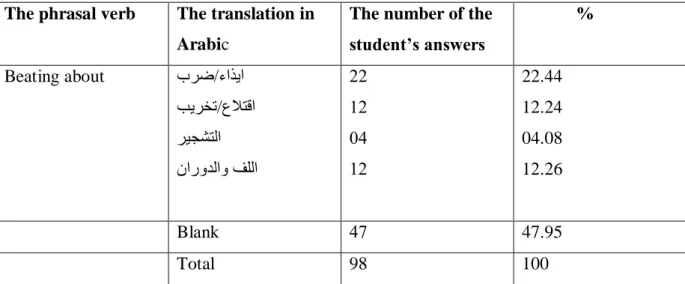
The number of the student’s answers % Beating about برض/ءاذيا علاتقا / بيرخت ريجشتلا نارودلاو فللا 22 12 04 12 22.44 12.24 04.08 12.26 Blank 47 47.95 Total 98 100
The table above shows that the majority of the student’s translations of the PV into Arabic in a wrong way using literal translation .i.e. 22.44% answered by برض .ءاذيا, and 12.24 % by بيرخت/علاتقا, and 04.08 with ريجشتلا, these translation are incorrect because the student are using the context in wrong manner as this expression is used like that in the English language culture to mean speaking around something many times. Yet, just 12.24 % of the student provided the correct equivalent for the expression as نارودلاو فللا.Therefore, 47.95% left blanks .i.e. they didn’t comprehend the sentence and even the expression is related to English language culture and heritage.
Table 09: The student’s Translation of the EPV ‘To break in’ into Arabic : The phrasal verb The Translation in
Arabic
The number of the student’s answers % Break in عطاقت لخدتت 79 07 80.61 07.14 Blank 12 12.24 Total 98 100
The majority of the students provided the acceptable translation for this phrasal verb( 80.61%) with عطاقت.i.e. they have understood the PV and its context.07.14 %of the answers are closer to the accurate meaning mainly because the lack of vocabulary in Arabic to choose the wright appropriate word to convey the intended idea. Therefore, 12.24% left unfilled spaces mainly due to the inability to express the idea or didn’t comprehend the concept even in English language.
Table 10 : Student’s Translation of the EPV ‘ To bring around’ into Arabic : The phrasal verb The Translation in
Arabic
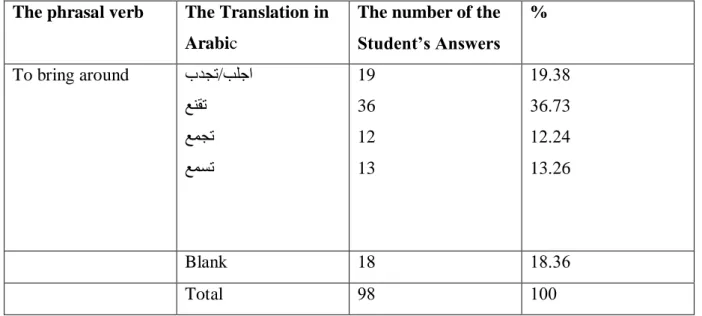
The number of the Student’s Answers % To bring around بدجت/بلجا عنقت عمجت عمست 19 36 12 13 19.38 36.73 12.24 13.26 Blank 18 18.36 Total 98 100