doi:10.1351/pac200678020241 © 2006 IUPAC
Photochemical release of various functional
groups*
Christian G. Bochet
‡Department of Chemistry, University of Fribourg, Chemin du Musée 9, CH-1700 Fribourg, Switzerland
Abstract: The photochemical liberation of functional groups is an attractive alternative to the traditional chemical approach. Several photolabile protecting groups have been developed in the past decades, but they were mainly designed to protect amines and carboxylic acids. In this account, we present some of our recent work on the photochemical release of other func-tions, such as silanols, aldehydes, and ketones. We also describe a new form of differentia-tion among several photolabile groups by the use of monochromatic light tuned to each of them: the chromatic orthogonality.
Keywords: photochemistry; protecting groups; chromatic orthogonality. INTRODUCTION
During the last few years, we have been active in investigating the possibility of selectively removing one among several protecting groups.
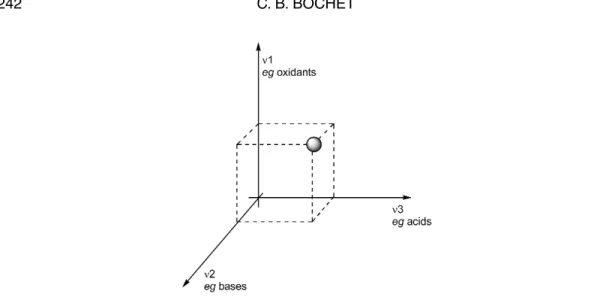
Whereas this operation constituted a real challenge in the last century, it has now become in-creasingly routine and predictable with the development of orthogonal protecting groups. Two groups are defined as orthogonal if one of them could selectively be removed in the presence of the other, and vice versa [1]. Figure 1 represents the reactivity of a protecting group under various chemical condi-tions (e.g., basic, acidic, or oxidizing). Ideally, a group should lie on one of the three orthogonal axes (hence, the term “orthogonality”), in order to react only under a very restricted set of conditions (e.g., only under acidic conditions).
In our approach, the orthogonal groups are all photolabile, and the specificity of their removal arises from the wavelength (i.e., the color) of a light beam. For this reason, we call this property chro-matic orthogonality. In other words, the differentiation of various groups arises from the choice of the incident light [2]. With regard to Fig. 1, this means that the orthogonal variables (i.e., the chemical con-ditions depicted along the various axes) are replaced by wavelength domains (ν1, ν2, and ν3).
*Pure Appl. Chem. 78, 197–523. An issue of reviews and research papers based on lectures presented at the 13th IUPAC
International Symposium on Organometallic Chemistry Directed Towards Organic Synthesis (OMCOS-13), Geneva, Switzerland, 17–21 July 2005.
LIBERATION OF CARBOXYLIC ACIDS
We have identified several pairs of chromatically orthogonal protecting groups, either among existing ones [3], or by designing new ones with properties tailored for our needs [4].
Partial orthogonality: Solid-phase peptide synthesis
A subset of orthogonality is called modulated lability [5], where one group can be removed in the pres-ence of others, but not the reverse. This case is best exemplified by the family of silicon-based pro-tecting groups, where a trimethylsilyl (TMS) ether can be hydrolyzed in the presence of a tert-butyl-dimethylsilyl ether, but never the other way around. In collaboration with the group of Bernd Giese at the University of Basel [6], we showed that the pivaloyl-derived photolabile group in Scheme 1 sur-vives the relatively mild conditions (i.e., a wavelength of 350 nm) needed to photolyze a nitroveratryl-derived one. In a later step, more energetic light (λ = 305 nm) is used to remove the pivaloyl group. However, the opposite sequence is not possible, because the nitroveratryl group is not stable to irradi-ation at 305 nm.
Fig. 1 Vectorial description of the reactivity of a protecting group.
Complete orthogonality: Use of existing photolabile groups
Complete chromatic orthogonality was found between the 3,5-dimethoxybenzoin group (254 nm) and the nitroveratryl group (420 nm), as exemplified by the photolysis of the diester in Scheme 2 where either step can be carried out before the other [3].
Complete orthogonality: Design of new groups
In order to find additional orthogonal dimensions, we needed to have a deeper control on the reaction kinetics. As the overall observed reaction rate (kobs) depends on the chromophore’s absorbance and the quantum yield for photocleavage, we wanted to fine-tune these parameters. The key step in the photo-chemical fragmentation of nitroveratryl alcohol esters is the abstraction of a benzylic hydrogen atom. Reasoning that there should be a significant H/D kinetic isotope effect, we prepared several deuterated analogs [4]. In some of them, the effect was sufficiently large (kH/kDup to 8) to be synthetically ex-ploited, as shown in Scheme 3. Thus, we achieved chromatic orthogonality between representatives of the same family of protecting groups.
Scheme 2
LIBERATION OF CARBONYL GROUPS
In the proof of principle shown above, we focused our attention on the liberation of carboxylic acids, masked (or “caged”) as photolabile esters. The liberation of amines is relatively similar, since the pho-tolysis of carbamates liberates a carbamic acid, prone to spontaneous (albeit sometimes slow) decar-boxylation. However, in order to generalize our approach, we would have to address a larger set of func-tional groups, including carbonyl compounds, alcohols, thiols, silanols, etc. Here, we will discuss the photochemical liberation of ketones, aldehydes, and silanols.
Liberation of ketone/aldehydes: Photolabile ketals/acetals
The ketals of bis(o-nitrophenyl)ethanediol and ketones or aldehydes are smoothly deprotected under neutral conditions by irradiation with light of 350 nm (Scheme 4; PPTS = pyridinium p-toluene-sulfonate). The chemical stability in basic, acidic, and oxidizing media makes this form of protection orthogonal to classical protecting groups. Both racemic and enantiopure forms are readily available in two steps from inexpensive starting materials [7].
Liberation of aldehydes: Photolabile a-acetoxyethers
Aldehydes and ketones are traditionally protected as acetals and ketals; the latter species offer good chemical resistance with respect to various conditions (basic, oxidizing, reducing, etc.). We have ex-ploited this feature by introducing the bis-(o-nitrophenyl)ethane-1,2-diol. On the other hand, when sta-bility in solution is not a central issue, α-acetoxy ethers with their inherently simpler structure repre-sent an attractive substitute to regular acetals, because their liberation is significantly less sensitive to the reaction medium (e.g., pH, water contents) (Scheme 5) [8].
LIBERATION OF SILANOLS: PHOTOLABILE SILYL ETHERS
Silyl ethers have been used as protecting groups for several decades, and their versatility and usefulness is documented in countless publications. In fact, none of the major total syntheses of complex natural products could have been achieved without silicon-based protecting groups. However, the attention is invariably focused on the organic residue (usually an alcohol) that is released upon deprotection and not
Scheme 4
dimerization to disiloxanes [10]. If one could photochemically generate silanols in a completely neutral medium and in a time-controlled fashion, the problem of dimerization would be significantly dimin-ished, and the silanols could be eventually used in situ. Hence, we reasoned that the standard photol-ysis of ortho-nitrobenzyl groups could be used to release silanols (Scheme 6):
For this purpose, we prepared a series of o-nitrobenzyl silyl ethers, with consistently high yields (60–97 %, see Table 1). As expected, their photolysis at 350 nm in acetonitrile (Rayonet® apparatus with RPR3500 lamps) smoothly released silanols, also in high yields (82–98 %), without producing significant amounts of disiloxanes, at least as long as we did not try to isolate the silanols in substance. Hence, we determined the liberation yield by 1H-NMR with an internal standard, and by comparison with independently prepared reference samples.
Table 1
Entry R1 R2 R3 Ether Silanol
1 Me Me CH=CH2 86 % 90 % 2 Me Ph Ph 88 % 98 % 3 Me Me Me 97 % 98 % 4 Me C18H37 Me 60 % 82 % 5 Bn Bn Bn 90 % 86 % 6 Me (CH2)6CH=CH2 Me 84 % 94 %
7 n-Hex n-Hex n-Hex 73 % 92 %
8 Ph Ph CH=CH2 71 % 97 %
As mentioned earlier, this procedure is only useful if silanols are needed for in situ use, such as microlithography, but in organic synthesis this requirement is less obvious. From this perspective, en-tries 1 and 8 of Table 1 are remarkable, because the silanol is a vinyldialkylsilanol. Recently, Denmark et al. have published a series of studies showing the usefulness of vinylsilanols as a safe replacement for the toxic vinylstannanes in Pd-catalyzed cross-coupling reactions. In this approach, the silanol is de-protonated by a suitable base (sodium hydride or potassium trimethylsilanolate) and is reactive enough to undergo transmetallation with an arylpalladium halide, hence entering the typical catalytic cycle for cross-coupling reactions (Scheme 7) [11].
Hence, we tried to plug our silanol photorelease method into this cycle. Our initial results were unsuccessful, because the photolabile silylethers were also chemically labile under the conditions de-veloped by Denmark et al., and therefore the cross-coupling occurred also in the absence of light. Unfortunately, the base was really needed, as stated in the original publication, and by the failure of cross-coupling in the photolysis of dimethylvinylsilanol and p-nitroiodobenzene in the presence of a Pd-catalyst in strictly neutral medium. We then screened a series of bases and conditions. Although this project is still in the preliminary phase, we have found that our masked vinylsilanols can be coupled with p-nitroiodobenzene, by using tripotassium phosphate as a base and Pd2dba3as a catalyst (yield up to 25 %; dba = dibenzyildeneacetone) (Scheme 8).
CONCLUSION
In conclusion, we have shown that the photochemical release of functional groups is not limited to the traditional carboxylic acids, ketones, or alcohols, but also to potentially more reactive groups, such as silanols. Since transition-metal-catalyzed processes are frequently part of cascade or domino reactions, precise control of the timing is critically important. Therefore, controlled release by an external trig-gering event is important, and we are continuing our efforts in this direction.
Scheme 7
ACKNOWLEDGMENTS
We thank our group of dedicated and talented coworkers who have made this work possible, in partic-ular, Dr. Aurélien Blanc and Jaime Lage Robles. We are also grateful to the Swiss National Science Foundation (grant 620-066063) for their generous financial support.
REFERENCES
1. (a) R. B. Merrifield, G. Barany, W. L. Cosand, M. Engelhard, S. Mojsov. Pept., Proc. Am. Pept. Symp. 5th, 488 (1977); (b) C. G. Bochet. J. Chem. Soc., Perkin Trans. 1 125–152 (2002). 2. C. G. Bochet. Synlett 2268–2274 (2004).
3. (a) C. G. Bochet. Angew. Chem., Int. Ed. 40, 2071–2073 (2001); (b) A. Blanc and C. G. Bochet. J. Org. Chem. 67, 5567–5577 (2002).
4. A. Blanc and C. G. Bochet. J. Am. Chem. Soc. 126, 7174–7175 (2004).
5. M. Schelhaas and H. Waldmann. Angew. Chem., Int. Ed. 35, 2056–2083 (1996). 6. M. Kessler, R. Glatthar, B. Giese, C. G. Bochet. Org. Lett. 5, 1179–1181 (2003). 7. A. Blanc and C. G. Bochet. J. Org. Chem. 68, 1138–1141 (2003).
8. J. Lage Robles and C. G. Bochet. Org. Lett. 7, 3545–3547 (2005).
9. For a recent review, see: V. Chandrasekhar, R. Boomishankar, S. Nagendran. Chem. Rev. 104, 5847–5910 (2004).
10. P. D. Lickiss. Adv. Inorg. Chem. 42, 147–262 (1995).
11. (a) S. E. Denmark and R. F. Sweis. J. Am. Chem. Soc. 123, 6439 (2001); (b) S. E. Denmark and R. F. Sweis. J. Am. Chem. Soc. 126, 4876 (2004).