arXiv:1309.6580v1 [hep-ex] 25 Sep 2013
Search for the X(4140) state in B
+→
J/ψφK
+decays with the D0 detector
V.M. Abazov,31B. Abbott,66 B.S. Acharya,25 M. Adams,45 T. Adams,43 J.P. Agnew,40 G.D. Alexeev,31 G. Alkhazov,35 A. Altona,55 A. Askew,43 S. Atkins,53 K. Augsten,7 C. Avila,5 F. Badaud,10 L. Bagby,44 B. Baldin,44 D.V. Bandurin,43S. Banerjee,25 E. Barberis,54 P. Baringer,52J.F. Bartlett,44 U. Bassler,15 V. Bazterra,45 A. Bean,52M. Begalli,2 L. Bellantoni,44 S.B. Beri,23G. Bernardi,14R. Bernhard,19 I. Bertram,38 M. Besan¸con,15 R. Beuselinck,39 P.C. Bhat,44 S. Bhatia,57 V. Bhatnagar,23 G. Blazey,46 S. Blessing,43K. Bloom,58
A. Boehnlein,44 D. Boline,63 E.E. Boos,33 G. Borissov,38 A. Brandt,69 O. Brandt,20 R. Brock,56 A. Bross,44 D. Brown,14 X.B. Bu,44 M. Buehler,44 V. Buescher,21 V. Bunichev,33 S. Burdinb,38 C.P. Buszello,37 E. Camacho-P´erez,28 B.C.K. Casey,44 H. Castilla-Valdez,28 S. Caughron,56 S. Chakrabarti,63 K.M. Chan,50 A. Chandra,71 E. Chapon,15G. Chen,52 S.W. Cho,27 S. Choi,27 B. Choudhary,24 S. Cihangir,44 D. Claes,58 J. Clutter,52 M. Cooke,44W.E. Cooper,44 M. Corcoran,71F. Couderc,15M.-C. Cousinou,12 D. Cutts,68 A. Das,41
G. Davies,39S.J. de Jong,29, 30 E. De La Cruz-Burelo,28 F. D´eliot,15R. Demina,62 D. Denisov,44 S.P. Denisov,34 S. Desai,44 C. Deterrec,20K. DeVaughan,58 H.T. Diehl,44M. Diesburg,44 P.F. Ding,40A. Dominguez,58A. Dubey,24
L.V. Dudko,33 A. Duperrin,12 S. Dutt,23 M. Eads,46 D. Edmunds,56J. Ellison,42 V.D. Elvira,44 Y. Enari,14 H. Evans,48 V.N. Evdokimov,34 L. Feng,46T. Ferbel,62 F. Fiedler,21F. Filthaut,29, 30 W. Fisher,56 H.E. Fisk,44 M. Fortner,46H. Fox,38 S. Fuess,44 P.H. Garbincius,44 A. Garcia-Bellido,62 J.A. Garc´ıa-Gonz´alez,28V. Gavrilov,32
W. Geng,12, 56 C.E. Gerber,45 Y. Gershtein,59 G. Ginther,44, 62 G. Golovanov,31 P.D. Grannis,63 S. Greder,16 H. Greenlee,44G. Grenier,17 Ph. Gris,10 J.-F. Grivaz,13 A. Grohsjeanc,15 S. Gr¨unendahl,44M.W. Gr¨unewald,26 T. Guillemin,13 G. Gutierrez,44P. Gutierrez,66 J. Haley,66 L. Han,4 K. Harder,40 A. Harel,62 J.M. Hauptman,51
J. Hays,39 T. Head,40 T. Hebbeker,18 D. Hedin,46 H. Hegab,67 A.P. Heinson,42 U. Heintz,68 C. Hensel,20 I. Heredia-De La Cruzd,28 K. Herner,44G. Heskethf,40 M.D. Hildreth,50 R. Hirosky,72T. Hoang,43 J.D. Hobbs,63 B. Hoeneisen,9 J. Hogan,71 M. Hohlfeld,21J.L. Holzbauer,57 I. Howley,69 Z. Hubacek,7, 15 V. Hynek,7 I. Iashvili,61 Y. Ilchenko,70 R. Illingworth,44 A.S. Ito,44 S. Jabeen,68 M. Jaffr´e,13A. Jayasinghe,66 M.S. Jeong,27 R. Jesik,39
P. Jiang,4 K. Johns,41 E. Johnson,56 M. Johnson,44 A. Jonckheere,44 P. Jonsson,39J. Joshi,42 A.W. Jung,44 A. Juste,36 E. Kajfasz,12D. Karmanov,33 I. Katsanos,58R. Kehoe,70 S. Kermiche,12N. Khalatyan,44A. Khanov,67
A. Kharchilava,61 Y.N. Kharzheev,31 I. Kiselevich,32J.M. Kohli,23 A.V. Kozelov,34 J. Kraus,57 A. Kumar,61 A. Kupco,8 T. Kurˇca,17 V.A. Kuzmin,33S. Lammers,48 P. Lebrun,17 H.S. Lee,27 S.W. Lee,51W.M. Lee,44 X. Lei,41
J. Lellouch,14 D. Li,14H. Li,72L. Li,42 Q.Z. Li,44 J.K. Lim,27 D. Lincoln,44 J. Linnemann,56 V.V. Lipaev,34 R. Lipton,44 H. Liu,70 Y. Liu,4 A. Lobodenko,35 M. Lokajicek,8 R. Lopes de Sa,63 R. Luna-Garciag,28 A.L. Lyon,44A.K.A. Maciel,1 R. Madar,19 R. Maga˜na-Villalba,28S. Malik,58V.L. Malyshev,31 J. Mansour,20
J. Mart´ınez-Ortega,28 R. McCarthy,63 C.L. McGivern,40 M.M. Meijer,29, 30 A. Melnitchouk,44 D. Menezes,46 P.G. Mercadante,3M. Merkin,33A. Meyer,18J. Meyeri,20 F. Miconi,16N.K. Mondal,25 M. Mulhearn,72 E. Nagy,12
M. Narain,68 R. Nayyar,41 H.A. Neal,55 J.P. Negret,5 P. Neustroev,35 H.T. Nguyen,72 T. Nunnemann,22 J. Orduna,71 N. Osman,12 J. Osta,50 A. Pal,69 N. Parashar,49 V. Parihar,68 S.K. Park,27R. Partridgee,68 N. Parua,48A. Patwaj,64 B. Penning,44 M. Perfilov,33 Y. Peters,20 K. Petridis,40G. Petrillo,62 P. P´etroff,13
M.-A. Pleier,64 V.M. Podstavkov,44 A.V. Popov,34 M. Prewitt,71D. Price,40 N. Prokopenko,34 J. Qian,55 A. Quadt,20 B. Quinn,57 P.N. Ratoff,38 I. Razumov,34 I. Ripp-Baudot,16F. Rizatdinova,67 M. Rominsky,44
A. Ross,38C. Royon,15P. Rubinov,44 R. Ruchti,50 G. Sajot,11 A. S´anchez-Hern´andez,28 M.P. Sanders,22 A.S. Santosh,1G. Savage,44 L. Sawyer,53 T. Scanlon,39 R.D. Schamberger,63Y. Scheglov,35 H. Schellman,47 C. Schwanenberger,40R. Schwienhorst,56 J. Sekaric,52H. Severini,66 E. Shabalina,20 V. Shary,15 S. Shaw,56 A.A. Shchukin,34 V. Simak,7 P. Skubic,66 P. Slattery,62 D. Smirnov,50 G.R. Snow,58 J. Snow,65 S. Snyder,64 S. S¨oldner-Rembold,40L. Sonnenschein,18 K. Soustruznik,6J. Stark,11D.A. Stoyanova,34M. Strauss,66L. Suter,40
P. Svoisky,66M. Titov,15 V.V. Tokmenin,31 Y.-T. Tsai,62 D. Tsybychev,63 B. Tuchming,15 C. Tully,60 L. Uvarov,35 S. Uvarov,35 S. Uzunyan,46 R. Van Kooten,48 W.M. van Leeuwen,29 N. Varelas,45 E.W. Varnes,41 I.A. Vasilyev,34A.Y. Verkheev,31 L.S. Vertogradov,31M. Verzocchi,44 M. Vesterinen,40 D. Vilanova,15 P. Vokac,7
H.D. Wahl,43 M.H.L.S. Wang,44 J. Warchol,50 G. Watts,73 M. Wayne,50 J. Weichert,21 L. Welty-Rieger,47 M.R.J. Williams,48 G.W. Wilson,52 M. Wobisch,53 D.R. Wood,54 T.R. Wyatt,40 Y. Xie,44 R. Yamada,44 S. Yang,4 T. Yasuda,44 Y.A. Yatsunenko,31 W. Ye,63 Z. Ye,44 H. Yin,44 K. Yip,64 S.W. Youn,44 J.M. Yu,55
J. Zennamo,61 T.G. Zhao,40 B. Zhou,55 J. Zhu,55 M. Zielinski,62 D. Zieminska,48 and L. Zivkovic14 (The D0 Collaboration∗
1LAFEX, Centro Brasileiro de Pesquisas F´ısicas, Rio de Janeiro, Brazil
2Universidade do Estado do Rio de Janeiro, Rio de Janeiro, Brazil
3Universidade Federal do ABC, Santo Andr´e, Brazil
4University of Science and Technology of China, Hefei, People’s Republic of China
5Universidad de los Andes, Bogot´a, Colombia
6Charles University, Faculty of Mathematics and Physics,
Center for Particle Physics, Prague, Czech Republic
7Czech Technical University in Prague, Prague, Czech Republic
8Institute of Physics, Academy of Sciences of the Czech Republic, Prague, Czech Republic
9Universidad San Francisco de Quito, Quito, Ecuador
10LPC, Universit´e Blaise Pascal, CNRS/IN2P3, Clermont, France
11LPSC, Universit´e Joseph Fourier Grenoble 1, CNRS/IN2P3,
Institut National Polytechnique de Grenoble, Grenoble, France
12CPPM, Aix-Marseille Universit´e, CNRS/IN2P3, Marseille, France
13LAL, Universit´e Paris-Sud, CNRS/IN2P3, Orsay, France
14LPNHE, Universit´es Paris VI and VII, CNRS/IN2P3, Paris, France
15CEA, Irfu, SPP, Saclay, France
16IPHC, Universit´e de Strasbourg, CNRS/IN2P3, Strasbourg, France
17IPNL, Universit´e Lyon 1, CNRS/IN2P3, Villeurbanne, France and Universit´e de Lyon, Lyon, France
18III. Physikalisches Institut A, RWTH Aachen University, Aachen, Germany
19Physikalisches Institut, Universit¨at Freiburg, Freiburg, Germany
20II. Physikalisches Institut, Georg-August-Universit¨at G¨ottingen, G¨ottingen, Germany
21Institut f¨ur Physik, Universit¨at Mainz, Mainz, Germany
22Ludwig-Maximilians-Universit¨at M¨unchen, M¨unchen, Germany
23Panjab University, Chandigarh, India
24Delhi University, Delhi, India
25Tata Institute of Fundamental Research, Mumbai, India
26University College Dublin, Dublin, Ireland
27Korea Detector Laboratory, Korea University, Seoul, Korea
28CINVESTAV, Mexico City, Mexico
29Nikhef, Science Park, Amsterdam, the Netherlands
30Radboud University Nijmegen, Nijmegen, the Netherlands
31Joint Institute for Nuclear Research, Dubna, Russia
32Institute for Theoretical and Experimental Physics, Moscow, Russia
33Moscow State University, Moscow, Russia
34Institute for High Energy Physics, Protvino, Russia
35Petersburg Nuclear Physics Institute, St. Petersburg, Russia
36Instituci´o Catalana de Recerca i Estudis Avan¸cats (ICREA) and Institut de F´ısica d’Altes Energies (IFAE), Barcelona, Spain
37Uppsala University, Uppsala, Sweden
38Lancaster University, Lancaster LA1 4YB, United Kingdom
39Imperial College London, London SW7 2AZ, United Kingdom
40The University of Manchester, Manchester M13 9PL, United Kingdom
41University of Arizona, Tucson, Arizona 85721, USA
42University of California Riverside, Riverside, California 92521, USA
43Florida State University, Tallahassee, Florida 32306, USA
44Fermi National Accelerator Laboratory, Batavia, Illinois 60510, USA
45University of Illinois at Chicago, Chicago, Illinois 60607, USA
46Northern Illinois University, DeKalb, Illinois 60115, USA
47Northwestern University, Evanston, Illinois 60208, USA
48Indiana University, Bloomington, Indiana 47405, USA
49Purdue University Calumet, Hammond, Indiana 46323, USA
50University of Notre Dame, Notre Dame, Indiana 46556, USA
51Iowa State University, Ames, Iowa 50011, USA
52University of Kansas, Lawrence, Kansas 66045, USA
53Louisiana Tech University, Ruston, Louisiana 71272, USA
54Northeastern University, Boston, Massachusetts 02115, USA
55University of Michigan, Ann Arbor, Michigan 48109, USA
56Michigan State University, East Lansing, Michigan 48824, USA
57University of Mississippi, University, Mississippi 38677, USA
58University of Nebraska, Lincoln, Nebraska 68588, USA
59Rutgers University, Piscataway, New Jersey 08855, USA
60Princeton University, Princeton, New Jersey 08544, USA
61State University of New York, Buffalo, New York 14260, USA
63State University of New York, Stony Brook, New York 11794, USA
64Brookhaven National Laboratory, Upton, New York 11973, USA
65Langston University, Langston, Oklahoma 73050, USA
66University of Oklahoma, Norman, Oklahoma 73019, USA
67Oklahoma State University, Stillwater, Oklahoma 74078, USA
68Brown University, Providence, Rhode Island 02912, USA
69University of Texas, Arlington, Texas 76019, USA
70Southern Methodist University, Dallas, Texas 75275, USA
71Rice University, Houston, Texas 77005, USA
72University of Virginia, Charlottesville, Virginia 22904, USA
73University of Washington, Seattle, Washington 98195, USA
(Dated: September 25,2013)
We investigate the decay B+
→ J/ψφK+ in a search for the X(4140) state, a narrow threshold
resonance in the J/ψφ system. The data sample corresponds to an integrated luminosity of 10.4 fb−1
of pp collisions at√s = 1.96 TeV collected by the D0 experiment at the Fermilab Tevatron collider.
We observe a mass peak with a statistical significance of 3.1 standard deviations and measure its invariant mass to be M = 4159.0 ± 4.3 (stat) ± 6.6 (syst) MeV and its width to be Γ = 19.9 ±
12.6 (stat)+1.0
−8.0(syst) MeV. Identifying this mass peak as the X(4140), we measure, for M (J/ψφ) <
4.59 GeV, the relative branching fraction Brel = B(B+ → X(4140)K+)/B(B+ → J/ψφK+) to
be 21 ± 8 (stat) ± 4 (syst)%. In addition, the data can accommodate the presence of a second enhancement at a mass of 4328.5 ± 12.0 MeV.
PACS numbers: 14.40.Cx,13.25.Cv,12.39.Mk
The X(4140) state [1] is a narrow resonance in the J/ψφ system produced near threshold. The CDF Col-laboration reported the first evidence [2] for this state (termed Y (4140)) in the decay B+ → J/ψφK+ (charge conjugation is implied throughout) and measured the in-variant mass M = 4143.0 ± 2.9(stat) ± 1.2 (syst) MeV and width Γ = 11.7+8.3−5.0(stat) ± 3.7 (syst) MeV.
The Belle Collaboration searched for X(4140) in the process γγ → J/ψφ and, finding no significant signal, reported upper limits on the product of the partial width Γγγ and branching fraction X(4140) → J/ψφ for JP = 0+ and 2+ [3]. At the LHC, both the LHCb and CMS Collaborations have searched for the state. The LHCb Collaboration found no evidence [4], in disagreement with the CDF measurement. A preliminary report [5] from the CMS Collaboration on a search for the same signature supports the CDF observation. With two out of four experiments failing to observe the X(4140) resonance the question of the existence of this state still remains open. A detailed review is given in Ref. [6].
The quark model of three-quark baryons and quark-antiquark mesons does not predict a hadronic state at this mass. The decay channel suggests that this reso-nance may be a cc bound state. However, at this mass,
∗with visitors from aAugustana College, Sioux Falls, SD, USA, bThe University of Liverpool, Liverpool, UK,cDESY, Hamburg,
Germany, dUniversidad Michoacana de San Nicolas de Hidalgo,
Morelia, MexicoeSLAC, Menlo Park, CA, USA,fUniversity
Col-lege London, London, UK,gCentro de Investigacion en
Computa-cion - IPN, Mexico City, Mexico,hUniversidade Estadual Paulista,
S˜ao Paulo, Brazil, iKarlsruher Institut f¨ur Technologie (KIT)
-Steinbuch Centre for Computing (SCC) andjOffice of Science, U.S.
Department of Energy, Washington, D.C. 20585, USA.
above the open-charm threshold of 3740 MeV, it is un-likely to be a conventional charmonium state. Such states are expected to decay predominantly to pairs of charmed mesons and they would have a much larger width than experimentally observed. It has been sug-gested that X(4140) is a molecular structure made of two charmed mesons, e.g. (Ds, Ds), but other possible states are hybrid particles composed of two quarks and a valence gluon (qqg) or four-quark combinations (ccss). For details see the review of hadronic spectroscopy in Ref. [7] and references therein.
In addition to X(4140), the CDF Collaboration re-ported seing a second enhancement in the same channel, located near 4.29 GeV. A similar structure is also seen by the CMS Collaboration [5]. Belle also reports a new structure at M = 4350.6+4.6−5.1(stat) ± 0.7 (syst) MeV.
In this Article we present results of a search for the X(4140) resonance and any excited states in the J/ψφ system in the decay sequence B+ → J/ψφK+, J/ψ → µ+µ−
, φ → K+K−
. The data sample corresponds to an integrated luminosity of 10.4 fb−1 collected with the D0 detector in pp collisions at the Fermilab Tevatron collider. The D0 detector consists of a central tracking sys-tem, calorimetry system and muon detectors, as de-tailed in Ref. [8]. The central tracking system comprises a silicon microstrip tracker (SMT) and a central fiber tracker (CFT), both located inside a 1.9 T superconduct-ing solenoidal magnet. The tracksuperconduct-ing system is designed to optimize tracking and vertexing for pseudorapidities |η| < 3, where η = − ln[tan(θ/2)], and θ is the polar angle with respect to the proton beam direction. The SMT can reconstruct the pp interaction vertex (PV) for interactions with at least three tracks with a precision of 40 µm in the plane transverse to the beam direction and determine the impact parameter of a track relative
to the PV with a precision between 20 and 50 µm, de-pending on the number of hits in the SMT. The muon detector, positioned outside the calorimeter, consists of a central muon system covering the pseudorapidity re-gion of |η| < 1 and a forward muon system covering the pseudorapidity region of 1 < |η| < 2. Both central and forward systems consist of a layer of drift tubes and scin-tillators inside 1.8 T toroidal magnets and two similar layers outside the toroids [9].
We use the Monte Carlo (MC) event generator pythia [10] interfaced with the particle decay pack-age EvtGen [11] to simulate the decay chain B+ → J/ψφK+, J/ψ → µ+µ−, φ → K+K−. The B+ decay is simulated according to three-body phase space. The de-tector response is simulated with geant [12]. Simulated signal events are overlayed with events from randomly collected pp bunch crossings to simulate multiple inter-actions.
Events used in this analysis are collected with both single-muon and dimuon triggers. Candidate events are required to include a pair of oppositely charged muons accompanied by three additional charged particles with transverse momenta above 0.7 GeV. Both muons are re-quired to be detected in the muon chambers inside the toroid magnet, and at least one of the muons is required to be also detected outside the toroid [13]. Each of the five final-state tracks is required to have at least one SMT hit and at least one CFT hit.
To form B+ candidates, muon pairs in the invariant mass range 2.9 < M (µ+µ−) < 3.3 GeV, consistent with J/ψ decay, are combined with pairs of oppositely charged particles (assigned the kaon mass hypothesis) with an in-variant mass in the range 0.99 < M (K+K−) < 1.07 GeV and with a third charged particle, also assigned the kaon mass hypothesis. The third kaon is required to have at least three SMT hits. The dimuon invariant mass is con-strained in the kinematic fit to the world-average J/ψ mass [1] and the five-track system is constrained to a common vertex. The trajectories of the five B+ decay products are adjusted according to the decay and kine-matic fit. The adjusted track parameters are used in the calculation of the B+ candidate mass. The B+ candi-dates are required to have an invariant mass in the range 5.15 < M (J/ψK+K−K+) < 5.45 GeV. The χ2 of the B+ vertex fit is required to be less than 20 for 6 degrees of freedom, with the contribution of the third kaon to the χ2 required to be less than 4.
To reconstruct the PV, tracks are selected that do not originate from the candidate B+ decay, and a constraint is applied to the average beam-spot position in the trans-verse plane. We define the signed decay length of a B+ meson, LB
xy, as the vector pointing from the PV to the de-cay vertex, projected on the transverse plane. We require LB
xy to be greater than 250 µm to suppress background from prompt J/ψ production. The angle between the pointing vector and the B+ meson transverse momen-tum is required to be less than 3.6◦
. We also reconstruct the decay vertex of the J/ψφ pair and require the
dis-tance between the B+ and J/ψφ vertices in the trans-verse plane and in the beam direction to be less than 50 µm and less than 150 µm, respectively (five times the RM S determined by MC). The selection is limited to events with M (J/ψφ) below 4.59 GeV. At larger masses background from other b hadron decays is large.
Background arises from a misidentified φ meson or a misidentified third kaon. To suppress background contri-bution from combinations including particles produced in the hadronization process or in other B hadron de-cays, we require the transverse momentum of the B+ meson to be between 7 and 30 GeV. The fraction of the B+transverse momentum carried by the three kaons is required to be greater than 0.2. We remove decays B → ψ(2S) + X by vetoing the mass range 3.661 < M (J/ψπ+π−
) < 3.711 GeV, equivalent to ±2.5 standard deviations around the world-average ψ(2S) mass [1], for all combinations of J/ψ produced with a pair of oppo-sitely charged particles assigned a pion mass hypothesis. For the remaining sample, we accept one candidate per event, selecting the combination with the lower φ can-didate mass. Simulations show that this choice is 95% efficient for the signal. Any sample bias resulting from the above selection is quantified and corrected using the efficiency determined by MC simulations.
The J/ψφK+ invariant mass distribution for B+ de-cay candidates satisfying the mass requirement 1.005 < M (φ) < 1.035 GeV consistent with the φ mass is shown in Fig.1(a). A binned maximum-likelihood fit of a Gaus-sian signal with a mass resolution set to the value of 18 MeV (obtained from simulations), with a second-order Chebyshev polynomial background, yields 215 ± 37 B+ events with a mean mass of M (B+) = 5277.8 ± 3.3 MeV, consistent with the world-average value of B+ mass [1]. We define the signal mass range as 5.23 < M (B+) < 5.33 GeV. Figure1(b) shows the J/ψ signal for events in the B+ signal region. A fit of a Gaussian function and a second-order Chebyshev polynomial background yields 1124 ± 70 J/ψ events out of a total of 1269 µ+µ− candi-dates, showing that most of the selected events, including background, have a J/ψ in the final state.
To establish a correspondence between the B+ sig-nal and the φ → K+K− decay, we compare the invari-ant mass distributions of the φ candidates in the B+ signal region and in the sidebands, defined as 5.15 < M (J/ψφK+) < 5.23 GeV or 5.33 < M (J/ψφK+) < 5.45 GeV. As seen in Fig.2(a), there is a clear φ signal in the B+signal region, while the φ signal is much less pro-nounced in the B+ sidebands. A fit, shown in Fig.2(b), of a relativistic P -wave Breit-Wigner function with pa-rameters set to the world-average values and a resolution of 3 MeV taken from simulations, together with a second-order Chebyshev polynomial background, yields 284 ± 40 φ candidates. A similar fit to the M (K+K−) distribution in the B+ sideband yields 115 ± 51 φ candidates. Scaling the φ yield to the signal region leads to approximately 50 candidates. Thus, the total number of φ events in the B+ signal region is consistent with the sum of the
num-) (GeVnum-)
+K
-K
+K
ψ
M(J/
5.2
5.3
5.4
Events /10 MeV
0
50
100
150
200
-1Dfl Run II, 10.4 fb
Data(a)
Full Fit Signal Bkg
) (GeV)
-µ
+µ
M(
2.9
3
3.1
3.2
3.3
Events /10 MeV
0
50
100
Dfl Run II, 10.4 fb-1 Data (b) Full Fit Signal BkgFIG. 1: (color online) (a) Invariant mass distribution of B+
→
J/ψφK+
candidates after the 1.005 < M (φ) < 1.035 GeV re-quirement. The fit of a Gaussian signal with a second-order Chebyshev polynomial background is superimposed. (b)
In-variant mass distribution M (µ+
µ−) after the B+
and φ mass window requirements. The fit of a Gaussian function with a second-order Chebyshev polynomial background is
superim-posed. The vertical green lines define the B+ signal region.
ber of B+ events determined in Fig.1and the expected contribution from background processes.
We examine combinations of J/ψ with one, two, or three charged particles, searching for structures that would affect the analysis of the J/ψφ distribution. There are multiple reasons for this study: (i) a resonance in a subsystem may create an enhancement in the M (J/ψφ) distribution leading to a false signal, (ii) identifying res-onances and applying appropriate mass restrictions to eliminate their effects would reduce background, (iii) finding a resonance and fitting its mass and width pro-vides an in situ calibration of the mass and resolution for a given configuration.
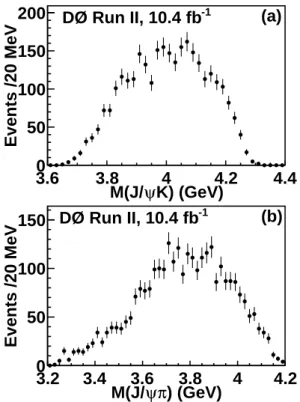
Of particular concern is the new charged charmonium-like object, Z(3900)±, observed independently by the BESIII [14] and Belle [15] Collaborations in the J/ψπ+ decay channel. The distributions of M (J/ψK), where the J/ψ is paired with the particle that is not associ-ated with the φ decay in the reconstructed B+ decay, is shown in Fig.3(a). No structures that would indicate res-onances or reflections of other decays are observed. The mass distribution for the same pair under the pion mass assignment, shown in Fig.3(b), is also structureless.
The M (J/ψπ+π−) distribution, before application of
) (GeV)
-K
+M(K
1
1.02
1.04
1.06
Events / 4 MeV
0
100
200
Data sideband + B -1DØ Run II, 10.4 fb
(a)
) (GeV)
-K
+M(K
1
1.02
1.04
1.06
Events / 4 MeV
0
100
200
Data
Full Fit
RBW, J=1
Bkg
-1DØ Run II, 10.4 fb
(b)
FIG. 2: (color online) (a) Invariant mass distribution of φ
can-didates after the B+
mass requirement 5.23 < M (B+
) < 5.33
GeV and in the B+
sidebands. (b) Invariant mass
distribu-tion of φ candidates after the B+
mass requirement. The fit of a relativistic P -wave Breit-Wigner function (RBW) with the world-average width of 4.26 MeV, convoluted with a Gaus-sian resolution of 3 MeV taken from simulations, with a second-order Chebyshev polynomial background is superim-posed. The vertical green lines define the φ signal region
the ψ(2S) veto, is shown in Fig. 4. In the fit the res-onance mass is set at the world-average value of ψ(2S) mass [1]. A fit with the mass allowed to vary gives the value consistent with the world-average value. The res-olution of 10 MeV is consistent with simulations. There are no enhancements other than the ψ(2S) meson peak that we remove from the sample.
Figure 5 shows the invariant mass distribution of the J/ψφ candidates within the B+ and φ mass windows. Overlaid is the background distribution estimated from the B+sidebands. An enhancement at low masses and a broader enhancement near 4.3 GeV are seen, consistent with the CDF [2] and CMS [5] results.
Small statistics and high background do not allow a detailed two-dimensional analysis of the three-body B+ decay. We therefore focus on the one-dimensional projec-tion of data on M (J/ψφ). In the search for the particular state X(4140), we define the allowed region for a possible resonance mass as M (J/ψφ) < 4.20 GeV, well above the X(4140) mass value, taking into account our mass resolu-tion. There are 80 events in this region. According to en-semble tests, with a large number of pseudo-experiments with the same signal and backgroud statistics, and as-suming a direct three-body B+ decay, the probability of
K) (GeV)
ψ
M(J/
3.6
3.8
4
4.2
4.4
Events /20 MeV
0
50
100
150
200
-1DØ Run II, 10.4 fb
(a)
) (GeV)
π
ψ
M(J/
3.2
3.4
3.6
3.8
4
4.2
Events /20 MeV
0
50
100
150
DØ Run II, 10.4 fb
-1(b)
FIG. 3: (a) Invariant mass distribution of J/ψK pairs
af-ter the mass requirements 5.23 < M (B+
) < 5.33 GeV and
1.005 < M (K+
K−) < 1.035 GeV. (b) Invariant mass of the
same pairs under the J/ψπ hypothesis.
) (GeV)
-π
+π
ψ
M(J/
3.6
3.8
4
Events /10 MeV
0
100
200
300
) (GeV)
-π
+π
ψ
M(J/
3.6
3.8
4
Events /10 MeV
0
100
200
300
DØ Run II, 10.4 fb
-1Data
Full Fit
Bkg
Signal
FIG. 4: (color online) Invariant mass distribution
M (J/ψπ+
π−) before the ψ(2S) veto. The fit assumes a
Gaus-sian ψ(2S) signal with the mean mass set to the world-average
value [1], and a free resolution parameter. The arrows
indi-cate the ±2.5 standard deviation range excluded from the analysis. The background is described by a product of a Lan-dau function and an exponential.
the phase space fluctuation to this value is 8 × 10⁻⁴. We divide the sample into 30 MeV wide intervals in M (J/ψφ) from 4.11 to 4.59 GeV and fit the subsamples for the number of events of the B+ decay (the bin cen-tered at M (J/ψφ) =4.155 GeV is further divided into two parts). In the fits, we constrain the B+ mean mass, as
) (GeV)
-K
+K
ψ
M(J/
4.2
4.3
4.4
4.5
Events /30 MeV
0
50
100
-1DØ Run II, 10.4 fb
(a)
Signal Region Sideband Region
) (GeV)
-K
+K
ψ
M(J/
4.2
4.3
4.4
4.5
Events /30 MeV
0
20
40
60
80
-1DØ Run II, 10.4 fb
(b)
FIG. 5: (color online) Invariant mass distribution M (J/ψφ)
after the mass requirements 5.23 < M (B+
) < 5.33 GeV and
1.005 < M (K+
K−) < 1.035 GeV. The background is
esti-mated from the B+
sidebands. (b) Difference between the distributions of the signal and normalized background.
well as the parameters describing the background shape, to the values obtained in the overall fit shown in Fig.1. According to simulations, the B+ mass resolution varies from 20 MeV for M (J/ψφ) < 4.3 GeV to 17 MeV for M (J/ψφ) > 4.5 GeV. This variation is taken into ac-count in the fits.
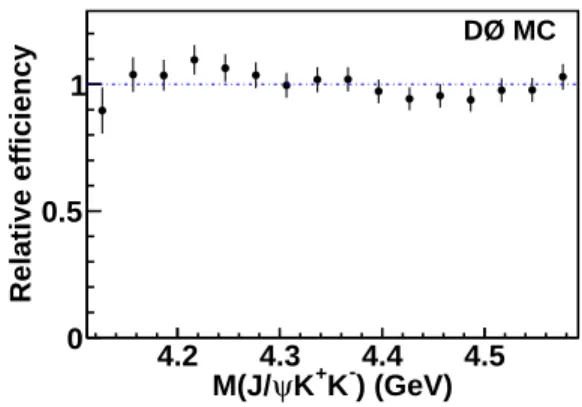
Two examples of the distributions are shown in Fig.6. The resulting B+ yield per 30 MeV as a function of M (J/ψφ), corrected for efficiency, is shown in Fig. 7. The relative efficiency as a function of J/ψφ mass is ob-tained by comparing the reconstructed spectrum from a full detector simulation with the three-body phase space distribution. The efficiency correction includes effects of the kinematic acceptance, as well as the reconstruction efficiency, the resolution, and the candidate selection effi-ciency. As shown in Fig.8, the efficiency is fairly uniform, with bin-to-bin variations within 10%.
To estimate the significance of the threshold structure, we perform a binned least-squares fit of the B+ yield to a sum of a resonance and a phase-space continuum template. We assume a relativistic Breit-Wigner sig-nal shape, with mass and width allowed to vary, con-voluted with the detector resolution of 4 MeV from sim-ulations. From the fit, shown in Fig. 7(b), we obtain 52 ± 19 (stat) signal events out of the total of 250 ± 36 events. The statistical significance of the structure, esti-mated from the χ2 difference with and without a
res-5.2
5.3
5.4
Events /12 MeV
0
5
10
-1 DØ Run II, 10.4 fb ) < 4.17 GeV -K + K ψ 4.155 < M(J/) (GeV)
+K
-K
+K
ψ
M(J/
5.2
5.3
5.4
Events /12 MeV
0
10
20
) < 4.23 GeV -K + K ψ 4.2 < M(J/ Data Full Fit Signal BkgFIG. 6: (color online) Invariant mass distributions of B+
→
J/ψφK+
candidates in two selected intervals of M (J/ψφ). Superimposed are the fits of a Gaussian signal (solid blue lines) with a second-order Chebyshev polynomial background (dashed red lines), with the signal and background shape
pa-rameters constrained to the results of the fit in Fig. 1, and
allowing for the signal yield to vary.
onant component, ∆χ2 = 14.7 for 3 degrees of free-dom, is 3.1 standard deviations. The fitted mass of this state is 4159.0 ± 4.3 (stat) MeV and the width is 19.9 ± 12.6 (stat) MeV. We identify this structure with X(4140) and we find that the quasi-two body decay B+ → X(4140)K+ constitutes (21 ± 8 (stat))% of the B+ → J/ψφK+ decay rate. The data also support the presence of a structure around 4300 MeV, however they do not allow a stable fit with an unconstrained width. When a second resonance is allowed by setting the nat-ural width to 30 MeV, consistent with the CDF data, the fit as shown in Fig.7(c) returns 47 ± 20 events at an invariant mass of 4328.5 ± 12.0 MeV.
The X(4140) mass and width measurements and the relative branching fraction are subject to systematic un-certainties associated with the precision of the B+ mass measurement, with the J/ψφ mass resolution in the vicin-ity of X(4140), and with the variation of the reconstruc-tion efficiency with M (J/ψφ). To estimate these uncer-tainties, we perform alternative fits applying more re-strictive event selection criteria, using a different bin size, and fitting the net mass distribution of J/ψφ pairs com-ing from B+ decay obtained by subtracting the prop-erly normalized background from the sideband region. In addition, we consider the following variations of the
) (GeV)
-K
+K
ψ
M(J/
4.2
4.3
4.4
4.5
) / 30 MeV
+N(B
0
20
40
60
DataPHSP -1DØ Run II, 10.4 fb
(a)
) (GeV)
-K
+K
ψ
M(J/
4.2
4.3
4.4
4.5
) / 30 MeV
+N(B
0
20
40
60
DataFull FitX(4140) PHSP -1
DØ Run II, 10.4 fb
(b)
) (GeV)
-K
+K
ψ
M(J/
4.2
4.3
4.4
4.5
) / 30 MeV
+N(B
0
20
40
60
DataFull FitX(4140) X(4330) PHSP -1
DØ Run II, 10.4 fb
(c)
FIG. 7: (color online) The B+
→ J/ψφK+ signal yield per
30 MeV resulting from fits in 17 M (J/ψφ) bins defined in the text, corrected for acceptance. Note that the second and third bins have widths of 15 MeV, and the points are nor-malized to the counts per 30 MeV as the rest of the bins. (a) Fit allowing for no J/ψφ resonance and assuming a
three-body phase-space (PHSP) [1]; (b) allowing for a Breit-Wigner
X(4140) signal with an unconstrained mass and width and with a resolution of 4 MeV; (c) allowing for two Breit-Wigner resonances where the natural width of the second is set to 30 MeV. The resonance contributions, the three-body phase-space contribution, and the total fit are also shown.
B+ mass fits in M (J/ψφ) intervals: We vary the B+ mean mass by its uncertainty of ±3 MeV, vary the B+ mass resolution by its uncertainty of ±1 MeV, vary back-ground parameters within their uncertainties and use a third-order Chebyshev polynomial in the fit to the back-ground.
In the nominal fits of the signal yield as a func-tion of M (J/ψφ), we use the J/ψφ mass resolufunc-tion of 4 MeV as obtained in simulations. For decay
pro-) (GeVpro-) -K + K ψ M(J/ 4.2 4.3 4.4 4.5 Relative efficiency 0 0.5 1 DØ MC
FIG. 8: Relative efficiency as a fucntion of of M (J/ψφ)
due to kinematic acceptance, reconstruction efficiency, and resolution.
cesses with a similar topology, ψ(2S) → J/ψπ+π− and X(3872) → J/ψπ+π−
, the measured mass resolutions are 9.9±0.3 MeV, and 15.9±3.2 MeV, respectively. Both are in a good agreement with simulations. Since the mass resolution is better for lower values of the kinetic energy released in the decay, the resolution for the structures under study is not larger than that for the ψ(2S) decay. We repeat the analysis using the value of 10 MeV. The change in the resolution does not affect the results for the resonance mass and yield but it reduces its width. We assign an asymmetric uncertainty of −8 MeV due to this effect.
We vary the efficiency dependence on M (J/ψφ) within the statistical uncertainties. In alternative fits, we use a relative efficiency that is independent of M (J/ψφ) and also a relative efficiency that drops to the value of 0.8 (instead of the default value of 0.9±0.1) at the M (J/ψφ) threshold.
From the results of the alternative fits we estimate the systematic uncertainties on the X(4140) mass and width to be ±4 MeV and +1−8 MeV, and the system-atic uncertainty of the relative branching fraction to be ±4%. We estimate the uncertainty in the J/ψφ mass scale from the vertex reconstruction by comparing
Mdef = M (J/ψφ) value used in this analysis with the alternative estimate, obtained from the mass difference Malt = M (µ+µ−K+K−) − M (µ+µ−) + M (J/ψ). The difference ∆M = Mdef − Malt is on average 1.3 MeV, and the RM S is 5.2 MeV. We conclude that there is no significant mass bias due to the vertexing procedure and we conservatively assign a systematic uncertainty of ±5.2 MeV due to the uncertainty in the J/ψφ mass scale. The statistical significance of the X(4140) signal is larger than 3 standard deviations in all alternative fits. A search conducted in the entire mass range (4.11, 4.59) GeV, ig-noring the prior observation of X(4140), would result in the signal significance reduced due to the “look elsewhere effect” [16] by the trial factor of 5 to 2.6 standard devia-tions.
In summary, in the decay B+ → J/ψφK+, we find a threshold enhancement in the J/ψφ mass distribu-tion consistent with the X(4140) state with a statisti-cal significance of 3.1 standard deviations. The data can also accommodate a second structure, at M2 = 4328.5 ± 12.0 MeV, consistent with Ref. [3]. The mea-sured invariant mass of the lower-mass peak is 4159.0 ± 4.3 (stat) ± 6.6 (syst) MeV and the measured width is 19.9 ± 12.6 (stat)+1−8(syst) MeV. The relative branch-ing fraction Brel = B(B+ → X(4140)K+)/B(B+ → J/ψφK+) (for M (J/ψφ) < 4.59 GeV) is measured to be (21 ± 8 (stat) ± 4 (syst))%. Our results support the existence of the X(4140) resonance.
We thank the staffs at Fermilab and collaborating in-stitutions, and acknowledge support from the DOE and NSF (USA); CEA and CNRS/IN2P3 (France); MON, NRC KI and RFBR (Russia); CNPq, FAPERJ, FAPESP and FUNDUNESP (Brazil); DAE and DST (India); Col-ciencias (Colombia); CONACyT (Mexico); NRF (Ko-rea); FOM (The Netherlands); STFC and the Royal So-ciety (United Kingdom); MSMT and GACR (Czech Re-public); BMBF and DFG (Germany); SFI (Ireland); The Swedish Research Council (Sweden); and CAS and CNSF (China).
[1] J. Beringer et al. (Particle Data Group), Phys. Rev. D
86, 010001 (2012).
[2] T. Aaltonen et al. (CDF Collaboration), Phys. Rev. Lett. 102, 242002 (2009).
[3] C. Shen et al. (Belle Collaboration), Phys. Rev. Lett.
104, 112004 (2010).
[4] R. Aaij et al. (LHCb Collaboration), Phys. Rev. D 85, 091103 (2012).
[5] CMS Collaboration, “Observation of structures in the
J/ψφ spectrum of B+
→ J/ψφK+
decays”, CMS-BPH-11-026.
[6] K. Yi, Int. J. Mod. Phys. A 28, 133030 (2013). [7] N. Drenska, R. Faccini, F. Piccinini, A. Polosa,
F. Renga and C. Sabelli, Riv. Nuovo Cim. 033, 633 (2010).
[8] V. M. Abazov et al. (D0 Collaboration), Nucl. Instrum. Methods Phys. Res. A 565, 463 (2006).
[9] V. M. Abazov et al. (D0 Collaboration), Nucl. Instrum. Methods Phys. Res. A 552, 372 (2005).
[10] H. U. Bengtsson and T. Sj¨ostrand, J. High Energy
Phys. 05, 026 (2006).
[11] D.J. Lange, Nucl. Instrum. Meth. A 462, 152 (2001). [12] R. Brun and F. Carminati, CERN Program Library
Writeup W5013.
[13] V. M. Abazov et al. (D0 Collaboration), submitted to Nucl. Instrum. Meth. Phys. Res. A, arXiv:1307.5202 (2013).
[14] M. Ablikim et al. (BESIII Collaboration), Phys. Rev. Lett. 110, 252001 (2013).
110, 252002 (2013).