Psychophysiology. 2020;57:e13556.
|
1 of 14https://doi.org/10.1111/psyp.13556 wileyonlinelibrary.com/journal/psyp
O R I G I N A L A R T I C L E
ERP evidence suggests that confrontation with deterministic
statements aligns subsequent other- and self-relevant error
processing
Daniela M. Pfabigan
1,2|
Clemens Mielacher
2,3|
Frédéric Dutheil
4|
Claus Lamm
2This is an open access article under the terms of the Creative Commons Attribution-NonCommercial License, which permits use, distribution and reproduction in any medium, provided the original work is properly cited and is not used for commercial purposes.
© 2020 The Authors. Psychophysiology published by Wiley Periodicals, Inc. on behalf of Society for Psychophysiological Research
1Department of Behavioural Sciences
in Medicine, Institute for Basic Medical Science, Faculty of Medicine, University of Oslo, Oslo, Norway
2Social, Cognitive and Affective
Neuroscience Unit, Department of Cognition, Emotion, and Methods in Psychology, Faculty of Psychology, University of Vienna, Vienna, Austria
3Division of Medical Psychology,
University of Bonn, Bonn, Germany
4Université Clermont Auvergne, CNRS,
LaPSCo, Physiological and Psychosocial Stress, University Hospital of Clermont– Ferrand, CHU Clermont–Ferrand, Preventive and Occupational Medicine, WittyFit, Clermont–Ferrand, France
Correspondence
Daniela M. Pfabigan and Claus Lamm, Department of Behavioural Sciences in Medicine, Institute for Basic Medical Science, Faculty of Medicine, University of Oslo, Oslo, Norway.
Email: [email protected] (D. M. P.) and [email protected] (C. L.)
Funding
Participants' financial remuneration was funded by a scholarship of the University of Vienna and by the Department of Cognition, Emotion, and Methods in Psychology, Faculty of Psychology, University of Vienna. Open access funding was provided by the University of Oslo.
Abstract
This study used event-related potential (ERP) measurements to investigate whether error processing in a social context is modulated by top-down influence of deter-ministic thinking, i.e., subjective beliefs that events are pre-determined by previ-ously existing causes. To this end, half of our participants were confronted with statements denying the existence of free will, aimed to induce more deterministic thinking, whereas the other half was assigned to a control group that read neutral statements. Thereafter, all participants performed a choice-reaction task for their own and for the benefit of a second participant. Error rates were comparable in both groups and benefit settings, while only control participants showed enhanced post-error slowing (PES) in other- compared to self-relevant trials. On the neural level, other-relevant errors elicited diminished early error signals (reduced ΔERN ampli-tudes) in deterministic-intervention participants compared to controls. In subsequent processing, ERPs of deterministic-intervention participants did not differentiate be-tween the benefit settings, while controls showed reduced ΔPe amplitudes for oth-ers compared to self-relevant errors. Taken together, our findings suggest that being confronted with deterministic compared to control statements reduced subsequent processing differences between other- and self-relevant error processing. This might be beneficial in social evaluation or intergroup situations because it could decrease self-cenetred processing biases often observed in these situations.
K E Y W O R D S
1
|
INTRODUCTION
Successful interactions with our fellow human beings require constant monitoring of their behavior to interpret their in-tentions, and to adapt our behavior to achieve varying goals. This implies that we are in control of choosing different ac-tions to flexibly react to changing situaac-tions. Contrasting this notion, recent years have seen an increasing belief that individual actions and outcomes are determined by external causes (Twenge, Zhang, & Im, 2004). This belief might put limits on one's ability to flexibly adapt behavior. Moreover, this more deterministic thinking style has also been associ-ated with psychological distress (Schroder, Callahan, Gornik, & Moser, 2018; Schroder, Dawood, Yalch, Donnellan, & Moser, 2015), which might be particularly disruptive in so-cial interactions. For example, individuals might refrain from helping others because they might believe that their actions could not improve the situation at hand, i.e., that their ac-tions “do not matter”. However, the assumption of negative effects of deterministic thinking in social interactions has not been tested so far since previous research regarding de-terministic thinking focused on behavioral and neural mark-ers of self-relevant behavior only (e.g., Rigoni, Pourtois, & Brass, 2015; Schroder, Moran, Donnellan, & Moser, 2014). The current study aimed to address this knowledge gap via assessing self- and other-relevant correlates of error process-ing (as a sub process of performance monitorprocess-ing) in a social setting when deterministic thinking is emphasized. Thereby, the particular impact of neural markers of error processing in relation to deterministic thinking and other-relevant behavior was investigated.
Social psychology offers different concepts tapping into deterministic thinking. One is the belief in free will, which is assumed to reflect a fundamental motive for individuals to show goal-directed behavior, which often requires effort-ful deliberate processing instead of automatic routines (e.g., Leotti, Iyengar, & Ochsner, 2010). Experimentally challeng-ing this belief in free will might consequently lead to reduced goal-directed behavior and is thereby associated with more deterministic thinking. Indeed, several no-free-will-manipu-lation studies reported cursory and antisocial behavior such as cheating and decreased prosociality (Baumeister, Masicampo, & DeWall, 2009; Vohs & Schooler, 2008; however, see Caspar, Vuillaume, Magalhães De Saldanha da Gama, & Cleeremans, 2017; Harms, Liket, Protzko, & Scholmerich, 2017; Open Science, 2015 for diverging results)—thereby providing a link to social behavior. Furthermore, also error processing was affected by a no-free-will-manipulation. Rigoni et al. (2015) reported decreased error-related brain activity only for their no-free-will-manipulation group, but no effects in a control group. Based on these two lines of research, we chose a similar no-free-will-manipulation as our experimental model of inducing deterministic thinking.
To quantify the combined impact of social setting and our deterministic intervention during error processing, we assessed event-related potentials (ERPs) during a choice-reaction task, which allow a precise temporal mapping of underlying cogni-tive processes. Half of our participants underwent a cognicogni-tive manipulation prior to the choice-reaction task, which aimed to induce more deterministic thinking (deterministic-inter-vention group). The other half of our participants were ex-posed to a control manipulation without any references to determinism. All participants performed the choice-reaction task for their own benefit (self-relevant setting) and for the benefit of another individual (other-relevant setting). As neu-ral correlates, we assessed the Error-Related Negativity com-ponent (ERN; Falkenstein, Hoormann, Christ, & Hohnsbein, 2000; Gehring, Goss, Coles, Meyer, & Donchin, 1993), which is a fronto-central negative deflection within the first 100 ms after error commission. It is considered as a rather automatic signal, either reflecting reinforcement learning (Holroyd & Coles, 2002), conflict processing (Botvinick, Carter, Braver, Barch, & Cohen, 2001), or motivational error signif-icance (Gehring & Willoughby, 2002). Further, ERN ampli-tude variation has also been interpreted as a self-protective threat-monitoring signal (Weinberg, Riesel, & Hajcak, 2012) reflecting the mobilization of defensive motivational systems after error detection. The ERN is followed by the positive- going, centrally located (late) Error Positivity component (Pe; Falkenstein et al., 2000; Falkenstein, Hohnsbein, Hoormann, & Blanke, 1991), with more positive amplitudes 200–400 ms after errors. Pe variation is considered reflecting conscious error processing (Nieuwenhuis, Richard Ridderinkhof, Blom, Band, & Kok, 2001) and general evidence accumulation after error commission (Steinhauser & Yeung, 2010), or affective responses after errors (Falkenstein et al., 2000).
Previous research has demonstrated that error-related ERPs are sensitive to the respective social setting. Enhanced ERN amplitudes were reported for self- compared to oth-er-relevant errors when the other person was not present (Kitayama & Park, 2014) or introduced as an unknown out-group member (Pfabigan, Holzner, & Lamm, 2016). In contrast, de Bruijn, Ruissen, and Radke (2017) observed no effects of social setting on ERN amplitudes when partici-pants performed the task in the actual presence of a co-player. Instead, diminished Pe amplitudes for others compared to self-relevant errors were found. The same error-related ERP variation also reflects the impact of cognitive manipula-tions tapping into deterministic thinking (such as mindset or randomness manipulations). A more deterministic mind-set led to weakened brain-behavior relationships (Schroder et al., 2014), while emphasizing unpredictability lead to ERN enhancement (Tullett, Kay, & Inzlicht, 2015).
The current study investigated the combined effects of social setting and a deterministic intervention on error pro-cessing to better capture real-life situations with which our
error processing system is confronted. For the ERN com-ponent, we hypothesized decreased ERN amplitudes in deterministic-intervention than control participants (Rigoni et al., 2015), but no differences for self- and other-relevant errors because a co-player was present as in de Bruijn et al. (2017). For the Pe component, we hypothesized no differ-ences between control and deterministic-intervention par-ticipants in line with Rigoni et al. (2015), but decreased Pe amplitudes for other- than self-relevant errors as in de Bruijn et al. (2017). We hypothesized opposite effects for ERN and Pe components because previous studies suggested that ERN amplitudes might be more sensitive to top-down manipula-tions-such as the current deterministic intervention-than Pe amplitudes (Pfabigan et al., 2013; Rigoni et al., 2015; Wang, Yang, & Wang, 2014). The latter component might be more sensitive to the social setting induced by the presence of and responsibility for another individual (de Bruijn et al., 2017). For both ERPs, interaction effects of social setting and the deterministic intervention were explored, for which we had, however, no a priori hypotheses. Furthermore, error rates, response times, and affective ratings during the experiment were explored concerning the intervention. At the end of the experiment, we gave participants the possibility to act proso-cially toward the other participant to probe potential negative effects of the deterministic intervention in a more ecologi-cally valid way than during the experiment.
2
|
METHOD
2.1
|
Participants
Forty-seven right-handed volunteers (Oldfield, 1971) par-ticipated in this study. Data of four participants were not
included in the further analysis because of excessive alpha artifact contamination, which made ERP identification im-possible. Thus, the final sample consisted of 43 participants (29 women, mean age 24.35 years, SD = 4.74, range: 18–36), of which 21 had been randomly assigned to the determinis-tic-intervention group. A priori power analysis suggested a sample size of 44 participants to detect medium-sized effects in a mixed ANOVA design (f = 0.25, α = .05, β = .90, cor-relation among repeated measures = .50; G*Power 3.1; Faul, Erdfelder, Buchner, & Lang, 2009). We recruited slightly more participants to be prepared for potential dropouts. The study was conducted in accordance with the Declaration of Helsinki (7th revision, 2013) and local ethical guidelines for experimentation with human participants (including ap-proval by an institutional review board) at the Faculty of Psychology, University of Vienna. Written informed consent was obtained from all participants prior to the experiment.
2.2
|
Experimental tasks and procedures
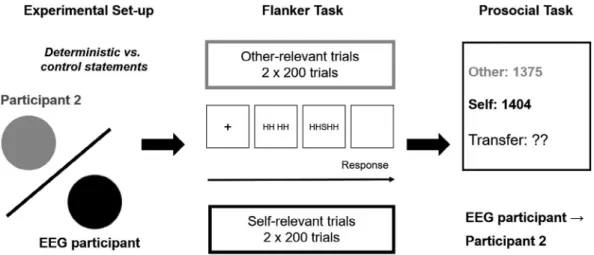
Figure 1 provides an overview of the experimental set-up. Upon arrival, participants were informed that they would per-form the current experiment for their own benefit and for the benefit of another person. When their electroencephalogram (EEG) preparation was finished, a female confederate arrived and was introduced as the second participant from whom skin conductance responses (SCR) would ostensibly be measured. After filling in several questionnaires, both participants were seated in the EEG chamber in front of separate PC monitors. An opaque divider was placed in between and participants were instructed to refrain from interacting with each other. They were presented with the same visual display during the experiment, but only the EEG participant was required to
FIGURE 1 Overview of the experimental set-up and tasks. First, both participants were seated in the EEG chamber, separated by an opaque divider and presented with deterministic or control statements. Second, EEG participants performed 800 Flanker task trials (400 trials for themselves, 400 trials for the second participant). Third, EEG participants were given the possibility to transfer any amount of their points to the second participant before the experiment ended
perform the task. The second participant (confederate) was instructed to passively observe the task.
We used a between-subjects design and applied a deter-ministic intervention to half of our participants, which aimed at temporarily increasing deterministic thinking via a mood induction-style procedure (Velten, 1968); previously adapted by Vohs and Schooler (2008). Participants in the determinis-tic-intervention group were presented with statements chal-lenging or denying the existence of free will and emphasizing determinism (e.g., All behavior is determined by brain
ac-tivity, which in turn is determined by a combination of en-vironmental and genetic factors). In contrast, participants
in the control group were presented with neutral statements unrelated to deterministic thinking (e.g., Pocket calculators
became common items only after 1970). While seated in the
EEG chamber, all participants were presented with 15 state-ments on screen (duration 45 s each). They were instructed to read the statements carefully and to take over the perspective of an individual who is strongly convinced by them. This pro-cedure has been successfully applied by previous studies (see Rigoni & Brass, 2014).
Afterwards, all EEG participants performed the choice-re-action task for their own benefit (self-relevant setting) and for the benefit of the second participant (other-relevant set-ting). Performing a flanker task (Eriksen & Eriksen, 1974), participants had to indicate target letters (H, S, K, or C) in the middle of a five-letter string via button press. To indicate their responses, participants had to use the keys 1 and 3 on the number pad of a standard German-language keyboard. The keys were assigned to the target letters and had to be pressed with the index and the middle finger of the right hand (counter-balanced assignment across participants). The letter strings were either congruent (e.g., HHHHH, SSSSS) or in-congruent (e.g., HHSHH, SSCSS) and presented centrally on black background. Each trial started with the presentation of a fixation cross for 200 ms, followed by the four outer letters for 100 ms. Next, the central letter was blended into this array for 35 ms (Kopp, Rist, & Mattler, 1996). Afterwards, partic-ipants had 870 ms to give a response while a black screen was presented. Performance feedback was only presented when participants responded too slow, demanding faster re-sponses (duration 1,000 ms), otherwise a fixation cross was shown (1,000 ms), followed by an inter-stimulus interval of 800–1,200 ms displaying the fixation cross. After 40 train-ing trials, participants performed 800 trials containtrain-ing 50% congruent and 50% incongruent stimuli, presented randomly. Participants were given short, self-paced breaks every 50 trials. Experimental blocks comprised of 200 trials each, re-peated two times. Two blocks (400 trials) were performed in the self-relevant setting in which participants' errors affected their own benefit. Two blocks (400 trials) were performed in the other-relevant setting in which participants' errors affected the benefit of the second participant (presented
alternating). At the start of each block, participants were ex-plicitly instructed on screen for whom they were performing the task in the upcoming trials (self-relevant vs. other-rele-vant setting). To increase saliency of the two different set-tings, different font colors (cyan vs. magenta) were used for the instruction and the stimuli per setting. The sequence of self- and other-setting and font colors were counterbalanced across participants.
Per setting, participants were initially endowed with 1,500 points as seed capital (one point equaling €0.01). If participants committed an error, five points were subtracted from the respective seed capital, and 10 points per missed response. Errors in the self-relevant setting reduced the par-ticipant's own pay-off, errors in the other-relevant setting reduced the pay-off of the second participant. Points per set-ting were converted into real monetary pay-offs at the end of the experiment. After each block, the current point score was presented on screen. Every 100 trials, participants had to give affective ratings addressing how ashamed, worried, happy, guilty, sad, responsible, or angered they felt during the last trials on a 5-point Likert scale ranging from 1 (not at all) to 5 (a lot).
At the end, final scores were presented for both settings. To assess prosocial behavior, EEG participants were given the opportunity to transfer any amount of points from their account to the second participant. Afterwards, electrodes were removed from both participants and they received their monetary pay-off based on the point transfer decision of the EEG participant (who received additional €10 as show up fee; EEG participants earned on average € 23.17, SD = 1.60).
2.3
|
Questionnaires
Prior to the experimental session, participants filled in online versions of several psychological questionnaires to better de-scribe the two groups. They filled in the Beck Depression Inventory (BDI-II; Beck, Steer, & Brown, 2006) and the trait version of the State-Trait Anxiety Inventory (STAI; Laux, Glanzmann, Schaffner, & Spielberger, 1981) to assess vari-ables that might influence the interpretation of results. Error-related brain activity is sensitive to individual variation in depressive and anxiety-related symptomatic (e.g., Aarts & Pourtois, 2010; Olvet & Hajcak, 2008). The BDI-II as-sesses the occurrence of depressive symptoms within the last two weeks via 21 items, which are answered from 0 to 3 (reflecting increasing symptom severity). Its Cronbach's alpha reliability is rα = .93. The STAI-Trait assesses
anxi-ety as a stable personality construct, asking how participants feel in general. It consists of 20 items answered on a 4-point Likert scale from 1 (almost never) to 4 (almost always); its Cronbach's alpha reliability is rα = .90. The Interpersonal
dispositional empathy traits relevant in regard to the social setting manipulation. The IRI consists of 16 items subsumed in four subscales: personal distress (capturing self-oriented aversive emotions), empathic concern (capturing feelings of concern or pity for another person), fantasy (capturing the tendency to identify with fictional characters), and perspec-tive taking (capturing the ability to reflect another person's point of view). It is answered on a 5-point Likert scale rang-ing from 1 (does not describe me well) to 5 (describes me very well). The German version of the IRI has a Cronbach's alpha reliability of rα = .73 (Paulus, 2009). The Free Will and
Determinism Scale (FAD-plus; Paulhus & Carey, 2011) was administered to assess trait lay beliefs in free will. It consists of 27 items subsumed in four subscales: lay belief in free will, scientific determinism, fatalistic determinism, and ran-domness, which are answered on a 5-point Likert scale rang-ing from 1 (strongly disagree) to 5 (strongly agree). The IRI and the FAD-plus were administered to exclude the possibil-ity that potential group differences would be attributable to differences in empathic traits (in particular personal distress and empathic concern as self- vs. other-oriented empathic traits), or trait belief in free will, respectively. Additionally, the FAD-plus was administered also after the experimental session to probe state effects of the current manipulation as done by previous studies, i.e., serving as a direct manipulation check (Rigoni et al., 2015; Rigoni, Wilquin, Brass, & Burle, 2013). Before and after the presentation of the deterministic-thinking or control statements, participants and confederates filled in the German version of the Positive and Negative Affect Schedule (PANAS; Krohne, Egloff, Kohlmann, & Tausch, 1996) to assess possible changes in positive and negative affect in response to the statements. The PANAS consists of 20 adjectives (10 for negative affect, 10 for posi-tive affect), which are rated on a 5-point Likert scale from 1 (not at all) to 5 (extremely). Cronbach's alpha reliability for both scales is rα = .84. After the experiment, EEG
partici-pants filled in questions assessing experienced distress after error commission, effort during the task, and performance satisfaction, asked separately for self- and other-relevant settings on 7-point Likert scales ranging from 1 (does not apply at all) to 7 (applies to the highest degree) (Pfabigan et al., 2016). Furthermore, they were asked general questions whether they felt distracted by the other participant, how dif-ficult they thought the task was, and how difdif-ficult it was to concentrate during the task.
2.4
|
Electrophysiological recording and
data analysis
The experiment was set up in an electromagnetically shielded chamber. Stimulus presentation was controlled by E-Prime 2.0 (Psychology Software Tools, Inc., Sharpsburg, PA).
Stimuli were presented on two 19 inch CRT monitors (re-fresh rate 85 Hz). EEG was recorded with 59 Ag/AgCl elec-trodes embedded equidistantly in an elastic electrode cap (EASYCAP GmbH, Herrsching, Germany, model M10). Vertical and horizontal electro-oculogram (EOG) was re-corded via four additional electrodes. A ground electrode was placed in the middle of the forehead serving as an on-line reference. Electrode impedances were kept below 4 kΩ by applying a skin-scratching procedure (Picton & Hillyard, 1972) and using degassed electrode gel (Electrode-Cap International, Inc., Eaton, OH). They were manually con-trolled with an impedance meter (Ing. Kurt Zickler GmbH, Pfaffstätten, Austria). All electrophysiological signals were recorded with a DC amplifier set-up (NeuroPrax, neuroConn GmbH, Ilmenau, Germany) from DC to 250 Hz and sampled at 500 Hz for digital storage. The second participant was con-nected to an 8-channel bioamplifier (Mobi8-BP; TMSi B. V., Enschede, the Netherlands) via two flat Ag/AgCl electrodes, which were placed at the medial phalanges of the index and the ring finger of her non-dominant hand. However, SCR data were not stored for data analysis. EEG data collection lasted about 50 min.
EEG data were analyzed using EEGLAB 13_1_1b (Delorme & Makeig, 2004) in Matlab 2014a. Offline, high pass (0.1 Hz) and low-pass filters (cut-off frequency 30 Hz, roll-off 6 dB/octave) were applied to continuous data. Subsequently, data were re-referenced to linked mastoids, segmented into epochs [−1,000; 2,500 ms] centered around the onset of the outer flankers, and extended infomax inde-pendent component analysis (ICA; Bell & Sejnowski, 1995) was applied to detect eye movement-related artifacts. After discarding them, response-locked data segments were ex-tracted starting 400 ms prior to the button press and lasting for 1,200 ms (other correct, other error, self-correct, and self
error) to assess ERN and Pe components. The mean activity
in the interval [−200; −100] ms prior to the button press was chosen as baseline interval because of its distance to the mo-toric response (see for example Good, Inzlicht, & Larson, 2015; Rigoni et al., 2015; Wang et al., 2014, for a similar approach). Subsequently, semi-automatic artifact correction was conducted in EEGLAB. Trials with voltage values ex-ceeding ±75 µV (pop_eegthres) or voltage drifts >50 µV (pop_eegrejtrend) were automatically marked by the algo-rithms. These trials were rejected in case visual inspection also indicated artifact affliction. On average, 322.24 (SD = 4.25) correct and 19.60 (SD = 17.26) erroneous re-sponse trials were available after artifact rejection per setting. Afterwards, difference waves were calculated via subtracting correct from erroneous trials separately for other- and self-rel-evant trials per participant (Luck, 2005) to eliminate pro-cesses common to error and correct trials as in, for example, Falkenstein et al. (1991), Meyer et al. (2012) and Rigoni et al. (2015). To keep the statistical model simple and to increase
ERP signal-to-noise ratio (Luck & Gaspelin, 2017), we as-sessed difference wave (Δ)ERPs at clusters of several merged electrodes applying a region of interest approach. An elec-trode cluster including FCz and its six surrounding elecelec-trodes (R11, R14 [FCz], R15, L8 [Fz], L9, L12, L16 [Cz]) was used for assessing the ΔERN component, a cluster including Pz and its five surrounding electrodes (R24 [CPz], R25, R29, L22, L26 [Pz], L27) for the ΔPe component.1 For the ΔERN
component, the most negative peak within 100 ms after the button press was extracted per participant and benefit condi-tion. Subsequently, mean amplitudes were calculated ±30 ms around each individual ΔERN peak. For the ΔPe component, the most positive peak 200–400 ms after button press was extracted per participant and benefit condition and mean am-plitudes were calculated ±100 ms around each individual ΔPe peak.2 The individual-mean-amplitudes approach was
chosen to take inter-individual ERP latency differences into account while concurrently benefitting from an approach av-eraging over a larger time window. Time windows for peak extraction were chosen based on previous literature (e.g., van Noordt & Segalowitz, 2012) and visual inspection.
As behavioral task measure, we explored reaction times, error rates, and post-error slowing (PES) behavior. Reaction times were defined as the interval from middle letter offset until button press. Reaction times faster than 200 ms were considered as anticipatory reactions and discarded (Hajcak, Moser, Yeung, & Simons, 2005; Pfabigan, Pripfl, Kroll, Sailer, & Lamm, 2015). Regarding the analysis of PES, only reaction times of correct trials were extracted participant-wise before and after erroneous trials (Dutilh et al., 2012).
2.5
|
Statistical analyses
A winsorizing procedure was applied to dependent vari-ables (ERPs and reaction time data) per group and setting to acknowledge different outlier rates per group (Wilcox, 2012). ERPs and behavioral data were analyzed using multilevel modeling (MLM) using the MIXED function in SPSS. This was done for ΔERN and ΔPe components to avoid losing participants for whom not all conditions were available (see de Bruijn et al., 2017; Saunders, Riesel, Klawohn, & Inzlicht, 2018). An MCAR test supports the assumption that all data were missing randomly (χ2
(2,
N=43) = 2.26, p = .323). Six participants committed less
than five error trials, which is a critical limit for a reliable ERN component assessment (Amodio et al., 2004; Pfabigan et al., 2013), in either the other- or the self-relevant setting. These cells were treated as missing values, both in EEG as well as in behavioral analyses.
For the ERP analysis, we used the following criteria for effect-coding the factors benefit setting and group: control group: −1; deterministic-intervention group: 1; other-rele-vant setting: −1; self-releother-rele-vant setting: 1. A multilevel model accounting for setting and group nested within participants was calculated by estimating a random intercept for each par-ticipant (via defining the relationship between the repeated measures of the factor benefit setting as a random-effects parameter. This led to a better model fit than not taking the repeated-measures design into account).
Individual mean reaction times were modeled separately as a function of correctness or congruency, benefit setting and
group as fixed effects, PES (Rabbitt, 1966) with sequence, benefit setting and group as fixed effects. We used the
fol-lowing criteria for effect-coding the factors
correctness/con-gruency/sequence, benefit setting, and group: (effect-coded: correctness: error: −1, correct: 1; congruency: incongruent:
−1, congruent: 1; sequence for PES analysis: pre-error: −1, post-error: 1; control group: −1; deterministic-intervention group: 1; other-relevant setting: −1; self-relevant setting: 1). Again, the repeated measures nature of the within-subject factors was defined as random effects parameter. To resolve possible three-way interactions regarding MLM of correct-ness, congruency, or PES reaction times, we chose a differ-ence score approach subtracting error from correct trials (for the correctness analysis), incongruent from congruent (for the congruency analysis), and pre-error from post-error trials (for the PES analysis). The amount of errors and the total amount of earned points were modeled with benefit setting and group; the absolute number of points transferred and their percentage portion in relation to the number of self-relevant points with
benefit setting as fixed effect. The number of participants
who refrained from transferring any points per group was compared with a χ2 test. Independent t tests were used to
ad-dress group differences of questionnaire scores. The items of the task evaluation questionnaire and affective ratings during the task were analyzed with separate mixed-model ANOVAs with the between-subject factor group and the within-subject factor benefit setting, or with independent t-tests when only group differences were tested. The PANAS ratings were also analyzed with this mixed-model ANOVA design, extended with the within-subject factor time of measurement (before/ after statement presentation). Lastly, scores of the FAD-plus subscales were compared with independent t tests.
Statistical analyses were performed in SPSS 22 (SPSS Inc., IBM Corporation, NY). Significant ANOVA inter-action effects were addressed with planned comparisons of deterministic-intervention versus control participants.
1The number of electrodes chosen for the clusters was determined by the
electrode layout of the EEG cap. Electrode FCz is surrounded by six electrodes, while Pz is surrounded by five electrodes when using the equidistant electrode layout of model M10—see Supporting Information.
2Please note: using a classical mean amplitudes approach for ΔERN (time
window 0–100 ms after the response) and ΔPe (time window 200–400 ms after response) ERP quantification yielded comparable results.
When calculating MLM, we applied an unstructured co-variance matrix, maximum likelihood estimations, and the Satterthwaite method for estimating degrees of free-dom as implemented in SPSS. Significant interactions in MLM were resolved with simple slope analysis (Aiken & West, 1991). The significance level was set at p < .05. We used partial eta-squared (𝜂2
p) as indicator of effect sizes for
classical ANOVAs (values of 0.01, 0.06, and 0.14 denote small, medium and large effects; Kirk, 1996), Cohen's d for t-tests (Cohen, 1988), and semi-partial R2 (Edwards,
Muller, Wolfinger, Qaqish, & Schabenberger, 2008) for MLM (values of 0.02, 0.13, and 0.26 denote small, me-dium, and large effects; Cohen, 1992).
3
|
RESULTS
3.1
|
Questionnaire results
Apart from significant differences regarding the empathy facet Fantasy, no group differences emerged for determin-istic-intervention and control participants in the question-naires administered prior to the experiment—see Table S1 in Supporting Information. This suggests highly comparable participant groups prior to the confrontation with determinis-tic versus control statements.
3.2
|
Rating results
Subjective ratings of experienced guilt (F(1,41) = 18.99, p
< .001, 𝜂2
p = 0.32) and responsibility (F(1,41) = 29.79, p <
.001, 𝜂2
p = 0.42) were higher for other- than self-relevant
setting trials, indicating that the social setting manipula-tion was successful. No other effects were observed for guilt (both p's > .236) and responsibility (both p's > .479). Deterministic-intervention participants gave lower worry rat-ings than control participants (F(1,41) = 4.69, p = .036, 𝜂2
p =
0.10) irrespective of the setting (both p's > .119). In contrast, their happiness ratings were by trend higher than those of control participants (F(1,41) = 3.95, p = .053, 𝜂2
p = 0.09)
ir-respective of setting (both p's > .123). For angriness ratings, an interaction effect was observed (F(1,41) = 6.19, p = .017,
𝜂2
p = 0.13; but no significant main effects, both p's > .215).
Planned comparisons showed that angriness ratings were lower in deterministic-intervention than in control partici-pants in self-relevant trials (p = .042), while no group dif-ferences were found in other-relevant trials (p = .795). These results indicate clear effects of the deterministic intervention on affective experiences during the task. Ratings of shame or sadness were not affected by group or setting (all p's > .182).
All participants reported to experience more distress after committing errors in the other- than the self-relevant setting
(F(1,41) = 17.49, p < .001, 𝜂2
p = 0.30) and higher task effort
during the other- than the self-relevant setting (F(1,41) = 5.42,
p = .025, 𝜂2
p = 0.12), further corroborating the social setting
manipulation. Subjective performance satisfaction was over-all comparable (over-all p's > .233). All participants gave simi-lar ratings concerning how well they could concentrate (p = .325) and how much they were distracted by the second par-ticipant (p = .178). By trend, control parpar-ticipants reported to experience the task as more difficult than deterministic-inter-vention participants (t(41) = 1.87, p = .069, Cohen's d = 0.57).
PANAS positive affect ratings were significantly lower after reading the statements in all participants (F(1,41) = 27.41, p
< .001, 𝜂2
p = 0.40); no other effects were observed for the
PANAS scales (all p's > .192). FAD-plus subscales did not differ between the two groups (all p's > .360), thereby failing to provide self-reported differences in deterministic thinking.
3.3
|
Behavioral results
Correctness-related reaction times were significantly influ-enced by correctness (b = 14.647, SE = 2.68, t(39.95) = 5.47,
p < .001, semi-partial R2 = .43), by a group x benefit setting
interaction (b = 4.524, SE = 2.24, t(40.34) = 2.02, p = .050,
semi-partial R2 = .09), and by the three-way interaction (b
= −3.916, SE = 1.88, t(37.14) = −2.26, p = .044, semi-partial
R2 = .10). To follow up on this interaction, we calculated
dif-ference scores between error and correct trials which again resulted in a group x benefit setting interaction (b = 7.73,
SE = 3.77, t(37.0) = 2.05, p = .047, semi-partial R2 = .10).
Simple slope analyses showed, however, no significant re-sults (all p's > .112).
Congruency-related reaction times were only significantly influenced by congruency (b = −27.651, SE = 1.13, t(43.00) =
−24.46, p < .001, semi-partial R2 = .93). Overall,
incongru-ent trials led to slower reaction times than congruincongru-ent trials. No other significant results were observed (all p's > .116).
We observed a stable PES effect with slower reaction times in trials following errors than trials preceding them (b = 19.658, SE = 2.06, t(38.97) = 9.54, p < .001,
semi-par-tial R2 = .70). The factor group approached significance
(b = 11.329, SE = 6.22, t(40.59) = 1.82, p = .076,
semi-par-tial R2 = .08); as did the interaction group × benefit setting
(b = 4.554, SE = 2.58, t(36.71) = 1.77, p = .086,
semi-par-tial R2 = .08). The three-way interaction was significant
(b = 3.929, SE = 1.63, t(38.62) = 2.41, p = .021, semi-partial
R2 = .13), no other effects reached significance (all p's >
.232). To follow up on the three-way interaction, we calcu-lated difference scores between pre- and post-error trials which again resulted in a group x benefit setting interaction (b = 7.97, SE = 3.29, t(38.04) = 2.42, p = .020,
semi-par-tial R2 = .13). Simple slope analyses showed that control
trials (b = −11.86, SE = 4.72, t(37.92) = −2.51, p = .016,
semi-partial R2 = .14; other-relevant: M = 49.05 ms,
SD = 31.63; self-relevant: M = 25.46 ms, SD = 31.94),
while no benefit setting effects were observed in deter-ministic-intervention participants (p = .378). By trend, deterministic-intervention participants showed more PES in self-relevant trials than controls (b = 9.90, SE = 5.30,
t(75.17) = 1.87, p = .065, semi-partial R2 = .04;
deter-ministic-thinking: M = 45.01 ms, SD = 38.89; controls:
M = 25.46 ms, SD = 31.94). No significant group effects
were found for other-relevant trials (p = .236).
Error numbers were comparable in both groups and ben-efit settings (all p's > .215), as were points earned at the end of the experiment (all p's > .479). On average, participants transferred 39.47 (3%) of their points to the second partic-ipant. These point transfers to the second participants (p = .917) as well as the percentage of own points transferred (p = .859) did not differ between the groups. Consequently, the second participant had more points in her account than the EEG participant in the end (b = −35.643, SE = 13.74, t(43.00)
= −2.59, p = .013, semi-partial R2 = .14). Five out of 22
control group participants did not transfer any points, and so did nine out of 21 deterministic-intervention participants. The distribution of those denying to share their points was comparable in both groups (χ2
(1, N=43) = 1.98, p = .159)—see
Table 1.
3.4
|
EEG results
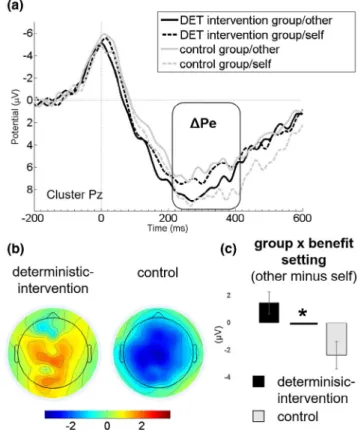
Figures 2 and 3 show distinct ΔERN and ΔPe peaks of the (error − correct) difference wave of the two groups for self- and other-relevant trials; Table 2 displays descriptives for the difference wave components. Information on ERN and Pe amplitude courses in all conditions can be found in Supporting Information (Section 4). Please note that the ΔERN component peaked rather early in the current study, a phenomenon we repeatedly observed in previous studies (Pfabigan et al., 2013, 2016). This may be related to trigger timing in the current Flanker task version and should not be interpreted in a functional way.
Benefit setting significantly moderated the effect of group
on ΔERN amplitudes (b = −0.910, SE = 0.40, t(39.2) = −2.26,
p = .029, semi-partial R2 = .12), while main effects were not
significant (both p's > .286). Simple slopes analyses showed significant group differences for other-relevant ΔERN ampli-tudes (b = 1.754, SE = 0.86, t(60.4) = 2.04, p = .045,
semi-par-tial R2 = .07), but not for self-relevant ones (p = .943).
Other-relevant ΔERN amplitudes were reduced in determin-istic-intervention (M = −5.51 µV, SD = 2.65) compared to control participants (M = −9.19 µV, SD = 8.12). Other- and self-relevant ΔERN amplitudes did not significantly differ within each group (both p's > .107).
Regarding ΔPe amplitudes, we again observed a sig-nificant moderating effect of benefit setting on group (b = −0.909, SE = 0.31, t(37.5) = −2.94, p = .006, semi-partial R2
= .19), while main effects were not significant (both p's > .405). Simple slopes analyses showed significant benefit
set-ting differences in control participants (b = 1.175, SE = 0.44, t(38.5) = 2.67, p = .011, semi-partial R2 = .16), but not in
deterministic-intervention participants (p = .131). ΔPe am-plitudes were reduced in other- (M = 6.37 µV, SD = 4.01) compared to self-relevant trials (M = 8.76 µV, SD = 6.19) in control participants. There were no significant group differ-ences concerning benefit setting (both p's > .155).
4
|
DISCUSSION
The current study set out to investigate whether inducing more deterministic thinking influences error processing in a social setting. Before we administered a choice-reaction task in which errors had consequences for oneself and for another individual, half of our participants underwent a determinis-tic statements intervention, while the other half read control statements. While deterministic-intervention participants did not directly report to think more deterministically than con-trols, we observed the effects of the applied intervention in several measures. PES was enhanced for other- compared to self-relevant trials in control participants, but comparable for both benefit settings in deterministic-intervention par-ticipants. In contrast, performance quality was comparable in both groups. On the neural level, our results suggest that having been confronted with deterministic statements inter-feres with neural monitoring processes of early error evalu-ation (ΔERN) and later motivevalu-ational/evidence accumulevalu-ation processes (ΔPe) differentially for other- versus self-relevant errors. However, we found no negative effects of the current deterministic intervention on prosocial behavioral tendencies at the end of the experiment.
In this experiment, ΔERN amplitudes were diminished for other-relevant errors in those participants who underwent the deterministic intervention. This suggests that the ΔERN group difference described by Rigoni et al. (2015) shifted from self- to other-relevant errors in the current social set-ting. One explanation might be that the presence of other individuals during experiments induces additional thoughts about social evaluations or evaluative threat (Leary, 1983; Park & Kitayama, 2014), which were particularly evident in the other-relevant setting when participants were responsi-ble for the outcome of this other individual. Relatedly, ERN enhancement has been interpreted as a self-protective threat monitoring signal (Weinberg et al., 2012). This would sug-gest that control participants successfully mobilized their defensive motivational system after error commission in the other-relevant setting to buffer evaluative threat, while
deterministic-intervention participants might have felt less need to do so—probably because they experienced less con-trol over their actions. Another explanation could be the interpretation of ΔERN amplitude variation as a prediction error signal (Alexander & Brown, 2011; Talmi, Atkinson, & El-Deredy, 2013), or as a correlate of subjective error signif-icance (Gehring & Willoughby, 2002; Yeung, Botvinick, & Cohen, 2004). Following this line of argumentation would suggest that error commission led to reduced prediction error signals and related negative affect (Schmeichel & Inzlicht,
2013), particularly following other-relevant errors in deter-ministic-intervention compared to control participants. This interpretation is partly corroborated by subjective ratings acquired during the task in which negative affective states such as subjective worry and anger were reported to be lower in deterministic-intervention than control participants, while subjective happiness was by trend rated higher by them (of note, these were mainly general phenomena which were not specific to the other-relevant setting though). Overall, the pro-cessing of other-relevant errors might have been prioritized
TABLE 1 Behavioral and rating data
Deterministic-intervention group Control group
Self Other Self Other
Reaction times (in ms) M SD M SD M SD M SD
Correct 464.77 36.04 463.53 39.62 447.14 34.35 448.34 30.10 Error 446.14 78.62 433.57 63.70 404.97 45.51 426.99 72.01 Congruent 438.71 41.64 434.93 43.10 413.83 33.66 418.15 44.10 Incongruent 488.74 33.56 488.64 39.32 474.52 37.24 474.93 35.56 Percent error frequency 4.52 3.85 4.79 3.34 5.97 6.03 6.78 6.11 Absolut error numbers 18.10 15.38 19.14 13.36 23.86 24.12 27.14 24.43 Post-error slowing (in ms)
Pre-error trials 455.27 55.21 458.29 50.41 433.38 43.97 436.37 49.09 Post-error-trials 500.28 45.60 494.67 49.72 458.84 39.85 485.43 37.12 Point score before transfer 1,368.10 109.22 1,364.29 98.77 1,345.68 160.95 1,334.32 138.50 Point score after transfer 1,329.90 139.04 1,402.48 131.32 1,305.00 181.02 1,375.00 157.41 Points transferred 38.19 88.55 40.68 70.36 Percentage points transferred 2.81 6.35 3.12 5.37
Ratings
Before After Before After
M SD M SD M SD M SD
PANAS positive affect 31.86 5.35 27.39 8.37 31.00 7.73 24.32 8.55 PANAS negative affect 12.33 3.26 12.19 3.59 11.77 2.33 10.86 1.98
Self Other Self Other
M SD M SD M SD M SD
Distress after errors 3.52 2.02 5.14 1.53 3.91 1.97 5.27 1.67 Task effort 6.48 0.98 6.67 0.66 6.05 1.68 6.55 0.91 Performance satisfaction 5.71 1.15 5.52 1.40 5.32 1.70 5.68 1.21 Distraction by other participant 1.62 0.92 2.23 1.82 Difficulties to concentrate 2.86 1.59 3.36 1.73 Experienced task difficulty 3.00 1.45 4.00 2.00 Angry 1.21 0.24 1.42 0.50 1.60 0.81 1.47 0.71 Ashamed 1.24 0.28 1.39 0.44 1.52 0.77 1.53 0.61 Guilty 1.15 0.28 1.63 0.64 1.44 0.68 1.76 0.84 Happy 3.07 1.11 2.81 1.20 2.38 0.81 2.32 0.98 Responsible 2.73 1.35 3.64 0.98 2.95 1.40 3.66 1.22 Sad 1.18 0.39 1.14 0.33 1.20 0.52 1.11 0.28 Worried 1.60 0.69 1.94 0.60 2.30 1.07 2.27 1.00
in the current experiment, which was then more susceptible to the effects of the deterministic statements intervention. Importantly, ΔERN amplitudes did not significantly differ between other- and self-relevant trials within each group, which is in line with a recent study by de Bruijn et al. (2017), in which a second person was also present during the exper-imental task. A differentiation of ERN amplitudes for self- and other-relevant settings might be observable only when the other person is not physically present (Kitayama & Park, 2014; Pfabigan et al., 2016).
Regarding the ΔPe component, we observed signifi-cantly reduced ΔPe amplitudes for other- than self-relevant errors in the control group only. This finding is in line with de Bruijn et al.'s work (2017), who suggested that Pe ampli-tude reduction for other-relevant errors reflects a diminished emotional/motivational response to errors. However, their in-terpretation is at odds with subjective ratings after our exper-iment in which all participants reported to experience more distress after error commission in the other-relevant setting.
It is possible that the online processing of othrelevant er-rors was prone to self-centric processing in controls, which is only overcome later on. Importantly, deterministic-inter-vention participants did not show this self-processing bias, which suggests that the current intervention could possibly
FIGURE 2 Panel (a) depicts grand average waveforms of the (error − correct) difference wave at the frontal electrode cluster of response-locked amplitude courses separately plotted for deterministic-intervention (DET deterministic-intervention; black) and control (grey) participants. Timepoint zero indicates participants’ button press. Panel (b) depicts scalp topographies (in µV) of the difference of other- minus self-relevant (error − correct) difference wave in the time window [0; 100] in relation to the button press for both groups. Panel (c) shows a bar graph illustrating the group × benefit setting interaction by plotting the difference of other- minus self-relevant difference wave ERN amplitudes. Error bars depict SEM
FIGURE 3 Panel (a) depicts grand average waveforms of the (error − correct) difference wave at the parietal electrode cluster of response-locked amplitude courses separately plotted for deterministic-intervention (DET deterministic-intervention; black) and control (grey) participants. Timepoint zero indicates participants’ button press. Panel (b) depicts scalp topographies (in µV) of the difference of other- minus self-relevant (error − correct) difference wave in the time window [200; 400] in relation to the button press for both groups. Panel (c) shows a bar graph illustrating the group × benefit setting interaction by plotting the difference of other- minus self-relevant difference wave Pe amplitudes. Error bars depict SEM
TABLE 2 EEG descriptives
Deterministic-intervention group Control group
M SD M SD ΔERN Other −5.51 2.65 −9.19 8.12 Self −7.45 5.53 −7.00 4.55 ΔPe Other 7.71 4.33 6.37 4.01 Self 6.67 4.27 8.76 6.19
be applied to reduce this kind of bias. Furthermore, it should be noted that ΔPe amplitude variation has also been inter-preted in light of evidence accumulation for error commis-sion (Steinhauser & Yeung, 2010). The current results could thus imply that control participants experienced a processing advantage for self- than other-relevant errors via enhanced evidence accumulation in the self-relevant setting, while deterministic-intervention participants showed comparable processing in both benefit settings. Again, a deterministic statements intervention could be one possibility to decrease this biased processing. Importantly, no group differences emerged for ΔPe amplitude variation, which is in line with the report by Rigoni et al. (2015).
Concerning behavior during the task, control participants seemed to be extra careful during other-relevant trials to adapt their behavior following errors as indicated by enhanced PES in these trials. Matching their behavior, control participants also reported to experience the whole experiment by trend as more difficult compared to deterministic-intervention partic-ipants. This supports the assumption that controls might have been more engaged in the whole experimental set-up than de-terministic-intervention participants. This had, however, no measurable impact on performance quality, as error numbers were comparable in both groups. On both the neural and the behavioral level, control participants were much more sus-ceptible to the influence of the social context manipulation than deterministic-intervention participants.
In this study, we found no evidence that our determin-istic statements intervention led to less prosocial behavior toward the second player. Reading and internalizing de-terministic statements might not constitute a manipulation strong enough to lead to antisocial tendencies. However, it is also possible that unfavorable behavioral consequences of thinking more deterministically might be more pronounced in anonymous than real social interaction situations. Indeed, Baumeister et al. (2009) demonstrated antisocial tendencies after a deterministic-thinking manipulation mostly using hypothetical scenarios in the reported experiments. The ab-sence of unfavorable consequences is further in line with a recent study by Harms et al. (2017), who only observed changes in behavior when considering religious beliefs in their analysis (a variable which unfortunately was not cap-tured in our study).
Our deterministic intervention seemed to decrease the de-mand for constant monitoring of the environment (at least for the most salient events in a given situation such as other-rel-evant errors in the current experiment) as it implies predeter-mined (action) outcomes, i.e., less control over one's actions. In contrast, in highly unpredictable environments, perfor-mance monitoring demands should be increased. Indeed, this was observed by Tullett et al. (2015) when administering a randomness manipulation emphasizing the environment's
unpredictability. The authors reported enhanced ERN ampli-tudes and self-reported anxiety after reading messages about randomness, which they interpreted as a need for heightened performance monitoring.
The major limitations of the current study are the appli-cation of a between- instead of a within-subjects design and missing self-reported evidence for a successful deterministic statements intervention. Our choice of experimental design did not collect a premanipulation measure of error process-ing, which would have allowed a better description of the de-terministic-intervention effects. Moreover, the questionnaire intended to serve as manipulation check (FAD-plus) did not show group differences regarding deterministic thinking. Reading and internalizing deterministic statements might either not have induced more deterministic thinking in the intervention participants, or the measure we used was not sensitive enough to capture effects of the intervention. Using a trait measure such as the FAD-plus as manipulation check might not be the optimal strategy to capture short-lived and fleeting effects of a cognitive manipulation such as the cur-rent one. In line, other studies also reported no significant group differences in FAD-plus scores after longer-lasting ex-periments (Rigoni et al., 2013, 2015). We strongly suggest that future studies should assess manipulation-specific rat-ings both during and directly after the experiment to provide a reliable manipulation check.
Despite these limitations, our experimental groups were well-matched and the observed group differences should be attributed to the applied deterministic statements intervention and resulting affective changes. Please refer to Supporting Information for further indirect evidence of the applied in-tervention (Section 9). Future studies should also aim at strengthening the applied cognitive interventions, for exam-ple by providing reminders during the experiment. Although not possible for the current experiment, future studies should also consider participants' sex/gender as moderating factor when applying deterministic-thinking manipulations (see Caspar, Vuillaume, Magalhães De Saldanha da Gama, & Cleeremans, 2017).
5
|
CONCLUSION
Overall, the current results imply that reading and internaliz-ing deterministic statements made subsequent error process-ing in other- and self-relevant contexts more similar to each other. This could be utilized in a positive way in certain social situations. For example, it might be beneficial for individuals who fear situations of social evaluations and comparisons (in which the intervention could dampen evaluative threat), or for individuals prone to egocentric and intergroup biases (by decreasing self-centric processing).
ACKNOWLEDGMENTS
We thank our confederates, as well as Lukas Lengersdorff and Florian Niederer for their support during data acquisi-tion. Summary level data are available on the Open Science Framework: https://osf.io/jbtae /
CONFLICT OF INTEREST
All authors declare that this research was conducted in the absence of any commercial or financial relationships that could be construed as a potential conflict of interest.
ORCID
Daniela M. Pfabigan https://orcid.org/0000-0002-4043-1695
Clemens Mielacher https://orcid.org/0000-0001-5339-3723
Frédéric Dutheil https://orcid.org/0000-0002-1468-6029
Claus Lamm https://orcid.org/0000-0002-5422-0653
REFERENCES
Aarts, K., & Pourtois, G. (2010). Anxiety not only increases, but also alters early error-monitoring functions. Cognitive, Affective and Behavioral
Neuroscience, 10, 479–492. https://doi.org/10.3758/CABN.10.4.479
Aiken, L. S., & West, S. G. (1991). Multiple regression: Testing and
interpreting interactions. Thousand Oaks, CA: Sage.
Alexander, W. H., & Brown, J. W. (2011). Medial prefrontal cortex as an action-outcome predictor. Nature Neuroscience, 14, 1338–1344. https://doi.org/10.1038/nn.2921
Amodio, D. M., Harmon-Jones, E., Devine, P. G., Curtin, J. J., Hartley, S. L., & Covert, A. E. (2004). Neural signals for the detection of unintentional race bias. Psychological Science, 15, 88–93. https:// doi.org/10.1111/j.0963-7214.2004.01502 003.x
Baumeister, R. F., Masicampo, E. J., & DeWall, C. N. (2009). Prosocial benefits of feeling free: Disbelief in free will increases aggres-sion and reduces helpfulness. Personality and Social Psychology
Bulletin, 35, 260–268. https://doi.org/10.1177/01461 67208 327217
Beck, A. T., Steer, R. A., & Brown, G. K. (2006). BDI-II beck
depres-sions-inventar (2nd ed.). Frankfurt/Main, Germany: Harcourt.
Bell, A. J., & Sejnowski, T. J. (1995). An information-maximization approach to blind separation and blind deconvolution. Neural
Computation, 7, 1129–1159. https://doi.org/10.1162/neco.1995.7.6.
1129
Botvinick, M. M., Carter, C. S., Braver, T. S., Barch, D. M., & Cohen, J. D. (2001). Conflict monitoring and cognitive control. Psychological
Review, 108, 624–652. https://doi.org/10.1037/0033-295x.108.3.624
Caspar, E. A., Vuillaume, L., De Saldanha, M., da Gama, P. A., & Cleeremans, A. (2017). The influence of (dis)belief in free will on immoral behavior. Frontiers in Psychology, 8, 20. https://doi. org/10.3389/fpsyg.2017.00020
Cohen, J. (1988). Statistical power analysis for the behavioral sciences. London, UK: Taylor & Francis Inc.
Cohen, J. (1992). A power primer. Psychological Bulletin, 112, 155– 159. https://doi.org/10.1037//0033-2909.112.1.155
Davis, M. H. (1983). Measuring individual differences in empa-thy: Evidence for a multidimensional approach. Journal of
Personality and Social Psychology, 44, 113–126. https://doi.org/10.
1037/0022-3514.44.1.113
de Bruijn, E. R. A., Ruissen, M. I., & Radke, S. (2017). Electrophysiological correlates of oxytocin-induced enhancement
of social performance monitoring. Social Cognitive and Affective
Neuroscience, 12, 1668–1677. https://doi.org/10.1093/scan/
nsx094
Delorme, A., & Makeig, S. (2004). EEGLAB: An open source toolbox for analysis of single-trial EEG dynamics including independent component analysis. Journal of Neuroscience Methods, 134, 9–21. https://doi.org/10.1016/j.jneum eth.2003.10.009
Dutilh, G., van Ravenzwaaij, D., Nieuwenhuis, S., van der Maas, H. L. J., Forstmann, B. U., & Wagenmakers, E.-J. (2012). How to measure post-error slowing: A confound and a simple solution. Journal of
Mathematical Psychology, 56, 208–216. https://doi.org/10.1016/j.
jmp.2012.04.001
Edwards, L. J., Muller, K. E., Wolfinger, R. D., Qaqish, B. F., & Schabenberger, O. (2008). An R2 statistic for fixed effects in the linear mixed model. Statistics in Medicine, 27, 6137–6157. https:// doi.org/10.1002/sim.3429
Eriksen, B. A., & Eriksen, C. W. (1974). Effects of noise letters upon the identification of a target letter in a nonsearch task. Perception and
Psychophysics, 16, 143–149. https://doi.org/10.3758/BF032 03267
Falkenstein, M., Hohnsbein, J., Hoormann, J., & Blanke, L. (1991). Effects of crossmodal divided attention on late ERP components. II. Error processing in choice reaction tasks. Electroencephalography
and Clinical Neurophysiology, 78, 447–455. https://doi.
org/10.1016/0013-4694(91)90062 -9
Falkenstein, M., Hoormann, J., Christ, S., & Hohnsbein, J. (2000). ERP components on reaction errors and their functional significance: A tutorial. Biological Psychology, 51, 87–107. https://doi.org/10.1016/ s0301 -0511(99)00031 -9
Faul, F., Erdfelder, E., Buchner, A., & Lang, A. G. (2009). Statistical power analyses using G*Power 3.1: Tests for correlation and regres-sion analyses. Behavior Research Methods, 41, 1149–1160. https:// doi.org/10.3758/BRM.41.4.1149
Gehring, W. J., Goss, B., Coles, M. G. H., Meyer, D. E., & Donchin, E. (1993). A neural system for error detection and com-pensation. Psychological Science, 4, 385–390. https://doi. org/10.1111/j.1467-9280.1993.tb005 86.x
Gehring, W. J., & Willoughby, A. R. (2002). The medial frontal cortex and the rapid processing of monetary gains and losses. Science, 295, 2279–2282. https://doi.org/10.1126/scien ce.1066893
Good, M., Inzlicht, M., & Larson, M. J. (2015). God will forgive: Reflecting on God's love decreases neurophysiological responses to errors. Social Cognitive and Affective Neuroscience, 10, 357–363. https://doi.org/10.1093/scan/nsu096
Hajcak, G., Moser, J. S., Yeung, N., & Simons, R. F. (2005). On the ERN and the significance of errors. Psychophysiology, 42, 151–160. https://doi.org/10.1111/j.1469-8986.2005.00270.x
Harms, J., Liket, K., Protzko, J., & Scholmerich, V. (2017). Free to help? An experiment on free will belief and altruism. PLoS ONE,
12, e0173193. https://doi.org/10.1371/journ al.pone.0173193
Holroyd, C. B., & Coles, M. G. H. (2002). The neural basis of human error processing: Reinforcement learning, dopamine, and the er-ror-related negativity. Psychological Review, 109, 679–709. https:// doi.org/10.1037/0033-295X.109.4.679
Kirk, R. E. (1996). Practical significance: A concept whose time has come. Educational and Psychological Measurement, 56, 746–759. https://doi.org/10.1177/00131 64496 05600 5002
Kitayama, S., & Park, J. (2014). Error-related brain activity reveals self-centric motivation: Culture matters. Journal of Experimental
Kopp, B., Rist, F., & Mattler, U. (1996). N200 in the flanker task as a neuro-behavioral tool for investigating executive control. Psychophysiology,
33, 282–294. https://doi.org/10.1111/j.1469-8986.1996.tb004 25.x
Krohne, H. W., Egloff, B., Kohlmann, C. W., & Tausch, A. (1996). Investigations with a German version of the Positive and Negative Affect Schedule (PANAS). Diagnostica, 42, 139–156.
Laux, L., Glanzmann, P., Schaffner, P., & Spielberger, C. D. (1981). Das
state-trait-angstinventar. Göttingen, Germany: Hogrefe.
Leary, M. R. (1983). A brief version of the fear of negative evaluation scale. Personality and Social Psychology Bulletin, 9, 371–375. https://doi.org/10.1177/01461 67283 093007
Leotti, L. A., Iyengar, S. S., & Ochsner, K. N. (2010). Born to choose: The origins and value of the need for control. Trends in Cognitive
Sciences, 14, 457–463. https://doi.org/10.1016/j.tics.2010.08.001
Luck, S. J. (2005). An introduction to the event-related technique. Cambridge, MA: MIT Press.
Luck, S. J., & Gaspelin, N. (2017). How to get statistically signif-icant effects in any ERP experiment (and why you shouldn't).
Psychophysiology, 54, 146–157. https://doi.org/10.1111/psyp.
12639
Meyer, A., Klein, D. N., Torpey, D. C., Kujawa, A. J., Hayden, E. P., Sheikh, H. I., … Hajcak, G. (2012). Additive effects of the dopa-mine D2 receptor and dopadopa-mine transporter genes on the error-re-lated negativity in young children. Genes Brain and Behavior, 11, 695–703. https://doi.org/10.1111/j.1601-183X.2012.00812.x Nieuwenhuis, S., Richard Ridderinkhof, K., Blom, J., Band, G. P.
H., & Kok, A. (2001). Error-related brain potentials are differ-entially related to awareness of response errors: Evidence from an antisaccade task. Psychophysiology, 38, 752–760. https://doi. org/10.1111/1469-8986.3850752
Oldfield, R. C. (1971). The assessment and analysis of handedness: The Edinburgh inventory. Neuropsychologia, 9, 97–113. https://doi. org/10.1016/0028-3932(71)90067 -4
Olvet, D. M., & Hajcak, G. (2008). The error-related negativity (ERN) and psychopathology: Toward an endophenotype. Clinical
Psychology Review, 28, 1343–1354. https://doi.org/10.1016/j.
cpr.2008.07.003
Open Science Collaboration. (2015). PSYCHOLOGY. Estimating the reproducibility of psychological science. Science, 349, aac4716. https://doi.org/10.1126/scien ce.aac4716
Park, J., & Kitayama, S. (2014). Interdependent selves show face-in-duced facilitation of error processing: Cultural neuroscience of self-threat. Social Cognitive and Affective Neuroscience, 9, 201–208. https://doi.org/10.1093/scan/nss125
Paulhus, D. L., & Carey, J. M. (2011). The FAD–Plus: Measuring lay beliefs regarding free will and related constructs. Journal of
Personality Assessment, 93, 96–104. https://doi.org/10.1080/00223
891.2010.528483
Paulus, C. (2009). Der Saarbrücker Persönlichkeitsfragebogen SPF
(IRI) Zur Messung von Empathie: Psychometrische Evaluation der Deutschen Version des Interpersonal Reactivity Index. Retrieved
from http://psydok.sulb.uni-saarl and.de/vollt exte/2009/2363/ Pfabigan, D. M., Holzner, M. T., & Lamm, C. (2016). Performance
monitoring during a minimal group manipulation. Social Cognitive
and Affective Neuroscience, 11, 1560–1568. https://doi.org/10.1093/
scan/nsw071
Pfabigan, D. M., Pintzinger, N. M., Siedek, D. R., Lamm, C., Derntl, B., & Sailer, U. (2013). Feelings of helplessness increase ERN am-plitudes in healthy individuals. Neuropsychologia, 51, 613–621. https://doi.org/10.1016/j.neuro psych ologia.2012.12.008
Pfabigan, D. M., Pripfl, J., Kroll, S. L., Sailer, U., & Lamm, C. (2015). Event-related potentials in performance monitoring are influenced by the endogenous opioid system. Neuropsychologia, 77, 242–252. https://doi.org/10.1016/j.neuro psych ologia.2015.08.028
Picton, T. W., & Hillyard, S. A. (1972). Cephalic skin potentials in electroencephalography. Electroencephalography and Clinical
Neurophysiology, 33, 419–424.
https://doi.org/10.1016/0013-4694(72)90122 -8
Rabbitt, P. M. (1966). Errors and error correction in choice-response tasks. Journal of Experimental Psychology, 71, 264–272. https:// doi.org/10.1037/h0022853
Rigoni, D., & Brass, M. (2014). From intentions to neurons: Social and neural consequences of disbelieving in free will. Topoi, 33, 5–12. https://doi.org/10.1007/s1124 5-013-9210-y
Rigoni, D., Pourtois, G., & Brass, M. (2015). 'Why should I care?' Challenging free will attenuates neural reaction to errors. Social
Cognitive and Affective Neuroscience, 10, 262–268. https://doi.
org/10.1093/scan/nsu068
Rigoni, D., Wilquin, H., Brass, M., & Burle, B. (2013). When errors do not matter: Weakening belief in intentional control impairs cognitive reaction to errors. Cognition, 127, 264–269. https://doi. org/10.1016/j.cogni tion.2013.01.009
Saunders, B., Riesel, A., Klawohn, J., & Inzlicht, M. (2018). Interpersonal touch enhances cognitive control: A neurophysiolog-ical investigation. Journal of Experimental Psychology: General,
147, 1066–1077. https://doi.org/10.1037/xge00 00412
Schmeichel, B. J., & Inzlicht, M. (2013). Incidental and integral effects of emotions on selfcontrol. In M. D. Robinson, E. R. Watkins, & E. Harmon-Jones (Eds.), Handbook of cognition and emotion (pp. 272–290). New York: Guilford Press.
Schroder, H. S., Callahan, C. P., Gornik, A. E., & Moser, J. S. (2018). The fixed mindset of anxiety predicts future distress: A longitudi-nal study. Behavior Therapy, 50, 710–717. https://doi.org/10.1016/j. beth.2018.11.001
Schroder, H. S., Dawood, S., Yalch, M. M., Donnellan, M. B., & Moser, J. S. (2015). The role of implicit theories in mental health symp-toms, emotion regulation, and hypothetical treatment choices in college students. Cognitive Therapy and Research, 39, 120–139. https://doi.org/10.1007/s1060 8-014-9652-6
Schroder, H. S., Moran, T. P., Donnellan, M. B., & Moser, J. S. (2014). Mindset induction effects on cognitive control: A neurobehav-ioral investigation. Biological Psychology, 103, 27–37. https://doi. org/10.1016/j.biops ycho.2014.08.004
Steinhauser, M., & Yeung, N. (2010). Decision processes in human per-formance monitoring. Journal of Neuroscience, 30, 15643–15653. https://doi.org/10.1523/JNEUR OSCI.1899-10.2010
Talmi, D., Atkinson, R., & El-Deredy, W. (2013). The feedback-related negativity signals salience prediction errors, not reward predic-tion errors. Journal of Neuroscience, 33, 8264–8269. https://doi. org/10.1523/JNEUR OSCI.5695-12.2013
Tullett, A. M., Kay, A. C., & Inzlicht, M. (2015). Randomness increases self-reported anxiety and neurophysiological correlates of perfor-mance monitoring. Social Cognitive and Affective Neuroscience, 10, 628–635. https://doi.org/10.1093/scan/nsu097
Twenge, J. M., Zhang, L., & Im, C. (2004). It's beyond my control: A cross-temporal meta-analysis of increasing externality in locus of control, 1960–2002. Personality and Social Psychology Review, 8, 308–319. https://doi.org/10.1207/s1532 7957p spr08 03_5
van Noordt, S., & Segalowitz, S. (2012). Performance monitoring and the medial prefrontal cortex: A review of individual differences and
context effects as a window on self-regulation. Frontiers in Human
Neuroscience, 6, 197. https://doi.org/10.3389/fnhum.2012.00197
Velten, E. Jr. (1968). A laboratory task for induction of mood states.
Behaviour Research and Therapy, 6, 473–482. https://doi.
org/10.1016/0005-7967(68)90028 -4
Vohs, K. D., & Schooler, J. W. (2008). The value of believ-ing in free will: Encouragbeliev-ing a belief in determinism in-creases cheating. Psychological Science, 19, 49–54. https://doi. org/10.1111/j.1467-9280.2008.02045.x
Wang, Y., Yang, L., & Wang, Y. (2014). Suppression (but not reap-praisal) impairs subsequent error detection: An ERP study of emo-tion regulaemo-tion's resource-depleting effect. PLoS ONE, 9, e96339. https://doi.org/10.1371/journ al.pone.0096339
Weinberg, A., Riesel, A., & Hajcak, G. (2012). Integrating multiple perspectives on error-related brain activity: The ERN as a neural indicator of trait defensive reactivity. Motivation and Emotion, 36, 84–100. https://doi.org/10.1007/s1103 1-011-9269-y
Wilcox, R. R. (2012). Modern statistics for the social and behavioral
sciences: A practical introduction. London, UK: Taylor & Francis
Group.
Yeung, N., Botvinick, M. M., & Cohen, J. D. (2004). The neural basis of error detection: Conflict monitoring and the error-re-lated negativity. Psychological Review, 111, 931–959. https://doi. org/10.1037/0033-295x.111.4.939
SUPPORTING INFORMATION
Additional Supporting Information may be found online in the Supporting Information section.
How to cite this article: Pfabigan DM, Mielacher C,
Dutheil F, Lamm C. ERP evidence suggests that confrontation with deterministic statements aligns subsequent other- and self-relevant error processing.
Psychophysiology. 2020;57:e13556. https://doi.