HAL Id: insu-01621391
https://hal-insu.archives-ouvertes.fr/insu-01621391
Submitted on 23 Oct 2017
HAL is a multi-disciplinary open access
archive for the deposit and dissemination of
sci-entific research documents, whether they are
pub-lished or not. The documents may come from
teaching and research institutions in France or
abroad, or from public or private research centers.
L’archive ouverte pluridisciplinaire HAL, est
destinée au dépôt et à la diffusion de documents
scientifiques de niveau recherche, publiés ou non,
émanant des établissements d’enseignement et de
recherche français ou étrangers, des laboratoires
publics ou privés.
Martian GCM with complete CO2 clouds microphysics
Joachim Audouard, Anni Määttänen, Constantino Listowski, François Forget,
Ehouarn Millour, Aymeric Spiga
To cite this version:
Joachim Audouard, Anni Määttänen, Constantino Listowski, François Forget, Ehouarn Millour, et al..
Martian GCM with complete CO2 clouds microphysics. European Planetary Science Congress 2017,
Sep 2017, Riga, Latvia. pp.EPSC2017-254. �insu-01621391�
Martian GCM with complete CO2 clouds microphysics
J. Audouard (1), A. Määttänen (1), C. Listowski (1), F. Forget (2), E. Millour (2) and A. Spiga (2)(1) LATMOS/IPSL, UVSQ Université Paris-Saclay, UPMC Univ. Paris 06, CNRS, Guyancourt, France; (2) Laboratoire de Météorologie Dynamique (CNRS/IPSL/UMPC), Paris, France. ([email protected])
Abstract
Towards understanding Martian CO2 cloud
formation, abundance and features, including their formation and evolution in a Global Climate Model (GCM) is necessary. Their precise radiative impact on the climate throughout the history of the planet is especially of prime importance due to the backscattering of the infrared photons by the CO2 ice
crystals that might have contributed to a greenhouse effect.
The purpose of this work is to include a complete and validated CO2 cloud scheme (developped by [1,2]) in
the GCM of the Laboratoire de Météorologie Dynamique (LMD) [3]. We hereafter present the key steps of this coupling and the first results.
1. Introduction
Numerous observations (e.g. [4,5,6,7,8]), theoretical advances and modeling works [1,2,9,10,11,12] have improved our understanding of CO2 cloud formation
and dynamics on Mars. These clouds, less frequently observed than the water ice clouds, form in the troposphere at the poles during winter and at equatorial latitudes in the mesosphere (60 – 110 km). Atmospheric CO2 condensation requires extremely
low temperatures to produce supersaturation. Such low temperatures are reached during the polar night and have been observed at low latitudes in the mesosphere [5, 13, 14]. These cold pockets are most likely produced by gravity waves propagating to the upper atmosphere [12], at the altitudes of the temperature minima caused by the thermal tides.
Moreover, aerosol particles must be present for the CO2 to condense on them by the mean of
heterogeneous nucleation. At high mesospheric altitudes and such low pressures (typically 0.01 Pa), it is unknown whether dust lifted from the surface or particles coming from above (such as meteoritic smoke particles) prevail. CO2 clouds are short-lived
and do not last long after the favorable conditions vanish (about a dozen of minutes, [2]).
2. CO
2clouds scheme for the GCM
We have adapted the CO2 cloud microphysics scheme
of [1,2] for his coupling with the LMD-GCM presented in [3]. The atmosphere is discretized in 32 layers up to about 120 km in the GCM and the timestep is about 7.5 minutes. During one such timestep, the CO2 cloud scheme is called 50 times
(i.e. every 9.5 seconds) and it includes includes heterogeneous nucleation on aerosols (dust, meteoritic smoke particles and water ice clouds), CO2
ice nucleation and sublimation (as a function of CO2
partial pressure and temperature) and sedimentation of the particles. For a better nucleation accuracy, the moments of the CO2 ice particles population are
distributed into 100 bin sizes.
3. Results
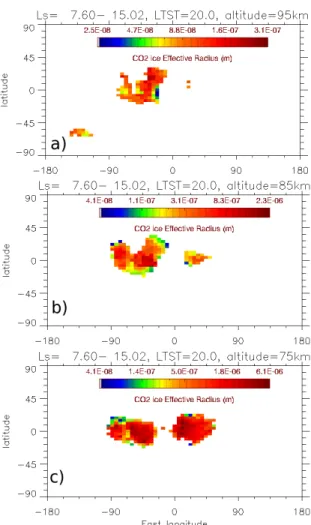
We have simulated an entire Martian Year, with a resolution of ~7.5 minutes, from the surface to about 120 km. The GCM outputs have been re-binned 15 sols at a time in altitude (13 10-km wide layers) and in local time (30 min resolution). The simulations show frequent CO2 clouds at low latitude at
mesospheric altitudes during the northen hemisphere spring and autumn (Ls 0-45 and Ls 150-190). Overall, nighttime clouds are higher (up to ~ 100 km) and are composed of smaller particles than daytime clouds (down to about ~40km). CO2 clouds form
with respect to the upward propagation of the thermal tide. Clouds are observed at the poles at mesospheric and tropospheric altitudes (even close to the surface) at the poles during their respective winters. Examples can be seen in figures 1,2 and 3.
4. Summary and Conclusions
A complete meteorology of CO2 clouds inferred from
the GCM will be presented and discussed at the conference. The sensibility with regards to various smulation parametrers will also be adressed.
EPSC Abstracts
Vol. 11, EPSC2017-254, 2017
European Planetary Science Congress 2017 c
Acknowledgements
J.A. work is funded by the excellence laboratory Exploration Spatiale des Environnements Planétaires, Labex ESEP N 2011-LABX-030.
References
[1] Listowski, C. et al., 2013, Near-pure vapor
condensation in the Martian atmosphere: CO2 ice crystal growth, JGR, 118, 10, 2153-2171 ; [2] Listowski, C. et al.,
2014, Modeling the microphysics of CO2 ice clouds within wave-induced cold pockets in the martian mesosphere, Icarus, 237, 239-261; [3] Forget, F. et al., 1999, Improved general circulation models of the Martian atmosphere from the surface to above 80 km, JGR, 104, E10; [4] Clancy and Sandor, 1998, CO2 ice clouds in the upper atmosphere of Mars, GRL, 25, 4, 489-492 ;[5] Montmessin, F. et al., 2006, Subvisible CO 2 ice clouds detected in the mesosphere of Mars, Icarus, 183, 2, p. 403-410; [6] Montmessin, F. et al., 2007, Hyperspectral imaging of convective CO2 ice clouds in the equatorial mesosphere of Mars, Journal of Geophysical Research, 112, E11;
[7] Määttänen, A. et al., 2010, Mapping the mesospheric
clouds on Mars: MEx/OMEGA and MEx/HRSC observations and challenges for atmospheric models, Icarus, 209, 2, 452-469; [8] Vincendon, M. et al., 2011, New near-IR observations of mesospheric CO2 and H2O clouds on Mars, JGR, 116; [9] Määttänen, A. et al., 2005, Nucleation studies in the Martian atmosphere, JGR, 110, E2; [10] Määttänen, A. et al., 2007, Two-component heterogeneous nucleation kinetics and an application to Mars, J. of Chemical Physics, 127, 13; [11] Colaprete, A. et al., 2008, CO 2 clouds, CAPE and convection on Mars: Observations and general circulation modeling, PSS, 56, 2; [12] Spiga, A. et al., 2012, Gravity waves, cold pockets and CO2 clouds in the Martian mesosphere, GRL, 39, 2 :
[13] Schofield, J. T. et al., 1997, The Mars Pathfinder
Atmospheric Structure Investigation/Meteorology, Science, 278, 5344; [14] Forget, F. et al., 2009, Density and temperatures of the upper Martian atmosphere measured by stellar occultations with Mars Express SPICAM, JGR, 114, E1
Fig.
2: Map of maximum CO2 ice clouds opacity at 1µm, at a local time of 20 LTST, bewteen 7.6 and 15.02° LS.
Fig.1: Distribution of CO2 ice clouds particles
effective radius as a function of local time and altitude (indicated by different colors). Every line represents a latitude, and the thicker the line, the closer to a pole the latitude is.
Fig.3: Maps of CO2 clouds ice particles effective
Radius. Local time is 20LTST and 3 altitudes are shown: 95km (a), 85km (b) and 75 km(a).