xiST.
eF
TEry4
OCT 11
1A6
CHILDREN'S PERCEPTION AND VALUE . IN THE URBAN ENVIRONMENT
by
Eugene Darwin Cizek
B. Arch. Louisiana State University
(1964)
Submitted in Partial Fulfillment
of the Requirements for the Degree of Master in City Planning at the Massachusetts Institute of Technology July, 1966 Signature of Author...-i... W-. .. ... . *o * ... 0.... ...0
'epartment of City and Regional Planning,
July 15, 1966
Certified by... o .- ... -... ... . ..
Thesis Supervisor
.- - t
Accepted by...
Chairman, Departmental Comittee on Graduate Students
ACKNOWLEDGEMENTS
I wish to thank the following people for their assistance in the writing of this thesis:
Donald Appleyard, my thesis advisor
Staff and children of the Roxbury Y.M.C.A.
Sears Roebuck Foundation, A.I.A.F.
Foundation and M.I.T. Scholarship Fund Marcia McMahon
Mina Harrington Jean McBeth
CHILDREN'S PERCEPTION AND VALUES IN THE URBAN ENVIRONMENT
by
Eugene Darwin Cizek
Submitted to the Department of City. and Regional Planning on July 15, 1966, in partial fulfillment
of the requirements for the degree of Master in City Planning at the Massachusetts Institute of
Technology.
PROBLEM:
The lack of knowledge and understanding of the planner regarding the
interaction of man and his environment; specifically related to the
child of urban poverty whose needs and values of the environment have
not been sufficiently considered.
OBJECTIVES:
To determine the elements and relationships most valued in the
environ-ment by the children and to see if they can be classified categorically
in some manner. To determine the criteria by which children evaluate
elements and relationships in their environment. To investigate the effect of activity on the children's perception and values in their environment. And to develop methods of interviewing and categories of
data which can be used as a basis for further study and investigation.
PROCEDURE:
A general survey was made of the relevant written material and the
poverty areas of Boston. Hypotheses were formulated for investigation.
A preliminary interview was given in four contrasting areas of poverty with the selection of one area for intensive research over a period of
ten weeks. A center of activity in the area was chosen in which
inter-views were given and observations made. A series of questionnaires
were developed and administered. The results of these actions were
evaluated and served as the basis for this thesis.
RESULTS:
The elements and relationships valued in the environment by the children were determined and categorized. The criteria for evaluations were determined and ranked by individual characteristics and by functional
and perceptual connotations. The effect of activity was investigated.
The methods of research and study used and the interviews developed were found to be successful.
The appendices present details and copies of the interviews, suggestions
for further study and implications for planning.
Thesis Supervisor: Donald Appleyard
TABLE OF CONTENTS Page Dedication Acknowledgements Abstract.... ... ... List of Tables. ...an ... ...
Lists of Maps and Illustrations...
I. II. III.
IV.
V. VI. VII.VIII.
IX. ....0
. .. O.. ... 0 ... 0 24
5
Methods of Research and Stud... 28 Washington Park Eauto...51
Evaluations and Criteria ... ...
69
Elements Evaluated...o
95
Activity and Value...*~~****o...--.-.117
Structure and Value...o...l 3l
Change and Value...
Conclusion..*...----146
Appendices
A. The
Interviews...158
B. Suggestions for Further Study...190
C. Implications for
Planning...203
Table
One: Characteristics of the Children...
Two: Evaluations Per Photograph...
Three: Activity Responses, Interview F.
Four: Elements Evaluated and Criteria..
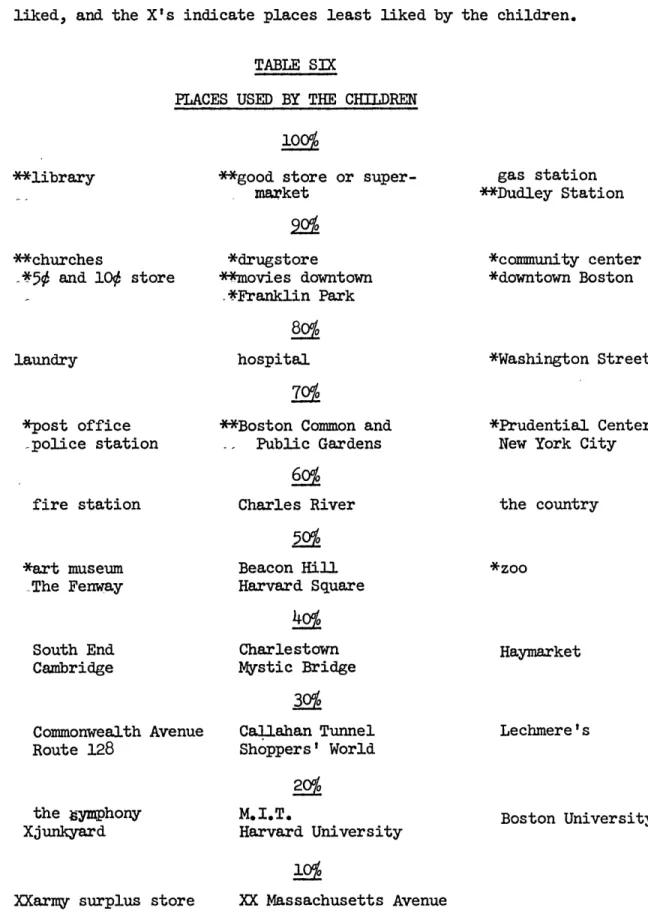
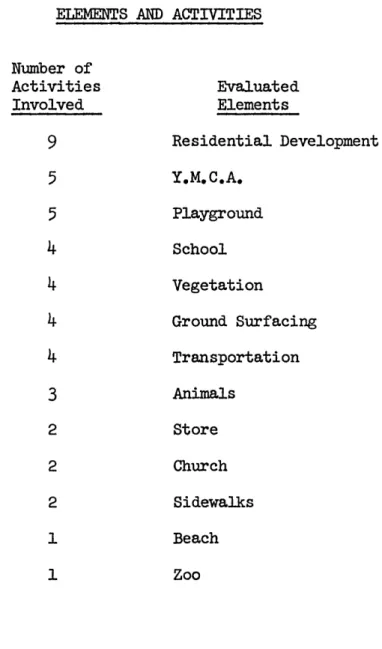
Five: Children's Activities... Six: Places Used by the Children...
Seven: Elements and Activities...
4
... 0 ... 0 ... 0 ... 0 ... 9 ... 0 ... 0 Page ...37
... 63
... 66
. 0 00 71 . 0 .. 119 . ... 122 ... 124 ... 0 a ... 0 0 .. 0 .. 0LIST OF MAPS
One: Location of the Area of Study... 54
Two: Location and Changes of Activity Foci in the Roxbury-North Dorchester GNRP...
55
Three: Location and Description of Projects in the Washington Park Renewal Area...
56
Four: General Conditions of the Study Area... 57
LIST OF PHOTOGRAPHS AND ILLUSTRATIONS Numbers Page 1 - 8 Washington Park Evaluation Photographs... 62
9 - 15 Children's Drawings of "My House"...
99
16 - 29 Children's Drawings of "Summer Activities"...127
30 - 39 Children's Maps of "My Neighborhood"...136
40 - 41 Photographs for Interview L "New versus Old"...189
IlTRODUCTION
A major problem facing the planner today is his lack of knowledge and understanding regarding the interaction of man and his environment. Increased population and urban concentration have made it evident that although man knows much about manipulating his physical world, he knows very little about the effect of these mani-pulations on the people who inhabit it. The purpose of this thesis
was to investigate certain aspects of this problem. It was
concerned with children's perception and values in the urban environ-ment. It was limited in scope to children between the ages of seven and eleven who reside in a poverty area of Boston.
Considering the scope of the thesis and the limitations
of time, the primary objectives were:
1. To determine the elements and relationships
most valued in the environment by the children
and to see if they can be classified categorically
in some manner.
2. To determine the criteria by which children value
elements and relationships in the environment.
7
3. To investigate the effect of activity on the
children's perception and values in the
environ-ment.
4. To develop methods of interviewing and categories
of data which can be used as a basis for further
study and investigation.
In addition to the primary objects, there were two areas for
secondary consideration. One was to investigate the effect of change in the urban environment on the children and their reactions to it. The other was to investigate the degree to which the children structured their environment and the implications of it.
In considering the children's perception and value in the urban environment, the terms of consideration must be defined. Perception referred to the act or process of responding to stimuli
in the environment. Value referred to choice and preference, "what
the child liked or disliked." The urban environment was limited to
the environment with which the child was familiar, his neighborhood,
community and the Boston Area; the degree of familiarity was set by the area chosen for study but was not determined until after the research, study and evaluation had been completed. The frame of reference thus included seven to eleven year old children who resided
in a poverty area in the City of Boston, and who were asked to
evalu-ate their environment as relevalu-ated to the objectives of the thesis.
Necessary background information was acquired through a
survey of the written material felt to be relevant to the objectives
and scope of the thesis. Most of the readings dealt with the
and the effects of his interaction with the environment. The
results from the survey were organized as they related to the research
and studies: The organization included:
A. General Development B. Perception C. Structure D. Elements Perceived E. Representation F. Problems of Interpretation G. Children of Poverty H. Value A. General Development
Seven to eleven year old children represent the period of
child development which is most significant from the standpoint of
the socialization processes. The influence of the environment and
society is much more significant than for the preschool child. The
behavior patterns and characteristics which develop during this period
will continue through adolescence and will determine the kind of
adult the child will become.2
The child of this period is at the age of "Industry versus
Inferiority." 3 He has acquired a sense of direction and purpose to
his life and now must bear the frustrations of learning the ways and
technicalities of society. The industry of the child must be
directed toward a method. The sense of inferiority must be comple-mented with a sense of competence. The proper development of
9
method and competence will equip the child for the problems and frustrations of adolescence, the age of "Identity versus Role Confusion." 4
The values of the children focus on the things of
society and the roles they will play in it. They axe concerned with
how to manipulate and "work" things.5 They often concentrate on a
particular object or person such as an automobile or a policeman;
they think about how it would be to drive the automobile, and what it
would be like to be a policeman. As their skills of reading, writing,
and drawing develop, they use these faculties to further explore the
people and elements of society and to express their findings verbally
and graphically.
The children begin to think of school as a culture in
itself. This becomes one of their major interests and is joined by the family organization to become the two major foci of their life.6 The idea of school and home is often qualified by other places of activity and interest. Thus a community center, park,
store or other activity oriented place becomes a part of the child's
world. These activity foci are often considered as a part of
school or the home, or as independent entities; much of this
depends on the orientation and development background of the child.7 The bodily activities of the children of this age group reflect their growth and development. The seven-year old is variable in the intensity of his activity; he does certain things very
intensively for a period of time and then will leave it. As he
grows older, this sporadic interest will gradually become more stable.
ex-haustion becomes the reason for stopping and resting instead of the
behavior traits of earlier years. Activities which involve much body
movement are popular. Bicycles and other vehicles for riding and
"driving" are most favored. There is also an increasing interest in
group efforts; the seven-year old is more interested in himself and
in perhaps another person, but the eleven-year old has reached the
point of orientation for team games and for learning to perform
skillfully. The bodily activities reflect the growing concern of the
children to explore, learn and experience as much of their world as
they can.8
The seven-year old is leaving, his past habits of
tensional outlets and remains rather free; his play is spontaneous and
not too emotional. The eight year old begins to sporadically fall
back into his early habits and is beginning to develop the tensional
outlets of the older child. From the age of nine and on, boys
begin to develop individual tensional outlets; this is combined with
all forms of "letting off steam" such as wrestling, fighting and
running. The nine-year old girl begins to wander around the house,
restless and moody; she cannot sit still and varies from joining
the boys in a wrestling match to being completely withdrawn. Both boys and girls from the age of ten are showing some of the tensional outlets of the adolescent; girls being more precocious in this respect than boys.9
The child's interest in the family is very strong. The
changes which occur in family relations are those related to the child's feeling a "need" to be a part of the family. There is some variety in this feeling, but generally as the child ages he becomes more
11
independent and does not feel that he needs his family as much. The
family is important to the nine-year old, but in practice he would
rather be away from the family, on his own or with his own friends.1 0 This attitude of independence grows as the child enters preadolescence
and becomes a major conflict and frustration.U
The values and growth characteristics are further reflected 12
in the things the children from seven to eleven like to play.
The seven-year old has a more limited range of interests than the eleven-year old. He participates more in solitary play. He likes to collect, swap and play games such as library, post office, train and school. His interest in swimming is often strong. The
differences in play orientation between boys and girls become
evident. Girls during this period become more directed to playing
house and other things associated with the woman's role in society.
The boys begin to utilize tools to fix things around the house, to
build structures and to play war games, cops and robbers, and
commandos. From nine to eleven the child works and plays to the
extreme. He is busy with his own activities and plans very
carefully what he is going to do. Individual differences between
children develop and become apparent. Some children tend to limit
their play to more indoor activities and others to more outdoor
activities. Mental versus physical orientation also begins to
develop in the eleven-year old.
Another characteristic of the seven to eleven year old
children in regard to this thesis is their responsiveness to
reason.13 The seven year old is in a transition stage. It is now
make simple decisions; this is especially true if both alternatives
appeal to him. It is difficult to change his mind, but he will
occasionally listen to reason and change his attitude without becoming
temperamental. He has standards and is trying to live up to them; he must be appealed to ethically.14 The eight year old makes up his mind easily. He is more confused about the little decisions, and
in general knows what he wants. He can listen to reason and change his attitude, but he does like to have his own way.15 By nine
years of age, the child is able to make up his mind quickly and change it in response to most reasons. This flexibility and more
open-mindedness continues through the age of ten and begins to be tempered with the confusion and frustration of preadolescence. This latter trait develops at a varied age level and depends on the
precocity of the child.
Knowledge of spacial definition and location are enlarging concerns for the seven year old. He has just left the feeling and sense that he is the "center of the universe;' this transition began when he was six years old.16 He is becoming more aware and
under-standing- of relationships throughout the whole community.17 He is
interested in details about the grocer, policeman, fireman, garbage man, etc. He is interested in having his own place. He realizes that there are other places beside his home, school and adjacent
community. He shows marked improvement in his understanding of
geographic orientation.19 As the child grows from seven to nine so
does his ability to find his way around; he can take bus trips alone and go for walks. His interest is widening to include many community problems and concerns such as health, life, property, commercial
13
activities, manufacturing, agricultural industries, transportation, 20 weather, animal life, plant life and holiday and seasonal activities.
He is developing a strong sense of details for things, places,
activi-ties and people. All of these facets of growth continue through the
ages of ten or eleven years. Once the child reaches preadolescence,
his attention to detail concentrates on self-identity and role playing.
His interests focus on the attitudes and activities of his peer group.
He leaves the world of childhood.
B. Perception
The child's perception of his environment involves his
interaction with it.2 1 As he grows and develops his ability to
assert himself, his perceptual development expands; it is a continuous
and quantitative versus qualitative process.22 The children of seven
to eleven years are in that period of development which is most involved
with the environment. The child of seven has sufficient muscular
and motor abilities to interact intensively with his physical world;
his desire to explore and manipulate furthers the interaction. He
is 'bhenomenistic in: the sense that his cognitive structure is so
organized that the surface appearances of things are over-attended to;
his thought is dominated by the environmental properties which
strike him first."2 3 "He fails to relate in a logical way successive
cognitive impressions; thus heaviness and lightness are successively
invoked as explanatory principles with no thought to the
contradic-tion involved, as though the need to reconcile opposing impressions
Although the child is phenomenistic, he has begun to see
symbolic materials and elements. This is especially evident in the
ways in which he expresses himself graphically. His ability to
verbalize is not so symbol oriented; the seven year old has just begun
this aspect of his development. His use of symbols in understanding
and speaking will develop as he grows older.2 5
C. Structure
The operations involved in children's measuring and
struc-turing (organizing and locating of parts) of their environment have
their roots in perceptual activity (the visual estimates of size,
shape, etc.) and are not fully elaborated until sometime between
the ages of eight and eleven; this depending on the amount of
composi-tion involved in the operacomposi-tion itself.26 The reference system which the
children use is one which reflects their familiarity with it and
their ability to envisage it.2 7 They learn to describe changes of position within their reference system by using landmarks and
eventually develop a comprehensive system of these reference points
and the paths which connect them.28 Main buildings, squares, bridges, rivers, streams, their own school and their home are the landmarks
which go together to form the system.29
Jean Piaget has done much research in this area regarding
the child's formation of his reference system. He finds that
children below the age of four or five cannot be questioned.3 0
Between four and seven, the child cannot maintain his interest in the
15
themselves. Thus seven years is the minimum age at which questions
and interviewing can begin on a more comprehensive level.3 1
The major problems the child encounters in structuring his perceived environment relate to his distortion of distances. This
is due mainly to his egocentric illusion which he acquires in the
course of habitual journeys.32 These journeys are seen
unidirection-ally, and the children fail to equate the distance to a place with the distance back; the end points of the journey cannot be compared. 3 3 When objects are held together by strong interest, the distance is
dismissed altogether.
D. Elements Perceived
With the changing attitudes, values and growth
character-istics of the seven to eleven year old children, one wonders what he
selects to look at. Little study has been made to determine if
there is a hierarchy of things perceived by children. It is an area
often mentioned in readings but not in specific categories of elements.
An interesting project of Alvin K. Lukashok and Kevin Lynch resulted
in a list of things and elements people remembered from their
childhood. Since they are elements remembered, then it seems
logical that they must have been vividly experienced. This listing
is presented in the order of descending rank of importance:
1. Lawns 10. Water
2. Other ground surfaces 11. Cleanliness
3. Topography 12. Crowdedness
4. Wall materials 13. Awareness of a neighborhood
5. Trees 14. Play in waste areas
6. Mass transport 15. Order and maintenance
7. Color
16. Traffic
8.
FaimiliVs /house 17. Shoppingcars, space, physical marks of social status and sound. The
secondary elements include buildings, traffic, schools and playgrounds.
Although this study only concerned asking adults what they remembered,
it seems relevant as a list for comparison when seeking to determine
similar responses from the children. It is difficult to determine
what difference in effect the passage of time has on elements which
one sees at present and which one remembers from the past.
E. Representation
A major activity of the seven to eleven year old is
representing and expressing what he sees and experiences. These
activities represent a major source of information and a major
technique for interviewing and are therefore relevant for
considera-tion. Children see more than they draw but their representation is
conditioned by their stage of development and their evaluation of the
thing being drawn. The child is very conscious of detail; a major
attribute of his perception "consists in the formation of perceptual
concepts, in the grasping of integral features of structure."36
He is also conscious of color; the color the child gives to the
trees in his pictures is hardly a specific shade of green selected
from the hundreds of hues found in the trees; it is a color that
matches the overall impression given by trees." We are dealing
with an invention and not an imitation. "Representation never
produces a replica of the object but its structural equivalent in a
17
For centuries children have produced drawings in a similar
manner. "The development of pictorial form relies on basic properties of the nervous system, whose functioning is not greatly modified by cultural and individual differences."40 "It is for this reason that the drawings of children look essentially alike throughout the
world, and that there are such striking similarities among the
early (prehistoric children's art) art products of different
civilizations."41
"The young child spontaneously discovers and accepts the
fact that a visual object on paper can stand for an enormously
different one in nature, provided
it is its structural equivalent
in the given medium."42 "The psychological reason for this striking
phenomenon would seem to be, in the first place, that in human
perceiv-ing and thinkperceiv-ing similarity is not based on piecemeal identity but
on the correspondence of essential structural features; secondly,
that an unspoiled mind spontaneously understands any given object
according to the laws of its context.""
The seven to eleven year
old has the unspoiled (less conditioned by society and the adult world)
mind and the ability of spontaneous reaction.
More particular to the age span under study, one finds that
it encompasses two basic stages of representational development and
orientation. The seven to nine year old is symbol oriented, and the
nine to eleven year old is analyzing the symbol. It is a situtation
of developing complexity. The symbol represents man and society.
The seven to nine year old looks, analyzes and draws each "one
thing or idea" which represents to him a particular aspect or quality
For example, the seven to nine year old will draw the same symbol for man to .represent fat men, skinny men and tall or short men. The
nine to eleven year old will actually make the differentiations in
size and probably include some detail about the clothes worn or some
other distinguishing characteristic.
The beginnings of awareness of the social world and its
many complexities is overwhelming for the seven to eleven year old;
he concentrates on the overall picture, the figure scheme.46 This
stage of development is characterized by two main features: "the use of a standardized formula for representing the human figure and the use of a base line to indicate space relationships among objects
in a picture." Also significant in development at this time is the
expanding nature of the child's social experiences. "Children at this
age draw isolated figures less frequently and reveal their growing
interrelationships by picturing groups of people, both children and
adults, and interactions between children and things." The child at this period settles on his own specific formula for drawing
familiar objects, especially people. "This formula - the 'schema'
or scheme - expresses the individual child's concept ofhuman beings
in a way that is temporarily satisfying to the child."49
As the child grows he deviates from his scheme only when
it proves inadequate for expressing either general concepts or some particular experience.50 When a scheme is repeated without variation for a long time it is a sign of a lack of growth1; The
19
this stage is his systematic indication of space relationships.5 2
The child develops a consistent way of relating objects to one another.53 This relationship usually involves a "base line," a line which is
generally parallel to the bottom of the page and relates all the objects
on the page.54 This base line is the symbol of the earth.55 The base
line becomes slanted to represent the slope of a hill; it twists and
turns to present a winding pathway.56 As the child approaches
nine years of age, his drawings become more and more complex; the
degree to which a child is able to represent complex spacial and
social situations reflects his inventiveness.57
"When boys start to make thoughtful, precise drawings of boats and airplanes and trains, and girls draw ladies' faces or
dresses or houses with the carefully indicated details, it is evident
that they are leaving the free and spontaneous expression of the six
to nine year period and are embarking upon the more strenuous and
inhibited phase that characterizes children between nine and twelve
years of age.58 The changes which occur are outgrowths of physical
and psychological developments which occur at this time, especially
those related to the control and coordination of the small-muscle
movements and a greater consciousness of sex differences.59 Both
boys and girls prefer to play with little things rather than
big things. These characteristics are reflected in the
"analysis qualities" of these children's drawings. The nine to
eleven year old has found the symbol for his representation and he
is analyzing it, expanding it and making it a product of greater detail and understanding.
and makes these differentiations in his drawings.61 His gang"
consciousness, or greater social dependence, often expresses itself
artistically in a conformity to peer group tastes and ccnventional
standards.62 "Along with the physical and social changes comes an
increasingly analytical attitude, evidence of the child's greater
intellectual maturity."63 "Drawings and paintings begin to reflect a more adult and critical attitude toward self expression; for
instance, more naturalistic proportions are used, along with greater differences in size between objects, and color is used less freely
and more literally, than in the early period."64 Perspective begins to appear; "as it is suggested, the ground line of the
schematic period disappears and becomes a ground plane."65
"Houses,
trees, figures and the other elements of the picture are placed on
the ground plane, often the objects overlap one another, and the sky comes down behind, meets the ground plane, and creates a horizon
line."66
F. Problems of Interpretation
This discussion of the children's means of representation
inherently brings
to light the problems to
be found in interpreting
their drawings.
One must determine the stage of development of
the childi Age is a good indicator, but this cannot always be relied
upon for the individual background, level of education and degree of
retardation or precocity must also be considered. Verbal explanation
of a drawing by the child artist can reveal much more information
21
to look at the drawings through the eyes of a child, and when possible
get the description of the artist and his colleagues. Often other
children's comments and explanations are useful when attempting to
discover the meaning the child had in mind when producing his
drawing
67
When the child is at the symbol or schematic stage, the
interpreter must be conscious of the details of the drawing. The child will use his "common symbol" for buildings and will give it more identity through the additions of such things as flags,
smoke-stacks, different kinds of roof shapes, signs, symbols and indications
of building materials. One must try to find what different
"addi-tions" mean to the individual child, as the child's individuality
comes into use at this point. A flag on a rectangular shape (a
typical building symbol) may signify a school to one child and a
city hall to another. Such symbols as crosses and steeples usually
indicate that the building is a church; these are two of the few
which can be so easily determined.
The drawings of the nine to eleven year old are more
explanatory and lucid, but the interpreter must still be cautious
about making judgments without first learning about the artist or
the background and development of his particular group. The tight
and meticulous drawing may represent hidden fears and frustrations
of the artist and not reflect his true feelings at the outset
investigation; the interpreter must be sensitive to these
differen-tiations
68
The child comes to know the visual world more comprehensively
by drawing, painting, writing and talking about it. These modes of
use of artistic expression in interviews represents a twofold accomplishment; the child learns something about what is being
considered in the interview, and the interviewer has a means for
determining what the children's reactions are. "The contents of
a child's pictures, the way they are drawn and painted, and the changes
that occur in the pictures over a period of time all provide new
avenues for knowing the child."69 Psychiatrists have found that the
child does not censor his drawings in the same way he censors his
speech; consequently many of the symbols that appear help us to
better understand. the children, their problems and their values.7 0
G. Children of Poverty
Since the environment plays such an important and determining role in the lives and development of the children from seven to
eleven years, it is an area of study needing consideration. And
since these children will condition their later life patterns and
habits by their experiences and development with the environment, it
seems especially relevant that the children of poverty should be
studied.7 1 If America is going to relieve her cities of their slums, then she must realize that the needs and desires of the
children must be considered and accommodated. How these children
of poverty see, use, value and represent their environment becomes
an important issue for planning.
Children have so far been discussed in general with no
indication of the special problems of the children of poverty. A
23
distorted growth and development in the poverty child.72 This
relationship is one of a more indirect nature meaning that the decay
and functional inadequacies of the poverty environment contribute to
such problems as lack of self evaluation and motivation, not as the
direct causes, but as the result of economic and social deficiencies.7 3 The condition of the environment affects ability to improve one's
circumstances; "evidence makes it clear that housing affects perception
of one's self, contributes to or relieves stress, and affects
health." The inadequacies of the educational system found in
poverty areas contribute to the retardation and lack of development
of the children.7 5 The overcrowdedness of the home is continued in the school. The lack of attention which the child at this stage of
development needs is continued in the school. Thus the two major
foci of the child's world are both inadequate to meet his needs.
The child's ability to respond to his environment is both
a positive and negative attribute. He is affected more intensely
by it than the adult; this results in graver conditions when the
condition is inadequate, but also means that he can be helped more
76
readily by improvements.7 In several studies made regarding the
effect of change in housing location and condition, it was found that "even when their parents are not responding at all, children change
their feelings about 'the whole of life' - a change particularly
noticeable in school." Other factors of poverty living which
affect negatively the child's development are mental stress (caused
by such factors as crowding, dilapidation, cockroaches, a high noise
level, social isolation and inadequate space), poor health (the
satisfaction to situation has an overall effect on attitudes)80 and
psycho-social deviations (high rates of mental illness, prostitution,
promiscuity).81
Deprivation of visual and other sensuous stimuli for
percep-tual development is thought by many behavioral scientists to be a
major factor in the retarded intellectual development of the slum
child.82
Martin .eDdUth says that the urban slum and its
over-crowded apartments offers the child a minimal range of stimuli.
The
sparsity of objects and lack of diversity of home artifacts which
are
available and
meaningful
to the child allows
him
few opportunities
to manipulate and organize the visual properties of his environment.
This contributes to his deficiency in organizing and discriminating
the nuances of his environment.
The child of today is faced with
a complex world full of diversity in perceptual experiences; the
slum child.'s inability to respond in the ways competition decrees
84
makes his deficiency an ever-increasing one.
H. Value
The object, organization and activity orientations of the
children show that the child expands his scope and understanding of
his environment and society as he grows.85 His likes and dislikes
change. His needs change also. The element or relationship which
the seven year old likes or dislikes depends to a great degree on his
needs and his exposure to other choices. The question of what the
child values is important because in determining his values, one can
see in some respect what understanding the child has of his needs and
25
what his desires are to satisfy them.
This brings forth the definition. and issues of value. The
definition of value is not one on which there is complete agreement
by the behavioral scientists. It is often defined as an attitude toward an object, a preference of qualities or relationships, a
rating of things in regard to personal desirability and others.87 The definition as given in the beginning of this chapter is perhaps
too simplistic, but purposefully so. The question of choice, preference,
like and dislike were used rather profusely in the readings surveyed.
Therefore these questions combined with the objects, elements and
relationships of the child's perception are used to define the term.
The issues of value become critical for the slum child who
quite often has not had the choices available to him for preference.
His general lack of perceptual development or his distorted perceptual
development will continue, increase and limit his abilities to function
88
in economic and social positions as an adult. The choices which he
is able to make and the changes he accommodates will not contribute
toward his improvement unless the choices and changes in the
environ-ment are improveenviron-ments. The child learns by adjusting to new
situa-tions and circumstances, but the chance for adjustment must come while he is still developing and growing intellectually.89
By determining the values of the poverty child toward his
environment, one can begin to see how changes should and could
take place. The elements he evaluates and the criteria he uses for
evaluation will present a framework for positive changes.
From the reading material hypotheses evolved which will be
1. The children are able to make evaluations of choice and preference regarding elements and relationships of the environment. Ability increases from seven to eleven.
2. Those elements and relationships of the
environ-ment with which the children have the most
inter-action are the most evaluated. Thus, the home,
school and activity foci and their related
develop-ment will be the eledevelop-ments most evaluated by the
children.
3. A major factor in the perception and value of an
element or relationship is its ability to hinder,
allow or promote activity by the children.
4. The problems and conditions of poverty are major
factors in the children's perception and value of
the elements and relationships in the environment.
5. The elements "remembered from childhood" by
adults are, in general, the elements most seen and
evaluated by the children in their environment.
6. The children are symbol oriented in their
evalua-tions and tend to rely on overall condievalua-tions,
qualities and attitudes. For example, they
develop a symbol for what they think "newness"
27
The emphasis of this thesis was on the field research and
studies. The objectives, survey of the written material and
develop-ment of the hypotheses were used to provide a framework and background
for the research and investigation in the field. Patience,
observa-tion, recording and evaluation became the main activities for the
remainder of the thesis experience.
METHODS OF RESEARCH A)ND STUDY
After establishing the objectives and hypotheses for
consideration, the following procedure was followed:
1. A field survey was made of the Boston poverty
areas using photographic recording, observation
of children's behavior patterns and places of play
and discussion with area residents.9 1
2. Four areas were selected for further study due to
their homogeneity of social, economic and ethnic
characteristics and their contrast of physical,
environmental character. Each area also had some
kind of community center facility through which interviews and observations could be made. The four areas selected focused on Cooper Community
Center in Roxbury, Harriet Tubman House in the
South End, Columbia Point Public Housing Project
Center in South Boston and (Washington Park) Y.M.C.A.
in Roxbury.
29
3. A general interview was given involving mimeographed
questionnaires and map drawing. The children
were observed while participating in the interviews.
4. The Washington Park Area in Roxbury was chosen as
the location for further study over a period of
ten weeks.
5. Arrangements were made to work at the Roxbury Y.M.C.A. with a group of children from seven to
eleven years of age. The work centered around an
art class which I taught each week for two hours
on Thursday afternoons. The class had a threefold
purpose: to help the children in their art
experiences, to help them to better understand
their environment and their use of it, and to provide research information which became the basis for this thesis.
6. The staff of the Roxbury Y.M.C.A. were very helpful
and interested in the work I had undertaken.
Dis-cussions with them proved to be of great value
dur-ing the entire experience. Background data on the
children was obtained, but could not be used
explicitly in the writing of this thesis.
7. Informal discussions were held with the parents
of many of the children. This contributed
greatly to the understanding of the children's problems, behavior patterns and values.
8. Interviews and discussions occurred with the
children. Gradually friendships developed which
enabled me to become more than the art teacher
or social worker.
9. The field work was completed, data was tabulated
and evaluations were made.
The exploratory nature of the thesis was necessary in
order to grasp a larger view of a neighborhood or community than
behavioral science usually provided. The procedure which evolved
emphasized the need to look at a problem in a general way. After
initial investigation, the results would be used to determine what
should and could be changed during the next exploration. The
inter-views developed reflected this "try and reconsider" approach. The
mind and manner of the child was not easily coped with by standardized
and unvarying procedures.
The methods of research and study employed field surveys,
observations, discussions, and interviews. Each of these was
dis-cussed in order to show the context from which the thesis discussionsy
data and conclusions evolved.
A. Field Surveys
The field surveys examined environmental conditions such as
density, building styles and character, degree of cleanliness,
presence of blight and decay, signs of change (as new construction or
31
and congestion, amount and types of open space facilities, presence
of people and ethnic composition. The surveys were made by walking
and riding in the areas on a weekday and on the weekend. The results
were recorded through written and photographic means.9 2
The children's general use of the environment was observed,
including his activities and places of play. The kinds of games and
activities were recorded. Speculation was also made as to the kinds
of activities possible in the environment.
After the selection of Washington Park as the area of
further study, the area was traversed usually each Thursday before
the art class and at other times during the week. A week and a weekend
night were also surveyed, but due to the ages of the children,
relevant activity was not found.
B. Observations
The children were observed during the field surveys,
general interviews, Roxbury Y.M.C.A. art classes and interviews and
the many walks which were taken in the Washington Park Area. Much time was spent at the Y.M.C.A. just standing and watching the children as they spent their after school hours. Another major period of
observation occurred before class when the early arrivals appeared.
Because they were fewer in number, they were much freer in their
talk and actions. They usually helped to arrange the tables, chairs,
crayons and paper for the afternoon's activities. They did not feel
that they had to "perform" for their peer group and behaved more
contributed to the more relaxed situation.
After art class provided another special period. The children who stayed to help clean and carry the art materials
downstairs were often the ones who created the greatest disturbances during class. Several of the boys and girls did a complete "about face" in attitude and actions when class was over. Many would ask to be given time to complete their class or interview projects.
Thus the two-hour class was usually extended to three or four. The
results of the "after hour" periods produced very useful data and
extended meaningful friendships.
C. Discussions
The casual questions asked children during the field
surveys about "what they did?", "where they played?", and "what
they liked and disliked about their neighborhood?" provided a major
portion of the basis for the general interviews. The children were
usually very friendly and answered quite spontaneously. Their only
response to the camera and picture taking was, "Take my picture, Mister?" A quick photograph was often the open door to a lengthy
discussion. This was especially helpful when children met on a walk
appeared in art class during the first few periods. Familiarity
became a major factor of communication.
Discussions with the staffs of the various settlement
houses and community centers during the general interviews provided
much information about the social and economic conditions and problems
determin-33
ing ways through which the children could better learn to experience
and use their environments stimulated much interesting discussion.
The special interest of establishing some type of "environmental use"
program at the Roxbury Y.M.C.A. allowed much freedom in the content
and procedures used in the art classes.
Discussions with parents provided some of the happiest
and most painful experiences of the research period. One could see
the children's characteristics reflected in their parents. Children
with special behavior problems were usually much more understandable
after a meeting with the parents, or parent as the case usually
turned out to be. The family problems of the poverty children were
acute. Many examples mentioned by Alvin Schorr in Slums and Social
Insecurity were made most vivid when personally encountered.9 3 Similarly the joy brought when a family was undergoing social and
economic betterment was also experienced.
D. Interviews
The interviews were given to the children of the four
areas selected. They were limited to children between and including
the ages of seven to eleven years. The social and economic
character-istics of. all the children was similar with the exception of
Wash-ington Park where approximately twenty percent were middle class
or middle class oriented; the other children came from lower and
work-ing class environments. The intelligence and academic achievement
levels varied from exceptionally bright to major retardation.9 5 Several of the children who did not do well in school (had repeated
The brightest child had much facility in drawing and writing, but
behavior characteristics kept him from making the contributions that
he could; other children not nearly as bright or as old usually were
more diligent in their efforts to complete their projects.
The children from homes where the parents were anxious for
their children to learn and accomplish were the ones most well
behaved. Some parents (usually the mother) brought their children
to the Y.M.C.A. for activities and talked with the staff members
involved; these children normally had the least difficulty in
adjust-ing to the hectic and noisy conditions of the surroundadjust-ings.
In the general interview fifty-seven children were used
for all four areas. The interviews were given at the respective
activity centers previously mentioned. The place of interview was
always a large room with tables and chairs. A factor contributing
to the ease with which these interviews were executed was size of room or sense of enclosure. If the room was too small, then the
closeness and high noise level made the children too much aware of each other, and talking, arguing and fighting could evolve. The children needed room to write and draw, but the opposite situation of giving the interviews in a very large room (assembly area in an activity hall) gave the children too much space. Even the use of dividers did not help to confine their attention and.movements. The presence of other children and adults moving through the
interview area was the second major factor of disturbance. These
problems were overcome, and the interviews did produce useful results.
The general interview served as a preliminary investigation
35
showed that children responded well to mimeographed questionnaires that
dealt with their activities and places of play and to the map and
picture drawing.
It showed that children could be tested in groups, but that this caused limitations as to content and complexity of questions asked. The objective of developing group interviews made the
situations encountered very helpful in determining the obstacles and problems to be overcome. The interviews were given in existing
situations that could be used by others interested in the problems;
this made the results seem more useful for they reflected both the
problems and the means which were used to overcome them.
The Washington Park children will be discussed in more
detail for their work was used as the major source of data and
information. The art class at the Roxbury Y.M.C.A. provided a medium
through which extended studies and observations could be made. It
became a weekly activity for the children to attend, and thus
contact could be continued for longer periods of time. Increased
familiarity with the children resulted in freer expression by them.
There were limitations in the situation at the Y.M.C.A.
which must be considered when analyzing the data and reaching
conclu-sions. The art class was open to all children of the Roxbury Y.M.C.A. from seven to eleven years. The importance of repeated attendance
was stressed but was not compulsory. Interviews were given as a
group, and this reduced the amount of attention the child could
receive in regard to answering his questions about the material on
the questionnaire, helping him in spelling words and in general encouragement. It was possible for other children to come into the
arts and crafts room where the classes were held; this had a
disturbing effect. Discipline problems varied from period to period; one could never tell what a particular session would be like before-hand; this necessitated some kind of general picture drawing activity
at the beginning of the session to determine the tone of behavior for the rest of the period. The art class overlapped another class, and thus certain children often were late in arriving. The class was held from three to five in the afternoon; this meant it occurred
after a hard day's work at school. The children were tired and they
wanted a change of pace and activity. This worked both positively
and negatively in regard to the interviews, depending on how their
content attracted the children's interest.
Even with the limitations, a major problem of repetitive
attendance was successfully handled. I had been told at the beginning
of the session that I could not expect full attendance. The children must become interested if they are to be expected to return regularly.
Some children would come often but not consecutively.
A total of fifty-one children attended the twelve sessions over a period of ten weeks. Eight of the sessions involved inter-viewing, and the remaining four were used for art activities such as
drawing pictures for their parents, making cards for the holidays
that fell within the period, looking at books and magazines and for
general discussion.
Two of the sessions were held on a Saturday and a Tuesday
toward the end of the research experience. There were special
inter-view sessions in which the children were told that they were working
37
to write a paper; these two sessions proved to be most successful.
The children for these two major interview periods (each
two hours in length) were selected from the total group, especially
those who had attended at least five times, or who were suggested by
the staff. The purpose was to get a typical sample of the kinds of
children in Washington Park. The sample which resulted was felt to
be representative. Ten of these children (five girls and five
boys, ages seven to eleven years) were used as the data subjects
in the development of the thesis information tables. These children
had all completed Interviews E, F, G, H, I, J, K, and L which will be
discussed.
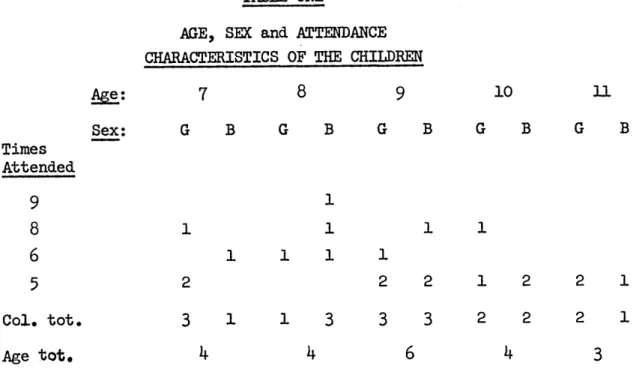
Out of the fifty-one children who attended at least one full
session (children who came in for partial periods were not counted as
full time participants), twenty-one attended at least five of the
sessions. The following table was developed:
TABLE ONE
AGE, SEX and ATTENDANCE CHARACTERISTICS OF THE CHILDREN
Age:
7
8
9
10
11
Sex: G B G B G B G B G B Times Attended9
1
8 1 1 1 1 6 1 1 1 1 5 2 2 2 1 2 2 1Col. tot.
3
1
1
3
3
3
2
2
2
l
Age tot.
4
4
6
4
3
Of the ten children used as data subjects, the five girls included: 1 - 7 year old 2 - 9 year olds 1 - 10 year old 1 - 11 year old
The five boys included:
1 - 7 year old
1 - 8 year old 3 - 9 year olds
This composition weights the reactions to the nine year
olds. Considering the range of development represented by the
children, it was felt that it could be considered typical of the
children of Washington Park.9 9
Differences due to age and sex were not generally reported.
The group was treated as a composite using total reactions and
results. A major reason for this was due to the fact that age was
often not the determining factor in a child's ability to respond to the interviews; his level of development was more important. Many seven year olds could verbalize and draw better than nine year olds; this was typical across all ages. The child who had the greatest
facility for expression was nine years old, but his temper and
behavior characteristics restricted his contribution. Sex differences
were found to be typical for children of this age level.100 The
girls liked and drew some things exclusive to them, and the boys did
samely. Initial result tabulations were made by sex but were aggregated
for the remainder of the work. Where age or sex was especially
significant, it was given mention.
39
map and picture drawing activities, photographs for evaluation, group discussion, individual conversation and tape recording. All were
successful except the latter. The tape recorder was brought to the
first class session, and the children asked such questions as,
"Who are you going to turn the recording over to?" or "Are you going to give it to our parents or teacher?" They were very skeptical as
to how I would "use" what they said, and thus their reactions were
inhibited. The other distraction it afforded involved the children's wanting to sing into the microphone "like the recording stars." The
recorder was not used again until the eighth week when sufficient
trust had been established. The noise level of the classroom did not
produce very audible recordings and so use was not continued. The
recorder would probably have worked much better in a smaller group,
but even then, it would have been an inhibiting factor.
Copies of the mimeographed interviews and related material
are included in Appendix A. Suggested changes and additions in
content and approach are included in Appendix B. Interview A was
used in four areas; the other interviews were used exclusively at
the Roxbury Y.M.C.A. in Washington Park.
Interview A - "General"
The purpose of the general interview was to determine the responses of the children to mimeographed questions and map and picture drawing. The mimeographs involved two questions: "When you play, do
you do any of these things?" and "Do you play in any of these places?"
re-If the child had difficulty in drawing the map, he was asked to
draw a picture. The interview took approximately one hour.
The results showed that the children responded
enthusiastic-ally to the questionnaires and drawing. The seven year olds often had
difficulty in reading and would have to be helped on particular words.
They showed that the scope and complexity of the interview could be
increased. Results from Interview A in the Washington Park Area are
included in Appendix A.101 Twelve children were interviewed in
Washington Park. For all four areas a total of 57 were interviewed.
Interview B - "Your Neighborhood"
Twenty-four children were asked to draw a map of their
neighborhood. If the child did not know what was meant by
neighbor-hood, it was explained as the "area around where you live and play."
The purpose of Interview B was to determine the children's concepts
of where they lived, what these included and what their abilities were
to represent them. This provided a basis for the picture drawing
activities and the descriptive discussion which followed. They were
asked to draw their house or "where they lived." They described the
liked and disliked qualities of their neighborhoods and homes and
talked about the houses of their neighbors and friends. Results
were written down, (Time duration: 2 hours.)
The children's ability to draw and talk about their environ-ment became apparent. Interview B showed that questions could be
41
especially if the children could actively participate in the interview by drawing, coloring or writing.
Interview C - "Perception and Places to Play"
The purpose of Interview C was to determine the responses
the children would make when shown a photograph and asked to list the things they saw. After the listing the children were asked to mark the things they liked and tell why. The ten children were given lined paper and pencils before being shown the photograph.
The results showed that the blank sheet of lined paper was
not as effective as one which looked more "important"lO2 such as the
mimeographed sheets of Interview A. The children hesitated in the
writing and constantly erased their work. It showed that the children
saw practically everything in the photograph, including vague hints
of cloud in the sky. When asked to evaluate, the children responded
quickly. This activity took approximately one hour. The slower and
younger children had more difficulty in writing and seemed hesitant to hand in their sheets, but when assured no grade would be given,
they responded. The first child to finish suggested that a grade be
given, but the majority of the other children vetoed the suggestion.
The photograph used was included in Appendix A.
Interview D - "Summer Activities"
The purpose of Interview D was to determine the kinds of activities the children liked and what they felt the physical
require-Summer was the season chosen because the weather was warm and the
children kept talking about how much they wanted summer to arrive.
They said that winter was "okay," but it was too cold, and there
weren't enough things to do.
The children used large sheets of newsprint paper (12" x
16"), colored pencils, crayons and regular pencils. The development
characteristics mentioned by Daniel Mendelowitzl03 were seen first
hand. The characteristics of age versus level of development became
apparent. Lists of activities, details and elements were made from
an examination of the resulting drawings; these were used in
prepar-ing the interviews which followed.
Interview E - "Housing Type and Playground Choice"
The purpose of Interview E was to determine the children's preference for housing types and playgrounds. Ten children were given two mimeographed sheets. The first sheet contained two
groups of pictures; the first, five different housing types; the
second, two playground choices. The children were asked to choose
the kind of place they would "most like to live and tell why. A
similar request was made for the playgrounds as to play preference
and why. Housing type choice was quickly made, but playground choice
was difficult as they liked most qualities in both. This led to
discussion about their choices.
43
like residences located around a large and busy play area. There
was also a taller, apartment structure with balconies. A wall
surrounded the area for car parking. The play area had trees, swings, play sculpture, swimming pool, grass areas and undivided areas of pavement. The children were asked if they liked the place to live; what they liked and why. They were asked to make the surfacing "like
they would prefer for it to be." This resulted in a determination
of their preference for surfacings and its relation to types of
play activity. It also involved much discussion about space and the
need for a variety of types to suit all their activities.
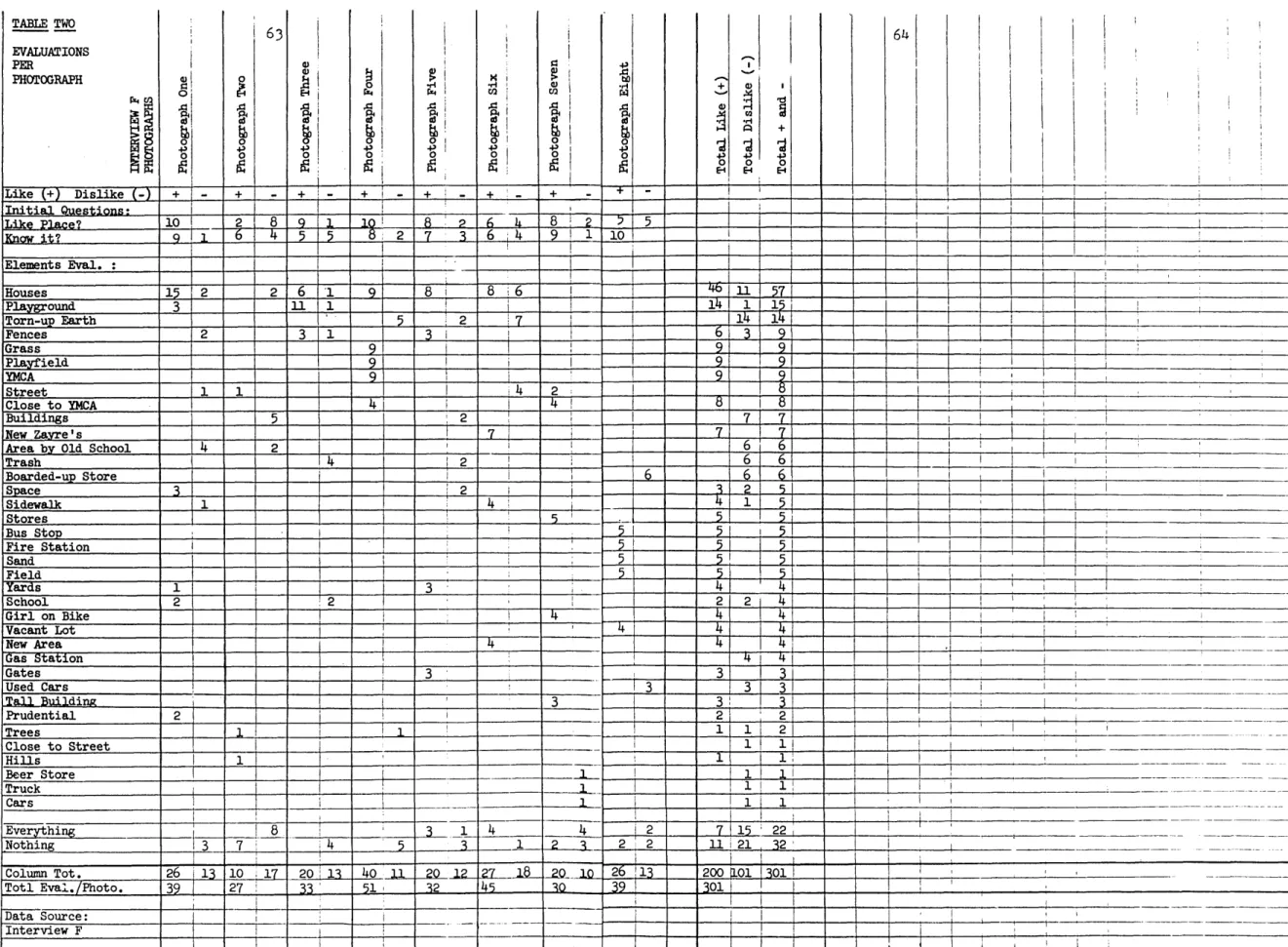
Interview F - "Washington Park Evaluation"
The purpose of this interview was to determine the evaluations
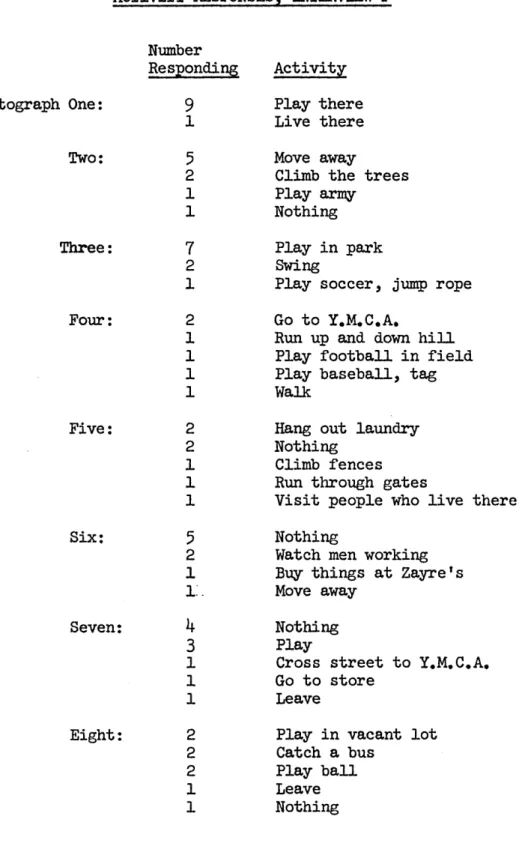
by the children of their surrounding environment. Fourteen children were shown eight photographs of the environment around the Roxbury Y.M.C.A. They were also given mimeographed sheets which listed numbers corresponding to the numbers on the photographs (4" x 6" in size mounted on a larger backing of white cardboard). They were asked to respond to eight questions by marking a "yes" or "no" for the first three and writing a response to the remaining five. The questions were:
"Do you like the place in the picture?" "Do you know the place?"
"Would you like to play there?"
"What would you like to do if you were in the place in the picture?"
"Wyit
"What do you dislike about the picture?" "Why?"
After evaluating all the photographs they were asked to chose the one they liked and the one they disliked the most and tell why. They were also asked to list the things they saw in the pictures,
but this became too long an activity and was not finished; it was
too repetitious an activity added to the already lengthy interview.
The interview was rather complex for the children, but they
responded very well. Their answers to "like" and "dislike" came quickly, but the "whys" were more difficult. The results became a major data source for the thesis and the basis for the following chapters.
The results showed what the children liked and disliked about their
area and why. Some elements needed further questioning in a more
uncomplicated and specific manner. Interview F showed which areas
needed further investigation.
The interview took approximately one hour and was the major accomplishment for the children during the special sessions. If
repeated, it should be condensed in length by showing fewer pictures that concentrate on more specific details.
The photographs used were black and white. Color was
avoided to eliminate that one very powerful characteristic. Even
then, the children talked about the color of something, but no
specific references were written by them in their responses. The
photographs also lacked any scenes with large numbers of people, but
the children did talk about activities which took place during the morning and evening rush hours in the areas photographed. They also