Defining New Business Models for the Mobile Device Supply Chain
byEthan Y Xu
Bachelor of Science in Electrical Engineering University of California, San Diego, 2006
Submitted to the MIT Sloan School of Management and the Electrical Engineering and Computer Science Division in Partial Fulfillment of the Requirements for the Degrees of
Master of Business Administration and
Master of Science in Electrical Engineering and Computer Science In conjunction with the Leaders for Global Operations Program at the
Massachusetts Institute of Technology
ARCHIVES
June 2012
© 2012 Ethan Y Xu. All rights reserved.
MAISSACHUSETTS NSTITUTE
FE L
'7 RN
I1
F
Signature of Author
Electrical Engineering and Computer Science Division, MIT Sloan School of Management
\
May 11, 2012 Certified by_Nncent W.S. Chan, The'Supervisor Professor, Electrical Engineeriygg anyomputer Science Division Certified by
' Vahram Erdekian, Thesis Supervisor Industry Co-director, L aders-fe% Global Dpeations Program Certified by
Don Rosenfield, Thesis Reader SenjerjLecturer, MIT Sloan School of Management Accepted by
Leslie Ko1ZidEj E S Graduate Officer Professor, Flectrical Engineering and Computer Science Division Accepted by
Maura M. Herson, Director of MBA Program MIT Sloan School of Management
The author hereby grants to MIT permission to reproduce and to distribute publicly paper and electronic copies of this thesis document in whole or in part in any medium now known or hereafter created
Defining New Business Models for the Mobile Device Supply Chain
byEthan Y Xu
Submitted to the MIT Sloan School of Management and the Electrical Engineering and Computer Science Division on May 11, 2012 in Partial Fulfillment of the Requirements for the Degrees of Master of
Business Administration and Master of Science in Electrical Engineering and Computer Science
Abstract
Mobile device companies typically manage supply and pricing for components that are used in production by their Vertical Integrators (VIs). By controlling the component pricing and supply chain, mobile device companies are able to increase their pricing and supply chain leverage over smaller component suppliers. Maintaining this leverage is crucial in ensuring that mobile device companies can mass-produce high quality products at efficient costs. However these advantages require that companies incur additional operational expenses associated with supply chain management. To reduce costs and improve lead times, OEM companies should consider having 1st Tier suppliers directly manage 2nd Tier suppliers.
This project will investigate VI capabilities to manage quality, design, and cost across the entire range of hardware used in Nokia phones. Alternatively, we will also identify specific program and commodity areas which may benefit from having a more integrated supply chain.
We will also investigate how Nokia can reduce supply chain management costs to meet future business needs related to cash flow.' By analyzing Nokia's historical supply chain performance, we will develop a model to quantify Nokia's "level of control" over its supply chain. We define this "level of control" in terms of the Operational Expenses and Investment which Nokia incurs in managing its supply chain. With this model, we will assess how future business constraints will affect Nokia's supply chain control. By evaluating key parameters which influence supply chain control, we can recommend how Nokia can allocate control across its supply chain. Finally, we will apply this model to recommend how Nokia should outsource supply chain management responsibility.
Thesis Supervisor: Vahram Erdekian
Title: Industry Co-director, Leaders for Global Operations Program Thesis Supervisor: Vincent W.S. Chan
Title: Professor of Electrical Engineering and Computer Science
Acknowledgments
I would like to thank Vah Erdekian for his broad and in-depth perspective on the electronics supply chain industry.
I would like to thank Professor Vincent Chan for his advice on building an analytical description of Nokia's supply chain performance.
I would like to thank Heikki Vuorenmaa, my supervisor at Nokia, for creating the opportunities which enabled me to understand Nokia's supply chain, from both a strategic and hands-on perspective.
I would like to thank Brad Mitchell for the time he has taken to review and provide feedback for this thesis.
Table of Contents
Abstract ... 3
A cknow ledgm ents...5
Table of Contents ... 7
1 Introduction ... 12
1.1 Background ... 12
1.2 Nokia's Purchasing M odel (AVAP)... 13
1.3 Problem Statem ent ... 14
1.4 Key Considerations ... 14
1.5 Purpose of Study ... 15
1.6 Approach ... 15
2 Background & Context...15
2.1 N okia Corporation...15
2.1.1 N okia's Product Developm ent... 16
2.1.2 N okia's Supply Chain Organization... 17
2.1.3 N okia's Sourcing Organization... 17
2.1.4 N okia's Supply Chain -Informal Advantages ... 18
2.1.5 N okia's Supply Chain -Form al Structure... 19
2.2.1 In-house vs. O utsourced Design ... 22
2.3 Key Com petitors in the M obile Device Industry ... 22
2 .3 .1 S a m su n g ... 2 2 2 .3 .2 A p p le... 2 4 2 .3 .3 M o to ro la ... 2 5 2.4 Briefing on Ecosystem s: Android, Apple, and W indows... 26
2.4.1 Ecosystem A nalysis and Conclusions... 29
2.5 Contract M anufacturer Landscape... 30
2.6 Overall Observations ... 1
3 Project Scope & Current State... ... 33
3.1 M obile Device Hardware Com m odities ... . 33
3 .1 .1 D isp la y ... 33
3 .1.2 M e c h a n ic s ... 3 4 3.1.3 Electrom echanics...35
3.2 N okia Factories & Suppliers... 36
3.3 Business M odels Considered... 38
3.3.1 Assigned V endor Assigned Price... 38
3 .3 .3 T u rn k ey ... 4 0
3.3.4 Original Design M anufacturing (ODM ) ... 41
3.4 Desired Outcome with Business M odel Recommendation ... 42
4 P roject D etails ... 4 3 4.1 Detailed Hypothesis ... 43
4.2 Research M ethodology...45
4.2.1 Phase 1 - Information Gathering ... 45
4.2.2 Phase 2 -Organization and Presentation... 46
4.2.3 Phase 3 & 4 -M ock and Real Trial (Original Plan)...46
4.2.4 Revised Plan...48
5 Current State Analysis: Comparing Business M odel Performance... 50
5.1 Comparison Metrics to Analyze Program and Commodity Performance...50
5.1.1 Technology: New Component Counts ... 51
5.1.2 Quality: Supplier Quality Action Requests, Failure Rates ... 52
5.1.3 Supply Shortage Surprises: Frequency and Scale ... 53
5.1.4 Cost: Operating Expenses, Forecasts, and Cost Reductions ... 54
5.2 Analysis of M etrics across Commodities... 56
5.2.2 Com mod ity 4 ... 58
5.3 Performance Analysis of Com modities ... 59
5 .3 .1 C o m m o d ity 1 ... 6 0 5.3.2 Com modity 2 ... 61 5 .3 .3 C o m m o d ity 3 ... 6 3 5.3.4 Com m odity 4 ... 65 5.3.5 Com m odity 5 ... 67 5.3.6 Com modity 6 ... 68
6 Supply Chain Model ... 70
6 .1 P u rp o se o f M o d e l...-... 7 0 6.2 Summary of the M odel Framework... 70
6.2.1 General Form of the M odel... 70
6.2.2 Specific Form of the M odel Applied at the Commodity Level ... 71
6.2.3 Estimating Future Operational Expenses (x,)... 77
6.2.4 Estimating Future Investment Levels (y,) ... 78
6.3 Quantifying Nokia's Future Supply Chain Control... 80
6.4 Identifying Correlations between Supply Chain Control and Performance... 81
6.4.2 M ethod to Normalize Data... 82
6.4.3 Correlations between Supply Chain Performance M etrics... 83
6.5 Summary of Analysis ... 88 7 Conclusion ... ... )9 1 7 .1 C om m odity I 1 ... 9 2 7.2 Commodity 2... 94 7.3 Commodity 3... 95 7.4 Commodity 4... 96 7.5 Commodity 5... 97 7.6 Commodity 6... 99 7.7 F inal W ords ... 100 8 R eferen ces ... 104
1 Introduction
1.1
Background
Nokia manages its supply chain and manufacturing operations by focusing on four criteria: Product Technology, Quality, Cost, and Supply (TQSC).
- Product Technology defines the product's hardware capabilities: advanced displays, processors, cameras, etc.
- Quality is an indication of the customer's satisfaction with overall product performance.
- Cost describes the material, manufacturing, and supply chain expenses associated with producing the final product.
- Supply is defined by Nokia's ability to maintain availability of components used in production. Preventing supply chain disruptions caused by material shortages is one of Nokia's key supply chain management goals.
Nokia actively manages its supply chain in order to achieve its goals for TQSC. To do so, Nokia manages its overall supply chain consisting of component suppliers, vertical integrators, and Nokia's own
factories. Nokia factories make the final assembly of phones based on partial assemblies provided by the Vertical Integrator (VI). Vertical Integrators include contract manufacturers such as Foxconn.
Component suppliers provide the basic pieces that go into phones, such as speakers, electronic chips, and mechanical parts. A portion of these components are shipped to the VI for partial assembly. A portion of these subassemblies are then shipped to Nokia factories for final assembly. (See Figure I for an example supply chain showing Nokia's suppliers and Vls.)
2Wireless Handset EMS/ODM Struggle Despite Market Comeback, iSuppli Global Manufacturing and Design Analysis, Jan. 2010
Key
Nokia-managed
Supplier-managed
I.UlmllpO""I1st
Tier
Integrator
Q
Supplier
Component
Mdl
Supplier
M2nd
Tier
SUb-
Electronics
3rd Tier
component Sple
Supplier
Figure 1: Nokia's management of 1st, 2nd, and 3rd tier suppliers.
1.2 Nokia's Purchasing Model (AVAP)
In order to achieve purchasing economies of scale, Nokia negotiates component prices directly with suppliers. By maintaining a direct link to component suppliers, Nokia has the option to control when and how component orders are delivered. This is especially important during material shortages, when a supplier must decide which of its customers will receive the first shipment.
Considering Nokia's large purchasing economies, it is possible that some of Nokia's Vertical Integrators have smaller purchasing economies of scale. To address this weakness, Nokia can negotiate prices and capacity directly with component suppliers. Nokia then has the option to provide the VI with its
negotiated agreement. Such an arrangement may stipulate that the VI can purchase a certain quantity of components at a specific price from the component supplier. The VI is then able to order directly from the
component supplier on behalf of Nokia. The purchased components are used specifically to produce Nokia products. This model is called Assigned Vendor Assigned Price (AVAP).
1.3 Problem Statement
Under AVAP, the VI receives sensitive pricing information. If the VI purchases the same component on behalf of another customer, then the VI may benefit from knowing Nokia's negotiated price for that component. It is conceivable that Nokia is helping its competitors lower their purchasing costs using
information Nokia reveals to its VIs.
Commodity components are usually produced on a mass scale for companies across several industries. In some cases, VIs may be able to manage these commodity components at a relatively low cost. As
technology improves, more components become commoditized, making it easier for the VI to manage those components .
1.4
Key Considerations
This thesis studies the entire supply chain needed to produce the latest and most cutting-edge mobile devices. We will focus on the companies who design and sell mobile devices-including familiar brands such as Nokia, Apple, Samsung, and Motorola. We will also compare major Vertical Integrators and Original Design Manufacturers (ODMs), such as Foxconn and Compal Electronics. Key questions which we will explore include:
1. How must Nokia adapt its supply chain model to face future business goals and needs?
2. If the Nokia sources directly from suppliers, can it reduce costs and improve supply availability over the long-term?
3. If Nokia reduces its future Supply Chain OpEx and Investment, how will this affect Nokia's future supply chain control and purchasing power?
1.5
Purpose of Study
The goal of this study is to describe the costs and benefits of different operational business models and show how these models are relevant to Nokia. We will understand the costs and benefits by observing how current and pastoperational business models have affected production cost, quality, and supply. We will study these performance factors across major commodity areas,. By identifying how business model performance varies across different commodity areas, we can recommend a business model to achieve
future supply chain goals. In making a recommendation, we will also discuss future investment costs required to execute new business models. Finally, we will analyze Nokia's suppliers' capabilities and development areas required by future business models.
1.6
Approach
First, we will identify metrics to understand cost, quality, and supply performance on past programs. Second, we will compare these past performance metrics to current performance measures. Then, we will identify the costs and benefits observed in applying these new business models. Finally, we will
recommend a set of business models for future programs, based on Nokia's ability to invest in and scale new production.
2
Background & Context
Note: Information in this section is drawn from industry research reports, not from Nokia internal information.
2.1
Nokia Corporation
Nokia is the world's largest manufacturer of mobile phones, with a market share of 23% in the second quarter of 2011. It is based in Finland and employs over 132,000 employees across 120 countries, with major operations in Finland, China, and the US. In 2010, Nokia achieved annual revenue of over E42
billion and operating profit of E2 billion. In the third quarter of 201 1, Nokia recorded sales of E9 billion with a loss of C71 million. These figures place Nokia at #143 in the 2011 Fortune Global 500 list.
2.1.1 Nokia's Product Development
Product development requires coordination between major groups within Nokia, including Sales, R&D, Sourcing, and Logistics. Early on in the product development cycle, Nokia Sales and Marketing will identify phone features which consumers will want in the future. Some features depend on as yet non-existent software and hardware technologies. To deliver these features, Nokia will begin to develop relationships with software developers and component suppliers.
R&D begins by defining the phone concept and design, including the hardware and software architecture required to run the future phone. Since on-time phone delivery depends on the available technology of Nokia's suppliers, R&D will coordinate with Sourcing to select suppliers who will produce the phone later on. This process requires trading off various phone designs based on functionality, cost, time, and ease of production.
While the phone design is being finalized, Sourcing will set up the supply chain necessary to begin full production. Hardware suppliers are selectcd and component prices and delivery schedules are negotiated.
Suppliers set up their manufacturing lines and prepare themselves for new manufacturing processes. Meanwhile, Sourcing representatives validate suppliers' processes according to a set of requirements. If those requirements are not met, Sourcing will provide corrective actions to help the supplier improve their
process. All this preparation is done to ensure that sufficient supplies of the new phone can quickly reach consumers.
Phones assembled from dozens of components create new challenges even after Sourcing has set up the supply chain. These challenges force Nokia to continually redesign its supply chain. To prepare for these cases, the Sourcing and Logistics groups work together to actively monitor material inventories,
production schedules, quality defects, and competitor forces affecting the global supply chain. Constant supply chain improvements ensure the cost-efficient production required to compete in the cutthroat mobile device industry.
In summary, Nokia adds value to the consumer by orchestrating a complex process involving Sales, R&D, and Supply Chain disciplines. While there are many phone manufacturers, few can provide an integrated hardware and software solution on a large scale to satisfy millions of consumers worldwide.
2.1.2 Nokia's Supply Chain Organization
As of mid-2011, Nokia's Markets division heads the supply chain, sales channel, brand and marketing functions of the company. The supply chain organization is further divided between Sourcing and Logistics groups. Sourcing is responsible for long-term supply chain planning, including supplier relationships, selecting new designs, and operations development. Logistics manages day-to-day supply chain and production issues, including monitoring inventory, quality, and in-house production.
NOKIA CORPORATION
MARKETS Mobile Phones Mobile Solutions
Supply Chain Sales Marketing
2.1.3 Nokia's Sourcing Organization
Nokia Sourcing group is organized by the major elements sourced for phone production, including
software and hardware. Semiconductors such as electronic chips have a dedicating sourcing group to meet unique industry challenges. These three sourcing groups are supported in a matrix organization by four other groups, as seen in the table below. This thesis deals primarily with Operations Development for the Hardware & ODM Sourcing organization (as highlighted below).
SOURCING
Mobile
Phones Sourcing Software, Hra
&Content, & r i D
Smart Devices Sourcing Services Semiconductor
Quality
Sourcing Sourcing S j! gOperation~s Dvlnn
The Hardware & ODM organization is the largest sourcing group, and is responsible for many major components required for phone production.
In addition to sourcing groups for each commodity, there are also dedicated Sourcing representatives for each product program, who are responsible for quality and supply issues specific to one program. This program-specific sourcing team operates at the intersection of Nokia's R&D and Sourcing groups, supporting Design for Manufacturability goals.
2.1.4
Nokia's Supply Chain
-
Informal Advantages
How has Nokia maintained its top position in the global mobile industry? A more fitting question may be: How has being the largest mobile device maker helped Nokia maintain its top position?
Nokia sold 453 million mobile phones in 2010, with a market share of 32.6%. Being the #1 mobile device maker gives Nokia unmatched purchasing and production economies of scale. Lower prices enable Nokia to choose the best combination of low-cost and high-quality components for its phones. This supply chain advantage continues to help Nokia dominate the developing world market, including India and Africa.
With its huge buying power, Nokia's supply chain directives are accommodated more easily by suppliers, who see Nokia as an important customer. This in turns provides Nokia with economies of scale to
2.1.5
Nokia's Supply Chain
-
Formal Structure
Because of Nokia's production scale, it is able to operate in-house manufacturing facilities throughout the world, located in Finland, Brazil, China (Beijing and Dongguan), Hungary, India, Mexico, and South Korea. According to iSuppli, Nokia prefers to retain final assembly in-house for quality control and logistics coordination. It outsources much of its mobile phones' modules and sub-assemblies to its Vertical Integrator partners.3 This structure results in Vertical Integrators and other suppliers performing
the lower "value-added" steps in phone production.
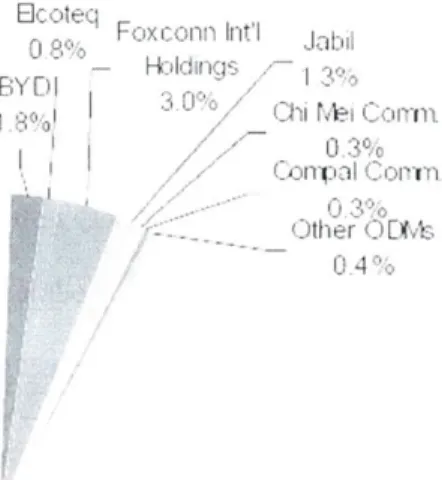
According to iSuppli, in 2009, Nokia maintained 92.1% of final production in-house while outsourcing 7.9% of its final production. Note: this does not imply that mobile device production is concentrated in-house. Many time-consuming manufacturing processes are performed by Vertical Integrator partners before Nokia takes over final assembly. The figure below shows Nokia's mobile device manufacturing partners and share splits in 2009.
3
Wireless Handset EMS/ODM Struggle Despite Market Comeback, iSuppli Global Manufacturing and DesignMFoxcon
IntI
BYDHI
C 3%
OKt her O)L/s 0.
In-house 9 2 1%,J
Suce: Supph *?crp |March 2C
Figure 2: Nokia's Proportion of In-House vs Outsourced Production
The large proportion of in-house production reflects the 2008 economic downturn and contraction in the mobile device market. To maintain a healthy level of in-house production, Nokia moved manufacturing back to its own factories. Thus, at the beginning of 2009, Nokia announced that it would gradually decrease (or cease) the use of contract manufacturers in certain areas including Printed Circuit Board (PCB) and final assembly (source: iSuppli).
iSuppli estimates that with Nokia's strategic pullback from outsourced programs, all of Nokia's contract manufacturing partners-except for BYD-saw their shares with Nokia decline in 2009. BYD, however, saw its share with Nokia double in the same period. This increase was due to Nokia's effort to lessen its reliance on Foxconn. By developing alternative vertical integrator partners, Nokia sought to reduce risk and maintain buying power over its supplier base.
In addition to Vertical Integrators, who specialize in providing manufacturing services, there is a special class of solution provider called Original Design Manufacturers. ODMs also provide design expertise and can assist companies in developing new phones. Many ODMs combine manufacturing and design
services to offer a more complete (and perhaps more expensive) solution. Among Nokia's partners, Foxconn and Compal Communications are notable ODMs (source: iSuppli).
2.2
Survey of the Mobile Device Industry
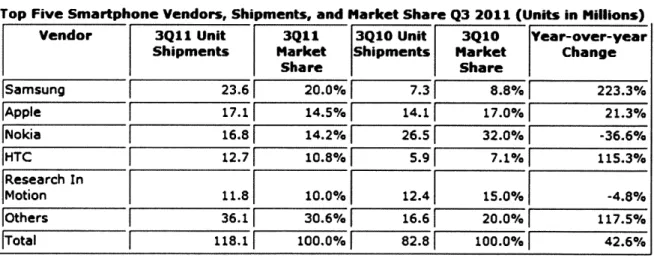
2011 experienced a shift in the mobile device competitive landscape, as Nokia dropped from the #1 place in smartphone market share. Growth at Samsung and HTC was driven by huge demand for Android phones, as Android eclipsed Apple's iOS as the dominant smart device platform with 47% market share (vs. 29% for Apple's iOS). The table below shows global smartphone sales and market share numbers for the period between July and September, 2011.
Top Five Smartphone Vendors, Shipments, and Market Share Q3 2011 (Units in Millions)
Vendor 3Q11 Unit 3Q11 3Q10 Unit 3Q10 Year-over-year
Shipments Market Shipments Market Change
Share Share Samsung 23.6 20.0% 7.31 8.8% 223.3% Apple 17.1 14.5% 14.| 17.0% 21.3% Nokia 16.8 14.2% 26.51 32.0% -36.6% HTC 12.7 10.8% 5.9| 7.1% 115.3% Research In Motion 11.8 10.0% 12.4 15.0% -4.8% Others 36.1 30.6% 16.61 20.0% 117.5% Total 118.1 100.0% 82.81 100.0% 42.6%
Figure 3: Global Smartphone Vendor Market Share (source: IDC)
The Others category include firms such as Motorola, Sony Ericsson, and LG, each with market share less than 5%. The Others category notably includes no-brand "grey-market" phones which are popular in emerging markets. These no-name brands are known for quickly producing cheap copies of famous brand
phones, making them popular alternatives in India, Africa, and rural China. These small competitors exert downward pressure on Nokia's and Samsung's product offerings in emerging markets. Price competition
is so acute that other major OEMs often lack the economies of scale and supply chain efficiency to compete in these markets.
2.2.1 In-house vs. Outsourced Design
Companies can outsource the development of their phones to Original Design Manufacturers (ODMs). ODMs provide a full suite of services for making a new phone, including: concept planning, external design, component selection, software and hardware integration, etc. Flextronics and Foxconn have actively developed and promoted their ODM capabilities.
OEMs such as Motorola and Sony Ericsson rely most heavily on ODMs. On the other hand, bigger players such as Nokia, Samsung, Apple, and LG prefer to retain design activities in house. As a result, iSuppli estimates that currently 80% of global mobile devices shipped are designed in-house by OEMs.
2.3 Key Competitors in the Mobile Device Industry
2.3.1 Samsung
Samsung sold just over 300 million phones for the first eleven months in 2011, putting it just under Nokia's total sales of 303.6 million phones over the same period. In comparison, Samsung sold 280
million phones in 2010 and 235 million phones in 2009. Such high growth rates have caused Samsung to increasingly rely on manufacturers such as Foxconn. In 2010, Samsung kept 100% of final assembly work in-house, while engaging Foxconn for PCB assemblies and sub-assemblies. The company still conducts primary R&D and production activities in-house.
Samsung operate production sites across the world to reduce costs, maintain competitiveness, and
simplify logistics. Up until 2008, most production was kept in Korea due to high profitability and fears of technology leaks. However, in the last five years, Samsung has significantly expanded production
capacity outside of Korea, especially in low cost countries such as China, India, and Vietnam. As of 2010, the proportion of overseas production has grown to over 80%. Nevertheless, Samsung is likely to
maintain its 50 million units / year production in Korea for several reasons. The Korea plant can better manage trade secrets on leading and high-end products. Furthermore, Samsung seeks to minimize potential political and public protests following its continued production offshoring.
Roughly 50% of the components in a typical Samsung phone come from Korean suppliers. However, Korean companies are relatively weak suppliers of baseband chips, RF modules, and power amplifiers, so Samsung relies on other companies for these components.
Samsung's strategy emphasizes Korean suppliers for three main reasons: trust, ease of control and bargaining power, and the ability to respond faster to Samsung's requests. This shows that Samsung leverages informal supply chain advantages to maintain its competitiveness.
In expanding production into low-cost countries, Samsung has developed a network of Korean suppliers around its major factory in Huizhou, China. Its Vietnam factory also relies on some suppliers in Huizhou, while Samsung continues to ramp up suppliers around its Vietnam site. Samsung's India facility is at an earlier stage, but is expected to ramp up along similar lines.
The Vietnam and Brazilian facilities help Samsung improve its competitive position in these markets, partly by reducing import duties for phones manufactured and sold in these countries. In some facilities, Samsung has the additional advantage of producing flat panel TVs and other Samsung products. This allows Samsung to quickly scale production at new sites and also shift production volumes depending on changes in demand.
We believe that strong demand has enabled Samsung to localize its material supply chain across most of its major production sites. To support sudden demand, Samsung will also gradually engage contract manufacturers for more advanced production. For example, by partnering with Foxconn for its LCD-TV ODM programs, Samsung shows that it is open to outsourcing further work, especially in board-level assembly and sub-assembly production.
2.3.2 Apple
Apple sold 72.3 million iPhones in 2011, making it the #2 smartphone vendor. The large number is all the more surprising because Apple has by far the fewest models and SKUs among all the top OEMs.
Apple is an asset-light company, focusing on research and development while outsourcing manufacturing and fulfillment of its products. Components and assembly are sourced to low-cost, high-speed suppliers. Apple outsources its entire product manufacturing to contract manufacturers. Before 2011, Apple relied exclusively on Hon Hai, the parent company of Foxconn, as its contract manufacturer across many product categories. Hon Hai also served as a strategic mechanical part supplier. Since 2011, Apple has diversified its contract manufacturer portfolio to include Pegatron, for production of CDMA phones.
To protect its proprietary design, Apple is highly involved in material procurement and does not allow contract manufacturers much flexibility in quoting and selecting suppliers. For mechanical parts, Apple takes full ownership of the sourcing process: contract negotiation, engineering changes, vendor approval, etc.
Because Apple retains tight control of its supply chain, it chooses to (and is required to) minimize the amount of variation in its devices. One iPhone model is released per year and variations are limited to different memory capacities. By limiting product variation, Apple can achieve high volumes and insist on custom designs instead of off the shelf parts. This practice frustrates many of Apple's suppliers, who find themselves unable to use extra inventory for other platforms.
Apple maintains synchronized communication throughout its supply chain, allowing the company to respond quickly to changes in demand. Its supply chain strategy is best described as a highly
synchronized, interdependent network of global external suppliers and partners. This allows Apple to provide anticipated sales volume figures to help component suppliers plan production. Next, Apple's Electronic Manufacturing Service providers (i.e. contract manufacturers such as Foxconn and Pegatron) receive components which they use to assemble, package, and ship the final iPhone.
The above strategy allows Apple to minimize inventories throughout its supply chain. Apple stores provide another key differentiator allowing Apple to make accurate demand forecasts. These stores provide an up-to-date picture of sales volumes and customer returns. Furthermore, all new iPhone users must register their devices through iTunes. This allows Apple to track new purchases made through retailer and wireless service provider channels.
Apple is famous for cutting large deals with suppliers by prepaying for future shipments. In some cases, Apple will invest in building the production capabilities which its suppliers will need. As of 2011, Apple can still approach these transactions more confidently than other OEMs because it can rely on a devoted customer base eager to buy the next iPhone.
2.3.3 Motorola
In the mid-1990s, Motorola and Nokia roughly split the market for mobile phones. In 2011, Motorola was the eighth largest OEM, with 5% of the market. After witnessing continued market share decline,
Motorola undertook a series of structural changes to its supply chain beginning in 2005. Because these changes failed, it is instructive to study Motorola's supply chain strategy.
Before 2007, Motorola maintained the most decentralized R&D structure of all major OEMs. High overhead and potential labor duplication made this model unsustainable as Motorola's sales continued to decline. The firm moved quickly to scale down R&D operations in France, Singapore, China, and the
United Kingdom. This allowed Motorola to outsource its product design to ODMs (Original Design Manufacturers).
Motorola gained some initial success with its outsourcing strategy. The industry-wide downturn in 2008 drove most other OEMs to shift production in-house. ODMs facing excess capacity were eager to strike deals with Motorola. As a result, Motorola began to outsource the majority of its final production. Of course, Motorola's supply chain executives realized they needed to maintain purchasing power.
Therefore, they prevented their ODMs from quoting and selecting suppliers. Instead, Motorola took full ownership of contract negotiations and component purchases. These efforts did not help Motorola regain market share. The company currently focuses on mid-range to high-end Android devices, which provide Motorola with better profit margins compared to lower-end products.
2.4
Briefing on Ecosystems: Android, Apple, and Windows
Operating Systern Share of Smartphone Sales
28%,
+3/
The figure above shows the historic market share for the major smartphone ecosystems, as well as recent growth rates for the Android, iOS, and RIM platforms. Windows Phone 7 (WP7) continues to seek broader awareness, app developer support, and partnerships with wireless service providers. Nokia's bet on WP7 is a huge win for Microsoft, because Nokia's large production volumes can help bring WP7 into the hands of many first-time smartphone users.
To seal the partnership, Microsoft offered Nokia broader control of several WP7 features. Currently, Nokia has developed Nokia-specific apps for navigation and music in order to differentiate its products. Nevertheless, we believe it is in Microsoft's long-term interest to ensure a consistent user experience and
level playing field among its device OEMs.
Differences between the three ecosystems-Android, iOS, and Windows-will drive future sales. Therefore, the figure below summarizes some of the key features and differences among the three ecosystems.
Android iOS Windows
Total Devices hundreds 11 20
Total Apps 380,000+ 500,000+ 43,000+
Tablet-optimized Apps Hundreds? 140,000 N/A
4G Support LTE, HSPA+, WiMax HSPA+ HSPA+
Cloud Integration 3rd party apps iCloud SkyDrive
Voice control Commands with some Natural language Commands
Natural language
Navigation Free 3rd party only 3rd party or Nokia
Search Provider Google Google, Yahoo, Bing
Bing
Devices: iOS has the least number of devices, with I models spread across its iPhone, iPad, and iPod touch lines.
Apps: As the newest platform with a much smaller market share, it is remarkable that WP7 has gained over 43,000 apps. Microsoft's efforts to woo and support developers seem to have paid off.
Tablets: The tablet market is still immature for both Android and WP7, with Microsoft preparing its Windows 8 tablets for launch in 2012.
4G will drive the evolution of future smartphone apps. In the US, Android is best positioned, since it offers 4G phones on several service provider networks.
Cloud Integration: Released in Fall 2011, iCloud provides full syncing of content between iOS devices and Macs, including users' photos, music, contacts, reminders, browser bookmarks, notes, documents, calendar events, and some third-party apps. Android and WP7 provides limited contact syncing and app backups.
Voice control: Apple surprised everyone with its Siri platform, which allowed users to submit queries by speaking in natural language. Both Android and WP7 are striving to develop this feature for their future products.
Navigation: When Android launched late in 2009, it bundled an excellent voiced turn-by-turn navigation app. This provided a key differentiator compared to iOS, which relied on 3rd party apps costing over $50. The Nokia Drive app is a feature that differentiates Nokia devices from other Windows phones.
Search Provider: As of Dec 2011, Bing's US market share reached 15% of the desktop search market. Users prefer to search using Google, so being tied to Bing places WP7 at a disadvantage.
Dual-core devices: With WP7 lacking dual-core support, Nokia was unable to release high-end dual-core phones. This is a small example of how relying on WP7 limits Nokia's product offerings.
2.4.1
Ecosystem Analysis and Conclusions
Android and iOS are dominating the smartphone market, with their wide base of applications. Users of both platforms are highly satisfied with their experience, with 85% of Apple users willing to consider repurchasing an iPhone and 84% of Android users willing to consider an Android-based smartphone (source: "The Smartphone Market is There to be Won", GFK Insights4u). Furthermore, customers who have already invested in apps for one ecosystem will face switching costs when moving to another platform.
To break into the smartphone market, WP7 needs to offer new and valuable features. In our previous comparison, we showed that WP7 is a competitive smartphone platform, yet still lacks several key features. Windows Phone 8, slated for mid-2012, will address dual-core support, LTE, and
high-resolution screens. Additionally, Microsoft can differentiate its offering by linking Windows Phone to the Office platform. A feature allowing users to sync Office files between their business computer, tablet, and smartphone may offer a compelling reason to choose the Windows Phone.
We believe the success of the Windows Phone depends on three factors: device functionality, wide availability of apps, and easy integration with business systems.
Device functionality: Nokia's designers and manufacturing planners can build competitive hardware
showcasing the latest Windows Phone features. Nokia's success here will help Microsoft attract more developers to drive wider app availability.
Integration with business systems: Microsoft has an opportunity to target business users switching from
RIM. However, in the US, many people are now using their personal smartphones for work, aided by software that allows easy switching between different profiles. This trend is already benefitting iOS and Android. Thus, Microsoft and Nokia should also target business markets in non-US and emerging countries, where users are beginning to discover smartphones. Driving US market share will be more
difficult-Windows Phone has the best chance in the low and medium-range segments attractive to first-time smartphone users. The smartphone market is shaping up, and the Windows Phone must build by targeting multiple (if scattered) user segments.
2.5
Contract Manufacturer Landscape
In recent years, handset OEMs have outsourced slightly less than 30% of their production to contract manufacturers (including ODMs). This was motivated by a desire to manage quality and logistics in-house. Especially during the 2008 - 2009 downturn, OEMs brought outsourced production back in-house to optimize internal capacity utilization. More recently, with the popularity of smart phones, OEMs have found very few contract manufacturers with the capability to design and build smart phones. The only contract manufacturer capable of making smart phones, HTC, decided to build exclusively for its own brand.
The EMS provider and ODMdichotomy: Electronic Manufacturing Service (EMS) providers focus on providing manufacturing services, while Original Design Manufacturers (ODMs) offer more design services. So what is the difference between EMS providers and ODMs? Recent trends show that EMS providers are building their design expertise, placing themselves in direct competition with ODMs. So the differences between EMS providers and ODMs continue to shrink.
(Note: the numbers below for Foxconn and Flextronics include their revenues for non-mobile phone segments.)
Traditional EMS providers include Foxconn (annual revenues: $59.31B) and BYD Electronic ($2.52B). They offer extensive and cost-efficient manufacturing services, especially for construction of mobile phone enclosures and Commodity 3. ODMs include Flextronics ($28.7B) and Compal Communications ($490.5M). ODMs offer manufacturing services, but differentiate themselves by also offering services
traditionally performed by the OEM's own R&D unit. By offering a one-stop shop for phone development and production, ODMs typically command higher prices.
Looking to the future, we expect the major OEMs to retain in-house design while outsourcing production of low and mid-range smartphones. Foxconn is poised to execute well in this environment, as it continues to build scale and increase vertical integration. For example, Foxconn recently purchased display maker Chimei Innolux, allowing it to offer its customers a one-shop solution for mechanical, display, and circuit board assembly. OEMs relying on Foxconn's extensive services can theoretically expect improvements in lead-time and cost. Nevertheless, other specialized suppliers still offer better quality and technology.
BYD is notable in being the most successful copycat of Foxconn's business model. It builds
manufacturing facilities in low-cost locations co-located with OEM's production facilities. BYD also relies on building a vertical integrated supply chain to improve its cost-competitiveness. While BYD has yet to achieve Foxconn's scale and lacks in-house design expertise, we see BYD as the true challenger to Foxconn's low-cost EMS model.
Flextronics's future is the most uncertain: While the firm offers the most extensive design capabilities, it is continually challenged to compete against the extreme low cost structure inherent in its Chinese and Taiwanese competitors. Another ODM, Compal Communications, saw its fortunes improve by partnering with Nokia.4 As Compal continues to build its in-house design competencies, it has potential to fill in the space of former ODM, HTC.
2.6
Overall Observations
Among the OEMs we have analyzed, the most successful have maintained strong competencies in sourcing, design, and supply chain management. Some examples:
4 "Compal Communications to see strong smartphone shipments to Nokia in 2Q12," Digitimes, April 24, 2012
- Sourcing. Apple retains full control of material procurement, and does not allow contract
manufacturers much flexibility in quoting and selecting suppliers.
- Supply Chain Management: Samsung keeps 100% of final production in-house to better manage
quality and logistics.
- Design. HTC is a technology leader, having released the first Windows phone, the first Android
phone, and the first 4G phone.
By comparing with the laggards such as Motorola and Sony Ericsson, we can conclude that the leading
OEMs:
- Actively participate in key areas of the value chain. Whether it is in sales, supply chain management, sourcing, or design, leaders prove that their participation is critical to the mobile phone value chain. (In other words, they don't simply splash their brand on an ODM-designed phone.)
- Achieve large production volumes: By standardizing designs and minimizing product variation, Apple has gained economies of scale even though it makes one quarter the number of phones annually as Nokia.
- Maintain strong design competencies: Firms differentiate themselves in key areas of the user
experience: Apple through iOS, Samsung through excellent hardware and displays, and HTC through the features it has developed on top of the Android platform.
On the other hand, successful OEMs will outsource low value-added activities to their contract manufacturers. At the same time, OEMs must ensure that they maintain negotiating power over their supplier base. Thus, the right supply chain strategy will vary depending on the specific OEM's situation. Some approaches may include:
- Developing vertical integrator capabilities to manage quality In their chase for low costs, contract manufacturers do not develop quality management skills for the long-term. While squeezing VIs on cost, OEMS also implicitly agree to monitor quality through their internal teams.
o Proposal: OEMs should assess their quality resolution processes to determine whether problems can be solved more quickly and cheaply using the supplier's resources and teams. If the OEM pursues this strategy, they must be prepared to invest resources into their VI partner.
- Standardizing components across product lines: Doing so will improve purchasing economies of scale and also reduce inventories. Production forecasts require less safety stock when certain purchase orders can be pooled together. With more standardization, OEMs can realize less liability for over-forecasts and can more efficiently ramp down production.
o Proposal: OEMs' product planning and R&D teams need to understand the true customer value of using new components vs. financial costs. Purchasing managers, who are happy to increase their work scope, must also be incentivized properly.
- Enabling the VI to directly source components under the turnkey model: Low cost purchasing is best achieved by sourcing in large volumes. Under this model, the VI will directly negotiate prices and manage quality for the components they source. The VI will charge the OEM a higher component price to account for the VI's management fee. This fee should still cost less compared to OEM's
internal team managing the same activity.
o Proposal: First, the OEM must help teach the VI's personnel how to manage component quality. Then, a combined sourcing team from the OEM and VI works together to develop sourcing and supply risk strategies. After a period of time, the VI's sourcing capabilities and costs can be measured to determine long-term savings.
In sections 6 and 7, we will develop a model to determine whether these recommendations make sense for Nokia's future supply chain. Our analysis will compare Nokia's supply chain models with historical performance. Then we will assess Nokia's future business needs and its impact on future supply chain performance. Only by quantifying data in this way can we make a recommendation for Nokia's future
supply chain strategy.
3
Project Scope & Current State
3.1
Mobile Device Hardware Commodities
The most important components in a mobile device include the display, mechanics, and electromechanics. These component commodities are important to study for three reasons:
1. They typically represent technologically advanced components, which carry technological and production risk. These risks create uncertainty in achieving production, cost, and supply stability targets.
2. They require greater upfront investment in production and quality verification equipment. 3. These commodities represent entire industries and supplier bases.
3.1.1 Display
Display assemblies consist of a Display module and a Touch module. The Touch module is responsible for registering the user's "touch" input and the Display module provides the "display."
Display assemblies are fundamentally complex and require coordination with many suppliers.
Technological complexity creates long lead-times for component and subcomponent sourcing, especially with the Display Driver Integrated Circuit (DDI IC) and Touch IC subcomponents. Although these IC's represent a small portion of the overall price of a phone, they are critical for Display and Touch
functionality.
When planning for future product demand, sourcing managers must account for long lead-time delays in responding to volume changes with critical components. One solution is to directly manage sourcing for a critical subcomponent, by defining capacity, price, and component selection. The Display module
supplier is then responsible for ensuring sufficient supplies of their product, which includes all critical subcomponents such as the DDI IC.
Display are a major factor in the end-user experience, and they are usually the most expensive
components in the overall phone. Samsung's dominance in the Display market gives it distinct cost and supply advantages. First, Samsung supplies Display to several major OEMls. This gives Samsung some insight into the products and volumes shipped by its major competitors. Secondly, by making its own components, Samsung can produce phones more cost-efficiently and undercut competitors. Lastly, by managing both Display and phone production, Samsung can cut their manufacturing lead-times and simplify logistics. Samsung's example shows how companies gain an advantage by controlling key elements of the product value chain.
3.1.2 Mechanics
Mobile phone Mechanics includes all structural and mechanical components used in phone production. This includes phone covers, keypads, antennas, internal assemblies to hold together
components, etc. The mechanical area also includes subcomponents made using special materials, metals, and plastics.
Vertical Integrators such as Foxconn have capability to produce specific mechanical components in-house. They can then partially assemble the phone by placing the phone electronics, display, camera, etc. into the Mechanics enclosure.6 This results in a partially assembled phone module which can be further customized and tested at a later step. Vertical Integrators, as their names imply, prefer to manufacture components used in their production. From both the OEM and VI perspective, there are several advantages:
1. The VI provides more value-added services, and can reap a greater share of the profit.
2. Producing Mechanics in-house makes its simpler for the VI to manage its mechanical component supply chain and quality. This consolidation reduces upfront lead-time and also reduces lead-time when troubleshooting component quality problems.
3. The OEM can simplify its supply chain management, since it can deal directly with the VI for all the services the VI provides.
The VI is also motivated to control more aspects of phone production, since doing so improves their negotiation power with the OEM. Similarly, the VI will also have more opportunities for cost reduction,
and can pass along these cost savings to demanding OEM customers.
3.1.3 Electromechanics
Electromechanics components include components combining both electronics and mechanics. Common Electromechanics components include printed circuit boards (PCB), connectors, and audio components. The PCB connects all of the major electronic components of the phone, including the chipset and other wireless connectivity modules. Flexible Printed Circuits (FPCs) are a special class of circuit boards allowing electronic components to be mounted on a flexible plastic substrate. This technology gives designers more flexibility in styling and shaping the phone (e.g. for flip-phones and slider-phones). Due
to the FPC's complexity, a specialized FPC supplier sometimes assembles the electronic components onto the flexible circuit, using surface mounting technology.' This introduces an added step in the supply chain and increases production lead-times.
Because electromechanics subcomponents directly affect the end-user experience, companies must carefully select these components. After component selection, quality can still degrade if the components are assembled and tested inconsistently. Thus, successful manufacturing requires active coordination between the OEM, audio supplier, and Vertical Integrator.
For example, audio performance usually benefits from open space (i.e. squeezing audio components in tight spaces muffles sounds and reduces audio quality). For this reason, there may be multiple audio components used across several products and form factors. This introduces added supply chain complexityfor hanset OEMs who manage multiple audio component suppliers.
3.2
Nokia Factories & Suppliers
This thesis considers Nokia's in-house production, and also manufacturing activities performed by suppliers and Vertical Integrators under Nokia's direction. A simplified organization of Nokia and its supplier relationships is shown below:
Key
Nokia-managed
Supplier-managed
"'"
"'~
(
omponeni
1st
Tier
IntegratorSupplier
Component
Mdl
Supplier
M2nd
Tier
Sub-
Electronics
3r
Tier
component
Sple
Supplier
Figure 5: Nokia's management of 1st, 2nd, and 3rd tier suppliers.
1"V tier suppliers ship product directly to Nokia factories. 2nd tier suppliers ship directly to 1"t tier suppliers, and so on. Realistically, there can be several 5* tier suppliers for specialized components and
subcomponents. Whether or not Nokia manages these N-th tier suppliers depends on a host of factors, including the component's supply shortage risk and overall financial value. Nth tier suppliers are usually managed only by the (N-i)th tier who is their customer.
Nokia directly manage 1" tier suppliers to ensure that its own factories receive steady supplies of
materials needed for production. Nokia also manages 2 nd tier suppliers because they provide components which can impact Nokia's own production. While this management approach reduces supply risk, it also demands greater coordination with suppliers and Vertical Integrators. This thesis investigates when it is optimal for Nokia to manage its suppliers. To perform this analysis, we will look at historical supply chain performance.
3.3
Business Models Considered
3.3.1 Assigned Vendor Assigned Price
Under the AVAP model, companies (usually OEMs) takes control of sourcing and supply chain
management. The Contract Manufacturer takes responsibility for manufacturing and related activities. A brief example of an AVAP process:
(1) The OEM company and component supplier agree on 20 million units shipped over 10 months at $10 / unit. The 10 million units will be split equally between two contract manufacturers.
(2) The company informs one of the contract mnanufactuers that they must purchase 10 million units over 10 months at $10 / unit. These 10 million units will be ordered at a constant rate of I million
units / month. To maintain a lean inventory, the CM orders these components on a weekly basis. The CM determines the specific number of units it will purchase weekly.
(3) The supplier delivers components directly to the contract manufacturer. (4) The CM assembles the unit and ships product to the company.
(5) The company then pays the CM for the component costs plus the CM's manufacturing value added services.
Advantages: AVAP enables the CM to directly manage their short-term inventory, while following mid and long-term demand forecasts set by the OEM. The CM receives shipments directly from the supplier, reducing order lead-times. In theory, the CM should obtain better service from the supplier since they are paying for the components. Furthermore, the CM strives to ensure that the components they receive meet quality standards.
Disadvantages. More typically, the component supplier prefers to deal directly with the OEM on quality and supply issues. Since the OEM's sourcing team made the initial price and contract agreement, they are usually better informed than the CM on supply chain issues. The OEM's internal R&D teams are well equipped to solve quality problems that arise, and the component supplier prefers that the OEM arbitrates when the supplier and CM disagree on quality issues. Under AVAP, the OEM may incur higher costs required to actively manage product quality.
Suppliers offer different prices to different customers, depending on each customers' situation. When suppliers give favorable prices to one OEM, they prefer these terms to be kept secret from other
customers. AVAP makes price confidentiality more difficult, since the CM must know the pricing terms to make its assigned purchases. Since the CM manufactures for multiple OEMs, there is risk that favorable pricing terms are leaked.
3.3.2 Buy & Sell
Under the B&S model, the company (OEM) takes greater control of component purchasing, in addition to upfront price negotiations. Under AVAP, the contract manufacturer pays the component supplier directly. However, in B&S, the company pays the supplier for components which the CM uses in its production. The CM still places orders directly from the component supplier and the component supplier still ships directly to the CM. Thus, when executed properly, B&S does not increase logistical delays for the CM to receive shipments from suppliers.
One of B&S's main advantages is that it keeps component prices confidential between the OEM and component supplier. However there is extra complexity for the OEM to manage financial transactions, logistics, and quality issues. To reduce lead-time in ordering components, all three parties-the OEM, CM, and supplier-can maintain integrated computer systems showing scheduled orders, payments, and materials in transit. These systems also enable the OEM to monitor inventory held by the CM and supplier. Using this information, the OEM can better allocate inventory across its supply chain.
When using the B&S model, OEMs can also take additional responsibilities for material planning, inventory management, and delivery planning. This requires more supply chain staffing and resources, but has potential to reduce excess inventories, especially when the OEM uses several contract
manufacturers. These improvements are best realized in high-value components with greater risk of supply shortage. Thus, OEMs can selectively apply the B&S model to components which benefit from increased supply chain control. Lower cost and less risky components present fewer value-added
opportunities for the OEM to manage. These components can be managed using alternative models, including AVAP or Turnkey (see below).
3.3.3 Turnkey
Under the turnkey model, the OEM defines the concept, industrial design, and specifications (at the module or entire phone level). The VI is then responsible for making the internal design and internal connection to meet the OEM's requirements.
An OEM typically uses the turnkey model to source components which they are unable to or choose not to produce in-house. For example, the OEM may obtain ready-made chipsets, displays, and batteries from its turnkey suppliers. The OEM then designs the whole product around these components. In some cases, the OEM may source entire modules using turnkey. (Modules integrate several components together into one package.)
OEMs wishing control quality directly can specify certain components which the turnkey provider must use. The turnkey provider will then source these components directly to create a customized solution. After defining the components used in the turnkey solution, the OEM may also define quality tests to be performed by the turnkey provider. Although the OEM incurs higher costs, it is better positioned to influence the final product offering.
With the turnkey model, the turnkey manufacturer usually demands a higher price for their greater contribution to the solution. However, the turnkey solution may still be the cheaper option, particularly if the OEM is sourcing fron a specialized supplier with economies of scale. By using the turnkey model, the OEM chooses to manage the most important areas of product design and quality, while outsourcing other areas to specialist suppliers.
3.3.4 Original Design Manufacturing (ODM)
In the ODM model, the OEM purchases an entire product from an ODM, and then sells that product under its own brand. The ODM model is famous in the notebook industry, where Taiwanese ODMs design entire notebooks, which are subsequently branded and sold by US companies such as Dell and HP. In mobile devices, ODMs typically produce simpler solutions such as batteries, chargers, and bluetooth headsets.
A key characteristic of the ODM model is that the ODM owns and/or designs in-house the products they offer. For complex products, the OEM may work with the ODM in design and quality test. ODMs capable of providing full design and manufacturing services will demand a higher price for their solution. However, this does not necessarily mean higher overall costs for the OEM. For example, the OEM can
save on costs for the additional services performed by the ODM, allowing the OEM to realize lower overall costs. Of course, cost is not the only major factor. The OEM and ODM relationship, as well as the ODM's understanding of the OEM's market are also crucial to the OEM's success.
A key dynamic in the OEM and ODM relationship is the profit margin allocated between the two parties. The OEM is primarily responsible for overall technical direction, software developer relations, marketing, and sales. The ODM is responsible for product design and manufacturing. Both parties may share
responsibility for component selection, sourcing, quality management, logistics, and after-sales support. ODMs that capture a greater share of the overall responsibilities improve their argument for a higher
share of the profit margins. As HTC has illustrated, ODMs who develop strong competencies can create their own brands and markets.