HAL Id: cea-02329324
https://hal-cea.archives-ouvertes.fr/cea-02329324
Submitted on 23 Oct 2019
HAL is a multi-disciplinary open access
archive for the deposit and dissemination of sci-entific research documents, whether they are pub-lished or not. The documents may come from teaching and research institutions in France or abroad, or from public or private research centers.
L’archive ouverte pluridisciplinaire HAL, est destinée au dépôt et à la diffusion de documents scientifiques de niveau recherche, publiés ou non, émanant des établissements d’enseignement et de recherche français ou étrangers, des laboratoires publics ou privés.
Measuring SANS and NMR simultaneously: a new tool
for transient physics
R de Oliveira-Silva, A. Belime, C Le Coeur, A Chennevière, A Helary, F.
Cousin, P. Judeinstein, D. Sakellariou, J.-M Zanotti
To cite this version:
R de Oliveira-Silva, A. Belime, C Le Coeur, A Chennevière, A Helary, et al.. Measuring SANS and NMR simultaneously: a new tool for transient physics. Journées de la Diffusion Neutronique 2019, Sep 2019, Saint Martin de Londres, France. �cea-02329324�
Instrumentation – 26
Measuring SANS and NMR simultaneously: a new tool for transient physics
R. de Oliveira-Silva1,2, A. Bélime1, C. Le Coeur1,3, A. Chennevière1, A. Helary1, F. Cousin1, P.
Judeinstein1,4, D. Sakellariou2,5, J.-M. Zanotti1
1 Laboratoire Léon Brillouin, CEA-CNRS (UMR-12), CEA Saclay, Université Paris-Saclay, 91191 Gif-sur-Yvette Cedex, France.
2 Current address: Centre for Membrane Separations, Adsorption, Catalysis and Spectroscopy for Sustainable Solutions, Department of Microbial and Molecular Systems (M2S), KU Leuven, Celestijnenlaan 200F p.o. box 2454, 3001 Leuven, Belgium.
3 ICMPE (UMR 7182), CNRS, UPEC, Université Paris Est, 94320 Thiais, FR
4Laboratoire de Physique des Solides, (UMR CNRS 8502), Université Paris-Sud, Université Paris-Saclay, 91405 Orsay, FR.
5 NIMBE, CEA-CNRS (UMR 3685), CEA Saclay, Université Paris-Saclay, 91191 Gif-sur-Yvette Cedex, FR. Specific properties of soft condensed matter result from the control of subtle interactions which trigger macroscopic variations. In such (macro)molecular assemblies, tuning molecular interactions via external chemo/thermo/photo (…) stimuli is often the key point to control self-aggregation mechanisms and the visible properties (optical, viscosity, color …). Analysis of such multi-scale transformations requires usually a multi-technique approach to probe both structural and dynamical changes. To this respect, Small Angle Neutron Scattering (SANS) is a central tool to probe nanometric structures while Nuclear Magnetic Resonance (NMR) is a versatile technique which can easily probe dynamical information such as local reorientation mechanisms (relaxation times) and self-diffusion coefficients of molecules.
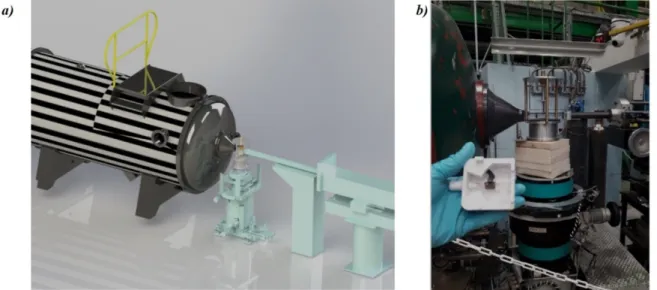
In this talk, we report on an original setup which allows to measure simultaneously in-situ SANS and NMR using a low-field spectrometer[1]. We illustrate the capabilities of alliancing these experimental methods by
following the critical temperature-induced phase separation of a concentrated Poly(Methacrylic Acid) (PMAA) solution at its Lower Critical Solution Temperature (LCST). The characteristic size related to the domain growth of the polymer-rich phase of the gel is monitored by the evolution of the SANS spectra, while the dynamics of the sol phase (H2O and polymer) is simultaneously characterized by NMR by
measuring T1, T2 and the diffusion coefficient. A specific cell was carefully deisigned to optimize thermalization of the sample and in particular its equilibration time. The acquisition time needed to reach good signal-to-noise ratios, for both NMR and SANS, match: it is of the order of one hour. Altogether, we show that in-situ low-field NMR/SANS coupling the NMR is meaningful and is a promising experimental approach. Such multimodal approach is of major interest when a sample experiences transient physical states or evolves rapidly and/or irreversibly.
Figure 1 : a) 3D model of the implementation of a low field NMR spectrometer on the LLB SANS instrument PAXY – the one-sided NMR magnet is seen in the middle of the drawing between the neutron guide (in turquoise blue)and the neutron detector box (zebra) (courtesy P. Lavie). b) Real picture of the central part and the NMR-Neutron probehead.
[1] R. de Oliveira-Silva, A. Bélime, C. Le Coeur, A. Chennevière, A. Helary, F. Cousin, P. Judeinstein, D. Sakellariou, J.-M. Zanotti,