HAL Id: cea-02289470
https://hal-cea.archives-ouvertes.fr/cea-02289470
Submitted on 16 Sep 2019
HAL is a multi-disciplinary open access
archive for the deposit and dissemination of
sci-entific research documents, whether they are
pub-lished or not. The documents may come from
teaching and research institutions in France or
abroad, or from public or private research centers.
L’archive ouverte pluridisciplinaire HAL, est
destinée au dépôt et à la diffusion de documents
scientifiques de niveau recherche, publiés ou non,
émanant des établissements d’enseignement et de
recherche français ou étrangers, des laboratoires
publics ou privés.
Heritability of the language network using resting state
fMRI data
Yasmina Mekki, Cathy Philippe, Vincent Guillemot, Hervé Lemaître, Vincent
Frouin
To cite this version:
Yasmina Mekki, Cathy Philippe, Vincent Guillemot, Hervé Lemaître, Vincent Frouin. Heritability of
the language network using resting state fMRI data. COGNOMICS Conference 2019: Bridging Gaps,
Sep 2019, Nijmegen, Netherlands. �cea-02289470�
Heritability of the language network using
resting state fMRI data
Yasmina Mekki
1,B
, Cathy Philippe
1
, Vincent Guillemot
2
, Herv´e Lemaitre
3,4
and
Vincent Frouin
1
1Neurospin, Institut Joliot, CEA - Universit´e Paris-Saclay, 91191 Gif-Sur-Yvette, France 2Pasteur Institute, Bioinformatics and Biostatistics Hub, C3BI, USR 3756 IP CNRS, Paris, France
3Institut National de la Sant´e et de la Recherche M´edicale, INSERM Unit Neuroimaging and Psychiatry, Facult´e de m´edecine Universit´e Paris-Sud Le Kremlin-Bicˆetre France 4Universit´e Paris Descartes, Sorbonne Paris Cit´e Paris France
Abstract
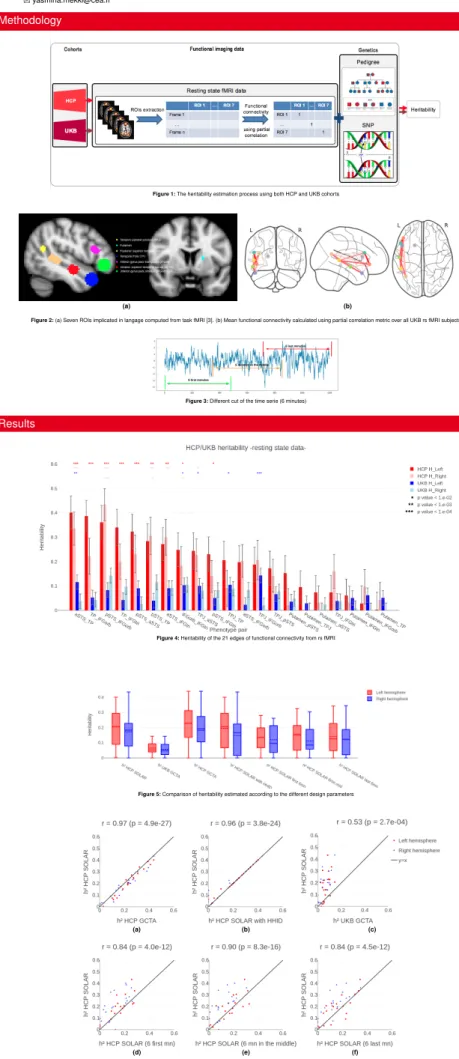
Language is a singularity of the human species. Part of the genes that are associated with brain capabilities are expected to underlie the human language faculty. Estimation of the part of variance attributable to genetic variation across subjects in functional brain imaging within the regions of the language, provide us a quantification of the genetic influence, called heritability. UK Biobank (UKB) with 19,336 subjects as well as Human Connectome Project (HCP) with 1113 subjects are used for that purpose. The present work consists in estimating the heritability of the language network (LN), by using resting state fMRI connectivity computed with regions of interest (ROI) extracted from task based fMRI. Significant heritabilities were observed (UKB: h2=10%
-14% HCP: h2=22% - 43%). The heritability h2obtained from different population studies are
highly variable. The substancial differences between the two cohorts are studied and discussed here. Despite these differences, it seems that the brain organization supporting language in human is under genetic influence.
Introduction
I
Functional MR imaging (fMRI) is recognized to produce valuable phenotypes
to study the genetic roots of the human brain organization underlying
lan-guage. Two specific settings are classically used to acquire such
pheno-types:
ILanguage specific task-based fMRI produces individual activations in language ROIs that are considered as phenotypes, but
IResting state fMRI (rsfMRI) can be a valid alternative to produce functional connectivity
which assess how signal co-vary between language ROIs [1].
I
In this work, the heritability studies utilize the co-activation of specific ROIs
using resting state fMRI data as language phenotype.
I
Two different kind of cohorts were used:
IHCP composed of related subjects (twins and siblings).
IUKB composed of non related subjects.
I
A gap of heritability estimation between differently designed cohorts has
been reported in [2].
I
This study aims to:
IEstimate the heritability of a specific language network.
IBring some clarification to the origin of the observed h2gap by studying the different
design parameters :
IThe length of the time series.
IPedigrees vs genotyped SNPs.
IThe subjects relatedness : Model the shared environment between subjects using the household information (HHID)
Materials and Methods
UK Biobank (UKB)I19.336 participants underwent a rsfMRI experiment. IDuration = 6 min, TR = 0.735s ! 490 time points.
IQC on genetic data, excluding thus, subjects with unusual heterozygosity, high missingness, sex mismatches. Only subject identified as belonging to the British ancestry were kept. IAge range: 40-70 years old, N = 18.851, F: 8.918, M: 9.933.
Human Connectome Project (HCP)
I1.113 participants underwent a rsfMRI experiment. 143 monozygotic, 85 dizygotic verified twins and family members.
ITwo sessions of 2 runs each. Duration = 14:33 min, TR = 720 ms ! 1.200 time points per run.
IQC on genetic data, updating thus, the zygosity measures self reported by twins. Only subject whom performed the 4 runs & identified as Caucasian were kept.
IAge range: 22-37 years old, N = 739, F: 606, M: 507.
Phenotypes
ISeven ROIs identified by [3] from task fMRI experiments were used. See Fig 2a. IAverage signal was extracted from the ROI at each time frame.
IFunctional connectivity was computed between each pair using partial correlation ! 21 edges strength. See Fig 2b.
Heritability
IDepending on the genetic data available, two ways are considered to estimate the kinship matrix using:
IGCTA (Genome wide complex trait analysis) [4] on genotyped SNPs ! HCP and UKB.
ISOLAR (Sequential Oligogenic Linkage Analysis Routines) [5] on pedigrees ! HCP. ICovariates (UKB): sex, genotype array type, age, age2, sex*age, sex*age2and the 10 first
genetic principal components for population structure. ICovariates (HCP): sex, age, age2, sex*age, sex*age2and ethnicity.
IMultiple test corrected with Bonferroni correction.
Discussion
I
Higher heritability estimations in HCP compared to UKB. See Fig 4 & 6c.
ILength of the time series: the h2obtained after cutting the time series length (See Fig 3)
reduce the gap. See Fig 5, 6d, 6e, 6f.
IIn HCP, h2computed on genotyped SNPs are slightly higher than those obtained with
pedigrees. See Fig 6a.
ITaking into account the household effect does not substantially impact the heritability esti-mates. See Fig 6b.
I
It is noteworthy that:
IHeritabilities have different estimates on both left and right hemispheres but behave simi-larly when varying the values of the studied parameters.
IThe pattern of heritability across the phenotypes remains consistent between the two co-horts.
IResults are consistent with those obtained by [6] using surface area and cortical thickness as phenotypes.
Conclusion
I
Different parameters have a substantial impact on heritability estimates; the
method used, the length of the time series analysed and the environmental
effect.
I
The household information does not capture well the environmental impact.
IThe results suggest some genetic influence on the phenotypes we chosen
which indicates that the human language brain organization is under relatively
strong genetic control.
References
1. Cole M. et al. “Smith S. et al. Activity flow over resting-state networks shapes cognitive task activations”. In: Nat neuroscience 19.12 (2016), p. 1718. 2. Young A. “Solving the missing heritability problem”. In: PLoS Genet 15.6 (2019).
3. Pallier C. et al. “Cortical representation of the constituent structure of sentences”. In: PNAS 108.6 (2011), pp. 2522–2527. 4. Yang J. et al. “GCTA: a tool for genome-wide complex trait analysis”. In: The American Journal of Human Genetics 88.1 (2011), pp. 76–82. 5. Almasy L. and Blangero J. “Multipoint quantitative-trait linkage analysis in general pedigrees”. In: The American Journal of Human Genetics 62.5 (1998),
pp. 1198–1211.
6. Le Guen Y. et al. “Heritability of surface area and cortical thickness: a comparison between the Human Connectome Project and the UK Biobank dataset”. In: ISBI (2019).
Methodology
Figure 1: The heritability estimation process using both HCP and UKB cohorts
(a) (b)
Figure 2: (a) Seven ROIs implicated in langage computed from task fMRI [3]. (b) Mean functional connectivity calculated using partial correlation metric over all UKB rs fMRI subjects
Figure 3: Different cut of the time serie (6 minutes)
Results
Figure 4: Heritability of the 21 edges of functional connectivity from rs fMRI
Figure 5: Comparison of heritability estimated according to the different design parameters
(a) (b) (c)
(d) (e) (f)
Figure 6: Comparison between heritability obtained with SOLAR on HCP (concatenation of the 4 runs) and the ones obtained with : (a) GCTA on HCP, (b) SOLAR on HCP taking into account the shared
environment, (c) GCTA on UKB, (d) SOLAR on HCP (6 first minutes of the signal), (e) SOLAR on HCP (6 minutes in the middle of the signal), (f) SOLAR on HCP (6 last minutes of the signal))
* *****