HAL Id: hal-01362520
https://hal.archives-ouvertes.fr/hal-01362520
Submitted on 9 Sep 2016HAL is a multi-disciplinary open access archive for the deposit and dissemination of sci-entific research documents, whether they are pub-lished or not. The documents may come from teaching and research institutions in France or abroad, or from public or private research centers.
L’archive ouverte pluridisciplinaire HAL, est destinée au dépôt et à la diffusion de documents scientifiques de niveau recherche, publiés ou non, émanant des établissements d’enseignement et de recherche français ou étrangers, des laboratoires publics ou privés.
Gérald Rocher, Jean-Yves Tigli
To cite this version:
Gérald Rocher, Jean-Yves Tigli. Semantic-based web services for devices selection. [Research Report] Laboratoire I3S / UNS. 2015. �hal-01362520�
Laboratoire d'Informatique, Signaux et Systèmes de Sophia-Antipolis (I3S) - UMR7271 - UNS CNRS 2000, route des Lucioles - Les Algorithmes - bât. Euclide B 06900 Sophia Antipolis - France http://www.i3s.unice.fr
LABORATOIRE
INFORMATIQUE, SIGNAUX ET SYSTÈMES DE SOPHIA ANTIPOLIS UMR7271
SEMANTIC-BASED
WEB SERVICES FOR DEVICES
SELECTION
Gérald Rocher, Jean-Yves Tigli
EQUIPE SPARKSRapport de Recherche
2
WEB SERVICES FOR DEVICES
SELECTION
Gérald Rocher1, Jean-Yves Tigli2
Equipe SPARKS 09-2015 - 73 pages
Abstract:
The last decade achievements in computer hardware miniaturization and power consumption reduction has permitted the multiplication of connected devices integrated in everyday life physical objects (chair, table, lamp, etc…) and physical environments (house, building, vehicle, etc…). These devices implement resources interacting with objects (actuator) and/or gathering data (sensor) about themselves, the objects or the environment. Access to these resources is achieved through services exposing their interfaces and allowing communication with the digital world. Widely deployed in so called ambient environments, these devices and services are selected by ambient applications (service matchmaking) that make them work in concert to assist users in several distinct domains (healthcare, smart houses, etc…). This cooperation requires a strong interoperability between devices, firstly achieved by allowing them to communicate. Although work on communication protocols (IoT, Internet of Things) tries to provide a solution to the technological heterogeneity issue, it is still challenging due to the large number of initiatives in this field. Among all the possible solutions, web-services based approach (WoT, Web of Things) is now widely accepted.
With this hypothesis, and going a step further, the purpose of the present document is to address the semantic heterogeneity issue inherent to the large number of heterogeneous devices and services present in the environment targeting multiple domains (smart homes, smart cities, building automation, healthcare, etc…). This heterogeneity is problematic for ambient applications to select, among all the available devices and services, the most relevant ones. We investigate in this document how semantic web technologies can be leveraged to enrich devices and services with semantic annotations used to qualify it (SWoT, Semantic Web of Things) and help applications selection mechanism to increase the relevancy of the selected devices and services.
Key-words: internet of things, semantic web of things
1Laboratoire I3S – Université Nice Sophia Antipolis – [email protected]
Introduction... 8
1.1 Motivations ... 8
1.2 Context ... 8
1.3 Structure of the document... 8
2. Knowledge Modeling ... 10
2.1 Introduction ... 10
2.2 Semantic Web Knowledge Modeling Technologies in a Nutshell... 11
2.2.1 Triples and URIs ... 11
2.2.2 RDF ... 12
2.2.3 RDFS ... 13
2.2.4 OWL Family ... 14
2.2.5 Knowledge modeling language compatibility ... 16
2.2.6 Summary: The Modeling Layers... 17
2.3 What knowledge in the context of ambient environments? ... 18
2.4 Which Meta Meta Model to Use?... 18
2.5 The Open World Assumption... 20
2.6 Ontology Modeling Approaches... 21
2.6.1 Global Ontology (GO) Approach ... 21
2.6.2 Multiple Local Ontology Approach (MLO) ... 22
2.6.3 Hybrid Approach ... 23
2.6.4 Fragmented Hybrid (FH) Approach... 23
2.7 Conclusion ... 24
2.8 References ... 25
3. Knowledge Extraction... 26
3.1 Introduction ... 26
3.2 From Knowledge to Annotations... 26
3.2.1 Extraction From Upper Ontologies ... 26
3.2.2 Extraction From Web Pages ... 27
3.3 Web Services Standards Used to Convey the Knowledge ... 28
3.3.1 Web Services Description Languages... 28
3.4 Conclusion ... 30 3.5 References ... 31 4. Knowledge Integration ... 33 4.1 Introduction ... 33 4.2 Knowledge Base ... 34 4.3 Reasoning ... 35
4.3.1 Knowledge Base Interpretation ... 35
4.3.2 Reasoning Tasks ... 35
4.3.3 ∑ Saturation & Inference Rules... 36
4.3.4 Reasoning Over Linked Vocabulary ... 37
4.4 Ambient Systems Dynamicity and Impacts on the Knowledge Integration ... 37
4.4.1 Role Assertion Level Dynamicity ... 38
4.4.2 Concept Assertion Level Dynamicity ... 38
4.4.3 GCI Level Dynamicity ... 39
4.5 Heterogeneous GCI Integration Issues... 40
4.5.1 Ontology Merging & Integration ... 40
4.5.2 Ontology Alignment and Mapping ... 40
4.5.3 All Together ... 41
4.6 The Semantic Heterogeneity is Good! ... 41
4.7 Knowledge integration model ... 42
4.8 Experimentations ... 44
4.8.1 Use-case#1 : A New Environment Exploration ... 44
4.8.2 Use-case#2 : Search For Energy-Efficient Devices... 44
4.8.3 Experimentations Setup ... 44
4.8.4 Results... 45
4
4.10 References ... 48
5. Knowledge Management ... 50
5.1 Introduction ... 50
5.2 GCI Size Containment ... 50
5.3 GCI Quality Over Time... 51
5.3.1 Incoherencies and Inconsistencies Management ... 51
5.3.2 Validity ... 52 5.4 Conclusion ... 52 5.5 References ... 53 6. Knowledge Retrieval ... 54 6.1 Introduction ... 54 6.2 SPARQL ... 54
6.3 Selection Rule Model Proposal ... 56
6.3.1 Selection Rule Semantic Heterogeneity Management... 57
6.3.2 From Subgraphs Matching to Ontology Similarity Measurement ... 57
6.3.3 Selection Rule Answers Ranking ... 58
6.3.4 Selection Rule Expressivity vs Knowledge Base Content Evolution ... 59
6.4 Use-case ... 60
6.4.1 Selection Rule Definition at Design Time ... 60
6.4.2 Selection Rule Alignment with Knowledge Base at Run Time... 60
6.4.3 Selection Rule Enrichment with New GCI at Run Time ... 60
6.4.4 Selection Rule ⇔ Knowledge Base Similarity Measurement ... 61
6.4.5 Selection Rule Answers Extraction and Ranking ... 61
6.5 Conclusion ... 63
6.6 References ... 64
7. Conclusion and Future Work ... 65
7.1 Summary ... 65
7.2 Future work ... 66
8. Bibliography ... 68
9. Annexes ... 69
9.1 Sub-Ontology Extraction Tool ... 69
9.1.1 Introduction ... 69
9.1.2 Gathering Ontology from the Web ... 69
9.1.3 Extracting Sub-Ontology ... 69
9.1.4 Measuring the Similarity Between Ontologies ... 73
9.1.5 SPARQL Endpoint ... 74
9.1.6 Conclusion ... 74
Figure 1 : IoT : Technological & Semantic heterogeneity1 ... 9
Figure 2 : The Semantic Web stack ... 11
Figure 3 : Simple RDF graph example ... 12
Figure 4 : Structuring RDF graph ... 13
Figure 5 : A small RDFS knowledge description model ... 13
Figure 6 : Knowledge modeling abstraction layers... 17
Figure 7 : Ambient environment knowledge types... 18
Figure 8 : OWL family DL correspondance ... 20
Figure 9 : IoT 2003 - 2020 projection1 ... 21
Figure 10 : IoT companies and device manufacturers ... 22
Figure 11 : Ontology modeling, the GO approach ... 22
Figure 12 : Ontology modeling, the MLO approach ... 23
Figure 13 : Ontology modeling, the hybrid approach ... 23
Figure 14 : Ontology modeling, the FH approach ... 24
Figure 15 : MLO-LD approach ... 28
Figure 16 : WS-* SWS approaches... 29
Figure 17 : MLO + Top down services description approach ... 29
Figure 18 : MLO + Bottom up services description approach ... 29
Figure 19 : Mobile ambient system ... 38
Figure 20 : Fixed ambient system ... 38
Figure 21 : The role assertion level dynamicity ... 38
Figure 22 : The concept assertion level dynamicity ... 39
Figure 23 : The terminological knowledge ... 39
Figure 24 : Ontology Merging & Integration ... 40
Figure 25 : Ontology alignment and mapping ... 40
Figure 26 : GCI Integration process over time ... 41
Figure 27 : Knowledge integration model ... 42
Figure 28 : ABox integration process over time ... 43
Figure 29 : ABox integration ... 43
Figure 30 : Knowledge model management approaches expected performances ... 43
Figure 31 : Elederly people displacement scheme ... 44
Figure 32 : Elederly people displacement scheme ... 44
Figure 33 : Use-case#1 local ontologies (potentially incomplete)... 45
Figure 34 : Use case#1 execution results ... 46
Figure 35 : Android tablet simple ontology ... 47
Figure 36 : Hifi simple ontology ... 47
Figure 37 : Ontology exemple : E concept removal ... 51
Figure 38 : Ontology incoherency and inconsistency examples ... 51
Figure 39 : SPARQL query RDF subgraph matching ... 55
Figure 40 : Proposed rule model ... 56
Figure 41 : SPARQL query based rule model... 56
Figure 42 : Selection Rule GCI alignment with knowledge base GCI ... 57
Figure 43 : Selection rule enrichment over time ... 59
Figure 44 : Selection rule defined at design time ... 60
Figure 45 : Knowledge base at t+n ... 60
Figure 46 : Selection rule aligned with knowledge base content... 60
Figure 47 : Basic TV ontology brought by a newly discovered device ... 61
Figure 48 : Basic TV ontology is merged with the selection rule ... 61
Figure 49 : Knowledge base extracted sub-ontology from selection rule... 62
Figure 50 : Sub-ontology defining the concept TV and its instance(s) ... 62
Figure 51 : From IoT to SWOT+ ... 66
Figure 52 : From functional composition to semantic composition ... 67
Figure 53 : Gathering ontology from the web... 69
Figure 54 : Selection of the concept to be extracted in a sub-ontology (1)... 69
Figure 55 : Ontology vizualization with WebVOWL ... 70
Figure 56 : Selection of the concept to be extracted in a sub-ontology (2)... 70
6
Figure 58 : LOV vocabulary selection ... 71
Figure 59 : Alignment algorithm and threshold value selection ... 71
Figure 60 : Snake sub-ontology aligned with LOV vocabulary ... 71
Figure 61 : Alignment with WordNet synonyms ... 72
Figure 62 : Snake ontology aligned with WordNet synonyms ... 72
Figure 63 : Transistive inferences added to the sub-ontology ... 72
Figure 64 : Sub-ontology knowledge coverage by depth ... 73
Figure 65 : Sub-ontology knowledge coverage by probability ... 73
Figure 66 : Sub-ontology consistency checking ... 73
Figure 67 : Sub-ontology generation... 73
Table 1 : DLs family main constructors ... 19
Table 2 : OWL family expressivity vs computing complexity comparison ... 20
Table 3 : Knowledge base ABox, TBox and RBox axioms ... 34
Table 4 : ALC constructors... 35
Table 5 : State of the art reasoners comparison [10] ... 37
Table 6 : Instances ranking with regards to the selection rule... 62
Publications
[1] G.Rocher, J.Y. Tigli, Stephane Lavirotte, Rahma Daikhi. Run-Time knowledge model enrichment in SWoT: A step toward ambient services selection relevancy. 2015 IoT international conference, Seoul. [2] … and more to come
1.1 Motivations
The last decade achievements in computer hardware miniaturization and power consumption reduction has permitted the multiplication of connected devices integrated in everyday life physical objects (chair, table, lamp, etc…) and physical environments (house, building, vehicle, etc…). These devices implement resources interacting with objects (actuator) and/or gathering data (sensor) about themselves, the objects or the environment [1]. Access to these resources is achieved through services exposing their interfaces and allowing communication with the digital world. Widely deployed in so called ambient environments [2], these devices and services are selected by ambient applications (service matchmaking) that make them work in concert to assist users in several distinct domains (healthcare, smart houses, etc…). This cooperation requires a strong
interoperability between devices, firstly achieved by allowing them to communicate. Although work on communication protocols (IoT, Internet of Things) tries to provide a solution to the technological heterogeneity issue, it is still challenging due to the large number of initiatives in this field [3]. Among all the possible solutions, web-services based approach (WoT, Web of Things) is now widely accepted [4].
With this hypothesis, and going a step further, the purpose of the present document is to address the
semantic heterogeneity issue inherent to the large number of heterogeneous devices and services present in the environment targeting multiple domains (smart homes, smart cities, building automation, healthcare, etc…)(Figure 1). This heterogeneity is problematic for ambient applications to select, among all the available devices and services, the most relevant ones. We investigate in this document how semantic web technologies can be leveraged to enrich devices and services with semantic annotations used to qualify it (SWoT, Semantic Web of Things) and help applications selection mechanism to increase the relevancy of the selected devices and services.
1.2 Context
The CONTINUUM1 project addresses the problem of the service continuity in the context of ambient
environments. It aims at defining theoretical models needed to enable software’s to dynamically adapt themselves to their environment and ensure the service continuity to mobile users in heterogeneous and physical environments where available resources are variable over time. Three challenges have been identified: (1) the management and adaptation to the context, (2) the management of the semantic heterogeneity and (3) the control of the balance in between the system autonomy and the human control. This project has resulted so far in the development of a middleware (WComp)[5] based on component and services assembly [6] giving the software’s the capability to adapt themselves to the multiple context aspects (device interconnection, physical environment state, users, etc…) thereby ensuring service continuity. This document represents a straight continuation of this project and addresses the semantic heterogeneity challenge.
1.3 Structure of the
document
In chapter 2 (Knowledge Modeling), we review the main technologies used in the domain of the semantic web to formally describe the knowledge (Paragraph 2.2). We describe the underlying theoretical foundations of these technologies and address it from two points of views: (1) The knowledge expressivity they provide, (2) their computational complexity. Then, we give an overview of the knowledge types to be described in the context of ambient environments (Paragraph. 2.3) and propose a knowledge modeling approach based on heterogeneous devices and services description models (Paragraph. 2.6).
In chapter 3 (Knowledge Extraction), we address the challenge of developing knowledge models and propose some approaches aimed at leveraging the world wide web available formal knowledge and translating it to reusable knowledge models (Paragraph. 3.2). Then we review several standards used to convey the knowledge from the devices to the ambient systems and challenge them with regards to their ability at conveying all the necessary knowledge types to be described (Paragraph. 3.3).
In chapter 4 (Knowledge Integration), we first describe the knowledge base foundations (Paragraph. 4.2) and reasoning capabilities (Paragraph. 4.3). We review: (1) the challenges at dynamically integrating
9
heterogeneous knowledge models in a knowledge base over time (enrichment), (2) the approaches helping to cope with it (Paragraph 4.5) and (3) explain (Paragraph 4.6) the main advantages of having a continuous
1Project for service continuity in ubiquitous and mobile computing - French national research agency - ANR-08-VERS-0005.
knowledge enrichment. We then present an overall integration model (Paragraph. 4.7) and validate it on two motivating scenarios (Paragraph. 4.8).
In chapter 5 (Knowledge Management), we review some knowledge base management solutions aimed at: (1) limiting the size of the knowledge base over time (Paragraph. 5.2), and (2) ensuring the quality of the knowledge base content (consistency, coherency and validity)(Paragraph. 5.3).
In chapter 6 (Knowledge Extraction), we give an overview of SPARQL (Paragraph. 6.2), the standard for querying and retrieving information from a knowledge base, and its foundations. We demonstrate that the SPARQL underlying knowledge retrieval model is not suitable when used to execute expressive selection rules on unknown knowledge base content. Therefore, we propose an alternative (Paragraph. 6.3) that is validated on a use-case (Paragraph. 6.4).
The chapter 7 (Conclusion and Future Work) finally concludes this document with a short summary and provide an outlook on the potential future work.
1Internet of Things Architecture - IoT-A
Figure 1 : IoT : Technological & Semantic heterogeneity1
Application domains
Semantic heterogeneity
Communication protocols
Technological heterogeneity
2 .1 Introduction ... 1 0 2 .2 Semantic Web Knowledge Modeling Technologies in a Nutshell ... 1 1
2.2.1 Triples and URIs ... 11
2.2.2 RDF ... 12
2.2.3 RDFS ... 13
2.2.4 OWL Family ... 14
2.2.5 Knowledge modeling language compatibility ... 16
2.2.6 Summary : The Modeling Layers ... 17
2 .3 What knowledge in the context of ambient environments?... 1 8 2 .4 Which Meta Meta Model to Use? ... 1 8 2 .5 The Open World Assumption ... 2 0 2 .6 Ontology Modeling Approaches ... 2 1 2.6.1 Global Ontology (GO) Approach... 21
2.6.2 Multiple Local Ontology Approach (MLO) ... 22
2.6.3 Hybrid Approach ... 23
2.6.4 Fragmented Hybrid (FH) Approach ... 23 2 .7 Conclusion ... 2 4 2 .8 References ... 2 5
2.1 Introduction
In ambient systems, software applications have to makedecisions about devices and services to be used in concert to assist users. “Make a decision” is a behavior related to intelligence whose foundation is knowledge
[1]. In the context of ambient software applications, this intelligent behavior has to be achieved autonomously
by computational means. Indeed, the physical environment the ambient applications interact with is highly dynamic and devices and services availability cannot be anticipated. This concern is well addressed by artificial intelligence (AI) systems based on knowledge representation models and reasoning techniques. Knowledge representation models are based on formal symbols used to represent a set of propositions (concepts, relationships between concepts, etc…) believed by the knowledge model designer. Reasoning is the formal manipulation of the symbols to infer the representation of a new set of propositions.
As devices communication protocol relies on web-services (WoT, Web of Things), we first investigate in this chapter, what are the technologies used by the Web community to represent and reason on the knowledge available on the web (Semantic Web). Such technologies are, for example, used by web search engines to retrieve and rank the most relevant web information based on user needs or preferences from metadata used to qualify web pages content. The problem statement the semantic web technologies help to solve, is close to the problem of selecting, among all the devices and services available in the environment, the mo st relevant ones to assist users based on their needs, preferences, etc… This has already been well understood and addressed by the WoT community and semanticallyenriched metadata are now widely used to qualify devices and services (SWoT, Semantic Web of Things).
However, in most of the current work, metadata relies on ad-hoc knowledge representation models structuring all the concepts and relationships for a specific domain targeting specific applications (smart homes, smart cities, building automation, healthcare, etc…). Thus, extending the scope of use of the information to multiple applicative domains implies to develop a comprehensive knowledge representation model from heterogeneous knowledge representation models which is unlikely to happen in the SWoT context where domains to cover are countless. In addition, most of the existing domain knowledge description models doesn’t follow the semantic web best practices1, limiting, de facto, the reusability of their information outside
their initial scope [2].
Then, after having reviewed the several knowledge representation modeling approaches and, after having defined the knowledge to be represented in the context of ambient systems, we propose an approach based on heterogeneous knowledge representation models to qualify and self-describe devices and services through semantically enriched metadata. Unlike current approaches, knowledge description models are restricted to the devices they describe and are embedded in the metadata.
11
2.2 Semantic Web Knowledge Modeling Technologies in a Nutshell
The term “Semantic Web” represents an evolution of the world wide web from a web of interlinked documents targeted towards human consumers to a web of data that makes web content more machine processable (aka Web 3.0).
“I have a dream for the Web [in which computers] become capable of analyzing all the data on the Web —
the content, links, and transactions between people and computers. A “Semantic Web”, which should make this possible, has yet to emerge, but when it does, the day-to-day mechanisms of trade, bureaucracy and our daily lives will be handled by machines talking to machines. The “intelligent agents” people have touted for ages will finally materialize.”
— Tim Berners-Lee, Weaving the Web [3] Semantic web technologies are summarized in the “Semantic Web Stack” (Figure 2). There are many good introductory documents available on the semantic web and associated technologies. The reader interested in acquiring a more detailed knowledge in this area will read the following documents: “Semantic Web for the Working Ontologist” [4], “A Semantic Web Primer” [5], “Programming the Semantic Web” [6], etc…
Semantic modeling is the process of interpreting the world (or specific domains of interest) by asserting statements about the world, in other words, enouncing constraints on the possible world states. For that purpose, the interesting technologies in the Semantic web stack are (1) triples and URI (Uniform Resource Identifier), (2) RDF (Resource Description Framework) and RDFS (RDF-Schema), (3) OWL (Web Ontology Language), succinctly described in the next paragraphs.
Each language brings different expressivity capabilities (different abilities to describe the world and express statements about it). The higher is the expressivity the lower is the abstraction of the described world and better could be the relevancy of the selected services.
2.2.1 Triples and URIs
A triple describes a proposition (a fact, a statement) composed of a subject, a predicate and an object. For example the triple “iQ700 hasManufacturer Siemens” is a proposition stating that iQ700 entity is manufactured by Siemens. The predicate, in that case, defines a relationship between the subject and the object (the term “Semantics” refers to this simple data model linking together two entities by a relationship). Subject and predicate may also be referred to as property and value respectively. For example the triple “iQ700 hasTemperature 125” is a proposition stating that the entity property “hasTemperature” has value “125”.
A triple provides an explicit semantics based on agreed terms. The terms used in the propositions (subject, predicate, object, property, value type) have to be unambiguously defined. For that purpose URIs (Uniform Resource Identifier) [8] are used to uniquely identify each term of a proposition. For example, the statement “iQ700 hasManufacturer Siemens” can then be rewritten as follow:
<http://www.example.org/iQ700><http://www.example.org/hasManufacturer><http://www.example. org/Siemens>
Therefore, from a semantic standpoint, the terms <http://www.example.org/iQ700> and <http://www.my-ontology.com/iQ700> a re two dif f e re nt reso urces.
<http://www.example.org/> and <http://www.my-ontology.com/> are the URI prefix.
12
2.2.2 RDF
The stack above triples and URI is the Resource Description Framework (RDF). RDF is a graph model used to describe web resources. The graph is a set of triples where subject and object are nodes of the graph, and the predicate is a directed edge describing the relationship between nodes (Figure 3). All nodes and edges are defined by URIs except when the edge defines is a property in which case the object is a literal value (plain or typed). RDF introduces a mechanism to make URIs more readable by aliasing URI prefix with an RDF prefix namespace (For example “rdf” for <http://www.w3.org/1999/02/22-rdf-syntax-ns#>).
While graph representation is good for humans understanding, it is not adequate for machines to process the information it describes. For that reason RDF graph statements are serialized to an XML-based syntax document (RDF/XMLformat). Note that several other serialization formats exist, among which the most used are Turtle (Terse RDF Triple Language) and N3 (N-Triple). In this document, all listings use the
abbreviated RDF/XML notation.
An RDF/XML document is represented by the tag rdf:RDF. The content of the document is a set of descriptions represented by the tag rdf:Description. Each description is a statement about a resource defined either by attribute rdf:ID or rdf:about. In a general form, the triple <subject,predicate,object> can be serialized in the XML/RDF form as follow:
<rdf:Description rdf:about="subject"> <ex:predicate>
<rdf:Description rdf:about="object"/> </ex:predicate>
</rdf:Description>
Therefore, the graph in Figure 3 can be serialized in RDF/XML format as follow:
<?xml version="1.0"?> <rdf:RDF xmlns:rdf=”http://www.w3.org/1999/02/22-rdf-syntax-ns#” xmlns:ex=”http://www.example.org#”> <rdf:Description rdf:about=”http://www.example.org/iQ700”> <ex:hasManufacturer rdf:about=http://www.example.org/Siemens”/> </rdf:Description> </rdf:RDF>
RDF introduces a small vocabulary to express statements about the knowledge. For example, rdf:type expresses membership hierarchy used to structure the graph. Hence, the graph in Figure 3 can, for example, be structured as shown in Figure 4 (considering two additional statements).
Beside rdf:type, RDF defines a vocabulary to write collections (rdf:first, rdf:rest, rdf:nil, rdf:List), describe structured values (rdf:value) or containers of values (rdf:Seq, rdf:Bag, rdf:Alt,etc…) without making any strong restriction/conditions on it.
RDF also introduces a reification mechanism used to make statements about other statements by turning statements into resources. In the general form the triple <subject,predicate,object> can be reified
under the resource “StatementAboutStatement” as follow: http://www.example.org/iQ700
http://www.example.org/Siemens http://www.example.org/hasManufacturer
13 <rdf:Statement rdf:ID="StatementAboutStatement"> <rdf:subject rdf:resource="subject"/> <rdf:predicate rdf:resource="predicate"/> <rdf:object rdf:resource=”object”/> </rdf:Statement>
RDF is a universal generic language not suited to define semantics for any particular application domain. For that purpose, RDFS (RDF-Schema), the next layer in the Semantic stack on top of RDF, has to be used.
2.2.3 RDFS
RDFS extends RDF vocabulary and introduces basic elements (class, class hierarchy, inheritance, properties and properties hierarchy), helping the knowledge description model designer to describe and classify the concepts, the entities and the relationships of a specificapplicationdomain. This extended vocabulary actually allows designer to add semantic constraints linked to a particular application domain. The knowledge description model of a specific domain is called an ontology.
By introducing the notion of class, RDFS also introduces the notion of instances (or individuals) of a class. The relationship between class and its instance(s) is done through rdf:type. For instance, a simple ontology is depicted in Figure 5.
By inheritance, ex:Siemens and ex:iQ700 are also respectively an ex:Company and an ex:Appliance. Additionally, RDFS introduces some mechanisms to define a signature of a relationship restraining its scope of application (note that relationships and properties as defined in Paragraph. 2.2.1 are both described using rdf:Property). For example, the description of the relationship ex:hasManufacturer can be described as follow:
Figure 4 : Structuring RDF graph
ex:iQ700 ex:Siemens ex:hasManufacturer ex:Oven rdf:type rdf:type ex:Manufacturer ex:Company rdf:type Classes Instances of classes
Figure 5 : A small RDFS knowledge description model ex:hasManufacturer rdfs:subClassOf rdf:type ex:Appliance ex:Manufacturer ex:Oven ex:iQ700 rdfs:subClassOf ex:Siemens “2”^^xsd:integer ex:hasRacks
14
<rdf:Property rdf:ID="http://www.example.org/hasManufacturer"> <rdfs:domain rdf:resource="http://www.example.org/Appliance"/> <rdfs:range rdf:resource="http://www.example.org/Manufacturer"/> </rdf:Property>
The whole ontology depicted in Figure 5 is defined here after using RDFS :
<?xml version="1.0"?> <!DOCTYPE rdf:RDF [ <!ENTITY xsd "http://www.w3.org/2001/XMLSchema#"> ]> <rdf:RDF xmlns:xsd=”&xsd;” xmlns:rdf=”http://www.w3.org/1999/02/22-rdf-syntax-ns#” xmlns:rdfs=”http://www.w3.org/2000/01/rdf-schema#”> <rdfs:Class rdf:ID=”Appliance”/> <rdfs:Class rdf:ID=”Company”/> <rdfs:Class rdf:ID=”Oven”> <rdfs:subClassOf rdf:resource=”#Appliance”/> <rdfs:Class> <rdfs:Class rdf:ID=”Manufacturer”> <rdfs:subClassOf rdf:resource=”#Company”/> <rdfs:Class> <rdf:Property rdf:ID=”hasManufacturer"> <rdfs:domain rdf:resource="#Appliance"/> <rdfs:range rdf:resource="#Manufacturer"/> </rdf:Property> <rdf:Property rdf:ID=”hasRacks"> <rdfs:domain rdf:resource="#Oven"/> <rdfs:range rdf:resource="&xsd;integer"/> </rdf:Property> <rdf:Description rdf:about=”#Siemens”> <rdf:type rdf:resource=”#Manufacturer”/> </rdf:Description> <rdf:Description rdf:about=”#iQ700”> <rdf:type rdf:resource=”#Oven”/> <hasManufacturer rdf:resource=”#Siemens”/> <hasRacks rdf:datatype=”&xsd;integer”>2</hasRacks> </rdf:Description> </rdf:RDF> 2.2.4 OWL Family
On top of RDF and RDFS in the Semantic web stack, OWL (Web Ontology Language) brings much more expressivity for describing classes, properties and relationships by relying on and extending RDF fact-stating ability and RDFS class and property structuring capabilities. It allows the designer to specify a class as logical combinations of other classes (owl:intersectionOf, owl:unionOf, etc…) or to express disjointure between classes (owl:disjointWith). Additional class axioms can also be used to define equality between classes (owl:equivalentClass and owl:sameAs).
OWL extends rdf:Property semantics with owl:datatypeProperty, owl:ObjectProperty, etc… Some restrictions can be defined on the property values (owl:allValuesFrom, owl:someValuesFrom, owl:maxCardinality, etc…). Finally OWL adds some properties characterization mechanisms like symmetry (owl:SymetricProperty), transitivity (owl:TransistiveProperty) or inverse property (owl:InverseOf). Finally, ontology import is supported (owl:import) allowing to reuse and share ontologies.
15
For example [11], using RDFS a knowledge designer can: Declare classes like Manufacturer, Appliance, Oven, State that Oven is a subclass of Appliance,
State that Siemens and Samsung are both instances of the class Manufacturer,
Declare hasManufacturer as a property relating the class Appliance (its domain) and Manufacturer (its range),
State that hasRacks is a property, with Oven as its domain and integer as its range, State that iQ700 is an instance of the class Oven, and that its hasRacks has value 2. With OWL he can additionally:
State that Manufacturer and Appliance are disjoint classes; State that Siemens and Samsung are distinct individuals;
Declare manufacturerOf as the inverse property of hasManufacturer;
State that the class MultipleRacks is defined precisely as those members of the class Oven that have at least 2 values for the property hasRacks;
State that hasRacks is a functional property (An Oven instance cannot have multiple values for rack).
These are the main capabilities brought by OWL. For a complete overview, the reader will review the OWL reference document [9] and the OWL guide [10].
The whole ontology depicted in Figure 5 (enriched with above statements) can be defined with OWL as follow: <?xml version="1.0"?> <!DOCTYPE rdf:RDF [ <!ENTITY xsd "http://www.w3.org/2001/XMLSchema#"> ]> <rdf:RDF xmlns:xsd=”&xsd;” xmlns:rdf=”http://www.w3.org/1999/02/22-rdf-syntax-ns#” xmlns:rdfs=”http://www.w3.org/2000/01/rdf-schema#” xmlns:owl=”http://www.w3.org/2002/07/owl#” xmlns="http://www.example.org/home#" xml:base=”http://www.example.org/iQ700”> <owl:Ontology rdf:about=”http://www.example.org/iQ700”> <owl:versionInfo>1.0</owl:versionInfo>
<rdfs:comment>An ontology example</rdfs:comment> </owl:Ontology> <owl:Class rdf:ID=”Appliance”/> <owl:Class rdf:ID=”Company”/> <owl:Class rdf:ID=”Oven”> <rdfs:subClassOf rdf:resource=”#Appliance”/> </owl:Class> <owl:Class rdf:ID=”Manufacturer”> <rdfs:subClassOf rdf:resource=”#Company”/> <owl:disjointWith rdf:resource=”#Appliance”/> </owl:Class> <owl:Class rdf:about=”#Siemens”/> <rdf:type rdf:resource=”#Manufacturer”/> </owl:Class> <owl:Class rdf:about=”Samsung”> <rdf:type rdf:resource=”#Manufacturer”/> <owl:disjointWith rdf:resource=”#Siemens”/> </owl:Class>
16 <owl:Class rdf:ID=”MultipleRacks”> <owl:Restriction> <owl:onProperty rdf:resource="hasRacks"/> <owl:someValuesFrom> <xsd:minInclusive rdf:datatype="&xsd;integer">2</xsd:minInclusive> </owl:someValuesFrom> </owl:Restriction> </owl:Class> <owl:Class rdf:ID=”iQ700”> <rdf:type rdf:resource=”#Oven”/> <hasRacks rdf:datatype=”&xsd;integer”>2</hasRacks> <hasManufacturer rdf:resource=”#Siemens”/> </owl:Class> <owl:ObjectProperty rdf:ID=”hasManufacturer"> <rdfs:domain rdf:resource="#Appliance"/> <rdfs:range rdf:resource="#Manufacturer"/> </owl:ObjectProperty> <owl:ObjectProperty rdf:about="manufacturerOf"> <owl:inverseOf rdf:resource="#hasManufacturer"/> </owl:ObjectProperty> <owl:DatatypeProperty rdf:ID=”hasRacks"> <rdfs:domain rdf:resource="#Oven"/> <rdfs:range rdf:resource="&xsd;integer"/> </owl:DatatypeProperty> <owl:FunctionalProperty rdf:about="#hasRacks"/> </rdf:RDF>
OWL is quite complex and is derived in three sub-languages (from the less to the maximal complexity): 1) OWL Lite has a limited expressivity (class hierarchy, simple restrictions). For instance it is not
possible with OWL Lite to state that an appliance has one manufacturer but can have one or multiple references names,
2) OWL DL has a high expressivity (full OWL vocabulary with some usage restrictions). For instance, with OWL DL, a class cannot be also an individual or a property,
3) OWL Full has the maximal expressivity (full OWL vocabulary without any restriction). From a statement expressivity standpoint, OWL Lite ⊏ OWL DL ⊏ OWL Full.
OWL has been revised (OWL2 [27][28]) to overcome short-comings of OWL, such as expressivity issues, problems with its syntax, etc… OWL 2 is backward compatible with OWL and comes with two major sub-languages (OWL2 DL and OWL2 FULL) and three profiles (OWL 2 EL, OWL 2 QL and OWL 2 RL) that have restricted expressivity (but still sufficient for a large variety of applications) and thus favorable computational properties.
2.2.5 Knowledge modeling language compatibility
It is important to notice that OWL Lite and OWL-DL are not extensions of RDF language. An RDF triple is not necessarily valid in these sub-languages.
Firstly, in OWL Full, owl:Class is defined as equivalent to rdfs:Class (then all subclasses of rdfs:Class are also subclasses of owl:Class) whereas in OWL Lite and OWL DL, owl:Class is defined as a subclass of rdfs:Class (and then classes in an RDF/RDFS document that are subclasses of rdfs:Class cannot be a instances or subclasses of owl:Class).
Secondly, OLW introduces owl:dataTypeProperty and owl:ObjectProperty whereas RDFS uses rdf:Property. In OWL Full, owl:ObjectProperty is defined as equivalent to rdf:Property whereas owl:dataTypeProperty is defined as a subclass of rdf:Property and then also a subclass of owl:objectProperty (all properties in OWL defined with owl:datatypeProperty are also considered as
17
owl:objectProperty). In OWL Lite and OWL DL, owl:ObjectProperty and owl:datatypeProperty are defined as disjoint to rdf:Property.
2.2.6 Summary: The Modeling Layers
We have reviewed so far the Semantic web technologies (standard vocabularies RDF/RDFS and OWL) a knowledge designer can use to formally describe the set of terms and relationships of a specific domain knowledge model (specific vocabulary, ontology). Thus, standard vocabularies is the meta model of the specific vocabulary. Knowledge designers give an abstraction model of the real world by stating a se t of facts on the individuals defining a model. This model is built upon the specific vocabulary of terms and relationships which act as the meta model of the model. The Figure 6 (from [15]) depicts the complete overview of these abstraction layers.
Figure 6 : Knowledge modeling abstraction layers Represents real world objects
A bs tract s yntax (RDF) ov:Oven ov:Manufacturer ov:Appliance ex:iQ700 ex:Siemens ov:hasManufacturer rdfs:domain rdfs:range rdfs:subClassOf ex:hasManufacturer rdfs:Resource rdfs:Class rdf:Property Subject Object rdfs:range rdf:type rdf:type rdfs:subClassOf Predicate rdfs:domain rdfs:subClassOf rdf:type rdf:type rdf:type
Meta m eta Model Standard vocabularies (RDF, RDFS, OWL) Meta Model Definition of terminology (Vocabularies/ Ontologies) Model Asserion of facts A bs traction rdf:type rdf:type
18
2.3 What knowledge in the context of ambient environments?
We have given so far a short introduction on the main semantic web technologies aimed at describing and model a knowledge and their associated modeling layers. Now let’s define what type of knowledge has to be modeled in order to help ambient systems, based on this knowledge, to select the relevant devices and services and then better assist the users.
From an architecture standpoint, ambient systems are built upon software services integrated in devices
placed in a physicalenvironment (embedded in an object, on users, etc…). These devices implement resources
interacting with objects (actuator) and/or gathering data (sensor) about themselves, the objects or the environment. Access to these resources is achieved through the services exposing their interface to the ambient application. From this description results three fundamental knowledge types (Figure 7):
1. The contextual knowledge denotes facts qualifying the device in its environment (aka context aware applications) gathered from sensors. For instance, its location, its acceleration, etc… This kind of knowledge can be associated to instance properties and values in the semantic web description language (the model layer).
2. The structural knowledge denotes facts qualifying the intrinsic characteristics of the device and/or the resources. For instance, its size, its category (TV, Car, Oven, Lamp, etc…), etc… This kind of knowledge can be associated to the meta model layer defining concepts and properties, relating either a concept to another (e.g. TV is a Device) or a concept to a value (TV has display size 15 inches).
3. Finally, the functional knowledge, that is the web services APIs, have to be described (method names, input types, output types). This is necessary: (1) to give a semantic of the purpose/usage of the services (functionality, pre-conditions, post-conditions, etc…), (2) as the web services have to work in concert, some web services output are input to some others and interoperability verification are needed (data types).
As being related to real world environments and objects, the ambie nt systems underlying knowledge model has to be as expressive as possible to give the knowledge designer the capacity to describe the world components and express statements about them as accurately as possible. This is key in order to minimize the abstraction level and then, increase the chance, for the ambient systems, to efficiently segregate devices and services and select the most relevant ones.
2.4 Which Meta Meta Model to Use?
At a first glance, one can say that the more a language is expressive the better it is to accurately shape a model of a knowledge domain. So, OWL family and more particularly OWL Full seems to be the best choice for describing the complex knowledge about ambient environments (Paragraph 2.3). At this point, it seems appropriate to discuss the reasoning capabilities of these languages (linked to their expressivity) and their impacts in term of computing complexity (and hence in term of the whole ambient system responsiveness). Indeed, the choice of the modeling language has (also) to be driven by the constraints inherent to the “embedded” characteristic of the ambient systems and then their relatively low computing resources.
Reasoning (see also Paragraph. 4.3) is the process of deriving facts that are not explicitly expressed in the ontology (inferencing). First-order logic (FOL, also called predicate logic) is the formal foundation of the
Figure 7 : Ambient environment knowledge types
Device Physical environment
Service
Resource API Contextual knowledge Structural knowledge Functional knowledge19
OWL language and is good at representing the knowledge (based on triples) and reason on it. Actually, from a logical standpoint, OWL classes are una ry predicates (e.g. Device(x) standing for x is a Device), properties are binary predicates mapping an instance of a class (the domain of the relationship) to instances of a class or datatype (the range of the relationship), and co nstraints which could be translated to logical formulas. The issue with FOL is that the logical entailment computation problem is not decidable (It doesn’t exist a
computational process that solves the problem in a finite number of steps). Descriptio n logics (DLs) [23][24][25][26] are fragments of FOL which have been created to overcome FOL decidability issue (DLs have restrictions on logical formulas thereby ensuring decidability). Each DL brings more or less expressivity power and reasoning capabilities (computational complexity) depending logics formulas supported.
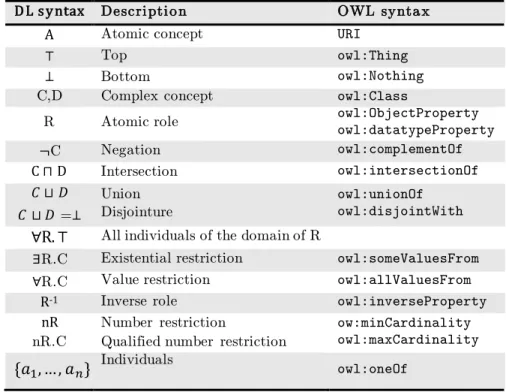
DLs are composed by basic descriptions (the atomic concepts (A,B,…), the atomic roles (R,…) and the individuals) and constructors (Table 1) from which can be built complex concepts (C,D…) and roles descriptions. The DL syntax is given by its signature and the constructors. The example in Figure 5 can be represented in DL as follow:
Manufacturer ⊑ Company
Oven ⊑ Appliance ⊓ ∀hasManufacturer.Manufacturer Oven(iQ700)
Manufacturer(Siemens)
hasManufacturer(iQ700; Siemens)
In the example above, Manufacturer, Company and Oven are concepts names, hasManufacturer is a role name and iQ700 and Siemens are individual names. ⊓(intersection) and ∀(value restriction) are constructors. Table. 1 summarizes the main DLs (AL, ALC, S) and extensions (I,H,F, etc…) and associated constructors along with OWL syntax.
Table 1 : DLs family main constructors
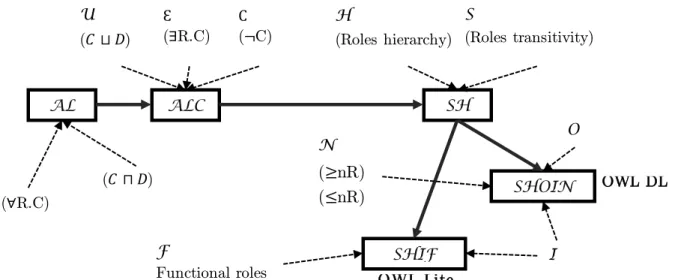
OWL is built upon DLs (Figure 8) and, from a DLs standpoint, OWL family expressivity/computational complexity could be classified as depicted in the Table 2.
D L s y ntax Descri pti o n OWL synta x
A Atomic concept URI
⊤ Top owl:Thing
⊥ Bottom owl:Nothing
C,D Complex concept owl:Class
R Atomic role owl:ObjectProperty
owl:datatypeProperty ¬C Negation owl:complementOf C ⊓ D Intersection owl:intersectionOf 𝐶 ⊔ 𝐷 𝐶 ⊔ 𝐷 =⊥ Union Disjointure owl:unionOf owl:disjointWith ∀R. ⊤ All individuals of the domain of R
∃R.C Existential restriction owl:someValuesFrom
∀R.C Value restriction owl:allValuesFrom
R-1 Inverse role owl:inverseProperty
nR Number restriction ow:minCardinality
owl:maxCardinality nR.C Qualified number restriction
{𝑎1, … , 𝑎𝑛} Individuals owl:oneOf DL Constructors AL ⊤,⊥,A,¬A,C⊓D,∀R. ⊤, ∀R. C Extensions… ALC ¬C , C ⊔ 𝐷, ∃R.C S See Paragraph. 4.3 Roles transitivity
+I R-1
+H See Paragraph. 4.3 Roles hierarchy +F See Paragraph. 4.3 Functional roles
+N (≥nR)
(≤nR)
+Q (≥nR.C)
(≤nR.C) +O {𝑎1,… , 𝑎𝑛}
20
OWL Family DLs Family Wo rst-case reasoning*
co mbined Complexity** Expressivity Co mments
OWL Lite SHIF EXPTIME1 ++
OWL DL SHOIN NEXPTIME2 +++
OWL Full N/A No n decida ble +++++
OWL 2 DL SROIQ [29] N2EXPTIME3 ++++
OWL 2 EL EL++ PTIME4 ++
For applications that need to create ontologies with very large number of classes and/or
properties (TBox)
OWL 2 QL DL-Lite
based NLOGSPACE5 +
For applications that want to reason on top of very large volumes of data (ABox)
OWL 2 RL PTIME - For applications that want to
describe rules in ontologies.
*Ontology Consistency, Class Expression Satisfiability, Class Expression Subsumption, Instance Checking (See Paragraph. 4.3)
**The complexity measured with respect to both the size of the axioms, the size of the assertions
1EXPTIME : The set of problems resolved by deterministic Turing machine using at most exponential time
2NEXPTIME : The set of problems resolved by non-deterministic Turing machines using at most exponential time
3N2EXPTIME : The set of problems resolved by non-deterministic Turing machines using at most double exponential time.
4PTIME : The set of problems resolved by deterministic Turing machine using at most polynomial time
5NLOGSPACE : The set of problems resolved by Turing machines using at most logarithmic working memory
Note: NLOGSPACE ⊆ PTIME ⊆ EXPTIME ⊆ NEXPTIME ⊆ N2EXPTIME
Table 2 : OWL family expressivity vs computing complexity comparison
The choice of the knowledge modeling language to be used (the meta meta model) to describe the devices and the services (the meta model and the model), taking into account the high modeling language expressivity needed in the context of ambient environments and the reasoning decidability, leads to choose OWL(2) DL.
2.5 The Open World Assumption
In [4], authors have identified the following characteristics of the semantic web knowledge description languages:
1) Anyone can say Anything about Any topic (AAA). A knowledge model designer is free to write any assertions (the model in Figure 6) envisioning a meaning whose terms (subject, predicate and object) are either defined by himself or, as often the case and promoted by the W3C, rely on known published vocabularies6 (the meta model in Figure 6). Note that the authorities publishing these vocabularies
cannot enforce the way it has to be used. Thus, it is necessary, for the designer, to get an expertise of
6http://lov.okfn.org/dataset/lov/ N (≥nR) (≤nR) F Functional roles C (¬C) Ԑ (∃R.C) U (𝐶 ⊔ 𝐷) AL ALC SH SHOIN SHIF S (Roles transitivity) H (Roles hierarchy) O I (∀R.C) (𝐶 ⊓ 𝐷) OWL Lite OWL DL
21
2) The domain to be modeled or rely on a domain expert familiar with the underlying semantics of the terms. While it cannot be completely avoided, this would limit the semantic heterogeneity issue that may prevent different vocabularies about the same domain to cooperate as they use different concepts and relationships for the same meaning,
3) Open World Assumption (OWA): due to 1), there might be new or complementary knowledge description that we a re not aware of. Therefore, no conclusion can be drawn from the non-existence of assertions (As opposed to the Close World Assumption (CWA) where missing assertions are considered false),
4) Non unique naming assumption: Importantly, as designer can locally define URIs, the same concept can be represented by different URIs across several ontologies (in that case, OWL allows to define class equivalence).
These characteristics are very important in the case of their application to describe real world devices and services. In most of the current ambient applications, devices and services knowledge description models rely on static and ad-hoc vocabularies (meta model) defining and structuring all the concepts and relationships for a specific domain targeting specific applications (smart homes, smart cities, building automation, healthcare, etc…).
However, while this approach is a solution for handling the semantic heterogeneity issue (the meaning of all the assertions in the devices and services knowledge description models rely on a global and common vocabulary), it limits the scope of use of the
information to a single applicative domain. Extending the scope of use of the information to multiple applicative domains implies to develop a
comprehensive vocabulary describing the world from heterogeneous vocabularies which is unlikely to happen in the SWoT context where domains to cover are countless.
There are many IoT companies and connected devices manufacturers all around the world (
Figure 10), and certainly much more to come (Figure 9), each of them addressing a particular domain (Figure 1) and having their own understanding and context usages of terms that it would be worth to describe through heterogeneous vocabularies (referring to AAA).
2.6 Ontology Modeling Approaches
Some projects acknowledged the fact that multiple heterogeneous ontologies management is needed in the case of systems targeting a wide range of applicative domains. For example, in the context of ambient intelligent environments (AIEs), ATRACO project authors [12][13] envision that a comprehensive, agreed and validated ontology is unlikely to happen, and that, more realistically, device manufacturers will independently develop their own ontologies. Authors in [13], depict three possible ontology architectures to represent and manage distributed knowledge sources:
2.6.1 Global Ontology (GO) Approach
With this approach, a global domain ontology is used to formally and strictly describe all the concepts, the relationships and the individuals of a given domain. There is no need for metadata self -describing the devices and the services in that case. As we ha ve seen previously, a n a ccepted a nd validated ontology describing the whole world’s concepts, relationships and instances is unlikely to happen [13]. The approach and modeling levels distribution is depicted in the Figure 11.
1https://www.cisco.com/web/about/ac79/docs/innov/IoT_IBSG_0411FINAL.pdf
22
Figure 10 : IoT companies and device manufacturers
2.6.2 Multiple Local Ontology Approach (MLO)
With this approach, each device, through embedded metadata, embeds its own domain ontology based on its own vocabulary (referring to AAA). This approach is the best fitting with our problem statement as it allows knowledge publishers to rely on their own vocabulary. The approach and modeling levels distribution is depicted in the Figure. 8.
Some projects make use of heterogeneous ontologies. For example, in the context of ambient intelligent environments (AIEs), ATRACO project previously discussed [12][13] is built around agents exchanging data between each other. This project is based on an upper ontology (Paragraph 2.6.3) but allows software agents to independently and locally describe and rely on their own ontolo gy.
Figure 11 : Ontology modeling, the GO approach
Meta model Meta meta model
Abstract syntax
Model Global ontology
23
2.6.3 Hybrid Approach
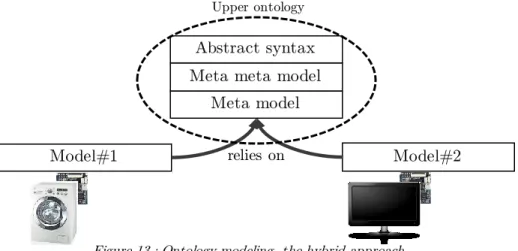
Each device defines, through embedded metadata, his own domain knowledge (Model) built from a common vocabulary (Meta model + Meta meta model, aka Upper ontology). Like for the global ontology approach depicted in the Paragraph 2.6.1, there is currently no agreed and widely used common and global vocabulary (world comprehensive meta model) available. The approach and modeling levels distribution is depicted in the Figure 13.
For example, in [16] authors have defined layered ontologies defining a common ontology from which semantic annotations can be defined and deployed on devices. The authors highlight the need for a standardization committee and the need, for the manufacturers to develop their device ontologies based on the defined and agreed vocabulary. As it is a good solution to cope with the semantic heterogeneity issue, in SWoT context, it is unlikely that such a standardization could occur.
Most of the projects rely on ad-hoc ontologies specific to domain like smart offices [17], smart homes [18], ambient assisted living [19], sensors [20], [21] , smart cities [22], etc…
2.6.4 Fragmented Hybrid (FH) Approach
This approach can be placed in between the MLO and the Hybrid approach. An upper ontology is fragmented in multiple sub-ontologies defining independently each concept of the global ontology (Paragraph. 2.6.1). It is depicted in the Figure 14. Thus, given an upper ontology U defining C concepts, 𝑈 = 𝑆𝑢𝑏1∪ 𝑆𝑢𝑏2… ∪
𝑆𝑢𝑏𝑛 𝑤ℎ𝑒𝑟𝑒 𝑛 = ∁. Since both approaches (MLO and FH) can be used together and are conceptually closed,
except if it is explicitly denoted FH, we will consider (and denote) FH as MLO in the rest of the document.
Figure 12 : Ontology modeling, the MLO approach
Figure 13 : Ontology modeling, the hybrid approach
Model#2 Meta meta model
Abstract syntax
relies on
Model#1
Meta model#1 Meta model#2
Local ontology#1 Local ontology#2
Model#2 Meta meta model
Abstract syntax
relies on
Model#1
Meta model Upper ontology
24
2.7 Conclusion
We have briefly reviewed in this chapter the main web semantic knowledge modeling technologies used to formally describe knowledge and their capabilities for expressing, with more or less expressivity, facts about the real world (Paragraph 2.2). We have then defined (Paragraph 2.3), in the context of ambient systems, the knowledge types to be described: (1) the contextual knowledge, (2) the structural knowledge and (3) the functional knowledge. Such a variety of knowledge domains to cover enforces the need for a high knowledge model expressivity. While expressivity is key at reducing the knowledge abstraction level and then helps ambient systems to better segregate devices and services, it implies computational complexity that may be problematic for ambient systems with low computational resources. We concluded that OWL(2) DL is the language better fitting with the expressivity/computational complexity cons traints (Paragraph. 2.4). OWL language is built on: (1) the AAA slogan (Anyone can say Anything about Any topic) and (2) the open world assumption (there might be new or complementary knowledge description that we are not aware of). This tells us that the development of a comprehensive model of the world is not going to happen but instead, as per (1) and (2) paradigms, has to be built from the capitalization of multiple knowledge providers (Paragraph. 2.5). Unfortunately, most of the approaches, in the domain of ambient systems, relies on an ad-hoc knowledge model, which goes against the aforementioned paradigms. It exists a constellation of IoT providers and we envision that each of them will use their own knowledge model. After having reviewed the main ontology modeling approaches (Paragraph 2.6), we have proposed an approach based on heterogeneous knowledge representation models (MLO or MLO + FH approaches) to qualify and self-describe devices and services through semantically enriched metadata (Paragraph 2.6.2).
While this approach brings semantics heterogeneity issues the ambient systems have to cope with when integrating this heterogeneous knowledge (Chapter 3), it gives outstanding perspectives in term of services selection relevancy improvement. Indeed, as the same terms might be differently described in heterogeneous ontologies, they may acquire a more accurate meaning throughout an evolutionary process, the ir meaning being shaped through the assertions done by their publishers (The IoT manufacturers).
Model#2 Meta meta model
Abstract syntax
Model#1
Meta model Fragmented Upper ontology
𝑆𝑢𝑏1 𝑆𝑢𝑏2 𝑆𝑢𝑏𝑛 𝑆𝑢𝑏2 Meta model
𝑆𝑢𝑏1 Meta model
25
2.8 References
[1] Brachman, R., & Levesque, H. (2004). Knowledge representation and reasoning. Elsevier.
[2] Gyrard, A., Bonnet, C., & Boudaoud, K. (2014, March). Enrich machine-to-machine data with semantic web technologies for crossdomain applications. In Internet of Things (WF-IoT), 2014 IEEE World Forum on (pp. 559-564). IEEE.
[3] Berners-Lee, T., Fischetti, M., & Foreword By-Dertouzos, M. L. (2000). Weaving the Web: The original design and ultimate destiny of the World Wide Web by its inventor. HarperInformation.
[4] D. Allemang and J. Hendler. Semantic Web for the Working Ontologist: Effective Modeling in RDFS and OWL. Morgan Kaufmann, 2011.
[5] G. Antoniou and F. Van Harmelen. A semantic web primer. 2nd. MIT Press, 2008.
[6] T. Segaran, C. Evans, and J. Taylor. Programming the semantic web. O’Reilly Media, 2009.
[7] Jeremy J. Carroll and Graham Klyne. Resource Description Framework (RDF): Concepts and Abstract Syntax. W3C Recommendation 10 February 2004. url:http://www.w3.org/TR/2004/REC-rdf-concepts-20040210/. [8] L. Masinter, T. Berners-Lee, and R.T. Fielding. Uniform resource identifier(URI): Generic syntax (2005). [9] http://www.w3.org/TR/owl-ref/
[10] http://www.w3.org/TR/owl-guide/
[11] Horrocks, I., Patel-Schneider, P. F., & Van Harmelen, F. (2003). From SHIQ and RDF to OWL: The making of a web ontology language. Web semantics: science, services and agents on the World Wide Web, 1(1), 7 -26. [12] Goumopoulos, Christos, et al. "Atraco: Adaptive and trusted ambient ecologies." Adaptive and
Self-Organizing Systems Workshops, 2008. SASOW 2008. Second IEEE International Conference on. IEEE, 2008. [13] Wache, H., Voegele, T., Visser, U., Stuckenschmidt, H., Schuster, G., Neumann, H., & H übner, S. (2001,
August). Ontology-based integration of information-a survey of existing approaches. In IJCAI-01 workshop: ontologies and information sharing (Vol. 2001, pp. 108 -117).
[14] Kameas, A., & Seremeti, L. (2011). Ontology-based knowledge management in NGAIEs. In Next Generation Intelligent Environments (pp. 85-126). Springer New York.
[15] Holst, T. (2013). Structural analysis of unknown RDF datasets via SPARQL endpoints (Doctoral dissertation, Master thesis defense 11).
[16] Dibowski, H., & Kabitzsch, K. (2011). Ontology-based device descriptions and device repository for building automation devices. EURASIP Journal on Embedded Systems, 2011, 3.
[17] Ryu, M., Kim, J., & Yun, J. (2015). Integrated Semantics Service Platform for the Internet of Things: A Case Study of a Smart Office. Sensors, 15(1), 2137-2160.
[18] Vacher, M., Istrate, D., Portet, F., Joubert, T., Chevalier, T., Smidtas, S., ... & Méniard, S. (2011, August). The sweet-home project: Audio technology in smart homes to improve well -being and reliance. In Engineering in Medicine and Biology Society, EMBC, 2011 Annual International Conference of the IEEE (pp. 5291 -5294). IEEE.
[19] Jacquet, C., Mohamed, A., & Bellik, Y. (2013). An Ambient Assisted Living Framework with Automatic Self -Diagnosis. International Journal on Advances in Life Sciences, 5(1).
[20] Park, D. H., Bang, H. C., Pyo, C. S., & Kang, S. J. (2014, March). Semantic open IoT service platform technology. In Internet of Things (WF-IoT), 2014 IEEE World Forum on (pp. 85-88). IEEE.
[21] Alirezaie, M., & Loutfi, A. (2014). Reasoning for Improved Sensor Data Interpretation in a Smart Home. arXiv preprint arXiv:1412.7961.
[22] Lécué, F., Schumann, A., & Sbodio, M. L. (2012). Applying semantic web technologies for diagnosing road traffic congestions. In The Semantic Web–ISWC 2012 (pp. 114-130). Springer Berlin Heidelberg
[23] Baader, F. (2003). The description logic handbook: theory, implementation, and applications. Cambridge university press.
[24] Horrocks, I. (2005). Owl: A description logic based ontology language. In Logic Programming (pp. 1-4). Springer Berlin Heidelberg.
[25] Krötzsch, M., Simancik, F., & Horrocks, I. (2012). A description logic primer. arXiv preprint arXiv:1201.4089. [26] Horrocks, I., Patel-Schneider, P. F., & Van Harmelen, F. (2003). From SHIQ and RDF to OWL: The making of a web ontology language. Web semantics: science, services and agents on the World Wide Web, 1(1), 7 -26. [27] http://www.w3.org/TR/owl2-primer/
[28] Grau, B. C., Horrocks, I., Motik, B., Parsia, B., Patel-Schneider, P., & Sattler, U. (2008). OWL 2: The next step for OWL. Web Semantics: Science, Services and Agents on the World Wide Web, 6(4), 309 -322.
3. Knowledge Extraction
3 .1 Introduction ... 2 6 3 .2 From Knowledge to Annotations ... 2 6 3.2.1 Extraction From Upper Ontologies... 26 3.2.2 Extraction From Web Pages ... 27 3 .3 Web Services Standards Used to Convey the Knowledge ... 2 8 3.3.1 Web Services Description Languages ... 28 3 .4 Conclusion ... 3 0 3 .5 References ... 3 1
3.1 Introduction
Modeling an ontology from scratch is a long and costly process as it requires experts’ knowledge to be abstracted in ontologies by using adequate terms, properties and relationships. Also, has we have seen in Chapter. 2, semantic web knowledge modeling languages are complex and subtle, and there might be numerous ways to model the same knowledge. So, it is a safe bet that manufacturers, to reduce development costs, will enforce the knowledge reusability through the development of interoperable knowledge fragments self-describing the devices and the services (Assuming that manufacturers will be the knowledge publishers).
It already exists a constellation of formally described knowledge freely available all over the web. However, while formally described, this knowledge cannot be used “as is” to annotate the devices since: (1) it is often drowned in an Upper ontology or spread out in a web page and (2) does not follow the semantic web best practices [8], limiting, de facto, the reusability of their information outside their initial scope [1].
In this chapter we first investigate how to turn the already existing formal knowledge into metadata. Providing the manufacturers with tools helping them to rapidly extract and encapsulate the knowledge into metadata is key to reduce the products design to market cycle time. In the second part of this chapter we will give a short overview of the existing web services description languages that can be used to convey the formal knowledge descriptions to the ambient systems and investigate if these languages are adapted to convey all the needed knowledge descriptions types (functional, structural and contextual).
3.2 From Knowledge to Annotations
3.2.1 Extraction From Upper OntologiesThere are numerous upper ontologies available on the web covering several domains ( smart offices [2], smart homes [3], ambient assisted living [4], sensors [5],[6], smart cities [7]). Some ontologies are well-established ontologies whose terms and relationships semantics have been deeply validated. However, these ontologies being often huge and, due to the embedded systems limited resources and the high ambient systems responsiveness needed, cannot be used “as is”. Therefore, an ontology designer would want to reuse, from the upper ontology, only the statements needed to qualify a given concept (a signature). For instance, DogOnt [11] ontology (version 3.2.11, 897 classes, 32 object properties, 46 datatype properties and 267 individuals) aims at defining the vocabulary for Intelligent Domotic Environments (IDE). It defines a set of white goods (washing machine, stove, oven, fridge, dishwasher, deep freezer, cooker, boiler, etc…) with their associated concepts hierarchy and relationships. A designer of an ontology O interested by the Fridge signature could import DogOnt ontology (hereby ensuring Fridge semantics conservation) but the resulting ontology (O ∪ DogOnt) would be much complex to work with (search, reasoning,…). The idea is for the designer of O to only extract the fragment (aka module, descriptive subgraph, RDF molecule, etc…) of DogOnt that just
describes the Fridge concepts that have to be reused in O. The problem statement is then the following: given an upper ontology O, we want to extract the minimal set S of assertions (𝑆 ⊑ 𝑂), a module, qualifying the concept C (𝐶 ∈ 𝑂) without degrading its semantics (extraction safety). This problem is well addressed in the literature [9][10] and there exists several subgraph extraction methods (Concise bounded description1 (CBD)
of a resource, (more generally a resource), Minimum Self-contained Graphs (MSGs)[27], RDF Molecules [28], etc…).
27
Also, care has to be taken regarding the upper ontologies quality. Authors in [1] have classified up to 291 IoT based projects ontologies from which only 23 follow the semantic web best practices recommendations [8].
Module extraction is out of the scope of this document but for the purpose of experimentations (Paragraph. 4.8), we have developed a small straightforward algorithm based on (CBD based) explained hereafter.
Algorithm 1: Module extraction. Given an ontology O and a signature S, compute module O’
begin
Visited := {}; R := getResource(S);
sList := O.listStatements() where statement’s subject is equal or equivalent to R; for all stmt ∈ sList do
O’ := O’ + stmt; extract(stmt); end for
end;
: extract(stmt)
if(isResource(stmt.subject) and Visited[stmt.subject] = false) { Visited[stmt.subject] := true;
r := getResource(stmt.subject); pList := getProperties(r); for all p ∈ pList {
O’ += p; extract(p); end for
end if }
3.2.2 Extraction From Web Pages
The World Wide Web contains a lot of data about products and manufacturers (from the manufacturer’s
products web pages or resellers). However, most of these web pages (depicting products features) are unstructured and not semantically enriched, or when enriched, does not follow the semantic web best practices [8]. One of the best practices is to publish web data as interlinked RDF graphs (Linked Data (LOD)) following some basic principles [12]:
1) Use URIs to name things,
2) Use HTTP URIs so that names can be dereferenced, 3) Return a RDF graph upon dereferencing of those URIs,
4) Use HTTP URIs in returned RDF graphs (here the interlinked vision).
(1) is about identifying the data source hence enabling the data extraction tool to check for its reliability, (4) Here the recommendation is to use the Linked Open Vocabulary (LOV1) as the meta model for the model
describing the data in the returned RDF graphs (and not just owl:sameAs with possible semantic issues [15]).
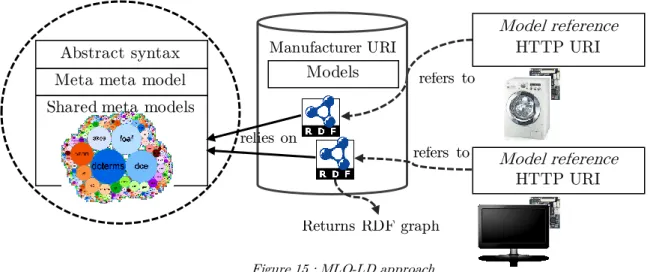
There are clear advantages at using LOV along with LOD [14]: (1) Most popular vocabularies form now a core of the Semantic Web standards, (2) vocabularies rely more and more on each other through reusing, refining or extending, stating equivalences, etc… thus increasing the meaning of the terms used in those vocabularies, (3) it reduces the semantic heterogeneity (there exist up to 517 vocabularies to date manufacturers can use to describe their devices). Some tools2 exists to transform a dataset (html, xml, csv,
etc…) to LOD that can further be used to qualify data in the web pages… or directly used in the device metadata hereby extending the ontology modeling approaches presented in Paragraph. 2.6 with a new one in between the MLO approach (Paragraph. 2.6.2) and the Hybrid approach (Paragraph. 2.6.3). We call this additional approach the Multiple Local Ontology approach based on Linked Data (MLO-LD). This approach is depicted in the Figure 15.
1http://lov.okfn.org/dataset/lov/