HAL Id: hal-02442282
https://hal-cea.archives-ouvertes.fr/hal-02442282
Submitted on 16 Jan 2020
HAL is a multi-disciplinary open access
archive for the deposit and dissemination of
sci-entific research documents, whether they are
pub-lished or not. The documents may come from
teaching and research institutions in France or
abroad, or from public or private research centers.
L’archive ouverte pluridisciplinaire HAL, est
destinée au dépôt et à la diffusion de documents
scientifiques de niveau recherche, publiés ou non,
émanant des établissements d’enseignement et de
recherche français ou étrangers, des laboratoires
publics ou privés.
A Lattice Boltzmann approach to model radionuclides
diffusion through unsaturated argillite micro-fractures
S. Gueddani, A. Genty, M. Dymitrowska
To cite this version:
S. Gueddani, A. Genty, M. Dymitrowska. A Lattice Boltzmann approach to model radionuclides
diffusion through unsaturated argillite micro-fractures. CMWR 2016 - Computational Methods for
Water Resources, Jun 2016, Toronto, Canada. �hal-02442282�
A Lattice Boltzmann approach to model radionuclides diffusion
through unsaturated argillite micro-fractures
S. Gueddani
, Institut de Radioprotection et de Sûreté Nucléaire, F-92262, Fontenay-aux-Roses, France.A. Genty
,
DEN-Service de thermo-hydraulique et de mécanique des fluides STMF, CEA, Université Paris-Saclay, F-91191, Gif-sur-Yvette, France.M. Dymitrowska
,
Institut de Radioprotection et de Sûreté Nucléaire, F-92262, Fontenay-aux-Roses, France.Key words: Effective Diffusion, Unsaturated Fractures,
Argillaceous Porous Media
Introduction
In the context of radioactive waste management, deep geological repository in indurated argillaceous media is considered as a potential solution. Radionuclides transport through argillaceous media is then of concern and some works focused on the Excavated Damaged Zone (EDZ) surrounding the vaults and the galleries of the repository. Indeed, argillaceous media in the EDZ presents some micro-fractures where radionuclides transport through diffusion can be enhanced and EDZ is considered as a potential preferential pathway and deserve a particular attention.
Micro-fractures can be fully saturated or not depending on their location and on the flows history inside the repository. Saturation level of the fractures can result from desaturation process during the excavation phase or from hydrogen flow where hydrogen is produced from corrosion of the waste metallic canisters after repository closure. In this work, we will focus on radionuclide diffusion through unsaturated micro-fractures.
In order to simulate diffusion process inside micro-fractures geometry, we chose to use a Lattice Boltzmann Model (LBM) that allows i) to easily represent the fracture geometry available from X-ray tomographic images, ii) to simulate water-gas distribution inside the fracture for different saturation levels, and iii) to simulate diffusion inside the resulting connected water pathway.
Lattice Boltzmann Model
The LBM we used in this work is based on a Two-Relaxation-Time (TRT) collision operator. Water-gas distribution was simulated using the LBM described in [1] which follows the Shen-Chen approach through a particular source term. Diffusion simulation in the resulting water connected pathway was conducted using the same procedure than the one described in [2] and allows the computation of the effective diffusion coefficient for the considered fracture.
Results
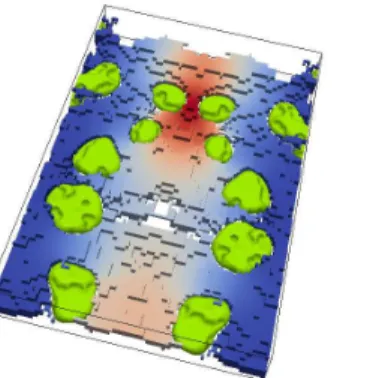
We conducted diffusion simulations for different saturation in a micro-fracture presenting an average aperture of about 2 µm. Computations where performed starting from an initial Dirac imposed concentration in the center of the fracture. An example of computed concentration distribution after 300 time steps inside the fracture for a saturation value of 0.78 is shown on Figure 1.
Figure 1: Concentration field inside a micro-fracture
filed with gas bubbles (in green) at saturation of 0.78.
Effective diffusion coefficient was computed as a function of fracture saturation from our diffusion simulations. The effective diffusion coefficient behavior was found to be non-standard close to high saturation value.
References
[1] A. Genty and V. Pot. Numerical Simulation of 3D Liquid–Gas Distribution in Porous Media by a Two-Phase TRT Lattice Boltzmann Method. Transport
Porous Med., 96(2), 271-294, (2013).
[2] A. Genty and V. Pot. Numerical Calculation of Effective Diffusion in Unsaturated Porous Media by the TRT Lattice Boltzmann Method. Transport