HAL Id: hal-01356016
https://hal.archives-ouvertes.fr/hal-01356016
Submitted on 30 Aug 2016
HAL is a multi-disciplinary open access
archive for the deposit and dissemination of
sci-entific research documents, whether they are
pub-lished or not. The documents may come from
teaching and research institutions in France or
abroad, or from public or private research centers.
L’archive ouverte pluridisciplinaire HAL, est
destinée au dépôt et à la diffusion de documents
scientifiques de niveau recherche, publiés ou non,
émanant des établissements d’enseignement et de
recherche français ou étrangers, des laboratoires
publics ou privés.
Pierre Beckouche, Claude Grasland, France Guérin-Pace, Jean-Yves Moisseron
To cite this version:
Pierre Beckouche, Claude Grasland, France Guérin-Pace, Jean-Yves Moisseron. Founding territorial
sciences. France. Collège international des sciences du territoire, 2016. �hal-01356016�
Editors
Pierre Beckouche, Claude Grasland,
France Guérin-Pace, Jean-Yves Moisseron
Founding
Founding
territorial sciences
Editors
Pierre Beckouche, Claude Grasland,
France Guérin-Pace, Jean-Yves Moisseron
Territorial sciences: Why a book on territories,
and why a collection of essays?
From having been a fashionable trend in various guises, the question of territory has become a major focus of research in recent years. The premise of this book is that it is impossible to address many of the major challenges facing contemporary societies without taking into account their territorial dimensions. These include climate and energy change, population ageing and health care provision, widening social inequalities and increasing access to basic services, urbanization and urban-rural relations, the mobility revolution, decentralization and local development, the obsolescence of the nation-state and European integration, globaliza-tion, and new North-South relations.Yet the question remains: Does the territorial dimension of the changes affecting contem-porary societies justify the need to create a Collège international des sciences du territoire (CIST, the International College of Territorial Sciences) and to lay the foundations of a new discipline by holding an international conference? The purpose of the “Founding Territorial Sciences” conference – a conference aimed at bringing together researchers from many different disciplines – was to address the following question: Are the concept of territory and the territorial dimension of contemporary challenges important enough to warrant the deve-lopment of a new interdisciplinary field, or even a new research field? Or should the aim simply be to harmonize the methods of territorial analysis applied to a wide range of different issues and disciplines (the environment, energy, health, international relations, etc.) based on a view of the territorial sciences as mere “scientific knowledge”?
The broad perspective taken in this book encompasses a wide range of disciplines. The assumption is that disciplines that involve the study of space (e.g. geography and geopo-litics, environmental science, spatial planning, urban development and architecture, urban history and urban sociology, urban and regional economics, and the study and practice of development) make a major contribution to our understanding of territories. This new field
will also be of interest to researchers in other social sciences, including demography, the sociology of public policy, institutional economics, environmental law and international law, but also the natural sciences (hydrology and geology), the life sciences (biology, agronomy, health, etc.) and engineering science (geomatics, scientific modeling, complex systems). The interdisciplinarity of the territorial sciences will depend on how we define the field – i.e. as a form of scientific knowledge or as an emerging discipline. If we define the territo-rial sciences as scientific knowledge, the assumption will be that the combined resources of a range of disciplines are needed to understand the territoriality, or territorial dimension, of their objects of study. The aim is to focus on the conceptual approach to the term “terri-tory” in order to highlight potential variations or differences between different disciplines, the assumption being that the study of space in different fields needs to be based on similar methods (i.e. criteria for delimiting space, the measurement of interactions, the role of territo-ries in social representations, the degree of consistency between functional and institutional spaces, and the spatial analysis of resource allocation, among other things). In this sense, it may be more accurate to speak of the “science of territories”, or even simply to develop a common methodology, since the assumption is that territories serve to reveal multidiscipli-nary issues involving other disciplines.
However, if we take the view that the concept of territory can be the object of an autonomous discipline, i.e. “the science of territory”, the key concepts, principles and methods of the field will need to be defined. Here, the assumption is that researchers with an interest in territorial issues will need to focus on the territory itself rather than broader issues such as the relation-ship between the individual and the collective. To put it another way, researchers will need to view these broader issues as providing an opportunity to improve our understanding of territory as a research object. Based on the hypothetico-deductive method, the resulting laws will serve to highlight general empirical patterns showing how territories function, but will also serve to demonstrate the diversity of territories based on the analysis of deviations from these patterns. The new field will also need to resist the twin temptations of exceptionalism (i.e. all territories are different and no general proposition can be formulated about them) and deter-minism (i.e. a unique principle governs how territories function, regardless of time and place). In any event, it would be absurd to build a science along these lines solely on the basis of the concept of territory and without seeking to combine it, at the very least, with concepts such as space, network and scale.
The aim of this book is to examine these questions and to engage in debates focusing on both scientific and practical considerations as part of a new series entitled “Sciences du
terri-toires” (territorial sciences), in collaboration with Karthala. This first volume includes some of
the papers and debates from the founding conference held by the Collège international des sciences du territoire on 27, 28 and 29 November 2011. Included here are the contributions that focused most directly on the research question presented in this introduction and further
developed in the Debate paper1. We have opted to include the Debate paper despite feeling
that it remains incomplete. The debate is ongoing and the Debate paper needs to be seen as a work-in-progress.
Part one examines recent developments at an international level, focusing on both traditional debates, such as the debate between the spatial approach and the territorial approach or the place versus space debate, and the relationships between researchers and the actors of territorial development. Recent initiatives in Germany, Quebec, Italy and the United States are examined in order to better understand recent debates in France over the development of a transdisciplinary field centered around the concept of territory.
The collection of territorial data and the processing of local and micro-local data is a major focus of research at the CIST. However, as shown in part two, the combination of rich and varied territorial data collected at different levels raises a number of theoretical, methodolo-gical and empirical issues.
The relationship between social demand and professional practice is a major focus of the territorial sciences, given the close ties between territories and the actors of territorial transfor-mation. The assumption is that territories are an important meeting point with social demand,
and therefore with policy-making and action. Therefore, the task of the territorial sciences is
to articulate and address territorial issues and to provide tools to promote public debate and support decision-making, which is precisely the focus of part three.
The discussions generated by the conference are only partly reproduced in this volume. The
debate continues on a daily basis in the various events held as part of the GIS CIST2 and will
be further explored in future publications in the series, of which this volume is the first.
Territory as the legible, tangible product of
complex processes and as a resource for action
Pierre BECKOUCHE, Claude GRASLAND,
France GUÉRIN-PACE, Jean-Yves MOISSERON
11. THE “SPATIAL TURN”, OR THE RISE OF THE CONCEPT OF TERRITORY
Since the 1980s, there has been growing interest in the question of territory among social scientists. Let us begin with a brief outline 1of the various meanings of the concept in different social science disciplines (note, however, that the meaning of “territory” is invariably
disci-pline- and context-specific2). A good example of the growing popularity of the concept is
the increasing focus on territorial issues in anthropology. Anthropologists have applied the concept of territoriality to both traditional and modern societies, with concepts such as
house-hold, urbanization and network playing an important role in recent research. More generally,
there has been increasing interest in the symbolic dimension of territories, especially from a community and relational perspective (e.g. the national imagination of diaspora communities, the tension between the sense of origin and the reconfiguration of identity in new local terri-torialities, and the myth – or myths – of return).
There has also been a shift in the approach to territorial issues among historians. In traditio-nal historiography, the concept of space involved notions such as the state, natiotraditio-nal borders and lines of demarcation or peripheries. Some studies in the new history (or nouvelle histoire) focused on specific territories, though always in traditional territorial contexts and frameworks (i.e. country, nation or village). Space was also at the heart of major historical studies, such as
1 This chapter was reviewed and edited by members of the CIST, and in particular by Chloé Didelon, Timothée Giraud and Marta Severo.
2 This section is based on preliminary research conducted by the CIST prior to the 2011 conference, and in parti-cular on contributions from Martine Hovanessian, Jean-Paul Billaud, Hervé Brédif and Marie-Louise Pelus-Kaplan.
the work of Pierre Chaunu on transatlantic trade or Fernand Braudel on the Mediterranean. However, the resurgence of interest in the question of territory only really began in the 1980s as a result of the development of interdisciplinary research. Recent studies have focused more on spatial processes (broadly corresponding to “territorial” processes) than on ontological or political space. The basic premise of recent research in this area is that space is a construct rather than a given. Hence the interest in landscapes, representations (mental maps), in domestic space, and in the environment – in short, in the question of space constructed by collective actors seizing upon social and cultural problems and inequalities and involved in new systems of governance. There has also been a spatial turn in economics as a result of research on economic inequa-lity and the unequal distribution of wealth and the underlying geographical concentration of
production. One scholar3 was even awarded a Nobel Prize for his work in geographical
econo-mics. Until recently, mainstream research had failed to provide solutions to these problems, largely because the concept of space in neoclassical economics was limited to questions of distance and cost. Trade barriers were seen as “imperfections” impeding the development of an ideal market designed to ensure prosperity for all. In short, the concept of territory was stripped of content, devoid of identity, and reduced to a residue. General equilibrium theory states that spatial inequalities are bound to decrease. However, recent studies have highlighted agglomeration forces that go against the grain of the idea of equilibrium. Returns to scale and positive externalities are now seen as centripetal forces, suggesting a greater emphasis on cumulative benefits (as opposed to the comparative advantages highlighted by Simon Kuznets and Jeffrey Williamson, the inheritors of Adam Smith, who see general equi-librium as a process resulting in the reduction of territorial disparities). More recent studies have viewed territories as resources or even as factors of production. The result has been the emergence of a new concept: territorial capital. In this view, territorial practices (i.e. spatial planning) and policies are placed at the heart of research and policy recommendations. It is also important to acknowledge the debate over the term “common good” at the crossroads of economics, law and political science, where recent discussions have also often involved a territorial dimension (such as water, air, forests, or pastureland). The political economist and Nobel Prize winner Elinor Ostrom showed that alongside privatization and public mana-gement (the state), social collectivities are also capable of managing common goods in an economically viable way through specific institutional arrangements. In the economics of conventions, sociologists, political scientists and other scholars outside economics with an interest in the cultural and institutional characteristics of different countries have highlighted significant differences between national responses to globalization. In other words, global norms produce different effects and serve to highlight the specific features of each territory. Geography has also experienced what might be termed a “territorial turn”. Over the past twenty years, the growing popularity of the term “territory” has both enriched and complicated research in this area. In geography, territory provides a basis for examining the political, insti-tutional and financial mechanisms governing the production of space and for understanding
local interactions, while also highlighting the importance of the “interplay of actors”. Theoretical geography and spatial analysis have explicitly recognized these conceptual developments by integrating into classical spatial interaction models (based on the continuous effects of distance) barrier parameters, or, in other words, territorial interaction parameters (based on the discreet effect of a frontier that sharply reduces probabilities). While the idea is not new (consider the work of August Lösch), it is only recently that we have begun to consider terri-torial effects such as these as intrinsic components of the behavior of actors (as opposed to viewing them as mere residue). Therefore, Tobler’s first law of geography (i.e. “everything is related to everything else, but near things are more related than distant things”) can now be supplemented by a second law that takes into account the discontinuities created by borders (“everything is related to everything else, but places belonging to the same territory are more related than places separated by borders”, Grasland, 2009).
There are many other disciplinary and thematic examples of the rise and success of territory as a research topic in recent decades. But how can we explain the success of territory?
2. TERRITORY AS THE LEGIBLE, TANGIBLE PRODUCT OF COMPLEX PROCESSES
Our hypothesis is that the success of the concept of territory can be explained by the “inte-grative” nature of the concept as a palimpsest recording the traces of past events within the landscape through complex historical processes, as a record available for analysis, and as a tool for informing future policy developments. Let us clarify this point.
2.1. The era of complexity
The notion of “complexity” as a tool for understanding contemporary societies first emerged in the 1970s. Following Edgar Morin (among others), theories of complexity and complex systems theory were developed to explain large-scale systems composed of many
interac-ting, nonlinear and self-organized components4. The earliest studies in this area have since
proved useful. The basic assumption is that the increasing complexity of human organizations and their interaction with the environment requires appropriate conceptual and technical tools. What is true of the social sciences is also true of emerging disciplines such as computer science, but also of the self-proclaimed “hard” sciences – with “complexity” appearing to provide the basis for bridging the traditional gap between the “hard” and “soft” sciences. For example, modern biology, based on the discovery of the genetic code in the 1960s, needs the concept of “biocomplexity” to understand the complex network of interactions linking DNA
4 There are two main approaches to complexity. The first approach, developed by Edgar Morin and Anthony Wilden (among others), is related to the problem of uncertainty in knowledge and to attempts to go beyond the traditional distinction between the subject of knowledge (i.e. the knowing subject or the observer) and the object of knowledge, with all the associated social and ethical implications. The second approach, developed at the Santa Fe Institute in the 1980s, involves using computational tools to model “complex adaptive systems” contai-ning a large number of independent, interrelated and interacting elements and bringing together neighboring disciplines such as physics, chemistry, biology and ecology in a common mathematical framework.
to proteins (not an automatic coding, but involving processes with multiple determinants and trajectories, feedback loops, etc., as shown by the work of Henri Atlan). The immunologist George Klein argued that “from now on biologists will not only have to live with complexity,
they will also need to love it”5. In other words, biologists will also need to collaborate with other
disciplines in order to deal with complexity. Similar developments have taken place in the “new geography”, a field that emerged in the French-speaking world in the 1960s and 1970s. Far from being limited to quantitative methods, the “new geography” has also benefited from the discovery of systemic analysis, which has provided the basis for building new bridges with other disciplines (such as computer science, physics, and ecology), resulting in the increa-sing contribution of geographers to the goal of information science and complex systems. Contemporary research is the product of a long historical process marked by increasing
inter-disciplinarity6, but also by increasing links between theory, modeling, observation and
simula-tion, between fundamental and applied research, and between research and social practice. While interdisciplinary collaboration has always existed, it is particularly characteristic of the advent of complexity and the generalization of digital tools. As we will see, this explains the highly interdisciplinary nature of the territorial sciences and their organic relationship to social needs and demands.
Let us focus on social issues. Four interrelated developments appear to account for the advent of the idea of a society conceived as an infinitely complex combination of elements. These developments are indicative of four major paradigms.
2.2. The new paradigms of complexity
2.2.1 The technical paradigm (accessibility)
The new technical paradigm is the result of two major developments over recent decades: the mobility revolution (i.e. the mobility of people, goods and information) and the development of digital technology. The digital revolution has had a profound impact on work methods in all sectors of activity. The interoperability of digital information opens up a potentially infinite field of research and action by breaking down traditional barriers and dividing lines, such as the boundaries between different sectors of the economy, between the public and private spheres, between administrators and the administered, between professional and personal life, between production and consumption, between the reception and production of media information, and between art and science.
Interaction has also become a central feature of social production, and accessibility (whether it be access to data, goods, services, territories, well-being, etc.) has emerged as a key charac-teristic of current practices in a wide range of areas, to such an extent that accessibility may
5 Seminar cited by Henri Atlan (2010).
6 Interdisciplinarity is at the heart of complex systems. For example, Murray Gell-Mann, one of the founders of the Santa Fe Institute, worked at the interface of particle physics and the theory of evolution.
be said to have become a defining feature of modern life. Many recent studies have attemp-ted to demonstrate the changing nature of our space-time. The assumption is that speed has become both the condition of accessibility and one of its limiting factors (along with connec-tivity). Processes are becoming faster and interactions are multiplying rapidly, resulting in a fragmented succession of “immediacy” – a sign of the triumph of “presentism” (Virilio, 1995). Space is now subject to “generalized mobility” (the ideology of generalized mobility, according
to Allemand, Ascher and Lévy7), a phenomenon that has generated a whole new range of social
issues, including the right to mobility, the foundation of a “universal mobility service” (Ascher, 2005). In an effort to regulate “universal mobility”, Thrift (2012) went so far as to ask whether traceability systems (barcodes, SIM cards, RFID technologies, etc.) might lead to a “new world order”. The task of governing the reconfiguration of space-time is left to information processing systems, which have come to play a central role in modern life – a development that Nicholas Negroponte had predicted more than fifteen years ago in his book Being Digital (Negroponte, 1995). These systems provide a basis for managing complexity (operational dimension), but also for monitoring (political or policing dimension) and explaining it (cognitive dimension).
2.2.2 The cultural paradigm (innovation)
The cultural dimension of the new paradigm involves a shift from an architecture of meaning defined by memory and repetition – in other words, a culture defined by the relation to the past – to an architecture defined by creation, i.e. a culture defined by the relation to the future. Jean-Paul Sartre anticipated this shift by positing that “existence precedes essence” (in other words, it is not what or who we are that determines our actions, but rather our projects and actions that define who and what we are). This has been a long and slow process. Marcel Gauchet (1985) traced the roots of the shift to the beginning of the Christian era, and even to a pivotal moment in the history of humanity (the “Axial Age”) – the middle of the first millen-nium BC. Cornelius Castoriadis (1996) saw the Greek cities of antiquity and Western moder-nity as the two great historical moments in the self-proclaimed “autonomy” of societies based on the idea that we have the right to be what we make of ourselves, whether individually or collectively. However, it was not until the twentieth century that society defined by its project became the dominant model (at least in the West), despite the resistance of societies based on social status and defined primarily by the past.
Another way of putting this is to say, following Louis Dumont (1983), that the relationships between groups and individuals have shifted toward a greater emphasis on autonomy. The contemporary emphasis on “individualism” places a high value on self-creation (the imperative of autonomy), whereas holism is based on compliance with norms and an emphasis on social order. The transgression of traditional boundaries associated with the emancipation from tradi-tional status positions has emerged as the dominant cultural paradigm of the modern era, a concomitant of the paradigm of accessibility. Transcendental categories (the State, God, the King, the People, Socialism, etc.) have also come under increasing scrutiny in recent times. Whether accepted or rejected, meaning in contemporary society is not a given but a product
of the transgression of traditional boundaries, social innovation and the rejection of arguments
from authority. Today, meaning is a matter of creation rather than transmission8.
2.2.3 The economic paradigm (market)
In the economic sphere, the new paradigm is rooted in the (supposed) triumph of global capita-lism and the rule of the market – a system in which goods and services are produced and traded freely to quench the thirst for accumulation and in which growth is seen as the only solution to contemporary problems. We will briefly outline the chief characteristics of this paradigm: – A product of the rise of neoliberalism following the collapse of socialism after 1989-1991, the “Washington consensus” is based on the premise that the system is optimal and that growth is strongest when “pure and perfect” competition (i.e. diversity of actors and absence of monopoly, product homogeneity, market transparency, free entry and exit, free movement of factors of production) is the dominant and, if possible, globalized paradigm. In this view, competing territories are seen as goods among others.
– The market economy paradigm has become so powerful that it now extends to all aspects of society, with the reification and commodification of human relationships giving birth to the idea of a market society.
Many criticisms have been leveled at the new economic paradigm in recent years, particularly since the political shock of 9/11 and the 2008 economic crisis. An alternative vision has yet to emerge, although the rise of emerging economies and regional economic communities may be an indication that a more polycentric and “regional” vision of the world-system is starting to take shape.
2.2.4 The political paradigm (deregulation)
The current political paradigm sees globalization as a sign of the end of the nation-state, as the contestation of a unique and transcendental normative framework, or even as the contestation of all normative frameworks (or what some see as the revenge of society and the economy on politics, a movement that led to a wave of deregulation in the 1980s and 1990s). The new paradigm represents the revenge of informality on formality, of actors on the system, of civil society on the state, of creativity on control, of horizontality on verti-cality, and of the individual on structures – a movement indicative of the emergence of “a world order in which solidarity is free from state interference” (Badie, 1995). The idea of a unique nation-state has been superseded by pluralism and, in particular, by the emergence of a plurality of normative frameworks. Today, the assumption is that norms are produced rather than inherited. New rules have emerged, and the constraints they impose are no longer necessarily grounded in or justified by their constitutional origin or basis. Norms
8 Following Bruno Latour (1991, 2012), we may question the validity of these claims. The assumption is that the supposed shift is more a matter of discourse. The question that arises is: Have we ever been modern? The para-digm of transgression and self-creation is increasingly contested, and there has been a resurgence of interest in the idea of impossibility and the importance of limits and constraints, whether religious, symbolic or environmen-tal, though not to such an extent as to become the new intellectual paradigm.
and rules are now produced by many bodies, some of which are not always clearly iden-tified (UN institutions, Bretton Woods institutions, European Union, NGOs, unions, firms, etc.). There is also an assumption that norms extend beyond the technical and economic sphere, encompassing ethics, the environment, and society. In some contexts, they may even be said to extend beyond the sphere of regulation (consider, for example, the concept of corporate social responsibility). Though initially defined as incentives, some norms end up having force of law. For example, the OECD makes “Recommendations” that states are urged to incorporate into their legal systems, while the ILO makes “Declarations”, the World Bank issues “Guidelines” and NGOs threaten to “name and shame” companies that fail to comply with codes of conduct and fundamental rights.
2.3 The impact of the new paradigms on the importance of territory
The new paradigms have a number of implications for the development of a science of territory. The first is the need for unified representations of the social narrative. The increasing diversity of available reference points (whether symbolic, cultural, identity-related, technical, local, or inter-national) complicates the task of developing a widely applicable frame of reference – i.e. appli-cable from one individual or group to another. Mobilizing people or a society requires a sufficiently unified representation to serve as a basis for action. Although traditional authorities such as the state or the Church have continued in their efforts to play this unifying role, the onus is now on individuals and social groups to develop their own representation of the world. We suggest that territories may help to give substance and consistency to unified collective representations. The second implication is the new relationship between substantive content (truth, justice,
etc.) and the tools and methods used to construct such content. Since every society needs
to develop its own narrative, there is an assumption that the way in which the basic mate-rials of its values are arranged and organized matters just as much as their content. What this involves is a shift from teleology to methodology, a shift illustrated by the prevalence of the Rawlsian conception of justice in which the procedural transparency and fairness of the conditions of justice count just as much as the substantive content of the Good. This is reflected in the broader changes affecting contemporary societies, which are increasingly defined less by the end than by the means, less by laws than by contracts, less by external foundations than by results and outcomes, less by ideology than by practical realities, and less by rules or principles based on a limited number of axioms than by the processing of
large amounts of data9.
The third implication is the changing relationship between knowledge and society. The society of accessibility and the idea of a project-driven society in which meaning is constructed rather than natural imply the active involvement and participation of all actors. Today, the world of
9 The generalization of a form of evaluation that replaces a principled-based approach with a consequentialist approach is indicative of the decline of principles in favor of a process of meaning construction through resources and results.
knowledge, science and research involves an increasing number of social actors, and it is becoming increasingly less acceptable to define knowledge as the preserve of experts and technocrats. The paradox is clear for all to see: increasing complexity means that knowledge is increasingly becoming a matter for experts, a trend at odds with “individualism” (i.e. demo-cracy or, following Castoriadis, autonomy) and the emphasis on universal access to knowledge and shared decision-making and target-setting. Hence the emphasis on communicating issues and challenges to the widest possible audience. Hence also the emphasis on the tools used to represent knowledge and to visualize data, information and debates. Alongside poli-tical democracy, the emphasis on “technical democracy” or “participatory democracy” implies promoting transparency over opacity in a world subject to constant change and innovation. Transparent procedures must involve new actors to define common policies. The point is not only to promote “participatory democracy” but to encourage the co-construction of frames of reference by diverse actors in order to combat the process of “dual delegation” separating experts from laymen and citizens from their institutional representatives.
2.4. The debate over the disappearance of territories
At first sight, none of these developments appear to be favorable to territories. Indeed, the mobility revolution, ubiquity and digital interoperability are often thought to be indicative of the end of geography, particularly for those who have come to be known as “digital natives”. Here, the assumption is that a society based on individualism reduces territorialized society to a historical relic that will only last as long as the nation-state or the city are able to resist a form of spatial organization defined by “inter” and “trans” paradigms (interurban, transnatio-nal, network-based, etc.). The territory of the nation is assumed to be a declining framework, a trend associated with the emergence of a new generation of citizens intent on inventing the present on a global scene. There is also an assumption that the market economy is based on (and indeed requires) the free circulation of production factors. In other words, any producer or consumer, wherever they may be in the world, should ideally have access to these factors since the global circulation of production factors ensures their optimal use.
Finally, the new means of communication are assumed to provide a basis for the emergence of groups of actors organized not on a territorial basis (in the sense of being delimited) but on the basis of variable geometry. Here, the territory is viewed simply as a contingent support tool, with actors requiring it to have generic qualities to ensure accessibility (consider the generalization of the equipment and resources of territories as communication networks, the convergence of architectural and town-planning models throughout the world, the growing success of the globalized circulation of brands not tied to particular areas or terroirs in agribu-siness, etc.). Broadly speaking, the effect of the dematerialization of social activities (consider the rise of the intellectual functions of conception, design and organization at the expense of production functions, but also the role of ICT and remote control systems) is to “deterri-torialize” human activities. There is an assumption that networks have become the domi-nant organizational model, while space has come to be viewed as a mere support tool or as an obsolete framework. Notwithstanding their naivety, and despite all the evidence to
the contrary, these prophecies raise interesting questions and provide a basis for enriching our conceptual frameworks by combining the concepts of network, space and territory more productively (Jessop et al., 2008).
The long-standing “network versus territory” debate has challenged the assumed superiority of the former over the latter. The first argument against this view is descriptive and posits that, while networks may undermine or destroy territories built on the principle of spatial conti-guity (e.g. countries), they have not replaced them. The assumption here is that networks have always existed and it will take a lot to kill off a form of national organization that the economy of the twentieth century has done so much to promote and consolidate. Second, the critique of the violence and oppression associated with nation-state governance and territorial borders no longer holds true. The idea of power as land-based only applied in an era in which wealth was property. Since then, the theory and reality of property and owner-ship have changed radically. Today, property is inherently mobile and movable and financial flows have emerged as the new instrument of domination. There are also growing calls for greater protection against their power. Lastly, as Pierre Hassner (1996) argued in response to Bertrand Badie: “we can imagine a world dominated by networks. However, it is difficult to see how they might produce a balance between affective identification and functional effi-ciency in which the conflicting needs of the soul and human society are met”. Badie cites the example of the vitality of the Chinese diaspora in Eastern Asia, a diaspora that supposedly
transcends traditional boundaries and frontiers10. However, it is important not to forget that the
Chinese diaspora has built its system of mutual trust on, and in their name of, their national community of origin.
Recent studies have shown that networks and territories are complementary systems, focu-sing in particular on how networks generate (i.e. delineate) new territories (see the recent work of the LATTS and Géographie-cités research centers on the links between networks and territories). This applies at local, national and international levels. For example, the Euro-Mediterranean region, if it were ever to become a reality, will probably be largely based on energy networks (specifically, gas and electricity). Fundamentally, the interaction between networks and territories serves to redefine the concept of scale. It may even serve as the matrix of an overarching “vision”, just as the railway was for the Saint-Simonians in the “Mediterranean system” (Le Chevallier, 1832).
2.5. A territorial interpretive framework
In 2001, Rogério Haesbaert attacked “the myth of deterritorialization”, warning against the tendency to rely on convenient slogans and formulas (such as “the annihilation of space by time”) that construe territories as obstacles to progress and mobility. Rather than deterrito-rialization, Haesbaert argues that we should speak of “multi-territorialization”, suggesting the
10 “The sinicized world is increasingly characterized by all kinds of cross-border mobility in which financial flows, migration flows and cultural flows describe circles of exchange that transcend national spaces” (Badie, op. cit.).
possibility of constantly reconstructing our territory by experimenting with different territories at the same time. This possibility has always existed, though never in the contemporary era. Karl Polanyi (1983) was the first to challenge the idea of an economy that can be modeled and viewed in “isolation” from society. The assumption is that it is impossible to isolate the flow of production factors from the concrete conditions of their production and, in particular, from the specific institutional arrangements of particular societies. The concept of territory provides a good approximation of the specific historical, cultural, political, legal and biophysi-cal interaction process through which a society or an individual are integrated into the market. International relations specialists say much the same thing in arguing that the realist para-digm (based on pure power relations between states) remains a fundamental framework of interpretation, though it may also need to consider other actors of international relations operating at a national level (for example, global cities) or supranational level (for example, diasporas, NGOs, and multinational firms).
There are a number of arguments against the supposed disappearance of territories. The implications of the new paradigms – i.e. the need for unified representations of social narratives, the new relationships between substantive content and the tools needed to develop such content, and the changing relationship between knowledge and society – have created a need for rootedness (both theoretical and practical) that territories are capable of fulfilling. Far from being mere support structures, territories need to be seen as operational tools for developing common references and shared content, as common frameworks for action, and as forms of inter-intelligibility enabling communication between (and the translation of) diverse academic and social languages. The equivalent of the concept of territory in IT is the operating system enabling the integration of several software programs.
2.6. The ambitions of the CIST
The purpose of the founding conference of the CIST was to challenge the idea that terri-tories have been rendered obsolete by the paradigms of accessibility, the free circulation of production factors and the transgression of boundaries, but also to argue that territo-ries provide a useful framework for interpreting and understanding the changes implied by these new paradigms. In the new framework, territories are assumed to have the following properties:
– Delimitation (a concept defined as a gradual process and that raises the questions of thresholds, border effects and internal-external relations) is the expression of the obstacle to hypermobility and accessibility; this obstacle may be specific to particular phenomena (effect of distance on diffusion – for example, the spread of seeds or the dispersion of radioactive material); it may also take different forms in different social groups (easy accessibility for some, limited accessibility for others).
– Whether local or involving different levels or scales, interactions come from the forms of access made possible by territories; modern territories can be a real factor of production (see
the concept of organizational performance applied by Pierre Veltz11 to territories). We noted
above that the capacity of territories to articulate and combine different levels and scales was at the heart of the relationship between “area” and “network”.
– The materiality or specificity of place refers to the absolute (biological, physical or social) properties of a territory that will reduce the need to describe or model it based on common quantitative criteria (Sassen, 2006). Territories with exceptional physical properties are a good example; hence the difficulty of explaining concrete space in mathematical economics. This concretion has an important temporal dimension. To paraphrase Marcel Roncayolo (Chesneau and Roncayolo, 2011), territories are a form of “consolidated time”, meaning that they resist a definition of society as the sum of all possible combinations (i.e. society defined by its vision or project) and remind us of the importance of memory and heritage (see the cultural tradition and its degree of resistance to external influence; see also the questionable notion of “civilizational area”). According to Veltz (op. cit.), territories are the “complex sugars” of growth and development, a way of resisting the tyranny of short-termism and of promoting a long-term view of development. It is not that territories are forever beyond acculturation or that they cannot behave like any other territory. Rather, the point is that interaction is
neces-sarily relative to its constituent physical and social elements12.
The three properties (delimitation, interactions, specificity) are not specific to territories. The peculiarity of territories is that they are characterized by these properties and by those that result from the interactions between them, as shown by the notions of “environment” (gene-rated by the materiality and interactions of places) and “localization” (delimitations and the materiality of places). The resulting whole can be described as “territoriality”.
“Territorialization” involves another set of qualities or properties:
– Representation refers to the capacity of a territory to form a social narrative. The specificity of territories and the effect of their interactions (expressed in the landscape or in the local culture) make them particularly well-suited to this role. This may be at a local, regional or national level – recall, for example, that the universal political figure of modernity, the nation-state, was formed on a territorial basis; it may also be at the level of large regions (“Europe”, etc.). Whether individual or collective, unique or shared, agreed-upon or not, the representa-tion of territory generates expressions ranging from a mobilizarepresenta-tion of the territory as an iden-tity referent to sometimes violent demands at the root of conflicts.
– The allocation of resources, activities and responsibilities largely involves a territorial approach and perspective. Most major bodies and authorities (firms, the state, churches, international organizations, etc.) rely on a territorial strategy. The allocation of their resources contributes to constructing or characterizing territories.
– Finally, there is the question of mobilization. Mobilization implies a unified representa-tion of the social narrative and a sufficiently coherent material basis for acrepresenta-tion. The greater
11 See Veltz (2005).
12 Are we seeing the return of Vidal de la Blache, the founder of the Annales de géographie in the late nine-teenth century? Vidal de la Blache studied the physical-social interactions characterizing the different regions of France based on what might be termed the “natural science of lifestyles”.
the complexity of processes and the greater the diversity of actions, the greater the utility of relying on territories. Consider the following example: in order to cope with the inherent uncertainty of globalization, firms need to be locally, nationally or regionally embedded to allow for some degree of predictability and to ensure actual or potential access to scarce resources (training systems, technological competencies, relations of trust in the area of credit, etc., hence the constant dialectic of the deterritorialization and reterritorialization of firms).
Navigating between representation and mobilization, territories remain the main source or basis of legitimacy. The assumption is that territories enable contact with populations and provide a basis for understanding, decision making and action. Pierre Hassner (op. cit.) is right to say that Facebook networks have limitations. Every social activity can have its own regulatory framework and scale. But policy-making – the domain of arbitration – requires a
common denominator – a role that territories can potentially perform. Territories are local
and, above all, national. The assumption is that the national is not the sum of local territo-ries since some matters are only relevant or applicable at a national level (see the work of
Laurent Davezies13 on the geography of public finance, the broadest level for addressing
the needs of the population and as yet the only real form of political legitimacy14). At a higher
level (e.g. Europe), and even more so at a global level, the question that arises is the nature and basis of legitimacy (see the criticisms leveled by Pierre Rosanvallon at the limits of the technocratic management of globalization and the lack of legitimacy of EU bodies). The debates surrounding global governance reform have focused on the shift from the G8 to the G20 and, according to the Stiglitz report on global financial governance, on the need for a “G192” (i.e. the UN), but also on the shift from nations to regions (European Union, Mercosur, etc.) in the domain of representation in international organizations (e.g. Bretton Woods). In any case, it is clear that the discussion of legitimacy is largely grounded in terri-torial units and levels.
Because of these qualities and properties, territories may be said to provide a useful inter-pretive framework for the study of complexity. We suggest that territories form a tangible sign that can inform both research and practice.
3. THE TERRITORIAL SCIENCES: A DISCIPLINE, AN INTERDISCIPLINARY FIELD, A FORM OF KNOWLEDGE OR A MULTIDISCIPLINARY SUBJECT?
3.1. At the crossroads of ‘territoriality” and “territorialization”
Two observations need to be made to understand the difference between “territoriality” and “territorialization”. First, territoriality refers to a cross-sectional situation at time t, while terri-torialization implies a longitudinal perspective. The point is not to distinguish between “objec-tive” and “subjec“objec-tive” (or “instinc“objec-tive” and “strategic”) dimensions. Brighenti (2010) reminds us
13 Davezies, 2008.
that a science of territory cannot be based on the juxtaposition of a “deterministic” biological
or ethological approach and a sociological “constructivist” approach15. In other words,
terri-tories have both a functional dimension and a symbolic dimension involving perceptions and representations, and the two dimensions interact. Consider, for example, the “delimitation” property, which lends itself to an analysis of territorialization (representation, strategy, mobili-zation, etc.). The issue is to know who determines the delimitation of a territory, but also why and how they do it.
3.2. Material and immaterial territories
Second, the qualities and properties described above (accessibility and delimitation, inte-ractions and the perception of inteinte-ractions, representation, legitimacy and mobilization of actors) are also characteristic of virtual spaces, thus opening new perspectives for the combined analysis of “material” and “immaterial” territories based on their interactions rather than their juxtaposition. The notion of “augmented reality”, based on the approach deve-loped by McLuhan (1964), is a good metaphor for the links between the two types of territo-ries. However, in order to understand cyberspace, and in particular the relationship between cyberspace and material territories, we will need to consider the claim that “since the ocean of information is constantly reinventing itself and was neither planned nor intended by anyone, it would be pointless to look for a beautiful Cartesian structure or even to attempt to map it” (Godefredi, 2011).
3.3. Objects and interdisciplinarity
The broad perspective taken in this book encompasses a wide range of disciplines. The assumption is that the disciplines that involve the study of space (e.g. geography and geopolitics, environmental science, spatial planning, urban development and architecture, urban history and urban sociology, urban and regional economics, and the study and prac-tice of development) make a major contribution to our understanding of territories. This new field will also be of interest to researchers in other social sciences, including demography, the sociology of public policy, institutional economics, environmental law and internatio-nal law, but also the natural sciences (hydrology and geology), the life sciences (biology, agronomy, health, etc.) and engineering science (geomatics, statistical modeling, complex systems).
The territorial perspective has the potential to provide insights into a wide range of multidisci-plinary subjects. To date, the Scientific Council of the CIST has identified the following areas: – The relationship between the individual and the collective (identity questions; individuali-zation of practices and social fragmentation; policies against social inequality among popula-tions and/or territories, etc.);
15 To use the term employed by many authors, notably historians, who have tended to interpret identity ques-tions as politically and socially constructed processes; see, for example, Anderson (1983), Hobsbawm and Ranger (1983), Le Bras (1997), and Thiesse (1999).
– The new norms and regulations generated by globalization (the new role of the state and the proliferation of producers of norms and standards; the increasing obsolescence of natio-nal regulations as a result of the emergence of local and transnationatio-nal frameworks; common goods and multi-actor governance, etc.);
– Trends and discontinuities in social, physical or biological events (risks and vulnerabilities; security, sustainability and resilience; policies for crisis prevention and management policies; need for long-term planning with the increasing pace of social practices, etc.).
3.4. Mere knowledge...
The object and interdisciplinarity of the territorial sciences will depend on how we define the field – i.e. as a form of scientific (or academic) knowledge or as an emerging disci-pline. If we define the territorial sciences as scientific knowledge, the assumption will be that the combined resources of a range of disciplines are needed to understand the territoriality, or territorial dimension, of their objects of study. The aim is to focus on the conceptual approach to the term “territory” in order to highlight potential variations or differences between different disciplines, the assumption being that the study of space in different fields needs to be based on similar methods (i.e. criteria for delimiting space, the measurement of interactions, the role of territories in social representations, the degree of consistency between functional and institutional spaces, and the spatial analysis of resource allocation, among other things). In this sense, it may be more accurate to speak of the “science of territories”, or even simply a methodology, since the assumption is that territories serve to reveal multidisciplinary issues involving other disciplines beyond the field.
More modestly, we might even argue that the spatial turn is primarily a sign of advances in fields (such as history, economics, political science, biology, agronomy or climatology) that examine the question of territory viewed simply as a multidisciplinary subject. If the notion of territory is so “fashionable”, it is perhaps because the mobility revolution, the increasing pressure of human production on the biosphere and the challenges to the traditional geogra-phical frameworks of the nation-state pose unprecedented challenges. In other words, is it simply that the “territorial sciences” refer to a diverse set of territorial problems facing socie-ties and established disciplines? In this view, the spatial turn might be seen as evidence of the capacity of different disciplines to address territorial questions rather than as a demons-tration of the relevance of an autonomous field of “territorial science”. To put it another way: “Territoriology should be developed in an open field, through problems rather than through a discipline” (Brighenti, op. cit.).
3.5. ... or an autonomous academic discipline?
If we take the view that the concept of territory can be the object of an autonomous disci-pline, the key concepts, principles and methods of the field will need to be defined. Here, the assumption is that researchers with an interest in territorial issues will need to focus on
the territory itself rather than broader issues such as the relationship between the individual and the collective. To put it another way, researchers will need to view these broader issues as providing an opportunity to improve our understanding of territory as a research object. Based on the hypothetico-deductive method, the resulting laws will serve to highlight general empirical patterns showing how territories function, but also to demonstrate the diversity of territories based on the analysis of deviations from these patterns. The new field will also need to resist the twin temptations of exceptionalism (i.e. all territories are different and no general proposition can be formulated about them) and determinism (i.e. a unique principle governs how territories function, regardless of time and place). In any event, it would be absurd to build a science along these lines solely on the basis of the concept of territory and without seeking to combine it, at the very least, with concepts such as space, network and scale – even at the risk of finding out that the science of territory is nothing more than a new name for a rebuilt geography.
As we know, the history of disciplines is marked by the disappearance or relegation of some fields (e.g. philology or classical studies) and by the emergence of new disciplines (IT, communication, etc.). There is a case for arguing that the importance of territorial issues justify the development of a new discipline specifically devoted to the study of territories.
A less ambitious option would be to approach the “science of territories” as an interdiscipli-nary field. Many new fields are emerging at the margins of several disciplines, a process that has produced new reference disciplines (biochemistry, astrophysics, etc.) and new research areas covering several disciplines (e.g. cognitive science) based, for example, on powerful
new methods of investigation replacing traditional frameworks and approaches16. The
chal-lenge is to ensure the coherence and consistency of the new field and to develop strong links
between disciplines beyond simple analogies or metaphors17.
Planning is a good case as a simultaneously interdisciplinary and professional field. Rather than emerging from new research questions, the field of planning emerged as a result of the interest of professional practitioners (i.e. property developers, land developers, hauliers and transport specialists, and local authorities, among others) in research conducted in a range of disciplines. The internalization of their practices as part of a new hybrid field with academic and professional aspirations provides a basis for explaining the transformation of territories by these professionals and facilitates the interaction between research and social demand. The fact that, faced with the paradigm of hyper accessibility, distance is a hindrance, a constraint and sometimes an opportunity (attractiveness of territories, pioneer frontiers, etc.) makes territories a fundamental practical issue, thus justifying the existence of a hybrid
16 “A new field of investigation, hitherto separated by the division of academic labor and its disciplinary institu-tionalization, gradually emerges from the development and study of unsolved problems or unexpected findings made possible by advances in theory, methodology and technical procedures for experimentation and verifica-tion.” (Turmel, 1985).
17 The experience of other interdisciplinary fields or countries in the area of the territorial sciences (for example, the Center for spatially integrated social science at the University of California, Santa Barbara) was a key focus of the conference.
field such as planning. Is it not true to say that such hybridization is characteristic of all the territorial sciences?
3.6. The importance of social demand and the role of territorial information
Whatever the case (scientific knowledge or field, even scientific discipline), the connection
with social demand and professional practice is a major characteristic of territorial sciences18,
given the issues that connect territories to those involved in their transformation. The
assumption is that territories are an important meeting point with social demand, and there-fore with policy-making and action. Therethere-fore, the task of the territorial sciences is to
articu-late and address territorial issues and to provide tools to promote public debate and support decision-making.
This is one of the reasons why territorial information – a necessity for the production of such tools – is also a central focus of the territorial sciences. Rather than territorial “data”, it is more accurate to speak of information produced and organized on a territorial basis or, to use a more fashionable term, territorial ontologies. The conceptualization of territorial information is a central aspect of the formulation of theories and implies a clear distinc-tion between hypotheses and their validadistinc-tion. Not unlike social categories, political and administrative divisions are both a condition for the study of reality and a dimension of this reality requiring analysis. More generally, the new geolocalized information systems (such as GPS) need to be theorized before any practical use can be made of them. Digitization allows for data interoperability, just as integrated data analysis serves to highlight contem-porary forms of spatial organization (network architecture, new roles of metropolitan hubs, spatialization of social practices, etc.). However, territorial information will only promote the “integrating” function of territories if it is viewed as an object of critical inquiry and reflection.
CONCLUSION
It seems reasonable to suggest that the answer to the question as to whether territo-rial sciences form a science, an interdisciplinary field or mere knowledge will emerge from empirical, methodological and theoretical research on territorial information. If it transpires that research on the concepts, sources, methods, uses and promotion of territorial information define the heart of the new science and determine its relationship with other disciplines, we may arrive at some form of disciplinary autonomy (i.e. “the science of territory” or “the territorial sciences”). However, if the results of research were to be limited to the development of protocols for processing territorial data appli-cable across several disciplines, territorial sciences would be nothing more than a form of knowledge.
18 Until the results of the conference become available, we will continue to use this term (i.e. sciences in the plural) to refer to the object of CIST research.
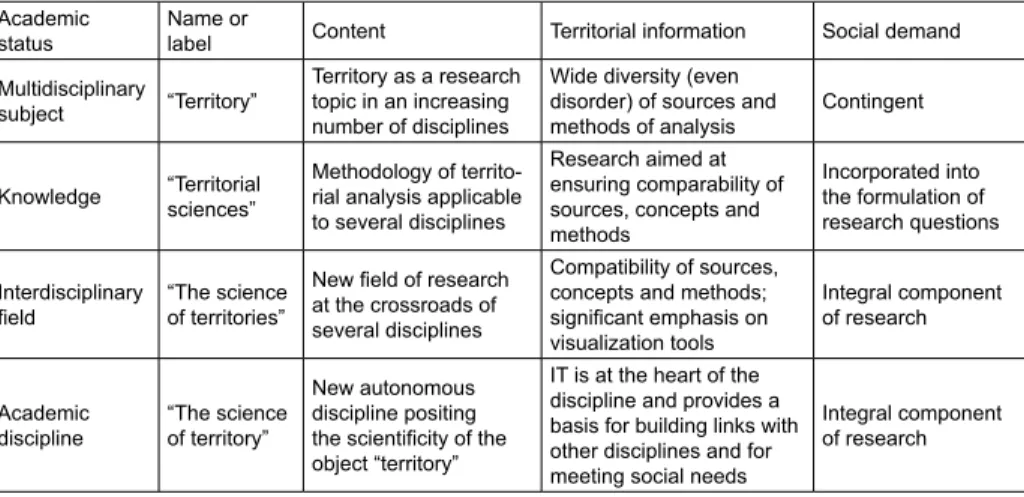
Table 1. Foreseen answers of the conference over the scientific status of territorial sciences
Academic
status Name or label Content Territorial information Social demand Multidisciplinary
subject “Territory”
Territory as a research topic in an increasing number of disciplines
Wide diversity (even disorder) of sources and
methods of analysis Contingent
Knowledge “Territorial sciences” Methodology of territo-rial analysis applicable to several disciplines
Research aimed at ensuring comparability of sources, concepts and methods
Incorporated into the formulation of research questions
Interdisciplinary
field “The science of territories”
New field of research at the crossroads of several disciplines
Compatibility of sources, concepts and methods; significant emphasis on visualization tools
Integral component of research
Academic
discipline “The science of territory”
New autonomous discipline positing the scientificity of the object “territory”
IT is at the heart of the discipline and provides a basis for building links with other disciplines and for meeting social needs
Integral component of research
Our conclusions on the above considerations leave us somewhat perplexed. This text ultima-tely on ly triggers a thinking process that is currently under way and is set to open up pers-pectives and respond to the contemporary challenges that new scientific paradigms attempt to tackle and resolve. We have observed how all scientific disciplines have been affected by the spatial turn. But this is only the start of the story. Theoretical paradigms and the reality of “social cohesion” have collided to form a new configuration made up of science and demo-cracy in a bifurcating world characterized by increasingly vague contours. As researchers, teachers and citizens, we are shaped and surrounded by these changes. The dough kneaded here is only a vague indication of the definitive form of the bread that will eventually emerge from the oven. The secret alchemy of the fermentation process has only produced soft shapes whose richness comes from their future. To extend the metaphor, we might say that the ambition of the CIST is to be the leavening agent that will allow for the emergence of a science of territories.
BIBLIOGRAPHY
Anderson, B. (1983): Imagined Communities. Reflections on the Origin and Spread of Nationalism, London-New York: Verso.
Ascher, F. (2005): “Les sens du mouvement: modernités et mobilités”, in Allemand, S., Ascher, F. and Lévy, J. (eds.), Les sens du mouvement : modernité et mobilités dans les sociétés urbaines
contemporaines, Paris: Belin.
Atlan, H. (2010): L’avenir de la prédiction, Les Carnets des dialogues du matin, Paris: Institut Diderot. Badie, B. (1995): La fin des territoires. Essai sur le désordre international et sur l’utilité sociale du
respect, Paris: Fayard.
Brighenti, A. M. (2010): “On Territoriology: Towards a General Science of Territory”, Theory, culture
and society, Sage Journals online, 2010, vol. 27, no. 1.
Chesneau, I. and Roncayolo, M. (2011): L’Abécédaire de Marcel Roncayolo, introduction à une
lecture de la ville, Paris: InFolio.
Davezies, L. (2008): La République et ses territoires : la circulation invisible des richesses, La République des Idées, Paris: Seuil.
Dumont, L. (1983): Essai sur l’individualisme. Une perspective anthropologique sur l’idéologie
moderne, Paris: Seuil.
Gauchet, M. (1985): Le désenchantement du monde, Paris: Gallimard.
Grasland, C. (2009): “Spatial Analysis of Social Facts”, in Bavaud, F. and Mager C. (eds.), Handbook
of Theoretical and Quantitative Geography, Lausanne: FGSE, pp. 117-174.
Godefridi, D. (2011): La réalité augmentée ou l’ère Wikileaks, Brussels: Texquis.
Haesbaert, R. (2001): “Le mythe de la déterritorialisation. De la ‘fin des territoires’ à la multi-territo-rialité”, Géographie et culture, no. 40, pp. 53-75.
Hassner, P. (1996): “Ni sang ni sol ? Crise de l’Europe et dialectique de la territorialité”, Cultures &
Conflits, no. 21-22.
Hobsbawm, E. and Ranger, T. (eds.), (1983): The Invention of Tradition, Cambridge: Cambridge University Press.
Jessop, B., Brenner, N. and Jones, M. (2008): “Theorizing socio spatial relations”, Environment and
Planning: D. Society and Space, vol. 26, pp. 389-401.
Latour, B. (1991): Nous n’avons jamais été modernes. Essai d’anthropologie symétrique, Paris: La Découverte.
— (2012): Enquête sur les modes d’existence. Une anthropologie des Modernes, Paris: La Découverte.
Le Bras, H. (1997): Le démon des origines. Démographie et extrême-droite, La Tour d’Aigues: Éditions de l’Aube.
Le Chevallier, M. (1832): Politique industrielle, système de la Méditerranée, Paris: Le Globe. McLuhan, M. (1964): Understanding Media: The Extensions of Man, New-York: McGraw. Negroponte, N. (1995): Being Digital, New York: Knopf.
Polanyi, K. (1983): La grande transformation, Paris: Gallimard.
Sassen, S. (2006): Territory, Authority, Rights: From Medieval to Global Assemblages, Princeton: Princeton University Press.
Thiesse, A.-T. (1999): La création des identités nationales, Paris: Seuil.
Thrift, N., Tickell, A. and Woolgar, S. (2012): Globalization in Practice, Oxford: Oxford University Press.
Turmel, A. (1985): “Autonomie disciplinaire. Frontières entre disciplines et démarches scientifiques”, in Boisjoly, J. and Pronovost, G. (eds.), La sociologie et l’anthropologie au Québec. Conjonctures,
débats, savoirs et métiers, Actes du Colloque de l’ACSALF, Montréal, Cahiers de l’ACSALF, no. 33.
Veltz, P. (2005): Mondialisation, villes et territoires, Paris: PUF. Virilio, P. (1995): La vitesse de libération, Paris: Galilée.
APPENDIX:
The international scientific
debate on territory
Territoriality: a tension at the heart of
territorial contradictions
Guy DI MÉO
As a result of developments over the past three decades, the term “territory” has become a part of our everyday language. The concept owes its popularity to the fact that it has come to mean something more than the legitimate boundaries of nation-states and their adminis-trative divisions. The concept first gained legitimacy in public life as a result of the increasing emphasis on territory and territorial structures in politics. It is in this sense that the term has enjoyed a new lease of life. The result has been the emergence of new objects, particularly in France, where the increased emphasis on decentralization and spatial reconfigurations (i.e. communities of communes and cities, regional natural parks and areas, departments and regions endowed with new powers, etc.) has had a significant impact in recent years. However, while political and administrative power has become increasingly territorialized under new spatial conditions, the popularity of the term has also spread beyond the political sphere. The economy, associations, the media, marketing, planning and development – in short, many areas of social and public life, communication, and activism – have become increasingly territorialized, but also increasingly keen to promote their territoriality. These developments raise a number of questions: Was the aim, as has often been said, to build more effective structures and organizations that take account of spatial data and the potential resources of territories, including both material resources (goods, heritage, know-how and skills) and conceptual resources (identities and memories, environmental amenities, etc.)? Or was the aim of these institutions to strengthen their identification for internal purposes (i.e. increased use and involvement of staff and other resources) or to assert their pres-ence in the markets in order to attract a new generation of customers increasingly aware of
terroirs and of the importance of the origin of products and associated distribution circuits? It
seems likely that both factors played a part. Some have interpreted these developments as a response to the homogenizing effects of globalization, while others have seen them as a sign