Publisher’s version / Version de l'éditeur:
Canadian Acoustics, 29, September 3, pp. 56-57, 2001-10-01
READ THESE TERMS AND CONDITIONS CAREFULLY BEFORE USING THIS WEBSITE. https://nrc-publications.canada.ca/eng/copyright
Vous avez des questions? Nous pouvons vous aider. Pour communiquer directement avec un auteur, consultez la
première page de la revue dans laquelle son article a été publié afin de trouver ses coordonnées. Si vous n’arrivez pas à les repérer, communiquez avec nous à [email protected].
Questions? Contact the NRC Publications Archive team at
[email protected]. If you wish to email the authors directly, please see the first page of the publication for their contact information.
NRC Publications Archive
Archives des publications du CNRC
This publication could be one of several versions: author’s original, accepted manuscript or the publisher’s version. / La version de cette publication peut être l’une des suivantes : la version prépublication de l’auteur, la version acceptée du manuscrit ou la version de l’éditeur.
Access and use of this website and the material on it are subject to the Terms and Conditions set forth at
Acceptable party wall sound insulation criteria
Bradley, J. S.
https://publications-cnrc.canada.ca/fra/droits
L’accès à ce site Web et l’utilisation de son contenu sont assujettis aux conditions présentées dans le site LISEZ CES CONDITIONS ATTENTIVEMENT AVANT D’UTILISER CE SITE WEB.
NRC Publications Record / Notice d'Archives des publications de CNRC:
https://nrc-publications.canada.ca/eng/view/object/?id=373ddd15-38b8-49ab-906a-6cea5ebb5f64 https://publications-cnrc.canada.ca/fra/voir/objet/?id=373ddd15-38b8-49ab-906a-6cea5ebb5f64Acceptable party wall sound insulation criteria
Bradley, J.S
A version of this paper is published in / Une version de ce document se trouve dans:
Canadian Acoustics, v. 29, no. 3, Sept. 2001, pp. 56-57
www.nrc.ca/irc/ircpubs
Canadian Acoustics / Acoustique Canadienne Vol. 29 No. 3 (2001) - 56
ACCEPTABLE PARTY WALL SOUND INSULATION CRITERIA
J.S. Bradley
Institute for Research in Construction, National Research Council, Montreal Rd. Ottawa, K1A 0R6
Introduction
This paper present the results of analyses of aggregate response data from a field survey of the sound insulation of walls separating multiple unit housing in 3 Canadian cities. The survey included extensive face-to-face interviews in subjects’ homes as well as complete sound transmission loss measurements of party walls between homes and ambient noise measurements in each home over a complete 24 hour period.
A total of 600 subjects were interviewed in 300 pairs of homes. Homes were equally distributed among the combinations of owners and renters, row housing and apartments and 3 cities (Toronto, Vancouver and Montreal). Subjects were first approached by letter asking them to participate in a building satisfaction survey and were subsequently interviewed in their homes. Initial questions obtained spontaneous responses without any mention of sound insulation or noise. Subsequent questions gathered directly elicited responses concerning whether they heard various sounds and how annoying they were. For most survey questions, responses were in the form of 7-point response scales. The survey procedure was essentially the same as that found to be successful in a smaller pilot study.
In this paper only the apparent STC ratings (i.e. including possible flanking paths) of the walls will be presented. They varied from 38 to 60 with a mean of 49.8. Data were aggregated into 8 groups by apparent STC rating.
The Importance of Sound Insulation
Direct questions about noise or sound insulation can potentially bias results by sensitizing subjects to the importance of sound insulation between homes. The initial questions were intended to avoid this problem by obtaining spontaneous responses related to the importance of sound
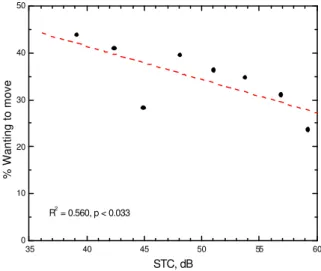
insulation. For example, when subjects were asked if they would like to move from their present home, the percentage saying yes significantly decreased with increasing measured STC of their party wall. (See Figure 1). Of the people saying they would like to move in each of the 8 STC groups, 94 to 100 % of them gave a noise related reason. Sound insulation is clearly a major cause of people wanting to move and noise problems appear to be an almost ubiquitous reason for wanting to move. When subjects were asked how satisfied they were with the building in which they lived, the responses were significantly related to measured STC values (see Table I) and subjects with better sound insulation were more satisfied with their building.
Subjects’ responses concerning how considerate their neighbours were, were also significantly related to measured STC values. That is, subjects with lower sound insulation tended to blame their neighbours as being less considerate. Poor sound insulation between homes is thus seen to be a potential cause of social disruption.
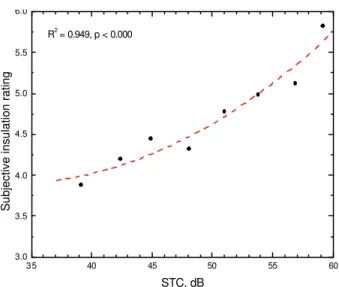
When asked how often they were awakened by noises from neighbours in their building, their responses were again significantly related to measured STC values (See Table I). Thus the quality of resident’s sleep is related to the amount of sound insulation between their homes. When subjects were asked to rate the sound insulation between them and their neighbours, their responses were significantly related to measured STC values as shown in Figure 2. Subjects are aware of the quality of the sound insulation; it is important to them, and it affects their quality of life. 35 40 45 50 55 60 0 10 20 30 40 50 R2 = 0.560, p < 0.033 % Wanting to move STC, dB
Figure 1. Percentage wanting to move versus STC.
Response R2 p
Percentage wanting to move. 0.560 0.033 How satisfied with your
building?
0.832 0.002
How considerate are your neighbours?
0.857 0.001
How often awakened due to noise from neighbours?
0.602 0.024
Subjective rating of sound insulation.
0.921 0.000
Table I. Relationships with measured STC values.
(R
2is coefficient of determination, p is
probability of the result occurring by chance).
Canadian Acoustics / Acoustique Canadienne Vol. 29 No. 3 (2001) - 57
Deriving Goals for Better Sound Insulation
The questionnaire included many items that asked directly how often they heard specific sounds and how annoying they were. They concerned sounds from neighbours either side, sounds of neighbour’s voices, sounds of neighbour’s radios and televisions, and music related sounds from their neighbours. A factor analysis of the responses simply suggested that each pair of responses concerning hearing and being annoyed by a particular type of sound were related. Thus in the following analyses the averages of each pair of responses is considered.
Figure 3 plots the average responses to questions asking about sounds from their neighbours either side of them. These included responses to questions asking how often they heard these noises and how annoying they were. Similar plots were produced for responses concerning
sounds of neighbour’s voices, sounds of neighbour’s radio and TV and music related sounds. The best-fit regression lines to these average responses are compared in Figure 4.
The R2 values for these plots varied from 0.772 to 0.944 and all indicated significant relationships. All of these responses show similar patterns. For lower STC values, the responses do not vary with STC but for higher STC values they systematically decrease with increasing STC. Disturbance from neighbour’s noises depends, not only on the amount of sound insulation, but also on how noisy their neighbours are and how frequently they make noise. For lower STC values, the sound insulation was not as effective and the average frequency of hearing neighbours simply depends on how often the neighbours are noisy. It is only above about STC 50 that these responses decrease systematically with increasing sound insulation. Therefore sound insulation of greater than STC 50 is required to decrease the disturbance that these noises cause.
If one compares the point at which each curve starts decreasing with increasing STC value, one can estimate where sound insulation starts influencing subjects’ perceptions of various types of sounds. For voice sounds, this point is a little less than STC 50. For radio and television sounds as well as more general sounds from neighbours either side, the critical point is about STC 50. However, for music related sounds, the sound insulation must be greater than about STC 55 to reduce its impact on residents. These differences are consistent with the likely strength and the potential disturbance of these sounds.
Conclusions
For most types of sound, the benefits of sound insulation only occur for STC ratings substantially above STC 50. For music related sounds, the sound insulation becomes more effective for STC values well over STC 55. Responses are close to 1 for an STC of 60 indicating that at this point residents would not hear these sounds from their neighbours ‘at all’ and they were ‘not at all annoyed’ by them. An effective STC of 55 is therefore recommended as a realistic goal and STC 60 as a more ideal goal for party wall sound insulation.
35 40 45 50 55 60 3.0 3.5 4.0 4.5 5.0 5.5 6.0 R2 = 0.949, p < 0.000
Subjective insulation rating
STC, dB
Figure 2. Subjective rating of sound insulation vs. STC.
35 40 45 50 55 60 1.0 1.5 2.0 2.5 3.0 Side Voices Radio TV Music
Best fit curves
STC, dB
Figure 4. Regression fits to average responses vs. STC .
35 40 45 50 55 60 1.0 1.5 2.0 2.5 3.0 R2 = 0.818, p < 0.002
Sounds from either side
STC, dB
Figure 3. Responses concerning sounds from neighbours either side versus STC.